

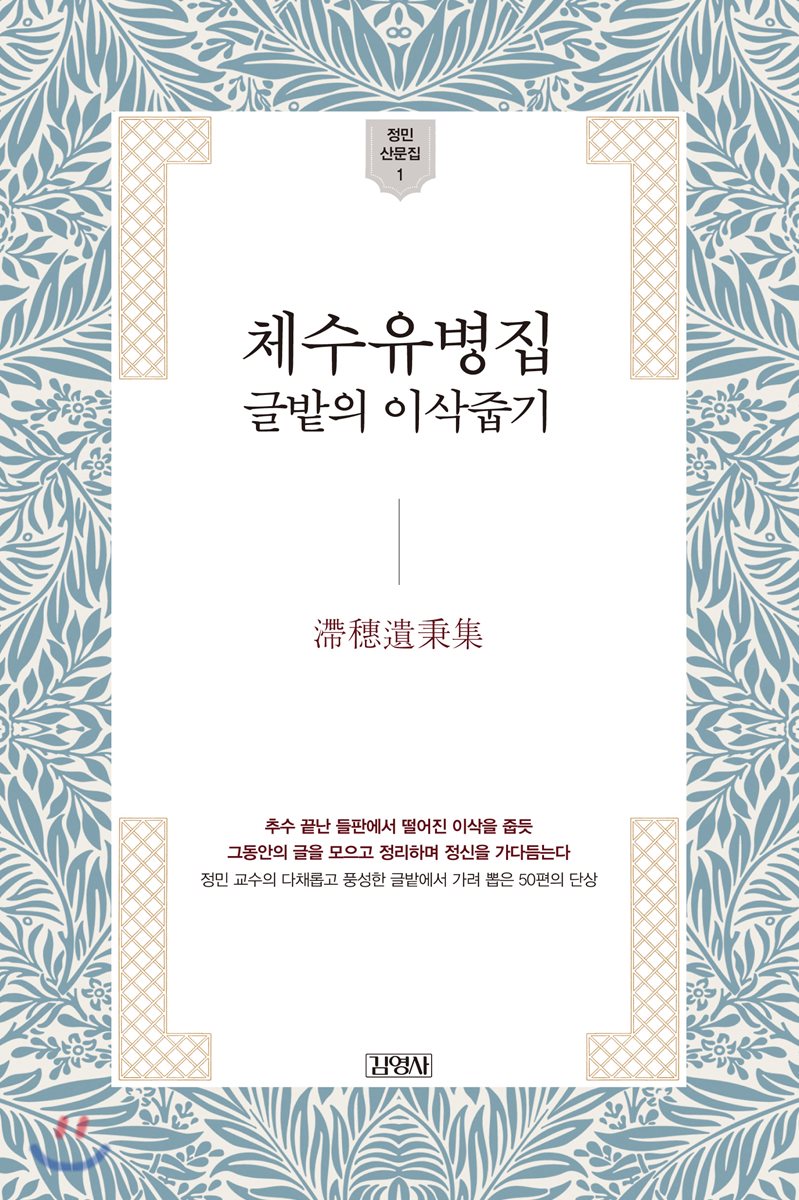
Chesuyubyungjip
 |
Description
Book Introduction
- A word from MD
-
A collection of essays by Professor Jeong Min, a classicistThis is a collection of essays by Professor Jeong Min, who has widely introduced the value and beauty of classical Chinese literature to the public in modern language.
I have compiled into one volume 50 prose pieces that I have kept from including in dozens of books I have published.
You can encounter rich stories about the purpose of studying, the joy of reading, and the charm of Yeonam and Dasan.
January 8, 2019. Humanities PD Son Min-gyu
50 famous quotes selected from the diverse and rich writings of classicist Professor Jeong Min.
“I gather and organize my writings, like gleaning fallen grain from a field after the harvest, and clear my mind.”
Professor Jeong Min, a leading classical scholar of our time, has revived the traditional values and beauty contained in Chinese literature, a treasure trove known as "an inexhaustible treasure," in modern language.
He is renowned for his diverse and interesting research on the lives and studies of Silhak scholars of the Joseon Dynasty, tea culture, flowers and birds, and his writing style that is free of unnecessary details and has a lingering feel. He presents a collection of prose titled "Chesu Yubyeongjip - Gleaning the Gleans of the Field of Writing," which summarizes his life and research over the past ten years.
Chesu (滯穗) refers to rice stalks that have fallen, and yubyung (遺秉) refers to rice ears that remain on the paddy field.
It means picking up trash.
Just as one picks up the fallen sheaves and ears of grain from a field after the harvest, I have compiled 50 stories that I had not been able to include in dozens of books and saved them into one volume.
From the joy of reading that subverts the status quo and dismantles everyday life, to Professor Jeongmin's story about the two great intellectuals, Yeonam and Dasan, to suggestions on the humanistic insights that can be unlocked by changing the path of inquiry.
We encounter the essence of Professor Jeongmin's brilliant thoughts, carefully selected from his diverse and rich writings.
“I gather and organize my writings, like gleaning fallen grain from a field after the harvest, and clear my mind.”
Professor Jeong Min, a leading classical scholar of our time, has revived the traditional values and beauty contained in Chinese literature, a treasure trove known as "an inexhaustible treasure," in modern language.
He is renowned for his diverse and interesting research on the lives and studies of Silhak scholars of the Joseon Dynasty, tea culture, flowers and birds, and his writing style that is free of unnecessary details and has a lingering feel. He presents a collection of prose titled "Chesu Yubyeongjip - Gleaning the Gleans of the Field of Writing," which summarizes his life and research over the past ten years.
Chesu (滯穗) refers to rice stalks that have fallen, and yubyung (遺秉) refers to rice ears that remain on the paddy field.
It means picking up trash.
Just as one picks up the fallen sheaves and ears of grain from a field after the harvest, I have compiled 50 stories that I had not been able to include in dozens of books and saved them into one volume.
From the joy of reading that subverts the status quo and dismantles everyday life, to Professor Jeongmin's story about the two great intellectuals, Yeonam and Dasan, to suggestions on the humanistic insights that can be unlocked by changing the path of inquiry.
We encounter the essence of Professor Jeongmin's brilliant thoughts, carefully selected from his diverse and rich writings.
- You can preview some of the book's contents.
Preview
index
introduction
Part 1: Cultural Perspective
A moment that flashes like lightning
A day without studying is like not living.
Differences in culture and metaphors
sad dream
Rhythm of Culture
English study
Small, big lessons
Between fact and truth
Vice Minister of Taichung
shadow without light
A person who takes care of himself
Our classics met on the Sorbonne campus
Part 2: Yeonam and Dasan
Yeonam, the subversiveness of a style that transcends taboos
The world's best travelogue, "Yeolha Diary"
The humanistic spirit of the 『Yeolha Diary』
Dasan's knowledge management: Thinking is competitiveness.
Dasan's method of teaching disciples
The best memo maniac, Dasan Jeong Yak-yong
The Secrets of Knowledge Management: Asking Dasan
There is no passion without rest.
Part 3: Old Meaning, New Feeling
Dawn Monk
Goryeo ginseng in costume
Hobyeon
Giyang
tirade
Habituation pipe
Orisanggong
unpleasantness
Su-gyeong-shin
Old Man Chrysanthemum
Balhapgogeum
Sui River
King Jeongjo's archery
Cao Cao's fake tomb
Munduru secret recipe
Hojil
Hogokjang
Readability
Pyo Seon-mun
Yeosongpyoin
absolute poverty
Park Myeong-gyo
Six Idioms
The best cultural content 『Donguibogam』
Part 4: Finding Context
Change the path of the question
Paper writing and text analysis
If you don't want to change, you have to change.
Finding Vision in the Vein of Our Classics
supplement
To my young friends who have entered the university gates
If you can't avoid it, enjoy it.
Part 1: Cultural Perspective
A moment that flashes like lightning
A day without studying is like not living.
Differences in culture and metaphors
sad dream
Rhythm of Culture
English study
Small, big lessons
Between fact and truth
Vice Minister of Taichung
shadow without light
A person who takes care of himself
Our classics met on the Sorbonne campus
Part 2: Yeonam and Dasan
Yeonam, the subversiveness of a style that transcends taboos
The world's best travelogue, "Yeolha Diary"
The humanistic spirit of the 『Yeolha Diary』
Dasan's knowledge management: Thinking is competitiveness.
Dasan's method of teaching disciples
The best memo maniac, Dasan Jeong Yak-yong
The Secrets of Knowledge Management: Asking Dasan
There is no passion without rest.
Part 3: Old Meaning, New Feeling
Dawn Monk
Goryeo ginseng in costume
Hobyeon
Giyang
tirade
Habituation pipe
Orisanggong
unpleasantness
Su-gyeong-shin
Old Man Chrysanthemum
Balhapgogeum
Sui River
King Jeongjo's archery
Cao Cao's fake tomb
Munduru secret recipe
Hojil
Hogokjang
Readability
Pyo Seon-mun
Yeosongpyoin
absolute poverty
Park Myeong-gyo
Six Idioms
The best cultural content 『Donguibogam』
Part 4: Finding Context
Change the path of the question
Paper writing and text analysis
If you don't want to change, you have to change.
Finding Vision in the Vein of Our Classics
supplement
To my young friends who have entered the university gates
If you can't avoid it, enjoy it.
Into the book
The moments that pile up little by little become history.
The past and present are the time periods that are covered by the present.
The past, present, and future are intertwined and revolve around each other.
The reason the old is precious is because it was the present at that time.
If I live diligently today, future generations will call it a time worth cherishing.
(…) I’ve done a lot of work like this in the past.
For books like 『Dasan's Sayings on Life』, 『Seong Dae-jung's Sayings on Life』, 『The Sound of Bamboo Rain』, 『Waking Up in the Middle of the Night』, and 『Only Reading』, I cut the back of the pages in half, pasted the original text by section, and carried it around in my bag. I mainly wrote interpretations and commentaries on books on the subway.
At home, I used it while sitting on the sofa and resting, or even while sitting on the toilet.
After I finished interpreting and commenting, I kept the paper separately and filled it with new paper and always carried it in my bag.
If I forget about it for a while and work on it, before I know it, it will be the length of a book.
---From "A day without studying is like not living"
Jeongjo always finished archery without firing the last arrow out of 50 arrows.
Why didn't he shoot? It was to show the virtue of humility as an emperor.
I saved the last one, leaving it as a lingering feeling instead of going all the way.
The saying in the Book of Documents, “Humility brings gain, arrogance brings loss [謙受益, 滿招損]” has exactly this meaning.
(…) The king’s archery competition always ended with a pledge between the king and his subjects to strengthen their relationship with the people.
It is a beautiful landscape of the Holy Age.
The courtiers painted and wrote about this scene and hung it on the wall to commemorate the king's love for his subjects and the honor of having them close to the king in this sacred court.
It can be filled, but it leaves a little bit empty.
It doesn't end until the very end.
Even in archery, he guarded against arrogance and practiced humility and generosity, establishing discipline between the ruler and his subjects and sharing his love and care for the people.
---From "Jeongjo's Archery"
The second opportunity to open my eyes to the charm of classics came belatedly, in the summer of my fourth year of college.
A special lecture on Chinese characters was opened in the department.
We invited a Chinese teacher from outside and gave a special summer vacation lecture.
I thought I was pretty good at Chinese characters because I memorized Chinese poems by heart in high school.
I missed the first week because of the calligraphy class's rubbing trip.
It wasn't until the following week that I went out for the first time.
I sat in the middle seat in the first row.
At that time, Professor Lee Ki-seok, who was in charge of the Chinese classics class, was lecturing on Mencius.
He had me read each phrase out loud and then explained it one by one.
The teacher asked me questions, but I couldn't answer a single one.
My pride was so hurt.
From then on, I began to study Chinese characters in earnest with a teacher.
When I went to graduate school, I naturally chose to major in classical literature, even though no one told me to.
---From "If you don't want to change, you have to change"
Classics are a treasure trove of content.
Everything that needs to be there is there.
Whatever you are looking for, we have it.
Need an essay guide? This country, Joseon, has selected its talents through essay tests for 500 years.
The theories of writing are abundant in the numerous collections of writings by the scholar-officials.
If you just match the eye level, you can still have competitive content.
Are you curious about reading education? I can't list all the articles titled "Reading Theory."
If we translate it into modern language and organize it, it is better than any Western reading theory.
(…) Things are always changing.
People's tastes also continue to flow.
I liked it yesterday, but today I don't even look at it.
Today's enthusiasm doesn't last until tomorrow.
People's tastes change in an instant.
If I jump into a business today because someone else is making money from it, I won't be able to make money from then on.
No matter how excellent the content of a classic is, it cannot be done without the ability to improvise and adapt.
---From "Finding Vision in the Vein of Our Classics"
Listen deeply to your inner voice.
The moment a goal is achieved, it disappears.
If you set new goals well, life will find its way and the process will take its course.
Otherwise, the harder you work, the more complicated things become.
Enjoy everything that is allowed to you.
Think more deeply and be miserably frustrated.
Until I break the dead skin cells of my small self and stand tall as my true self.
Read more books to build your subjectivity.
Travel further afield.
Leisure doesn't just happen.
Leisure is not something that is given.
It has to be created.
The old people said that the answer to life is in reading ten thousand books and traveling ten thousand miles.
In the process, your perspective on life deepens and a sense of pride builds up in your heart.
The past and present are the time periods that are covered by the present.
The past, present, and future are intertwined and revolve around each other.
The reason the old is precious is because it was the present at that time.
If I live diligently today, future generations will call it a time worth cherishing.
(…) I’ve done a lot of work like this in the past.
For books like 『Dasan's Sayings on Life』, 『Seong Dae-jung's Sayings on Life』, 『The Sound of Bamboo Rain』, 『Waking Up in the Middle of the Night』, and 『Only Reading』, I cut the back of the pages in half, pasted the original text by section, and carried it around in my bag. I mainly wrote interpretations and commentaries on books on the subway.
At home, I used it while sitting on the sofa and resting, or even while sitting on the toilet.
After I finished interpreting and commenting, I kept the paper separately and filled it with new paper and always carried it in my bag.
If I forget about it for a while and work on it, before I know it, it will be the length of a book.
---From "A day without studying is like not living"
Jeongjo always finished archery without firing the last arrow out of 50 arrows.
Why didn't he shoot? It was to show the virtue of humility as an emperor.
I saved the last one, leaving it as a lingering feeling instead of going all the way.
The saying in the Book of Documents, “Humility brings gain, arrogance brings loss [謙受益, 滿招損]” has exactly this meaning.
(…) The king’s archery competition always ended with a pledge between the king and his subjects to strengthen their relationship with the people.
It is a beautiful landscape of the Holy Age.
The courtiers painted and wrote about this scene and hung it on the wall to commemorate the king's love for his subjects and the honor of having them close to the king in this sacred court.
It can be filled, but it leaves a little bit empty.
It doesn't end until the very end.
Even in archery, he guarded against arrogance and practiced humility and generosity, establishing discipline between the ruler and his subjects and sharing his love and care for the people.
---From "Jeongjo's Archery"
The second opportunity to open my eyes to the charm of classics came belatedly, in the summer of my fourth year of college.
A special lecture on Chinese characters was opened in the department.
We invited a Chinese teacher from outside and gave a special summer vacation lecture.
I thought I was pretty good at Chinese characters because I memorized Chinese poems by heart in high school.
I missed the first week because of the calligraphy class's rubbing trip.
It wasn't until the following week that I went out for the first time.
I sat in the middle seat in the first row.
At that time, Professor Lee Ki-seok, who was in charge of the Chinese classics class, was lecturing on Mencius.
He had me read each phrase out loud and then explained it one by one.
The teacher asked me questions, but I couldn't answer a single one.
My pride was so hurt.
From then on, I began to study Chinese characters in earnest with a teacher.
When I went to graduate school, I naturally chose to major in classical literature, even though no one told me to.
---From "If you don't want to change, you have to change"
Classics are a treasure trove of content.
Everything that needs to be there is there.
Whatever you are looking for, we have it.
Need an essay guide? This country, Joseon, has selected its talents through essay tests for 500 years.
The theories of writing are abundant in the numerous collections of writings by the scholar-officials.
If you just match the eye level, you can still have competitive content.
Are you curious about reading education? I can't list all the articles titled "Reading Theory."
If we translate it into modern language and organize it, it is better than any Western reading theory.
(…) Things are always changing.
People's tastes also continue to flow.
I liked it yesterday, but today I don't even look at it.
Today's enthusiasm doesn't last until tomorrow.
People's tastes change in an instant.
If I jump into a business today because someone else is making money from it, I won't be able to make money from then on.
No matter how excellent the content of a classic is, it cannot be done without the ability to improvise and adapt.
---From "Finding Vision in the Vein of Our Classics"
Listen deeply to your inner voice.
The moment a goal is achieved, it disappears.
If you set new goals well, life will find its way and the process will take its course.
Otherwise, the harder you work, the more complicated things become.
Enjoy everything that is allowed to you.
Think more deeply and be miserably frustrated.
Until I break the dead skin cells of my small self and stand tall as my true self.
Read more books to build your subjectivity.
Travel further afield.
Leisure doesn't just happen.
Leisure is not something that is given.
It has to be created.
The old people said that the answer to life is in reading ten thousand books and traveling ten thousand miles.
In the process, your perspective on life deepens and a sense of pride builds up in your heart.
---From "To Young Friends Entering the University Gate"
Publisher's Review
Flashes of thought, deep reflections, and a collection of essays by classicist Professor Jeong Min.
“Like gleaning the fallen ears of grain from a field after the harvest
“I gather and organize my writings and clear my head.”
Professor Jeong Min, a classicist, has revived the traditional values and beauty contained in Chinese literature, a treasure trove known as "an inexhaustible treasure," in modern language.
He is a representative scholar of our time who has communicated with the public by classifying vast amounts of data, eliminating difficulty and dullness, and presenting variations on various topics, based on the principle of “Sangdonggui (尙同求異)” that “one should not simply follow the old, but one should not be completely different from the old.”
He is renowned for his diverse and interesting research on the lives and studies of Silhak scholars from the classics to the Joseon Dynasty, tea culture, flowers and birds, and his writing style that is free of unnecessary details and has a lingering feel. He presents a collection of essays that summarizes his life and research over the past ten years.
‘Jeongmin’s Prose Collection Volume 1’ is ‘Chesuyu Byeongjip - Gleaning the Ears of Wheat in the Field of Writing’.
Chesu (滯穗) is the rice that has fallen, and yubyung (遺秉) is the rice ears that remain on the field.
It means picking up trash.
The title of the book, 'Che Su-yu-byeong-jip', comes from this passage.
Just as one picks up the fallen sheaves and ears of grain from a field after the harvest, I have compiled 50 stories that I had not been able to include in dozens of books and saved them into one volume.
This book is a living testimony of the past times spent by Professor Jeongmin.
As the author says, “Each piece of writing contains the expressions of that time and the thoughts of that time,” traces of various aspects of life, such as research and experience as a scholar, and philosophy, can be felt throughout the book.
From the joy of reading that subverts the status quo and dismantles everyday life, to Professor Jeongmin's story about the two great intellectuals, Yeonam and Dasan, to suggestions on the humanistic insights that can be unlocked by changing the path of inquiry.
You can encounter the essence of Professor Jeongmin's brilliant thoughts, carefully selected from his diverse and rich writings.
From short reflections on life and culture to old meanings and new emotions that illuminate the present through the past,
Discover the utility and study methods of the humanities, and the power of thought that overwhelmed the era of Yeonam and Dasan.
This book is divided into four parts according to the nature of the writing.
Part 1, ‘Cultural Perspective’, contains fragments of life and thoughts on culture.
Part 2, ‘Yeonam and Dasan’, is about two intellectuals that Professor Jeong Min loved: Park Ji-won and Jeong Yak-yong.
Part 3, "Old Meaning, New Feeling," is a collection of short essays that examine the present through the lens of the past, while Part 4, "In Search of Context," addresses the usefulness of the humanities and methods of study in an era of change.
The final appendix contains a warm yet poignant message for incoming freshmen just entering college.
In Part 1, the author, who has mainly introduced the reading methods of the ancients, now fully demonstrates his own reading method and the joy of reading that he has experienced with his whole body.
For him, reading is not simply a matter of seeking knowledge.
By changing the question, you can turn insignificant things into sparkling jewels and even get ideas for new works.
Seeing things that others cannot see, allowing them to enter your life and becoming a more open person, overturning the status quo and dismantling the everyday—that is the guideline and goal of reading.
The greatest joy of reading for me is to stop reading someone else's book and think of my own, and to think of this and then encounter that thought.
The results are completely different, but the concept and the core came from there.
The more diverse the field and culture, the greater the scope of wonder.
Why didn't I think of this sooner? The constant, repetitive back-and-forth is suddenly unbearable.
In times like these, reading is a subversion of the status quo and a dismantling of everyday life.
In a flash of lightning, everything changes.
What else in the world can give such enlightenment than reading?
Books aren't just books.
Reading is most powerful when it goes beyond the written word and reads the text of the world.
Reading reaches its full potential only when we read between the lines of life and discern the hidden order.
I begin to see things that others cannot see even when they are looking at me.
Things that had no meaning until yesterday begin to walk into my life and interfere.
In fact, a lot of reading is just practice to get to this stage.
To read more, think more, and become a more open-minded person—this is my lifelong reading guide and goal.
---From "A Moment That Flashes Like Lightning"
Part 2 is full of anecdotes about Park Ji-won of Yeonam, who overpowered people with the power of reason, and Jeong Yak-yong of Dasan, who solved problems with the power of method.
The world's greatest travelogue, 『Yeolha Diary』, is a fascinating exploration of the hidden humanistic spirit and the unique stylistic subversiveness of Yeonam that transcends taboos, as well as the teaching methods of Dasan, the greatest note-taker, and his own methods of relaxation and recharging.
Yeonam's writing style is subversive.
He rejected the values that everyone took for granted.
He looked upside down, turned it over, and changed it.
It's obvious when you hear it and it makes sense when you think about it, but no one said anything like that before.
So, it always touched on the taboos of the times.
He spoke without hesitation about what everyone knew but wanted to keep quiet about.
Every time Yeonam published a piece of writing, the young writers of the time were in an uproar.
I was amazed by the pioneering spirit of the idea and thrilled by the novelty of its concept.
They followed Yeonam, cheering.
I mimicked his tone and agreed with his thoughts.
King Jeongjo had already recognized the subversive nature of his writing style.
So the card he pulled out was ‘Style Reform’.
The idea was to correct the intellectual discipline by restoring the correct writing style.
Has any king, past or present, ever used his literary style as a trump card to establish social discipline? At the center of this unprecedented development was Yeonam.
It would be difficult to find another example where the destructive power of one person's writing style was so significant.
---From "Yeonam, the subversiveness of a style that transcends taboos"
The person who best understood the power of notes and utilized them effectively was Dasan Jeong Yak-yong.
He can be said to be the greatest note-taking fanatic in Joseon.
I wrote whenever I had time, and wrote down whatever came to mind.
This happened when I was young and was listening to King Jeongjo's lecture on the Book of Songs.
Jeongjo gave a huge amount of homework every day.
When everyone else was struggling, Dasan was the only one who managed it.
The secret was in my usual note-taking habits.
He usually made a notebook with different topics and wrote down the necessary information.
No matter what question the king asked, the answer was in the notebook.
There was no competition with other people in the first place.
Every time he took a test, he got first place.
He later compiled over 700 small questions posed by King Jeongjo and his own answers into a book called 『Shi Jing Gang-ui (詩經講義)』.
Reading this book not only brings back vivid images of the study scene at the time, but also makes you once again amazed by Dasan's wide range of knowledge.
However, among the many ministers who studied together at that time, no one left a record like Dasan.
---From "The Best Note-Magician, Dasan Jeong Yak-yong"
In Part 3, various stories with old meanings, such as ‘Jang Gwang-seol’, ‘Haeng Yong-gwan’, ‘Ho-jil’, and ‘Yeo-pyo Song-in’, are unraveled from a modern perspective.
Among them, there is a story about skill, and skill is an itching sensation.
It refers to a very strong desire, a kind of desire for expression.
“That’s also a skill, oh my, it’s frustrating.
“Let me show you what I’m capable of?” The image of modern people busy showing off with shallow skills is vivid.
After Jing Ke failed to assassinate Qin Shi Huang, his friend, the musician Gao Jianli, hid his identity and went to Qin to work as a hired hand.
I worked hard for several years.
One day, a guest came to the owner's house and played the zither.
The workmanship was poor.
Gojeomli, unable to bear the pressure, secretly commented on the performance.
When another servant told his master, the master called him and had him play the harp.
He put on the musician's uniform he had kept and went out to perform an amazing performance.
That day, he became an overnight star.
Finally, he became a musician for Qin Shi Huang and entered the palace.
He played a musical instrument next to the emperor, and attempted to assassinate him with it, but failed and died a tragic death.
In 『An’s Family Precepts』, after introducing the story of Go Jeom-ri, it was explained that “Gi-yang is someone who has talent and is very energetic.”
Itching is an unbearable itch.
I can't live without expressing myself.
Only when you let out a sigh of relief can you breathe properly and feel truly alive.
The world is overflowing with shallow talents and empty skills that are like churning out products in a factory without any such thirst.
---From "Giyang"
Part 4 contains Professor Jeongmin's insightful insights into the mindset with which we should live in an age of change and the meaning of the old or classics to us.
In addition, you can get a glimpse into the author's journey from realizing the charm of classics in a high school Chinese literature class to becoming a classicist, as well as the importance of text analysis and its procedures.
Studying the classics is like having a conversation with people of old.
How wonderful it is to meet the ancient people who have already returned to the earth through their writings and feel their living, breathing breath.
Classics do not lose their value at all over time.
Every day is new, always new.
Through the classics, we transcend the limitations of time and space and communicate directly with the past.
Time passes and the way of life constantly changes.
At this time, the past is not a fixed and unchanging value.
The ancients did not follow others, but instead created their own voices, which became classics.
The way for me to truly learn from their footsteps now is not to imitate them exactly, but to create my own voice, just as they did.
Then, in the future, people will call what I did a classic.
If you want to become the unchanging old days, you have to change.
In the midst of change, wisdom that penetrates the unchanging essence of life springs forth.
---From "If you don't want to change, you have to change"
* Dasan told him to clean his desk once every two weeks, and Yeonam washed away the notes he had written in his youth by washing them in the stream.
It's good to be busy and run around every day, but you have to clean up, throw away, and organize once in a while to come to your senses.
That way you won't lose me.
Whether it's a year-end party or a year-end party, everyone has their own way of wrapping up the past year and welcoming the new year. But how about reflecting on the past year and renewing your spirit, like gleaning the fallen grain from a harvested field? That's the true meaning of the four characters "체수유병" (Chesuyubyung) that they convey to us today.
“Like gleaning the fallen ears of grain from a field after the harvest
“I gather and organize my writings and clear my head.”
Professor Jeong Min, a classicist, has revived the traditional values and beauty contained in Chinese literature, a treasure trove known as "an inexhaustible treasure," in modern language.
He is a representative scholar of our time who has communicated with the public by classifying vast amounts of data, eliminating difficulty and dullness, and presenting variations on various topics, based on the principle of “Sangdonggui (尙同求異)” that “one should not simply follow the old, but one should not be completely different from the old.”
He is renowned for his diverse and interesting research on the lives and studies of Silhak scholars from the classics to the Joseon Dynasty, tea culture, flowers and birds, and his writing style that is free of unnecessary details and has a lingering feel. He presents a collection of essays that summarizes his life and research over the past ten years.
‘Jeongmin’s Prose Collection Volume 1’ is ‘Chesuyu Byeongjip - Gleaning the Ears of Wheat in the Field of Writing’.
Chesu (滯穗) is the rice that has fallen, and yubyung (遺秉) is the rice ears that remain on the field.
It means picking up trash.
The title of the book, 'Che Su-yu-byeong-jip', comes from this passage.
Just as one picks up the fallen sheaves and ears of grain from a field after the harvest, I have compiled 50 stories that I had not been able to include in dozens of books and saved them into one volume.
This book is a living testimony of the past times spent by Professor Jeongmin.
As the author says, “Each piece of writing contains the expressions of that time and the thoughts of that time,” traces of various aspects of life, such as research and experience as a scholar, and philosophy, can be felt throughout the book.
From the joy of reading that subverts the status quo and dismantles everyday life, to Professor Jeongmin's story about the two great intellectuals, Yeonam and Dasan, to suggestions on the humanistic insights that can be unlocked by changing the path of inquiry.
You can encounter the essence of Professor Jeongmin's brilliant thoughts, carefully selected from his diverse and rich writings.
From short reflections on life and culture to old meanings and new emotions that illuminate the present through the past,
Discover the utility and study methods of the humanities, and the power of thought that overwhelmed the era of Yeonam and Dasan.
This book is divided into four parts according to the nature of the writing.
Part 1, ‘Cultural Perspective’, contains fragments of life and thoughts on culture.
Part 2, ‘Yeonam and Dasan’, is about two intellectuals that Professor Jeong Min loved: Park Ji-won and Jeong Yak-yong.
Part 3, "Old Meaning, New Feeling," is a collection of short essays that examine the present through the lens of the past, while Part 4, "In Search of Context," addresses the usefulness of the humanities and methods of study in an era of change.
The final appendix contains a warm yet poignant message for incoming freshmen just entering college.
In Part 1, the author, who has mainly introduced the reading methods of the ancients, now fully demonstrates his own reading method and the joy of reading that he has experienced with his whole body.
For him, reading is not simply a matter of seeking knowledge.
By changing the question, you can turn insignificant things into sparkling jewels and even get ideas for new works.
Seeing things that others cannot see, allowing them to enter your life and becoming a more open person, overturning the status quo and dismantling the everyday—that is the guideline and goal of reading.
The greatest joy of reading for me is to stop reading someone else's book and think of my own, and to think of this and then encounter that thought.
The results are completely different, but the concept and the core came from there.
The more diverse the field and culture, the greater the scope of wonder.
Why didn't I think of this sooner? The constant, repetitive back-and-forth is suddenly unbearable.
In times like these, reading is a subversion of the status quo and a dismantling of everyday life.
In a flash of lightning, everything changes.
What else in the world can give such enlightenment than reading?
Books aren't just books.
Reading is most powerful when it goes beyond the written word and reads the text of the world.
Reading reaches its full potential only when we read between the lines of life and discern the hidden order.
I begin to see things that others cannot see even when they are looking at me.
Things that had no meaning until yesterday begin to walk into my life and interfere.
In fact, a lot of reading is just practice to get to this stage.
To read more, think more, and become a more open-minded person—this is my lifelong reading guide and goal.
---From "A Moment That Flashes Like Lightning"
Part 2 is full of anecdotes about Park Ji-won of Yeonam, who overpowered people with the power of reason, and Jeong Yak-yong of Dasan, who solved problems with the power of method.
The world's greatest travelogue, 『Yeolha Diary』, is a fascinating exploration of the hidden humanistic spirit and the unique stylistic subversiveness of Yeonam that transcends taboos, as well as the teaching methods of Dasan, the greatest note-taker, and his own methods of relaxation and recharging.
Yeonam's writing style is subversive.
He rejected the values that everyone took for granted.
He looked upside down, turned it over, and changed it.
It's obvious when you hear it and it makes sense when you think about it, but no one said anything like that before.
So, it always touched on the taboos of the times.
He spoke without hesitation about what everyone knew but wanted to keep quiet about.
Every time Yeonam published a piece of writing, the young writers of the time were in an uproar.
I was amazed by the pioneering spirit of the idea and thrilled by the novelty of its concept.
They followed Yeonam, cheering.
I mimicked his tone and agreed with his thoughts.
King Jeongjo had already recognized the subversive nature of his writing style.
So the card he pulled out was ‘Style Reform’.
The idea was to correct the intellectual discipline by restoring the correct writing style.
Has any king, past or present, ever used his literary style as a trump card to establish social discipline? At the center of this unprecedented development was Yeonam.
It would be difficult to find another example where the destructive power of one person's writing style was so significant.
---From "Yeonam, the subversiveness of a style that transcends taboos"
The person who best understood the power of notes and utilized them effectively was Dasan Jeong Yak-yong.
He can be said to be the greatest note-taking fanatic in Joseon.
I wrote whenever I had time, and wrote down whatever came to mind.
This happened when I was young and was listening to King Jeongjo's lecture on the Book of Songs.
Jeongjo gave a huge amount of homework every day.
When everyone else was struggling, Dasan was the only one who managed it.
The secret was in my usual note-taking habits.
He usually made a notebook with different topics and wrote down the necessary information.
No matter what question the king asked, the answer was in the notebook.
There was no competition with other people in the first place.
Every time he took a test, he got first place.
He later compiled over 700 small questions posed by King Jeongjo and his own answers into a book called 『Shi Jing Gang-ui (詩經講義)』.
Reading this book not only brings back vivid images of the study scene at the time, but also makes you once again amazed by Dasan's wide range of knowledge.
However, among the many ministers who studied together at that time, no one left a record like Dasan.
---From "The Best Note-Magician, Dasan Jeong Yak-yong"
In Part 3, various stories with old meanings, such as ‘Jang Gwang-seol’, ‘Haeng Yong-gwan’, ‘Ho-jil’, and ‘Yeo-pyo Song-in’, are unraveled from a modern perspective.
Among them, there is a story about skill, and skill is an itching sensation.
It refers to a very strong desire, a kind of desire for expression.
“That’s also a skill, oh my, it’s frustrating.
“Let me show you what I’m capable of?” The image of modern people busy showing off with shallow skills is vivid.
After Jing Ke failed to assassinate Qin Shi Huang, his friend, the musician Gao Jianli, hid his identity and went to Qin to work as a hired hand.
I worked hard for several years.
One day, a guest came to the owner's house and played the zither.
The workmanship was poor.
Gojeomli, unable to bear the pressure, secretly commented on the performance.
When another servant told his master, the master called him and had him play the harp.
He put on the musician's uniform he had kept and went out to perform an amazing performance.
That day, he became an overnight star.
Finally, he became a musician for Qin Shi Huang and entered the palace.
He played a musical instrument next to the emperor, and attempted to assassinate him with it, but failed and died a tragic death.
In 『An’s Family Precepts』, after introducing the story of Go Jeom-ri, it was explained that “Gi-yang is someone who has talent and is very energetic.”
Itching is an unbearable itch.
I can't live without expressing myself.
Only when you let out a sigh of relief can you breathe properly and feel truly alive.
The world is overflowing with shallow talents and empty skills that are like churning out products in a factory without any such thirst.
---From "Giyang"
Part 4 contains Professor Jeongmin's insightful insights into the mindset with which we should live in an age of change and the meaning of the old or classics to us.
In addition, you can get a glimpse into the author's journey from realizing the charm of classics in a high school Chinese literature class to becoming a classicist, as well as the importance of text analysis and its procedures.
Studying the classics is like having a conversation with people of old.
How wonderful it is to meet the ancient people who have already returned to the earth through their writings and feel their living, breathing breath.
Classics do not lose their value at all over time.
Every day is new, always new.
Through the classics, we transcend the limitations of time and space and communicate directly with the past.
Time passes and the way of life constantly changes.
At this time, the past is not a fixed and unchanging value.
The ancients did not follow others, but instead created their own voices, which became classics.
The way for me to truly learn from their footsteps now is not to imitate them exactly, but to create my own voice, just as they did.
Then, in the future, people will call what I did a classic.
If you want to become the unchanging old days, you have to change.
In the midst of change, wisdom that penetrates the unchanging essence of life springs forth.
---From "If you don't want to change, you have to change"
* Dasan told him to clean his desk once every two weeks, and Yeonam washed away the notes he had written in his youth by washing them in the stream.
It's good to be busy and run around every day, but you have to clean up, throw away, and organize once in a while to come to your senses.
That way you won't lose me.
Whether it's a year-end party or a year-end party, everyone has their own way of wrapping up the past year and welcoming the new year. But how about reflecting on the past year and renewing your spirit, like gleaning the fallen grain from a harvested field? That's the true meaning of the four characters "체수유병" (Chesuyubyung) that they convey to us today.
GOODS SPECIFICS
- Date of issue: January 1, 2019
- Page count, weight, size: 264 pages | 406g | 140*210*20mm
- ISBN13: 9788934984719
- ISBN10: 8934984716
You may also like
카테고리
korean


korean

![ELLE 엘르 스페셜 에디션 A형 : 12월 [2025]](http://librairie.coreenne.fr/cdn/shop/files/b8e27a3de6c9538896439686c6b0e8fb.jpg?v=1766436872&width=3840)


