

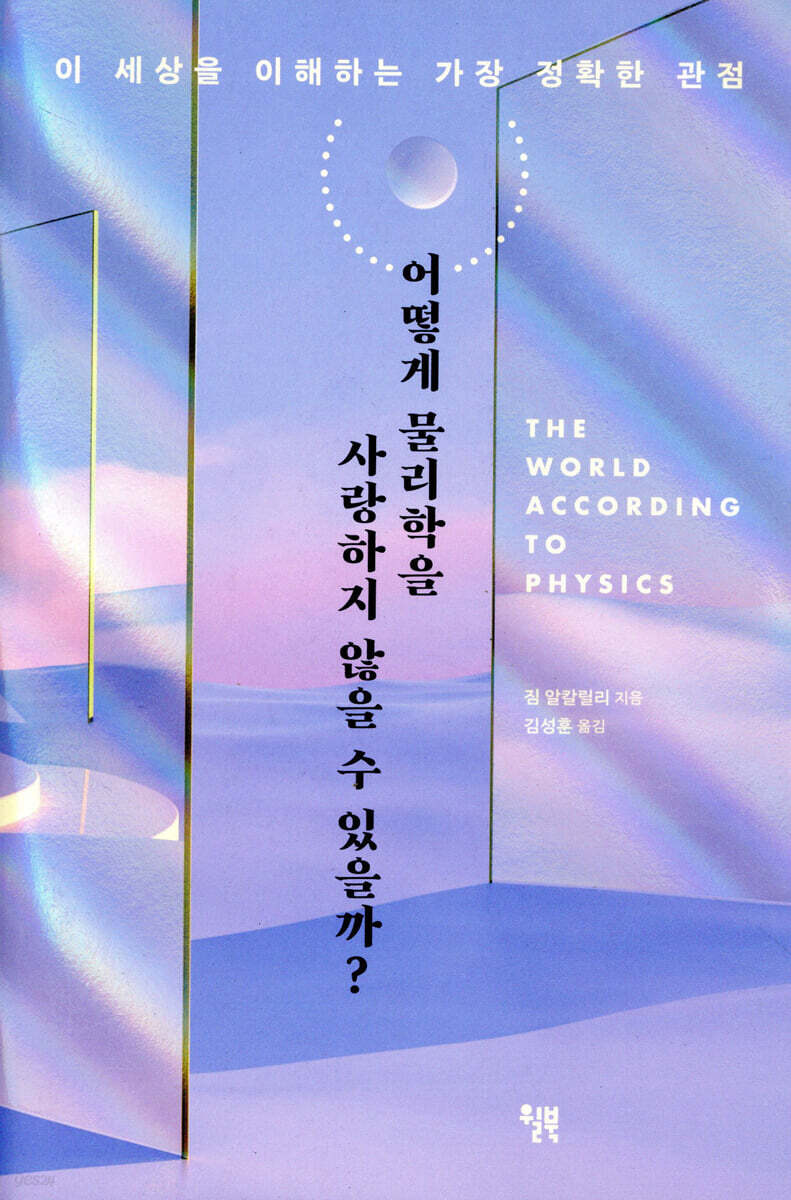
How can you not love physics?
 |
Description
Book Introduction
The allure of physics, as determinedly demonstrated by physicist and science communicator Jim Al-Khalili.
An ode to the joys of physics and scientific methodology Explains the three pillars of modern physics: quantum mechanics, relativity, and thermodynamics, without formulas! This book, written by a science communicator who connects the public with science and a professor of theoretical physics at the University of Surrey, explores the charm of physics one by one. He gently explains the world of physics, which he has loved his entire life, in a gentle voice, as if he were a scientist uncle telling stories to his nephew who knows nothing. Professor Jim Al-Khalili, who first fell in love with physics as a teenager, asserts that there is no other way to explain the world than through physics. What would the world look like to a quantum physicist who says that physics is the only way to understand the world most accurately? Without using complex formulas or incomprehensible jargon, the author explains how physics, which he loves so much, elucidates the fundamental principles and principles of the world, and where the latest achievements in physics lie. It covers the achievements of physics and the theories of integration and unification achieved by the three pillars of modern physics: quantum mechanics, relativity, and thermodynamics, but it is written in easy language so that even non-specialists can understand it, starting from the basics, so it is surprisingly easy to read for a scientific book. The beauty of physics, or science, as the author puts it, lies in the belief that current truths can be changed by new experiments at any time, and in the fact that we continue to move forward despite this. Let's listen to the author's story, which introduces the true attitude of science, believing in true progress and embracing the openness of knowledge, and the figure of scientists who strive to move forward through endless verification through experimentation. The author's background and charm, as the inaugural recipient of the Stephen Hawking Medal, awarded to those who have advanced the communication between the public and science, are reflected in every sentence. Even if you don't know anything about physics, you can't help but love it. |
- You can preview some of the book's contents.
Preview
index
Recommendation
introduction
1 Awe from understanding
What We Don't Know * How Progress Is Made * In Search of Simplicity
2 scales
Universality * Symmetry * Reductionism * Limits of Universality
3 Space and Time
How do physicists define time and space? * Einstein's special theory of relativity * Einstein's general theory of relativity * The expansion of space
4 Energy and Matter
Energy * Matter and Mass * The Basic Components of Matter * A Brief History of Matter and Energy
5 Quantum World
The Fundamentals of Quantum Mechanics * What Does It All Mean? * Entanglement, Measurement, and Decoherence
6 Thermodynamics and the Arrow of Time
Statistical mechanics and thermodynamics * Determinism and randomness * So what is time?
7 Unification
Quantum field theory * In search of quantum gravity * String theory * Loop quantum gravity
8 The Future of Physics
Dark matter, dark energy, inflation and the multiverse, information, ER=EPR, a crisis in physics?, and reasons for optimism.
9 Usefulness of Physics
Where Physics, Chemistry, and Biology Meet * The Quantum Revolution Continues * Quantum Computers and 21st Century Science
10 Think Like a Physicist
On Honesty and Doubt * On Theory and Knowledge * On Truth * Physicists Are People Too
Acknowledgements
Further Reading
Search
introduction
1 Awe from understanding
What We Don't Know * How Progress Is Made * In Search of Simplicity
2 scales
Universality * Symmetry * Reductionism * Limits of Universality
3 Space and Time
How do physicists define time and space? * Einstein's special theory of relativity * Einstein's general theory of relativity * The expansion of space
4 Energy and Matter
Energy * Matter and Mass * The Basic Components of Matter * A Brief History of Matter and Energy
5 Quantum World
The Fundamentals of Quantum Mechanics * What Does It All Mean? * Entanglement, Measurement, and Decoherence
6 Thermodynamics and the Arrow of Time
Statistical mechanics and thermodynamics * Determinism and randomness * So what is time?
7 Unification
Quantum field theory * In search of quantum gravity * String theory * Loop quantum gravity
8 The Future of Physics
Dark matter, dark energy, inflation and the multiverse, information, ER=EPR, a crisis in physics?, and reasons for optimism.
9 Usefulness of Physics
Where Physics, Chemistry, and Biology Meet * The Quantum Revolution Continues * Quantum Computers and 21st Century Science
10 Think Like a Physicist
On Honesty and Doubt * On Theory and Knowledge * On Truth * Physicists Are People Too
Acknowledgements
Further Reading
Search
Detailed image
.jpg)
Into the book
This book is an ode to physics.
I first fell in love with physics as a teenager.
Honestly, I've gotten better at physics since I realized I'm good at it.
Physics is a fun mix of puzzle solving and common sense.
It was like a neck.
It was fun to play with equations and algebraic symbols and put numbers in and see the secrets of nature revealed.
--- p.11
To find answers to life's riddles, some people turn to religion, some to ideologies, and some to belief systems.
But for me, there is no alternative to carefully formulating hypotheses, testing them, and then deducing facts about nature.
This is a typical feature of scientific methodology.
All the various truth-seeking methods for understanding the world are equally valid.
I don't think that understanding the world through science, especially physics, is just one of them.
Science is the only method we can trust.
--- p.12
Science has one important difference from other fields.
The point is that widely held scientific views or long-held theories can be rendered obsolete and replaced by new worldviews with just a single, careful observation or experimental result.
--- p.23
Just because a major new scientific discovery comes out that completely changes our view of the world, not all scientists immediately embrace it.
But that's not a science problem, it's a problem for the parties involved.
Scientific progress is unstoppable, and progress is always a good thing.
Knowledge and enlightenment are always better than ignorance.
We start from a state of ignorance, but we are determined to find out what we don't know.
There may be some controversy along the way, but ultimately, we cannot ignore what we have discovered.
When it comes to scientific understanding of the world's reality, the argument that "ignorance is bliss" is nothing but garbage.
Douglas Adams once said:
“I will always choose the awe that comes from understanding over the awe that comes from ignorance.” --- p.24
Scientific disciplines advance through the continuous interaction of theory and experiment, and physics is particularly so.
A theory can survive the test of time only if its predictions are confirmed by experiments.
Any good theory should make new predictions that can be tested experimentally.
However, if the experimental results conflict with the theory, the theory must be modified or discarded altogether.
Conversely, sometimes we discover unexplained phenomena in the laboratory that require new theories.
There is probably no other scientific field where this kind of collaboration is as beautifully realized as physics.
Theorems in theoretical mathematics are proven by logic, deduction, and axiomatic truths.
It doesn't need to be verified in the real world.
On the other hand, fields like geology, behavioral biology, and behavioral psychology are largely observational sciences, expanding their understanding by painstakingly collecting data from the natural world or verifying it through meticulously designed experiments.
But physics can only progress when theory and experiment work hand in hand, pointing each other in the right direction.
--- p.29~30
Unlike philosophy, logic, and theoretical mathematics, physics is an empirical and quantitative science.
Physics proceeds by verifying concepts through reproducible observations, measurements, and experiments.
Physicists may sometimes propose unusual and bizarre mathematical theories, but to assess their effectiveness and true power, we must examine whether they describe verifiable, real-world phenomena.
This is also why Stephen Hawking did not win the Nobel Prize despite his research on Hawking radiation, a phenomenon in which black holes emit energy, in the mid-1970s.
The Nobel Prize is awarded only to theories or discoveries that have been experimentally confirmed.
--- p.43
The world of physics did not become established as a proper discipline until the 17th century.
It was largely due to the invention of two of the most important pieces of equipment in all of science.
These are telescopes and microscopes.
If we could only understand the world we can see with our naked eyes, physics would not have advanced so far.
--- p.44
By the end of the 19th century, physics seemed to be complete.
Physics gave us Newtonian mechanics, electromagnetism, and thermodynamics, and showed that these three fields can successfully explain the motion and behavior of objects of all sizes, from the trajectories of cannonballs to clocks, storms, steam engines, magnets, motors, pendulums, and planets, and almost every phenomenon we encounter around us.
The discipline that studies all of this is collectively called 'classical physics'.
What we still learn in school is mainly classical physics.
It is true that classical physics was quite excellent, but it could not explain everything.
As physicists turned their attention to the microscopic components of physics, atoms and molecules, new phenomena were discovered that could not be explained by conventional physics.
The rules and equations we had been using so far seemed to no longer apply there.
--- p.127
The thorny issue of defining the boundary between the microscopic quantum world and the macroscopic classical world was first made famous by Erwin Schrödinger in the 1930s.
At that time, Schrödinger devised a famous thought experiment.
Although Schrödinger was one of the pioneers and founders of the field of quantum mechanics, he himself expressed doubts about the meaning of quantum mechanics.
He asked what would happen if a cat was placed in a box containing radioactive material and a deadly poison.
The box is designed so that when the radioactive material emits particles, a device detects them and releases the poison contained in the bottle. --- p.147
The true value of science comes not from certainty, but from openness to uncertainty.
Science questions current knowledge and is always ready to replace it with deeper knowledge whenever something better emerges.
In other fields, this attitude might be considered capricious.
But that's not the case in science.
Science advances only when scientists remain unwavering in their commitment to quality honesty and skepticism.
I first fell in love with physics as a teenager.
Honestly, I've gotten better at physics since I realized I'm good at it.
Physics is a fun mix of puzzle solving and common sense.
It was like a neck.
It was fun to play with equations and algebraic symbols and put numbers in and see the secrets of nature revealed.
--- p.11
To find answers to life's riddles, some people turn to religion, some to ideologies, and some to belief systems.
But for me, there is no alternative to carefully formulating hypotheses, testing them, and then deducing facts about nature.
This is a typical feature of scientific methodology.
All the various truth-seeking methods for understanding the world are equally valid.
I don't think that understanding the world through science, especially physics, is just one of them.
Science is the only method we can trust.
--- p.12
Science has one important difference from other fields.
The point is that widely held scientific views or long-held theories can be rendered obsolete and replaced by new worldviews with just a single, careful observation or experimental result.
--- p.23
Just because a major new scientific discovery comes out that completely changes our view of the world, not all scientists immediately embrace it.
But that's not a science problem, it's a problem for the parties involved.
Scientific progress is unstoppable, and progress is always a good thing.
Knowledge and enlightenment are always better than ignorance.
We start from a state of ignorance, but we are determined to find out what we don't know.
There may be some controversy along the way, but ultimately, we cannot ignore what we have discovered.
When it comes to scientific understanding of the world's reality, the argument that "ignorance is bliss" is nothing but garbage.
Douglas Adams once said:
“I will always choose the awe that comes from understanding over the awe that comes from ignorance.” --- p.24
Scientific disciplines advance through the continuous interaction of theory and experiment, and physics is particularly so.
A theory can survive the test of time only if its predictions are confirmed by experiments.
Any good theory should make new predictions that can be tested experimentally.
However, if the experimental results conflict with the theory, the theory must be modified or discarded altogether.
Conversely, sometimes we discover unexplained phenomena in the laboratory that require new theories.
There is probably no other scientific field where this kind of collaboration is as beautifully realized as physics.
Theorems in theoretical mathematics are proven by logic, deduction, and axiomatic truths.
It doesn't need to be verified in the real world.
On the other hand, fields like geology, behavioral biology, and behavioral psychology are largely observational sciences, expanding their understanding by painstakingly collecting data from the natural world or verifying it through meticulously designed experiments.
But physics can only progress when theory and experiment work hand in hand, pointing each other in the right direction.
--- p.29~30
Unlike philosophy, logic, and theoretical mathematics, physics is an empirical and quantitative science.
Physics proceeds by verifying concepts through reproducible observations, measurements, and experiments.
Physicists may sometimes propose unusual and bizarre mathematical theories, but to assess their effectiveness and true power, we must examine whether they describe verifiable, real-world phenomena.
This is also why Stephen Hawking did not win the Nobel Prize despite his research on Hawking radiation, a phenomenon in which black holes emit energy, in the mid-1970s.
The Nobel Prize is awarded only to theories or discoveries that have been experimentally confirmed.
--- p.43
The world of physics did not become established as a proper discipline until the 17th century.
It was largely due to the invention of two of the most important pieces of equipment in all of science.
These are telescopes and microscopes.
If we could only understand the world we can see with our naked eyes, physics would not have advanced so far.
--- p.44
By the end of the 19th century, physics seemed to be complete.
Physics gave us Newtonian mechanics, electromagnetism, and thermodynamics, and showed that these three fields can successfully explain the motion and behavior of objects of all sizes, from the trajectories of cannonballs to clocks, storms, steam engines, magnets, motors, pendulums, and planets, and almost every phenomenon we encounter around us.
The discipline that studies all of this is collectively called 'classical physics'.
What we still learn in school is mainly classical physics.
It is true that classical physics was quite excellent, but it could not explain everything.
As physicists turned their attention to the microscopic components of physics, atoms and molecules, new phenomena were discovered that could not be explained by conventional physics.
The rules and equations we had been using so far seemed to no longer apply there.
--- p.127
The thorny issue of defining the boundary between the microscopic quantum world and the macroscopic classical world was first made famous by Erwin Schrödinger in the 1930s.
At that time, Schrödinger devised a famous thought experiment.
Although Schrödinger was one of the pioneers and founders of the field of quantum mechanics, he himself expressed doubts about the meaning of quantum mechanics.
He asked what would happen if a cat was placed in a box containing radioactive material and a deadly poison.
The box is designed so that when the radioactive material emits particles, a device detects them and releases the poison contained in the bottle. --- p.147
The true value of science comes not from certainty, but from openness to uncertainty.
Science questions current knowledge and is always ready to replace it with deeper knowledge whenever something better emerges.
In other fields, this attitude might be considered capricious.
But that's not the case in science.
Science advances only when scientists remain unwavering in their commitment to quality honesty and skepticism.
--- p.273~274
Publisher's Review
Physics is so fascinating that you can't help but love it. What is it about it that makes it so appealing?
On the beauty of thinking and looking like a scientist
The book begins with the author's confession that he fell in love with physics as a teenager, over 40 years ago.
Physics is a subject that is not easy to approach for most people. What made scientist Jim Al-Khalili 'love' physics throughout his life?
Alkali cites several reasons.
He begins with an honest confession that he began to like physics even more after realizing that he had some talent for it. He says that physics, which seemed to be a fun mix of puzzle solving and common sense and that it unravels the secrets of nature and the universe, was very fascinating.
He also points out that physics has a special feature in that experiments and theories work together perfectly to advance progress.
While observational sciences like geology and biology broaden understanding through data collection, meticulous experimental design, and verification, physics must also take theoretical leaps based on such experiments.
Physicists build on existing theories by researching and verifying them, and then presenting new theories to the world.
Alkali expresses this by saying, "There is no other discipline in which theory and experiment work hand in hand, each showing the other where to take the next step, as in physics."
Modern physics is a discipline that is constantly changing and undergoing research.
From Newton, Dirac, Higgs, Schrödinger, Einstein, and Steven Weinberg, physics has consistently solved new puzzles that arose at points thought to have been solved, in surprising ways.
In "How Can You Not Love Physics?", the author's earnest and affectionate energy is conveyed through every line, as he seeks to share with everyone the beauty of physics, which, despite wandering through complex labyrinths and sometimes experiencing ups and downs, ultimately reaches the truth.
The author, a theoretical physicist and science communicator, explains in an easy-to-understand way.
The vast and high-dimensional flow and development of physics
What makes this book special is that it succeeds in explaining physics, a subject that can feel particularly distant to non-specialists, to the general public in clear and concise language.
Even for those who are interested in science, let alone those who are 'science illiterate', it is very difficult to fully understand quantum mechanics and the theory of relativity, which are considered the essence of modern physics.
This book covers time and space, the vast universe and the tiny quantum world, theoretical physics and the physics of everyday life in an intuitively understandable way, encompassing not only scientific knowledge but also methodology and philosophy.
It also covers the overall flow of physics, the three major theories that lead modern physics, and the most recent discussions, in a way that even non-majors would find useful.
The secret to effectively presenting this vast volume in a single, small book lies in the author's expertise as a quantum physicist and science communicator who has hosted a popular BBC science documentary.
If you're thinking of textbook-like explanations of complex formulas, you'll be surprised by the author's approachable storytelling, presented without difficult formulas.
The author was actually the first recipient of the Stephen Hawking Medal, awarded to those who have made significant contributions to the advancement of science communication with the public, for his outstanding ability to convey the latest knowledge of contemporary scientists to the general public in a digestible manner through science podcasts and documentaries.
If you want to get a feel for the concepts and flow of physics that you've never quite grasped no matter how much you hear about them, open this book.
“Where has physics come from?”
A glance at the latest physics
This book is also very useful for readers who want to learn in easy language how far the latest physics has come.
It will also be fascinating for science nerds interested in how far physics has come since quantum mechanics and relativity.
By the end of the 19th century, physics seemed complete.
By developing Newtonian mechanics, electromagnetism, and thermodynamics, it seemed possible to successfully explain all objects and phenomena (cannonballs, clocks, storms, steam engines, magnets, motors, pendulums, planets, etc.).
But when physicists turned their attention to the microscopic components of physics, atoms and molecules, new phenomena that could not be explained by conventional physics began to be discovered.
This is the beginning of modern physics and the focus of this book.
Rather than simply explaining the theories and concepts of physics, the author focuses on how the theories of physics have developed.
Beginning with the story of Erwin Schrödinger, the pioneer of quantum mechanics, it unfolds the story of physics that began with quantum theory, including string theory and loop quantum gravity.
For example, string theory, which states that elementary particles are actually tiny strings vibrating in a hidden dimension, begins with the quantum mechanical properties of 'matter' in spacetime.
Ring quantum gravity is a theory that began with the view that 'spacetime itself' is a more fundamental concept than the matter contained in spacetime.
In this way, physicists' research progresses through the process of branching out into new theories based on existing theories.
The process in which experiments and theories advance together can be said to be the core of physics, which the author loves.
If the physics explanations in this book are easy to understand, it is likely because the author pays attention to the flow of scientific progress.
Rather than delving into the depths of theory, it follows the development of theory and explains the principles by which physics develops and progresses.
A love for science and knowledge that naturally flows from
Open-mindedness toward the world
The core of the scientific attitude pointed out in this book, which talks about how to think, verify, and view the world like a physicist, is the openness to accept doubt.
Science is an open-minded discipline that assumes that existing theories can be discarded when new experiments emerge, without being governed by prejudice or stereotypes.
The public thinks that scientists work alone in laboratories or pursue perfect formulas, disconnected from reality. However, science, especially physics, is a discipline that progresses only when experiments and theories work together, and because new theories inevitably develop based on existing theories and experiments, it has the characteristics of a communal discipline more than any other discipline.
The 'peer review' process of scientific methodology is precisely this internal correction procedure as a community.
For scientists, critical evaluation is a natural process.
The scientist's openness to consistently question and criticize in order to develop a solid theory and approach it honestly is the essence of the objective scientific methodology that allows the author to confidently state that "there is no other alternative to understanding this world."
The way a physicist views the world, as the author puts it, is something that is needed not only by scientists but also by everyone living in this world.
An attitude that keeps in mind that what you believe can fundamentally change at any time, and an attitude that loves knowledge while being open to different opinions.
By doing so, we can find a way to approach the truth of the world.
This is probably the reason why you 'can't help but love' the physics discussed in this book.
On the beauty of thinking and looking like a scientist
The book begins with the author's confession that he fell in love with physics as a teenager, over 40 years ago.
Physics is a subject that is not easy to approach for most people. What made scientist Jim Al-Khalili 'love' physics throughout his life?
Alkali cites several reasons.
He begins with an honest confession that he began to like physics even more after realizing that he had some talent for it. He says that physics, which seemed to be a fun mix of puzzle solving and common sense and that it unravels the secrets of nature and the universe, was very fascinating.
He also points out that physics has a special feature in that experiments and theories work together perfectly to advance progress.
While observational sciences like geology and biology broaden understanding through data collection, meticulous experimental design, and verification, physics must also take theoretical leaps based on such experiments.
Physicists build on existing theories by researching and verifying them, and then presenting new theories to the world.
Alkali expresses this by saying, "There is no other discipline in which theory and experiment work hand in hand, each showing the other where to take the next step, as in physics."
Modern physics is a discipline that is constantly changing and undergoing research.
From Newton, Dirac, Higgs, Schrödinger, Einstein, and Steven Weinberg, physics has consistently solved new puzzles that arose at points thought to have been solved, in surprising ways.
In "How Can You Not Love Physics?", the author's earnest and affectionate energy is conveyed through every line, as he seeks to share with everyone the beauty of physics, which, despite wandering through complex labyrinths and sometimes experiencing ups and downs, ultimately reaches the truth.
The author, a theoretical physicist and science communicator, explains in an easy-to-understand way.
The vast and high-dimensional flow and development of physics
What makes this book special is that it succeeds in explaining physics, a subject that can feel particularly distant to non-specialists, to the general public in clear and concise language.
Even for those who are interested in science, let alone those who are 'science illiterate', it is very difficult to fully understand quantum mechanics and the theory of relativity, which are considered the essence of modern physics.
This book covers time and space, the vast universe and the tiny quantum world, theoretical physics and the physics of everyday life in an intuitively understandable way, encompassing not only scientific knowledge but also methodology and philosophy.
It also covers the overall flow of physics, the three major theories that lead modern physics, and the most recent discussions, in a way that even non-majors would find useful.
The secret to effectively presenting this vast volume in a single, small book lies in the author's expertise as a quantum physicist and science communicator who has hosted a popular BBC science documentary.
If you're thinking of textbook-like explanations of complex formulas, you'll be surprised by the author's approachable storytelling, presented without difficult formulas.
The author was actually the first recipient of the Stephen Hawking Medal, awarded to those who have made significant contributions to the advancement of science communication with the public, for his outstanding ability to convey the latest knowledge of contemporary scientists to the general public in a digestible manner through science podcasts and documentaries.
If you want to get a feel for the concepts and flow of physics that you've never quite grasped no matter how much you hear about them, open this book.
“Where has physics come from?”
A glance at the latest physics
This book is also very useful for readers who want to learn in easy language how far the latest physics has come.
It will also be fascinating for science nerds interested in how far physics has come since quantum mechanics and relativity.
By the end of the 19th century, physics seemed complete.
By developing Newtonian mechanics, electromagnetism, and thermodynamics, it seemed possible to successfully explain all objects and phenomena (cannonballs, clocks, storms, steam engines, magnets, motors, pendulums, planets, etc.).
But when physicists turned their attention to the microscopic components of physics, atoms and molecules, new phenomena that could not be explained by conventional physics began to be discovered.
This is the beginning of modern physics and the focus of this book.
Rather than simply explaining the theories and concepts of physics, the author focuses on how the theories of physics have developed.
Beginning with the story of Erwin Schrödinger, the pioneer of quantum mechanics, it unfolds the story of physics that began with quantum theory, including string theory and loop quantum gravity.
For example, string theory, which states that elementary particles are actually tiny strings vibrating in a hidden dimension, begins with the quantum mechanical properties of 'matter' in spacetime.
Ring quantum gravity is a theory that began with the view that 'spacetime itself' is a more fundamental concept than the matter contained in spacetime.
In this way, physicists' research progresses through the process of branching out into new theories based on existing theories.
The process in which experiments and theories advance together can be said to be the core of physics, which the author loves.
If the physics explanations in this book are easy to understand, it is likely because the author pays attention to the flow of scientific progress.
Rather than delving into the depths of theory, it follows the development of theory and explains the principles by which physics develops and progresses.
A love for science and knowledge that naturally flows from
Open-mindedness toward the world
The core of the scientific attitude pointed out in this book, which talks about how to think, verify, and view the world like a physicist, is the openness to accept doubt.
Science is an open-minded discipline that assumes that existing theories can be discarded when new experiments emerge, without being governed by prejudice or stereotypes.
The public thinks that scientists work alone in laboratories or pursue perfect formulas, disconnected from reality. However, science, especially physics, is a discipline that progresses only when experiments and theories work together, and because new theories inevitably develop based on existing theories and experiments, it has the characteristics of a communal discipline more than any other discipline.
The 'peer review' process of scientific methodology is precisely this internal correction procedure as a community.
For scientists, critical evaluation is a natural process.
The scientist's openness to consistently question and criticize in order to develop a solid theory and approach it honestly is the essence of the objective scientific methodology that allows the author to confidently state that "there is no other alternative to understanding this world."
The way a physicist views the world, as the author puts it, is something that is needed not only by scientists but also by everyone living in this world.
An attitude that keeps in mind that what you believe can fundamentally change at any time, and an attitude that loves knowledge while being open to different opinions.
By doing so, we can find a way to approach the truth of the world.
This is probably the reason why you 'can't help but love' the physics discussed in this book.
GOODS SPECIFICS
- Date of issue: May 10, 2022
- Page count, weight, size: 312 pages | 422g | 140*210*20mm
- ISBN13: 9791155814673
- ISBN10: 1155814673
You may also like
카테고리
korean


korean

![ELLE 엘르 스페셜 에디션 A형 : 12월 [2025]](http://librairie.coreenne.fr/cdn/shop/files/b8e27a3de6c9538896439686c6b0e8fb.jpg?v=1766436872&width=3840)


