

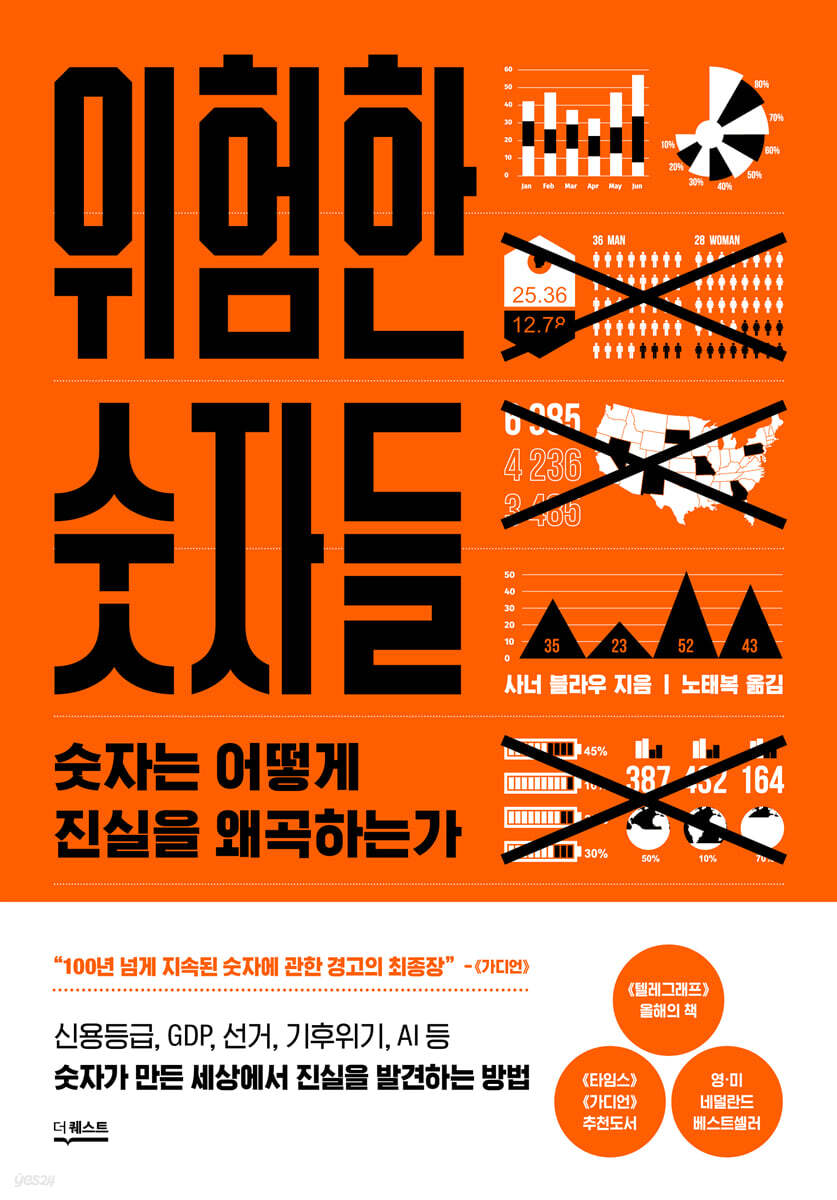
Dangerous numbers
 |
Description
Book Introduction
"The final chapter in a century-long series of warnings about numbers." _《The Guardian》 Why We Keep Getting It Wrong Despite Numerous Warnings A must-read for this era, focusing on the human instinctive bias toward numbers. At 7:30 a.m. on March 9, 2022, how did you feel when you saw the exit poll results for the presidential election? Whether you cheered or were disappointed, you might have also cast a skeptical eye, wondering, "Are the exit polls really accurate?" In the 2016 US presidential election that elected Trump, many newspapers claimed that pre-election polls were significantly off, but considering the margin of error, the polls were generally accurate. Moreover, although the gap between the polls and the election results was much smaller than in 2012 when Obama was elected, no media outlet predicted that outcome. In fact, if the margin of error were taken into account, Trump's election was not surprising at all. But people, especially the media, were certain that the candidate they supported and had previously predicted would win. The result of writing the article was that everyone looked at the results of the opinion poll and interpreted them the way they wanted to. It was an incident caused by the instinctive number bias of humans. The dangerous thing is humans. And numbers are made dangerous by people who are well aware of the dangerous number biases of humans. No matter how much knowledge we have, this is why we still make mistakes. Dangerous Numbers is the first book to warn of the pitfalls of numbers while also pointing out their root causes. Imagine a world without numbers. We won't know economic statistics, test scores, or polls, let alone how many ICU beds are left or whether the vaccine is effective. Numbers literally make all the difference in the world. Will you be someone who lives by the numbers, or someone who sees through the truth behind them? The moment you close the last page of "Dangerous Numbers," you'll be someone who uses numbers properly. |
- You can preview some of the book's contents.
Preview
index
To those living in the era of the veterinary pandemic,
Preface_Numbers Lie
Chapter 1: When did we become obsessed with numbers?
The first moment we became obsessed with numbers│The beginning of standardization│The beginning of collecting numbers on a large scale│The beginning of analyzing numbers│The breakdown of intuition, error, and conflict of interest
Chapter 2: Made-Up Numbers Rule the World
"I'd rather have discovered that black people are smart" │ A few important caveats │ Five subjective choices │ The truth revealed thanks to numbers
Chapter 3: The Story of "Sex" Seen Through a Suspicious Lens
Three Statisticians Ask Kinsey | The Wrong Question | People Missed in the Survey | The Interview Group Is Too Small | Is Random Sampling the Solution? | People Who Don't Want to Participate | Overlooking the Margin of Error | People Who Need Special Results
Chapter 4: Why the Clear Fact that Smoking Causes Lung Cancer Was Doubted
Lying with Statistics│Did Hitler Almost Save Millions?│The Most Insidious Marketing Trick│Coincidences, Missing Factors, and Reverse Causality│How Much Is Enough?│How to Lie with Smoking Statistics
Chapter 5: There is no infallible calculating machine.
One of the most dangerous ideas of our time│What on earth is an algorithm?│The dangerous use of algorithms│Where garbage goes in, garbage comes out│Correlation vs. causation that confuses even algorithms│Numbers have actually changed the truth│What do you want to gain from numbers?
Chapter 6: The Power to Overcome the Number Instinct
Why do we keep getting wrong research results? │Interpretations that feel good even when they're bad │How do numbers make you feel? │Examine the first rule again! │Acknowledge uncertainty │Check for conflicting interests
Conclusion: Now is the time to put the numbers back where they belong.
Checklist_Practice of Questioning Numbers
Preface_Numbers Lie
Chapter 1: When did we become obsessed with numbers?
The first moment we became obsessed with numbers│The beginning of standardization│The beginning of collecting numbers on a large scale│The beginning of analyzing numbers│The breakdown of intuition, error, and conflict of interest
Chapter 2: Made-Up Numbers Rule the World
"I'd rather have discovered that black people are smart" │ A few important caveats │ Five subjective choices │ The truth revealed thanks to numbers
Chapter 3: The Story of "Sex" Seen Through a Suspicious Lens
Three Statisticians Ask Kinsey | The Wrong Question | People Missed in the Survey | The Interview Group Is Too Small | Is Random Sampling the Solution? | People Who Don't Want to Participate | Overlooking the Margin of Error | People Who Need Special Results
Chapter 4: Why the Clear Fact that Smoking Causes Lung Cancer Was Doubted
Lying with Statistics│Did Hitler Almost Save Millions?│The Most Insidious Marketing Trick│Coincidences, Missing Factors, and Reverse Causality│How Much Is Enough?│How to Lie with Smoking Statistics
Chapter 5: There is no infallible calculating machine.
One of the most dangerous ideas of our time│What on earth is an algorithm?│The dangerous use of algorithms│Where garbage goes in, garbage comes out│Correlation vs. causation that confuses even algorithms│Numbers have actually changed the truth│What do you want to gain from numbers?
Chapter 6: The Power to Overcome the Number Instinct
Why do we keep getting wrong research results? │Interpretations that feel good even when they're bad │How do numbers make you feel? │Examine the first rule again! │Acknowledge uncertainty │Check for conflicting interests
Conclusion: Now is the time to put the numbers back where they belong.
Checklist_Practice of Questioning Numbers
Detailed image

Into the book
I was researching her happiness, but I realized that there were no numbers that could describe her life living in a tent.
Juanita also taught me something else.
The fact is that I had a strong influence on what numbers she would say.
I decided in advance that happiness was important and quantifiable.
I also came up with the idea of using diagrams to ask these abstract questions.
Juanita was also not considered intelligent enough to say anything about income inequality.
Me, me, me, in the end it was me.
--- From "Preface, Numbers Lie"
The statistics on poverty and crime, the civil registration system, the averages and charts we see in the newspapers every day, all have their roots in the 19th century, less than 200 years ago.
All of this didn't come out of nowhere.
--- From "Chapter 1, When Did We Start Obsessing Over Numbers?"
Arguments about intelligence and skin color always deal with averages.
The average of one group is lower than the average of another group.
But behind the two averages lies the entire range of scores.
According to Wechsler Intelligence Scale scores, many black Americans are more intelligent than the average white American.
You could say it like this:
Many white Americans score lower than the average black American.
In other words, this type of average has little to do with individual scores.
--- From "Chapter 2, The Made Numbers Rule the World"
Arguments about intelligence and skin color always deal with averages.
The average of one group is lower than the average of another group.
But behind the two averages lies the entire range of scores.
According to Wechsler Intelligence Scale scores, many black Americans are more intelligent than the average white American.
You could say it like this:
Many white Americans score lower than the average black American.
In other words, this type of average has little to do with individual scores.
--- From "Chapter 2, The Made Numbers Rule the World"
The key to sampling is not quantity, but representativeness.
It was precisely in this respect that Kinsey's research method had a problem.
There were many places Kinsey didn't visit: conservative Christian communities, industrial areas, rural towns.
Black people were also completely excluded.
Other groups (homosexuals, students, people from the Midwest) were underrepresented.
--- From "Chapter 3, The Story of 'Sex' Seen Through a Suspicious Lens"
The tobacco industry's goal was not to prove that smoking was good for your health.
It was already enough to raise doubts about the harmful effects of cigarettes.
Since the Oak Room meeting, the Tobacco Industry Research Committee has done everything it can to confuse the scientific findings on smoking.
Proctor wrote:
“The goal was to ‘research to prevent discovery,’ and then ‘claim that despite the enormous amount of money poured into research on smoking and health, no harm has been proven.’”
--- From “Chapter 4, Why the Clear Fact that Smoking Causes Lung Cancer Was Doubted”
'Numbers are both the cause and the result of what makes up the world.' The same goes for credit scores.
People with certain tendencies have a harder time getting loans, which leads them to fall into poverty more quickly, making it even harder to get loans, and thus accelerating poverty.
Such algorithms become self-fulfilling prophets, realizing their own predictions.
The number of people who have to figure out the truth ends up changing the truth.
--- From "Chapter 5, There is no infallible calculating machine"
If you want to notice when numbers are being misused, it's important to recognize errors in reasoning and understand your own intuition.
But perhaps the most important question is this:
Who's behind the numbers? Does that person have a stake in the outcome?
Juanita also taught me something else.
The fact is that I had a strong influence on what numbers she would say.
I decided in advance that happiness was important and quantifiable.
I also came up with the idea of using diagrams to ask these abstract questions.
Juanita was also not considered intelligent enough to say anything about income inequality.
Me, me, me, in the end it was me.
--- From "Preface, Numbers Lie"
The statistics on poverty and crime, the civil registration system, the averages and charts we see in the newspapers every day, all have their roots in the 19th century, less than 200 years ago.
All of this didn't come out of nowhere.
--- From "Chapter 1, When Did We Start Obsessing Over Numbers?"
Arguments about intelligence and skin color always deal with averages.
The average of one group is lower than the average of another group.
But behind the two averages lies the entire range of scores.
According to Wechsler Intelligence Scale scores, many black Americans are more intelligent than the average white American.
You could say it like this:
Many white Americans score lower than the average black American.
In other words, this type of average has little to do with individual scores.
--- From "Chapter 2, The Made Numbers Rule the World"
Arguments about intelligence and skin color always deal with averages.
The average of one group is lower than the average of another group.
But behind the two averages lies the entire range of scores.
According to Wechsler Intelligence Scale scores, many black Americans are more intelligent than the average white American.
You could say it like this:
Many white Americans score lower than the average black American.
In other words, this type of average has little to do with individual scores.
--- From "Chapter 2, The Made Numbers Rule the World"
The key to sampling is not quantity, but representativeness.
It was precisely in this respect that Kinsey's research method had a problem.
There were many places Kinsey didn't visit: conservative Christian communities, industrial areas, rural towns.
Black people were also completely excluded.
Other groups (homosexuals, students, people from the Midwest) were underrepresented.
--- From "Chapter 3, The Story of 'Sex' Seen Through a Suspicious Lens"
The tobacco industry's goal was not to prove that smoking was good for your health.
It was already enough to raise doubts about the harmful effects of cigarettes.
Since the Oak Room meeting, the Tobacco Industry Research Committee has done everything it can to confuse the scientific findings on smoking.
Proctor wrote:
“The goal was to ‘research to prevent discovery,’ and then ‘claim that despite the enormous amount of money poured into research on smoking and health, no harm has been proven.’”
--- From “Chapter 4, Why the Clear Fact that Smoking Causes Lung Cancer Was Doubted”
'Numbers are both the cause and the result of what makes up the world.' The same goes for credit scores.
People with certain tendencies have a harder time getting loans, which leads them to fall into poverty more quickly, making it even harder to get loans, and thus accelerating poverty.
Such algorithms become self-fulfilling prophets, realizing their own predictions.
The number of people who have to figure out the truth ends up changing the truth.
--- From "Chapter 5, There is no infallible calculating machine"
If you want to notice when numbers are being misused, it's important to recognize errors in reasoning and understand your own intuition.
But perhaps the most important question is this:
Who's behind the numbers? Does that person have a stake in the outcome?
--- From "Chapter 6, The Power to Overcome the Number Instinct"
Publisher's Review
Climate crisis, credit scores, college entrance exam grades, GDP…
The numbers that are created rule the world.
Your credit score is a number that determines your life.
If you have a low credit score, you may not be able to get a credit card.
I can't even start a new business.
You need a certain credit score to get various loans from banks, and if your score is high, you can even get preferential interest rates.
Some companies evaluate job applicants based on their credit scores.
It's not just about credit scores. Countries are graded based on GDP, and students' 12 years of hard work are evaluated based on their CSAT scores.
It's a world where things are judged by numbers.
But we created all these numbers.
For convenience or any purpose.
In times of war, the concept of national income became extremely difficult.
The government wanted to spend money on weapons rather than welfare, but according to the concept, such government spending would mean a decrease in national income and thus weaken support for the war.
So the solution was a different metric: GDP. GDP measures the total value of all goods and services produced in a country, including those produced by the government (e.g., weapons).
According to this, even the newly created bomber was beneficial to the economy. GDP was a figure created solely for political purposes.
Chapter 2, from “Manufactured Numbers Rule the World”
Due to measures to prevent the spread of the COVID-19 virus, Dutch people are smoking more, becoming unemployed, and suffering from depression.
On the other hand, the dashboard did not include figures on lifestyle, employment, or mental health.
This was because other priorities were prioritized, to protect those vulnerable to the virus without placing an undue burden on medical activities.
It was not only a statistical judgment, but also a moral judgment.
In the new society, from “To those living in the age of the veterinary pandemic”
Are people with high credit scores truly honest? Are students with high test scores truly smart? Can a country with a high GDP be considered developed? The numbers that should capture the truth may actually be distorting the truth.
The moment we take these numbers for granted, prejudice and discrimination are born.
The same is true in this age where computers calculate everything.
Computers cannot create objective numbers.
Now that humans have to input data into computers, the results that the computers calculate are ultimately the sum of numbers created by humans.
Since we cannot escape the shackles of manufactured numbers, we must have eyes that can see through the truth behind the numbers.
The Surprising Signal of Judging Numbers in the Big Data Era: Human Number Bias
Notice and judge your emotions!
Dangerous Numbers is the first book to uncover the root causes of why humans continue to make numerical mistakes.
In fact, warnings about numbers have been around for a long time.
Beyond the fact that numbers are made up, examples include confusing correlation with causation, considering the margin of error, and being wary of unrepresentative sampling.
Yet, despite all these warnings, people continue to spread myths about homosexuality, believe that alcohol can be good for your health, and even doubt the obvious fact that smoking causes lung cancer.
Why do we keep getting it wrong? Yale University professor Dan Kahan and his research team showed participants a chart from a fictitious clinical trial of a skin ointment and asked them to perform rigorous calculations.
As a result, people who scored high on math tests tended to give the correct answers.
But another experiment yielded different results.
When we gave them a chart about gun control and asked them to do the same calculations, even the best math people got it wrong.
Even though it was a chart with the same difficulty as the previous figures!
Kahan argued that the answers given by the experimental participants no longer had anything to do with the truth.
The answers were intended to preserve the participant's identity or sense of belonging to the group to which he or she belongs.
People who were good at math were the same.
They often gave such answers without even knowing it.
They deceived themselves with their own psychological state.
That is, when people know more facts and have greater talents, they also deceive themselves more.
Our brain works like a lawyer.
In other words, we are forced to find arguments to defend our convictions.
From Chapter 6, “The Power to Overcome the Number Instinct”
How do you feel when you see the headline, "One drink could shorten your life by 30 minutes"? Does it strike you as absurd? Perhaps you only drink wine or beer once every other day? Understanding your own emotions is crucial if you want to recognize when numbers are being misused.
Why do I feel happy or angry when I see that number? Do I have a vested interest in that number? In today's complex society, where countless conflicting interests exist, knowledge of numbers alone cannot provide the answer.
Notice and judge your emotions!
Highly recommended by Rutger Bregman, author of "Humankind"
“Blau is the best teacher we could ever hope for.”
The author, Saner Blau, is a mathematics journalist for Correspondent, a pioneer in crowdfunding journalism that has taken Europe by storm, and a journalist in residence at the Netherlands Institute for Advanced Study. He is also a promising numbers expert.
He is known for his in-depth articles on how numbers are used in coronavirus statistics, artificial intelligence, and future predictions.
Her first book, Dangerous Numbers, was even recommended to "people who don't know how to count" by Femke Halsema, the mayor of Amsterdam, as it was rich in psychology, history, and social issues that ordinary people could easily understand.
Blau points out that 'number bias' is not limited to the general public, but also happens to number experts like himself.
The reason countless statisticians have defended the link between smoking and lung cancer for 50 years, the famous Kinsey report that is still talked about today, the climate change graph in a conservative magazine that shows almost no temperature fluctuations… all of these were numbers produced because the experts believed they were right.
And the author was no exception.
I overlooked one important factor.
When I realized that I was particularly excited by the conclusion that drinking was okay, I read Prasad's tweet again.
Nowhere did it say that drinking was not harmful, only that the study was flawed.
Like Kahan's study, I chose the interpretation that fit my group.
It wasn't the correct interpretation, but it was an interpretation that felt right.
I was good at interpreting things that way.
Because, in my profession, I know all sorts of arguments that would refute that type of research.
It turns out my brain works like a lawyer's.
From Chapter 6, “The Power to Overcome the Number Instinct”
How can we see the truth when faced with the number experts who believe they are right? Blau says the only answer is to practice questioning numbers.
This is a practice where, whenever you encounter a number, you ask yourself questions such as who the number is from, whether the number is a standardized value, how it was collected and analyzed, in what form it was presented, and most importantly, what emotions it made you feel.
Numbers are known to reflect complex reality, but in reality they only approximate it.
Albert Einstein said, “Not everything that is meaningful can be counted, and not everything that is countable is meaningful.”
I hope that through Blau's "Dangerous Numbers," you will develop the habit of questioning numbers and not get lost in a world made of numbers.
The numbers that are created rule the world.
Your credit score is a number that determines your life.
If you have a low credit score, you may not be able to get a credit card.
I can't even start a new business.
You need a certain credit score to get various loans from banks, and if your score is high, you can even get preferential interest rates.
Some companies evaluate job applicants based on their credit scores.
It's not just about credit scores. Countries are graded based on GDP, and students' 12 years of hard work are evaluated based on their CSAT scores.
It's a world where things are judged by numbers.
But we created all these numbers.
For convenience or any purpose.
In times of war, the concept of national income became extremely difficult.
The government wanted to spend money on weapons rather than welfare, but according to the concept, such government spending would mean a decrease in national income and thus weaken support for the war.
So the solution was a different metric: GDP. GDP measures the total value of all goods and services produced in a country, including those produced by the government (e.g., weapons).
According to this, even the newly created bomber was beneficial to the economy. GDP was a figure created solely for political purposes.
Chapter 2, from “Manufactured Numbers Rule the World”
Due to measures to prevent the spread of the COVID-19 virus, Dutch people are smoking more, becoming unemployed, and suffering from depression.
On the other hand, the dashboard did not include figures on lifestyle, employment, or mental health.
This was because other priorities were prioritized, to protect those vulnerable to the virus without placing an undue burden on medical activities.
It was not only a statistical judgment, but also a moral judgment.
In the new society, from “To those living in the age of the veterinary pandemic”
Are people with high credit scores truly honest? Are students with high test scores truly smart? Can a country with a high GDP be considered developed? The numbers that should capture the truth may actually be distorting the truth.
The moment we take these numbers for granted, prejudice and discrimination are born.
The same is true in this age where computers calculate everything.
Computers cannot create objective numbers.
Now that humans have to input data into computers, the results that the computers calculate are ultimately the sum of numbers created by humans.
Since we cannot escape the shackles of manufactured numbers, we must have eyes that can see through the truth behind the numbers.
The Surprising Signal of Judging Numbers in the Big Data Era: Human Number Bias
Notice and judge your emotions!
Dangerous Numbers is the first book to uncover the root causes of why humans continue to make numerical mistakes.
In fact, warnings about numbers have been around for a long time.
Beyond the fact that numbers are made up, examples include confusing correlation with causation, considering the margin of error, and being wary of unrepresentative sampling.
Yet, despite all these warnings, people continue to spread myths about homosexuality, believe that alcohol can be good for your health, and even doubt the obvious fact that smoking causes lung cancer.
Why do we keep getting it wrong? Yale University professor Dan Kahan and his research team showed participants a chart from a fictitious clinical trial of a skin ointment and asked them to perform rigorous calculations.
As a result, people who scored high on math tests tended to give the correct answers.
But another experiment yielded different results.
When we gave them a chart about gun control and asked them to do the same calculations, even the best math people got it wrong.
Even though it was a chart with the same difficulty as the previous figures!
Kahan argued that the answers given by the experimental participants no longer had anything to do with the truth.
The answers were intended to preserve the participant's identity or sense of belonging to the group to which he or she belongs.
People who were good at math were the same.
They often gave such answers without even knowing it.
They deceived themselves with their own psychological state.
That is, when people know more facts and have greater talents, they also deceive themselves more.
Our brain works like a lawyer.
In other words, we are forced to find arguments to defend our convictions.
From Chapter 6, “The Power to Overcome the Number Instinct”
How do you feel when you see the headline, "One drink could shorten your life by 30 minutes"? Does it strike you as absurd? Perhaps you only drink wine or beer once every other day? Understanding your own emotions is crucial if you want to recognize when numbers are being misused.
Why do I feel happy or angry when I see that number? Do I have a vested interest in that number? In today's complex society, where countless conflicting interests exist, knowledge of numbers alone cannot provide the answer.
Notice and judge your emotions!
Highly recommended by Rutger Bregman, author of "Humankind"
“Blau is the best teacher we could ever hope for.”
The author, Saner Blau, is a mathematics journalist for Correspondent, a pioneer in crowdfunding journalism that has taken Europe by storm, and a journalist in residence at the Netherlands Institute for Advanced Study. He is also a promising numbers expert.
He is known for his in-depth articles on how numbers are used in coronavirus statistics, artificial intelligence, and future predictions.
Her first book, Dangerous Numbers, was even recommended to "people who don't know how to count" by Femke Halsema, the mayor of Amsterdam, as it was rich in psychology, history, and social issues that ordinary people could easily understand.
Blau points out that 'number bias' is not limited to the general public, but also happens to number experts like himself.
The reason countless statisticians have defended the link between smoking and lung cancer for 50 years, the famous Kinsey report that is still talked about today, the climate change graph in a conservative magazine that shows almost no temperature fluctuations… all of these were numbers produced because the experts believed they were right.
And the author was no exception.
I overlooked one important factor.
When I realized that I was particularly excited by the conclusion that drinking was okay, I read Prasad's tweet again.
Nowhere did it say that drinking was not harmful, only that the study was flawed.
Like Kahan's study, I chose the interpretation that fit my group.
It wasn't the correct interpretation, but it was an interpretation that felt right.
I was good at interpreting things that way.
Because, in my profession, I know all sorts of arguments that would refute that type of research.
It turns out my brain works like a lawyer's.
From Chapter 6, “The Power to Overcome the Number Instinct”
How can we see the truth when faced with the number experts who believe they are right? Blau says the only answer is to practice questioning numbers.
This is a practice where, whenever you encounter a number, you ask yourself questions such as who the number is from, whether the number is a standardized value, how it was collected and analyzed, in what form it was presented, and most importantly, what emotions it made you feel.
Numbers are known to reflect complex reality, but in reality they only approximate it.
Albert Einstein said, “Not everything that is meaningful can be counted, and not everything that is countable is meaningful.”
I hope that through Blau's "Dangerous Numbers," you will develop the habit of questioning numbers and not get lost in a world made of numbers.
GOODS SPECIFICS
- Date of issue: March 31, 2022
- Page count, weight, size: 264 pages | 392g | 150*215*20mm
- ISBN13: 9791165218935
- ISBN10: 1165218933
You may also like
카테고리
korean


korean

![ELLE 엘르 스페셜 에디션 A형 : 12월 [2025]](http://librairie.coreenne.fr/cdn/shop/files/b8e27a3de6c9538896439686c6b0e8fb.jpg?v=1766436872&width=3840)


