

Code Breaker
 |
Description
Book Introduction
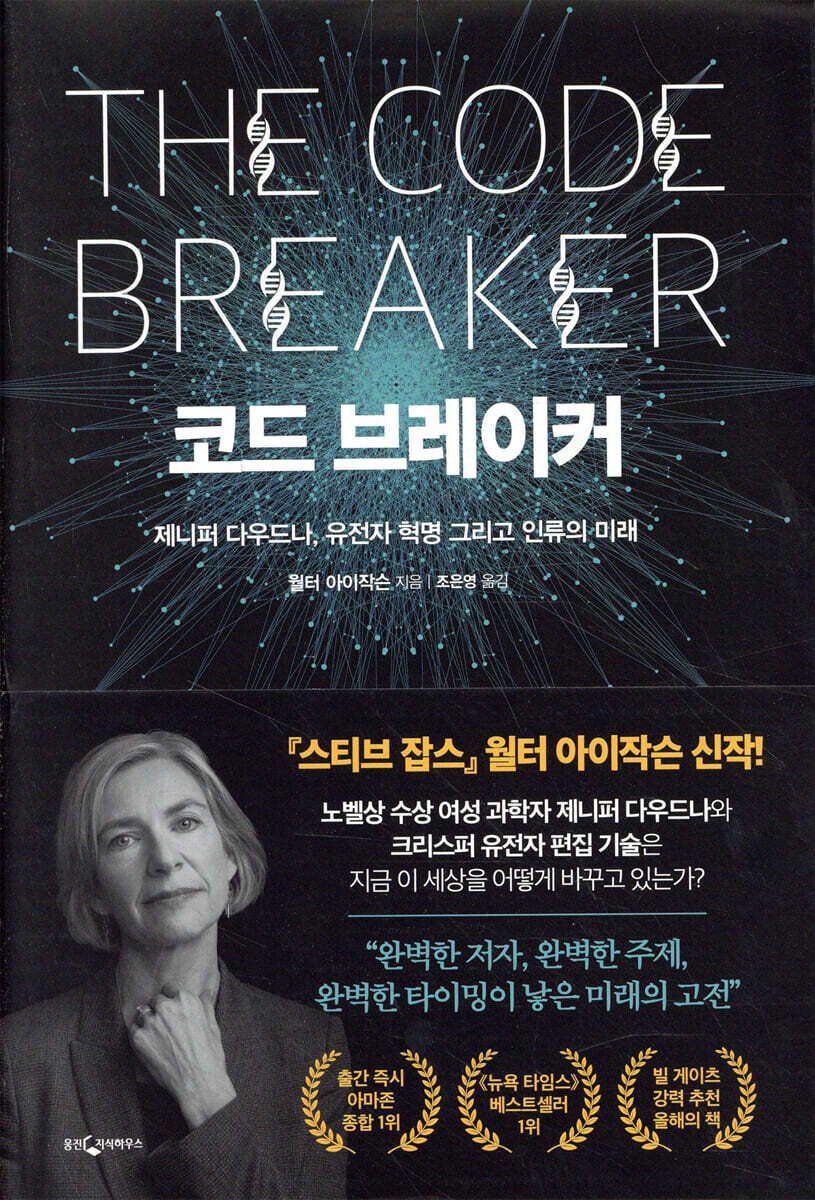
A new book by Walter Isaacson, author of "Steve Jobs"! The woman who saved humanity in the war against the virus 2020 Nobel Prize in Chemistry Winners Jennifer Doudna's first official biography #1 on Amazon's comprehensive charts immediately after publication #1 New York Times bestseller Bill Gates Highly Recommends 'Book of the Year' Time and the Washington Post named it one of the best books of 2021. Walter Isaacson, author of the international bestseller "Steve Jobs," returns with his new book, "Code Breaker." This book densely portrays the life of Jennifer Doudna, a world-renowned female scientist, winner of the 2020 Nobel Prize in Chemistry, a pioneer in CRISPR gene editing technology, and a world-renowned female scientist. Although Dowdna was looked down upon as a child, saying things like, “What kind of science is a girl doing?”, she did not give up and pursued the path of a researcher. And in collaboration with French microbiologist Emmanuel Charpentier, he was the first in the world to elucidate the operating mechanism of the CRISPR system, an adaptive immune system that bacteria use to defend themselves against viruses. She and her scientists then transformed the CRISPR system into a human gene editing tool. This technology, which diagnoses and treats genetically incurable diseases, is also widely applied today in the development of COVID-19 vaccines, diagnosis, and treatment research. This book skillfully weaves together the story of a female scientist's rise to fame in pursuit of the secrets of life and the development of CRISPR gene editing technology, guiding readers into the era of 21st-century life sciences. |
- You can preview some of the book's contents.
Preview
index
Part 1: The Origin of Life
Chapter 1: Hilo, Hawaii | Chapter 2: Genes | Chapter 3: DNA | Chapter 4: Becoming a Biochemist | Chapter 5: The Human Genome | Chapter 6: RNA |
Chapter 7: Twists and Folds | Chapter 8: Berkeley
Part 2: The Discovery of CRISPR
Chapter 9: Repeated Sequences | Chapter 10: Free Speech Movement Cafe | Chapter 11: Jumping into CRISPR | Chapter 12: Yogurt Makers | Chapter 13: Genentech | Chapter 14: Doudna Labs | Chapter 15: Caribou | Chapter 16: Emmanuel Charpentier | Chapter 17: CRISPR-Cas9 | Chapter 18: The 2012 Science Paper | Chapter 19: Showdown on the Pitch
Part 3: Gene Editing
Chapter 20: Human Gene Editing Tools | Chapter 21: Race | Chapter 22: Zhang Feng | Chapter 23: George Church | Chapter 24: Zhang Wrestles with CRISPR
Chapter 25: Doudna Takes the Pitch | Chapter 26: A Close Battle | Chapter 27: Doudna's Final Sprint | Chapter 28: Building a Company | Chapter 29: Dear Friends | Chapter 30: The Heroes of CRISPR | Chapter 31: Patents
Part 4: Using CRISPR
Chapter 32: Treatment | Chapter 33: Biohacking | Chapter 34: DARPA and Anti-CRISPR
Part 5 Public Scientists
Chapter 35: Rules of the Road | Chapter 36: Doudna Steps Out
Part 6 Crispr Baby
Chapter 37: He Jiankui | Chapter 38: The Hong Kong International Conference | Chapter 39: Social Acceptance
Part 7 Moral Issues
Chapter 40: Red Line | Chapter 41: Thought Experiment | Chapter 42: Who Should Make the Decisions? | Chapter 43: Doudna's Ethical Journey
Special report from the 8th front line
Chapter 44: Quebec | Chapter 45: Learning Gene Editing | Chapter 46: Thinking Back to Watson | Chapter 47: Doudna Visits Watson
Part 9 Coronavirus
Chapter 48: Battle Readiness Order | Chapter 49: Diagnostic Testing | Chapter 50: Berkeley Lab | Chapter 51: Mammoths and Sherlock | Chapter 52: Coronavirus Testing | Chapter 53: Vaccines | Chapter 54: CRISPR Therapeutics | Chapter 55: Cold Spring Harbor Virtual Conference | Chapter 56: The Nobel Prize
Chapter 1: Hilo, Hawaii | Chapter 2: Genes | Chapter 3: DNA | Chapter 4: Becoming a Biochemist | Chapter 5: The Human Genome | Chapter 6: RNA |
Chapter 7: Twists and Folds | Chapter 8: Berkeley
Part 2: The Discovery of CRISPR
Chapter 9: Repeated Sequences | Chapter 10: Free Speech Movement Cafe | Chapter 11: Jumping into CRISPR | Chapter 12: Yogurt Makers | Chapter 13: Genentech | Chapter 14: Doudna Labs | Chapter 15: Caribou | Chapter 16: Emmanuel Charpentier | Chapter 17: CRISPR-Cas9 | Chapter 18: The 2012 Science Paper | Chapter 19: Showdown on the Pitch
Part 3: Gene Editing
Chapter 20: Human Gene Editing Tools | Chapter 21: Race | Chapter 22: Zhang Feng | Chapter 23: George Church | Chapter 24: Zhang Wrestles with CRISPR
Chapter 25: Doudna Takes the Pitch | Chapter 26: A Close Battle | Chapter 27: Doudna's Final Sprint | Chapter 28: Building a Company | Chapter 29: Dear Friends | Chapter 30: The Heroes of CRISPR | Chapter 31: Patents
Part 4: Using CRISPR
Chapter 32: Treatment | Chapter 33: Biohacking | Chapter 34: DARPA and Anti-CRISPR
Part 5 Public Scientists
Chapter 35: Rules of the Road | Chapter 36: Doudna Steps Out
Part 6 Crispr Baby
Chapter 37: He Jiankui | Chapter 38: The Hong Kong International Conference | Chapter 39: Social Acceptance
Part 7 Moral Issues
Chapter 40: Red Line | Chapter 41: Thought Experiment | Chapter 42: Who Should Make the Decisions? | Chapter 43: Doudna's Ethical Journey
Special report from the 8th front line
Chapter 44: Quebec | Chapter 45: Learning Gene Editing | Chapter 46: Thinking Back to Watson | Chapter 47: Doudna Visits Watson
Part 9 Coronavirus
Chapter 48: Battle Readiness Order | Chapter 49: Diagnostic Testing | Chapter 50: Berkeley Lab | Chapter 51: Mammoths and Sherlock | Chapter 52: Coronavirus Testing | Chapter 53: Vaccines | Chapter 54: CRISPR Therapeutics | Chapter 55: Cold Spring Harbor Virtual Conference | Chapter 56: The Nobel Prize
Detailed image
.jpg)
Into the book
Deciding whether, and if so, when, it will be possible to edit our own genes will be one of the most important challenges of the 21st century.
So we need to understand how that process works.
Furthermore, as we experience recurring viral pandemics, the need for understanding life phenomena is also becoming increasingly urgent.
There is joy in uncovering the laws of nature.
The pleasure will be even greater if the target is ourselves.
Dowdna enjoyed that joy, and so can we.
That's what I'm trying to say in this book.
--- p.
11
“While I felt like Franklin was being overlooked, I was more struck by the fact that women can be great scientists too,” Doudna said.
“What does that mean? Everyone has probably heard of Marie Curie at least once.
But reading this book made me think about it seriously for the first time.
“Women can be scientists too.” --- p.29
I'm going to ask a big question.
Shostak was a great thinker who enjoyed delving into concrete experiments, but at the same time consistently asked fundamental questions.
“If there are no questions to answer, what’s the point of doing science?” This admonition soon became Doudna’s motto.
--- p.77
The two most important advances achieved by the joint research of Doudna and Charpentier today are:
First, we discovered that tracrRNA not only generates crRNA, but more importantly, it plays a crucial role in the cleavage process by binding to target DNA together with the Cas9 enzyme.
Second, they invented a way to fuse those two RNAs into one single guide RNA.
By studying a phenomenon that evolution has refined over a billion years in bacteria, they have turned a miracle of nature into a tool for human use.
--- p.187
Competition is the driving force of discovery.
Dowdna called competition “the spark that ignites the engine,” and it certainly worked that way for him.
From a young age, Dowdna was never ashamed of being greedy.
But at the same time, she knew how to balance fairness and honesty among her colleagues.
Dowdna learned the importance of competition while reading The Double Helix.
Through this book, she saw how learning about Linus Pauling's progress was a powerful catalyst for James Watson and Francis, and she later wrote:
“Healthy competition has fueled some of humanity’s greatest discoveries.” --- p.215
Wouldn't it be useful in a pandemic era if society could harness the biological wisdom and innovative minds of the public?
Wouldn't it be nice if citizens could at least test themselves and their neighbors for infection at home?
It is also possible to trace contact routes or collect data through crowdsourcing.
While there's still a clear line between officially recognized biologists and DIY hackers, Josiah Jainer is dedicated to blurring that line.
And CRISPR and COVID-19 will play a big part in this.
(Pages 339-340, Chapter 33: Biohacking)
Doudna, sitting in the audience, was sweating profusely.
“I was so nervous and nauseous, I was freaking out,” he said, adding that the amazing gene-editing tool he co-invented, CRISPR-Cas9, was being used to create the first genetically modified babies.
Moreover, this happened before safety issues were clinically tested, ethical issues were resolved, or even a social consensus was reached on whether this was the right way for science and humanity to evolve.
“I was incredibly disappointed and disgusted by the way the CRISPR gene scissors were used.
“I was concerned that it was a rush driven not by medical necessity or a desire to help those in dire need, but by a desire to attract world attention and be labeled ‘first.’” --- p.420
We need to have some humility and respect for nature and God, and regulate how humans can tamper with their genes.
Does that mean we should completely ban it? After all, we Homo sapiens are part of nature, no different from bacteria, sharks, or butterflies.
Whether by infinite wisdom or a single mistake, nature has endowed the human species with the power to edit its own genes.
You can criticize the use of CRISPR, but you can't say it's because it's unnatural.
If you think about it, this is a natural technique, just like any other trick used by bacteria and viruses.
--- p.477
“Is there any other field of study as cutthroat and competitive as biology?” an attendee asked me after Jang and Sternberg concluded their almost confrontational lectures.
My answer is simple.
Yes, it exists.
This is true in every field, from business to journalism.
Rather, biological research is distinguished from other fields by the well-organized collaborative system it has in place.
Even if you look at the Quebec Society alone, isn't it filled with the camaraderie of warriors competing over a common topic of inquiry?
The desire to win prizes and patents can be competitive, but it also accelerates the pace of discovery.
And the same passion to discover the “infinite wonders of nature” that Leonardo da Vinci spoke of motivates them.
Especially when it comes to breathtakingly beautiful things that happen inside living cells.
(Page 492, Chapter 44: Quebec)
The invention of easily reprogrammable RNA vaccines was a lightning triumph of human ingenuity.
But underlying it all lies decades of research driven by curiosity about the most fundamental aspect of life: how genes encoded in DNA are transferred to RNA strands to instruct cells to assemble proteins.
Similarly, CRISPR gene-editing technology began with understanding how bacteria use RNA to direct enzymes to cut up dangerous viruses.
Great inventions come from an understanding of basic science.
This is the beauty of nature.
(Page 585, Chapter 53: Vaccines)
Most of the questions asked at the press conference focused on what the award meant to women.
“I’m so proud to be a woman!” Dowdna replied with a big smile.
“This cannot be anything but a joyous occasion for great women, especially young women.
Many women feel that no matter what they do, they don't get the recognition they would if they were a man.
I want to see the times change.
“I believe this Nobel Prize is a step in the right direction.” (Page 615, “Chapter 56: The Nobel Prize”)
After millions of centuries of natural evolution, we humans now have the ability to hack the code of life and design our own genetic future.
No, to confound those who would label gene editing as “unnatural” or “god-like,” we could put it this way:
Nature and the Nature God, in their infinite wisdom, chose one species to evolve so that it could modify its own genome, and somehow that species happened to be us.
So we need to understand how that process works.
Furthermore, as we experience recurring viral pandemics, the need for understanding life phenomena is also becoming increasingly urgent.
There is joy in uncovering the laws of nature.
The pleasure will be even greater if the target is ourselves.
Dowdna enjoyed that joy, and so can we.
That's what I'm trying to say in this book.
--- p.
11
“While I felt like Franklin was being overlooked, I was more struck by the fact that women can be great scientists too,” Doudna said.
“What does that mean? Everyone has probably heard of Marie Curie at least once.
But reading this book made me think about it seriously for the first time.
“Women can be scientists too.” --- p.29
I'm going to ask a big question.
Shostak was a great thinker who enjoyed delving into concrete experiments, but at the same time consistently asked fundamental questions.
“If there are no questions to answer, what’s the point of doing science?” This admonition soon became Doudna’s motto.
--- p.77
The two most important advances achieved by the joint research of Doudna and Charpentier today are:
First, we discovered that tracrRNA not only generates crRNA, but more importantly, it plays a crucial role in the cleavage process by binding to target DNA together with the Cas9 enzyme.
Second, they invented a way to fuse those two RNAs into one single guide RNA.
By studying a phenomenon that evolution has refined over a billion years in bacteria, they have turned a miracle of nature into a tool for human use.
--- p.187
Competition is the driving force of discovery.
Dowdna called competition “the spark that ignites the engine,” and it certainly worked that way for him.
From a young age, Dowdna was never ashamed of being greedy.
But at the same time, she knew how to balance fairness and honesty among her colleagues.
Dowdna learned the importance of competition while reading The Double Helix.
Through this book, she saw how learning about Linus Pauling's progress was a powerful catalyst for James Watson and Francis, and she later wrote:
“Healthy competition has fueled some of humanity’s greatest discoveries.” --- p.215
Wouldn't it be useful in a pandemic era if society could harness the biological wisdom and innovative minds of the public?
Wouldn't it be nice if citizens could at least test themselves and their neighbors for infection at home?
It is also possible to trace contact routes or collect data through crowdsourcing.
While there's still a clear line between officially recognized biologists and DIY hackers, Josiah Jainer is dedicated to blurring that line.
And CRISPR and COVID-19 will play a big part in this.
(Pages 339-340, Chapter 33: Biohacking)
Doudna, sitting in the audience, was sweating profusely.
“I was so nervous and nauseous, I was freaking out,” he said, adding that the amazing gene-editing tool he co-invented, CRISPR-Cas9, was being used to create the first genetically modified babies.
Moreover, this happened before safety issues were clinically tested, ethical issues were resolved, or even a social consensus was reached on whether this was the right way for science and humanity to evolve.
“I was incredibly disappointed and disgusted by the way the CRISPR gene scissors were used.
“I was concerned that it was a rush driven not by medical necessity or a desire to help those in dire need, but by a desire to attract world attention and be labeled ‘first.’” --- p.420
We need to have some humility and respect for nature and God, and regulate how humans can tamper with their genes.
Does that mean we should completely ban it? After all, we Homo sapiens are part of nature, no different from bacteria, sharks, or butterflies.
Whether by infinite wisdom or a single mistake, nature has endowed the human species with the power to edit its own genes.
You can criticize the use of CRISPR, but you can't say it's because it's unnatural.
If you think about it, this is a natural technique, just like any other trick used by bacteria and viruses.
--- p.477
“Is there any other field of study as cutthroat and competitive as biology?” an attendee asked me after Jang and Sternberg concluded their almost confrontational lectures.
My answer is simple.
Yes, it exists.
This is true in every field, from business to journalism.
Rather, biological research is distinguished from other fields by the well-organized collaborative system it has in place.
Even if you look at the Quebec Society alone, isn't it filled with the camaraderie of warriors competing over a common topic of inquiry?
The desire to win prizes and patents can be competitive, but it also accelerates the pace of discovery.
And the same passion to discover the “infinite wonders of nature” that Leonardo da Vinci spoke of motivates them.
Especially when it comes to breathtakingly beautiful things that happen inside living cells.
(Page 492, Chapter 44: Quebec)
The invention of easily reprogrammable RNA vaccines was a lightning triumph of human ingenuity.
But underlying it all lies decades of research driven by curiosity about the most fundamental aspect of life: how genes encoded in DNA are transferred to RNA strands to instruct cells to assemble proteins.
Similarly, CRISPR gene-editing technology began with understanding how bacteria use RNA to direct enzymes to cut up dangerous viruses.
Great inventions come from an understanding of basic science.
This is the beauty of nature.
(Page 585, Chapter 53: Vaccines)
Most of the questions asked at the press conference focused on what the award meant to women.
“I’m so proud to be a woman!” Dowdna replied with a big smile.
“This cannot be anything but a joyous occasion for great women, especially young women.
Many women feel that no matter what they do, they don't get the recognition they would if they were a man.
I want to see the times change.
“I believe this Nobel Prize is a step in the right direction.” (Page 615, “Chapter 56: The Nobel Prize”)
After millions of centuries of natural evolution, we humans now have the ability to hack the code of life and design our own genetic future.
No, to confound those who would label gene editing as “unnatural” or “god-like,” we could put it this way:
Nature and the Nature God, in their infinite wisdom, chose one species to evolve so that it could modify its own genome, and somehow that species happened to be us.
--- p.627
Publisher's Review
About a female scientist who changed the world
A very special story
“This year’s award goes to Rewriting the Code of Life.
“With these genetic scissors, life science has entered a new era.” (p. 614, Royal Swedish Academy of Sciences)
The 2020 Nobel Prize in Chemistry surprised the world when it went to two female scientists.
The protagonists were Jennifer Doudna and Emmanuelle Charpentier.
In 2012, the two were the first in the world to elucidate the composition and operation of the CRISPR system, the adaptive immune system that bacteria use to defend themselves against viruses.
This system is soon to be developed into a gene editing technology (hereinafter referred to as 'CRISPR gene editing technology' or 'CRISPR scissors'), and is not only contributing to the dream of treating cancer and genetic diseases, but is also being widely applied in the development of COVID-19 vaccines and in diagnostic and therapeutic research.
This book, "Code Breaker," is the first official biography of Jennifer Doudna, a pioneer in CRISPR research and Nobel Prize-winning female scientist.
But Doudna's path to success as a scientist was not so smooth.
As a child, she had to endure belittling remarks from her guidance counselor, such as, “What kind of science is a girl doing?”
Even after becoming a scientist, I had to struggle to stand out among countless "alpha male" competitors and get my research recognized.
“A 2019 study of 6 million female-authored papers found that … women use 21 percent fewer positive or promotional words about their research than men.
And to some extent, as a result of this trend, their papers are 10 percent less likely to be cited.” (pp. 157-158)
So, the fact that Doudna is the sixth female winner of the Nobel Prize in Chemistry in the nearly 100-year history is very significant.
"Code Breaker" is a remarkable drama about a woman who overcomes the prejudice she endured because of her gender and grows into a world-class scientist.
Walter Isaacson, author of 'Steve Jobs'
Why Jennifer Doudna Matters
"Code Breaker" is a biography of a modern person written by Walter Isaacson, a world-renowned "genius expert" biographer, 10 years after his 2011 book "Steve Jobs."
Even before Doudna won the Nobel Prize, Isaacson began writing this book with her as the protagonist.
Why did he pay attention to Jennifer Doudna?
“The first revolution that encompassed the first half of the 20th century was led by physics.
… … The second half of the 20th century was the age of information technology.
… … Now we have entered a third, more important era, the era of the life sciences revolution.
“Children who have studied the genetic code will join those who have studied digital learning.” (p. 12)
In fact, in the United States, the percentage of science prodigies applying to life sciences, genetic engineering, and medicine is increasing.
Citizen scientists and biohackers are also reprogramming life with gene-editing kits in their home labs, sharing the process in real time with people around the world.
The CRISPR gene editing technology, first developed by Jennifer Doudna, opened the door to this era of life sciences.
Compared to existing gene editing tools, it is inexpensive, simple to manufacture, and has high accuracy and efficiency.
In this book, readers can get a glimpse into the future of biology and medicine that CRISPR scissors will shape.
“CRISPR gene editing technology is one of the most exciting scientific innovations of our time.
Anyone can easily understand the discovery through this book.
Even I learned a lot.” (Bill Gates, founder of Microsoft)
How Great Scientific Discoveries Are Made
: The power of curiosity and collaboration
Walter Isaacson has constantly explored what creates innovation, covering the lives of countless geniuses.
What he focuses on in this book is none other than ‘curiosity.’
In fact, CRISPR research began when microbiologists were trying to explain a mysterious phenomenon they had stumbled upon in the DNA of bacteria.
Doudna also began to dream of becoming a scientist who would explore the workings of life while encountering mimosas and eyeless spiders in the Hawaiian nature as a child.
“More than anything, I want to make people aware of the importance of basic science.
Basic science refers to inquiry driven by curiosity.
This means that it is not an academic discipline that was started for the purpose of applying research results.
However, research that begins with curiosity about the wonders of nature sometimes sows the seeds of innovation for the future in unexpected ways.” (p. 19)
Moreover, the world of science today is not led by just one genius.
Steve Jobs chose not the Macintosh or the iPhone as his greatest invention, but the team that created them.
Likewise, the life science revolution led by CRISPR scissors also started with excellent teamwork.
In addition to Doudna and Charpentier, representative collaborative research projects include those by Martin Inek and Blake Wiedenheft, Rodolphe Barangou and Philippe Orbat, Elicha Delčeva and Krzysztof Hilinski, Eric Sontheimer and Luciano Marraffini, and Marraffini and Zhang Feng.
In addition, large and small labs and groups sharing data and opinions have led the way in the life sciences.
The author clearly demonstrates that a research ecosystem managed by the collaboration of creative and passionate scientists fosters humanity's greatest discoveries.
“This book, a nuanced look at how scientific research is done, captures the struggles of the lab, the fleeting moments of inspiration, the whirlwinds of creativity, the competition and camaraderie, and the common cause that transcends them all.
The Economist
Are we wise enough to determine our own destiny?
: Genetic engineering and moral issues
“Sharon Duchesneau and Candy McCullough, a lesbian couple, wanted to use sperm donation to conceive a baby.
Both are deaf, and they viewed hearing loss as a part of who they were rather than a condition to be cured, and they wanted a child who would share that cultural identity.
So they put out an ad to find a sperm donor with congenital hearing impairment, and eventually had a deaf baby.” (p. 455)
Code Breaker also delves into the ethical and social issues that genetic engineering poses.
As the above examples show, the question of altering genes leads to a much larger and more important question than whether it is morally right or wrong.
This not only forces us to fundamentally rethink concepts like disability, homosexuality, and race, but also raises profound questions about how far parents can interfere in their children's lives, whether such intervention is fair, and whether the happiness it brings is desirable.
If we were given the technology to safely edit genes to confer immunity to the COVID-19 virus, would it be wrong to use it or not? How valid is the logic that editing for therapeutic purposes is acceptable, but editing for enhanced abilities is not? Can the government prevent people from choosing their children's genes on the grounds that it harms community diversity? On the other hand, if it allows it, how far should it go? Could genetic disparities based on parents' socioeconomic status arise, exacerbating inequality?
Through engaging thought experiments, case studies, and interviews, Code Breaker provides a concrete example of what we should consider when developing a set of principles to include in our moral scale.
And it emphasizes the need for a balance between unconditional approval and absolute prohibition.
“We now have the power to shape the future of our genes.
It is truly a great and fearsome ability.
“So we must move forward cautiously, respecting the power given to us.” (p. 486, Jennifer Doudna)
Overcoming the Virus Attack with the Power of Life Science
The Future of CRISPR Gene Editing Technology
In fact, CRISPR research is one of the most competitive fields.
A representative case that shows such an atmosphere is the patent dispute between Doudna (joint patent with Doudna and Charpentier, University of Berkeley and University of Vienna) and Zhang (joint patent with Zhang and Broad Institute, MIT, and Harvard).
This dispute has become something of a battleground in the CRISPR research field and remains unresolved.
However, COVID-19 has rekindled the camaraderie among these life science "warriors," breaking down the long-standing barriers between academia and the laboratory, and creating an opportunity for everyone to participate in problem-solving.
Today, the Moderna and Pfizer vaccines were able to be developed just over a year into the pandemic thanks to these changes.
Additionally, home kits that use the principle of CRISPR scissors to diagnose viruses and treatments that destroy viral genes and suppress their activity are being actively researched around the world.
“The war against COVID-19 did not proceed according to the existing rules.
Under the leadership of Doudna and Zhang Feng, most academic labs shared their findings with everyone fighting the virus, enabling greater collaboration among researchers and even across countries.
As a result, scientists around the world have contributed to an open database of coronavirus sequences, with 36,000 entries by the end of August 2020.
“Just look at the consortium that Dowdna created by bringing together labs in the Bay Area; if they had to worry about intellectual property rights negotiations, they wouldn’t have come together so quickly.” (p. 619)
The pandemic has forced us to reassess the value of gene editing and biotechnology.
Because I have personally experienced that if used wisely, it is a technology that can protect humanity from viruses.
Before labeling this technology and knowledge as sacred or unnatural, why not give it a chance to be used positively and ethically? "Code Breaker" offers the courage and wisdom to take a cautious step into a future brimming with danger, opportunity, and hope.
A very special story
“This year’s award goes to Rewriting the Code of Life.
“With these genetic scissors, life science has entered a new era.” (p. 614, Royal Swedish Academy of Sciences)
The 2020 Nobel Prize in Chemistry surprised the world when it went to two female scientists.
The protagonists were Jennifer Doudna and Emmanuelle Charpentier.
In 2012, the two were the first in the world to elucidate the composition and operation of the CRISPR system, the adaptive immune system that bacteria use to defend themselves against viruses.
This system is soon to be developed into a gene editing technology (hereinafter referred to as 'CRISPR gene editing technology' or 'CRISPR scissors'), and is not only contributing to the dream of treating cancer and genetic diseases, but is also being widely applied in the development of COVID-19 vaccines and in diagnostic and therapeutic research.
This book, "Code Breaker," is the first official biography of Jennifer Doudna, a pioneer in CRISPR research and Nobel Prize-winning female scientist.
But Doudna's path to success as a scientist was not so smooth.
As a child, she had to endure belittling remarks from her guidance counselor, such as, “What kind of science is a girl doing?”
Even after becoming a scientist, I had to struggle to stand out among countless "alpha male" competitors and get my research recognized.
“A 2019 study of 6 million female-authored papers found that … women use 21 percent fewer positive or promotional words about their research than men.
And to some extent, as a result of this trend, their papers are 10 percent less likely to be cited.” (pp. 157-158)
So, the fact that Doudna is the sixth female winner of the Nobel Prize in Chemistry in the nearly 100-year history is very significant.
"Code Breaker" is a remarkable drama about a woman who overcomes the prejudice she endured because of her gender and grows into a world-class scientist.
Walter Isaacson, author of 'Steve Jobs'
Why Jennifer Doudna Matters
"Code Breaker" is a biography of a modern person written by Walter Isaacson, a world-renowned "genius expert" biographer, 10 years after his 2011 book "Steve Jobs."
Even before Doudna won the Nobel Prize, Isaacson began writing this book with her as the protagonist.
Why did he pay attention to Jennifer Doudna?
“The first revolution that encompassed the first half of the 20th century was led by physics.
… … The second half of the 20th century was the age of information technology.
… … Now we have entered a third, more important era, the era of the life sciences revolution.
“Children who have studied the genetic code will join those who have studied digital learning.” (p. 12)
In fact, in the United States, the percentage of science prodigies applying to life sciences, genetic engineering, and medicine is increasing.
Citizen scientists and biohackers are also reprogramming life with gene-editing kits in their home labs, sharing the process in real time with people around the world.
The CRISPR gene editing technology, first developed by Jennifer Doudna, opened the door to this era of life sciences.
Compared to existing gene editing tools, it is inexpensive, simple to manufacture, and has high accuracy and efficiency.
In this book, readers can get a glimpse into the future of biology and medicine that CRISPR scissors will shape.
“CRISPR gene editing technology is one of the most exciting scientific innovations of our time.
Anyone can easily understand the discovery through this book.
Even I learned a lot.” (Bill Gates, founder of Microsoft)
How Great Scientific Discoveries Are Made
: The power of curiosity and collaboration
Walter Isaacson has constantly explored what creates innovation, covering the lives of countless geniuses.
What he focuses on in this book is none other than ‘curiosity.’
In fact, CRISPR research began when microbiologists were trying to explain a mysterious phenomenon they had stumbled upon in the DNA of bacteria.
Doudna also began to dream of becoming a scientist who would explore the workings of life while encountering mimosas and eyeless spiders in the Hawaiian nature as a child.
“More than anything, I want to make people aware of the importance of basic science.
Basic science refers to inquiry driven by curiosity.
This means that it is not an academic discipline that was started for the purpose of applying research results.
However, research that begins with curiosity about the wonders of nature sometimes sows the seeds of innovation for the future in unexpected ways.” (p. 19)
Moreover, the world of science today is not led by just one genius.
Steve Jobs chose not the Macintosh or the iPhone as his greatest invention, but the team that created them.
Likewise, the life science revolution led by CRISPR scissors also started with excellent teamwork.
In addition to Doudna and Charpentier, representative collaborative research projects include those by Martin Inek and Blake Wiedenheft, Rodolphe Barangou and Philippe Orbat, Elicha Delčeva and Krzysztof Hilinski, Eric Sontheimer and Luciano Marraffini, and Marraffini and Zhang Feng.
In addition, large and small labs and groups sharing data and opinions have led the way in the life sciences.
The author clearly demonstrates that a research ecosystem managed by the collaboration of creative and passionate scientists fosters humanity's greatest discoveries.
“This book, a nuanced look at how scientific research is done, captures the struggles of the lab, the fleeting moments of inspiration, the whirlwinds of creativity, the competition and camaraderie, and the common cause that transcends them all.
The Economist
Are we wise enough to determine our own destiny?
: Genetic engineering and moral issues
“Sharon Duchesneau and Candy McCullough, a lesbian couple, wanted to use sperm donation to conceive a baby.
Both are deaf, and they viewed hearing loss as a part of who they were rather than a condition to be cured, and they wanted a child who would share that cultural identity.
So they put out an ad to find a sperm donor with congenital hearing impairment, and eventually had a deaf baby.” (p. 455)
Code Breaker also delves into the ethical and social issues that genetic engineering poses.
As the above examples show, the question of altering genes leads to a much larger and more important question than whether it is morally right or wrong.
This not only forces us to fundamentally rethink concepts like disability, homosexuality, and race, but also raises profound questions about how far parents can interfere in their children's lives, whether such intervention is fair, and whether the happiness it brings is desirable.
If we were given the technology to safely edit genes to confer immunity to the COVID-19 virus, would it be wrong to use it or not? How valid is the logic that editing for therapeutic purposes is acceptable, but editing for enhanced abilities is not? Can the government prevent people from choosing their children's genes on the grounds that it harms community diversity? On the other hand, if it allows it, how far should it go? Could genetic disparities based on parents' socioeconomic status arise, exacerbating inequality?
Through engaging thought experiments, case studies, and interviews, Code Breaker provides a concrete example of what we should consider when developing a set of principles to include in our moral scale.
And it emphasizes the need for a balance between unconditional approval and absolute prohibition.
“We now have the power to shape the future of our genes.
It is truly a great and fearsome ability.
“So we must move forward cautiously, respecting the power given to us.” (p. 486, Jennifer Doudna)
Overcoming the Virus Attack with the Power of Life Science
The Future of CRISPR Gene Editing Technology
In fact, CRISPR research is one of the most competitive fields.
A representative case that shows such an atmosphere is the patent dispute between Doudna (joint patent with Doudna and Charpentier, University of Berkeley and University of Vienna) and Zhang (joint patent with Zhang and Broad Institute, MIT, and Harvard).
This dispute has become something of a battleground in the CRISPR research field and remains unresolved.
However, COVID-19 has rekindled the camaraderie among these life science "warriors," breaking down the long-standing barriers between academia and the laboratory, and creating an opportunity for everyone to participate in problem-solving.
Today, the Moderna and Pfizer vaccines were able to be developed just over a year into the pandemic thanks to these changes.
Additionally, home kits that use the principle of CRISPR scissors to diagnose viruses and treatments that destroy viral genes and suppress their activity are being actively researched around the world.
“The war against COVID-19 did not proceed according to the existing rules.
Under the leadership of Doudna and Zhang Feng, most academic labs shared their findings with everyone fighting the virus, enabling greater collaboration among researchers and even across countries.
As a result, scientists around the world have contributed to an open database of coronavirus sequences, with 36,000 entries by the end of August 2020.
“Just look at the consortium that Dowdna created by bringing together labs in the Bay Area; if they had to worry about intellectual property rights negotiations, they wouldn’t have come together so quickly.” (p. 619)
The pandemic has forced us to reassess the value of gene editing and biotechnology.
Because I have personally experienced that if used wisely, it is a technology that can protect humanity from viruses.
Before labeling this technology and knowledge as sacred or unnatural, why not give it a chance to be used positively and ethically? "Code Breaker" offers the courage and wisdom to take a cautious step into a future brimming with danger, opportunity, and hope.
GOODS SPECIFICS
- Publication date: February 22, 2022
- Page count, weight, size: 696 pages | 1,116g | 150*225*35mm
- ISBN13: 9788901256603
- ISBN10: 8901256606
You may also like
카테고리
korean


korean

![GQ KOREA Mark (Monthly): December [2025]](http://librairie.coreenne.fr/cdn/shop/files/8ef265dbbfbf186523ed75ba7319009d.jpg?v=1765340328&width=3840)


