

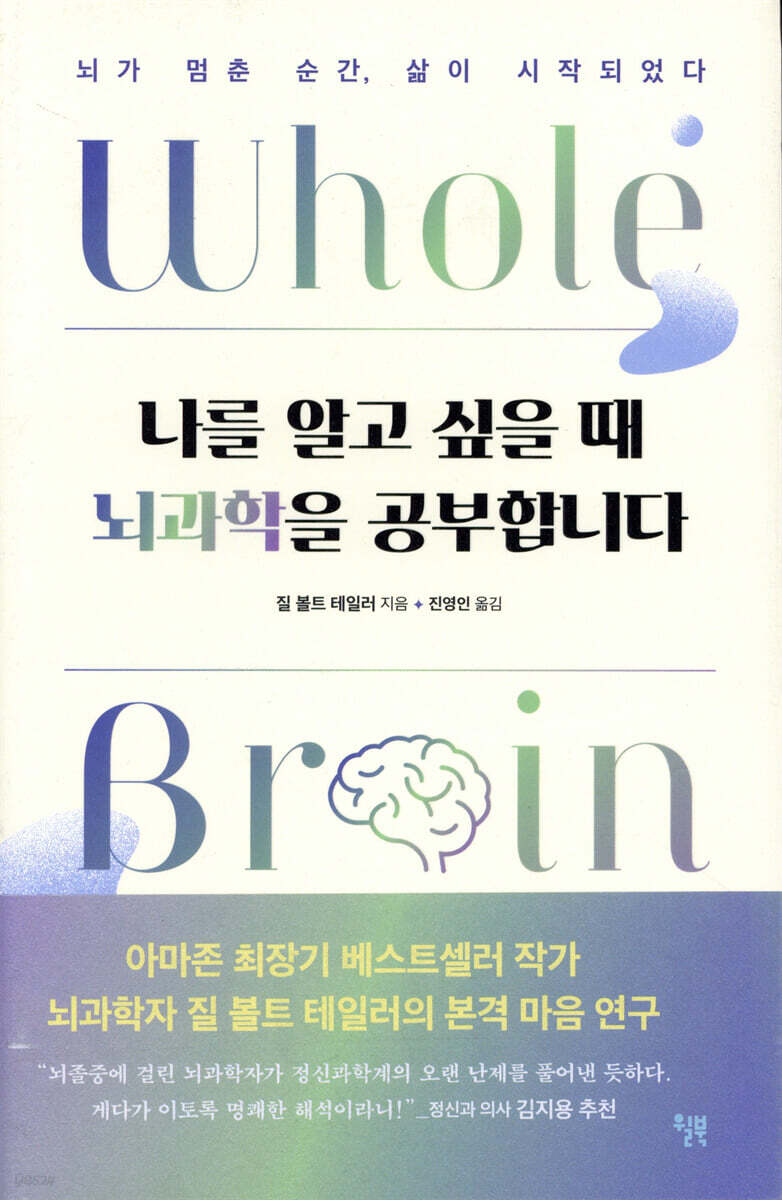
When you want to know yourself, study brain science.
 |
Description
Book Introduction
A new book from the author of Amazon's longest-running bestseller, "I Thought I Was Dead."
What a Stroke-Suffering Neurologist Learned About the Brain After It Stopped Working
Neuroscientist Jaeseung Jeong strongly recommends psychiatrist Jiyong Kim from "Brain Rich People."
The second book by Jill Bolte Taylor, the first neuroscientist to observe the process of brain collapse after suffering a stroke at age 37.
The author, who was studying the brain at Harvard University, gained attention in a TED talk after sharing his experience of living with only the right brain after suffering from left brain damage.
Even at the moment of his brain collapse, he thought, “A stroke for a neuroscientist? How cool!” As a relentless neuroscientist, and as a human who personally experienced the brain’s resilience by learning numbers and language one by one with a damaged left brain, this time he focuses on ‘the working principles of the mind based on brain science.’
It reveals the intimate mechanisms of the brain and emotions and presents tools for a whole-brain life in simple and clear language.
If we truly want to know ourselves, if we want to take control of our lives, we must study the brain science behind our emotions.
Understanding how the brain works behind emotions allows us to be less dependent on our emotions and gives us the power to choose how we feel.
This is the 'whole-brained life' and subjective life that this book emphasizes.
The world of emotions discovered by neuroscientists is deep and wonderful.
Let's delve into the anatomy of the brain and mind through the eyes of a scientist, and the story of one human being who has endured the suffering that exists beyond.
'
What a Stroke-Suffering Neurologist Learned About the Brain After It Stopped Working
Neuroscientist Jaeseung Jeong strongly recommends psychiatrist Jiyong Kim from "Brain Rich People."
The second book by Jill Bolte Taylor, the first neuroscientist to observe the process of brain collapse after suffering a stroke at age 37.
The author, who was studying the brain at Harvard University, gained attention in a TED talk after sharing his experience of living with only the right brain after suffering from left brain damage.
Even at the moment of his brain collapse, he thought, “A stroke for a neuroscientist? How cool!” As a relentless neuroscientist, and as a human who personally experienced the brain’s resilience by learning numbers and language one by one with a damaged left brain, this time he focuses on ‘the working principles of the mind based on brain science.’
It reveals the intimate mechanisms of the brain and emotions and presents tools for a whole-brain life in simple and clear language.
If we truly want to know ourselves, if we want to take control of our lives, we must study the brain science behind our emotions.
Understanding how the brain works behind emotions allows us to be less dependent on our emotions and gives us the power to choose how we feel.
This is the 'whole-brained life' and subjective life that this book emphasizes.
The world of emotions discovered by neuroscientists is deep and wonderful.
Let's delve into the anatomy of the brain and mind through the eyes of a scientist, and the story of one human being who has endured the suffering that exists beyond.
'
- You can preview some of the book's contents.
Preview
index
Recommendation
Preface Peace is just a flow of thoughts
Part 1: Dissecting the Brain and Mind
Chapter 1: The Truth About the Brain After It Stopped Working
Chapter 2: Mechanisms of the Brain and Mind
Chapter 3: The Four Selves in the Brain
Part 2 Four Characters
Chapter 4 Character 1: Left-Brain Thinking
Chapter 5 Character 2: Left-Brained Emotional Type
Chapter 6 Character 3: Right-Brained Emotional Type
Chapter 7 Character 4: Right-Brain Thinking
Chapter 8 Brain Summit: Technologies for a Whole-Brain Life
Part 3 Four Characters in Our Lives
Chapter 9: My Relationship: The Four Characters and the Body
Chapter 10: Relationships with Others: Four Characters and Their Relationships
Chapter 11 Disconnection and Reconnection: Addiction and Recovery in Four Characters
Chapter 12 Generations and Personality: The Influence of Four Characters and Technologies
Conclusion Perfect, complete and beautiful
Preface Peace is just a flow of thoughts
Part 1: Dissecting the Brain and Mind
Chapter 1: The Truth About the Brain After It Stopped Working
Chapter 2: Mechanisms of the Brain and Mind
Chapter 3: The Four Selves in the Brain
Part 2 Four Characters
Chapter 4 Character 1: Left-Brain Thinking
Chapter 5 Character 2: Left-Brained Emotional Type
Chapter 6 Character 3: Right-Brained Emotional Type
Chapter 7 Character 4: Right-Brain Thinking
Chapter 8 Brain Summit: Technologies for a Whole-Brain Life
Part 3 Four Characters in Our Lives
Chapter 9: My Relationship: The Four Characters and the Body
Chapter 10: Relationships with Others: Four Characters and Their Relationships
Chapter 11 Disconnection and Reconnection: Addiction and Recovery in Four Characters
Chapter 12 Generations and Personality: The Influence of Four Characters and Technologies
Conclusion Perfect, complete and beautiful
Detailed image

Into the book
After brain surgery, I regained the ability to experience new emotions.
But I had to relearn how to name the emotions I was experiencing.
I remember describing one element of pain.
My heart was racing, my jaw was twitching, the hair on the back of my neck was prickling, my hands were clenched into fists, and sweat was breaking out on my skin.
I felt like an animal wandering in the wild.
I wanted to hit, bite, and attack with all my might.
My mother said that a series of such states were anger.
From then on, I could sense when my anger circuitry was triggered.
--- p.124
But no matter how hard I tried, I couldn't understand why people kept engaging in the anger circuit and making it work.
Because the anger came across as too violent and internally unhealthy.
And by paying attention to the early signs of anger, I realized that I had the power to control it.
All you had to do was stop the circuit before it completely rotated.
As time passed and my character 2 recovered, I discovered that even if the circuit was triggered, it took less than 90 seconds for a particular neural loop to start working and then completely stop.
--- p.124
I mitigate Character 2's hostility by recognizing that Character 2 is in a triggered state.
Then quickly press the stop button.
Intentionally appeases Character 2 before saying or doing something they might later regret.
Feeling shame or guilt about Character 2's wiring will only serve to distract you from your attempts to heal Character 2.
So when character 2 is triggered, we use the 90-second rule.
It gives you time to take a break or start over, such as counting to ten.
--- p.229
After writing "I Thought I Was Dead," I had no intention of writing another book, but I felt like I had something important to say.
We have an amygdala, hippocampus, and anterior cingulate gyrus, one in each hemisphere, which are involved in emotional
I realized that the system is functionally separate, but most people don't know this.
That's why people have a hard time controlling their emotional reactivity.
If we believe we have no choice, we act automatically.
When we understand the anatomy that underlies our choices, we gain the power not only to not react to stimuli, but also to make informed decisions.
--- p.363
One of the many beautiful things about the four character system is that when we open ourselves to the four characters, they have the power to shape every moment of our lives in a very positive way.
This book deals with how to love not only the four characters within ourselves, but also the four characters in others.
--- p.364
Every human being has a wonderful brain with four characters, and the ability to choose which of the four characters to embody at any given moment.
Conclusion_Perfect, Complete, and Beautiful, 364 pages
If we train our brain, we can easily switch between the four characters.
This allows new connections to be formed between different brain cell modules.
By using this network to bring the four characters into your brain conversation at any time, you can live a purposeful life in your best form.
Every human being has a wonderful brain with four characters, and the ability to choose which of the four characters to embody at any given moment.
--- p.365
When we realize that every ability we have depends on the cells that perform that function, we become more aware of the fact that the brain is a very intricately woven network of cells, and that our emotions, experiential feelings, thoughts, and behaviors are simply the workings of a network of cells.
Feeling joy or feeling misery is due to the wiring of the brain.
We have the power to choose how much of each circuit we activate, and how we feel about it.
You can choose to disconnect from the emotion early, feel the corresponding circuits in your body working, and then let them go after 90 seconds.
Or you can just act out your feelings for 90 seconds.
Alternatively, you could re-activate that circuit and feel that feeling over and over again for 90 minutes, or 90 years.
But I had to relearn how to name the emotions I was experiencing.
I remember describing one element of pain.
My heart was racing, my jaw was twitching, the hair on the back of my neck was prickling, my hands were clenched into fists, and sweat was breaking out on my skin.
I felt like an animal wandering in the wild.
I wanted to hit, bite, and attack with all my might.
My mother said that a series of such states were anger.
From then on, I could sense when my anger circuitry was triggered.
--- p.124
But no matter how hard I tried, I couldn't understand why people kept engaging in the anger circuit and making it work.
Because the anger came across as too violent and internally unhealthy.
And by paying attention to the early signs of anger, I realized that I had the power to control it.
All you had to do was stop the circuit before it completely rotated.
As time passed and my character 2 recovered, I discovered that even if the circuit was triggered, it took less than 90 seconds for a particular neural loop to start working and then completely stop.
--- p.124
I mitigate Character 2's hostility by recognizing that Character 2 is in a triggered state.
Then quickly press the stop button.
Intentionally appeases Character 2 before saying or doing something they might later regret.
Feeling shame or guilt about Character 2's wiring will only serve to distract you from your attempts to heal Character 2.
So when character 2 is triggered, we use the 90-second rule.
It gives you time to take a break or start over, such as counting to ten.
--- p.229
After writing "I Thought I Was Dead," I had no intention of writing another book, but I felt like I had something important to say.
We have an amygdala, hippocampus, and anterior cingulate gyrus, one in each hemisphere, which are involved in emotional
I realized that the system is functionally separate, but most people don't know this.
That's why people have a hard time controlling their emotional reactivity.
If we believe we have no choice, we act automatically.
When we understand the anatomy that underlies our choices, we gain the power not only to not react to stimuli, but also to make informed decisions.
--- p.363
One of the many beautiful things about the four character system is that when we open ourselves to the four characters, they have the power to shape every moment of our lives in a very positive way.
This book deals with how to love not only the four characters within ourselves, but also the four characters in others.
--- p.364
Every human being has a wonderful brain with four characters, and the ability to choose which of the four characters to embody at any given moment.
Conclusion_Perfect, Complete, and Beautiful, 364 pages
If we train our brain, we can easily switch between the four characters.
This allows new connections to be formed between different brain cell modules.
By using this network to bring the four characters into your brain conversation at any time, you can live a purposeful life in your best form.
Every human being has a wonderful brain with four characters, and the ability to choose which of the four characters to embody at any given moment.
--- p.365
When we realize that every ability we have depends on the cells that perform that function, we become more aware of the fact that the brain is a very intricately woven network of cells, and that our emotions, experiential feelings, thoughts, and behaviors are simply the workings of a network of cells.
Feeling joy or feeling misery is due to the wiring of the brain.
We have the power to choose how much of each circuit we activate, and how we feel about it.
You can choose to disconnect from the emotion early, feel the corresponding circuits in your body working, and then let them go after 90 seconds.
Or you can just act out your feelings for 90 seconds.
Alternatively, you could re-activate that circuit and feel that feeling over and over again for 90 minutes, or 90 years.
--- p.366
Publisher's Review
After the brain stops, life begins.
The day her brain stopped working, Jill Bolte Taylor confesses she got a second chance at life.
The famous '90-second rule' was the key to his realization.
Our emotions are simply a result of brain chemistry, and if we remain angry after 90 seconds, it means we have chosen to feel that way.
He goes a step further with this insight and talks about the emotions that are created by the unique characteristics of the left and right brain.
In addition to the characteristics of the left and right brain, this book shows four characters within the brain by combining the emotional and thinking types.
We have four unique selves that arise from the circuitry of our brains.
What matters is how we externally express these four characters when we encounter external stimuli, relationships, or conflicts.
This is what makes this book different from other books on the mind: it explains the 'functions of the brain' and the 'operations of emotions' as one.
Rather than defining human nature as a single entity based on four unique characteristics within the brain, this book scientifically explains why our diverse range of emotions arise and how personality traits emerge.
This assumes that we humans are not defined by the definitive concepts of extroverts or thinking types, but rather as complex beings with a mixture of all characters.
This assumption embodies the psychological insight that no emotion we feel should be neglected, and that all emotions must be properly acknowledged so that we can accept our true selves and live healthy lives.
Jill Bolte Taylor's vision of a whole-brained life is one where we become masters of our emotions.
By giving ourselves a character, we are able to step back and look at ourselves objectively.
Thinking emotional creatures
The author emphasizes that humans are 'thinking, emotional creatures'.
We are stimulated by the external environment, think through the brain, and receive emotions through the cingulate cortex.
Simply put, we don't feel emotions and then think, we think and then feel emotions.
Because of this characteristic of thinking first and then feeling, humans are swayed by emotions after they perceive.
At the same time, this property also allows us to control our emotions.
If we can read emotional patterns in our thought processes before we feel them, that is, if we understand the principles of thought and emotion, we can gain control over our emotions.
The author, who realized that humans think first and then feel emotions, proposes a way to look at emotions objectively.
It is called 'Brain Summit'.
Although it may seem like a childish word at first, this process is effective in objectifying emotions.
The author emphasizes that the emotions we feel are our own choices, and devotes a significant portion of the book to explaining their validity and principles.
We will live with all our brains, we are imperfect but complete beings.
He is a 'lucky scientist' who has observed the paralysis of brain function as if he were an observer, and experienced firsthand the process of emotions and thoughts returning during the recovery process.
This unique experience has allowed him to gain a more detailed and scientific understanding of the brain, our emotions, and, by extension, our lives.
What might feel like meditation to some, or a moment of deep breathing to others, is the author's simplified concept of emotional selection to make it easier to understand.
The 'four characters' can also be seen as the author's unique concept to more clearly explain how the brain works.
Are you immersed in the MBTI and psychology to understand yourself? Listen to Jill Bolte Taylor's story, which reveals the essential characteristics of "the complete human being" beyond the categorization process.
Understanding the brain allows us to gain a deeper understanding of ourselves as humans.
What Jill Bolte Taylor felt after her brain stopped working, and what she wanted to tell us after 10 years, is that emotions are entirely under our control and that a whole-brained life is the path to happiness.
The day her brain stopped working, Jill Bolte Taylor confesses she got a second chance at life.
The famous '90-second rule' was the key to his realization.
Our emotions are simply a result of brain chemistry, and if we remain angry after 90 seconds, it means we have chosen to feel that way.
He goes a step further with this insight and talks about the emotions that are created by the unique characteristics of the left and right brain.
In addition to the characteristics of the left and right brain, this book shows four characters within the brain by combining the emotional and thinking types.
We have four unique selves that arise from the circuitry of our brains.
What matters is how we externally express these four characters when we encounter external stimuli, relationships, or conflicts.
This is what makes this book different from other books on the mind: it explains the 'functions of the brain' and the 'operations of emotions' as one.
Rather than defining human nature as a single entity based on four unique characteristics within the brain, this book scientifically explains why our diverse range of emotions arise and how personality traits emerge.
This assumes that we humans are not defined by the definitive concepts of extroverts or thinking types, but rather as complex beings with a mixture of all characters.
This assumption embodies the psychological insight that no emotion we feel should be neglected, and that all emotions must be properly acknowledged so that we can accept our true selves and live healthy lives.
Jill Bolte Taylor's vision of a whole-brained life is one where we become masters of our emotions.
By giving ourselves a character, we are able to step back and look at ourselves objectively.
Thinking emotional creatures
The author emphasizes that humans are 'thinking, emotional creatures'.
We are stimulated by the external environment, think through the brain, and receive emotions through the cingulate cortex.
Simply put, we don't feel emotions and then think, we think and then feel emotions.
Because of this characteristic of thinking first and then feeling, humans are swayed by emotions after they perceive.
At the same time, this property also allows us to control our emotions.
If we can read emotional patterns in our thought processes before we feel them, that is, if we understand the principles of thought and emotion, we can gain control over our emotions.
The author, who realized that humans think first and then feel emotions, proposes a way to look at emotions objectively.
It is called 'Brain Summit'.
Although it may seem like a childish word at first, this process is effective in objectifying emotions.
The author emphasizes that the emotions we feel are our own choices, and devotes a significant portion of the book to explaining their validity and principles.
We will live with all our brains, we are imperfect but complete beings.
He is a 'lucky scientist' who has observed the paralysis of brain function as if he were an observer, and experienced firsthand the process of emotions and thoughts returning during the recovery process.
This unique experience has allowed him to gain a more detailed and scientific understanding of the brain, our emotions, and, by extension, our lives.
What might feel like meditation to some, or a moment of deep breathing to others, is the author's simplified concept of emotional selection to make it easier to understand.
The 'four characters' can also be seen as the author's unique concept to more clearly explain how the brain works.
Are you immersed in the MBTI and psychology to understand yourself? Listen to Jill Bolte Taylor's story, which reveals the essential characteristics of "the complete human being" beyond the categorization process.
Understanding the brain allows us to gain a deeper understanding of ourselves as humans.
What Jill Bolte Taylor felt after her brain stopped working, and what she wanted to tell us after 10 years, is that emotions are entirely under our control and that a whole-brained life is the path to happiness.
GOODS SPECIFICS
- Publication date: March 30, 2022
- Page count, weight, size: 392 pages | 564g | 145*220*30mm
- ISBN13: 9791155814512
- ISBN10: 1155814517
You may also like
카테고리
korean


korean

![ELLE 엘르 스페셜 에디션 A형 : 12월 [2025]](http://librairie.coreenne.fr/cdn/shop/files/b8e27a3de6c9538896439686c6b0e8fb.jpg?v=1766436872&width=3840)


