

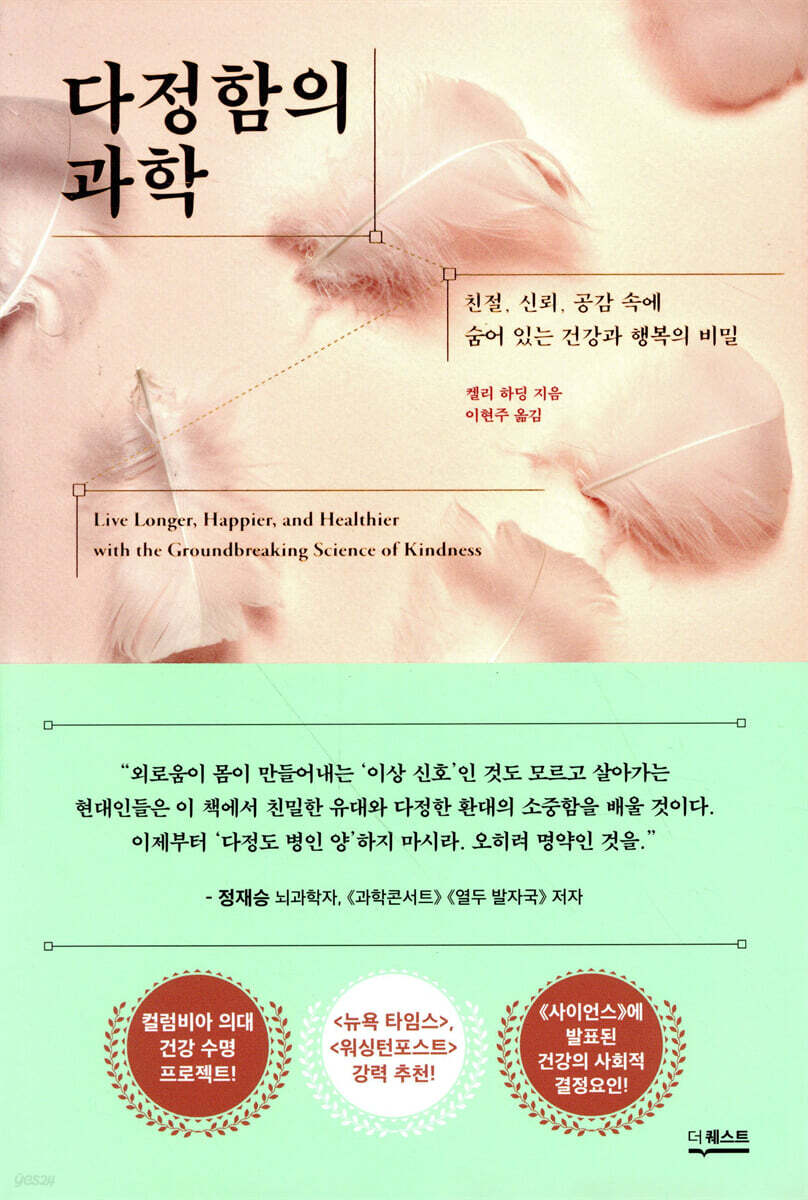
The Science of Affection
 |
Description
Book Introduction
- A word from MD
-
I recommend affection to those who want to live well.
Is there a royal road to health? A psychiatry professor, drawing on clinical experience and clinical data, scientifically analyzed the impact of social factors like hugging and hand-holding on health and longevity.
A book that proves that the 'affection' we experience in interpersonal relationships, rather than the existing secrets to longevity, reduces our risk of illness and allows us to live longer.
February 4, 2022. Natural Science PD Kim Yu-ri
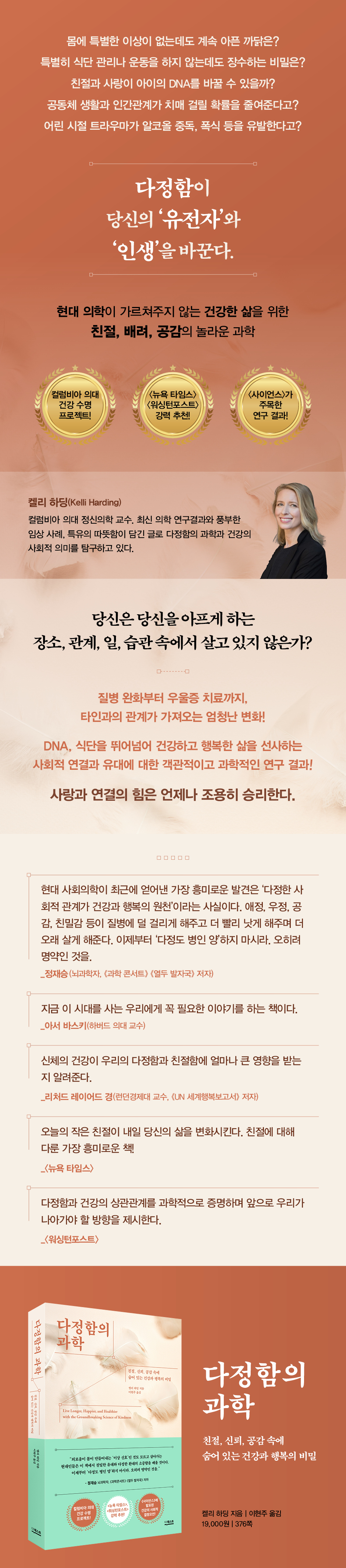
The power of love and connection always quietly triumphs.
The Amazing Science of Kindness for a Healthy Life That Modern Medicine Doesn't Teach You
* Research results highlighted by Science!
* A hot topic book selected by major American media outlets such as [The New York Times] and [The Washington Post]!
* Highly recommended by Professor Jaeseung Jeong, Professor Arthur Barsky of Harvard Medical School, and others!
The answer to a healthy life lies in sociology, not medicine!
In these times of social isolation due to COVID-19, how will the lack of communication and loneliness change our lives?
Hidden in the extremely human things of kindness, trust, empathy, and other emotions and flesh-and-blood
The Secret to Health and Happiness
Why do I keep feeling sick even though there is nothing particularly wrong with my body?
Is childhood trauma the reason for alcoholism, binge eating, etc.?
What is the secret to living a long life without any special diet or exercise?
Kindness and love change a child's DNA?
Why do community living and relationships reduce the risk of dementia?
People who receive hugs every day are 32% less likely to get sick.
Dr. Kelly Harding, a professor of psychiatry at Columbia University School of Medicine, draws on her extensive clinical experience and case studies to provide an interesting analysis of how seemingly unrelated social factors, such as family relationships, education level, and neighborhood, affect health and longevity.
Emotions like warm embraces of affection, friendships of encouragement and support, and intimacy of understanding and empathy make us less susceptible to illness and help us live longer.
It clearly explains the social determinants of health, which modern medicine has not previously focused on, through scientific yet rich storytelling.
The Amazing Science of Kindness for a Healthy Life That Modern Medicine Doesn't Teach You
* Research results highlighted by Science!
* A hot topic book selected by major American media outlets such as [The New York Times] and [The Washington Post]!
* Highly recommended by Professor Jaeseung Jeong, Professor Arthur Barsky of Harvard Medical School, and others!
The answer to a healthy life lies in sociology, not medicine!
In these times of social isolation due to COVID-19, how will the lack of communication and loneliness change our lives?
Hidden in the extremely human things of kindness, trust, empathy, and other emotions and flesh-and-blood
The Secret to Health and Happiness
Why do I keep feeling sick even though there is nothing particularly wrong with my body?
Is childhood trauma the reason for alcoholism, binge eating, etc.?
What is the secret to living a long life without any special diet or exercise?
Kindness and love change a child's DNA?
Why do community living and relationships reduce the risk of dementia?
People who receive hugs every day are 32% less likely to get sick.
Dr. Kelly Harding, a professor of psychiatry at Columbia University School of Medicine, draws on her extensive clinical experience and case studies to provide an interesting analysis of how seemingly unrelated social factors, such as family relationships, education level, and neighborhood, affect health and longevity.
Emotions like warm embraces of affection, friendships of encouragement and support, and intimacy of understanding and empathy make us less susceptible to illness and help us live longer.
It clearly explains the social determinants of health, which modern medicine has not previously focused on, through scientific yet rich storytelling.
- You can preview some of the book's contents.
Preview
index
Recommendation_ 'Affection' is a painkiller and a cure, a vitamin and a nutrient_ Jaeseung Jeong (neuroscientist)
Introduction_ What are we missing in medicine?
Part 1.
Hidden Factors of Health
Chapter 1.
Social Determinants of Health: Discovering the True Meaning of Health Beyond the Clinic
Chapter 2.
One-on-one relationship_ Even if you only have one close person!
Chapter 3.
Social Connections: People can never live alone.
Chapter 4.
Work and Career_Is your job a means of making money or a source of satisfaction?
Chapter 5.
Education: Discovering your own sense of purpose and passion in everyday life
Chapter 6.
Neighborhoods and Neighborhoods_Where you live determines your life.
Chapter 7.
Fairness: Treat others as you would like to be treated.
Chapter 8.
Environmental Influences_How to Accept Adversity Positively
Part 2.
Essential elements of health
Chapter 9.
Personal Health: Finding the Connection Between Body and Mind
Chapter 10.
Group Health: How to Stand Up to Unkindness
Conclusion: Health is hidden in the small moments of everyday life.
Going Out_ The Eternal Mystery
Introduction_ What are we missing in medicine?
Part 1.
Hidden Factors of Health
Chapter 1.
Social Determinants of Health: Discovering the True Meaning of Health Beyond the Clinic
Chapter 2.
One-on-one relationship_ Even if you only have one close person!
Chapter 3.
Social Connections: People can never live alone.
Chapter 4.
Work and Career_Is your job a means of making money or a source of satisfaction?
Chapter 5.
Education: Discovering your own sense of purpose and passion in everyday life
Chapter 6.
Neighborhoods and Neighborhoods_Where you live determines your life.
Chapter 7.
Fairness: Treat others as you would like to be treated.
Chapter 8.
Environmental Influences_How to Accept Adversity Positively
Part 2.
Essential elements of health
Chapter 9.
Personal Health: Finding the Connection Between Body and Mind
Chapter 10.
Group Health: How to Stand Up to Unkindness
Conclusion: Health is hidden in the small moments of everyday life.
Going Out_ The Eternal Mystery
Detailed image
Into the book
We have been missing important health-related factors.
Love, friendship, dignity—these are the hidden factors that make us truly healthy, the purpose of our neighborhoods, schools, and workplaces.
While we strive to provide the best, most cutting-edge, personalized healthcare services, we have completely overlooked the social aspect of health.
Just having something that gets you up in the morning and out of bed can have a positive impact on your physical health.
As we have seen, a healthy life cannot be achieved through advances in biomedicine alone.
Common advice like, "Eat healthier food! Exercise! Get more sleep!" doesn't make us any healthier than we are now.
These approaches overlook the important 'social factors' that create a healthy mind and body.
Ultimately, what affects our health in the most meaningful way has less to do with what happens in the doctor's office and more to do with how we treat each other, how we live, and how we think about what it means to be human.
---From "Entering"
Loneliness is like a killer hiding in the basement of a horror movie.
The fear a killer instills can strike in an instant and last for days, leaving you wanting to reconnect with others.
Over time, loneliness poses greater physical risks than other well-known risk factors, such as obesity, lethargy, high blood pressure, and bad cholesterol.
A meta-analysis of 4 million people found that obesity increased the risk of premature death by 30 percent, while loneliness increased it by 50 percent.
We always talk about the obesity epidemic, but what about the millions of lonely people? Chronic loneliness increases the risk of heart disease and stroke by about 30 percent.
Loneliness has the same effect as smoking 15 cigarettes a day or drinking too much alcohol.
(…) the data speaks clearly.
Now, social engagement must be considered as important as exercise, diet, and sleep.
Numerous studies show that community social support is necessary for health.
Laughter, warmth, respect, trust, consideration, and support are beneficial to physical health.
According to research by Robin Dunbar, professor of evolutionary psychology at Oxford University, having three to five close friends is optimal for your health, but having just one friend to keep an eye on you can be helpful.
---「Chapter 3.
From “Social Connection”
In the 1970s, it was thought that people with the most responsibility at work were more stressed and therefore at higher risk for heart attacks.
But the data showed the opposite.
Those at risk of sudden death were not the CEOs who worked in the fanciest offices.
People in the lowest positions were three to six times more likely to die from heart attacks than those in higher positions.
The inverse association between job title and coronary heart disease occurred at a stepwise rate according to job title.
Top-level administrators had less heart disease than professionals (such as doctors and lawyers), who had less heart disease than general staff, who had less heart disease than support workers like maintenance workers.
The higher the position in an organization, the more likely it was that the heart would be healthy.
---「Chapter 4.
From “Work and Work”
Having to face everyday biases while working, driving, or even just buying a snack at the small supermarket can be stressful.
In the 1970s, Harvard psychiatrist Dr. Chester Pierce coined the term microaggressions to describe subtle discrimination that occurs in everyday life.
Dr. Pierce hypothesized that everyday insults, if accumulated over time, would have negative health consequences.
It's no different from being slowly stabbed to death.
(…) Here is the scenario.
Ahmad is a young man who is routinely asked about his origins by everyone he meets, including his professors.
When he answers, “America,” they say, “No, my hometown.”
If micro-attacks accumulate over time, they become macro-attacks.
The daily hassles of living in a culture where we feel threatened, bullied, and disrespected take a toll on our bodies.
People who reported experiencing discrimination also had higher rates of disease.
This leads to chronic activation of the hypothalamic-pituitary-adrenocortical (HPA) axis, increased blood pressure reactivity, cortisol levels, cytokinesin, blood sugar levels, and numerous other health problems, including stroke, cancer, and heart disease.
---「Chapter 7.
Among “fairness”
Excessive or persistent stress that is not alleviated by a caring caregiver in childhood alters not only gene expression but also the structure of developing brain circuits through epigenetic changes.
This also means potential health problems that may arise decades later.
One study observed a 9-year-old boy living in a stressful home environment and a 9-year-old boy living in a stable, nurturing environment.
High-stress families were characterized by harsh parenting styles, low parental education, and persistent financial burden.
The researchers found that children who lived under a lot of environmental stress had telomeres that were 40 percent shorter than those who lived in more stable homes.
The shorter the telomere length, the shorter the lifespan and the higher the risk of developing various diseases.
Another important thing to consider is that the stress of frequent exposure to yelling is just as detrimental to a child's health as corporal punishment.
The stress children experience from being separated from their parents for long periods of time can put them at risk for illness years later as adults.
Higher levels of inflammatory C-reactive protein have been found in people whose parents separated during childhood.
Meanwhile, oxytocin, or the "love hormone," which has anti-inflammatory properties, was found to double while hugging a loved one, such as a parent.
If love is nature's anti-inflammatory, it makes sense why its presence or absence has such a profound impact on our health.
And you can understand why petting the rabbits changed things.
Love, friendship, dignity—these are the hidden factors that make us truly healthy, the purpose of our neighborhoods, schools, and workplaces.
While we strive to provide the best, most cutting-edge, personalized healthcare services, we have completely overlooked the social aspect of health.
Just having something that gets you up in the morning and out of bed can have a positive impact on your physical health.
As we have seen, a healthy life cannot be achieved through advances in biomedicine alone.
Common advice like, "Eat healthier food! Exercise! Get more sleep!" doesn't make us any healthier than we are now.
These approaches overlook the important 'social factors' that create a healthy mind and body.
Ultimately, what affects our health in the most meaningful way has less to do with what happens in the doctor's office and more to do with how we treat each other, how we live, and how we think about what it means to be human.
---From "Entering"
Loneliness is like a killer hiding in the basement of a horror movie.
The fear a killer instills can strike in an instant and last for days, leaving you wanting to reconnect with others.
Over time, loneliness poses greater physical risks than other well-known risk factors, such as obesity, lethargy, high blood pressure, and bad cholesterol.
A meta-analysis of 4 million people found that obesity increased the risk of premature death by 30 percent, while loneliness increased it by 50 percent.
We always talk about the obesity epidemic, but what about the millions of lonely people? Chronic loneliness increases the risk of heart disease and stroke by about 30 percent.
Loneliness has the same effect as smoking 15 cigarettes a day or drinking too much alcohol.
(…) the data speaks clearly.
Now, social engagement must be considered as important as exercise, diet, and sleep.
Numerous studies show that community social support is necessary for health.
Laughter, warmth, respect, trust, consideration, and support are beneficial to physical health.
According to research by Robin Dunbar, professor of evolutionary psychology at Oxford University, having three to five close friends is optimal for your health, but having just one friend to keep an eye on you can be helpful.
---「Chapter 3.
From “Social Connection”
In the 1970s, it was thought that people with the most responsibility at work were more stressed and therefore at higher risk for heart attacks.
But the data showed the opposite.
Those at risk of sudden death were not the CEOs who worked in the fanciest offices.
People in the lowest positions were three to six times more likely to die from heart attacks than those in higher positions.
The inverse association between job title and coronary heart disease occurred at a stepwise rate according to job title.
Top-level administrators had less heart disease than professionals (such as doctors and lawyers), who had less heart disease than general staff, who had less heart disease than support workers like maintenance workers.
The higher the position in an organization, the more likely it was that the heart would be healthy.
---「Chapter 4.
From “Work and Work”
Having to face everyday biases while working, driving, or even just buying a snack at the small supermarket can be stressful.
In the 1970s, Harvard psychiatrist Dr. Chester Pierce coined the term microaggressions to describe subtle discrimination that occurs in everyday life.
Dr. Pierce hypothesized that everyday insults, if accumulated over time, would have negative health consequences.
It's no different from being slowly stabbed to death.
(…) Here is the scenario.
Ahmad is a young man who is routinely asked about his origins by everyone he meets, including his professors.
When he answers, “America,” they say, “No, my hometown.”
If micro-attacks accumulate over time, they become macro-attacks.
The daily hassles of living in a culture where we feel threatened, bullied, and disrespected take a toll on our bodies.
People who reported experiencing discrimination also had higher rates of disease.
This leads to chronic activation of the hypothalamic-pituitary-adrenocortical (HPA) axis, increased blood pressure reactivity, cortisol levels, cytokinesin, blood sugar levels, and numerous other health problems, including stroke, cancer, and heart disease.
---「Chapter 7.
Among “fairness”
Excessive or persistent stress that is not alleviated by a caring caregiver in childhood alters not only gene expression but also the structure of developing brain circuits through epigenetic changes.
This also means potential health problems that may arise decades later.
One study observed a 9-year-old boy living in a stressful home environment and a 9-year-old boy living in a stable, nurturing environment.
High-stress families were characterized by harsh parenting styles, low parental education, and persistent financial burden.
The researchers found that children who lived under a lot of environmental stress had telomeres that were 40 percent shorter than those who lived in more stable homes.
The shorter the telomere length, the shorter the lifespan and the higher the risk of developing various diseases.
Another important thing to consider is that the stress of frequent exposure to yelling is just as detrimental to a child's health as corporal punishment.
The stress children experience from being separated from their parents for long periods of time can put them at risk for illness years later as adults.
Higher levels of inflammatory C-reactive protein have been found in people whose parents separated during childhood.
Meanwhile, oxytocin, or the "love hormone," which has anti-inflammatory properties, was found to double while hugging a loved one, such as a parent.
If love is nature's anti-inflammatory, it makes sense why its presence or absence has such a profound impact on our health.
And you can understand why petting the rabbits changed things.
---Chapter 9.
From “Personal Health”
From “Personal Health”
Publisher's Review
Why didn't the beloved rabbit get sick?
The best book scientifically analyzing the impact of affection on individual and societal health!
Medicine has made remarkable achievements through various medical research and advancements in surgical techniques.
However, despite the tremendous advancement in medical knowledge and technology, modern people can never be said to be in good health.
Although we are free from the threats of hunger, famine, and basic diseases, other problems such as obesity, depression, and suicide threaten our health.
If medical advancements and expensive treatments don't provide real benefits for our health, then what makes us healthy? What should we consider to live healthier lives in modern society?
Dr. Kelly Harding, a professor at Columbia University School of Medicine, has met countless patients in her hospital who are medically "healthy" but in pain, as well as patients who live healthy, bright lives despite their illnesses.
He knew that mental health affected physical health, but he wanted to analyze it scientifically and objectively.
While conducting various studies to find hidden factors that affect health, a clue to solving the question was found in the results of an experiment called the 'standard rabbit model'.
“Dr. Robert Nerem’s research team fed rabbits high-fat feed and checked their cholesterol levels.
After a few months, all the rabbits had elevated cholesterol levels, and they were now at increased risk for heart attacks and strokes.
However, one group of rabbits in particular had 60 percent less fat accumulated in their blood vessels than the other rabbits.
Dr. Nerem's research team discovered a surprising fact while searching for the reason for this anomaly.
The healthy rabbits were cared for by a caring researcher who talked to them, hugged them, and stroked them every time he fed them.
“What separates the rabbits from the healthy ones is not diet or genes, but affection.”
Health is not simply determined by the presence or absence of illness.
Beyond clinical and medical outcomes, there are many potential factors that can influence health.
Social factors that seem unrelated to health, such as close relationships with family, friends, and neighbors, where you live, your job, education, and your sense of purpose, all have a complex impact on your health.
This book, written by a practicing physician and drawing on his extensive experience and clinical case studies, examines potential factors that impact health and explores ways to fundamentally improve health beyond the current medical model.
People who are sick but don't have a disease vs.
A person who is healthy despite being sick
Now, if you are sick for no reason, look at your surroundings, not your body!
* Case 1.
Bella was diagnosed with pancreatic cancer at age 71 and has undergone chemotherapy and surgery, but she looks bright and youthful.
Daisy is 43 years old and has no particular medical conditions, but is always tired and complains of pain here and there.
Clinically, 'sick' Bella is healthy, but 'healthy' Daisy is physically ill.
According to the 'biopsychosocial' model, Bella was healthy because she had a family, community, and hobbies to rely on, while Daisy was lonely, had nowhere to rely on, and was often sick due to being isolated at work due to frequent sick leave.
A patient's personal life has a major impact on his or her health.
* Case 2.
Randy was diagnosed with diabetes in his late 30s, and later developed complications that led to toe gangrene, necessitating amputation of his legs.
Randy's daily routine of enjoying alcohol, smoking, and frequently eating fast food was a potential threat to his health.
For Randy to truly heal, he needs to develop good eating habits and ask his coworkers to help him quit drinking and smoking.
Health can fundamentally be improved only when social efforts are combined with individual efforts.
* Case 3.
Kate gave birth to twins, one of whom was born healthy, but the other was not.
Kate held the dead baby to her chest, caressing it and whispering tender words into its ear.
Then, miraculously, the baby, who had already been declared dead by the doctor, opened his eyes and started breathing.
The doctor focused only on the baby's body, but the potential factor of the mother's love changed the baby's fate.
* Case 4.
The town of Roseto, Pennsylvania, has far fewer heart disease cases than the national average.
People there don't follow any special diets or exercise.
However, they talked and ate together with their neighbors on a daily basis, and the children played with their grandparents.
A unique sense of belonging, trust, and equality permeated the village community.
* Case 5.
Workplace stress not only threatens mental health but also physical health.
A large-scale study of London civil servants in the 1960s, which followed them for seven years, revealed the shocking fact that the main cause of heart disease was not high cholesterol or high blood pressure, but rank.
Those in lower-ranking or unstable employment were three to six times more likely to die from heart disease than those in lower-ranking or unstable employment.
* Case 6.
Swedish researchers have discovered that environmental factors, rather than genetic factors, have a greater influence on the length of telomeres, the genes that determine aging and body age.
Long-term exposure to stress shortens telomeres.
Curiosity, self-actualization, learning, exercise, meditation, a healthy diet, and positive relationships with friends and family can help prevent telomere shortening and reduce your risk of disease.
* Case 7.
While the infant mortality rate on Armitage Street in Chicago is just 2.4 per 1,000 live births, that rate soars to 19.3 on neighboring Garfield Street.
In the United States, a person's zip code is said to be more indicative of their health status than their genetic code.
Where you live determines your health, whether there's a park near you or a place to buy healthy groceries.
* Case 8.
Income disparity and gender discrimination contribute to depression.
Women who are equally qualified but earn lower wages than men are more than twice as likely to experience depression and four times as likely to experience anxiety.
In egalitarian communities, such as the kibbutzim in Israel, men and women have similar life expectancies, but in places where discrimination exists, stress can cause life expectancy to differ.
* Case 9.
In the United States, studies have shown that doctors diagnose people of color with mental illness more often than white people.
In 1970, Harvard University published a study showing that small, insignificant discriminations that become "microaggressions" in our daily lives can pose a serious threat to our health.
Although there are no innate differences based on race or gender, environmental factors have a significant impact on their health.
* Case 10.
Exposure to trauma in childhood increases the risk of a range of adult diseases, including cancer, heart disease, and lung disease.
Uncovering hidden traumas can help you identify potential health hazards.
Trauma causes toxic stress, which stimulates physiological activity that is 'severe, persistent, and repetitive'.
* Case 11.
A study that followed New Zealand children into adulthood found that those who felt lonely and isolated were 37 percent more likely to be overweight, have high blood pressure, and other metabolic diseases as adults.
Positive relationships help us live longer and healthier lives.
In the end, people become miracles to people!
All about social connections and bonds that transform our lives.
The factors that determine our health and happiness are not just our genes and the presence or absence of disease.
By moving beyond the narrow perspective of modern medicine, which focuses solely on the body, and focusing on the ripple effects of an individual's life and environment, we can view health from a new perspective.
A complex mix of self-love, empathy for others, kindness and compassion, a healthy and safe environment, fairness free from discrimination and prejudice, and various efforts and policies to enhance individual and collective resilience all contribute to health.
We must now look at human health and happiness from a broader perspective.
Small actions of an individual have a ripple effect on those around them.
Small decisions we make in our daily lives can make a big difference in our lives and the lives of those around us.
A truly healthy life comes from thinking together about potential health factors, building solidarity with one another, and finding purpose and joy in life together.
This book clearly shows that small acts of kindness, such as empathizing with others and being kind, are the first steps toward fundamental change that will make us and society healthier.
The best book scientifically analyzing the impact of affection on individual and societal health!
Medicine has made remarkable achievements through various medical research and advancements in surgical techniques.
However, despite the tremendous advancement in medical knowledge and technology, modern people can never be said to be in good health.
Although we are free from the threats of hunger, famine, and basic diseases, other problems such as obesity, depression, and suicide threaten our health.
If medical advancements and expensive treatments don't provide real benefits for our health, then what makes us healthy? What should we consider to live healthier lives in modern society?
Dr. Kelly Harding, a professor at Columbia University School of Medicine, has met countless patients in her hospital who are medically "healthy" but in pain, as well as patients who live healthy, bright lives despite their illnesses.
He knew that mental health affected physical health, but he wanted to analyze it scientifically and objectively.
While conducting various studies to find hidden factors that affect health, a clue to solving the question was found in the results of an experiment called the 'standard rabbit model'.
“Dr. Robert Nerem’s research team fed rabbits high-fat feed and checked their cholesterol levels.
After a few months, all the rabbits had elevated cholesterol levels, and they were now at increased risk for heart attacks and strokes.
However, one group of rabbits in particular had 60 percent less fat accumulated in their blood vessels than the other rabbits.
Dr. Nerem's research team discovered a surprising fact while searching for the reason for this anomaly.
The healthy rabbits were cared for by a caring researcher who talked to them, hugged them, and stroked them every time he fed them.
“What separates the rabbits from the healthy ones is not diet or genes, but affection.”
Health is not simply determined by the presence or absence of illness.
Beyond clinical and medical outcomes, there are many potential factors that can influence health.
Social factors that seem unrelated to health, such as close relationships with family, friends, and neighbors, where you live, your job, education, and your sense of purpose, all have a complex impact on your health.
This book, written by a practicing physician and drawing on his extensive experience and clinical case studies, examines potential factors that impact health and explores ways to fundamentally improve health beyond the current medical model.
People who are sick but don't have a disease vs.
A person who is healthy despite being sick
Now, if you are sick for no reason, look at your surroundings, not your body!
* Case 1.
Bella was diagnosed with pancreatic cancer at age 71 and has undergone chemotherapy and surgery, but she looks bright and youthful.
Daisy is 43 years old and has no particular medical conditions, but is always tired and complains of pain here and there.
Clinically, 'sick' Bella is healthy, but 'healthy' Daisy is physically ill.
According to the 'biopsychosocial' model, Bella was healthy because she had a family, community, and hobbies to rely on, while Daisy was lonely, had nowhere to rely on, and was often sick due to being isolated at work due to frequent sick leave.
A patient's personal life has a major impact on his or her health.
* Case 2.
Randy was diagnosed with diabetes in his late 30s, and later developed complications that led to toe gangrene, necessitating amputation of his legs.
Randy's daily routine of enjoying alcohol, smoking, and frequently eating fast food was a potential threat to his health.
For Randy to truly heal, he needs to develop good eating habits and ask his coworkers to help him quit drinking and smoking.
Health can fundamentally be improved only when social efforts are combined with individual efforts.
* Case 3.
Kate gave birth to twins, one of whom was born healthy, but the other was not.
Kate held the dead baby to her chest, caressing it and whispering tender words into its ear.
Then, miraculously, the baby, who had already been declared dead by the doctor, opened his eyes and started breathing.
The doctor focused only on the baby's body, but the potential factor of the mother's love changed the baby's fate.
* Case 4.
The town of Roseto, Pennsylvania, has far fewer heart disease cases than the national average.
People there don't follow any special diets or exercise.
However, they talked and ate together with their neighbors on a daily basis, and the children played with their grandparents.
A unique sense of belonging, trust, and equality permeated the village community.
* Case 5.
Workplace stress not only threatens mental health but also physical health.
A large-scale study of London civil servants in the 1960s, which followed them for seven years, revealed the shocking fact that the main cause of heart disease was not high cholesterol or high blood pressure, but rank.
Those in lower-ranking or unstable employment were three to six times more likely to die from heart disease than those in lower-ranking or unstable employment.
* Case 6.
Swedish researchers have discovered that environmental factors, rather than genetic factors, have a greater influence on the length of telomeres, the genes that determine aging and body age.
Long-term exposure to stress shortens telomeres.
Curiosity, self-actualization, learning, exercise, meditation, a healthy diet, and positive relationships with friends and family can help prevent telomere shortening and reduce your risk of disease.
* Case 7.
While the infant mortality rate on Armitage Street in Chicago is just 2.4 per 1,000 live births, that rate soars to 19.3 on neighboring Garfield Street.
In the United States, a person's zip code is said to be more indicative of their health status than their genetic code.
Where you live determines your health, whether there's a park near you or a place to buy healthy groceries.
* Case 8.
Income disparity and gender discrimination contribute to depression.
Women who are equally qualified but earn lower wages than men are more than twice as likely to experience depression and four times as likely to experience anxiety.
In egalitarian communities, such as the kibbutzim in Israel, men and women have similar life expectancies, but in places where discrimination exists, stress can cause life expectancy to differ.
* Case 9.
In the United States, studies have shown that doctors diagnose people of color with mental illness more often than white people.
In 1970, Harvard University published a study showing that small, insignificant discriminations that become "microaggressions" in our daily lives can pose a serious threat to our health.
Although there are no innate differences based on race or gender, environmental factors have a significant impact on their health.
* Case 10.
Exposure to trauma in childhood increases the risk of a range of adult diseases, including cancer, heart disease, and lung disease.
Uncovering hidden traumas can help you identify potential health hazards.
Trauma causes toxic stress, which stimulates physiological activity that is 'severe, persistent, and repetitive'.
* Case 11.
A study that followed New Zealand children into adulthood found that those who felt lonely and isolated were 37 percent more likely to be overweight, have high blood pressure, and other metabolic diseases as adults.
Positive relationships help us live longer and healthier lives.
In the end, people become miracles to people!
All about social connections and bonds that transform our lives.
The factors that determine our health and happiness are not just our genes and the presence or absence of disease.
By moving beyond the narrow perspective of modern medicine, which focuses solely on the body, and focusing on the ripple effects of an individual's life and environment, we can view health from a new perspective.
A complex mix of self-love, empathy for others, kindness and compassion, a healthy and safe environment, fairness free from discrimination and prejudice, and various efforts and policies to enhance individual and collective resilience all contribute to health.
We must now look at human health and happiness from a broader perspective.
Small actions of an individual have a ripple effect on those around them.
Small decisions we make in our daily lives can make a big difference in our lives and the lives of those around us.
A truly healthy life comes from thinking together about potential health factors, building solidarity with one another, and finding purpose and joy in life together.
This book clearly shows that small acts of kindness, such as empathizing with others and being kind, are the first steps toward fundamental change that will make us and society healthier.
GOODS SPECIFICS
- Date of issue: January 28, 2022
- Page count, weight, size: 376 pages | 548g | 152*225*30mm
- ISBN13: 9791165218386
- ISBN10: 1165218380
You may also like
카테고리
korean


korean

![ELLE 엘르 스페셜 에디션 A형 : 12월 [2025]](http://librairie.coreenne.fr/cdn/shop/files/b8e27a3de6c9538896439686c6b0e8fb.jpg?v=1766436872&width=3840)


