

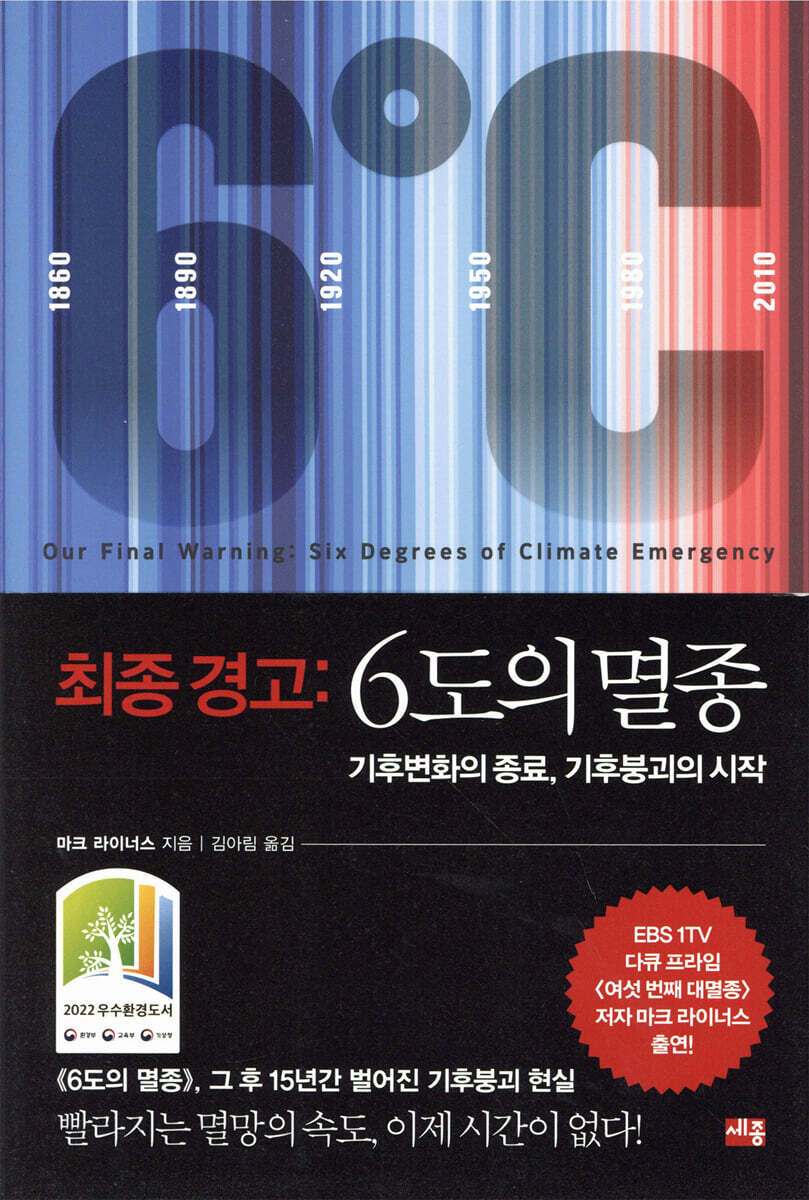
Final Warning: Extinction of the Sixth Degree
 |
Description
Book Introduction
"Six Degrees of Extinction": A Clear Depiction of Climate Disaster Mark Linus' final warning to humanity! “The prediction made 15 years ago has become reality. “The timeline for climate collapse has been brought forward by 30 years!” Mark Lynas, author of the landmark science book “Six Degrees of Extinction,” which sounded the alarm on climate change, confesses in his new book “Final Warning: Six Degrees of Extinction.” "The major hurricane (Houston, USA, damages estimated at 110 trillion won) predicted for 2045 has become a reality. The rate of global warming has exceeded scientific predictions, and the actual atmospheric conditions have been even more explosive. “The majority of our behavior has not changed, and some are even questioning the seriousness of climate change.” This is one of the reasons why he is writing the ‘6℃ Scenario’ again after 15 years. What makes "6 Degrees of Extinction" special among countless environmental books is that it depicts, like a movie, what will happen around the world every time the average temperature of the Earth rises by 1℃. Mark Lynas, a world-renowned environmental researcher, felt frustrated by the neglect of the research of outstanding scientists, so he wrote a book that immediately became a global bestseller. At the time, we were concerned about a 1℃ rise, but now it has become a reality. He is also known for accurately predicting the California wildfires and the Houston hurricane. The clock on climate change has ticked faster and the situation has become more dire. Rather than thinking about polar bears, humanity must keep the temperature rise below 1.5℃ for its own survival. In fact, there is no time to spare, as the events predicted for a 3°C rise (massive fires and hurricanes) are already happening. This new book also vividly depicts the events that will occur as the Earth's temperature rises. The author's urgent warning is that if things don't change, the time it takes to reach a 2°C or 3°C rise will be much shorter. Maintaining optimism doesn't make the world a more optimistic place. The preface to the Korean edition offers frank advice on Korea's energy policy. |
- You can preview some of the book's contents.
Preview
index
Preface for Korean Readers
Before entering
1℃ rise
News of the Century | View from Mauna Loa | Back to the Future | Greenland Lakes | The North Pole on Thin Ice | The Collapse of the Gulf Stream | Antarctic Icebergs | Melting Icebergs | Unpredictable Floods | Houston Hurricanes | Sea Level Rise | Paradise Lost | Heat Refugees | Going Against Nature | Trees Dying | The Heating Ocean | Coral Bleaching
2℃ rise
Day Zero in the Arctic | Tipping Point in Antarctica | Deadly Dengue Fever | Threats to Food Production | The Dangers of Heatstroke | Africa's Drying Continent | Disappearing Glaciers | Future Floods | Climate Collapse | The Fate of the Amazon | Natural Perils | The Empty Ocean
3℃ rise
Hottest in History | Collapsing Glaciers, Rising Sea Levels | Hotter Than Hellfire | Deserts Under Attack | Impact on Food Production | Darkened Mountains | Deadly Floods | Wildlife Refuges | Destruction of the Amazon | Permafrost Feedbacks | Ice-Free Arctic Ocean
4℃ rise
Deadly heat | Earth uninhabitable | Dust and fire | Melting snow | Floods | Hurricane warnings | Crop failures | Mass extinction | Climate change in the Atlantic | Antarctic apocalypse | Carbon bomb in the Arctic
5 degree rise
Heat Shock | Climate Refuge | Ice-Free Antarctica | Anomalous Hothouse | Arctic Rainforests | Anoxic Oceans | A 2℃ Tipping Point? | Life and Death in a 5℃ World
6℃ rise
Catastrophic Failure | Cretaceous Hypergreenhouse | Permian Extinction | Killing Mechanism | Explosions of the Past | Living Hell | Venus Effect
Endgame
A 0.5℃ difference | When the rise exceeds 2℃ | A 4℃ rise | Towards 6℃ warming | Choose life
Acknowledgements
Translator's Note
References
Before entering
1℃ rise
News of the Century | View from Mauna Loa | Back to the Future | Greenland Lakes | The North Pole on Thin Ice | The Collapse of the Gulf Stream | Antarctic Icebergs | Melting Icebergs | Unpredictable Floods | Houston Hurricanes | Sea Level Rise | Paradise Lost | Heat Refugees | Going Against Nature | Trees Dying | The Heating Ocean | Coral Bleaching
2℃ rise
Day Zero in the Arctic | Tipping Point in Antarctica | Deadly Dengue Fever | Threats to Food Production | The Dangers of Heatstroke | Africa's Drying Continent | Disappearing Glaciers | Future Floods | Climate Collapse | The Fate of the Amazon | Natural Perils | The Empty Ocean
3℃ rise
Hottest in History | Collapsing Glaciers, Rising Sea Levels | Hotter Than Hellfire | Deserts Under Attack | Impact on Food Production | Darkened Mountains | Deadly Floods | Wildlife Refuges | Destruction of the Amazon | Permafrost Feedbacks | Ice-Free Arctic Ocean
4℃ rise
Deadly heat | Earth uninhabitable | Dust and fire | Melting snow | Floods | Hurricane warnings | Crop failures | Mass extinction | Climate change in the Atlantic | Antarctic apocalypse | Carbon bomb in the Arctic
5 degree rise
Heat Shock | Climate Refuge | Ice-Free Antarctica | Anomalous Hothouse | Arctic Rainforests | Anoxic Oceans | A 2℃ Tipping Point? | Life and Death in a 5℃ World
6℃ rise
Catastrophic Failure | Cretaceous Hypergreenhouse | Permian Extinction | Killing Mechanism | Explosions of the Past | Living Hell | Venus Effect
Endgame
A 0.5℃ difference | When the rise exceeds 2℃ | A 4℃ rise | Towards 6℃ warming | Choose life
Acknowledgements
Translator's Note
References
Detailed image
.jpg)
Into the book
Over the past 20 years, scientists have conducted a lot of research and written papers.
But somehow, the activities of these scientists failed to fully permeate and become established within the political system.
Each chapter in this book richly and clearly illustrates what a continuous rise in temperature of 1°C would mean for human society and the natural world.
The situation has now become desperate and no one among the readers knows what will happen next.
--- From "Before Entering"
When I wrote "Six Degrees of Extinction" nearly 15 years ago, a "world with a 1℃ rise" was still a possibility for the future.
It's like moving forward a chapter of the book.
What was once a possibility of the future has become a reality.
And if we fail to reduce carbon emissions in time, the increasingly frightening impacts of a world warming 2°C, 3°C, 4°C, or more, which we will explore in detail later in this book, may one day become our present.
This news is truly the final warning.
--- 「Chapter 1.
From "1℃ Rise"
Researchers found that the torrential rains that struck Wuhan, China, in 2016 and 2017 would be 10 times more likely to occur today in a world where temperatures are 1°C higher.
The storm dropped over a metre of rain, caused severe flooding, 237 deaths and $22 billion in economic damage, making it the second-costliest climate disaster in history.
--- 「Chapter 1.
From "1℃ Rise"
Scientists now believe the threshold for an ice-free summer in the Arctic lies somewhere in the world where temperatures have risen by 2°C.
The entire Arctic doesn't have to melt to be classified as "ice-free."
While some ice may remain on the coasts of Ellesmere Island and northern Greenland for years, the rest of the vast Arctic Ocean may become open water.
A generally accepted definition of 'ice-free' is the first year in which sea ice extent falls below 1 million square kilometers in late summer, in September.
A 2017 paper in the journal Nature Climate Change concluded that “if we achieve the Paris Agreement target of 1.5°C of warming, we can certainly avoid an ice-free Arctic in the summer,” but if we reach 2°C, the probability of avoiding an ice-free Arctic drops to one-third.
--- 「Chapter 2.
From "2℃ Rise"
The decisions we make this century about how much coal, oil, and gas we burn now will affect generations to come.
Perhaps future generations will resent us for no longer having a stable coastline and for having to continually rebuild cities farther inland.
(There might be a New-New-New York.) Perhaps there will be Atlantis, the mythical capitals that were once London, Washington, D.C., and Bangkok, but are now submerged beneath the waves of the ocean.
Or even if people still live in today's large coastal cities, they may be trapped behind massive barricades to keep out the angry waves.
Meanwhile, residents will be cowering on their rooftops every time a storm hits, fearing another catastrophic flood.
--- Chapter 3.
From "3℃ Rise"
Like other warm-blooded animals, humans must release excess heat to maintain their body temperature at a stable 37°C.
Sweating lowers body temperature through evaporation and cooling.
When the humidity in the air is low enough, heat continues to escape as liquid sweat evaporates.
However, once both humidity and temperature pass critical levels, no amount of sweating will cool the body, and unless cooling occurs from the outside, death is inevitable.
It doesn't matter how good your physical condition is.
It doesn't matter whether there is shade or water nearby.
If you were to go outside of this artificially cooled environment and survive for more than a few hours under these conditions, you would die.
This much is certain.
In a world where temperatures have risen by 4°C, we are turning what was once a warm place into a death trap, hostile to virtually all life.
--- 「Chapter 4.
From "4℃ Rise"
Perhaps the remains of human cities will remain on the ocean floor as concrete and glass tombs populated by heat-tolerant marine species, including jellyfish and seaweed.
Some of humanity's larger, more valuable settlements, those outside the extreme heat of the tropics, may persist a little longer, trapped by prison-like sea walls that hold back the rising seas.
But coastal protection measures may only delay the inevitable consequences that will come anyway.
Someday, when the next megastorm or Category 6 hurricane hits, the seawall will breach and the seawater will rush in.
The apocalypse of climate destruction will repeat itself not once but many times.
The final moment when the countdown to the end stops and the three-story high wall of seawater reaches the shore varies from city to city.
--- 「Chapter 5.
From "5℃ Rise"
Looking at the last three IPCC reports, I found that although 6℃ is within the upper limit of the predictions made by probabilistic climate models, researchers are reluctant to talk about it.
This may be because climatologists are, after all, human.
Scientists, too, hope for the best and try to avoid worst-case scenarios when they have time to focus on more moderate outcomes.
Many experts also believe that raising the current global temperature by 6°C would require unchecked carbon emissions and positive feedback loops, which are highly unlikely to happen.
They don't want to risk their careers or lose out on research grant opportunities by being labeled as "unnecessary alarmists" or "doomsday talkers."
--- Chapter 6.
From "6℃ Rise"
I say again, it is not too late, and it will never be too late.
A rise of 1.5℃ is better than 2℃, 2℃ is better than 3℃, and 3℃ is better than 3.5℃.
We must never give up and give up hope for a better future.
Still, our choices over the coming decades will have a major impact on how much warming accelerates during this century.
However, if there is one thing I would like to insist on, it is that the burden of sacrifice should be shared fairly.
We cannot demand carbon reductions at the expense of perpetuating or worsening human poverty and inequality.
But somehow, the activities of these scientists failed to fully permeate and become established within the political system.
Each chapter in this book richly and clearly illustrates what a continuous rise in temperature of 1°C would mean for human society and the natural world.
The situation has now become desperate and no one among the readers knows what will happen next.
--- From "Before Entering"
When I wrote "Six Degrees of Extinction" nearly 15 years ago, a "world with a 1℃ rise" was still a possibility for the future.
It's like moving forward a chapter of the book.
What was once a possibility of the future has become a reality.
And if we fail to reduce carbon emissions in time, the increasingly frightening impacts of a world warming 2°C, 3°C, 4°C, or more, which we will explore in detail later in this book, may one day become our present.
This news is truly the final warning.
--- 「Chapter 1.
From "1℃ Rise"
Researchers found that the torrential rains that struck Wuhan, China, in 2016 and 2017 would be 10 times more likely to occur today in a world where temperatures are 1°C higher.
The storm dropped over a metre of rain, caused severe flooding, 237 deaths and $22 billion in economic damage, making it the second-costliest climate disaster in history.
--- 「Chapter 1.
From "1℃ Rise"
Scientists now believe the threshold for an ice-free summer in the Arctic lies somewhere in the world where temperatures have risen by 2°C.
The entire Arctic doesn't have to melt to be classified as "ice-free."
While some ice may remain on the coasts of Ellesmere Island and northern Greenland for years, the rest of the vast Arctic Ocean may become open water.
A generally accepted definition of 'ice-free' is the first year in which sea ice extent falls below 1 million square kilometers in late summer, in September.
A 2017 paper in the journal Nature Climate Change concluded that “if we achieve the Paris Agreement target of 1.5°C of warming, we can certainly avoid an ice-free Arctic in the summer,” but if we reach 2°C, the probability of avoiding an ice-free Arctic drops to one-third.
--- 「Chapter 2.
From "2℃ Rise"
The decisions we make this century about how much coal, oil, and gas we burn now will affect generations to come.
Perhaps future generations will resent us for no longer having a stable coastline and for having to continually rebuild cities farther inland.
(There might be a New-New-New York.) Perhaps there will be Atlantis, the mythical capitals that were once London, Washington, D.C., and Bangkok, but are now submerged beneath the waves of the ocean.
Or even if people still live in today's large coastal cities, they may be trapped behind massive barricades to keep out the angry waves.
Meanwhile, residents will be cowering on their rooftops every time a storm hits, fearing another catastrophic flood.
--- Chapter 3.
From "3℃ Rise"
Like other warm-blooded animals, humans must release excess heat to maintain their body temperature at a stable 37°C.
Sweating lowers body temperature through evaporation and cooling.
When the humidity in the air is low enough, heat continues to escape as liquid sweat evaporates.
However, once both humidity and temperature pass critical levels, no amount of sweating will cool the body, and unless cooling occurs from the outside, death is inevitable.
It doesn't matter how good your physical condition is.
It doesn't matter whether there is shade or water nearby.
If you were to go outside of this artificially cooled environment and survive for more than a few hours under these conditions, you would die.
This much is certain.
In a world where temperatures have risen by 4°C, we are turning what was once a warm place into a death trap, hostile to virtually all life.
--- 「Chapter 4.
From "4℃ Rise"
Perhaps the remains of human cities will remain on the ocean floor as concrete and glass tombs populated by heat-tolerant marine species, including jellyfish and seaweed.
Some of humanity's larger, more valuable settlements, those outside the extreme heat of the tropics, may persist a little longer, trapped by prison-like sea walls that hold back the rising seas.
But coastal protection measures may only delay the inevitable consequences that will come anyway.
Someday, when the next megastorm or Category 6 hurricane hits, the seawall will breach and the seawater will rush in.
The apocalypse of climate destruction will repeat itself not once but many times.
The final moment when the countdown to the end stops and the three-story high wall of seawater reaches the shore varies from city to city.
--- 「Chapter 5.
From "5℃ Rise"
Looking at the last three IPCC reports, I found that although 6℃ is within the upper limit of the predictions made by probabilistic climate models, researchers are reluctant to talk about it.
This may be because climatologists are, after all, human.
Scientists, too, hope for the best and try to avoid worst-case scenarios when they have time to focus on more moderate outcomes.
Many experts also believe that raising the current global temperature by 6°C would require unchecked carbon emissions and positive feedback loops, which are highly unlikely to happen.
They don't want to risk their careers or lose out on research grant opportunities by being labeled as "unnecessary alarmists" or "doomsday talkers."
--- Chapter 6.
From "6℃ Rise"
I say again, it is not too late, and it will never be too late.
A rise of 1.5℃ is better than 2℃, 2℃ is better than 3℃, and 3℃ is better than 3.5℃.
We must never give up and give up hope for a better future.
Still, our choices over the coming decades will have a major impact on how much warming accelerates during this century.
However, if there is one thing I would like to insist on, it is that the burden of sacrifice should be shared fairly.
We cannot demand carbon reductions at the expense of perpetuating or worsening human poverty and inequality.
--- Chapter 7.
From "Endgame"
From "Endgame"
Publisher's Review
The 'Countdown to Extinction' has already begun!
The author's prediction came true, but the event occurred 30 years earlier.
“Unfortunately, I am considerably more pessimistic about the future than when Six Degrees of Extinction was first published.
“The goal of this book is to present scientific facts clearly so that no one can make excuses to deny the phenomenon of climate change.” (From “Before We Begin”)
What if the events predicted 15 years ago under the significantly higher 3°C scenario had actually happened? In Chapter 3 of "6 Degrees of Extinction," Mark Lynas focuses on the potential for hurricanes in Houston and wildfires in California.
In a world where temperatures have risen by 3 degrees Celsius, warmer oceans will allow tropical cyclones to gather more energy, leading to more powerful hurricanes that could devastate vulnerable coastal cities in tropical regions, he warned, pointing to Houston in the US.
He also mentioned California, explaining that if the world continues to warm, there is a high probability that much of the western United States will experience a similar disaster as the Great Drought of the Middle Ages.
The number of wildfires that "get out of control" in California is expected to increase, and the fire season could become two to three weeks longer each year.
Unfortunately, his prediction, which came true, became a hot topic in Korea as well.
Now, those events have moved from "Final Warning: 6 Degrees of Extinction" to a chapter reflecting the "1℃ rise" of today's world.
It took 150 years for the temperature to rise by 1℃,
It is expected to take 15 years to reach 2°C and 20 years to reach 3°C.
We are living in a world where the temperature has risen by 1℃, which was still a possibility in the future when I wrote “Six Degrees of Extinction.”
It was in 2015 that news was first announced that the global average surface temperature had risen 1℃ above pre-industrial levels for the first time.
The target for limiting global warming is 1.5℃, as was decided at the 26th Conference of the Parties to the United Nations Framework Convention on Climate Change (COP26) following the Paris Agreement on Climate Change.
It took 150 years for the Earth to rise 1°C, but the time it is expected to take for another 1°C rise is only 15 years.
If we don't change things now, the world will experience a rapid temperature rise of 2℃ by 2030 and 3℃ by 2050. This is not a novel or a movie, but a reflection of 99.9% of scientists' research.
1℃ Rise: The World Today
Many of the situations the author predicted in "Extinction of the Six Degrees" have become reality.
The melting of Greenland ice sheets in the 2℃ warming chapter, the wildfires in California and the massive hurricane in Houston in the 3℃ warming chapter have become a reality and have now been moved to the 1℃ warming chapter.
Glaciers in Peru are at risk of disappearing completely, and in 2015, the tip of the Antarctic Peninsula experienced a temperature of 17.5°C, which was classified as an "extreme Antarctic heatwave."
The summer of 2019 saw the Arctic on fire, and coastal communities now face a new threat: "sunny day flooding," where roads and parks become inundated with seawater even on clear days with little sea breeze.
The torrential rains that struck Wuhan, China, in 2016 and 2017 are ten times more likely to occur today in a world where temperatures have risen by 1°C.
These are frightening phenomena, but they are just the beginning compared to what is to come.
2℃ Rise: By 2030, 500,000 people will die from malnutrition due to climate change.
Scientists are confident that the threshold for "Arctic Day Zero," the day when the Arctic ice disappears, is somewhere in the world where temperatures have risen by 2 degrees Celsius.
Arctic warming could directly damage the ecosystem, affecting wildlife and humans alike.
Permafrost is melting as the area where ice melts gradually moves north due to a warming climate.
The biggest threat posed by thawing permafrost is that it will further accelerate global climate breakdown.
In addition, in a world where temperatures have risen by 2℃, developing countries are turning on countless air conditioners to survive the heatwave, which ultimately leads to increased carbon dioxide emissions and more heat generation.
This will also result in accelerating global warming.
If this happens, it is unlikely that we will remain in a world where temperatures have risen by 2℃ permanently.
It will probably provide a shortcut to a 3℃ world.
3℃ Rise: By 2050, we will be exposed to temperatures and humidity levels that will reach "death threshold."
The inevitable consequence of Greenland's glacial melt is that sea levels will rise by several meters over several centuries.
Perhaps future generations will resent us for no longer having a stable coastline and for having to continually rebuild cities farther inland.
There may be a legend of Atlantis, a mythical capital city that was once London, Washington, D.C., and Bangkok, but is now submerged in the sea.
At the same time, on one side of the globe, a heat wave is occurring that is considered extremely dangerous to most people.
One-third of the Earth's surface will be exposed to temperatures and humidity levels that will reach "death threshold" every year.
The impact of a 3℃ rise will affect not only people but also crops.
The outlook for global food production has become bleak, with production of two important global food crops, corn and soybeans, plummeting.
Considering our current lifestyle, whether we enter a 3℃ world is likely already beyond our control.
So, we need to look at what will happen in a world where global warming rises by 4℃.
4℃ Rise: Mass Extinction Strikes by 2075
Droughts and heatwaves are destroying crops in major grain-producing regions around the world, sending prices soaring and forcing tens of millions of hungry people onto the streets or across borders.
Globally, the number of days exposed to extreme heat increases 30-fold, and in Africa it increases more than 100-fold.
A significant portion of the planet Earth becomes biologically unsuitable for human habitation.
In a 4℃ world, the rate of temperature rise is so unprecedented that it could be seen as the reemergence of a climate not experienced for tens of millions of years, surpassing the evolutionary experience of many plants and animals.
It is certain that mass extinction will occur under these circumstances.
At least one-sixth of all species are at risk of extinction.
This near-catastrophic biological extinction would also impact marine ecosystems, with global ocean temperatures exceeding 100 percent of the thermal tolerance limits of species living in tropical marine ecosystems.
5℃ Rise: 2090, the End of Life on Earth Approaches
In a world where temperatures rise by 5℃, the end of life on Earth as we know it is near.
The polar caps are melting, and complex human societies have long since teetered on the brink of collapse.
North Africa, the Middle East and South Asia are experiencing record high temperatures.
In the humid and extreme heat, all other warm-blooded animals, including livestock and wild animals, would die if they could not find cool shelter.
Food production is reaching its limits, global food trade is coming to an end, and most countries are forced to pursue some form of self-sufficiency to feed their populations.
And most of those attempts will come to nothing.
The closest previous geological period to a 5°C rise in global climate was the Paleocene-Eocene maximum warming period, about 56 million years ago.
It's very similar to what the world would look like if we continued to rapidly increase fossil fuel consumption at the current rate.
It is an inhumane and violent world that is almost unrecognizable, so different from the Earth that humanity has known so far.
But the worst mass extinction in history, which wiped out 90 percent of life on Earth, occurred alongside a sudden temperature rise of 6°C.
6℃ Rise: Approaching the Final Tipping Point by the End of This Century
All the world's forests, from the Arctic to the equator, are burning simultaneously.
The flames burn brightly, making the night as bright as day.
The remains of dying plants are washed into the sea by torrential rains, like the flood described in the Bible.
Ecosystems and food chains no longer exist in a practical sense.
A daily battle for survival ensues, and the only winners are the animals, bacteria, and fungi that feed on corpses.
The ocean surface is so hot that nothing can survive.
Humanity's concerted effort to mine and burn fossil fuels to power the world's industrialized economies is accelerating at least ten times faster than the catastrophic carbon emissions that led to the worst mass extinction in Earth's history.
This means that we are actually conducting a true first experiment in the rate and volume of greenhouse gas emissions in Earth's geological history.
This level of warming threatens the very survival of the human species.
We can still save the planet ourselves
The author wrote "Final Warning: Six Degrees of Extinction" not to make ominous predictions about an inevitable apocalypse.
To explain and warn about the choices we face.
If we continue to live complacently as we do now, humanity will eventually face extinction.
However, with this book, the author wants to suggest 'hope that still remains'.
The author concludes the book with a fervent request for participation in the following pledge:
“Please join us in making the following pledge:
Even as I see the waters rising and the desert growing, I will continue to fight.
I will never give up, and I will not become a passive, defeatist.
Even if the beauty of the vibrant world today is eroded or loses its luster.
I reject self-centered thinking, including survivalism, and will always share what I have with those in need if they need it.
I will never give in to despair and will continue to fight to save what remains.
If necessary, I will continue to fight for years, decades, with endless determination and boundless affection, until this fever stops and our children's future is in sight.” (Chapter 7, 'Endgame')
The author's prediction came true, but the event occurred 30 years earlier.
“Unfortunately, I am considerably more pessimistic about the future than when Six Degrees of Extinction was first published.
“The goal of this book is to present scientific facts clearly so that no one can make excuses to deny the phenomenon of climate change.” (From “Before We Begin”)
What if the events predicted 15 years ago under the significantly higher 3°C scenario had actually happened? In Chapter 3 of "6 Degrees of Extinction," Mark Lynas focuses on the potential for hurricanes in Houston and wildfires in California.
In a world where temperatures have risen by 3 degrees Celsius, warmer oceans will allow tropical cyclones to gather more energy, leading to more powerful hurricanes that could devastate vulnerable coastal cities in tropical regions, he warned, pointing to Houston in the US.
He also mentioned California, explaining that if the world continues to warm, there is a high probability that much of the western United States will experience a similar disaster as the Great Drought of the Middle Ages.
The number of wildfires that "get out of control" in California is expected to increase, and the fire season could become two to three weeks longer each year.
Unfortunately, his prediction, which came true, became a hot topic in Korea as well.
Now, those events have moved from "Final Warning: 6 Degrees of Extinction" to a chapter reflecting the "1℃ rise" of today's world.
It took 150 years for the temperature to rise by 1℃,
It is expected to take 15 years to reach 2°C and 20 years to reach 3°C.
We are living in a world where the temperature has risen by 1℃, which was still a possibility in the future when I wrote “Six Degrees of Extinction.”
It was in 2015 that news was first announced that the global average surface temperature had risen 1℃ above pre-industrial levels for the first time.
The target for limiting global warming is 1.5℃, as was decided at the 26th Conference of the Parties to the United Nations Framework Convention on Climate Change (COP26) following the Paris Agreement on Climate Change.
It took 150 years for the Earth to rise 1°C, but the time it is expected to take for another 1°C rise is only 15 years.
If we don't change things now, the world will experience a rapid temperature rise of 2℃ by 2030 and 3℃ by 2050. This is not a novel or a movie, but a reflection of 99.9% of scientists' research.
1℃ Rise: The World Today
Many of the situations the author predicted in "Extinction of the Six Degrees" have become reality.
The melting of Greenland ice sheets in the 2℃ warming chapter, the wildfires in California and the massive hurricane in Houston in the 3℃ warming chapter have become a reality and have now been moved to the 1℃ warming chapter.
Glaciers in Peru are at risk of disappearing completely, and in 2015, the tip of the Antarctic Peninsula experienced a temperature of 17.5°C, which was classified as an "extreme Antarctic heatwave."
The summer of 2019 saw the Arctic on fire, and coastal communities now face a new threat: "sunny day flooding," where roads and parks become inundated with seawater even on clear days with little sea breeze.
The torrential rains that struck Wuhan, China, in 2016 and 2017 are ten times more likely to occur today in a world where temperatures have risen by 1°C.
These are frightening phenomena, but they are just the beginning compared to what is to come.
2℃ Rise: By 2030, 500,000 people will die from malnutrition due to climate change.
Scientists are confident that the threshold for "Arctic Day Zero," the day when the Arctic ice disappears, is somewhere in the world where temperatures have risen by 2 degrees Celsius.
Arctic warming could directly damage the ecosystem, affecting wildlife and humans alike.
Permafrost is melting as the area where ice melts gradually moves north due to a warming climate.
The biggest threat posed by thawing permafrost is that it will further accelerate global climate breakdown.
In addition, in a world where temperatures have risen by 2℃, developing countries are turning on countless air conditioners to survive the heatwave, which ultimately leads to increased carbon dioxide emissions and more heat generation.
This will also result in accelerating global warming.
If this happens, it is unlikely that we will remain in a world where temperatures have risen by 2℃ permanently.
It will probably provide a shortcut to a 3℃ world.
3℃ Rise: By 2050, we will be exposed to temperatures and humidity levels that will reach "death threshold."
The inevitable consequence of Greenland's glacial melt is that sea levels will rise by several meters over several centuries.
Perhaps future generations will resent us for no longer having a stable coastline and for having to continually rebuild cities farther inland.
There may be a legend of Atlantis, a mythical capital city that was once London, Washington, D.C., and Bangkok, but is now submerged in the sea.
At the same time, on one side of the globe, a heat wave is occurring that is considered extremely dangerous to most people.
One-third of the Earth's surface will be exposed to temperatures and humidity levels that will reach "death threshold" every year.
The impact of a 3℃ rise will affect not only people but also crops.
The outlook for global food production has become bleak, with production of two important global food crops, corn and soybeans, plummeting.
Considering our current lifestyle, whether we enter a 3℃ world is likely already beyond our control.
So, we need to look at what will happen in a world where global warming rises by 4℃.
4℃ Rise: Mass Extinction Strikes by 2075
Droughts and heatwaves are destroying crops in major grain-producing regions around the world, sending prices soaring and forcing tens of millions of hungry people onto the streets or across borders.
Globally, the number of days exposed to extreme heat increases 30-fold, and in Africa it increases more than 100-fold.
A significant portion of the planet Earth becomes biologically unsuitable for human habitation.
In a 4℃ world, the rate of temperature rise is so unprecedented that it could be seen as the reemergence of a climate not experienced for tens of millions of years, surpassing the evolutionary experience of many plants and animals.
It is certain that mass extinction will occur under these circumstances.
At least one-sixth of all species are at risk of extinction.
This near-catastrophic biological extinction would also impact marine ecosystems, with global ocean temperatures exceeding 100 percent of the thermal tolerance limits of species living in tropical marine ecosystems.
5℃ Rise: 2090, the End of Life on Earth Approaches
In a world where temperatures rise by 5℃, the end of life on Earth as we know it is near.
The polar caps are melting, and complex human societies have long since teetered on the brink of collapse.
North Africa, the Middle East and South Asia are experiencing record high temperatures.
In the humid and extreme heat, all other warm-blooded animals, including livestock and wild animals, would die if they could not find cool shelter.
Food production is reaching its limits, global food trade is coming to an end, and most countries are forced to pursue some form of self-sufficiency to feed their populations.
And most of those attempts will come to nothing.
The closest previous geological period to a 5°C rise in global climate was the Paleocene-Eocene maximum warming period, about 56 million years ago.
It's very similar to what the world would look like if we continued to rapidly increase fossil fuel consumption at the current rate.
It is an inhumane and violent world that is almost unrecognizable, so different from the Earth that humanity has known so far.
But the worst mass extinction in history, which wiped out 90 percent of life on Earth, occurred alongside a sudden temperature rise of 6°C.
6℃ Rise: Approaching the Final Tipping Point by the End of This Century
All the world's forests, from the Arctic to the equator, are burning simultaneously.
The flames burn brightly, making the night as bright as day.
The remains of dying plants are washed into the sea by torrential rains, like the flood described in the Bible.
Ecosystems and food chains no longer exist in a practical sense.
A daily battle for survival ensues, and the only winners are the animals, bacteria, and fungi that feed on corpses.
The ocean surface is so hot that nothing can survive.
Humanity's concerted effort to mine and burn fossil fuels to power the world's industrialized economies is accelerating at least ten times faster than the catastrophic carbon emissions that led to the worst mass extinction in Earth's history.
This means that we are actually conducting a true first experiment in the rate and volume of greenhouse gas emissions in Earth's geological history.
This level of warming threatens the very survival of the human species.
We can still save the planet ourselves
The author wrote "Final Warning: Six Degrees of Extinction" not to make ominous predictions about an inevitable apocalypse.
To explain and warn about the choices we face.
If we continue to live complacently as we do now, humanity will eventually face extinction.
However, with this book, the author wants to suggest 'hope that still remains'.
The author concludes the book with a fervent request for participation in the following pledge:
“Please join us in making the following pledge:
Even as I see the waters rising and the desert growing, I will continue to fight.
I will never give up, and I will not become a passive, defeatist.
Even if the beauty of the vibrant world today is eroded or loses its luster.
I reject self-centered thinking, including survivalism, and will always share what I have with those in need if they need it.
I will never give in to despair and will continue to fight to save what remains.
If necessary, I will continue to fight for years, decades, with endless determination and boundless affection, until this fever stops and our children's future is in sight.” (Chapter 7, 'Endgame')
GOODS SPECIFICS
- Date of issue: January 24, 2022
- Page count, weight, size: 464 pages | 684g | 152*225*30mm
- ISBN13: 9788984079717
- ISBN10: 8984079715
You may also like
카테고리
korean


korean

![GQ KOREA Mark (Monthly): December [2025]](http://librairie.coreenne.fr/cdn/shop/files/8ef265dbbfbf186523ed75ba7319009d.jpg?v=1765340328&width=3840)


