

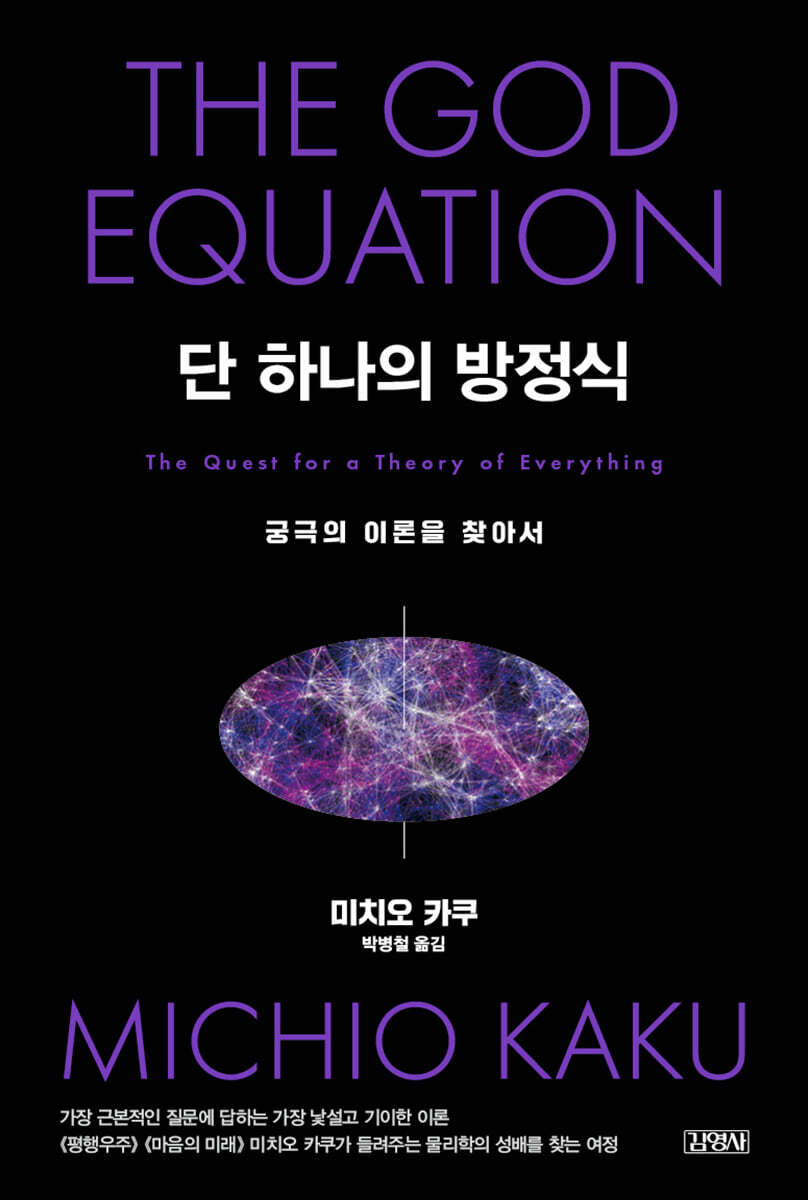
Just one equation
 |
Description
Book Introduction
“How do I and the universe exist?” The Theory of Everything: Answering the Most Fundamental Questions The Origin and Meaning of the Universe as Told by Cutting-Edge Theoretical Physics The culmination of the explorations of Michio Kaku, a theoretical physicist, founder of string theory, bestselling author, science entertainer, and futurist who has been pursuing this subject since he was eight years old. This book is written by a theoretical physicist who, as a bestselling science writer, has explored the deepest recesses of the mind (The Future of the Mind) and the farthest future of humanity (The Future of Humanity), returning to his field of expertise and a problem that has been on his mind since he was eight. In "A Single Equation," the author looks back on the development of physics from the atomic theory of ancient Greece, through Newton's classical mechanics, Einstein's theory of relativity, and quantum mechanics by Niels Bohr and Heisenberg, to the Standard Model. He clearly and eloquently explains what the four forces that exist in the universe are, how they are intertwined, and what scientific basis there is for the unification of these forces. Furthermore, we will briefly examine string theory and M-theory, which the author considers candidates for the 'theory of everything', and consider the philosophical significance of the 'theory of everything'. Let's embark on a quest to find the one equation, with the faithful translation and annotations of Dr. Park Byeong-cheol, a science translator who has translated all of Michio Kaku's major works. |
- You can preview some of the book's contents.
Preview
index
introduction.
The ultimate theory
Einstein's Dream / Critics
Chapter 1.
Old dream
Renaissance - The Return of Science / Newton's Theory of Forces / What is Symmetry? / Testing Newton's Laws / The Mysteries of Electricity and Magnetism / Maxwell's Equations / Has Science Reached its End?
Chapter 2.
Einstein's Journey to Unification
The Aesthetics of Symmetry / Gravity and Curved Space / Eclipses and Gravity / Two Polar Figures (1): Newton and Einstein / In Search of a Unified Theory
Chapter 3.
A leap forward in quantum theory
Quantum Revolution / Electron Waves / Periodic Table / Dirac's Electron Theory / What is the Reality of Waves? / The Clash of Two Giants / Schrödinger's Cat / The Energy Source of the Sun / Quantum Mechanics and War
Chapter 4.
The theory of 'almost everything'
Quantum Electrodynamics / Applying the Quantum Revolution / What is Life? / Nuclear Forces / Two Polar Contrasting Figures (2): Feynman and Gell-Mann / The Weak Force and Ghost Particles / Yang-Mills Theory / Higgs Boson - The God Particle / Theory of Almost Everything / The Large Hadron Collider
Chapter 5.
Dark space
The true nature of black holes / Wormholes / Time travel / How was the universe created? / Why is the night sky dark? / General relativity and the universe / The afterglow of the Big Bang / Inflation / The universe on the run / Wanted: Gravitons
Chapter 6.
String Theory's Advances: Promise and Challenges
String theory / 10 dimensions / Gravitons / Supersymmetry / M-theory / Holographic universe / Verification of the theory / Criticism poured on string theory / Can it be verified? / Searching for dark matter / Beyond the LHC / Using the Big Bang as an atom crusher / LISA / Proof of the inverse square law / Landscape problem / My personal view on string theory / Uncovering the piedramy
Chapter 7.
In search of meaning in the universe
Proving God / My Personal Perspective / Did the Universe Have a Beginning? / The Finite Universe / Conclusion
The ultimate theory
Einstein's Dream / Critics
Chapter 1.
Old dream
Renaissance - The Return of Science / Newton's Theory of Forces / What is Symmetry? / Testing Newton's Laws / The Mysteries of Electricity and Magnetism / Maxwell's Equations / Has Science Reached its End?
Chapter 2.
Einstein's Journey to Unification
The Aesthetics of Symmetry / Gravity and Curved Space / Eclipses and Gravity / Two Polar Figures (1): Newton and Einstein / In Search of a Unified Theory
Chapter 3.
A leap forward in quantum theory
Quantum Revolution / Electron Waves / Periodic Table / Dirac's Electron Theory / What is the Reality of Waves? / The Clash of Two Giants / Schrödinger's Cat / The Energy Source of the Sun / Quantum Mechanics and War
Chapter 4.
The theory of 'almost everything'
Quantum Electrodynamics / Applying the Quantum Revolution / What is Life? / Nuclear Forces / Two Polar Contrasting Figures (2): Feynman and Gell-Mann / The Weak Force and Ghost Particles / Yang-Mills Theory / Higgs Boson - The God Particle / Theory of Almost Everything / The Large Hadron Collider
Chapter 5.
Dark space
The true nature of black holes / Wormholes / Time travel / How was the universe created? / Why is the night sky dark? / General relativity and the universe / The afterglow of the Big Bang / Inflation / The universe on the run / Wanted: Gravitons
Chapter 6.
String Theory's Advances: Promise and Challenges
String theory / 10 dimensions / Gravitons / Supersymmetry / M-theory / Holographic universe / Verification of the theory / Criticism poured on string theory / Can it be verified? / Searching for dark matter / Beyond the LHC / Using the Big Bang as an atom crusher / LISA / Proof of the inverse square law / Landscape problem / My personal view on string theory / Uncovering the piedramy
Chapter 7.
In search of meaning in the universe
Proving God / My Personal Perspective / Did the Universe Have a Beginning? / The Finite Universe / Conclusion
Detailed image
Into the book
Imagine a giant sphere surrounding the Earth.
Gravity acts with the same strength at all points on a sphere.
This is precisely why the Earth is spherical.
When the Earth was first formed, gravity compressed it evenly, resulting in its spherical shape.
The same goes for other stars and planets.
Nowhere in the universe do you find a celestial body shaped like a cube or pyramid (most asteroids are irregular in shape, because their gravity is so weak that the pressure is not evenly distributed).
--- p.28
The reason astronauts on TV float around in their spaceships is not because they are 'so far from Earth that gravity has disappeared' (the altitude of the space station or space shuttle is at most 450 km.
At this rate, it's only about the distance from Seoul to Busan.
It is so close that the word 'universe' doesn't even fit - translator).
There is no place in the solar system where gravity is zero.
However, the reason the astronauts' bodies float is because the spaceship is 'falling to Earth' with them.
--- p.62
In the end, the force called gravity was an illusion, not a reality.
If you are sitting in a chair reading this book right now, you might be thinking, 'The reason my body isn't flying into space is because gravity is pulling me towards the chair.'
However, Einstein argues that you can remain seated in the chair because the mass of the Earth has warped the space above your head, which is pushing your body down into the chair.
--- p.65
As the value of Planck's constant is gradually reduced to approach 0, all equations of quantum theory become identical to Newton's equations (as h approaches 0, the behavior of particles that deviates from common sense becomes consistent with Newton's laws of motion that we are familiar with).
This is precisely why quantum effects are invisible on an everyday scale.
Because Planck's constant is so small, Newton's laws appear to be correct to our dull senses.
--- p.86
Schrödinger's cat paradox is reminiscent of a question posed by the 18th-century Irish philosopher and bishop George Berkeley.
If a large tree falls in a dense forest and no one sees or hears it, will it make a sound? Solipsists (egocentrics) would argue, "It doesn't make a sound."
However, quantum mechanics goes a step further and claims that 'if there are no people (observers) in the forest, the trees exist in a mixture of various states, such as charcoal, saplings, firewood, and plywood.'
--- p.100-101
Encouraged by the great success of applying quantum theory to subatomic particles, physicists began to reexamine general relativity, which had been a thorn in their side for decades.
By applying quantum mechanics to general relativity, we have come to dream of unifying the standard model and gravity.
If this research is successful, it will complete a theory that allows quantum corrections to both the standard model and general relativity, that is, a 'theory of everything'.
--- p.145
Although Einstein did not accept quantum mechanics until the day he died, quantum physicists have been working tirelessly to integrate quantum theory into general relativity, and as a result, relativity is currently experiencing a new renaissance.
As mentioned earlier, it is by no means easy to eliminate the infinities that appear in the quantum correction of gravity and fully understand gravity.
However, physicists have not only discovered many facts by applying quantum mechanics to stars (ignoring gravity corrections), but have also opened up a new scientific horizon called cosmology.
--- p.152
After much debate, Hawking finally admitted he might be wrong and came up with an ingenious solution.
If you throw a book into a black hole, the information may not disappear completely, but may be emitted in the form of Hawking radiation.
If we scrape together all the information contained in the faint Hawking radiation, we can recreate the original book.
Hawking's claims may be wrong, but it is clear that the radiation he discovered is at the heart of the problem.
--- p.163
In the early 1900s, Einstein discovered that the two pillars of physics (Newton's theory of gravity and Maxwell's electromagnetism) were in conflict, and after nearly a decade of searching for a solution, he completed his general theory of relativity.
With this, Newton's classical mechanics was driven out of the field of physics after nearly 250 years, and the great scientific revolution of the 20th century began in earnest.
A similar history is still repeating itself today.
On one hand, there is Einstein's theory of gravity (general relativity) that explains macroscopic phenomena such as black holes, the Big Bang, and the expansion of the universe, and on the other hand, there is quantum theory that describes the behavior of subatomic particles in the microscopic world.
The problem is that they are not at all friendly because they are based on different principles, different mathematics, and different philosophies.
--- p.194
No matter how much I think about it, it seems like all the constants of nature are intricately set up to allow life to exist.
How could that be? American physicist Freeman Dyson said, "It's as if the universe anticipated our arrival from the beginning."
If the nuclear force were just a little weaker than it is now, the sun would not have ignited and the solar system would have been in darkness. If the strong force were just a little stronger than it is now, the sun would have run out of fuel billions of years ago and become a dead star.
The reason we exist today is because the strength of the nuclear force miraculously coincided.
--- p.233-234
I personally believe that pessimism about string theory stems from misunderstanding.
Because evidence for a theory won't come from a super-large particle accelerator, but will be discovered naturally when someone perfects the mathematical framework of the theory.
The key point here is that experimental evidence for string theory may not necessarily be necessary.
--- p.238
Einstein compared himself to "a child who has just entered a great library."
It means that you are standing right in the middle of a universe full of mysteries, with answers written in a vast book.
The goal he pursued throughout his life was to read even just a few chapters of that book.
But Einstein quietly disappeared, leaving only questions.
If the universe is a vast library, who are the librarians who manage it, and who are the authors of the books? If all laws of physics are explained by the theory of all things, where do the equations come from?
--- p.247
The evaluation of literary works tends to become more complex as time passes and various opinions are presented.
For example, the evaluations of James Joyce's novels vary widely from critic to critic, and this situation will not change no matter how much time passes.
On the other hand, physical theories become simpler and more powerful over time, being reduced to a few equations.
This is the charm of physics.
--- p.252
Did God have no other options when he created the universe? Is there only one possible universe? Or was the current universe simply chosen from among many alternatives?
If I was right, there was no choice.
There is only one equation that correctly describes the universe.
Because other equations are not mathematically valid.
Therefore, there is only one final equation of the universe.
There may be infinite solutions to this universal equation, but there is only one equation itself.
Gravity acts with the same strength at all points on a sphere.
This is precisely why the Earth is spherical.
When the Earth was first formed, gravity compressed it evenly, resulting in its spherical shape.
The same goes for other stars and planets.
Nowhere in the universe do you find a celestial body shaped like a cube or pyramid (most asteroids are irregular in shape, because their gravity is so weak that the pressure is not evenly distributed).
--- p.28
The reason astronauts on TV float around in their spaceships is not because they are 'so far from Earth that gravity has disappeared' (the altitude of the space station or space shuttle is at most 450 km.
At this rate, it's only about the distance from Seoul to Busan.
It is so close that the word 'universe' doesn't even fit - translator).
There is no place in the solar system where gravity is zero.
However, the reason the astronauts' bodies float is because the spaceship is 'falling to Earth' with them.
--- p.62
In the end, the force called gravity was an illusion, not a reality.
If you are sitting in a chair reading this book right now, you might be thinking, 'The reason my body isn't flying into space is because gravity is pulling me towards the chair.'
However, Einstein argues that you can remain seated in the chair because the mass of the Earth has warped the space above your head, which is pushing your body down into the chair.
--- p.65
As the value of Planck's constant is gradually reduced to approach 0, all equations of quantum theory become identical to Newton's equations (as h approaches 0, the behavior of particles that deviates from common sense becomes consistent with Newton's laws of motion that we are familiar with).
This is precisely why quantum effects are invisible on an everyday scale.
Because Planck's constant is so small, Newton's laws appear to be correct to our dull senses.
--- p.86
Schrödinger's cat paradox is reminiscent of a question posed by the 18th-century Irish philosopher and bishop George Berkeley.
If a large tree falls in a dense forest and no one sees or hears it, will it make a sound? Solipsists (egocentrics) would argue, "It doesn't make a sound."
However, quantum mechanics goes a step further and claims that 'if there are no people (observers) in the forest, the trees exist in a mixture of various states, such as charcoal, saplings, firewood, and plywood.'
--- p.100-101
Encouraged by the great success of applying quantum theory to subatomic particles, physicists began to reexamine general relativity, which had been a thorn in their side for decades.
By applying quantum mechanics to general relativity, we have come to dream of unifying the standard model and gravity.
If this research is successful, it will complete a theory that allows quantum corrections to both the standard model and general relativity, that is, a 'theory of everything'.
--- p.145
Although Einstein did not accept quantum mechanics until the day he died, quantum physicists have been working tirelessly to integrate quantum theory into general relativity, and as a result, relativity is currently experiencing a new renaissance.
As mentioned earlier, it is by no means easy to eliminate the infinities that appear in the quantum correction of gravity and fully understand gravity.
However, physicists have not only discovered many facts by applying quantum mechanics to stars (ignoring gravity corrections), but have also opened up a new scientific horizon called cosmology.
--- p.152
After much debate, Hawking finally admitted he might be wrong and came up with an ingenious solution.
If you throw a book into a black hole, the information may not disappear completely, but may be emitted in the form of Hawking radiation.
If we scrape together all the information contained in the faint Hawking radiation, we can recreate the original book.
Hawking's claims may be wrong, but it is clear that the radiation he discovered is at the heart of the problem.
--- p.163
In the early 1900s, Einstein discovered that the two pillars of physics (Newton's theory of gravity and Maxwell's electromagnetism) were in conflict, and after nearly a decade of searching for a solution, he completed his general theory of relativity.
With this, Newton's classical mechanics was driven out of the field of physics after nearly 250 years, and the great scientific revolution of the 20th century began in earnest.
A similar history is still repeating itself today.
On one hand, there is Einstein's theory of gravity (general relativity) that explains macroscopic phenomena such as black holes, the Big Bang, and the expansion of the universe, and on the other hand, there is quantum theory that describes the behavior of subatomic particles in the microscopic world.
The problem is that they are not at all friendly because they are based on different principles, different mathematics, and different philosophies.
--- p.194
No matter how much I think about it, it seems like all the constants of nature are intricately set up to allow life to exist.
How could that be? American physicist Freeman Dyson said, "It's as if the universe anticipated our arrival from the beginning."
If the nuclear force were just a little weaker than it is now, the sun would not have ignited and the solar system would have been in darkness. If the strong force were just a little stronger than it is now, the sun would have run out of fuel billions of years ago and become a dead star.
The reason we exist today is because the strength of the nuclear force miraculously coincided.
--- p.233-234
I personally believe that pessimism about string theory stems from misunderstanding.
Because evidence for a theory won't come from a super-large particle accelerator, but will be discovered naturally when someone perfects the mathematical framework of the theory.
The key point here is that experimental evidence for string theory may not necessarily be necessary.
--- p.238
Einstein compared himself to "a child who has just entered a great library."
It means that you are standing right in the middle of a universe full of mysteries, with answers written in a vast book.
The goal he pursued throughout his life was to read even just a few chapters of that book.
But Einstein quietly disappeared, leaving only questions.
If the universe is a vast library, who are the librarians who manage it, and who are the authors of the books? If all laws of physics are explained by the theory of all things, where do the equations come from?
--- p.247
The evaluation of literary works tends to become more complex as time passes and various opinions are presented.
For example, the evaluations of James Joyce's novels vary widely from critic to critic, and this situation will not change no matter how much time passes.
On the other hand, physical theories become simpler and more powerful over time, being reduced to a few equations.
This is the charm of physics.
--- p.252
Did God have no other options when he created the universe? Is there only one possible universe? Or was the current universe simply chosen from among many alternatives?
If I was right, there was no choice.
There is only one equation that correctly describes the universe.
Because other equations are not mathematically valid.
Therefore, there is only one final equation of the universe.
There may be infinite solutions to this universal equation, but there is only one equation itself.
--- p.255
Publisher's Review
“A book that captures the amazing and mysterious beauty of the universe, the Earth, and ourselves.
“Recommended for anyone lost in thought about existence.” -Booklist
“If anyone can make the complex mathematics and physics of string theory easy to understand, it’s Kaku.” - Wall Street Journal
“An authoritative and accessible account of the theory of everything and string theory.” -Nature
“It will be an eye-opener for those new to string theory.” -Publisher's Weekly
"An important book that provides a clear introduction to ongoing research, even for those with a weak scientific foundation." -Kirkus Reviews
"This book is written in an easy-to-understand manner that even those with little knowledge of string theory, the history of physics, or quantum physics can understand.
If you have any interest in this topic, don't hesitate to read this book." - Amazon Reader
"I've always wanted to understand the history of physics and the significance of current research, but I've always been frustrated. This book really touched me.
"A concise, entertaining, and inspiring book." - Amazon Reader
"I read it all in one day.
I couldn't put the book down.
I think I'll read it again and again." - Amazon Reader
"This is the best book I've read in years.
"I highly recommend reading this book before teaching your kids anything about science." - Amazon Reader
“Recommended for anyone lost in thought about existence.” _Booklist
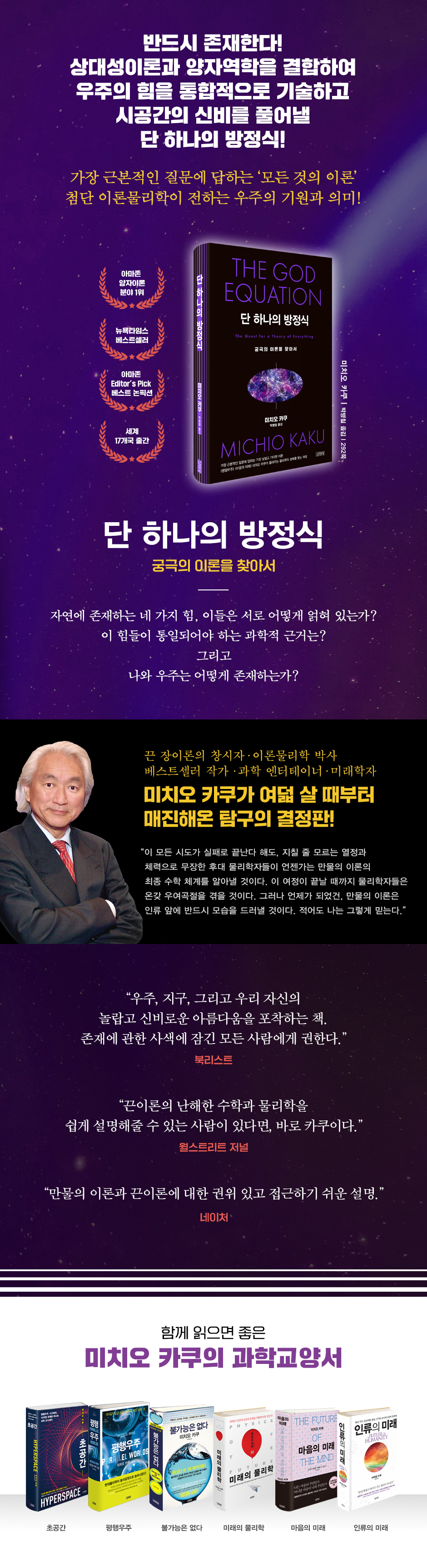
***#1 in Amazon Quantum Theory***
***New York Times Bestseller***
***Amazon Editor's Pick Best Nonfiction***
***Published in 17 countries worldwide***
How do I and the universe exist?
The Origin and Meaning of the Universe as Told by Cutting-Edge Theoretical Physics
By combining the theory of relativity and quantum mechanics and describing the forces of the universe in an integrated manner,
The one equation that will unlock the mysteries of space and time!
"Parallel Universes" and "The Future of the Mind": Michio Kaku's Journey to Find the Holy Grail of Physics
“If the ultimate theory is successfully constructed, it will undoubtedly be remembered as the greatest achievement in the history of science.
Imagine that everything from the Big Bang to the end of the universe is derived from a single equation.
"How profound and powerful is this theory? The ultimate theory is the Holy Grail of physics, the dream of all physicists, the final culmination of two thousand years of scientific inquiry seeking an answer to the question, 'What is this world made of?'" (pp. 8-9)
"The One Equation" is a book in which Michio Kaku, a world-renowned theoretical physicist and founder of string theory, returns to his field of expertise after exploring various topics such as the brain and space exploration as a bestselling author, and deals with the history of physics from the perspective of "the discovery of a unified theory."
There are four fundamental forces in nature.
1) Electromagnetic force - Electromagnetic force, which can be explained by Maxwell's equations, appears in various forms such as electricity, magnetism, and light.
2) Strong nuclear force (strong force) - The strong force, a strong attraction between protons and neutrons, provides energy to burning stars.
The sun was able to shine thanks to the force, so ultimately, humans came to exist thanks to the force.
3) Weak nuclear force (weak force) - The weak force is the force involved in all types of radioactive decay.
The reason the interior of the Earth is hot is because radioactive decay is occurring there.
Therefore, it can be said that the source of the enormous energy that causes volcanic eruptions and earthquakes is the weak force.
4) Gravity - Gravity, explained by Einstein's theory of general relativity, is the force that keeps planets, including the Earth, from leaving their orbits and maintains the shape of galaxies.
As the nature of these forces is revealed one by one, nature is gradually unveiled, and as civilized society undergoes a great scientific revolution, human life and civilization have undergone great changes.
The greatest challenge in theoretical physics is to find a 'theory of everything' that unifies these four forces, and this was the problem that Einstein immersed himself in during his later years.
Scientists have been trying to unify the weak force and electromagnetic force to create the 'electroweak theory', and then unify the weak theory and the strong force to create the 'standard model', but gravity has never been able to be unified.
After reviewing a brief history of theoretical physics focusing on the 'unified theory', Michio Kaku presents 'string theory' as a theory that can unify quantum mechanics (standard model) and relativity theory (gravity).
While the author acknowledges that string theory has "had its heyday and is now at a dead end," he argues that pessimism about string theory stems from a misunderstanding, arguing that "evidence for the theory will not come from super-large particle accelerators, but rather will be discovered naturally when someone perfects the mathematical framework of the theory" (p. 238).
He further explains the philosophical meaning of the 'Theory of Everything' and his own views, and concludes the book with a famous quote from Stephen Hawking on the subject.
“When a perfect theory is discovered, at first only a few scientists will understand it, but over time, everyone will understand it.
Then, not only philosophers and scientists, but also the general public can participate in the profound debate about 'Why does the universe and we exist?'
And if we find the answer to this question, it will go down in history as the greatest victory in human history.
“Because humans, who had lived in ignorance for a long time, have finally discovered the mind of God.” (p. 263)
What are the four forces that exist in nature?
How are these intertwined?
What are the scientific grounds and philosophical implications of the unification of these forces?
“The influence of the theory of everything on us will be largely philosophical.
Because a theory of everything will provide the ultimate answers to questions that have plagued great thinkers for generations.
"Is time travel possible? What existed before creation? Where did the universe come from?" (p. 245)
Michio Kaku looks back on the development of physics from the atomic theory of ancient Greece, through Newton's classical mechanics, Einstein's theory of relativity, and quantum mechanics by Niels Bohr and Heisenberg, to the Standard Model. He explains in a clear and flowing style what the four forces that exist in the universe are, how they are intertwined, and what scientific basis there is for the unification of these forces.
Some scientific questions that only a 'theory of everything' can answer include:
- Is time travel possible?
- Are there wormholes in our universe?
- What's inside a black hole?
- Are there other universes besides ours?
- Do higher-dimensional spaces with four or more dimensions really exist?
What happened just before the Big Bang, and why did it happen?
Michio Kaku says that the answer to the 'black hole information paradox' raised by Stephen Hawking can only be found when the theory of quantum gravity, that is, the 'theory of everything', which succeeds in quantum correction of the graviton, is completed.
"If you throw a book into a black hole, will the information inside it disappear forever?" (p. 162) This question, which is not well known to the general public but is a hot topic of debate in academic circles, is problematic because according to quantum mechanics, information never disappears, but inside a black hole, it appears to disappear.
He goes beyond scientific questions to ask philosophical and metaphysical questions.
He points out that Einstein compared himself to "a child who has just entered a huge library," and asks, "If the universe is a huge library, who is the librarian who manages it, and who is the author of the books?", "If all physical laws are explained by the theory of everything, where do the equations come from?", and continues to ask questions such as, "If the multiverse explains the cause of the Big Bang, when and how was the multiverse itself created?", "If the multiverse is an inevitable consequence of the theory of everything, where did the theory of everything come from?", and "Does the universe have a purpose and meaning?"
It is also interesting to get a glimpse into the thoughts of Michio Kaku, who identifies himself as an agnostic, on ‘God.’
PhD in theoretical physics, founder of string field theory, bestselling author,
Science entertainer and futurist Michio Kaku
The culmination of a quest I've been pursuing since I was eight years old
“His goal was to explain all things in the universe with a single equation that ‘contains the mind of God,’ but he passed away without ever being able to read the mind of God.
I decided to follow Einstein's path without any idea of how enormous the research would be.
“Because I wanted to somehow help fulfill the dream left behind by the greatest scientist of our time.” (p. 10)
Born in 1947, Michio Kaku heard the news of Einstein's death at the age of eight and decided to study the unified field theory that Einstein had been obsessed with until the day he died. He has been working to achieve that dream ever since.
The definitive edition of that exploration, 《The One Equation》, is a book written by a theoretical physicist who, as a bestselling science writer, explored the deepest recesses of the mind (《The Future of the Mind》) and the farthest future of humanity (《The Future of Humanity》), returned to his field of expertise and a problem that had been on his mind since he was eight.
What is particularly noticeable is the casual length and short breathing.
Compared to his previous major works, which were 500 to 600 pages long, his depth as a scientist and writer can be felt in the fact that he has included in less than 300 pages the major theories of theoretical physics that have revealed the fundamental forces of nature, the relationship between those forces, and even the meaning of existence for humans and the universe.
Contrary to the title, there are almost no equations in the text.
This book will provide intellectual satisfaction and the joy of reading to those lost in thought about existence.
“Recommended for anyone lost in thought about existence.” -Booklist
“If anyone can make the complex mathematics and physics of string theory easy to understand, it’s Kaku.” - Wall Street Journal
“An authoritative and accessible account of the theory of everything and string theory.” -Nature
“It will be an eye-opener for those new to string theory.” -Publisher's Weekly
"An important book that provides a clear introduction to ongoing research, even for those with a weak scientific foundation." -Kirkus Reviews
"This book is written in an easy-to-understand manner that even those with little knowledge of string theory, the history of physics, or quantum physics can understand.
If you have any interest in this topic, don't hesitate to read this book." - Amazon Reader
"I've always wanted to understand the history of physics and the significance of current research, but I've always been frustrated. This book really touched me.
"A concise, entertaining, and inspiring book." - Amazon Reader
"I read it all in one day.
I couldn't put the book down.
I think I'll read it again and again." - Amazon Reader
"This is the best book I've read in years.
"I highly recommend reading this book before teaching your kids anything about science." - Amazon Reader
“Recommended for anyone lost in thought about existence.” _Booklist
***#1 in Amazon Quantum Theory***
***New York Times Bestseller***
***Amazon Editor's Pick Best Nonfiction***
***Published in 17 countries worldwide***
How do I and the universe exist?
The Origin and Meaning of the Universe as Told by Cutting-Edge Theoretical Physics
By combining the theory of relativity and quantum mechanics and describing the forces of the universe in an integrated manner,
The one equation that will unlock the mysteries of space and time!
"Parallel Universes" and "The Future of the Mind": Michio Kaku's Journey to Find the Holy Grail of Physics
“If the ultimate theory is successfully constructed, it will undoubtedly be remembered as the greatest achievement in the history of science.
Imagine that everything from the Big Bang to the end of the universe is derived from a single equation.
"How profound and powerful is this theory? The ultimate theory is the Holy Grail of physics, the dream of all physicists, the final culmination of two thousand years of scientific inquiry seeking an answer to the question, 'What is this world made of?'" (pp. 8-9)
"The One Equation" is a book in which Michio Kaku, a world-renowned theoretical physicist and founder of string theory, returns to his field of expertise after exploring various topics such as the brain and space exploration as a bestselling author, and deals with the history of physics from the perspective of "the discovery of a unified theory."
There are four fundamental forces in nature.
1) Electromagnetic force - Electromagnetic force, which can be explained by Maxwell's equations, appears in various forms such as electricity, magnetism, and light.
2) Strong nuclear force (strong force) - The strong force, a strong attraction between protons and neutrons, provides energy to burning stars.
The sun was able to shine thanks to the force, so ultimately, humans came to exist thanks to the force.
3) Weak nuclear force (weak force) - The weak force is the force involved in all types of radioactive decay.
The reason the interior of the Earth is hot is because radioactive decay is occurring there.
Therefore, it can be said that the source of the enormous energy that causes volcanic eruptions and earthquakes is the weak force.
4) Gravity - Gravity, explained by Einstein's theory of general relativity, is the force that keeps planets, including the Earth, from leaving their orbits and maintains the shape of galaxies.
As the nature of these forces is revealed one by one, nature is gradually unveiled, and as civilized society undergoes a great scientific revolution, human life and civilization have undergone great changes.
The greatest challenge in theoretical physics is to find a 'theory of everything' that unifies these four forces, and this was the problem that Einstein immersed himself in during his later years.
Scientists have been trying to unify the weak force and electromagnetic force to create the 'electroweak theory', and then unify the weak theory and the strong force to create the 'standard model', but gravity has never been able to be unified.
After reviewing a brief history of theoretical physics focusing on the 'unified theory', Michio Kaku presents 'string theory' as a theory that can unify quantum mechanics (standard model) and relativity theory (gravity).
While the author acknowledges that string theory has "had its heyday and is now at a dead end," he argues that pessimism about string theory stems from a misunderstanding, arguing that "evidence for the theory will not come from super-large particle accelerators, but rather will be discovered naturally when someone perfects the mathematical framework of the theory" (p. 238).
He further explains the philosophical meaning of the 'Theory of Everything' and his own views, and concludes the book with a famous quote from Stephen Hawking on the subject.
“When a perfect theory is discovered, at first only a few scientists will understand it, but over time, everyone will understand it.
Then, not only philosophers and scientists, but also the general public can participate in the profound debate about 'Why does the universe and we exist?'
And if we find the answer to this question, it will go down in history as the greatest victory in human history.
“Because humans, who had lived in ignorance for a long time, have finally discovered the mind of God.” (p. 263)
What are the four forces that exist in nature?
How are these intertwined?
What are the scientific grounds and philosophical implications of the unification of these forces?
“The influence of the theory of everything on us will be largely philosophical.
Because a theory of everything will provide the ultimate answers to questions that have plagued great thinkers for generations.
"Is time travel possible? What existed before creation? Where did the universe come from?" (p. 245)
Michio Kaku looks back on the development of physics from the atomic theory of ancient Greece, through Newton's classical mechanics, Einstein's theory of relativity, and quantum mechanics by Niels Bohr and Heisenberg, to the Standard Model. He explains in a clear and flowing style what the four forces that exist in the universe are, how they are intertwined, and what scientific basis there is for the unification of these forces.
Some scientific questions that only a 'theory of everything' can answer include:
- Is time travel possible?
- Are there wormholes in our universe?
- What's inside a black hole?
- Are there other universes besides ours?
- Do higher-dimensional spaces with four or more dimensions really exist?
What happened just before the Big Bang, and why did it happen?
Michio Kaku says that the answer to the 'black hole information paradox' raised by Stephen Hawking can only be found when the theory of quantum gravity, that is, the 'theory of everything', which succeeds in quantum correction of the graviton, is completed.
"If you throw a book into a black hole, will the information inside it disappear forever?" (p. 162) This question, which is not well known to the general public but is a hot topic of debate in academic circles, is problematic because according to quantum mechanics, information never disappears, but inside a black hole, it appears to disappear.
He goes beyond scientific questions to ask philosophical and metaphysical questions.
He points out that Einstein compared himself to "a child who has just entered a huge library," and asks, "If the universe is a huge library, who is the librarian who manages it, and who is the author of the books?", "If all physical laws are explained by the theory of everything, where do the equations come from?", and continues to ask questions such as, "If the multiverse explains the cause of the Big Bang, when and how was the multiverse itself created?", "If the multiverse is an inevitable consequence of the theory of everything, where did the theory of everything come from?", and "Does the universe have a purpose and meaning?"
It is also interesting to get a glimpse into the thoughts of Michio Kaku, who identifies himself as an agnostic, on ‘God.’
PhD in theoretical physics, founder of string field theory, bestselling author,
Science entertainer and futurist Michio Kaku
The culmination of a quest I've been pursuing since I was eight years old
“His goal was to explain all things in the universe with a single equation that ‘contains the mind of God,’ but he passed away without ever being able to read the mind of God.
I decided to follow Einstein's path without any idea of how enormous the research would be.
“Because I wanted to somehow help fulfill the dream left behind by the greatest scientist of our time.” (p. 10)
Born in 1947, Michio Kaku heard the news of Einstein's death at the age of eight and decided to study the unified field theory that Einstein had been obsessed with until the day he died. He has been working to achieve that dream ever since.
The definitive edition of that exploration, 《The One Equation》, is a book written by a theoretical physicist who, as a bestselling science writer, explored the deepest recesses of the mind (《The Future of the Mind》) and the farthest future of humanity (《The Future of Humanity》), returned to his field of expertise and a problem that had been on his mind since he was eight.
What is particularly noticeable is the casual length and short breathing.
Compared to his previous major works, which were 500 to 600 pages long, his depth as a scientist and writer can be felt in the fact that he has included in less than 300 pages the major theories of theoretical physics that have revealed the fundamental forces of nature, the relationship between those forces, and even the meaning of existence for humans and the universe.
Contrary to the title, there are almost no equations in the text.
This book will provide intellectual satisfaction and the joy of reading to those lost in thought about existence.
GOODS SPECIFICS
- Publication date: November 29, 2021
- Format: Hardcover book binding method guide
- Page count, weight, size: 292 pages | 432g | 124*190*20mm
- ISBN13: 9788934959359
- ISBN10: 8934959355
You may also like
카테고리
korean


korean

![GQ KOREA Mark (Monthly): December [2025]](http://librairie.coreenne.fr/cdn/shop/files/8ef265dbbfbf186523ed75ba7319009d.jpg?v=1765340328&width=3840)


