

What happens will happen.
 |
Description
Book Introduction
- A word from MD
-
The answer to all existence lies in 'quantum'.A general introduction to quantum mechanics written by Professor Kwon Park, a world-renowned theoretical physicist and professor at the Graduate School of Advanced Science.
Quantum mechanics explains how and why we exist.
The world of quantum mechanics, told through stories of science, philosophy, film, science fiction, and personal anecdotes, is fascinating enough for general readers.
October 26, 2021. Natural Science PD Kim Tae-hee
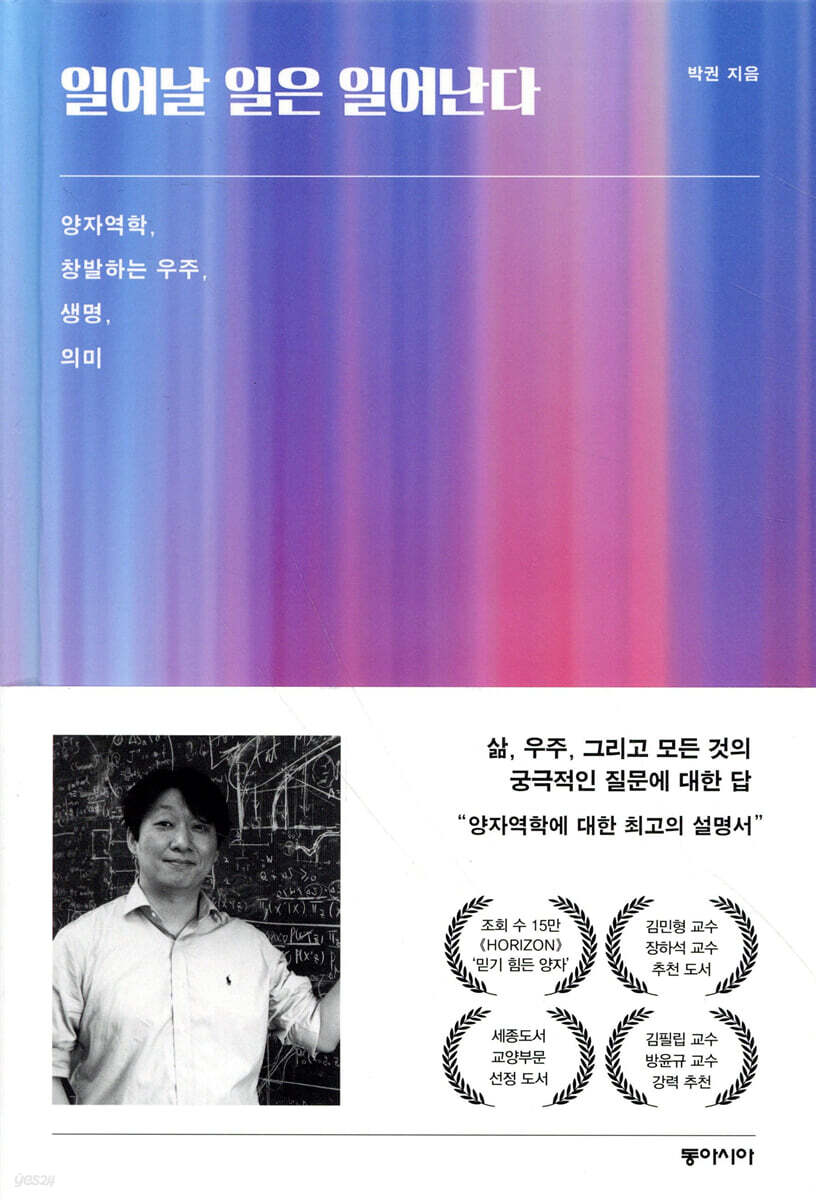
Life, the universe, and everything
The answer to the ultimate question
“The Ultimate Guide to Quantum Mechanics”
150,000 views on HORIZON: "The Unbelievable Quantum"
Books recommended by Professor Kim Min-hyung and Professor Jang Ha-seok
Professors Kim Philip and Bang Yoon-gyu strongly recommend
Sorov Prize, Academy of Advanced Sciences Academic Award
How everything is, and
One long argument as to why it exists
There is a famous question posed by Richard Feynman, the legendary physicist and 1965 Nobel Prize winner in Physics.
“If some great catastrophe occurred, destroying all scientific knowledge, and you could pass on only one sentence to the next generation, what would be the sentence that contained the most information in the fewest words?”
Feynman answered that it was knowledge of quantum mechanics, that everything is made of atoms that push and pull on each other.
Steven Weinberg, winner of the 1979 Nobel Prize in Physics, and Frank Wilczek, winner of the 2004 Nobel Prize in Physics, also predict that even if we discover the ultimate theory of science, quantum mechanics will remain a part of it, largely unaltered.
So why are the world's leading theoretical physicists so convinced that quantum mechanics is fundamental? According to the author, who won the 2000 Soroff Prize, it's because "our universe is quantum."
Why is everything made of atoms and not something else? What constitutes the forces that push and pull atoms? Is the fate of the universe predetermined? What is immutable? What is time, and how does it relate to disorder or information? Is artificial life possible? What is the relationship between predictability and free will? Can anything truly new emerge under the heavens? And above all, what is the meaning of our existence?
The author, a professor at the Graduate School of Advanced Science and a world-renowned physicist, demonstrates that the answers to all these questions lie in quantum mechanics, and that, at a fundamental level, everything converges to quantum mechanics.
This book is one long argument about how and why we exist.
“Answers to life’s important questions thread through every sentence of the book, like threads in a maze.”
Kim Min-hyung (Director of the International Institute for Mathematical Sciences, Edinburgh, author of "When Mathematics is Needed")
The answer to the ultimate question
“The Ultimate Guide to Quantum Mechanics”
150,000 views on HORIZON: "The Unbelievable Quantum"
Books recommended by Professor Kim Min-hyung and Professor Jang Ha-seok
Professors Kim Philip and Bang Yoon-gyu strongly recommend
Sorov Prize, Academy of Advanced Sciences Academic Award
How everything is, and
One long argument as to why it exists
There is a famous question posed by Richard Feynman, the legendary physicist and 1965 Nobel Prize winner in Physics.
“If some great catastrophe occurred, destroying all scientific knowledge, and you could pass on only one sentence to the next generation, what would be the sentence that contained the most information in the fewest words?”
Feynman answered that it was knowledge of quantum mechanics, that everything is made of atoms that push and pull on each other.
Steven Weinberg, winner of the 1979 Nobel Prize in Physics, and Frank Wilczek, winner of the 2004 Nobel Prize in Physics, also predict that even if we discover the ultimate theory of science, quantum mechanics will remain a part of it, largely unaltered.
So why are the world's leading theoretical physicists so convinced that quantum mechanics is fundamental? According to the author, who won the 2000 Soroff Prize, it's because "our universe is quantum."
Why is everything made of atoms and not something else? What constitutes the forces that push and pull atoms? Is the fate of the universe predetermined? What is immutable? What is time, and how does it relate to disorder or information? Is artificial life possible? What is the relationship between predictability and free will? Can anything truly new emerge under the heavens? And above all, what is the meaning of our existence?
The author, a professor at the Graduate School of Advanced Science and a world-renowned physicist, demonstrates that the answers to all these questions lie in quantum mechanics, and that, at a fundamental level, everything converges to quantum mechanics.
This book is one long argument about how and why we exist.
“Answers to life’s important questions thread through every sentence of the book, like threads in a maze.”
Kim Min-hyung (Director of the International Institute for Mathematical Sciences, Edinburgh, author of "When Mathematics is Needed")
- You can preview some of the book's contents.
Preview
index
Entering
Chapter 1: Waves: On Probability
Chapter 2: Atoms: On Universals
Chapter 3: Light: On Constancy
Chapter 4 Forces: On Interactions
Chapter 5: Matter: On Relationships
Chapter 6: Time: On Flow
Chapter 7: Existence: Concerning Appearance
The story continues
Acknowledgements
Search
Detailed image

Into the book
Why do we exist? This question is difficult to answer because the answer relies on value judgments.
And value judgments inevitably depend on an individual's philosophical and religious perspectives.
What answer would science, not philosophy or religion, offer to this question? To put it bluntly, science asks "how," not "why."
So, how do we exist? The interesting thing is that the more we ask "how," the closer we get to "why."
--- p.12-13
Everything is both a particle and a wave.
The electron waves stabilize the atoms by causing resonance.
However, the wave function that describes the electron's wave behavior should not be directly apparent.
What is actually measurable is not the wave function, but the probability.
But, strangely enough, this very fact provides the principle of power.
But the wave function does not completely hide its appearance.
For all matter in the universe to have mass, its wave function must be a complex number, not a simple probability.
In conclusion, quantum mechanics gives us the principles of all forces and mass that support our universe from the single fact of the existence of the wave function.
Isn't it incredibly strange yet surprisingly beautiful? --- p.20
There is a formula that the great physicist Feynman called “the most amazing mathematical formula.”
This is Euler's formula.
In other words, this formula mathematically rigorously supports the idea that any undulation is always related to the rotation of something.
In other words, this formula mathematically rigorously supports the fact that the wave function is the second hand of a clock.
Euler's formula is as follows:
The reason the above formula is called “the most amazing mathematical formula” is because it condenses some of the most important concepts in mathematics into one formula.
Exponential functions, imaginary functions, and trigonometric functions are just some of them.
--- p.42
In the world of classical mechanics, governed by Newton's laws of motion, all events are linked by precise causal relationships, like precision machinery.
Our choices are also part of this precise causal relationship.
So strictly speaking, all our choices are already decided.
We are merely beings making predetermined choices.
This is a mechanistic worldview.
But if our choices are predetermined, what does it mean to choose? Meanwhile, in the world of quantum mechanics, all events occur simultaneously.
However, all events interfere with each other, and the final outcome is given only by probability.
In a way, we are not choosing one, but making all choices simultaneously.
This is a probabilistic worldview.
But if our choices are merely probabilistic, what does it mean to choose? (…) Is there even such a thing as free will? --- p.53
Carbon can become a human, graphite, or diamond through spontaneous symmetry breaking.
Wait a minute! As far as we know, the universe operates deterministically.
For example, when an apple falls from a tree, it does not fall anywhere and at any time.
The apple falls at the exact time and place predicted by Newton's laws of motion and the law of universal gravitation.
In other words, the dynamics of the universe are completely determined by the laws of physics.
So, is it even possible to act spontaneously in a deterministic universe? Could this spontaneous symmetry-breaking hold some secret that makes us all, including the rose, the fox, and the little prince, unique? --- p.94-95
Is there anything in this world that remains constant? In the 2001 film "One Fine Spring Day," the protagonist, Sang-woo, follows his grandmother, who suffers from dementia, on his bicycle when she leaves home.
As always, my grandmother went to the train station to pick up my dead grandfather.
After sitting on a train station bench with his grandmother for a long time, waiting for his grandfather who never returns, Sang-woo tells his grandmother that it's time to go home.
Then, Sang-woo meets Eun-soo, who works as a PD at a broadcasting station in Gangneung.
Sangwoo, a sound engineer, goes around recording various sounds in Gangwon-do with Eunsu, and one day, after finishing recording late at night, he takes Eunsu home.
Eun-soo, who had feelings for Sang-woo as much as Sang-woo had feelings for her, asks Sang-woo as she enters the house.
“Do you want to eat ramen?” (…) Let’s ask again.
Is there anything in this world that remains constant? --- p.99-101
Do readers believe in fate? Simply put, fate is the idea that everything is predetermined.
Fate seems like a perspective that fits very well with the physical worldview.
According to physics, given the initial conditions, the dynamics of all particles are perfectly determined by the laws of physics.
So, in principle, the fate of the universe is also predetermined by the initial conditions.
This is the viewpoint of the mechanistic worldview or scientific determinism.
--- p.168
To know whether artificial life is possible, we must first understand what artificial life is.
And to know what artificial life is, we must know what life is.
So, let's start with a famous anecdote that illustrates the characteristics of life.
René Descartes, the famous French philosopher, mathematician, and physicist, once claimed during a meeting with Queen Christina of Sweden that the human body was no different from a machine.
In the words of the philosopher, the astute Queen Christina points out one important characteristic of life:
“Then show me that the clock over there can give birth to its own child.” --- p.261-262
Let's think about everything quantum mechanics has given us so far, as explained in this book.
*Quantum mechanics stabilizes atoms through resonance of wave functions.
*Quantum mechanics provides the principle of force through gauge symmetry.
*Quantum mechanics combines with chaos to give rise to the second law of thermodynamics.
*Quantum mechanics gives mass to every particle in the universe through spontaneous symmetry breaking.
Ultimately, quantum mechanics gives us almost everything we need to exist.
And value judgments inevitably depend on an individual's philosophical and religious perspectives.
What answer would science, not philosophy or religion, offer to this question? To put it bluntly, science asks "how," not "why."
So, how do we exist? The interesting thing is that the more we ask "how," the closer we get to "why."
--- p.12-13
Everything is both a particle and a wave.
The electron waves stabilize the atoms by causing resonance.
However, the wave function that describes the electron's wave behavior should not be directly apparent.
What is actually measurable is not the wave function, but the probability.
But, strangely enough, this very fact provides the principle of power.
But the wave function does not completely hide its appearance.
For all matter in the universe to have mass, its wave function must be a complex number, not a simple probability.
In conclusion, quantum mechanics gives us the principles of all forces and mass that support our universe from the single fact of the existence of the wave function.
Isn't it incredibly strange yet surprisingly beautiful? --- p.20
There is a formula that the great physicist Feynman called “the most amazing mathematical formula.”
This is Euler's formula.
In other words, this formula mathematically rigorously supports the idea that any undulation is always related to the rotation of something.
In other words, this formula mathematically rigorously supports the fact that the wave function is the second hand of a clock.
Euler's formula is as follows:
The reason the above formula is called “the most amazing mathematical formula” is because it condenses some of the most important concepts in mathematics into one formula.
Exponential functions, imaginary functions, and trigonometric functions are just some of them.
--- p.42
In the world of classical mechanics, governed by Newton's laws of motion, all events are linked by precise causal relationships, like precision machinery.
Our choices are also part of this precise causal relationship.
So strictly speaking, all our choices are already decided.
We are merely beings making predetermined choices.
This is a mechanistic worldview.
But if our choices are predetermined, what does it mean to choose? Meanwhile, in the world of quantum mechanics, all events occur simultaneously.
However, all events interfere with each other, and the final outcome is given only by probability.
In a way, we are not choosing one, but making all choices simultaneously.
This is a probabilistic worldview.
But if our choices are merely probabilistic, what does it mean to choose? (…) Is there even such a thing as free will? --- p.53
Carbon can become a human, graphite, or diamond through spontaneous symmetry breaking.
Wait a minute! As far as we know, the universe operates deterministically.
For example, when an apple falls from a tree, it does not fall anywhere and at any time.
The apple falls at the exact time and place predicted by Newton's laws of motion and the law of universal gravitation.
In other words, the dynamics of the universe are completely determined by the laws of physics.
So, is it even possible to act spontaneously in a deterministic universe? Could this spontaneous symmetry-breaking hold some secret that makes us all, including the rose, the fox, and the little prince, unique? --- p.94-95
Is there anything in this world that remains constant? In the 2001 film "One Fine Spring Day," the protagonist, Sang-woo, follows his grandmother, who suffers from dementia, on his bicycle when she leaves home.
As always, my grandmother went to the train station to pick up my dead grandfather.
After sitting on a train station bench with his grandmother for a long time, waiting for his grandfather who never returns, Sang-woo tells his grandmother that it's time to go home.
Then, Sang-woo meets Eun-soo, who works as a PD at a broadcasting station in Gangneung.
Sangwoo, a sound engineer, goes around recording various sounds in Gangwon-do with Eunsu, and one day, after finishing recording late at night, he takes Eunsu home.
Eun-soo, who had feelings for Sang-woo as much as Sang-woo had feelings for her, asks Sang-woo as she enters the house.
“Do you want to eat ramen?” (…) Let’s ask again.
Is there anything in this world that remains constant? --- p.99-101
Do readers believe in fate? Simply put, fate is the idea that everything is predetermined.
Fate seems like a perspective that fits very well with the physical worldview.
According to physics, given the initial conditions, the dynamics of all particles are perfectly determined by the laws of physics.
So, in principle, the fate of the universe is also predetermined by the initial conditions.
This is the viewpoint of the mechanistic worldview or scientific determinism.
--- p.168
To know whether artificial life is possible, we must first understand what artificial life is.
And to know what artificial life is, we must know what life is.
So, let's start with a famous anecdote that illustrates the characteristics of life.
René Descartes, the famous French philosopher, mathematician, and physicist, once claimed during a meeting with Queen Christina of Sweden that the human body was no different from a machine.
In the words of the philosopher, the astute Queen Christina points out one important characteristic of life:
“Then show me that the clock over there can give birth to its own child.” --- p.261-262
Let's think about everything quantum mechanics has given us so far, as explained in this book.
*Quantum mechanics stabilizes atoms through resonance of wave functions.
*Quantum mechanics provides the principle of force through gauge symmetry.
*Quantum mechanics combines with chaos to give rise to the second law of thermodynamics.
*Quantum mechanics gives mass to every particle in the universe through spontaneous symmetry breaking.
Ultimately, quantum mechanics gives us almost everything we need to exist.
--- p.316
Publisher's Review
The science of uncertainty, discontinuity, and incompleteness
“The Ultimate Guide to Quantum Mechanics”
* Quantum mechanics stabilizes atoms through resonance of wave functions.
* Quantum mechanics provides the principle of force through gauge symmetry.
* Quantum mechanics combined with chaos gives rise to the second law of thermodynamics.
* Quantum mechanics gives mass to every particle in the universe through spontaneous symmetry breaking.
As a theoretical physicist who studies physical phenomena that cannot be explained by the sum of their parts, the author begins with the smallest, most universal parts and moves on to physical phenomena that cannot be explained or predicted by the sum of their parts.
First, Chapter 1 discusses that everything in the universe is both a particle and a wave, and introduces the wave function that describes these waves.
Chapter 2 explains the Schrödinger equation, which describes the resonance of wave functions, and shows how the simplest hydrogen atom is created through the resonance of wave functions.
Chapter 3 introduces Maxwell's equations, the foundation of electromagnetic theory, and explains how the electromagnetic force, one of the fundamental forces, is determined by the pattern of the electromagnetic field.
Then, in Chapter 4, we explain the mechanisms of the remaining fundamental forces, namely gravity, the weak force, and the strong force, and show that all of these forces are based on a single principle called gauge symmetry.
Chapter 5, based on the theories and explanations learned in the previous chapters, derives the general laws by which all atoms, including hydrogen atoms, are formed, and further deals with the rules for the formation of molecules and lattice structures.
Chapter 6 shows how the directionality of time, which appears to flow from past to future, emerges from quantum mechanics, and Chapter 7 shows how the gauge symmetry that underpins quantum mechanics can spontaneously break to give rise to almost everything we need for our existence.
“This is the best guide to quantum mechanics.”
Bang Yun-gyu (Professor of Physics, Pohang University of Science and Technology, Director of the Asia-Pacific Center for Theoretical Physics)
From Laplace's Demon to Bergson's Time,
The Deep Philosophical Implications of the Quantum Universe
“This book is not simply a general science book.
“It is an ambitious work that poses deep philosophical questions.”
- Jang Ha-seok (Professor of History and Philosophy of Science, University of Cambridge, author of "The Philosophy of the Thermometer")
This book is one long argument about how and why we exist.
If quantum mechanics explains 'how' everything exists, the philosophical interpretation of quantum mechanics reveals 'why' we exist.
In other words, it reveals how meaning, as well as existence, can emerge from quantum matter.
So, based on quantum mechanics, the author explains how morality can arise spontaneously among agents through game theory, and answers the question of the possibility of artificial life and free will with Turing machines and the halting problem.
Furthermore, it discusses the meaning of existence through spontaneous symmetry breaking, and reveals what French philosopher Henri Bergson's 'creative evolution' means in the quantum universe.
“Set against the backdrop of many-body quantum field theory, this masterpiece connects diverse perspectives by blending film, personal anecdotes, information science, and philosophy.”
-Philip Kim (Professor of Physics, Harvard University)
What's really interesting is that what runs through this book doesn't seem like one 'theory' but rather several 'stories'.
As the author, who became known as a “physicist who criticizes movies” through the “Unbelievable Quantum” series in HORIZON, he generously brings in movies such as “One Fine Spring Day,” “Cinema Paradiso,” “Slumdog Millionaire,” “Cast Away,” and “Blade Runner,” and while talking about physics, at some point he takes the reader in front of the screen.
Professor Ha-seok Chang, Professor of History and Philosophy of Science at the University of Cambridge, was the first to receive and read this book and said the following:
“It uses science fiction and movie stories to make the most important ideas intuitive and conveys the meaning of scientific knowledge to human life from various perspectives.
“The author’s insight into the history and philosophy of science is incredible.”
“The Ultimate Guide to Quantum Mechanics”
* Quantum mechanics stabilizes atoms through resonance of wave functions.
* Quantum mechanics provides the principle of force through gauge symmetry.
* Quantum mechanics combined with chaos gives rise to the second law of thermodynamics.
* Quantum mechanics gives mass to every particle in the universe through spontaneous symmetry breaking.
As a theoretical physicist who studies physical phenomena that cannot be explained by the sum of their parts, the author begins with the smallest, most universal parts and moves on to physical phenomena that cannot be explained or predicted by the sum of their parts.
First, Chapter 1 discusses that everything in the universe is both a particle and a wave, and introduces the wave function that describes these waves.
Chapter 2 explains the Schrödinger equation, which describes the resonance of wave functions, and shows how the simplest hydrogen atom is created through the resonance of wave functions.
Chapter 3 introduces Maxwell's equations, the foundation of electromagnetic theory, and explains how the electromagnetic force, one of the fundamental forces, is determined by the pattern of the electromagnetic field.
Then, in Chapter 4, we explain the mechanisms of the remaining fundamental forces, namely gravity, the weak force, and the strong force, and show that all of these forces are based on a single principle called gauge symmetry.
Chapter 5, based on the theories and explanations learned in the previous chapters, derives the general laws by which all atoms, including hydrogen atoms, are formed, and further deals with the rules for the formation of molecules and lattice structures.
Chapter 6 shows how the directionality of time, which appears to flow from past to future, emerges from quantum mechanics, and Chapter 7 shows how the gauge symmetry that underpins quantum mechanics can spontaneously break to give rise to almost everything we need for our existence.
“This is the best guide to quantum mechanics.”
Bang Yun-gyu (Professor of Physics, Pohang University of Science and Technology, Director of the Asia-Pacific Center for Theoretical Physics)
From Laplace's Demon to Bergson's Time,
The Deep Philosophical Implications of the Quantum Universe
“This book is not simply a general science book.
“It is an ambitious work that poses deep philosophical questions.”
- Jang Ha-seok (Professor of History and Philosophy of Science, University of Cambridge, author of "The Philosophy of the Thermometer")
This book is one long argument about how and why we exist.
If quantum mechanics explains 'how' everything exists, the philosophical interpretation of quantum mechanics reveals 'why' we exist.
In other words, it reveals how meaning, as well as existence, can emerge from quantum matter.
So, based on quantum mechanics, the author explains how morality can arise spontaneously among agents through game theory, and answers the question of the possibility of artificial life and free will with Turing machines and the halting problem.
Furthermore, it discusses the meaning of existence through spontaneous symmetry breaking, and reveals what French philosopher Henri Bergson's 'creative evolution' means in the quantum universe.
“Set against the backdrop of many-body quantum field theory, this masterpiece connects diverse perspectives by blending film, personal anecdotes, information science, and philosophy.”
-Philip Kim (Professor of Physics, Harvard University)
What's really interesting is that what runs through this book doesn't seem like one 'theory' but rather several 'stories'.
As the author, who became known as a “physicist who criticizes movies” through the “Unbelievable Quantum” series in HORIZON, he generously brings in movies such as “One Fine Spring Day,” “Cinema Paradiso,” “Slumdog Millionaire,” “Cast Away,” and “Blade Runner,” and while talking about physics, at some point he takes the reader in front of the screen.
Professor Ha-seok Chang, Professor of History and Philosophy of Science at the University of Cambridge, was the first to receive and read this book and said the following:
“It uses science fiction and movie stories to make the most important ideas intuitive and conveys the meaning of scientific knowledge to human life from various perspectives.
“The author’s insight into the history and philosophy of science is incredible.”
GOODS SPECIFICS
- Publication date: October 15, 2021
- Format: Hardcover book binding method guide
- Page count, weight, size: 344 pages | 676g | 152*222*25mm
- ISBN13: 9788962623925
- ISBN10: 8962623927
You may also like
카테고리
korean


korean

![GQ KOREA Mark (Monthly): December [2025]](http://librairie.coreenne.fr/cdn/shop/files/8ef265dbbfbf186523ed75ba7319009d.jpg?v=1765340328&width=3840)


