

The universe does not continue
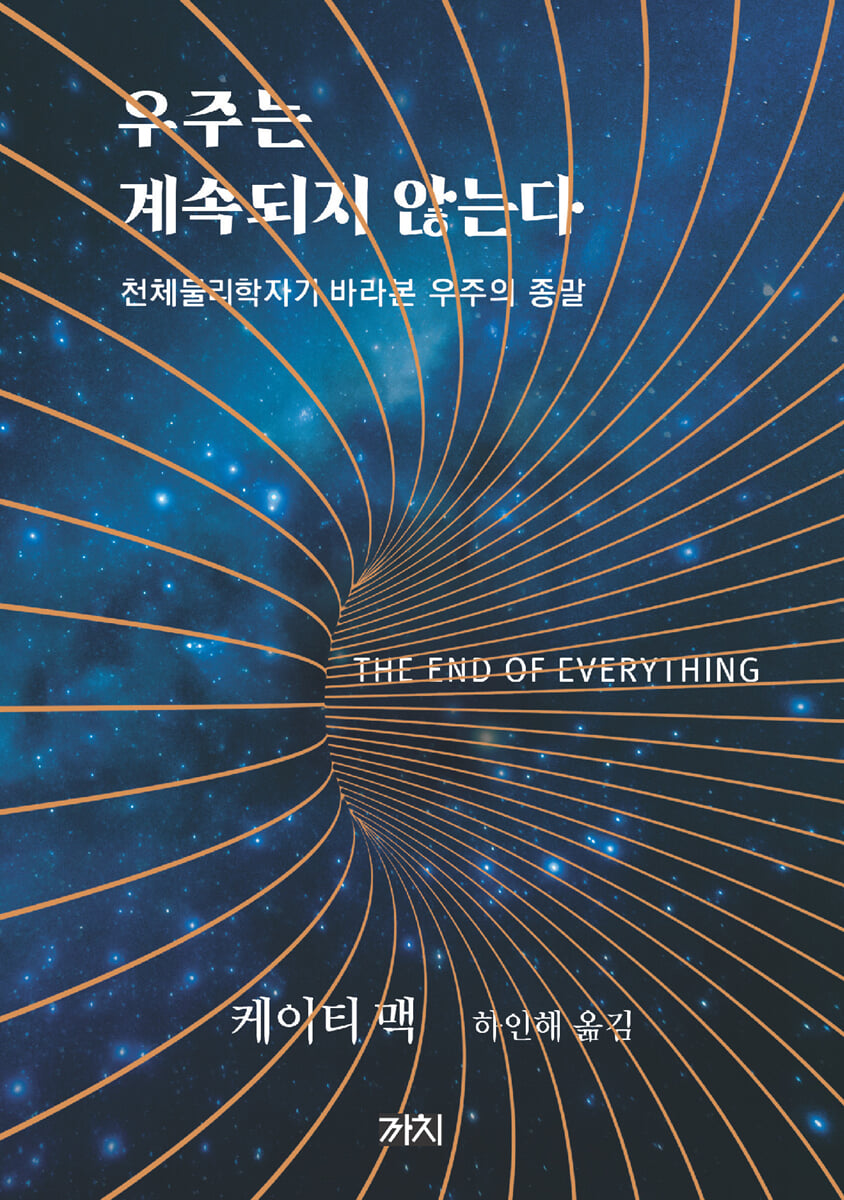 |
Description
Book Introduction
A Notable Book by the New York Times,
Book of the Year from The Washington Post, The Guardian, The Economist, and New Scientist
How will the universe end? Five intriguing scenarios.
How the world began and how it will end are questions that have long puzzled humanity.
From this, we know that the universe began as an extremely dense singularity 13.8 billion years ago.
So how will the universe end? And what does this question mean for us? This book seeks to answer those questions.
Author Katie Mack, a promising astrophysicist, explores the answer to this question from a cosmological perspective.
He presents five likely scenarios for how the universe might end.
In each scenario, the universe could collapse inward, be torn apart, or be trapped in an inescapable bubble of death.
As we examine how our knowledge of the universe and its ends has developed and delve into its meaning, we will learn important theoretical concepts and realize how they relate to our lives.
Book of the Year from The Washington Post, The Guardian, The Economist, and New Scientist
How will the universe end? Five intriguing scenarios.
How the world began and how it will end are questions that have long puzzled humanity.
From this, we know that the universe began as an extremely dense singularity 13.8 billion years ago.
So how will the universe end? And what does this question mean for us? This book seeks to answer those questions.
Author Katie Mack, a promising astrophysicist, explores the answer to this question from a cosmological perspective.
He presents five likely scenarios for how the universe might end.
In each scenario, the universe could collapse inward, be torn apart, or be trapped in an inescapable bubble of death.
As we examine how our knowledge of the universe and its ends has developed and delve into its meaning, we will learn important theoretical concepts and realize how they relate to our lives.
- You can preview some of the book's contents.
Preview
Detailed image

Publisher's Review
The universe and us seen through the end of the universe
We know that the universe was born from the Big Bang, and we are beginning to understand to some extent how the universe came to be in its present form.
But few people have ever thought that the universe might one day come to an end.
Katie Mack, an astrophysicist who actively engages with the public through social media and lectures, entered the field of astrophysics after hearing an astronomy professor say that the universe could end at any moment.
He was fascinated by Stephen Hawking's theories and studied them in depth. He also visited CERN's research facilities and met with numerous scholars studying the universe to exchange opinions, delving into what the end of our universe might look like.
In this book, he introduces the five most likely doomsday scenarios—the Big Crunch, Heat Death, the Big Rip, Vacuum Collapse, and Bounce—and explains in detail and wittily the cosmological concepts upon which each scenario is based.
Based on the latest scientific research, this book discusses the end of the universe and not only informs us about our present, but also offers a vision for the future of science.
Introducing our universe
The Journey of the Universe from the Big Bang to the Present
The universe is vast and beautiful.
We can observe the universe simply by looking up at the night sky.
However, all the stars that fill the night sky are from the past.
Light travels at incredibly fast speeds, but it takes time for light to travel very long distances.
The bright moon is 1.3 seconds into the past, and the sun we see is 8.3 minutes into the past.
In this way, we can see into the past by observing distant stars.
So, what was the universe like in the beginning when the Big Bang occurred? In other words, could we see the Big Bang? The answer is yes, we can.
The first people to see the Big Bang were Arno Penzias and Robert Wilson.
While conducting research using a radio telescope at Bell Labs, they heard a faint noise detected by the telescope.
In an attempt to eliminate this noise, I checked all the telescope wires and even chased away the pigeons, but the noise still persisted.
And they discovered that this noise was coming from space, a remnant of the time after the Big Bang when the universe was still hot: cosmic microwave background radiation.
We often think of the Big Bang as an explosion, but in fact, the Big Bang was not an explosion, but rather a rapid expansion.
This is an event that happened in a very short period of time called Planck time.
The universe, once extremely dense and fiery, went through a period of rapid expansion called inflation, and then entered the Quark Era, governed by laws closer to those of physics as we know them today.
Afterwards, protons and neutrons were created, and elements were created through a process called Big Bang nucleosynthesis.
As time passed and the universe continued to expand, all radiation and matter moved away from each other, creating space.
The tiny differences in density in this space caused matter to clump together, creating the galaxies, stars, planets, and us that we know today.
Just as the universe had a beginning, so too will it one day have an end.
What will the universe end like?
Five scenarios for the end of the universe
The Universe Is Shrinking Again?: The Big Crunch
The universe is continually expanding.
That too, accelerated expansion.
So what would happen if the universe stopped expanding and started contracting again? If gravity were to slow the expansion of the universe and pull everything back in, how would we know? If the universe were destined for a Big Crunch, we would witness a rapid, but then drastic, slowdown in the expansion.
And our neighboring galaxies will appear to be slowly approaching us, and perhaps our galaxy and our neighboring galaxy may collide.
As galaxies get closer and collide more frequently, the universe will descend into chaos, and the gravitational interactions of supermassive black holes will become more intense, releasing enormous amounts of energy.
And the universe will collapse inward with a Big Crunch.
Entropy, Live Forever: Heat Death
If the universe continues to expand, what will happen to it? To understand the end of a universe that continues to expand, we need to understand entropy.
Entropy can generally be explained in the context of disorder, and since entropy increases over time, it can be said to become disordered.
That is, as the universe continues to expand and there is more empty space in the universe, energy gradually dissipates.
If energy were dissipated, nothing could happen in the universe.
All substances also cannot come together and are scattered.
And the universe will come to a very quiet end.
A Universe Torn Apart: The Big Rip
The fact that the universe is expanding at an accelerating rate has led scientists to suspect that there is something else in the universe that we do not know about.
What exactly is dark matter and dark energy?
The name darkness is not given because it is dark, but because it refuses to interact with light.
Because we see the universe through light, dark matter and dark energy, which resist interaction with light, are extremely difficult subjects for scientists to study.
The nature of dark energy will play a crucial role in the end of the universe.
The Big Rip can be likened to untying a knot, starting with the largest and most complex knots in the universe: galaxy clusters.
The galaxies in the cluster are moving further apart, and the galaxies are quickly dispersing.
After that, stars and planets also leave their orbits and gradually disappear into the great darkness, and the universe becomes quiet.
But later, the structures in the universe suffer from the pressure of expansion and explode when they can no longer withstand it.
Not only that, but all the matter that makes up the universe will be shattered, and eventually molecules will break into atoms, and atoms will break into nuclei, and the very mesh that makes up space will be torn apart, and the universe will end.
The End of the Universe Faster Than Light: Vacuum Collapse
The apocalypse caused by vacuum collapse is literally the collapse of the vacuum state.
The Higgs field, which gives mass to particles, determines fundamental constants of nature, such as the charge of electrons and the amount of particles. The state in which the Higgs field exists is called the Higgs vacuum or vacuum state.
Vacuum collapse is a scenario where the current Higgs field value is not a true vacuum, but a fake vacuum, and if the Higgs field barrier were to collapse due to quantum tunneling or quantum fluctuations, everything would be destroyed quickly, cleanly, and painlessly.
Once a true vacuum begins, no matter what event triggers it, nothing can stop it.
Because vacuum collapse happens faster than the speed of light, we will be gone before we even know what has happened, and the universe will say goodbye.
Repeat again and again: Bounce
The first gravitational waves were detected on September 14, 2015, at 9:50:45 UTC.
The reason it has taken so long to detect gravitational waves is because gravity is so weak.
So scientists thought that gravity might appear weaker than it actually is.
In other words, scientists argued that gravity is strangely weak because it leaks out into another dimension, one that is larger than our universe.
If there is a larger dimension that contains our universe, then other universes are likely to exist as well.
These universes will move away from each other, collide, and bounce off each other, destroying everything and sending our universe into an end, starting a new Big Bang.
GOODS SPECIFICS
- Publication date: October 5, 2021
- Format: Hardcover book binding method guide
- Page count, weight, size: 264 pages | 508g | 145*225*20mm
- ISBN13: 9788972917533
- ISBN10: 8972917532
You may also like
카테고리
korean


korean

![ELLE 엘르 스페셜 에디션 A형 : 12월 [2025]](http://librairie.coreenne.fr/cdn/shop/files/b8e27a3de6c9538896439686c6b0e8fb.jpg?v=1766436872&width=3840)


