

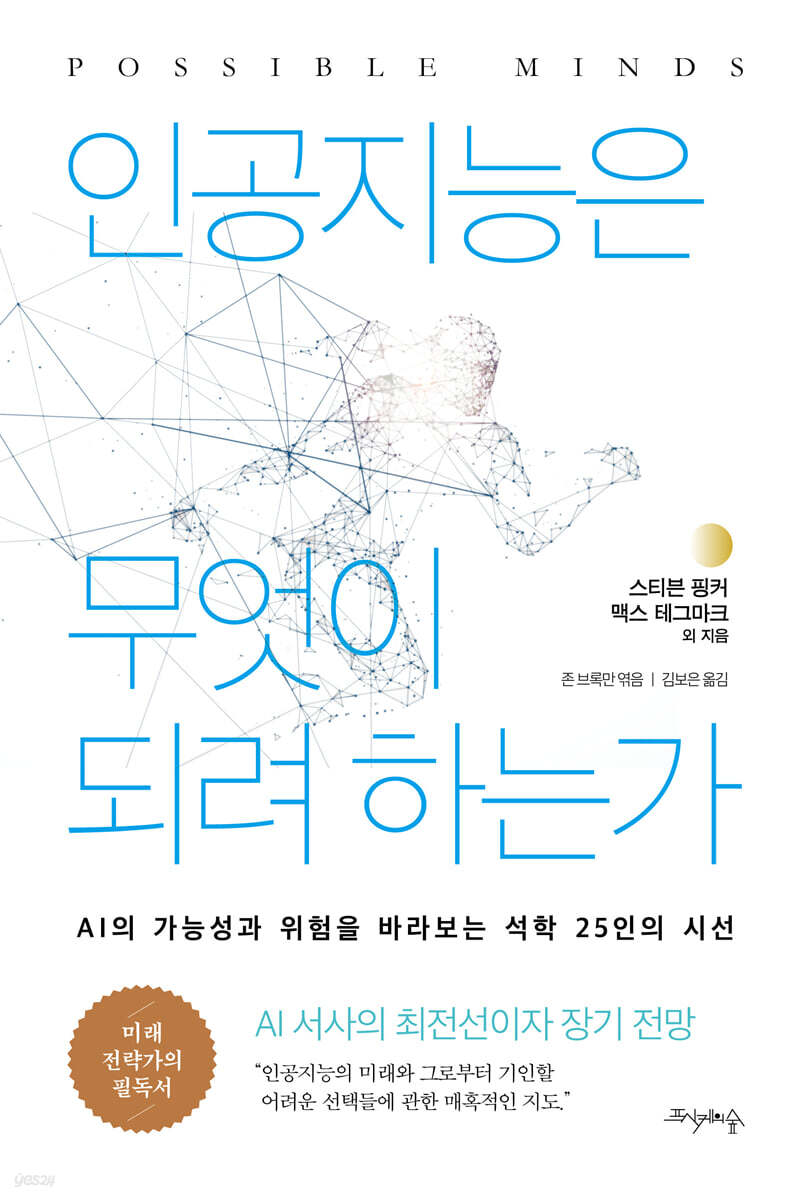
What artificial intelligence wants to become
 |
Description
Book Introduction
The Frontiers of Artificial Intelligence and the Long-Term Outlook
A gathering of the greatest scientific thinkers of our time.
"What Will Artificial Intelligence Become?" is the result of a deliberation on artificial intelligence by 25 of the most highly regarded scientific thinkers of our time, and is filled with extraordinary insights and long-term perspectives.
We thoroughly examine the possibilities, risks, and limitations of artificial intelligence technology, the most cutting-edge scientific technology and a powerful engine driving future industries.
The authors include renowned scholars known to Korean readers, such as Steven Pinker, Frank Wilczek, Daniel Dennett, Max Tegmark, Tom Griffiths, and Stuart Russell, as well as prominent figures who have made significant contributions in their respective fields.
They not only calmly examine the currently popular 'deep learning' artificial intelligence, but also continue to seriously discuss the 'superintelligent' artificial intelligence that will come in the future.
This is a selection from John Brockman, editor of the online knowledge salon 'Edge', who has been working on the book for five years. He has assembled a diverse team of experts from various fields, including scientists, programmers, engineers, thinkers, and artists, to promote the integration of knowledge with AI as the center.
A gathering of the greatest scientific thinkers of our time.
"What Will Artificial Intelligence Become?" is the result of a deliberation on artificial intelligence by 25 of the most highly regarded scientific thinkers of our time, and is filled with extraordinary insights and long-term perspectives.
We thoroughly examine the possibilities, risks, and limitations of artificial intelligence technology, the most cutting-edge scientific technology and a powerful engine driving future industries.
The authors include renowned scholars known to Korean readers, such as Steven Pinker, Frank Wilczek, Daniel Dennett, Max Tegmark, Tom Griffiths, and Stuart Russell, as well as prominent figures who have made significant contributions in their respective fields.
They not only calmly examine the currently popular 'deep learning' artificial intelligence, but also continue to seriously discuss the 'superintelligent' artificial intelligence that will come in the future.
This is a selection from John Brockman, editor of the online knowledge salon 'Edge', who has been working on the book for five years. He has assembled a diverse team of experts from various fields, including scientists, programmers, engineers, thinkers, and artists, to promote the integration of knowledge with AI as the center.
- You can preview some of the book's contents.
Preview
index
Prologue: The Potential and Risks of Artificial Intelligence
Chapter 1 Seth Lloyd: Wrong, But More Relevant Than Ever
Chapter 2: Judia Pearl: The Limits of the Opaque Treadmill
Chapter 3: Stuart Russell: Machines with Purpose
Chapter 4 George Dyson: The Third Law
Chapter 5 Daniel C.
Dennett: What can we do?
Chapter 6: Rodney Brooks: A Cruel Mess Created by Machines
Chapter 7 Frank Wilczek: The Integration of Intelligence
Chapter 8 Max Tegmark: Aspire to More Than Just Making Yourself Old-Fashioned
Chapter 9: Jan Tallinn: A Message of Resistance
Chapter 10: Steven Pinker: Technological Prophecy and the Underappreciated Causal Power of Ideas
Chapter 11 David Deutsch: Beyond Reward and Punishment
Chapter 12 Tom Griffiths: Artificial Use of Humans
Chapter 13: Anka Dragan: Putting Humans into the AI Equation
Chapter 14: Chris Anderson: Gradient Descent
Chapter 15 David Kaiser: Information for Winner, Shannon, and All of Us
Chapter 16: Neil Gershenfeld: Scaling
Chapter 17: Daniel Hillis: The First Machine Intelligence
Chapter 18 Venky Ramakrishnan: Will Computers Rule Humans?
Chapter 19: Alex 'Sandy' Pentland: Human Strategy
Chapter 20: Hans Ulrich Obrist: Making the Invisible Visible
Chapter 21: Alison Gopnik: Artificial Intelligence vs. a Four-Year-Old
Chapter 22: Peter Galison: The Algorithm Dreaming of Objectivity
Chapter 23 George M.
Church: The Rights of Machines
Chapter 24 Caroline A.
Jones: The Artistic Use of Cybernetic Beings
Chapter 25: Stephen Wolfram: Artificial Intelligence and the Future of Civilization
main
Search
Chapter 1 Seth Lloyd: Wrong, But More Relevant Than Ever
Chapter 2: Judia Pearl: The Limits of the Opaque Treadmill
Chapter 3: Stuart Russell: Machines with Purpose
Chapter 4 George Dyson: The Third Law
Chapter 5 Daniel C.
Dennett: What can we do?
Chapter 6: Rodney Brooks: A Cruel Mess Created by Machines
Chapter 7 Frank Wilczek: The Integration of Intelligence
Chapter 8 Max Tegmark: Aspire to More Than Just Making Yourself Old-Fashioned
Chapter 9: Jan Tallinn: A Message of Resistance
Chapter 10: Steven Pinker: Technological Prophecy and the Underappreciated Causal Power of Ideas
Chapter 11 David Deutsch: Beyond Reward and Punishment
Chapter 12 Tom Griffiths: Artificial Use of Humans
Chapter 13: Anka Dragan: Putting Humans into the AI Equation
Chapter 14: Chris Anderson: Gradient Descent
Chapter 15 David Kaiser: Information for Winner, Shannon, and All of Us
Chapter 16: Neil Gershenfeld: Scaling
Chapter 17: Daniel Hillis: The First Machine Intelligence
Chapter 18 Venky Ramakrishnan: Will Computers Rule Humans?
Chapter 19: Alex 'Sandy' Pentland: Human Strategy
Chapter 20: Hans Ulrich Obrist: Making the Invisible Visible
Chapter 21: Alison Gopnik: Artificial Intelligence vs. a Four-Year-Old
Chapter 22: Peter Galison: The Algorithm Dreaming of Objectivity
Chapter 23 George M.
Church: The Rights of Machines
Chapter 24 Caroline A.
Jones: The Artistic Use of Cybernetic Beings
Chapter 25: Stephen Wolfram: Artificial Intelligence and the Future of Civilization
main
Search
Publisher's Review
About artificial intelligence
Extraordinary insights with a long-term perspective
As the saying goes, “First is AI, second is AI, third is AI,” artificial intelligence technology is incredibly important.
Because it has a huge impact on future industries as well as society as a whole.
What are the possibilities and limitations of artificial intelligence, and what risks must humanity prepare for?
It is a difficult question, but it is also a task for humanity that must be answered.
The 25 authors whose names appear in this book are scientific thinkers who have demonstrated remarkable insight in their respective fields, and are intellectual giants who are well-suited to thoroughly dissect the "grand technology" of artificial intelligence.
Notable figures include Steven Pinker, who has been generating buzz with his disruptive writings, Max Tegmark, who has been providing a grand vision of the future of artificial intelligence in various media, and Stuart Russell, who has consistently raised the issue of human control over artificial intelligence.
Nobel Prize-winning scholars such as Frank Wilczek and Venky Ramakrishnan also view artificial intelligence with a clear and elegant perspective.
Daniel Dennett and Tom Griffiths, who are familiar to Korean intellectual readers through their impressive works, also joined the writing team.
Here's the full list of authors: Seth Lloyd, Judia Pearl, Stuart Russell, George Dyson, Daniel Dennett, Rodney Brooks, Frank Wilczek, Max Tegmark, Jan Tallinn, Steven Pinker, David Deutsch, Tom Griffiths, Anka Dragan, Chris Anderson, David Kaiser, Neil Gershenfeld, Daniel Hillis, Venky Ramakrishnan, Alex 'Sandy' Pentland, Hans Ulrich Obrist, Allison Gopnik, Peter Galison, George Church, Caroline Jones, and Stephen Wolfram.
(* Each profile and detailed character introduction is organized at the beginning of each chapter.)
“The future of artificial intelligence and
About the difficult choices that will result from it
“A fascinating map.”
What is unique about this book is that it covers the entire field of artificial intelligence.
It encompasses not only the currently popular 'deep learning' artificial intelligence, but also the 'super-intelligent' artificial intelligence that will come in the future.
It also traces the journey of artificial intelligence technology from its early history, beginning with von Neumann and Claude Shannon, to where it is today.
In other words, it helps you look at issues from a 'long-term' perspective and maintain a balanced perspective without being swayed by immediate issues.
So much so that one outlet even recommended it, saying, “Readers won’t find a better introduction to artificial intelligence” (Kirkus).
This book contains as many perspectives as there are authors: 25.
The discussion is so tense that it is difficult to be either optimistic or pessimistic.
The only thing they have in common is the starting point of the discussion.
Editor John Brockman brought up Norbert Wiener, who had previously coined the term cybernetics and strongly warned of its dangers.
Cybernetics predated today's concept of artificial intelligence, and Norbert Wiener, moreover, feared the dominance of cybernetics as if he were worried about the nuclear bomb.
This book was born from the idea that the authors could freely express their thoughts by using this as a starting point for discussion.
Some authors sympathize with such fears about artificial intelligence, while others dismiss them as a chronic human tendency to favor dystopian imaginations.
Many authors, regardless of the pros and cons, develop their own fascinating theories of artificial intelligence.
With these 25 pieces, readers will be able to complete their own mosaic picture.
Meeting after 5 years
John Brockman Selection
Another thing to note is the editor of this book, John Brockman.
He is the leader of the online knowledge salon 'Edge', and has played a significant role in integrating the intellectual achievements of Western academia, as his nickname, "the conductor of knowledge" suggests.
The Edge series, in which intellectual thinkers co-write books centered on a single topic, has been introduced in several volumes in Korea, exciting intellectual readers. This book is the latest work in this series, and for Korean readers, it is the first John Brockman Selection in nearly five years.
He assembled a diverse team of experts from various fields, including scientists, programmers, engineers, thinkers, and artists, to reveal the full scope of humanity's AI knowledge, while also seeking to open up new perspectives and inspiration through the synthesis of knowledge.
Recommendation
“A collection of concise and concise articles on artificial intelligence.
Readers won't find a better introduction to artificial intelligence.” _Kirkus
“A fascinating map of the future of AI and the difficult choices it will bring.” _Foreign Affairs
“The authors of this book agree on one important question:
The question is, 'What kind of danger can artificial intelligence pose to humans?'
This book offers a number of novel ideas within this framework.
“It’s enlightening, yet fun and engaging.” _Publisher’s Weekly
Extraordinary insights with a long-term perspective
As the saying goes, “First is AI, second is AI, third is AI,” artificial intelligence technology is incredibly important.
Because it has a huge impact on future industries as well as society as a whole.
What are the possibilities and limitations of artificial intelligence, and what risks must humanity prepare for?
It is a difficult question, but it is also a task for humanity that must be answered.
The 25 authors whose names appear in this book are scientific thinkers who have demonstrated remarkable insight in their respective fields, and are intellectual giants who are well-suited to thoroughly dissect the "grand technology" of artificial intelligence.
Notable figures include Steven Pinker, who has been generating buzz with his disruptive writings, Max Tegmark, who has been providing a grand vision of the future of artificial intelligence in various media, and Stuart Russell, who has consistently raised the issue of human control over artificial intelligence.
Nobel Prize-winning scholars such as Frank Wilczek and Venky Ramakrishnan also view artificial intelligence with a clear and elegant perspective.
Daniel Dennett and Tom Griffiths, who are familiar to Korean intellectual readers through their impressive works, also joined the writing team.
Here's the full list of authors: Seth Lloyd, Judia Pearl, Stuart Russell, George Dyson, Daniel Dennett, Rodney Brooks, Frank Wilczek, Max Tegmark, Jan Tallinn, Steven Pinker, David Deutsch, Tom Griffiths, Anka Dragan, Chris Anderson, David Kaiser, Neil Gershenfeld, Daniel Hillis, Venky Ramakrishnan, Alex 'Sandy' Pentland, Hans Ulrich Obrist, Allison Gopnik, Peter Galison, George Church, Caroline Jones, and Stephen Wolfram.
(* Each profile and detailed character introduction is organized at the beginning of each chapter.)
“The future of artificial intelligence and
About the difficult choices that will result from it
“A fascinating map.”
What is unique about this book is that it covers the entire field of artificial intelligence.
It encompasses not only the currently popular 'deep learning' artificial intelligence, but also the 'super-intelligent' artificial intelligence that will come in the future.
It also traces the journey of artificial intelligence technology from its early history, beginning with von Neumann and Claude Shannon, to where it is today.
In other words, it helps you look at issues from a 'long-term' perspective and maintain a balanced perspective without being swayed by immediate issues.
So much so that one outlet even recommended it, saying, “Readers won’t find a better introduction to artificial intelligence” (Kirkus).
This book contains as many perspectives as there are authors: 25.
The discussion is so tense that it is difficult to be either optimistic or pessimistic.
The only thing they have in common is the starting point of the discussion.
Editor John Brockman brought up Norbert Wiener, who had previously coined the term cybernetics and strongly warned of its dangers.
Cybernetics predated today's concept of artificial intelligence, and Norbert Wiener, moreover, feared the dominance of cybernetics as if he were worried about the nuclear bomb.
This book was born from the idea that the authors could freely express their thoughts by using this as a starting point for discussion.
Some authors sympathize with such fears about artificial intelligence, while others dismiss them as a chronic human tendency to favor dystopian imaginations.
Many authors, regardless of the pros and cons, develop their own fascinating theories of artificial intelligence.
With these 25 pieces, readers will be able to complete their own mosaic picture.
Meeting after 5 years
John Brockman Selection
Another thing to note is the editor of this book, John Brockman.
He is the leader of the online knowledge salon 'Edge', and has played a significant role in integrating the intellectual achievements of Western academia, as his nickname, "the conductor of knowledge" suggests.
The Edge series, in which intellectual thinkers co-write books centered on a single topic, has been introduced in several volumes in Korea, exciting intellectual readers. This book is the latest work in this series, and for Korean readers, it is the first John Brockman Selection in nearly five years.
He assembled a diverse team of experts from various fields, including scientists, programmers, engineers, thinkers, and artists, to reveal the full scope of humanity's AI knowledge, while also seeking to open up new perspectives and inspiration through the synthesis of knowledge.
Recommendation
“A collection of concise and concise articles on artificial intelligence.
Readers won't find a better introduction to artificial intelligence.” _Kirkus
“A fascinating map of the future of AI and the difficult choices it will bring.” _Foreign Affairs
“The authors of this book agree on one important question:
The question is, 'What kind of danger can artificial intelligence pose to humans?'
This book offers a number of novel ideas within this framework.
“It’s enlightening, yet fun and engaging.” _Publisher’s Weekly
GOODS SPECIFICS
- Publication date: August 23, 2021
- Page count, weight, size: 448 pages | 766g | 152*225*26mm
- ISBN13: 9791189336417
- ISBN10: 1189336413
You may also like
카테고리
korean


korean

![ELLE 엘르 스페셜 에디션 A형 : 12월 [2025]](http://librairie.coreenne.fr/cdn/shop/files/b8e27a3de6c9538896439686c6b0e8fb.jpg?v=1766436872&width=3840)


