

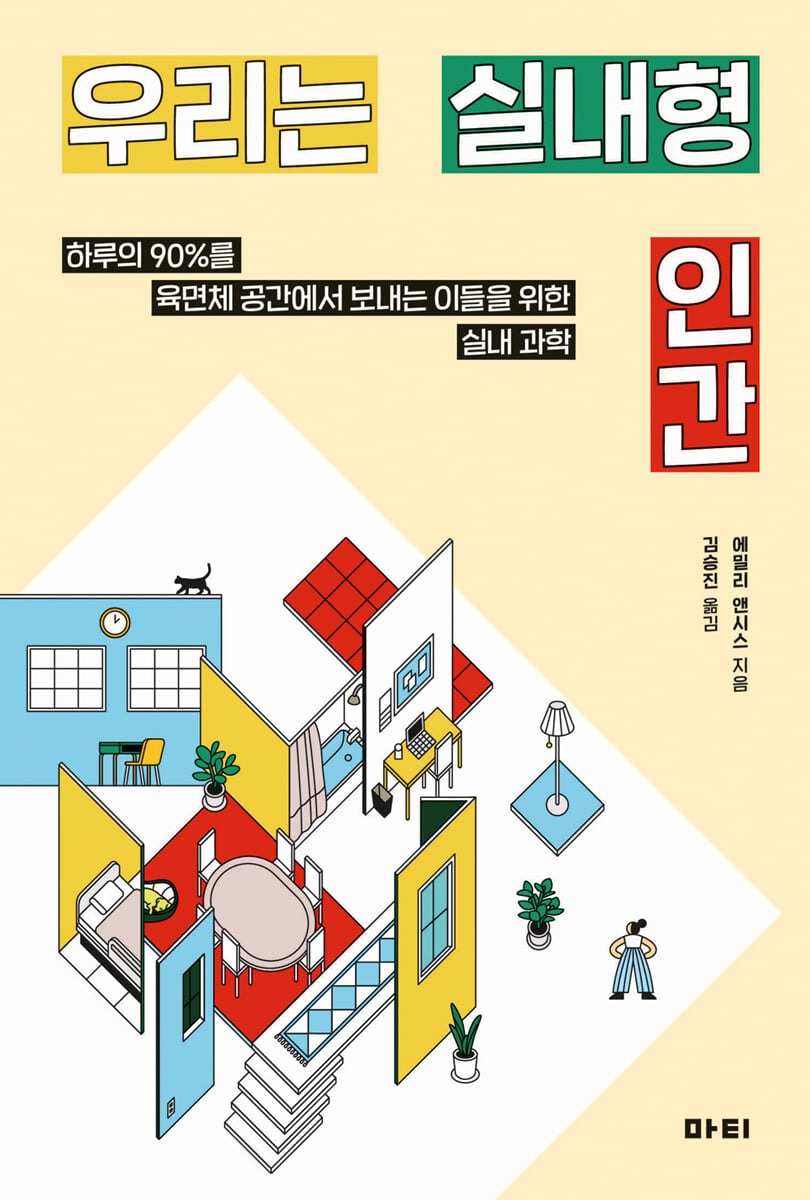
We are indoor people
 |
Description
Book Introduction
The indoor spaces where we work, play, learn, eat, and rest have an unknowing impact on our health and happiness.
Science journalist Emily Ansis explores everyday spaces like hospitals, schools, and offices, starting with a look inside the showerhead of a home to uncover the secrets our man-made indoor world holds and what healthy, safe, and equitable buildings should look like.
Moving forward, we explore spaces for indoor humans in an era of increasing life expectancy and climate change, including smart homes equipped with cutting-edge technology, floating homes, and 3D-printed space villages.
Science journalist Emily Ansis explores everyday spaces like hospitals, schools, and offices, starting with a look inside the showerhead of a home to uncover the secrets our man-made indoor world holds and what healthy, safe, and equitable buildings should look like.
Moving forward, we explore spaces for indoor humans in an era of increasing life expectancy and climate change, including smart homes equipped with cutting-edge technology, floating homes, and 3D-printed space villages.
- You can preview some of the book's contents.
Preview
index
Introduction
1 Indoor Jungle
2. Your own hospital room
The power of 3 steps
4 Office Syndrome Treatments
5 Full Spectrum
6 Break down the iron bars
7. A wall of speaking, listening, and recording
8 A house that floats on water
9 If we build a house on Mars
main
Acknowledgements
Search
1 Indoor Jungle
2. Your own hospital room
The power of 3 steps
4 Office Syndrome Treatments
5 Full Spectrum
6 Break down the iron bars
7. A wall of speaking, listening, and recording
8 A house that floats on water
9 If we build a house on Mars
main
Acknowledgements
Search
Detailed image

Publisher's Review
Home, school, office, hospital, prison…
A Guide for Indoor Humans Traveling Through All Kinds of Hexahedron Space
We are indoor people.
We spend 90 percent of our day indoors, such as at home, school, office, store, or restaurant.
As a species that has evolved to live indoors, humans are also working to develop indoor spaces.
A UN report estimates that by 2060, an area the size of Japan will be added to the world's indoor space each year.
The indoor world continues to expand.
Preoccupied with pioneering, we pay little attention to the potential of the hexahedral space.
Even though we spend so much time inside buildings, we don't pay much attention to how spaces affect our minds and bodies, our thoughts, emotions, behaviors, and relationships.
Emily Ansis, an indoor person and science journalist who loves staying indoors, sets out on an expedition to delve deeper into the expanding indoor spaces and the artificial worlds humanity has pioneered.
Starting from the most intimate space, home, to familiar yet different indoor spaces such as prisons and hospitals.
Everyone needs a sunny single room, not an expensive one.
Health is not just a personal issue, it is also a ‘space’ issue.
As the 19th-century British nurse Florence Nightingale intuitively realized, simply installing windows and changing ward design and bed arrangements could significantly reduce the spread of disease and mortality in hospitals.
The concept of "patient-centered care" has taken hold in hospitals as it has become known that walls with views of nature, private rooms with ample sunlight, and biorhythm lighting that adjusts the color and intensity of light play an important role in patient treatment and recovery.
In addition, modern hospitals consider noise management as a major challenge.
A study found that replacing the ceiling of a hospital filled with the sounds of medical staff and all kinds of machinery with a sound-absorbing material reduced the burden and stress on not only patients but also nurses.
But hospitals don't just have sickrooms.
How should high-risk spaces like operating rooms be designed? The author meticulously analyzes how hospital spaces function and how medical staff work. This author presents cutting-edge research on the layout of everything in an operating room—from patient beds to various surgical instruments and medical equipment, even down to the smallest details like trash cans—and the flow of medical staff.
How to become healthy without even knowing it
There are ways for people to become healthy without even knowing it.
It's about designing cities and indoor spaces so that people move more frequently.
If you widen or improve the pedestrian walkways, people will walk more often.
If we create safe bike lanes, people might commute by bike instead of car.
Studies have shown that people take the elevator less when the stairs are visible, wide, and beautiful (of course, accessibility for people with disabilities must be taken into account).
If you want to develop healthy habits, it's best to start early in life.
Even small changes to school design could potentially make children healthier.
For example, by making the gym walls out of glass to show that exercise is a fun activity, or by hiding what look like animal footprints on the floor of the building to experience the joy of walking.
Space plays an important role not only in physical activity but also in forming eating habits.
To prevent the cafeteria from becoming just a place to receive food handed out by adults, you can open up the kitchen or create cooking stations that are suitable for children's size to encourage them to get involved in the cooking process.
Of course, spatial design is not a panacea.
Indoor spaces can be impactful when approached from a multifaceted perspective, strengthening school policies and programs—such as empowering food service workers to act as educators, making healthy food options more visible, and offering after-school cooking classes.
If you feel the air quality in your office is unpleasant
Let's check the lighting, temperature, and humidity first.
According to one study, when people feel uncomfortable in an indoor space, they easily point to the invisible but omnipresent air as the cause of the problem.
In fact, this is a problem that can be solved by adjusting the temperature, noise, or lighting.
However, it is not easy to create an environment that suits each person in a space where many people gather together.
The temperature that I feel comfortable at may be perceived as cold or hot by my coworker.
The author interviews employees and researchers at companies like Humanize, a workplace analytics company; WeWork, which started as an office-sharing company and is developing office design automation software using the data it has accumulated; and Compy, a company developing products that empower workers to directly control their office environments, and explores offices incorporating new technologies.
Would creating intimate conference rooms, arranging employees so they work near windows as much as possible, and allowing workers to directly control the lighting, temperature, and humidity in their offices improve work efficiency? While it would be ideal to incorporate cutting-edge technology to allow workers to create a comfortable office environment tailored to their needs, there's no guarantee that technology will be used in a positive way.
The author also points out that cutting-edge technologies, or simply redesigning spaces, do not address fundamental labor issues such as overwork, unpaid wages, employment patterns, and contractual conditions.
Obsessive-compulsive disorder, hyper-sensitivity, ADHD, migraines, autism spectrum disorder
Indoor science considering neurological disorders
Ramps, wide doors, automatic doors, and toilet grab bars are all devices designed to improve accessibility for people with disabilities.
Although accessibility has improved compared to the past, barriers still remain and it has limitations in that it has primarily focused on people with physical disabilities.
For people with brain function differences, several elements of the indoor environment present challenges.
For example, people with autism become extremely sensitive to light and sound.
However, some autistic people enjoy sensory stimulation.
Some people with autism need to repeat certain behaviors, such as jumping up and down, to calm themselves down.
The spectrum of autism is broad.
Naturally, the spectrum of disabilities is also wide.
The author introduces living spaces for the independence of autistic people, design guidelines for people on the autism spectrum, and demonstrates the importance of interior spaces that carefully reflect the spectrum of neurological disorders.
Of course, there are limitations to this as well.
Buildings designed solely for the disabled isolate them from society.
If we want to create an equal and inclusive society, we must apply the concept of 'universal design'.
The core of universal design is that a design that works well for people who are considered to have "differences" in their bodies or brain functions is simply good design.
A prime example is that ramps have become inclusive not only for people with disabilities but also for people using strollers, the elderly, and even those pushing pushchairs or bicycles.
Universal design ensures equal access to all spaces for everyone.
If universal design is applied to buildings, the range of choices for living spaces will expand.
Internet of Things Optimized for Seniors
Buildings for senior care
Technologies that measure indoor air quality, tell you how much milk is left in your fridge, alert you when it's time to take your medication, and analyze your sleep patterns are no longer the stuff of science fiction.
In an era where life expectancy is increasing and the number of elderly people living alone is rapidly increasing, 'smart homes', buildings that act as doctors, are attracting attention.
By installing tracking devices such as sensors and cameras throughout the home, you can check in real time whether the elderly person is taking their medication properly or whether they have fallen and been left alone for a long time.
The goal of health monitoring is to help older people age in their own homes rather than in nursing homes.
These tracking technologies are double-edged swords.
While it would be beneficial if various data were used to care for individual health or supplement public health policies, they could also be used in ways we do not want.
Not everyone can benefit from these technologies.
The cost of installing and maintaining technology will widen health disparities.
Technology is not used equally.
As technology penetrates deeper into our indoor spaces, we will have to consider the equity and ethical issues of technology.
Climate change is changing homes
In flood-prone areas like the Maas River in the Netherlands and the remote Peruvian village of Belén, there are houses that rise when the water rises and then sink when it recedes.
Amphibious homes are based on the idea of living with water rather than fighting it.
This is why researchers are focusing on amphibious houses as a space to respond to climate change.
Elizabeth English, a professor of architecture at the University of Waterloo, founded the non-profit Floating House Project, which researches amphibious homes with architecture and engineering students.
The core of the research is to create an amphibious home that is realistically accessible to low-income people, using inexpensive and recyclable materials.
The damage from natural disasters and climate change is not equal.
Hurricane Katrina, which struck the southeastern United States in 2005, starkly exposed inequality.
Many poor people were unable to evacuate, were denied housing loans after the disaster, and had difficulty recovering due to lack of insurance and assets.
Of course, responding to a crisis doesn't only mean using unfamiliar methods like floating houses.
Hospitals in flood-prone areas may structure their buildings so that administrative offices are on the lower floors and patient rooms and machine rooms are on the upper floors.
Revision of the Building Act is also directly related to life.
Buildings can also be constructed using eco-friendly materials.
Looking back at history, humans have built homes that fit their living environments using materials that are readily available around them.
In cold regions, houses were built with thick layers of snow and turf, while people in tropical regions built their houses on high ground and covered them with palm or coconut thatch to allow for good ventilation.
Traditional building techniques may hold clues to solutions to climate change.
If we apply universal design to space
Indoor humans can go anywhere
"We Are Indoor Humans" introduces everyday spaces like homes, hospitals, schools, and offices, and then moves on to unfamiliar spaces like high-tech smart homes, prisons for criminals, full-spectrum spaces, floating houses, and 3D-printed space villages.
As we read this book, we will learn that small choices—how many windows to have, where to place stairs, how to arrange furniture—can have a huge impact on our lives.
At the same time, it is also true that even if it is a space that incorporates the latest academic research and technology, it does not solve all of the problems in our lives.
However, architecture and design that meticulously considers indoor humans can lead healthy lives and help society move in a more desirable direction.
If we pay attention to and actively voice our opinions on social issues surrounding the indoor environment in the process, indoor spaces can evolve into spaces that are equal and friendly to everyone.
A Guide for Indoor Humans Traveling Through All Kinds of Hexahedron Space
We are indoor people.
We spend 90 percent of our day indoors, such as at home, school, office, store, or restaurant.
As a species that has evolved to live indoors, humans are also working to develop indoor spaces.
A UN report estimates that by 2060, an area the size of Japan will be added to the world's indoor space each year.
The indoor world continues to expand.
Preoccupied with pioneering, we pay little attention to the potential of the hexahedral space.
Even though we spend so much time inside buildings, we don't pay much attention to how spaces affect our minds and bodies, our thoughts, emotions, behaviors, and relationships.
Emily Ansis, an indoor person and science journalist who loves staying indoors, sets out on an expedition to delve deeper into the expanding indoor spaces and the artificial worlds humanity has pioneered.
Starting from the most intimate space, home, to familiar yet different indoor spaces such as prisons and hospitals.
Everyone needs a sunny single room, not an expensive one.
Health is not just a personal issue, it is also a ‘space’ issue.
As the 19th-century British nurse Florence Nightingale intuitively realized, simply installing windows and changing ward design and bed arrangements could significantly reduce the spread of disease and mortality in hospitals.
The concept of "patient-centered care" has taken hold in hospitals as it has become known that walls with views of nature, private rooms with ample sunlight, and biorhythm lighting that adjusts the color and intensity of light play an important role in patient treatment and recovery.
In addition, modern hospitals consider noise management as a major challenge.
A study found that replacing the ceiling of a hospital filled with the sounds of medical staff and all kinds of machinery with a sound-absorbing material reduced the burden and stress on not only patients but also nurses.
But hospitals don't just have sickrooms.
How should high-risk spaces like operating rooms be designed? The author meticulously analyzes how hospital spaces function and how medical staff work. This author presents cutting-edge research on the layout of everything in an operating room—from patient beds to various surgical instruments and medical equipment, even down to the smallest details like trash cans—and the flow of medical staff.
How to become healthy without even knowing it
There are ways for people to become healthy without even knowing it.
It's about designing cities and indoor spaces so that people move more frequently.
If you widen or improve the pedestrian walkways, people will walk more often.
If we create safe bike lanes, people might commute by bike instead of car.
Studies have shown that people take the elevator less when the stairs are visible, wide, and beautiful (of course, accessibility for people with disabilities must be taken into account).
If you want to develop healthy habits, it's best to start early in life.
Even small changes to school design could potentially make children healthier.
For example, by making the gym walls out of glass to show that exercise is a fun activity, or by hiding what look like animal footprints on the floor of the building to experience the joy of walking.
Space plays an important role not only in physical activity but also in forming eating habits.
To prevent the cafeteria from becoming just a place to receive food handed out by adults, you can open up the kitchen or create cooking stations that are suitable for children's size to encourage them to get involved in the cooking process.
Of course, spatial design is not a panacea.
Indoor spaces can be impactful when approached from a multifaceted perspective, strengthening school policies and programs—such as empowering food service workers to act as educators, making healthy food options more visible, and offering after-school cooking classes.
If you feel the air quality in your office is unpleasant
Let's check the lighting, temperature, and humidity first.
According to one study, when people feel uncomfortable in an indoor space, they easily point to the invisible but omnipresent air as the cause of the problem.
In fact, this is a problem that can be solved by adjusting the temperature, noise, or lighting.
However, it is not easy to create an environment that suits each person in a space where many people gather together.
The temperature that I feel comfortable at may be perceived as cold or hot by my coworker.
The author interviews employees and researchers at companies like Humanize, a workplace analytics company; WeWork, which started as an office-sharing company and is developing office design automation software using the data it has accumulated; and Compy, a company developing products that empower workers to directly control their office environments, and explores offices incorporating new technologies.
Would creating intimate conference rooms, arranging employees so they work near windows as much as possible, and allowing workers to directly control the lighting, temperature, and humidity in their offices improve work efficiency? While it would be ideal to incorporate cutting-edge technology to allow workers to create a comfortable office environment tailored to their needs, there's no guarantee that technology will be used in a positive way.
The author also points out that cutting-edge technologies, or simply redesigning spaces, do not address fundamental labor issues such as overwork, unpaid wages, employment patterns, and contractual conditions.
Obsessive-compulsive disorder, hyper-sensitivity, ADHD, migraines, autism spectrum disorder
Indoor science considering neurological disorders
Ramps, wide doors, automatic doors, and toilet grab bars are all devices designed to improve accessibility for people with disabilities.
Although accessibility has improved compared to the past, barriers still remain and it has limitations in that it has primarily focused on people with physical disabilities.
For people with brain function differences, several elements of the indoor environment present challenges.
For example, people with autism become extremely sensitive to light and sound.
However, some autistic people enjoy sensory stimulation.
Some people with autism need to repeat certain behaviors, such as jumping up and down, to calm themselves down.
The spectrum of autism is broad.
Naturally, the spectrum of disabilities is also wide.
The author introduces living spaces for the independence of autistic people, design guidelines for people on the autism spectrum, and demonstrates the importance of interior spaces that carefully reflect the spectrum of neurological disorders.
Of course, there are limitations to this as well.
Buildings designed solely for the disabled isolate them from society.
If we want to create an equal and inclusive society, we must apply the concept of 'universal design'.
The core of universal design is that a design that works well for people who are considered to have "differences" in their bodies or brain functions is simply good design.
A prime example is that ramps have become inclusive not only for people with disabilities but also for people using strollers, the elderly, and even those pushing pushchairs or bicycles.
Universal design ensures equal access to all spaces for everyone.
If universal design is applied to buildings, the range of choices for living spaces will expand.
Internet of Things Optimized for Seniors
Buildings for senior care
Technologies that measure indoor air quality, tell you how much milk is left in your fridge, alert you when it's time to take your medication, and analyze your sleep patterns are no longer the stuff of science fiction.
In an era where life expectancy is increasing and the number of elderly people living alone is rapidly increasing, 'smart homes', buildings that act as doctors, are attracting attention.
By installing tracking devices such as sensors and cameras throughout the home, you can check in real time whether the elderly person is taking their medication properly or whether they have fallen and been left alone for a long time.
The goal of health monitoring is to help older people age in their own homes rather than in nursing homes.
These tracking technologies are double-edged swords.
While it would be beneficial if various data were used to care for individual health or supplement public health policies, they could also be used in ways we do not want.
Not everyone can benefit from these technologies.
The cost of installing and maintaining technology will widen health disparities.
Technology is not used equally.
As technology penetrates deeper into our indoor spaces, we will have to consider the equity and ethical issues of technology.
Climate change is changing homes
In flood-prone areas like the Maas River in the Netherlands and the remote Peruvian village of Belén, there are houses that rise when the water rises and then sink when it recedes.
Amphibious homes are based on the idea of living with water rather than fighting it.
This is why researchers are focusing on amphibious houses as a space to respond to climate change.
Elizabeth English, a professor of architecture at the University of Waterloo, founded the non-profit Floating House Project, which researches amphibious homes with architecture and engineering students.
The core of the research is to create an amphibious home that is realistically accessible to low-income people, using inexpensive and recyclable materials.
The damage from natural disasters and climate change is not equal.
Hurricane Katrina, which struck the southeastern United States in 2005, starkly exposed inequality.
Many poor people were unable to evacuate, were denied housing loans after the disaster, and had difficulty recovering due to lack of insurance and assets.
Of course, responding to a crisis doesn't only mean using unfamiliar methods like floating houses.
Hospitals in flood-prone areas may structure their buildings so that administrative offices are on the lower floors and patient rooms and machine rooms are on the upper floors.
Revision of the Building Act is also directly related to life.
Buildings can also be constructed using eco-friendly materials.
Looking back at history, humans have built homes that fit their living environments using materials that are readily available around them.
In cold regions, houses were built with thick layers of snow and turf, while people in tropical regions built their houses on high ground and covered them with palm or coconut thatch to allow for good ventilation.
Traditional building techniques may hold clues to solutions to climate change.
If we apply universal design to space
Indoor humans can go anywhere
"We Are Indoor Humans" introduces everyday spaces like homes, hospitals, schools, and offices, and then moves on to unfamiliar spaces like high-tech smart homes, prisons for criminals, full-spectrum spaces, floating houses, and 3D-printed space villages.
As we read this book, we will learn that small choices—how many windows to have, where to place stairs, how to arrange furniture—can have a huge impact on our lives.
At the same time, it is also true that even if it is a space that incorporates the latest academic research and technology, it does not solve all of the problems in our lives.
However, architecture and design that meticulously considers indoor humans can lead healthy lives and help society move in a more desirable direction.
If we pay attention to and actively voice our opinions on social issues surrounding the indoor environment in the process, indoor spaces can evolve into spaces that are equal and friendly to everyone.
GOODS SPECIFICS
- Publication date: July 15, 2021
- Page count, weight, size: 424 pages | 476g | 128*188*27mm
- ISBN13: 9791190853170
- ISBN10: 1190853175
You may also like
카테고리
korean


korean

![ELLE 엘르 스페셜 에디션 A형 : 12월 [2025]](http://librairie.coreenne.fr/cdn/shop/files/b8e27a3de6c9538896439686c6b0e8fb.jpg?v=1766436872&width=3840)


