

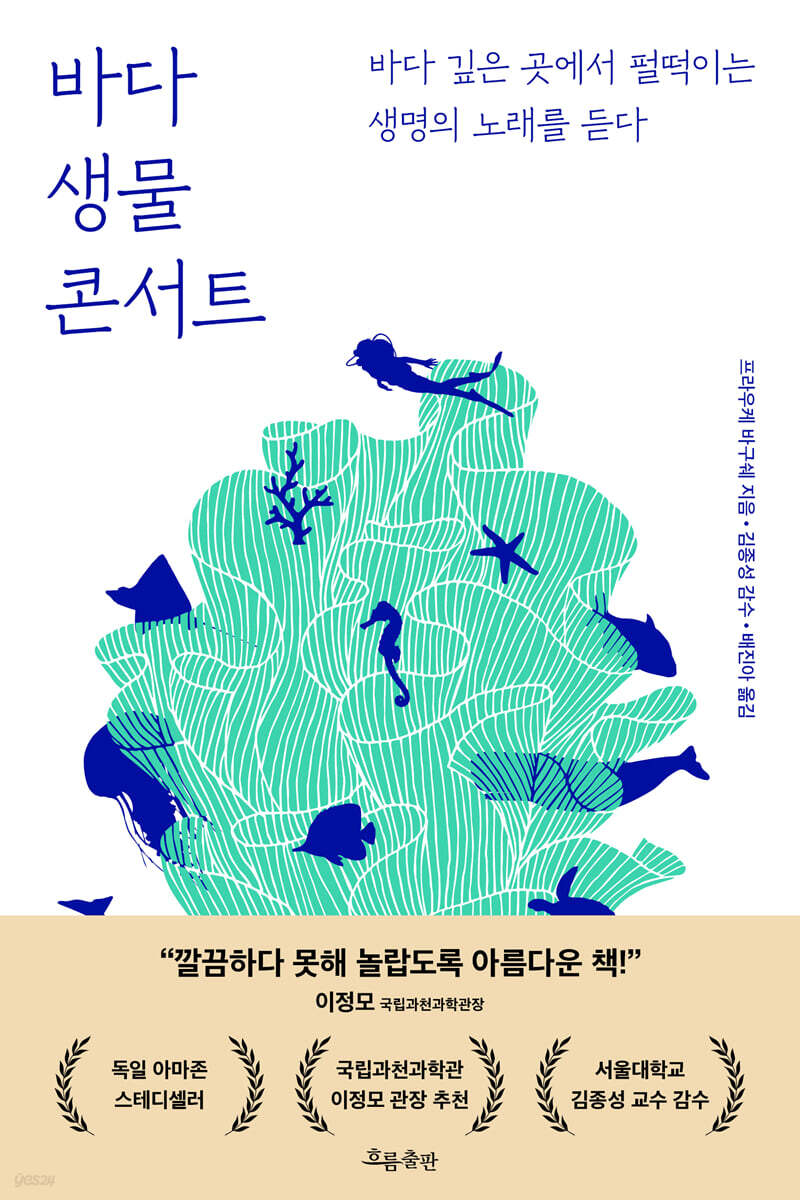
Sea Life Concert
 |
Description
Book Introduction
"A book so clean, it's surprisingly beautiful!" _Lee Jeong-mo (Director of the National Science Museum, Gwacheon)
A story about the ocean ecosystem, full of fascinating and mysterious secrets!
This is a science textbook introducing the ecology of the ocean and its creatures by Frauke Bagusche, a young scientist who is receiving the most attention in the field of marine ecology.
This book, "The Marine Life Concert," which is also the author's debut work, garnered attention as a hot science title at the 2019 London Book Fair even before its publication, and later became a steady seller on Amazon Germany, earning praise from numerous science readers.
The author, who has lived near the sea and studied the sea and marine life for a long time and says, “As a marine biologist to the core, there is (almost) nothing in my head but salt water,” is a scholar who has devoted himself to marine ecology research to the point of sailing a whopping 9,500 kilometers to inform the world about the problem of marine pollution.
This book, which criticizes human indifference and ignorance toward the ocean, which produces 70 percent of the Earth's oxygen, will provide an opportunity to reflect on the importance of the marine ecosystem with more clarity and certainty.
A story about the ocean ecosystem, full of fascinating and mysterious secrets!
This is a science textbook introducing the ecology of the ocean and its creatures by Frauke Bagusche, a young scientist who is receiving the most attention in the field of marine ecology.
This book, "The Marine Life Concert," which is also the author's debut work, garnered attention as a hot science title at the 2019 London Book Fair even before its publication, and later became a steady seller on Amazon Germany, earning praise from numerous science readers.
The author, who has lived near the sea and studied the sea and marine life for a long time and says, “As a marine biologist to the core, there is (almost) nothing in my head but salt water,” is a scholar who has devoted himself to marine ecology research to the point of sailing a whopping 9,500 kilometers to inform the world about the problem of marine pollution.
This book, which criticizes human indifference and ignorance toward the ocean, which produces 70 percent of the Earth's oxygen, will provide an opportunity to reflect on the importance of the marine ecosystem with more clarity and certainty.
index
Reviewer's note
introduction
Chapter 1: Plankton's Secret World Domination
Green Lungs / The Scent of the Sea / Small Bites for Big Eaters / Size Doesn't Matter /
Slippery Giant / The Light of the Sea
Chapter 2: Coral Reefs, the Cradle of the Sea
Coral Wedding / Fish Song / Nemo's Brothers / Underwater Hospital / Underwater Pharmacy /
Symbiosis, Parasitism, and Other Interrelationships / Battlefield Coral Reefs / Glowing Corals /
Hide your body perfectly
Chapter 3: Finite and Infinite Blue
Water, a substance with very special properties / Why the Baltic Sea is less salty than the Mediterranean Sea /
The Sea and the Underwater Conveyor Belt That Cooks the Climate / The Journey of a Sea Turtle / The Intelligent Singer /
The Hunted Hunter / Incredibly Abnormal Development
Chapter 4: The Deep Sea, Shrouded in Secrets
Creatures that survive in extreme conditions / Gold rush in the deep sea /
Sea monsters, deep-sea monsters, and the extraordinary adventures of sailors / Glitter in the dark /
Fragile predators and glass corals
Chapter 5: Sex and the Sea
The Black Soul of the Otter / Sodom and Gomorrah in Antarctica / Sometimes Size Matters /
About the Gladiator and the Independently Swimming Tentacles / Devoted Fathers /
Eels that enjoy wandering
Chapter 6: The Perilous Blue Miracle
The Curse of Black Gold / The Plastic Age / Are Bioplastics the Answer? /
Paradise polluted by trash / Island made of plastic /
Microplastics: A Nearly Invisible Danger / Climate Change and the Ocean / Coral Reef Death
The Sea is Starving / Improving Marine Aquaculture / The Future of the Sea, Our Future
Acknowledgements
References
Comprehensive references and additional information applicable to all chapters
introduction
Chapter 1: Plankton's Secret World Domination
Green Lungs / The Scent of the Sea / Small Bites for Big Eaters / Size Doesn't Matter /
Slippery Giant / The Light of the Sea
Chapter 2: Coral Reefs, the Cradle of the Sea
Coral Wedding / Fish Song / Nemo's Brothers / Underwater Hospital / Underwater Pharmacy /
Symbiosis, Parasitism, and Other Interrelationships / Battlefield Coral Reefs / Glowing Corals /
Hide your body perfectly
Chapter 3: Finite and Infinite Blue
Water, a substance with very special properties / Why the Baltic Sea is less salty than the Mediterranean Sea /
The Sea and the Underwater Conveyor Belt That Cooks the Climate / The Journey of a Sea Turtle / The Intelligent Singer /
The Hunted Hunter / Incredibly Abnormal Development
Chapter 4: The Deep Sea, Shrouded in Secrets
Creatures that survive in extreme conditions / Gold rush in the deep sea /
Sea monsters, deep-sea monsters, and the extraordinary adventures of sailors / Glitter in the dark /
Fragile predators and glass corals
Chapter 5: Sex and the Sea
The Black Soul of the Otter / Sodom and Gomorrah in Antarctica / Sometimes Size Matters /
About the Gladiator and the Independently Swimming Tentacles / Devoted Fathers /
Eels that enjoy wandering
Chapter 6: The Perilous Blue Miracle
The Curse of Black Gold / The Plastic Age / Are Bioplastics the Answer? /
Paradise polluted by trash / Island made of plastic /
Microplastics: A Nearly Invisible Danger / Climate Change and the Ocean / Coral Reef Death
The Sea is Starving / Improving Marine Aquaculture / The Future of the Sea, Our Future
Acknowledgements
References
Comprehensive references and additional information applicable to all chapters
Detailed image
.jpg)
Into the book
Wherever you are right now, whether in Cologne or Erfurt, walking in the Alps or lying still on the beach of Nordsee, with every breath you exhale and inhale you become intimately connected to the sea.
Because more than half of all the oxygen on Earth is produced by phytoplankton—extremely small plant organisms measuring between 0.0001 millimeters and 1 millimeter.
For this reason, phytoplankton is sometimes called the 'green lungs of the sea'.
These extremely small organisms photosynthesize much like trees on land, producing sugars and a byproduct called oxygen from water, carbon dioxide, and light energy.
These seaweeds that actively photosynthesize are called primary producers.
Sergei Petrovskii, a professor of applied mathematics at the University of Leicester in the UK, explained the impact of climate change by estimating that if the ocean temperature rises by 6℃, phytoplankton will decrease significantly, leading to a decrease in oxygen in the ocean as well as in the atmosphere around the world.
And as a result, he said, there would be mass deaths of humans and animals across the world.
--- p.27
Coral mating is a very tricky matter.
Because corals, being sessile animals, cannot actively seek out a mate.
How can we address this loss of mobility to find the perfect partner? Yes, meticulous planning is essential! Corals, who literally resemble German civil servants in their thoroughness, plan their spawning behavior with extreme meticulousness and precision.
Among corals, 'rapid mating' is taboo.
Mating in tropical corals usually occurs simultaneously during mass weddings held on the reef once or several times a year.
For this reason, hundreds of sex tourists flock to Australia's Great Barrier Reef every year.
They dive or snorkel to experience this unique spectacle, which resembles a snowstorm blowing beneath the surface.
At night, as if on command, coral polyps release their gametes, or sperm and eggs, into the water.
These mass coral spawning events, involving hundreds of different corals, are triggered by changes in water temperature, tides, the position of the sun and the intensity of moonlight.
--- pp.68~69
The starfish Acanthaster planci is another lawbreaker on the reef.
Like the parrotfish, the Acantaster plankti preys on coral polyps and can turn an entire reef into a wasteland in a short period of time.
The name Acantaster flankii wasn't just given to us.
This starfish species, with its red body covered in long stingers, is reminiscent of Jesus wearing a crown of thorns.
Another appropriate analogy might be the picture of the sun drawn by children.
If you look at the sun drawn by children, you can see that the rays are spreading out in all directions.
In the case of the Acanthaster flankii, the tentacles extend in all directions.
Adult starfish can grow up to 40 centimeters in size and have between 6 and 23 tentacles protected by spines.
This starfish lives on tropical reefs in the Indo-Pacific.
These animals are incredibly beautiful when viewed individually, but when they appear in large groups, they can cause significant damage to reefs.
It is very difficult for coral to overcome this damage and recover.
In this case, too, the absence of natural enemies is the main reason why animals that threaten coral appear in groups.
--- p.123
Orcas, the top predator in the marine ecosystem, have no natural enemies other than humans.
Orca pods have developed highly specialized hunting strategies depending on their habitat and prey type.
For example, orcas living in Antarctica swim together with their companions in an organized manner toward ice floes where one or more prey are sitting.
Their swimming motion creates a bow wave, which (from the killer whale's perspective) in the best case scenario, sweeps prey like seals or penguins from the moving ice floes into the killer whale's gaping mouth.
Orcas, another marine mammal species that specialize in hunting, are capable of echolocation using sound, but do not use this ability while hunting.
Although it is not known, it is presumed that they do this to avoid attracting the attention of their prey unnecessarily.
You are so incredibly smart!
--- pp.175~176
Sponges are essential to marine life.
Because not only does it filter huge amounts of water, it also provides living space for all sorts of small animals.
The Venus Basket Sponge is particularly suitable for hiding places because of its lattice structure.
Shrimp larvae of the Spongicolidae family are also well aware of this fact.
They usually pair up and swim through the lattice structure into the sponge, where one develops into a male and the other into a female.
After that, something happens that is commonly observed in couples.
It's about staying home leisurely and comfortably and eating together.
Shrimp is no exception in this regard.
After some time, the small animals grow too large to fit through the grid structure anymore.
As a result, they end up in a prison made of glass.
But actually, this is the best arrangement for both sponges and shrimp.
The shrimp clean the inside of the sponge and get their share of clean water and food.
And while the prison keeps them safe, they diligently produce future generations.
The offspring produced in this way pass through the lattice structure and return to the surface.
--- p.243
The mating behavior of deep-sea anglerfish is very unique.
Because the male and female truly become one.
Literally, a male who meets a female docks with her immediately.
It is believed that males find females by being attracted to the pheromones and light produced by the females.
When a male finds a female, he immediately combines her skin and blood with his own.
As a result, the male and female devils remain tightly bound to each other from then on.
In addition, the parasitic dwarf males are completely dependent on the females and receive nutrients through the female's blood circulation.
It is as if they have given up their own unique existence and are reduced to being mere sperm donors solely responsible for fertilizing eggs.
When the female dies, the male dies too.
In some species, more than one dwarf male may be observed (as evidenced by captured and dead specimens).
The highest recorded number was eight males mating with one female! In this way, the males sacrifice themselves completely to fulfill their reproductive duties.
--- p.271
Plastic waste is being improperly managed around the world.
Plastic waste is sometimes thrown directly into the ocean, sometimes carried by the wind, and sometimes transported from land to the sea via rivers.
Each year, between 4.8 and 12.7 million tons of plastic waste flows into the ocean worldwide.
That's equivalent to the equivalent of a garbage truck's worth of plastic dumped into the ocean every minute! Unless waste production is dramatically reduced, this staggering figure is projected to double by 2030 and even quadruple by 2050.
To put it simply, by 2025, there will be approximately 250 million tons of plastic waste floating in the ocean.
In short, for every three tons of fish, there will be one ton of plastic.
If things continue this way, by 2050 there will be more plastic than fish in the ocean! It's hard to imagine, but it will soon become a sad reality.
Because more than half of all the oxygen on Earth is produced by phytoplankton—extremely small plant organisms measuring between 0.0001 millimeters and 1 millimeter.
For this reason, phytoplankton is sometimes called the 'green lungs of the sea'.
These extremely small organisms photosynthesize much like trees on land, producing sugars and a byproduct called oxygen from water, carbon dioxide, and light energy.
These seaweeds that actively photosynthesize are called primary producers.
Sergei Petrovskii, a professor of applied mathematics at the University of Leicester in the UK, explained the impact of climate change by estimating that if the ocean temperature rises by 6℃, phytoplankton will decrease significantly, leading to a decrease in oxygen in the ocean as well as in the atmosphere around the world.
And as a result, he said, there would be mass deaths of humans and animals across the world.
--- p.27
Coral mating is a very tricky matter.
Because corals, being sessile animals, cannot actively seek out a mate.
How can we address this loss of mobility to find the perfect partner? Yes, meticulous planning is essential! Corals, who literally resemble German civil servants in their thoroughness, plan their spawning behavior with extreme meticulousness and precision.
Among corals, 'rapid mating' is taboo.
Mating in tropical corals usually occurs simultaneously during mass weddings held on the reef once or several times a year.
For this reason, hundreds of sex tourists flock to Australia's Great Barrier Reef every year.
They dive or snorkel to experience this unique spectacle, which resembles a snowstorm blowing beneath the surface.
At night, as if on command, coral polyps release their gametes, or sperm and eggs, into the water.
These mass coral spawning events, involving hundreds of different corals, are triggered by changes in water temperature, tides, the position of the sun and the intensity of moonlight.
--- pp.68~69
The starfish Acanthaster planci is another lawbreaker on the reef.
Like the parrotfish, the Acantaster plankti preys on coral polyps and can turn an entire reef into a wasteland in a short period of time.
The name Acantaster flankii wasn't just given to us.
This starfish species, with its red body covered in long stingers, is reminiscent of Jesus wearing a crown of thorns.
Another appropriate analogy might be the picture of the sun drawn by children.
If you look at the sun drawn by children, you can see that the rays are spreading out in all directions.
In the case of the Acanthaster flankii, the tentacles extend in all directions.
Adult starfish can grow up to 40 centimeters in size and have between 6 and 23 tentacles protected by spines.
This starfish lives on tropical reefs in the Indo-Pacific.
These animals are incredibly beautiful when viewed individually, but when they appear in large groups, they can cause significant damage to reefs.
It is very difficult for coral to overcome this damage and recover.
In this case, too, the absence of natural enemies is the main reason why animals that threaten coral appear in groups.
--- p.123
Orcas, the top predator in the marine ecosystem, have no natural enemies other than humans.
Orca pods have developed highly specialized hunting strategies depending on their habitat and prey type.
For example, orcas living in Antarctica swim together with their companions in an organized manner toward ice floes where one or more prey are sitting.
Their swimming motion creates a bow wave, which (from the killer whale's perspective) in the best case scenario, sweeps prey like seals or penguins from the moving ice floes into the killer whale's gaping mouth.
Orcas, another marine mammal species that specialize in hunting, are capable of echolocation using sound, but do not use this ability while hunting.
Although it is not known, it is presumed that they do this to avoid attracting the attention of their prey unnecessarily.
You are so incredibly smart!
--- pp.175~176
Sponges are essential to marine life.
Because not only does it filter huge amounts of water, it also provides living space for all sorts of small animals.
The Venus Basket Sponge is particularly suitable for hiding places because of its lattice structure.
Shrimp larvae of the Spongicolidae family are also well aware of this fact.
They usually pair up and swim through the lattice structure into the sponge, where one develops into a male and the other into a female.
After that, something happens that is commonly observed in couples.
It's about staying home leisurely and comfortably and eating together.
Shrimp is no exception in this regard.
After some time, the small animals grow too large to fit through the grid structure anymore.
As a result, they end up in a prison made of glass.
But actually, this is the best arrangement for both sponges and shrimp.
The shrimp clean the inside of the sponge and get their share of clean water and food.
And while the prison keeps them safe, they diligently produce future generations.
The offspring produced in this way pass through the lattice structure and return to the surface.
--- p.243
The mating behavior of deep-sea anglerfish is very unique.
Because the male and female truly become one.
Literally, a male who meets a female docks with her immediately.
It is believed that males find females by being attracted to the pheromones and light produced by the females.
When a male finds a female, he immediately combines her skin and blood with his own.
As a result, the male and female devils remain tightly bound to each other from then on.
In addition, the parasitic dwarf males are completely dependent on the females and receive nutrients through the female's blood circulation.
It is as if they have given up their own unique existence and are reduced to being mere sperm donors solely responsible for fertilizing eggs.
When the female dies, the male dies too.
In some species, more than one dwarf male may be observed (as evidenced by captured and dead specimens).
The highest recorded number was eight males mating with one female! In this way, the males sacrifice themselves completely to fulfill their reproductive duties.
--- p.271
Plastic waste is being improperly managed around the world.
Plastic waste is sometimes thrown directly into the ocean, sometimes carried by the wind, and sometimes transported from land to the sea via rivers.
Each year, between 4.8 and 12.7 million tons of plastic waste flows into the ocean worldwide.
That's equivalent to the equivalent of a garbage truck's worth of plastic dumped into the ocean every minute! Unless waste production is dramatically reduced, this staggering figure is projected to double by 2030 and even quadruple by 2050.
To put it simply, by 2025, there will be approximately 250 million tons of plastic waste floating in the ocean.
In short, for every three tons of fish, there will be one ton of plastic.
If things continue this way, by 2050 there will be more plastic than fish in the ocean! It's hard to imagine, but it will soon become a sad reality.
--- p.297
Publisher's Review
★★★★★ German Amazon Bestseller
★★★★★ Recommended by Director Lee Jeong-mo of the National Science Museum in Gwacheon
★★★★★ Supervised by Professor Jongseong Kim, Department of Earth and Life Sciences, Seoul National University
If there is magic on this planet, it is contained in the water.
Loren Eiseley, Professor of Anthropology, University of Pennsylvania
A treasure trove of ecosystems that do not readily allow human access,
An in-depth guide to the ocean and its creatures.
Humans are launching rockets into the sky and setting out to explore space.
Because I believe that there are great mysteries and secrets in the universe.
But there is a world within Earth that contains more mysteries and secrets than the universe.
It's the underwater world.
We humans know so little about the ocean compared to the universe.
Even with submarines and various underwater equipment, the underwater world accessible to humans remains limited, and we know little about what life exists and what activities occur in the deep sea.
Deep beneath the surface, the underwater world is full of mystery.
At night, the sea shines with a mysterious light.
Even tiny creatures like plankton possess incredible power and energy that humans cannot imagine.
Fish are never quiet and communicate with each other underwater with incredibly loud noises.
Dr. Frauke Bagusche, a world-renowned marine biologist and one of the most active voices on the issue of marine pollution, tells stories about the amazing world under the sea in this book.
It explains in an easy and fun way the laws of coexistence and symbiosis in the ocean, where the world's smallest and largest creatures coexist, where the mysterious ocean smell we smell when we walk along the shore comes from, and why the luminous phenomenon that beautifully colors the surface of the water at night occurs.
It also tells us why human emotions are stirred when we go to the sea, and the greatness of the sea, which has a tremendous impact not only on human emotions but also on human fate and survival, and even on the survival of the Earth.
The description of the ocean introduced in this book is not limited to what you learned in the book.
These are vivid stories that the author personally experienced while living on or in the sea.
The latest research findings on marine ecosystems, the results of scientific exploration, and the author's own personal experiences combine to create the most comprehensive and engaging book that explains the ocean, its animals, and the marine ecosystem in general in an accessible way.
“Wherever we are, we are connected to the ocean.
As the author says, “Everything we breathe and live in our daily lives goes to the sea and comes from the sea,” this book makes us realize again that all life on Earth is in a cycle with each other, and it clearly tells us why we must love and protect the sea.
The core values of this book are in line with those of Senegalese environmental activist Baba Dioum, who gave a speech at the 1968 International Union for Conservation of Nature (IUCN) General Assembly.
“Humans only protect what they love.
“We love only what we understand, and we understand only what we have been taught,” wrote author Dr. Bagusheh in the preface to this book, “I hope that through this book, I can awaken in the hearts of countless readers the love I have for the sea and the desire to protect this unique world.”
This book was published to help more people learn about the ocean, what they can do to regenerate it, and what they should focus on now to ensure that the land will be home to future generations.
A one-volume marine ecosystem lesson!
From plankton to blue whales,
The harmony of life created by sea creatures
Despite the fact that two-thirds of the Earth is covered by oceans and that the oceans constitute the largest ecosystem on Earth, we still know only a fraction of what happens under the surface.
Research on the lunar surface is even more active than on the deep sea.
The moon and the sea have one thing in common.
It has a much greater impact on the Earth's environment, and therefore human life, than humans realize.
It is none other than the very existence of mankind that is thanks to the sea.
This is because the oxygen needed for one of the two breaths we take is produced by microalgae in the ocean.
In fact, seaweed produces 70 percent of the Earth's oxygen, reduces greenhouse gases during photosynthesis, and also plays a role in purifying pollutants.
However, because the vast ecosystem known as the ocean does not allow easy access for humans, most of humanity has little knowledge about the ocean.
The author believes that this is why the importance of the ocean, which plays a major role in the Earth's environment, is being overlooked.
So, in 『Sea Life Concert』, the author provides various information about the major creatures that make up the ocean ecosystem, from plankton, animals too small to be seen with the naked eye, to sea turtles, sea otters, penguins, blue whales, deep-sea octopuses, and various types of seaweed and coral.
As a book containing the latest data on marine life, it also features many unfamiliar creatures that do not even have names in Korean.
It also contains a variety of information about marine life that is not widely known to the world.
However, another strength of this book is that it conveys information about the marine ecosystem in an easy and understandable way without being difficult or complicated, in line with the author's intention of writing, who is a marine ecologist who has lived his entire life at sea and wants to draw more people's interest in the ocean.
Dr. Lee Jeong-mo, director of the National Science Museum in Gwacheon, recommended this book and said the following:
“Instead of appealing for protection, this book paints a comprehensive picture of the ocean in a simple and concise tone.
In particular, the description of the history of the Earth and life through plankton and coral reefs is not only neat but also surprisingly beautiful.
“It was possible because the author is a scientist who has lived in the ocean and studied the ocean.” In addition, Professor Kim Jong-seong of the Department of Earth and Environmental Sciences at Seoul National University, a leading marine ecologist in Korea who was convinced of the value of this book and willingly accepted the review, commented on the book as follows in his review.
“The biggest charm of this book is that it has many main characters and many supporting characters.
Numerous marine creatures appear, including blue whales, sharks, red crabs, small crustaceans such as krill and copepods, jellyfish, and coral.
What is somewhat surprising is that the scientific names of numerous marine creatures are accurately recorded, making it a valuable academic reference.
The author's interpretation of the sea as a place where fish sing, snails and coral dance, and whales whistle is sweet, even warm.
It also does not miss out on the value and crisis of the ocean, and what humans must do in the future to coexist with it.
(…) This book contains valuable stories that even people who don’t know much about the ocean can easily understand and relate to.
“I recommend it to anyone who loves the sea.”
The reason this book covers the ecology of numerous marine creatures in detail is not simply to arouse interest, as if looking at the Animal Kingdom.
This is because each of their habits and ecologies interact with each other, change, and circulate, playing an important role in maintaining the health of the Earth.
Overfishing, marine pollution, and marine debris, including microplastics, pose serious threats to this vast and historic ecosystem.
If whales and sharks, the most overfished species in the world, become extinct, it would cause a huge problem for the food chain of the marine ecosystem.
For example, if a top predator, a shark, were to disappear, the number of lower-ranking species would increase, and if there is not enough food to meet the increased number of species, this would eventually lead to a chain reaction of extinctions.
If extinction spreads to seaweed, there will no longer be enough oxygen left on Earth to sustain human life.
In this way, environmental issues are issues that cannot be considered separately for land and sea.
This is also what the author emphasizes in this book.
The problem of the ocean is the problem of the Earth's ecosystem, so we must strive to preserve the marine ecosystem as soon as possible.
The sometimes mysterious and sometimes cruel lives of sea creatures
A raw, unspoiled underwater ecosystem revealed
Earth's climate is characterized by the oceans, warm and cold currents, cloud-forming algae, and water evaporation cycles.
The ocean has also provided humans with food and shelter for thousands of years, as well as important medicines, workplaces, and places of recovery.
The whisper of waves that cools the soul, the gentle sea breeze that clearly announces its presence, and the boundless vastness radiate an indescribable charm, while also providing an opportunity for people to calm their minds and find inspiration.
Deep-sea reefs that sparkle like glass, fish that communicate by singing loudly, octopuses that mimic over fifteen different animals, the secret of the sea's unusual glow at night, beautiful coral weddings, underwater pharmacies, fish that brush their own teeth, and even cruel yet strange reproduction methods - the underwater ecosystem is alive with surprising and mysterious laws of symbiosis and circulation that are still unknown to mankind.
You can find all this information at the Marine Life Concert.
First, Chapter 1, Plankton's Secret World Domination , explains how phytoplankton and zooplankton affect the stability of the marine ecosystem.
In particular, phytoplankton plays a key role in regulating the Earth's oxygen and carbon dioxide levels. The ocean contains 50 times more carbon dioxide than the atmosphere and 20 times more than plants and land.
Meanwhile, zooplankton have been thought to have no effect on ocean currents or sea movements due to their small size and small movements.
However, recent studies have shown that zooplankton move in huge swarms, periodically stirring up the ocean waters.
We also provide detailed information on jellyfish, a type of zooplankton, and the bioluminescence phenomenon that colors the night sea with beautiful light.
Chapter 2, Coral Reefs, the Cradle of the Sea , examines the formation and influence of corals and coral reefs.
Additionally, you can observe in detail the mating process of corals, which are sessile animals and have very difficult mating.
Additionally, coral provides a comfortable home for 25 percent of all fish, and you can also observe the interesting communication methods of the fish living in coral.
For example, spotted seahorses are unusual marine creatures that are monogamous and male-pregnant, and they communicate by rubbing the edges of their skull bones against the flat, crown-shaped part of their head, creating a clicking or snapping sound.
The process by which the clownfish, the main character of the famous animation "Finding Nemo," undergoes a sex change and reproduces at different times is surprising in itself.
You can also learn about the ecology of fish that live in symbiotic, parasitic, and other mutualistic relationships.
Chapter 3, Finite and Infinite Blue , begins with an explanation of the impact of the ocean on the Earth's ecosystem.
The factor that has the greatest influence on climate is the convection phenomenon, which is the flow of the ocean.
Convection is the phenomenon in which cold ocean water flows downward from the polar regions toward the equator, then rises again from the equator and flows toward the polar regions.
For this reason, if the Gulf Stream did not exist, the climate in Western and Northern Europe would be 5-10 degrees cooler.
Not only heat, but also marine animals move through ocean currents.
The description of sea turtle ecology points out that humans know very little about sea turtles and that they are the biggest natural enemy of sea turtles.
You can also learn about the vocal transmission method of the blue whale, the largest creature in the ocean, the tragedy caused by humans who coveted the scent of sperm whales, and the stereotypes that the movie Jaws created about sharks, an important member of the marine ecosystem.
Chapter 4: The Deep Sea, Surrounded by Secrets, shows the current progress of deep sea research.
It also explains how deep-sea hydrothermal vents, like 'lost cities' with their own bacterial communities, could have been the source of life.
The discovery of a mass spawning ground for octopuses and juveniles of the Arhynchobatidae family, Bathyraja spinosissima, near a hydrothermal vent 3 kilometers below the seabed has proven that hydrothermal vents are cradles that raise the offspring of precious marine life.
In addition, it explains the secrets of marine life that humans once called sea monsters and deep-sea monsters through the situation in which humans' desire for manganese nodules, a deep-sea mineral, led to a deep-sea gold rush, and the overwhelmingly large giant squid and the Antarctic heart-fin squid with enormous eyes.
Chapter 5, Sex and the Sea , covers the secrets of the male sea otter, known for his cute face and terrifying mating style; the prostitution that goes on among the Adélie penguins of Antarctica; the barnacle, which has a penis eight times its own size to overcome the difficulties of reproduction; and the reproductive organs of the blue whale, the world's largest creature, whose testicles alone weigh a whopping 70 kilograms.
You can also learn about the Macrostomum hystrix, a male pufferfish that reproduces by shooting sperm on its own head when it cannot find a mate, and the male pufferfish of the genus Torquigener, an example of a devoted father who painstakingly builds a nest and works tirelessly until the eggs laid by the female hatch.
Chapter 6, The Dangerous Blue Miracle , addresses the issue of pollution in the marine ecosystem.
You can learn about the pollution and marine life deaths caused by the recurring oil spills, the impact on the ocean of the increasing amount of plastics such as discarded fishing nets, the problems with bioplastics that are considered a solution to the plastic problem, the influx of various types of waste produced by humans into the ocean, the impact of microplastics on marine life and seabirds, and the problems caused in the ocean by global warming due to increased carbon dioxide emissions.
This book, which sheds light on the lives of countless marine creatures in detail, has only one purpose:
It is to elicit human interest and love for the sea.
As Professor Kim Jong-seong, the reviewer, stated in his review, “The sea, which has been healthy for quite some time, is in danger.
Because the rules of the sea have been broken.
Octopuses have eight legs, and it is said that more than 20 octopuses have recently appeared in our waters.
All kinds of discarded fishing gear, plastic, and trash are overflowing into the ocean, and oil pollution accidents, both large and small, continue to occur.
With the climate crisis becoming a daily occurrence, the ocean and marine life are finding it difficult to breathe.
“The future of the ocean, which the author is most concerned about, is the responsibility and homework of us all.”
It is like watching a beautiful ocean movie, and the fascinating and enchanting underwater world is meticulously depicted.
Although this book contains the latest marine data, it is written in a novel-like, captivating style that makes it a quick read.
_ 「Library Journal」
★★★★★ Recommended by Director Lee Jeong-mo of the National Science Museum in Gwacheon
★★★★★ Supervised by Professor Jongseong Kim, Department of Earth and Life Sciences, Seoul National University
If there is magic on this planet, it is contained in the water.
Loren Eiseley, Professor of Anthropology, University of Pennsylvania
A treasure trove of ecosystems that do not readily allow human access,
An in-depth guide to the ocean and its creatures.
Humans are launching rockets into the sky and setting out to explore space.
Because I believe that there are great mysteries and secrets in the universe.
But there is a world within Earth that contains more mysteries and secrets than the universe.
It's the underwater world.
We humans know so little about the ocean compared to the universe.
Even with submarines and various underwater equipment, the underwater world accessible to humans remains limited, and we know little about what life exists and what activities occur in the deep sea.
Deep beneath the surface, the underwater world is full of mystery.
At night, the sea shines with a mysterious light.
Even tiny creatures like plankton possess incredible power and energy that humans cannot imagine.
Fish are never quiet and communicate with each other underwater with incredibly loud noises.
Dr. Frauke Bagusche, a world-renowned marine biologist and one of the most active voices on the issue of marine pollution, tells stories about the amazing world under the sea in this book.
It explains in an easy and fun way the laws of coexistence and symbiosis in the ocean, where the world's smallest and largest creatures coexist, where the mysterious ocean smell we smell when we walk along the shore comes from, and why the luminous phenomenon that beautifully colors the surface of the water at night occurs.
It also tells us why human emotions are stirred when we go to the sea, and the greatness of the sea, which has a tremendous impact not only on human emotions but also on human fate and survival, and even on the survival of the Earth.
The description of the ocean introduced in this book is not limited to what you learned in the book.
These are vivid stories that the author personally experienced while living on or in the sea.
The latest research findings on marine ecosystems, the results of scientific exploration, and the author's own personal experiences combine to create the most comprehensive and engaging book that explains the ocean, its animals, and the marine ecosystem in general in an accessible way.
“Wherever we are, we are connected to the ocean.
As the author says, “Everything we breathe and live in our daily lives goes to the sea and comes from the sea,” this book makes us realize again that all life on Earth is in a cycle with each other, and it clearly tells us why we must love and protect the sea.
The core values of this book are in line with those of Senegalese environmental activist Baba Dioum, who gave a speech at the 1968 International Union for Conservation of Nature (IUCN) General Assembly.
“Humans only protect what they love.
“We love only what we understand, and we understand only what we have been taught,” wrote author Dr. Bagusheh in the preface to this book, “I hope that through this book, I can awaken in the hearts of countless readers the love I have for the sea and the desire to protect this unique world.”
This book was published to help more people learn about the ocean, what they can do to regenerate it, and what they should focus on now to ensure that the land will be home to future generations.
A one-volume marine ecosystem lesson!
From plankton to blue whales,
The harmony of life created by sea creatures
Despite the fact that two-thirds of the Earth is covered by oceans and that the oceans constitute the largest ecosystem on Earth, we still know only a fraction of what happens under the surface.
Research on the lunar surface is even more active than on the deep sea.
The moon and the sea have one thing in common.
It has a much greater impact on the Earth's environment, and therefore human life, than humans realize.
It is none other than the very existence of mankind that is thanks to the sea.
This is because the oxygen needed for one of the two breaths we take is produced by microalgae in the ocean.
In fact, seaweed produces 70 percent of the Earth's oxygen, reduces greenhouse gases during photosynthesis, and also plays a role in purifying pollutants.
However, because the vast ecosystem known as the ocean does not allow easy access for humans, most of humanity has little knowledge about the ocean.
The author believes that this is why the importance of the ocean, which plays a major role in the Earth's environment, is being overlooked.
So, in 『Sea Life Concert』, the author provides various information about the major creatures that make up the ocean ecosystem, from plankton, animals too small to be seen with the naked eye, to sea turtles, sea otters, penguins, blue whales, deep-sea octopuses, and various types of seaweed and coral.
As a book containing the latest data on marine life, it also features many unfamiliar creatures that do not even have names in Korean.
It also contains a variety of information about marine life that is not widely known to the world.
However, another strength of this book is that it conveys information about the marine ecosystem in an easy and understandable way without being difficult or complicated, in line with the author's intention of writing, who is a marine ecologist who has lived his entire life at sea and wants to draw more people's interest in the ocean.
Dr. Lee Jeong-mo, director of the National Science Museum in Gwacheon, recommended this book and said the following:
“Instead of appealing for protection, this book paints a comprehensive picture of the ocean in a simple and concise tone.
In particular, the description of the history of the Earth and life through plankton and coral reefs is not only neat but also surprisingly beautiful.
“It was possible because the author is a scientist who has lived in the ocean and studied the ocean.” In addition, Professor Kim Jong-seong of the Department of Earth and Environmental Sciences at Seoul National University, a leading marine ecologist in Korea who was convinced of the value of this book and willingly accepted the review, commented on the book as follows in his review.
“The biggest charm of this book is that it has many main characters and many supporting characters.
Numerous marine creatures appear, including blue whales, sharks, red crabs, small crustaceans such as krill and copepods, jellyfish, and coral.
What is somewhat surprising is that the scientific names of numerous marine creatures are accurately recorded, making it a valuable academic reference.
The author's interpretation of the sea as a place where fish sing, snails and coral dance, and whales whistle is sweet, even warm.
It also does not miss out on the value and crisis of the ocean, and what humans must do in the future to coexist with it.
(…) This book contains valuable stories that even people who don’t know much about the ocean can easily understand and relate to.
“I recommend it to anyone who loves the sea.”
The reason this book covers the ecology of numerous marine creatures in detail is not simply to arouse interest, as if looking at the Animal Kingdom.
This is because each of their habits and ecologies interact with each other, change, and circulate, playing an important role in maintaining the health of the Earth.
Overfishing, marine pollution, and marine debris, including microplastics, pose serious threats to this vast and historic ecosystem.
If whales and sharks, the most overfished species in the world, become extinct, it would cause a huge problem for the food chain of the marine ecosystem.
For example, if a top predator, a shark, were to disappear, the number of lower-ranking species would increase, and if there is not enough food to meet the increased number of species, this would eventually lead to a chain reaction of extinctions.
If extinction spreads to seaweed, there will no longer be enough oxygen left on Earth to sustain human life.
In this way, environmental issues are issues that cannot be considered separately for land and sea.
This is also what the author emphasizes in this book.
The problem of the ocean is the problem of the Earth's ecosystem, so we must strive to preserve the marine ecosystem as soon as possible.
The sometimes mysterious and sometimes cruel lives of sea creatures
A raw, unspoiled underwater ecosystem revealed
Earth's climate is characterized by the oceans, warm and cold currents, cloud-forming algae, and water evaporation cycles.
The ocean has also provided humans with food and shelter for thousands of years, as well as important medicines, workplaces, and places of recovery.
The whisper of waves that cools the soul, the gentle sea breeze that clearly announces its presence, and the boundless vastness radiate an indescribable charm, while also providing an opportunity for people to calm their minds and find inspiration.
Deep-sea reefs that sparkle like glass, fish that communicate by singing loudly, octopuses that mimic over fifteen different animals, the secret of the sea's unusual glow at night, beautiful coral weddings, underwater pharmacies, fish that brush their own teeth, and even cruel yet strange reproduction methods - the underwater ecosystem is alive with surprising and mysterious laws of symbiosis and circulation that are still unknown to mankind.
You can find all this information at the Marine Life Concert.
First, Chapter 1, Plankton's Secret World Domination , explains how phytoplankton and zooplankton affect the stability of the marine ecosystem.
In particular, phytoplankton plays a key role in regulating the Earth's oxygen and carbon dioxide levels. The ocean contains 50 times more carbon dioxide than the atmosphere and 20 times more than plants and land.
Meanwhile, zooplankton have been thought to have no effect on ocean currents or sea movements due to their small size and small movements.
However, recent studies have shown that zooplankton move in huge swarms, periodically stirring up the ocean waters.
We also provide detailed information on jellyfish, a type of zooplankton, and the bioluminescence phenomenon that colors the night sea with beautiful light.
Chapter 2, Coral Reefs, the Cradle of the Sea , examines the formation and influence of corals and coral reefs.
Additionally, you can observe in detail the mating process of corals, which are sessile animals and have very difficult mating.
Additionally, coral provides a comfortable home for 25 percent of all fish, and you can also observe the interesting communication methods of the fish living in coral.
For example, spotted seahorses are unusual marine creatures that are monogamous and male-pregnant, and they communicate by rubbing the edges of their skull bones against the flat, crown-shaped part of their head, creating a clicking or snapping sound.
The process by which the clownfish, the main character of the famous animation "Finding Nemo," undergoes a sex change and reproduces at different times is surprising in itself.
You can also learn about the ecology of fish that live in symbiotic, parasitic, and other mutualistic relationships.
Chapter 3, Finite and Infinite Blue , begins with an explanation of the impact of the ocean on the Earth's ecosystem.
The factor that has the greatest influence on climate is the convection phenomenon, which is the flow of the ocean.
Convection is the phenomenon in which cold ocean water flows downward from the polar regions toward the equator, then rises again from the equator and flows toward the polar regions.
For this reason, if the Gulf Stream did not exist, the climate in Western and Northern Europe would be 5-10 degrees cooler.
Not only heat, but also marine animals move through ocean currents.
The description of sea turtle ecology points out that humans know very little about sea turtles and that they are the biggest natural enemy of sea turtles.
You can also learn about the vocal transmission method of the blue whale, the largest creature in the ocean, the tragedy caused by humans who coveted the scent of sperm whales, and the stereotypes that the movie Jaws created about sharks, an important member of the marine ecosystem.
Chapter 4: The Deep Sea, Surrounded by Secrets, shows the current progress of deep sea research.
It also explains how deep-sea hydrothermal vents, like 'lost cities' with their own bacterial communities, could have been the source of life.
The discovery of a mass spawning ground for octopuses and juveniles of the Arhynchobatidae family, Bathyraja spinosissima, near a hydrothermal vent 3 kilometers below the seabed has proven that hydrothermal vents are cradles that raise the offspring of precious marine life.
In addition, it explains the secrets of marine life that humans once called sea monsters and deep-sea monsters through the situation in which humans' desire for manganese nodules, a deep-sea mineral, led to a deep-sea gold rush, and the overwhelmingly large giant squid and the Antarctic heart-fin squid with enormous eyes.
Chapter 5, Sex and the Sea , covers the secrets of the male sea otter, known for his cute face and terrifying mating style; the prostitution that goes on among the Adélie penguins of Antarctica; the barnacle, which has a penis eight times its own size to overcome the difficulties of reproduction; and the reproductive organs of the blue whale, the world's largest creature, whose testicles alone weigh a whopping 70 kilograms.
You can also learn about the Macrostomum hystrix, a male pufferfish that reproduces by shooting sperm on its own head when it cannot find a mate, and the male pufferfish of the genus Torquigener, an example of a devoted father who painstakingly builds a nest and works tirelessly until the eggs laid by the female hatch.
Chapter 6, The Dangerous Blue Miracle , addresses the issue of pollution in the marine ecosystem.
You can learn about the pollution and marine life deaths caused by the recurring oil spills, the impact on the ocean of the increasing amount of plastics such as discarded fishing nets, the problems with bioplastics that are considered a solution to the plastic problem, the influx of various types of waste produced by humans into the ocean, the impact of microplastics on marine life and seabirds, and the problems caused in the ocean by global warming due to increased carbon dioxide emissions.
This book, which sheds light on the lives of countless marine creatures in detail, has only one purpose:
It is to elicit human interest and love for the sea.
As Professor Kim Jong-seong, the reviewer, stated in his review, “The sea, which has been healthy for quite some time, is in danger.
Because the rules of the sea have been broken.
Octopuses have eight legs, and it is said that more than 20 octopuses have recently appeared in our waters.
All kinds of discarded fishing gear, plastic, and trash are overflowing into the ocean, and oil pollution accidents, both large and small, continue to occur.
With the climate crisis becoming a daily occurrence, the ocean and marine life are finding it difficult to breathe.
“The future of the ocean, which the author is most concerned about, is the responsibility and homework of us all.”
It is like watching a beautiful ocean movie, and the fascinating and enchanting underwater world is meticulously depicted.
Although this book contains the latest marine data, it is written in a novel-like, captivating style that makes it a quick read.
_ 「Library Journal」
GOODS SPECIFICS
- Publication date: July 15, 2021
- Page count, weight, size: 396 pages | 538g | 140*210*25mm
- ISBN13: 9788965964537
- ISBN10: 8965964539
You may also like
카테고리
korean


korean

![ELLE 엘르 스페셜 에디션 A형 : 12월 [2025]](http://librairie.coreenne.fr/cdn/shop/files/b8e27a3de6c9538896439686c6b0e8fb.jpg?v=1766436872&width=3840)


