

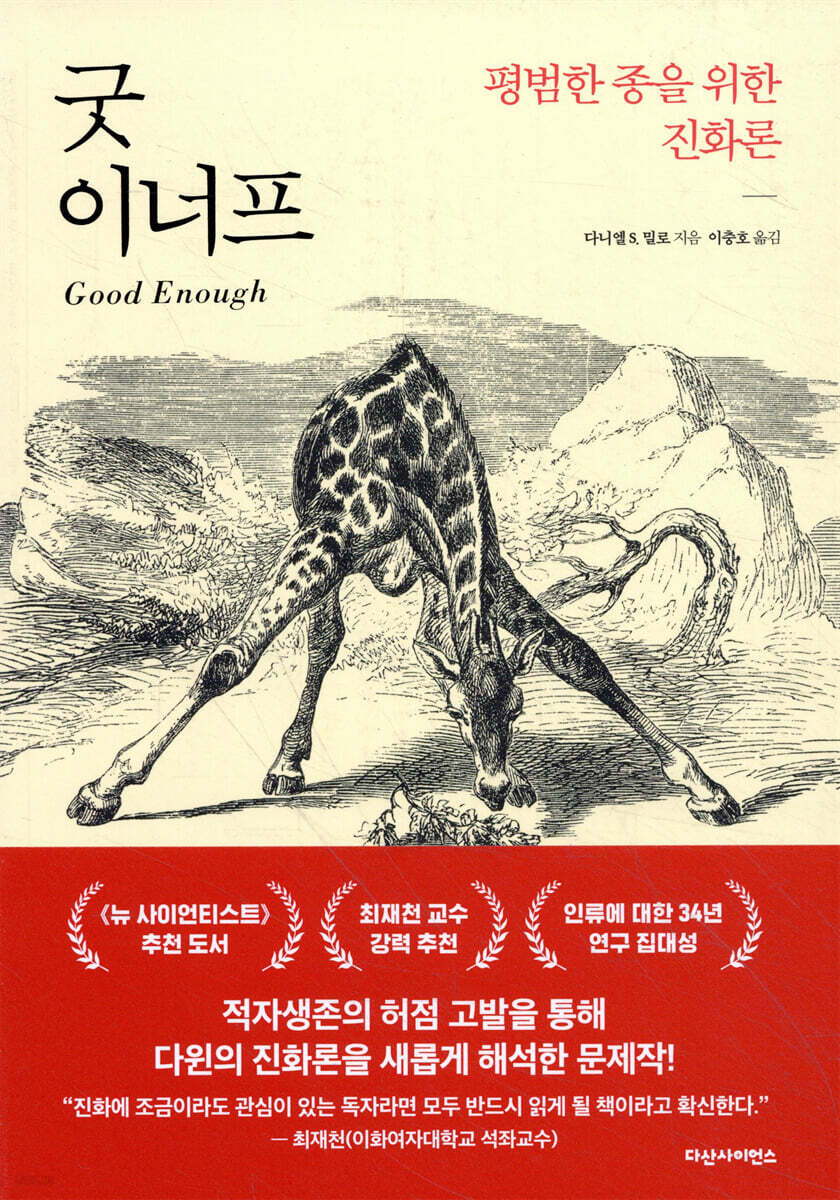
Good Enough
 |
Description
Book Introduction
“Even if you don’t try hard, even if it’s not enough,
“All life deserves to live!”
The law of nature that evolves through waste and excess, not through rationality and hierarchy.
Daniel Milo, the bestselling author of "The Invention of Tomorrow," which revealed the causes of human development, returns with a story that goes beyond his previous work and deals with nature, society, and life.
This book begins by challenging the law that has long guided nature and society: "Only the fittest survive."
By critically exploring Darwin's theory of evolution, it reveals why most living things in nature are not specialized species optimized for their environment, but rather general species with flaws, and that ordinary species can also survive without problems.
Furthermore, by applying this to human society, it provides an opportunity to look at life in a new way for modern people who live with the compulsion to improve in the midst of endless competition.
“All life deserves to live!”
The law of nature that evolves through waste and excess, not through rationality and hierarchy.
Daniel Milo, the bestselling author of "The Invention of Tomorrow," which revealed the causes of human development, returns with a story that goes beyond his previous work and deals with nature, society, and life.
This book begins by challenging the law that has long guided nature and society: "Only the fittest survive."
By critically exploring Darwin's theory of evolution, it reveals why most living things in nature are not specialized species optimized for their environment, but rather general species with flaws, and that ordinary species can also survive without problems.
Furthermore, by applying this to human society, it provides an opportunity to look at life in a new way for modern people who live with the compulsion to improve in the midst of endless competition.
- You can preview some of the book's contents.
Preview
index
Release and 'survival of the fittest' should have been comparative.
preface
Part 1 · Icons of Evolution
Chapter 1 · Giraffe: Science Begins with Wonder
Chapter 2 · The Domestication Analogy: Darwin's Original Sin
Chapter 3 · The Galapagos Islands and Finches: Two Unrepresentative Icons
Chapter 4: The Brain: Our Ancestors' Greatest Enemy
Part 2: The Good Enough Theory
Chapter 5 · Accepting Neutrality
Chapter 6 · Strange Scope: The Bias Toward Excess
Chapter 7: Nature's Safety Net
Part 3: Our Victory and Its Side Effects
Chapter 8: Inventions of Tomorrow
Chapter 9 · Humanity's Safety Net
Chapter 10: The Conspiracy of Excellence: A Critique of Evolutionary Ethics
Americas / Photos and Illustrations / Search
preface
Part 1 · Icons of Evolution
Chapter 1 · Giraffe: Science Begins with Wonder
Chapter 2 · The Domestication Analogy: Darwin's Original Sin
Chapter 3 · The Galapagos Islands and Finches: Two Unrepresentative Icons
Chapter 4: The Brain: Our Ancestors' Greatest Enemy
Part 2: The Good Enough Theory
Chapter 5 · Accepting Neutrality
Chapter 6 · Strange Scope: The Bias Toward Excess
Chapter 7: Nature's Safety Net
Part 3: Our Victory and Its Side Effects
Chapter 8: Inventions of Tomorrow
Chapter 9 · Humanity's Safety Net
Chapter 10: The Conspiracy of Excellence: A Critique of Evolutionary Ethics
Americas / Photos and Illustrations / Search
Into the book
Human society is not ruthlessly competitive, and neither is nature.
Both are tolerant of excess, inertia, error, mediocrity, and failed experiments.
In places where great success occurs in society and nature, luck can play a far more important role than ability.
But still, many people say that in nature and human history, the only thing that matters is ability (sometimes expressed as fitness, sometimes as advantage), and that everything follows the laws of Darwinism.
I am trying to destroy this very dogma.
--- pp.022-023, 「Preface」
The claim that giraffes' long necks give them an advantage in foraging turns out to be a concept invented by evolutionists who have never seen a giraffe in the wild.
During the dry season, giraffes mainly eat leaves from bushes or lower than shoulder height, and rarely eat leaves from higher places.
They spend about half their time foraging on leaves at or below 2 m, overlapping their foraging grounds with larger herbivores such as the gerenuk (Litocranius walleri), kudu (Tragelaphus imberbis) and greater kudu (Tragelaphus strepsiceros).
As if harboring a grudge against Darwinists, giraffes are more likely to forage for leaves from higher elevations during the rainy season when food is abundant.
--- p.087, Chapter 1: Giraffe: Science Begins with Wonder
It is more accurate to say that breeding was the cornerstone rather than the stepping stone in Darwin's argument.
Darwin never deviated from the logic of the domestication analogy, nor did he have the heart to do so, because he never saw it as a problem.
Natural selection was modeled after artificial selection, and natural selection worked in the same way as artificial selection.
Since then, this analogy has stayed with us, fostering the illusion that natural selection is an agent that endlessly optimizes species' performance in the struggle for survival.
--- p.099, "Chapter 2: Domestication Analogy: Darwin's Original Sin"
Those who study life can approach common properties even if they study only one organism.
However, the organism must be a true 'model' organism that helps with the problem being investigated.
Finches are excellent model organisms for studying natural selection, but that doesn't mean that beak evolution followed a typical, let alone common, path.
--- p.122, Chapter 3, The Galapagos Islands and Finches: Two Icons, Not Representative
From an evolutionary perspective, it suggests that the Homo brain is detrimental to all its owners.
The brain makes reproduction, both birth and postnatal growth, incredibly difficult.
A large skull can threaten the birth canal of the mother, putting the health of both mother and baby at risk.
Slow brain maturation further reduces the adult's reproductive potential by leaving the baby in a helpless, dependent state.
The brain has enormous energy demands, placing a heavy burden on available resources.
It is therefore not surprising that Homo sapiens has lived on the brink of extinction for a significant portion of its history, while all other species of the Homo lineage have long since gone extinct.
--- pp. 157-158, "Chapter 4: The Brain: Our Ancestors' Greatest Enemy"
Neutrality is also important in phylogeny, the process of development of species and their characters.
Neutrality is the raw material of invention.
All traits are the product of mutations that are born in a neutral state.
Most die neutrally, but one of the countless others plays a small but necessary role in the basic structure of life.
If biological mechanisms did not make replication errors, mistaking A for G or C for T, there would be no evolution.
Every trait is the most recent offspring of a series of replication errors.
--- p.206, Chapter 5: Accepting Neutrality
“Consider the enormous number of variations that every generation of every species offers.
Therefore, the number of useless mutations must also be enormous.
There will be hundreds of times more useful mutations than useful ones.”62 There is no room for natural selection to intervene here.
As stagnation continues, the extremes are eliminated.
But because natural selection can't keep pace with the generation of mutations (think of 88 million genetic variations), the extremes continue to fall out, and the range continues to widen.
Positive selection events occur during normal times, but they are very rare.
--- p.255, Chapter 6, Strange Scope: Bias for Excess
The safety net is so strong that the genetic lottery could create all sorts of sustainable deviations.
all.
The Horned Cicada's helmet proves that the deviance was very extreme before "the sentence of unfitness was read and the penalty of extinction was carried out."
The safety net is nature's safeguard for both the rich and the poor.
Excellence is neither harmful nor necessary.
Even the ordinary can be quite wonderful.
--- p.273, Chapter 7: Nature's Safety Net
Only man can escape the chains of fate, because only man can strive for something completely different.
(Omitted) Every ‘here’ has a corresponding ‘there’, and every ‘now’ has a corresponding ‘next’.
Every 'yes' is followed by a 'but', because the first 'see you tomorrow' meant the end of 'I had no choice.'
Because we have a future we can manipulate, humans can always do things differently, or at least imagine doing things differently.
--- p.297, Chapter 8: Inventions of Tomorrow
Our future-orientation can create opportunities for endless waste, anxiety, and boundless dependence.
But it also makes our species invincible.
Natural selection provided the basic infrastructure for the genus Homo, a model destined for extinction because of its wasteful brain.
But before that could happen, the future kept both the fittest and the mediocre alive by trapping Homo sapiens within its safety net.
No matter how much our bubbles inflate, no matter how far our minds wander from the concerns of choice—survival and reproduction—we will always be here.
--- p.334, Chapter 9, Humanity's Safety Net
It is absurd to think that nature demands excellence from each of us or rewards anyone for it.
What is considered excellence and what is rewarded for it is chosen by society.
The human world is a vast, almost borderless room that can accommodate the smart and the stupid, the experts and the dilettantes, the hard workers and the lazy, the champions and the mediocre.
Both are tolerant of excess, inertia, error, mediocrity, and failed experiments.
In places where great success occurs in society and nature, luck can play a far more important role than ability.
But still, many people say that in nature and human history, the only thing that matters is ability (sometimes expressed as fitness, sometimes as advantage), and that everything follows the laws of Darwinism.
I am trying to destroy this very dogma.
--- pp.022-023, 「Preface」
The claim that giraffes' long necks give them an advantage in foraging turns out to be a concept invented by evolutionists who have never seen a giraffe in the wild.
During the dry season, giraffes mainly eat leaves from bushes or lower than shoulder height, and rarely eat leaves from higher places.
They spend about half their time foraging on leaves at or below 2 m, overlapping their foraging grounds with larger herbivores such as the gerenuk (Litocranius walleri), kudu (Tragelaphus imberbis) and greater kudu (Tragelaphus strepsiceros).
As if harboring a grudge against Darwinists, giraffes are more likely to forage for leaves from higher elevations during the rainy season when food is abundant.
--- p.087, Chapter 1: Giraffe: Science Begins with Wonder
It is more accurate to say that breeding was the cornerstone rather than the stepping stone in Darwin's argument.
Darwin never deviated from the logic of the domestication analogy, nor did he have the heart to do so, because he never saw it as a problem.
Natural selection was modeled after artificial selection, and natural selection worked in the same way as artificial selection.
Since then, this analogy has stayed with us, fostering the illusion that natural selection is an agent that endlessly optimizes species' performance in the struggle for survival.
--- p.099, "Chapter 2: Domestication Analogy: Darwin's Original Sin"
Those who study life can approach common properties even if they study only one organism.
However, the organism must be a true 'model' organism that helps with the problem being investigated.
Finches are excellent model organisms for studying natural selection, but that doesn't mean that beak evolution followed a typical, let alone common, path.
--- p.122, Chapter 3, The Galapagos Islands and Finches: Two Icons, Not Representative
From an evolutionary perspective, it suggests that the Homo brain is detrimental to all its owners.
The brain makes reproduction, both birth and postnatal growth, incredibly difficult.
A large skull can threaten the birth canal of the mother, putting the health of both mother and baby at risk.
Slow brain maturation further reduces the adult's reproductive potential by leaving the baby in a helpless, dependent state.
The brain has enormous energy demands, placing a heavy burden on available resources.
It is therefore not surprising that Homo sapiens has lived on the brink of extinction for a significant portion of its history, while all other species of the Homo lineage have long since gone extinct.
--- pp. 157-158, "Chapter 4: The Brain: Our Ancestors' Greatest Enemy"
Neutrality is also important in phylogeny, the process of development of species and their characters.
Neutrality is the raw material of invention.
All traits are the product of mutations that are born in a neutral state.
Most die neutrally, but one of the countless others plays a small but necessary role in the basic structure of life.
If biological mechanisms did not make replication errors, mistaking A for G or C for T, there would be no evolution.
Every trait is the most recent offspring of a series of replication errors.
--- p.206, Chapter 5: Accepting Neutrality
“Consider the enormous number of variations that every generation of every species offers.
Therefore, the number of useless mutations must also be enormous.
There will be hundreds of times more useful mutations than useful ones.”62 There is no room for natural selection to intervene here.
As stagnation continues, the extremes are eliminated.
But because natural selection can't keep pace with the generation of mutations (think of 88 million genetic variations), the extremes continue to fall out, and the range continues to widen.
Positive selection events occur during normal times, but they are very rare.
--- p.255, Chapter 6, Strange Scope: Bias for Excess
The safety net is so strong that the genetic lottery could create all sorts of sustainable deviations.
all.
The Horned Cicada's helmet proves that the deviance was very extreme before "the sentence of unfitness was read and the penalty of extinction was carried out."
The safety net is nature's safeguard for both the rich and the poor.
Excellence is neither harmful nor necessary.
Even the ordinary can be quite wonderful.
--- p.273, Chapter 7: Nature's Safety Net
Only man can escape the chains of fate, because only man can strive for something completely different.
(Omitted) Every ‘here’ has a corresponding ‘there’, and every ‘now’ has a corresponding ‘next’.
Every 'yes' is followed by a 'but', because the first 'see you tomorrow' meant the end of 'I had no choice.'
Because we have a future we can manipulate, humans can always do things differently, or at least imagine doing things differently.
--- p.297, Chapter 8: Inventions of Tomorrow
Our future-orientation can create opportunities for endless waste, anxiety, and boundless dependence.
But it also makes our species invincible.
Natural selection provided the basic infrastructure for the genus Homo, a model destined for extinction because of its wasteful brain.
But before that could happen, the future kept both the fittest and the mediocre alive by trapping Homo sapiens within its safety net.
No matter how much our bubbles inflate, no matter how far our minds wander from the concerns of choice—survival and reproduction—we will always be here.
--- p.334, Chapter 9, Humanity's Safety Net
It is absurd to think that nature demands excellence from each of us or rewards anyone for it.
What is considered excellence and what is rewarded for it is chosen by society.
The human world is a vast, almost borderless room that can accommodate the smart and the stupid, the experts and the dilettantes, the hard workers and the lazy, the champions and the mediocre.
--- p.369, Chapter 10, The Conspiracy of Excellence: A Critique of Evolutionary Ethics
Publisher's Review
“Any reader with even the slightest interest in evolution
I am confident that this is a must-read book for everyone.” - Choi Jae-cheon
A world where even ordinary people, not just the best, can survive
Modern people live in a cutting-edge civilization where everything is highly developed, but their lives are still shrouded in anxiety about survival, as if they are stuck in the past.
Author Daniel S., who has been studying humanity for 34 years,
Milo says this is the result of the standards and competition that only consider the number one the best, regardless of the changing times.
In our country, which is experiencing serious social problems with the number of suicides reaching 27 per 100,000 people annually, Milo's claim is quite special.
I believe that humanity has been able to reach its current position by following this principle, believing that the law of survival of the fittest based on efficiency and optimization that exists in nature also applies to human society.
However, Milo directly refutes this idea, because in nature there is no survival of the fittest, and evolution is achieved through waste and excess rather than efficiency and optimization.
Just as he revealed in his previous work, "Future Addict," that the cause of human development was not the discovery of the brain or fire, but rather the creation of the concept of "tomorrow," Milo, who once again presents an argument that challenges existing perceptions, dispels human anxiety with the unexpected element of ordinariness and leads readers to feel the wonder of life.
Nature never said survival of the fittest!
Regarding how the pursuit of first place, the survival of the fittest, which causes social anxiety, became ingrained in human society, Millo says that it was because Darwin “translated the concept of survival of the fittest from nature to society” and it became “gospel in the thought of Milton Friedman” who demanded efficiency, rationality, and excellence.
In other words, survival of the fittest became the ideological foundation of capitalism and influenced human life.
However, Milo points out that this survival of the fittest is actually only seen in a very small part of nature, and that there is a problem with survival of the fittest itself.
According to survival of the fittest, only the fittest individuals with the best survival skills survive, and all other species are eliminated and become extinct.
However, actual observations show that the majority of species in nature are not optimized.
Milo uses the giraffe as an example of this, a phenomenon that has puzzled many evolutionists.
It is believed that giraffes evolved to have long necks to eat food from high places, but in reality, they prefer to eat grass that grows low in the ground, making their long necks seem pointless.
They also eat grass in low places during the dry season when food is scarce, where their food sources overlap with those of other competitors.
Rather, it is difficult to conclude that the giraffe's long neck has evolved optimally, given that it only eats leaves from high places during the rainy season when food is abundant.
In addition, there are countless cases where only shortcomings are observed, such as the fact that the brain, the organ that developed humanity, actually threatened the survival of early humans, and the fact that the cicada's headdress, which was only grandiose and had no function, continued to be maintained.
Unlike the explanation of survival of the fittest, which states that only the fittest survive, in reality, only creatures with their own weaknesses exist in nature, and most species and individuals are not special.
Based on this, Milo argues that all living things have survived so far not because they were selected for their optimal traits, but simply because they were not bad enough to be eliminated.
The human brain that can't stand boredom
The reason why survival of the fittest, despite being inaccurate, remains so powerful in human society is not only because of its connection to capitalism, but also because the human brain pursues excellence.
The human brain, which is overwhelmingly superior to that of other animals, used to function to its fullest extent, enabling us to avoid countless survival crises. However, in the present, when external dangers have almost disappeared, there is no place for this function to be used.
However, the human brain, which must continuously function, has been searching for ways to pursue it even when it does not need to, and has ended up chasing excessive excellence, putting humans on a train of limitless pursuit of excellence.
It was this characteristic of the brain that created a society that felt like it would soon be eliminated if it didn't improve.
A message found in nature's generosity
Through the reality of survival of the fittest and the characteristics of the brain, Milo makes us realize the endless pursuit of competition without a goal that entangles human life, and asks whether this is something that humanity should pursue to the point of self-destruction.
While the pursuit of excellence certainly brings the fruits of progress, if it becomes blind and uniform, it will only leave humanity feeling a sense of lack rather than a satisfying life.
Clearly, nature does not guarantee an 'affluent' life tailored to each individual's wishes.
Nature and society only guarantee the most basic things you need to be born and live, and you must obtain the wealth and fame that everyone desires.
Then, you might think, isn't it right to pursue competition and excellence in the end?
But this book is not about not pursuing excellence.
Nature and society guarantee survival, and therefore humanity can choose from a variety of possibilities beyond the simple pursuit of survival.
Just as nature allows for the majority of common species to have shortcomings, let's look at diversity without being obsessed with the single value of being number one.
Then you will be able to see a world of countless possibilities you have never seen before and feel the wonder and happiness of life.
I am confident that this is a must-read book for everyone.” - Choi Jae-cheon
A world where even ordinary people, not just the best, can survive
Modern people live in a cutting-edge civilization where everything is highly developed, but their lives are still shrouded in anxiety about survival, as if they are stuck in the past.
Author Daniel S., who has been studying humanity for 34 years,
Milo says this is the result of the standards and competition that only consider the number one the best, regardless of the changing times.
In our country, which is experiencing serious social problems with the number of suicides reaching 27 per 100,000 people annually, Milo's claim is quite special.
I believe that humanity has been able to reach its current position by following this principle, believing that the law of survival of the fittest based on efficiency and optimization that exists in nature also applies to human society.
However, Milo directly refutes this idea, because in nature there is no survival of the fittest, and evolution is achieved through waste and excess rather than efficiency and optimization.
Just as he revealed in his previous work, "Future Addict," that the cause of human development was not the discovery of the brain or fire, but rather the creation of the concept of "tomorrow," Milo, who once again presents an argument that challenges existing perceptions, dispels human anxiety with the unexpected element of ordinariness and leads readers to feel the wonder of life.
Nature never said survival of the fittest!
Regarding how the pursuit of first place, the survival of the fittest, which causes social anxiety, became ingrained in human society, Millo says that it was because Darwin “translated the concept of survival of the fittest from nature to society” and it became “gospel in the thought of Milton Friedman” who demanded efficiency, rationality, and excellence.
In other words, survival of the fittest became the ideological foundation of capitalism and influenced human life.
However, Milo points out that this survival of the fittest is actually only seen in a very small part of nature, and that there is a problem with survival of the fittest itself.
According to survival of the fittest, only the fittest individuals with the best survival skills survive, and all other species are eliminated and become extinct.
However, actual observations show that the majority of species in nature are not optimized.
Milo uses the giraffe as an example of this, a phenomenon that has puzzled many evolutionists.
It is believed that giraffes evolved to have long necks to eat food from high places, but in reality, they prefer to eat grass that grows low in the ground, making their long necks seem pointless.
They also eat grass in low places during the dry season when food is scarce, where their food sources overlap with those of other competitors.
Rather, it is difficult to conclude that the giraffe's long neck has evolved optimally, given that it only eats leaves from high places during the rainy season when food is abundant.
In addition, there are countless cases where only shortcomings are observed, such as the fact that the brain, the organ that developed humanity, actually threatened the survival of early humans, and the fact that the cicada's headdress, which was only grandiose and had no function, continued to be maintained.
Unlike the explanation of survival of the fittest, which states that only the fittest survive, in reality, only creatures with their own weaknesses exist in nature, and most species and individuals are not special.
Based on this, Milo argues that all living things have survived so far not because they were selected for their optimal traits, but simply because they were not bad enough to be eliminated.
The human brain that can't stand boredom
The reason why survival of the fittest, despite being inaccurate, remains so powerful in human society is not only because of its connection to capitalism, but also because the human brain pursues excellence.
The human brain, which is overwhelmingly superior to that of other animals, used to function to its fullest extent, enabling us to avoid countless survival crises. However, in the present, when external dangers have almost disappeared, there is no place for this function to be used.
However, the human brain, which must continuously function, has been searching for ways to pursue it even when it does not need to, and has ended up chasing excessive excellence, putting humans on a train of limitless pursuit of excellence.
It was this characteristic of the brain that created a society that felt like it would soon be eliminated if it didn't improve.
A message found in nature's generosity
Through the reality of survival of the fittest and the characteristics of the brain, Milo makes us realize the endless pursuit of competition without a goal that entangles human life, and asks whether this is something that humanity should pursue to the point of self-destruction.
While the pursuit of excellence certainly brings the fruits of progress, if it becomes blind and uniform, it will only leave humanity feeling a sense of lack rather than a satisfying life.
Clearly, nature does not guarantee an 'affluent' life tailored to each individual's wishes.
Nature and society only guarantee the most basic things you need to be born and live, and you must obtain the wealth and fame that everyone desires.
Then, you might think, isn't it right to pursue competition and excellence in the end?
But this book is not about not pursuing excellence.
Nature and society guarantee survival, and therefore humanity can choose from a variety of possibilities beyond the simple pursuit of survival.
Just as nature allows for the majority of common species to have shortcomings, let's look at diversity without being obsessed with the single value of being number one.
Then you will be able to see a world of countless possibilities you have never seen before and feel the wonder and happiness of life.
GOODS SPECIFICS
- Publication date: June 28, 2021
- Page count, weight, size: 432 pages | 728g | 152*215*27mm
- ISBN13: 9791130601298
- ISBN10: 1130601293
You may also like
카테고리
korean


korean

![GQ KOREA Mark (Monthly): December [2025]](http://librairie.coreenne.fr/cdn/shop/files/8ef265dbbfbf186523ed75ba7319009d.jpg?v=1765340328&width=3840)


