

Forest, I recommend watching it again
 |
Description
Book Introduction
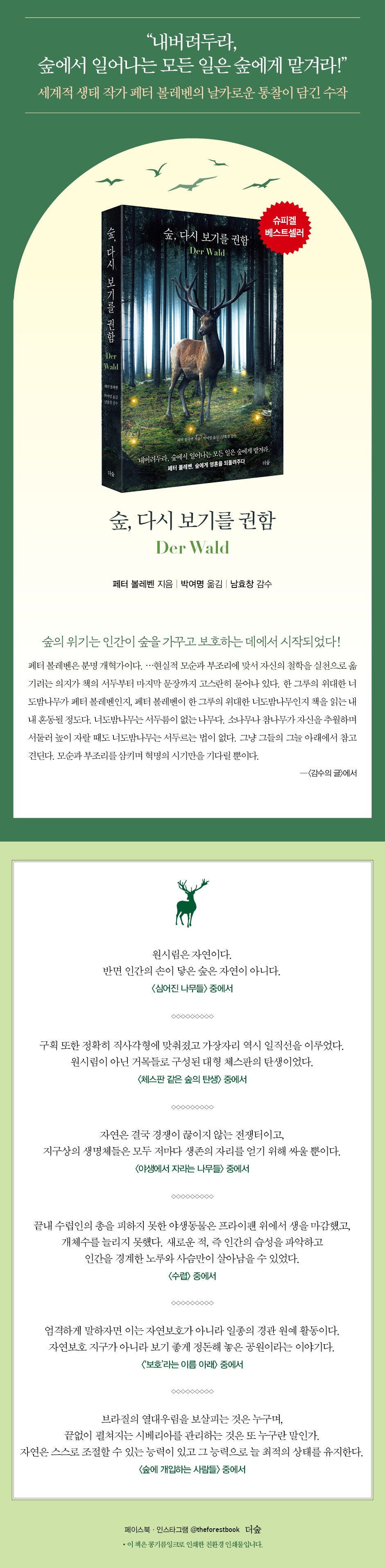
Peter Wohlleben, a world-renowned ecological writer whose work has become a genre unto itself, says:
“Let it be, whatever happens in the forest, leave it to the forest!”
"Forest, Revisited" is a book that asks the fundamental question of whether the things we do in the name of "nature conservation and environmental protection" are truly for the good of nature, especially in these times when the environment is becoming the most important issue.
Author Peter Wohlleben breaks away from a human-centric perspective and looks at trees and the world of nature through his own unique and distinctive perspective.
It is being revealed that human intervention in environmental protection, which does not respect the natural habits, is actually putting the forest in danger.
Nature knows how to create the environment it needs and has the ability to regulate itself, and through this ability, it has always maintained an optimal state.
Therefore, it reminds us that leaving the forest to return to its natural order is the way to make it a sustainable forest and a unique nature.
This book does not describe the forest, but guides readers to discover and understand it, and the author's empathy and respect for all living beings leave a deep resonance in the reader's heart.
And it reminds us of our responsibility towards nature, which we had forgotten.
Peter Wohlleben, who has been called a nature interpreter who translates scientific knowledge into emotions, a tree interpreter, a forest interpreter who conveys the mysteries of forest ecosystems, and a bestselling author, will once again bring forests to readers' bookshelves.
“Let it be, whatever happens in the forest, leave it to the forest!”
"Forest, Revisited" is a book that asks the fundamental question of whether the things we do in the name of "nature conservation and environmental protection" are truly for the good of nature, especially in these times when the environment is becoming the most important issue.
Author Peter Wohlleben breaks away from a human-centric perspective and looks at trees and the world of nature through his own unique and distinctive perspective.
It is being revealed that human intervention in environmental protection, which does not respect the natural habits, is actually putting the forest in danger.
Nature knows how to create the environment it needs and has the ability to regulate itself, and through this ability, it has always maintained an optimal state.
Therefore, it reminds us that leaving the forest to return to its natural order is the way to make it a sustainable forest and a unique nature.
This book does not describe the forest, but guides readers to discover and understand it, and the author's empathy and respect for all living beings leave a deep resonance in the reader's heart.
And it reminds us of our responsibility towards nature, which we had forgotten.
Peter Wohlleben, who has been called a nature interpreter who translates scientific knowledge into emotions, a tree interpreter, a forest interpreter who conveys the mysteries of forest ecosystems, and a bestselling author, will once again bring forests to readers' bookshelves.
- You can preview some of the book's contents.
Preview
index
Foreword / Reviewer's Note
Chapter 1: Becoming a Forest Management Expert
Chapter 2: Learning from the Forest
Chapter 3: The Birth of a Chessboard-Like Forest
Chapter 4 Trees Growing in the Wild
Chapter 5: Planted Trees
Chapter 6 Hunting
Chapter 7 Under the Name of 'Protection'
Chapter 8: People Who Intervene in the Forest
Chapter 9: Assessing Poor Forest Management
Chapter 10: The Consequences of Cost Reduction on Forests
Chapter 11: Under every tree there is eternal rest.
Chapter 12: Insights from a Forest Survival Experience
Chapter 13: What I Want to Tell Children
Chapter 14: The Future of Forests
Chapter 15: Trees Protected by the Stubbornness of the Forest Owners
Chapter 16 Young Forest Management Professionals
Chapter 17: Never Let Go of Hope
main
Chapter 1: Becoming a Forest Management Expert
Chapter 2: Learning from the Forest
Chapter 3: The Birth of a Chessboard-Like Forest
Chapter 4 Trees Growing in the Wild
Chapter 5: Planted Trees
Chapter 6 Hunting
Chapter 7 Under the Name of 'Protection'
Chapter 8: People Who Intervene in the Forest
Chapter 9: Assessing Poor Forest Management
Chapter 10: The Consequences of Cost Reduction on Forests
Chapter 11: Under every tree there is eternal rest.
Chapter 12: Insights from a Forest Survival Experience
Chapter 13: What I Want to Tell Children
Chapter 14: The Future of Forests
Chapter 15: Trees Protected by the Stubbornness of the Forest Owners
Chapter 16 Young Forest Management Professionals
Chapter 17: Never Let Go of Hope
main
Detailed image
Into the book
The noise and bustle of everyday life disappears in the forest.
As the wind rustles through the canopies, birds sing, and green leaves mingle with the blue sky.
It is time for us to take a deep breath and relax.
Forests also provide drinking water, clean air, and a diversity of biodiversity.
This is why we love the forest.
I would like to ask whether what we are seeing now is really nature in its true form.
As I began to critically examine the future of forests, I began to see countless forests as nothing more than green stage sets.
It was discovered that behind the scenes, ruthless exploitation was taking place.
Forest animals are relegated to the margins and are seen as little more than nuisances, and trees are merely raw materials with a predetermined lifespan.
--- From the "Header"
Peter Wohlleben is clearly a reformer.
… … The will to put one’s own philosophy into practice in the face of realistic contradictions and absurdities is evident from the beginning to the last sentence of the book.
It's almost as if I'm confused throughout the book whether Peter Wohlleben is the great beech tree or Peter Wohlleben is the great beech tree.
The oak tree is a tree that does not rush.
Even when pines and oaks grow taller and faster than they can, the beech tree never rushes.
Just endure it under their shadow.
We just swallow contradictions and absurdities and wait for the time of revolution.
--- From "The Supervisor's Note"
Wild animal accidents on the road are closely related to the situation of deer, which are so numerous that they have to compete for habitat.
What if the population had remained at its natural level? Naturally, no drivers would have made eye contact with deer.
Ultimately, the statistics clearly show that the trophy hunting culture that encourages breeding and feeding is the cause of the accident.
--- From Chapter 6: Hunting
When promoting this profession in relation to forests, the argument is made that forests are like fragile patients in need of care.
Only with the help of forest management experts can forests be kept safe from disease and damage.
It is said that it is not nature, but the Forest Service, that knows best which trees will grow ideally in which places.
Forest management experts are responsible for cutting down old trees in a timely manner and replacing them with vigorous young trees to ensure that the ecosystem can function fully.
Without them, there would be no forest.
This is the common perception of forest management professionals.
As you might expect, this is complete nonsense.
So who cares for the rainforests of Brazil, and who manages the endless expanses of Siberia? Nature possesses the ability to self-regulate, and through this ability, it maintains optimal conditions.
--- From "Chapter 8: People Who Intervene in the Forest"
My colleagues' words make sense, considering that my work has completely changed since I started running the tree farm.
Half of my working hours are spent guiding customers who inquire about the tree farm and selling trees to those who want to sign a contract.
But this is a good thing.
Most of the people who visit the arboretum share my values and, above all, love nature.
The cost of distribution was determined by considering the value of the timber of the selected trees.
With this, the beech tree, having paid off its debt, was able to grow old to its full potential.
As the wind rustles through the canopies, birds sing, and green leaves mingle with the blue sky.
It is time for us to take a deep breath and relax.
Forests also provide drinking water, clean air, and a diversity of biodiversity.
This is why we love the forest.
I would like to ask whether what we are seeing now is really nature in its true form.
As I began to critically examine the future of forests, I began to see countless forests as nothing more than green stage sets.
It was discovered that behind the scenes, ruthless exploitation was taking place.
Forest animals are relegated to the margins and are seen as little more than nuisances, and trees are merely raw materials with a predetermined lifespan.
--- From the "Header"
Peter Wohlleben is clearly a reformer.
… … The will to put one’s own philosophy into practice in the face of realistic contradictions and absurdities is evident from the beginning to the last sentence of the book.
It's almost as if I'm confused throughout the book whether Peter Wohlleben is the great beech tree or Peter Wohlleben is the great beech tree.
The oak tree is a tree that does not rush.
Even when pines and oaks grow taller and faster than they can, the beech tree never rushes.
Just endure it under their shadow.
We just swallow contradictions and absurdities and wait for the time of revolution.
--- From "The Supervisor's Note"
Wild animal accidents on the road are closely related to the situation of deer, which are so numerous that they have to compete for habitat.
What if the population had remained at its natural level? Naturally, no drivers would have made eye contact with deer.
Ultimately, the statistics clearly show that the trophy hunting culture that encourages breeding and feeding is the cause of the accident.
--- From Chapter 6: Hunting
When promoting this profession in relation to forests, the argument is made that forests are like fragile patients in need of care.
Only with the help of forest management experts can forests be kept safe from disease and damage.
It is said that it is not nature, but the Forest Service, that knows best which trees will grow ideally in which places.
Forest management experts are responsible for cutting down old trees in a timely manner and replacing them with vigorous young trees to ensure that the ecosystem can function fully.
Without them, there would be no forest.
This is the common perception of forest management professionals.
As you might expect, this is complete nonsense.
So who cares for the rainforests of Brazil, and who manages the endless expanses of Siberia? Nature possesses the ability to self-regulate, and through this ability, it maintains optimal conditions.
--- From "Chapter 8: People Who Intervene in the Forest"
My colleagues' words make sense, considering that my work has completely changed since I started running the tree farm.
Half of my working hours are spent guiding customers who inquire about the tree farm and selling trees to those who want to sign a contract.
But this is a good thing.
Most of the people who visit the arboretum share my values and, above all, love nature.
The cost of distribution was determined by considering the value of the timber of the selected trees.
With this, the beech tree, having paid off its debt, was able to grow old to its full potential.
--- From Chapter 11, “Under Every Tree There Is Eternal Rest”
Publisher's Review
The forest crisis began with humans cultivating and protecting the forest!
The forest is the last secret place left on Earth.
We believe that forests are a sanctuary, a place of rest, and a space that embodies nature's natural beauty, but unfortunately, this is not the case.
For centuries, forests have been considered as something that needs to be cared for, and humans have intervened in them. However, with the arrival of human hands, forests have entered a period of crisis.
Peter Wohlleben finds the cause in the way we look at the forest.
People say they love trees and forests as living things, but in reality, the real intention of those who protect and manage forests is to protect and manage them for forestry (and in Germany, hunting).
Trees are a resource, a commodity, that must be used for economic efficiency.
For example, if trees are not maintained or the timing for maintenance is missed, the value of the trees as a resource decreases and the forest becomes completely useless.
The forests around us today are, from a forestry perspective, nothing more than a collection of trees waiting to be cut down (as in Germany, with the addition of hunting, they also function as livestock farms with game).
Ultimately, we want forests that provide economic benefits tailored to our needs.
According to Peter Wohlleben, this view stems from the narrow-minded arrogance of humans who view nature as a fragile patient in need of care, and who believe that it is humans, not nature, who know which trees will grow best where.
There is also a lack of consideration, respect, and a deep understanding of the countless soil microorganisms, wild animals, and other living things in the forest.
Today's nature conservation is about selecting tree species according to trends without any consideration for the forest, clear-cutting or thinning when problems arise, and then replanting in that spot.
As a result, biodiversity was lost and primary forests disappeared.
But there is no forest in this world better than a natural forest untouched by human hands.
Forests are nature, not parks to be tended and maintained, and true nature conservation is not gardening.
Peter Wohlleben wants to protect the trees, forests, and the countless creatures that live within them from this ruthless human hand, so he does not use chemical fertilizers in the areas he manages, and he uses horses instead of machines that destroy the forest soil.
In addition, to protect the habitat of the old beech trees, we operate a tree farm that can be used for 99 years.
This is not forest management based on the economic logic of forestry, but true protection that allows nature to return to nature.
Is the forest we know truly nature?
Although trees are considered to be living beings without emotions or senses, they can see light and communicate with their fellows to share information.
If these trees are left to their own devices, as they did a long time ago, the seedlings will grow under the mother tree and coexist with microorganisms deep underground. One day, when the seedlings grow larger than the mother tree, the mother tree, having fulfilled its mission, will die.
Peter Wohlleben, with extensive field experience, says that observing and waiting for this process to take its course is the true protection of forests and ecosystems.
Nature is something that was not originally created by human hands.
The author also reveals the hidden truths of wind power and biomass, which are known as green energy sources that greatly contribute to preventing air pollution.
In reality, the process of installing wind turbines on mountains and cutting down many trees to make wood pellets releases large amounts of carbon dioxide stored in the soil.
During this time, wild animals lose their habitats, and many birds are said to be killed by the blades of wind turbines.
Peter Wohlleben makes a compelling point that true conservation of nature is about actively conserving energy rather than destroying so many trees and other life forms to produce green energy.
Trees have the ability to regulate everything on their own, from the deepest soil to the highest crown.
However, with human intervention, the forest is being robbed of its order, life, and community, and is being damaged.
Now, we must return the authority of nature to nature, and the results of intervention from a human-centered perspective are not only the destruction of forests and soil, but also climate change, air pollution, and water pollution.
It also serves as a painful warning that this is the price we and our descendants will have to pay.
This book is filled with the author's respect and consideration for all living beings, and his constant efforts to care for them.
Through beautiful expressions that are cynical, humorous, and sometimes thought-provoking, we encounter another entertaining humanities book.
The forest is the last secret place left on Earth.
We believe that forests are a sanctuary, a place of rest, and a space that embodies nature's natural beauty, but unfortunately, this is not the case.
For centuries, forests have been considered as something that needs to be cared for, and humans have intervened in them. However, with the arrival of human hands, forests have entered a period of crisis.
Peter Wohlleben finds the cause in the way we look at the forest.
People say they love trees and forests as living things, but in reality, the real intention of those who protect and manage forests is to protect and manage them for forestry (and in Germany, hunting).
Trees are a resource, a commodity, that must be used for economic efficiency.
For example, if trees are not maintained or the timing for maintenance is missed, the value of the trees as a resource decreases and the forest becomes completely useless.
The forests around us today are, from a forestry perspective, nothing more than a collection of trees waiting to be cut down (as in Germany, with the addition of hunting, they also function as livestock farms with game).
Ultimately, we want forests that provide economic benefits tailored to our needs.
According to Peter Wohlleben, this view stems from the narrow-minded arrogance of humans who view nature as a fragile patient in need of care, and who believe that it is humans, not nature, who know which trees will grow best where.
There is also a lack of consideration, respect, and a deep understanding of the countless soil microorganisms, wild animals, and other living things in the forest.
Today's nature conservation is about selecting tree species according to trends without any consideration for the forest, clear-cutting or thinning when problems arise, and then replanting in that spot.
As a result, biodiversity was lost and primary forests disappeared.
But there is no forest in this world better than a natural forest untouched by human hands.
Forests are nature, not parks to be tended and maintained, and true nature conservation is not gardening.
Peter Wohlleben wants to protect the trees, forests, and the countless creatures that live within them from this ruthless human hand, so he does not use chemical fertilizers in the areas he manages, and he uses horses instead of machines that destroy the forest soil.
In addition, to protect the habitat of the old beech trees, we operate a tree farm that can be used for 99 years.
This is not forest management based on the economic logic of forestry, but true protection that allows nature to return to nature.
Is the forest we know truly nature?
Although trees are considered to be living beings without emotions or senses, they can see light and communicate with their fellows to share information.
If these trees are left to their own devices, as they did a long time ago, the seedlings will grow under the mother tree and coexist with microorganisms deep underground. One day, when the seedlings grow larger than the mother tree, the mother tree, having fulfilled its mission, will die.
Peter Wohlleben, with extensive field experience, says that observing and waiting for this process to take its course is the true protection of forests and ecosystems.
Nature is something that was not originally created by human hands.
The author also reveals the hidden truths of wind power and biomass, which are known as green energy sources that greatly contribute to preventing air pollution.
In reality, the process of installing wind turbines on mountains and cutting down many trees to make wood pellets releases large amounts of carbon dioxide stored in the soil.
During this time, wild animals lose their habitats, and many birds are said to be killed by the blades of wind turbines.
Peter Wohlleben makes a compelling point that true conservation of nature is about actively conserving energy rather than destroying so many trees and other life forms to produce green energy.
Trees have the ability to regulate everything on their own, from the deepest soil to the highest crown.
However, with human intervention, the forest is being robbed of its order, life, and community, and is being damaged.
Now, we must return the authority of nature to nature, and the results of intervention from a human-centered perspective are not only the destruction of forests and soil, but also climate change, air pollution, and water pollution.
It also serves as a painful warning that this is the price we and our descendants will have to pay.
This book is filled with the author's respect and consideration for all living beings, and his constant efforts to care for them.
Through beautiful expressions that are cynical, humorous, and sometimes thought-provoking, we encounter another entertaining humanities book.
GOODS SPECIFICS
- Publication date: June 25, 2021
- Page count, weight, size: 372 pages | 578g | 145*210*22mm
- ISBN13: 9791190357654
- ISBN10: 1190357658
You may also like
카테고리
korean


korean

![ELLE 엘르 스페셜 에디션 A형 : 12월 [2025]](http://librairie.coreenne.fr/cdn/shop/files/b8e27a3de6c9538896439686c6b0e8fb.jpg?v=1766436872&width=3840)


