

Cosmos: Possible Worlds
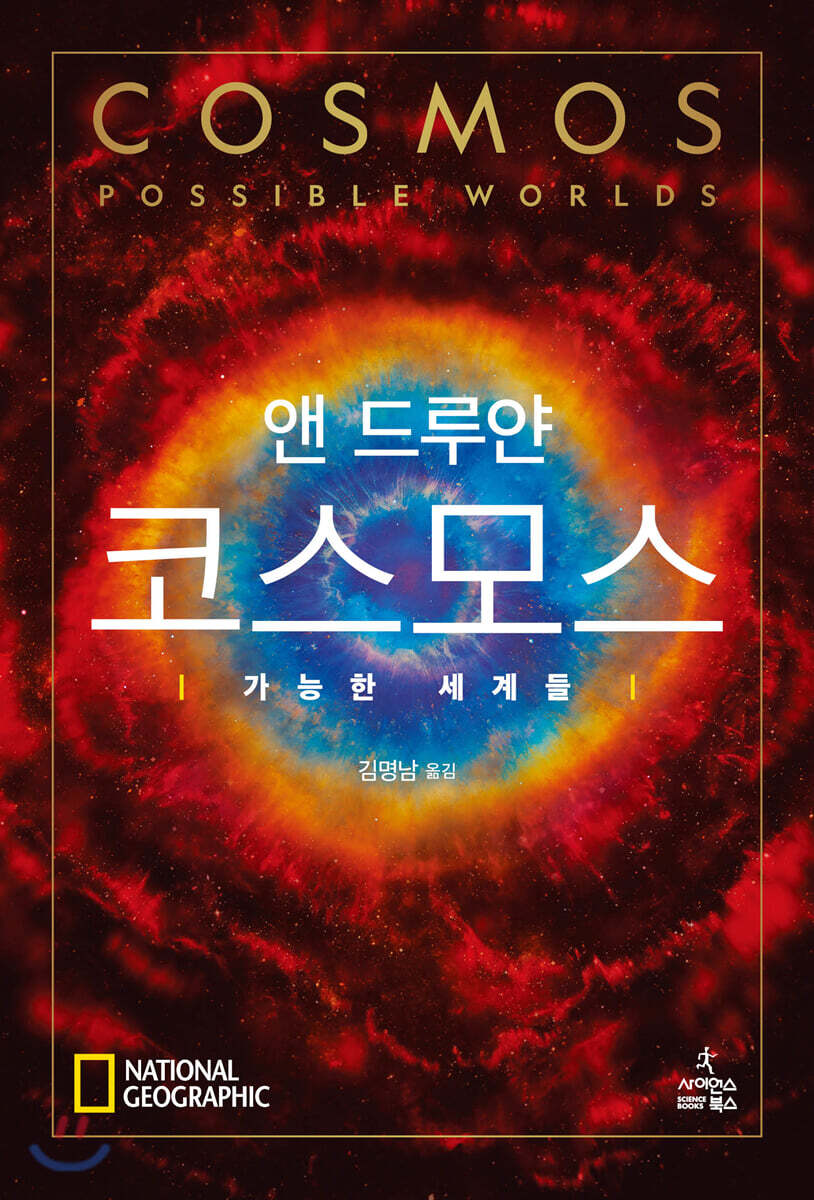 |
Description
Book Introduction
- A word from MD
-
The official sequel to Carl Sagan's CosmosAnn Drewyan, who has written and researched with Carl Sagan.
To mark the 40th anniversary of the publication of Cosmos, we are retelling its message through a new documentary and book.
It contains the astonishing scientific achievements of the past 40 years, stories of forgotten heroes, and a cosmic perspective on the future of humanity.
March 24, 2020. Natural Science PD Kim Tae-hee
One of the most read science books in history
The one and only book that carries on the spirit of Carl Sagan's "Cosmos"!
The legendary documentary "Cosmos", which was broadcast in 181 countries around the world in 1980 and 2014, sparked a global science boom.
This documentary and book of the same name, co-produced and published by Carl Sagan and Ann Druyan, have transcended time and generation for over 40 years, satisfying the intellectual curiosity of over a billion viewers and readers, as well as filling them with emotion, vividly showing how science is deeply intertwined with history, culture, and society.
More than 20 years after Carl Sagan's passing, Ann Druyan continues to keep the spirit of the "Cosmos" series alive, taking viewers and readers on a grand journey across 14 billion years of time and hundreds of billions of light-years of vast space.
The one and only book that carries on the spirit of Carl Sagan's "Cosmos"!
The legendary documentary "Cosmos", which was broadcast in 181 countries around the world in 1980 and 2014, sparked a global science boom.
This documentary and book of the same name, co-produced and published by Carl Sagan and Ann Druyan, have transcended time and generation for over 40 years, satisfying the intellectual curiosity of over a billion viewers and readers, as well as filling them with emotion, vividly showing how science is deeply intertwined with history, culture, and society.
More than 20 years after Carl Sagan's passing, Ann Druyan continues to keep the spirit of the "Cosmos" series alive, taking viewers and readers on a grand journey across 14 billion years of time and hundreds of billions of light-years of vast space.
- You can preview some of the book's contents.
Preview
index
Preface to the Korean edition: The Voice of Science
Prologue: Dreams are a Map
Chapter 1: The Ladder of Climbing Stars
Chapter 2 Oh, Great King
Chapter 3: The City of Lost Life
Chapter 4: Vavilov
Chapter 5: The Connectome of the Universe
Chapter 6: The Man with a Trillion Worlds
Chapter 7: Searching for Intelligent Life on Earth
Chapter 8 Cassini's Sacrifice
Chapter 9: Magic without Falsehood
Chapter 10: A Tale of Two Atoms
Chapter 11: The Fleeting Blessing of a Habitable Zone
Chapter 12: Living in the Anthropocene
Chapter 13 Possible Worlds
Acknowledgements
Further Reading
Copyright of the painting
Search
Prologue: Dreams are a Map
Chapter 1: The Ladder of Climbing Stars
Chapter 2 Oh, Great King
Chapter 3: The City of Lost Life
Chapter 4: Vavilov
Chapter 5: The Connectome of the Universe
Chapter 6: The Man with a Trillion Worlds
Chapter 7: Searching for Intelligent Life on Earth
Chapter 8 Cassini's Sacrifice
Chapter 9: Magic without Falsehood
Chapter 10: A Tale of Two Atoms
Chapter 11: The Fleeting Blessing of a Habitable Zone
Chapter 12: Living in the Anthropocene
Chapter 13 Possible Worlds
Acknowledgements
Further Reading
Copyright of the painting
Search
Publisher's Review
#1 Science Book Recommended by Korean Scientists
The official sequel to Carl Sagan's Cosmos
★ Sequel to "Cosmos: A Spacetime Odyssey," broadcast in 181 countries worldwide
Full coverage of the National Geographic documentary "Cosmos: Possible Worlds"
The legendary science show "Cosmos," which aired worldwide in 1980 and sparked a global science boom, has returned with a new book and documentary.
This is because in March 2020, 40 years after the first publication of the book "Cosmos" and the first broadcast of the documentary, Science Books Co., Ltd. translated and published Ann Druyan's "Cosmos: Possibl Worlds," which can be considered the official sequel to Carl Sagan's "Cosmos."
Released simultaneously worldwide to coincide with the worldwide broadcast of the television documentary of the same name, this book tells the story of the wondrous achievements of science over the past 40 years, the forgotten explorers of science that Carl Sagan failed to introduce, and the stories of our own Earth and other worlds that have come and gone countless times since the moment of the Big Bang 14 billion years ago, and once again conveys Carl Sagan's magnificent message of the essence of humanity from a cosmic perspective.
Since its first edition was published in 1980, it has been on the New York Times bestseller list for 70 consecutive weeks, becoming the first science book in history to sell over 500,000 copies and selling nearly 10 million copies worldwide. Cosmos is one of the most widely read science books in history and is considered a masterpiece of liberal arts that has instilled hope for space exploration across time and borders.
Additionally, a documentary produced simultaneously based on this book was broadcast in over 180 countries around the world, captivating over 700 million viewers and sparking the 'Cosmos Boom.'
More than 10 percent of the world's population has encountered science and space in some way through Carl Sagan's Cosmos.
Carl Sagan's Cosmos has been loved by scientists, general readers, and young people in Korea as well.
Since the publication of the complete edition and special edition of 『Cosmos』 by Science Books Inc. to commemorate the 10th anniversary of Carl Sagan's death, it has maintained its position as the best-selling book in the science field for over 15 years.
Also, it was selected as the best science book and classic liberal arts book by various organizations and people, such as 'No. 1 science book recommended to teenagers by Korean scientists' (Dong-A Ilbo survey), 'Science Book of the Year' jointly selected by Naver and Kyobo Bookstore, 'Science Book that Will Make You Cry' selected by KBS and TV Talk Books, 'Science Book that Shined This Year' selected by the Asia-Pacific Center for Theoretical Physics, 'Outstanding Academic Book' selected by the National Academy of Sciences of the Republic of Korea, and received high praise as a book that provides scientific wisdom, insight, knowledge, and inspiration that do not fade with time.
However, with Carl Sagan passing away in 1996, it was a great pity that we could not hear directly in his deep yet captivating voice the dazzling advancements in cutting-edge science that had been made over the 40 years since the first publication and broadcast in 1980.
Although several authors claiming to be Carl Sagan's successors and follow-up works to "Cosmos" have appeared in the publishing market, they have failed to satisfy readers' thirst.
However, Ann Druyan's Cosmos: Possible Worlds, published to coincide with the 40th anniversary of the publication (and airing of the documentary) of Cosmos, will be enough to appease the "Cosmos Generation" who grew up watching Cosmos and dreamed of space.
Because Ann Druyan was the “soul” of Cosmos.
From 1977 to 1980, Carl Sagan took a two-year leave from his position as professor of astrophysics at Cornell University to focus on writing books and making documentaries.
At all times, Ann Druyan was always by Sagan's side.
Ann Druyan, along with astronomer Steven Soter, served as co-writer on the documentary screenplay, and was a major influence on the book and documentary Cosmos.
Carl Sagan even dedicated Cosmos to Ann Druyan.
After the global hit of Cosmos, Ann Druyan married Carl Sagan and supported his writing, sometimes as a co-author and sometimes as an editor, working closely with him on books such as Pale Blue Dot, Comet, Shadows of Forgotten Ancestors, and Contact.
After Carl Sagan's death, he has been working to spread Carl Sagan's message around the world by planning and directing the Solar Sail Project (a project to develop a spacecraft powered by the light pressure of sunlight), which was his lifelong dream, planetary research centered around the Planetary Society, publishing the sequel to Cosmos, and producing documentaries.
The global success of the second documentary in the Cosmos series, Cosmos: A Space Time Odyssey (executive producer, director, co-screenwriter, Peabody Award, Emmy Award winner, broadcast in 172 countries worldwide) in 2014 and the successful orbital flight of LightSail 1 in 2015 would not have been possible without the efforts of Ann Druyan.
That's why Neil deGrasse Tyson, author of the 21st-century science bestseller Astrophysics Every Day and director of the Hayden Planetarium at the American Museum of Natural History in New York, called Ann Druyan "the soul of Cosmos."
One of the most read science books in history
The one and only book that carries on the spirit of Carl Sagan's "Cosmos"!
Like Carl Sagan's first Cosmos, Cosmos: Possible Worlds consists of 13 chapters and, like the first book in the series, is based on the script for the documentary of the same name, and contains all the content that could not be included in the documentary due to its temporal and formal limitations.
Ann Druyan, who humbly describes herself as “a hunter-gatherer of stories, not a scientist,” unfolds the stories she and Carl Sagan held most dear.
In the spirit and tradition of the "Cosmos" series, we introduce scientists who embarked on an endless journey to understand the origins of the universe and life, the hidden laws of nature, and the worlds they have created, which, thanks to their science, can now be imagined, resurrected, and even visited across billions of kilometers of space and billions of years of time.
But Ann Druyan's keen eye doesn't stop at the dazzling achievements of science; it also seeks out the forgotten heroes of scientific history.
The stories of scientific martyrs like Yuri Kondratyuk, who developed detailed plans for a lunar exploration 50 years before the Apollo program; Carl von Frisch, who analyzed the language system of bees and made possible the first encounter with non-human intelligent life; Nikolai Vavilov and his colleagues, who preserved plant seeds as a future biodiversity resource in a besieged city where 800,000 people were starving to death; the scientists who first discovered problems that even the world-renowned Einstein could not solve; and the young scientists who found solutions on the outskirts of academia are brought to life in Ann Druyan's elegant writing style.
Like Carl Sagan's original Cosmos, Ann Druyan's Cosmos: Possible Worlds pulls back the scientific curtain at every chapter, revealing a profound understanding of human emotions, a deep and broad exploration of the meaning of human history, and profound insights into the human condition, all based on a deep knowledge of religion, history, literature, and the arts.
Ann Druyan fully demonstrates what makes the Cosmos series different from any other science content.
However, while Carl Sagan was grand and weighty, Ann Druyan was delicate and elegant.
And it's warm.
Building on this warmth, Ann Druyan explores a romantic optimism about the future of humanity that science will bring.
In this book by Ann Druyan, who brings science together with art, history, and mythology, and whispers to us to revisit our essence from a cosmic perspective and awaken scientifically, readers of the 'Cosmos Generation' who received guidance for life and the future from the dreams Carl Sagan advocated will discover another path to the 'Cosmos'.
Science, like love, is a means to make such transcendence possible.
It is a means that enables us to have the thrilling experience of living as one whole.
The way science approaches nature is the same way I understand love.
Love tells us to embrace the reality of the other person instead of childishly projecting our own desires and fears onto them.
Such a strong love never stops trying to dig deeper and climb higher.
-In the text
This journey to understand our true place in the universe, the origin of life, and the laws of nature is a spiritual quest.
If this cannot be called a spiritual quest, what else can it be? - From the text
★ The latest installment in the legendary science epic "Cosmos" series, recommended by world-renowned figures and scientists, including former U.S. President Barack Obama, film director Christopher Nolan, and physicist Stephen Hawking!
★ The essence of scientific knowledge that has transcended time and moved people around the world for over 40 years, sweeping awards such as the Emmy Award and Peabody Award.
Dear Korean readers,
I'm glad to have this opportunity to talk with you.
Why you, of all people? This book will be translated and published in many countries around the world, so why am I writing a special foreword just for one country?
This book, Cosmos: Our World and Other Worlds, covers a wide range of topics.
Like the previous "Cosmos" documentaries and books, this book demonstrates how a scientific perspective can be a powerful force, more than anything else, as we strive to understand the wonders of nature and achieve seemingly impossible dreams.
I'll also tell you about the daring adventures of our ancestors, the explorers who, through their efforts, answered the question of where we are and what kind of being we are in the vast expanse of space and time. Some of these stories will undoubtedly be new to you.
This book will examine what human consciousness is, and also the consciousness of other life forms that coexist with us on this small planet.
And we will discover other life forms, some lost forever, some only recently discovered, some far away, and some very, very close, inside our own bodies.
But there is one theme that connects these colorful stories.
While these capabilities that humanity has acquired could yield truly remarkable achievements, they also pose a fatal threat to species we don't even know exist, and to the entirety of Earth's civilization.
You've probably heard many stories about the dark forces that could potentially lead humanity to destruction.
So, I won't go into detail about our human flaws one by one.
Because you probably already know this.
I just want to say this.
My point is that among all these flaws, there is one core problem, one that holds the key to solving many, if not all, of the crises we face.
If we could solve that problem among many others, we might be able to look to the future with more optimism.
The problem, I think, is that as many people as possible need to embrace science in a very different way than they do now.
Our attitude toward science should become more like the attitude toward internalizing other human belief systems.
Science isn't just a bunch of amazing facts.
I'm not just talking about practical knowledge, the kind that we use to give more and more functionality and fun to the toys we enjoy playing with.
I'm not just talking about difficult subjects that some people understand easily but others find completely incomprehensible.
Science is one way we see everything in the world.
Science sees through time.
No other human endeavor can match the power of science.
Scientists can accurately predict where distant celestial bodies will be millions of years from now.
I can tell you who your distant ancestors were, where they lived thousands of years ago, and even how they lived.
Scientists with such extraordinary powers are warning us today with unprecedented unity.
Scientists predicted the global catastrophe we have only recently realized could happen over 70 years ago.
Scientists now warn us that we have entered an era of mass extinction, one of our own making, and that this mass extinction will be on a different level than the ones that occurred before humans existed on Earth.
It's not too late.
But how can we listen to scientists and act in our own best interests? How can we grasp the horror and urgency of this issue? How can we feel the lives of our children and their descendants as if they were our own, so that we can stop sleepwalking into catastrophe?
I think this way.
If enough of us take to heart the words of scientists around the world and act, we can stop and reverse this catastrophe.
But then what do we do about it?
We must realize the responsibility our generation owes to those who came before us and to those who will follow.
Our generation is the most crucial link in the chain of life that has continued unbroken on Earth for approximately 4 billion years.
We must be the strongest link.
To honor the courage and talent of those who came before us, and to fulfill our most important duty to our children and their descendants.
We need to save the basic elements necessary for life, such as air, water, and the environment, as much as, if not more than, money.
If this world is completely ruined, what use would something like money, which is merely an artificial construct, be?
From now on, we need to think with a long-term perspective, like scientists do.
Our so-called leaders only care about the time until the next election or the quarterly evaluation.
We can no longer afford to continue with such short-sighted thinking.
The crisis we face, if we fail to properly resolve it, could destroy the entire Earth's civilization.
This is why I write specifically for Korean readers.
Because Korea has been a world leader in innovation, and innovation is precisely what is needed at this perilous moment in human history.
I hope so for you all.
Lead the world to a sustainable future.
Show that you can overcome this challenge, just as you have done with all the others you've faced so far.
Listen to the scientists and take action.
January 1, 2020
Ann Druyan
The official sequel to Carl Sagan's Cosmos
★ Sequel to "Cosmos: A Spacetime Odyssey," broadcast in 181 countries worldwide
Full coverage of the National Geographic documentary "Cosmos: Possible Worlds"
The legendary science show "Cosmos," which aired worldwide in 1980 and sparked a global science boom, has returned with a new book and documentary.
This is because in March 2020, 40 years after the first publication of the book "Cosmos" and the first broadcast of the documentary, Science Books Co., Ltd. translated and published Ann Druyan's "Cosmos: Possibl Worlds," which can be considered the official sequel to Carl Sagan's "Cosmos."
Released simultaneously worldwide to coincide with the worldwide broadcast of the television documentary of the same name, this book tells the story of the wondrous achievements of science over the past 40 years, the forgotten explorers of science that Carl Sagan failed to introduce, and the stories of our own Earth and other worlds that have come and gone countless times since the moment of the Big Bang 14 billion years ago, and once again conveys Carl Sagan's magnificent message of the essence of humanity from a cosmic perspective.
Since its first edition was published in 1980, it has been on the New York Times bestseller list for 70 consecutive weeks, becoming the first science book in history to sell over 500,000 copies and selling nearly 10 million copies worldwide. Cosmos is one of the most widely read science books in history and is considered a masterpiece of liberal arts that has instilled hope for space exploration across time and borders.
Additionally, a documentary produced simultaneously based on this book was broadcast in over 180 countries around the world, captivating over 700 million viewers and sparking the 'Cosmos Boom.'
More than 10 percent of the world's population has encountered science and space in some way through Carl Sagan's Cosmos.
Carl Sagan's Cosmos has been loved by scientists, general readers, and young people in Korea as well.
Since the publication of the complete edition and special edition of 『Cosmos』 by Science Books Inc. to commemorate the 10th anniversary of Carl Sagan's death, it has maintained its position as the best-selling book in the science field for over 15 years.
Also, it was selected as the best science book and classic liberal arts book by various organizations and people, such as 'No. 1 science book recommended to teenagers by Korean scientists' (Dong-A Ilbo survey), 'Science Book of the Year' jointly selected by Naver and Kyobo Bookstore, 'Science Book that Will Make You Cry' selected by KBS and TV Talk Books, 'Science Book that Shined This Year' selected by the Asia-Pacific Center for Theoretical Physics, 'Outstanding Academic Book' selected by the National Academy of Sciences of the Republic of Korea, and received high praise as a book that provides scientific wisdom, insight, knowledge, and inspiration that do not fade with time.
However, with Carl Sagan passing away in 1996, it was a great pity that we could not hear directly in his deep yet captivating voice the dazzling advancements in cutting-edge science that had been made over the 40 years since the first publication and broadcast in 1980.
Although several authors claiming to be Carl Sagan's successors and follow-up works to "Cosmos" have appeared in the publishing market, they have failed to satisfy readers' thirst.
However, Ann Druyan's Cosmos: Possible Worlds, published to coincide with the 40th anniversary of the publication (and airing of the documentary) of Cosmos, will be enough to appease the "Cosmos Generation" who grew up watching Cosmos and dreamed of space.
Because Ann Druyan was the “soul” of Cosmos.
From 1977 to 1980, Carl Sagan took a two-year leave from his position as professor of astrophysics at Cornell University to focus on writing books and making documentaries.
At all times, Ann Druyan was always by Sagan's side.
Ann Druyan, along with astronomer Steven Soter, served as co-writer on the documentary screenplay, and was a major influence on the book and documentary Cosmos.
Carl Sagan even dedicated Cosmos to Ann Druyan.
After the global hit of Cosmos, Ann Druyan married Carl Sagan and supported his writing, sometimes as a co-author and sometimes as an editor, working closely with him on books such as Pale Blue Dot, Comet, Shadows of Forgotten Ancestors, and Contact.
After Carl Sagan's death, he has been working to spread Carl Sagan's message around the world by planning and directing the Solar Sail Project (a project to develop a spacecraft powered by the light pressure of sunlight), which was his lifelong dream, planetary research centered around the Planetary Society, publishing the sequel to Cosmos, and producing documentaries.
The global success of the second documentary in the Cosmos series, Cosmos: A Space Time Odyssey (executive producer, director, co-screenwriter, Peabody Award, Emmy Award winner, broadcast in 172 countries worldwide) in 2014 and the successful orbital flight of LightSail 1 in 2015 would not have been possible without the efforts of Ann Druyan.
That's why Neil deGrasse Tyson, author of the 21st-century science bestseller Astrophysics Every Day and director of the Hayden Planetarium at the American Museum of Natural History in New York, called Ann Druyan "the soul of Cosmos."
One of the most read science books in history
The one and only book that carries on the spirit of Carl Sagan's "Cosmos"!
Like Carl Sagan's first Cosmos, Cosmos: Possible Worlds consists of 13 chapters and, like the first book in the series, is based on the script for the documentary of the same name, and contains all the content that could not be included in the documentary due to its temporal and formal limitations.
Ann Druyan, who humbly describes herself as “a hunter-gatherer of stories, not a scientist,” unfolds the stories she and Carl Sagan held most dear.
In the spirit and tradition of the "Cosmos" series, we introduce scientists who embarked on an endless journey to understand the origins of the universe and life, the hidden laws of nature, and the worlds they have created, which, thanks to their science, can now be imagined, resurrected, and even visited across billions of kilometers of space and billions of years of time.
But Ann Druyan's keen eye doesn't stop at the dazzling achievements of science; it also seeks out the forgotten heroes of scientific history.
The stories of scientific martyrs like Yuri Kondratyuk, who developed detailed plans for a lunar exploration 50 years before the Apollo program; Carl von Frisch, who analyzed the language system of bees and made possible the first encounter with non-human intelligent life; Nikolai Vavilov and his colleagues, who preserved plant seeds as a future biodiversity resource in a besieged city where 800,000 people were starving to death; the scientists who first discovered problems that even the world-renowned Einstein could not solve; and the young scientists who found solutions on the outskirts of academia are brought to life in Ann Druyan's elegant writing style.
Like Carl Sagan's original Cosmos, Ann Druyan's Cosmos: Possible Worlds pulls back the scientific curtain at every chapter, revealing a profound understanding of human emotions, a deep and broad exploration of the meaning of human history, and profound insights into the human condition, all based on a deep knowledge of religion, history, literature, and the arts.
Ann Druyan fully demonstrates what makes the Cosmos series different from any other science content.
However, while Carl Sagan was grand and weighty, Ann Druyan was delicate and elegant.
And it's warm.
Building on this warmth, Ann Druyan explores a romantic optimism about the future of humanity that science will bring.
In this book by Ann Druyan, who brings science together with art, history, and mythology, and whispers to us to revisit our essence from a cosmic perspective and awaken scientifically, readers of the 'Cosmos Generation' who received guidance for life and the future from the dreams Carl Sagan advocated will discover another path to the 'Cosmos'.
Science, like love, is a means to make such transcendence possible.
It is a means that enables us to have the thrilling experience of living as one whole.
The way science approaches nature is the same way I understand love.
Love tells us to embrace the reality of the other person instead of childishly projecting our own desires and fears onto them.
Such a strong love never stops trying to dig deeper and climb higher.
-In the text
This journey to understand our true place in the universe, the origin of life, and the laws of nature is a spiritual quest.
If this cannot be called a spiritual quest, what else can it be? - From the text
★ The latest installment in the legendary science epic "Cosmos" series, recommended by world-renowned figures and scientists, including former U.S. President Barack Obama, film director Christopher Nolan, and physicist Stephen Hawking!
★ The essence of scientific knowledge that has transcended time and moved people around the world for over 40 years, sweeping awards such as the Emmy Award and Peabody Award.
Dear Korean readers,
I'm glad to have this opportunity to talk with you.
Why you, of all people? This book will be translated and published in many countries around the world, so why am I writing a special foreword just for one country?
This book, Cosmos: Our World and Other Worlds, covers a wide range of topics.
Like the previous "Cosmos" documentaries and books, this book demonstrates how a scientific perspective can be a powerful force, more than anything else, as we strive to understand the wonders of nature and achieve seemingly impossible dreams.
I'll also tell you about the daring adventures of our ancestors, the explorers who, through their efforts, answered the question of where we are and what kind of being we are in the vast expanse of space and time. Some of these stories will undoubtedly be new to you.
This book will examine what human consciousness is, and also the consciousness of other life forms that coexist with us on this small planet.
And we will discover other life forms, some lost forever, some only recently discovered, some far away, and some very, very close, inside our own bodies.
But there is one theme that connects these colorful stories.
While these capabilities that humanity has acquired could yield truly remarkable achievements, they also pose a fatal threat to species we don't even know exist, and to the entirety of Earth's civilization.
You've probably heard many stories about the dark forces that could potentially lead humanity to destruction.
So, I won't go into detail about our human flaws one by one.
Because you probably already know this.
I just want to say this.
My point is that among all these flaws, there is one core problem, one that holds the key to solving many, if not all, of the crises we face.
If we could solve that problem among many others, we might be able to look to the future with more optimism.
The problem, I think, is that as many people as possible need to embrace science in a very different way than they do now.
Our attitude toward science should become more like the attitude toward internalizing other human belief systems.
Science isn't just a bunch of amazing facts.
I'm not just talking about practical knowledge, the kind that we use to give more and more functionality and fun to the toys we enjoy playing with.
I'm not just talking about difficult subjects that some people understand easily but others find completely incomprehensible.
Science is one way we see everything in the world.
Science sees through time.
No other human endeavor can match the power of science.
Scientists can accurately predict where distant celestial bodies will be millions of years from now.
I can tell you who your distant ancestors were, where they lived thousands of years ago, and even how they lived.
Scientists with such extraordinary powers are warning us today with unprecedented unity.
Scientists predicted the global catastrophe we have only recently realized could happen over 70 years ago.
Scientists now warn us that we have entered an era of mass extinction, one of our own making, and that this mass extinction will be on a different level than the ones that occurred before humans existed on Earth.
It's not too late.
But how can we listen to scientists and act in our own best interests? How can we grasp the horror and urgency of this issue? How can we feel the lives of our children and their descendants as if they were our own, so that we can stop sleepwalking into catastrophe?
I think this way.
If enough of us take to heart the words of scientists around the world and act, we can stop and reverse this catastrophe.
But then what do we do about it?
We must realize the responsibility our generation owes to those who came before us and to those who will follow.
Our generation is the most crucial link in the chain of life that has continued unbroken on Earth for approximately 4 billion years.
We must be the strongest link.
To honor the courage and talent of those who came before us, and to fulfill our most important duty to our children and their descendants.
We need to save the basic elements necessary for life, such as air, water, and the environment, as much as, if not more than, money.
If this world is completely ruined, what use would something like money, which is merely an artificial construct, be?
From now on, we need to think with a long-term perspective, like scientists do.
Our so-called leaders only care about the time until the next election or the quarterly evaluation.
We can no longer afford to continue with such short-sighted thinking.
The crisis we face, if we fail to properly resolve it, could destroy the entire Earth's civilization.
This is why I write specifically for Korean readers.
Because Korea has been a world leader in innovation, and innovation is precisely what is needed at this perilous moment in human history.
I hope so for you all.
Lead the world to a sustainable future.
Show that you can overcome this challenge, just as you have done with all the others you've faced so far.
Listen to the scientists and take action.
January 1, 2020
Ann Druyan
GOODS SPECIFICS
- Date of issue: March 20, 2020
- Page count, weight, size: 464 pages | 986g | 153*224*33mm
- ISBN13: 9791190403283
- ISBN10: 1190403285
You may also like
카테고리
korean


korean

![GQ KOREA Mark (Monthly): December [2025]](http://librairie.coreenne.fr/cdn/shop/files/8ef265dbbfbf186523ed75ba7319009d.jpg?v=1765340328&width=3840)


