

Strange Math Book
 |
Description
Book Introduction
- A word from MD
-
Understanding the World of Mathematics through PicturesWhat's really important in mathematics is not how to solve problems, but how to think mathematically.
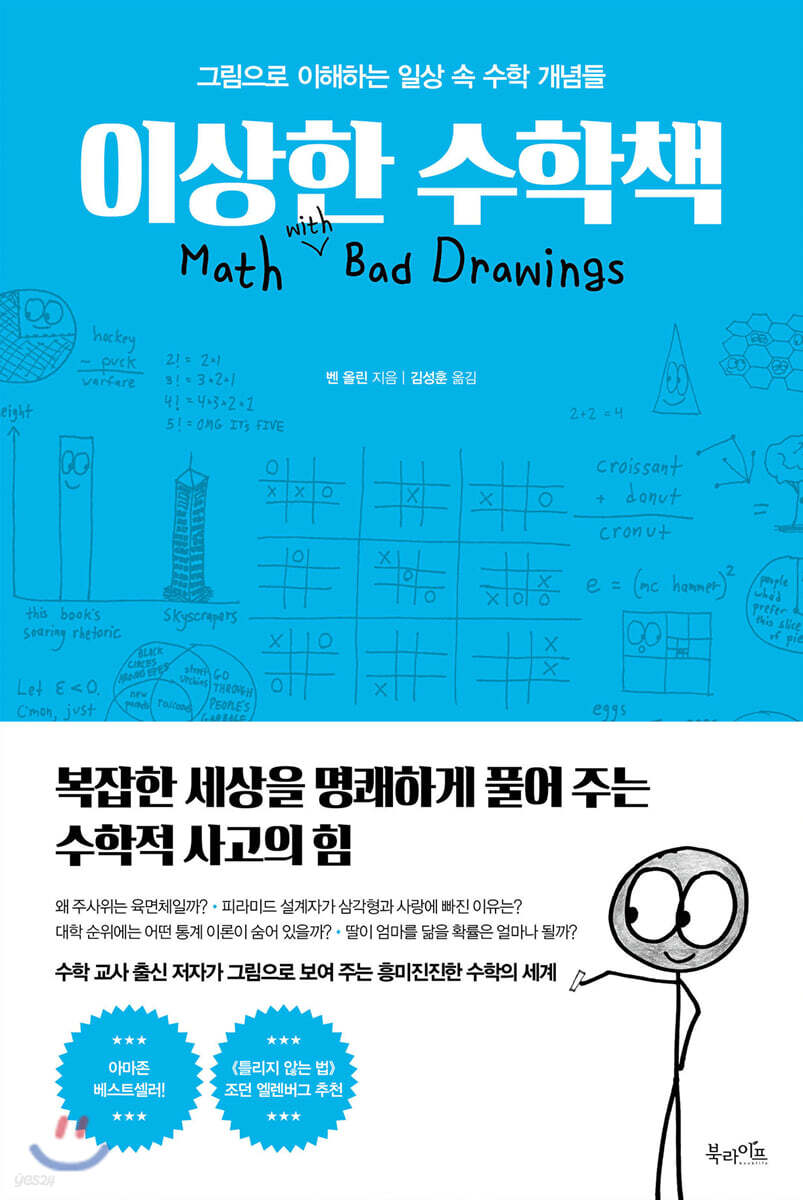
The author, a former math teacher, uses quirky illustrations and humorous jokes to explain difficult math concepts and principles in an easy-to-understand way.
For readers who are intimidated by complex formulas, unknown symbols, and graphs, mathematics is about to change.
March 20, 2020. Natural Science PD Kim Tae-hee
What really matters is not how to solve math problems.
How to think like a mathematician!
The exciting world of mathematics, illustrated by a former math teacher.
Why isn't math popular? When people think of math, these are the things that usually come to mind.
Confusing formulas, complex calculations, unknown graphs… … .
The same was true for the students the author met in the classroom.
High school freshmen's conclusions on 'Why study geometry' were as follows.
"We study mathematics to prove to colleges and employers that we're smart and hard-working." Is that really true? This book is an ambitious attempt to show mathematics not as a mechanism for distinguishing between high and low performers, but as a profound principle of the world.
In "The Strange Book of Mathematics," Ben Olin shows us the true face of mathematics we need to know right now.
The myriad uses of mathematics, the strange symbols, and the mind-boggling logical leaps and beliefs that characterize the study of mathematics, which are generally difficult to understand.
The author, who believes that mathematics should be accessible to everyone, uses his trademark colorful "weird pictures" and humorous jokes to explain mathematical concepts and principles in an easy-to-understand way.
A novel form of tic-tac-toe shows how mathematicians think, a pair of dice shows how to understand an economic crisis, and the mathematical headaches that come with trying to build a spherical Death Star from Star Wars.
Covering topics ranging from the US Electoral College to human genetics and why you shouldn't trust statistics, this book will be a life-changing read for both those who have grown up with math and those who have fallen in love with it.
How to think like a mathematician!
The exciting world of mathematics, illustrated by a former math teacher.
Why isn't math popular? When people think of math, these are the things that usually come to mind.
Confusing formulas, complex calculations, unknown graphs… … .
The same was true for the students the author met in the classroom.
High school freshmen's conclusions on 'Why study geometry' were as follows.
"We study mathematics to prove to colleges and employers that we're smart and hard-working." Is that really true? This book is an ambitious attempt to show mathematics not as a mechanism for distinguishing between high and low performers, but as a profound principle of the world.
In "The Strange Book of Mathematics," Ben Olin shows us the true face of mathematics we need to know right now.
The myriad uses of mathematics, the strange symbols, and the mind-boggling logical leaps and beliefs that characterize the study of mathematics, which are generally difficult to understand.
The author, who believes that mathematics should be accessible to everyone, uses his trademark colorful "weird pictures" and humorous jokes to explain mathematical concepts and principles in an easy-to-understand way.
A novel form of tic-tac-toe shows how mathematicians think, a pair of dice shows how to understand an economic crisis, and the mathematical headaches that come with trying to build a spherical Death Star from Star Wars.
Covering topics ranging from the US Electoral College to human genetics and why you shouldn't trust statistics, this book will be a life-changing read for both those who have grown up with math and those who have fallen in love with it.
- You can preview some of the book's contents.
Preview
index
preface
Part 1: How to Think Like a Mathematician
Chapter 1: Ultimate Tic-Tac-Toe
Chapter 2: How do students view mathematics?
Chapter 3: How Do Mathematicians View Mathematics?
Chapter 4: How do science and mathematics view each other?
Chapter 5: Outstanding Mathematicians and Great Mathematicians
Part 2 Design: The Geometry of Useful Things
Chapter 6: A City Built in Triangles
Chapter 7: Irrational Paper
Chapter 8: The Allegory of the Square and the Cube
Chapter 9: Dice Making Game
Chapter 10: The Death Star Story from Word of Mouth
Part 3: Probability: The Mathematics of Maybe
Chapter 11: Ten People You Met in the Lottery Line
Chapter 12: Children of Coins
Chapter 13: What Does Probability Mean to Your Career?
Chapter 14 Strange Insurance
Chapter 15: How to Ruin an Economy with a Pair of Dice
Part 4: Statistics: The Art of Lying Honestly
Chapter 16: Why I Don't Trust Statistics
Chapter 17: The Last .400 Hitter
Chapter 18: The Barbarians at the Gates of Science
Chapter 19: The Scoreboard Wars
Chapter 20: The Book Shredder
Part 5: The Turning Point: The Power of One Step
Chapter 21: The Last Grain on the Diamond Dust
Chapter 22: The Story of Tax Grades
Chapter 23: Is the US Presidential Election a Red and Blue Coloring Game?!
Chapter 24: Chaos in History
Acknowledgements
annotation
Part 1: How to Think Like a Mathematician
Chapter 1: Ultimate Tic-Tac-Toe
Chapter 2: How do students view mathematics?
Chapter 3: How Do Mathematicians View Mathematics?
Chapter 4: How do science and mathematics view each other?
Chapter 5: Outstanding Mathematicians and Great Mathematicians
Part 2 Design: The Geometry of Useful Things
Chapter 6: A City Built in Triangles
Chapter 7: Irrational Paper
Chapter 8: The Allegory of the Square and the Cube
Chapter 9: Dice Making Game
Chapter 10: The Death Star Story from Word of Mouth
Part 3: Probability: The Mathematics of Maybe
Chapter 11: Ten People You Met in the Lottery Line
Chapter 12: Children of Coins
Chapter 13: What Does Probability Mean to Your Career?
Chapter 14 Strange Insurance
Chapter 15: How to Ruin an Economy with a Pair of Dice
Part 4: Statistics: The Art of Lying Honestly
Chapter 16: Why I Don't Trust Statistics
Chapter 17: The Last .400 Hitter
Chapter 18: The Barbarians at the Gates of Science
Chapter 19: The Scoreboard Wars
Chapter 20: The Book Shredder
Part 5: The Turning Point: The Power of One Step
Chapter 21: The Last Grain on the Diamond Dust
Chapter 22: The Story of Tax Grades
Chapter 23: Is the US Presidential Election a Red and Blue Coloring Game?!
Chapter 24: Chaos in History
Acknowledgements
annotation
Detailed image

Into the book
When I graduated from college in 2009, I thought I knew why math wasn't popular.
This is because the way math is taught in general is flawed.
Math classes take beautiful, imaginative, and logical art, chop it up into tiny pieces, and then give students the impossible task of putting the pieces back together.
So it's no wonder that students are groaning, it's no wonder that students are failing math, and it's no wonder that adults grit their teeth when they recall the days when they studied math.
The solution was so obvious.
Mathematics needed a better explanation, and it needed someone to give it a better explanation.
--- p.7, from the 'Preface'
The greatest mathematicians throughout history have not stopped at achieving intellectual feats; they have also blazed new trails for others to follow.
Euclid put his past insights into an irreplaceable and invaluable textbook.
Cantor condensed his understanding of infinity into a concise argument that is easy to follow.
A mentor to generations of harmonic analysts, Stein became an advisor to mathematicians as great as himself.
(……) A mathematician who is unable to properly convey his thoughts will, like me that day, be isolated in his own thoughts like an island, unable to reach others.
On the other hand, mathematicians who can share the truth they know will enjoy the joy of being appreciated and treated as heroes by others.
--- p.68~69, from Part 1, Chapter 5, ‘Outstanding Mathematicians and Great Mathematicians’
Life is the same.
It's full of random, one-off events.
Trains can be delayed when you least expect it, unexpected comebacks can happen, and parking spaces can magically appear out of nowhere.
In this stormy world, nothing is impossible, and fate never foretells events.
But if you flip a coin trillion times, a completely different world unfolds.
A world well-rounded by long-term averages awaits.
Here, half of all coins land on heads, half of all newborns are boys, and events with a probability of one in a million happen roughly once in a million.
In this dazzlingly sunny world of theory, there is no whim or coincidence.
Caprice and chance are like pebbles thrown into the sea, lost in the sum total of all possibilities.
Probability theory bridges these two worlds.
The world we know is rough and ambiguous, so probability theory is necessary.
(……) We, who are destined to die, can never set foot in the world of eternity, but thanks to probability theory, we can glimpse that world.
--- p.172~173, from Part 3, 'Probability Theory: The Mathematics of Maybe'
Statistics allows us to build powerful models of reality through classification, estimation, and prediction.
Yes, that's right.
This whole process hinges on simplification.
Yes, that's right.
Simplification is lying through omission.
But if used well, statistics can be an honest lie.
This process requires all the virtues inherent in human thought, from curiosity to compassion.
If you look at it that way, statistics is not much different from the stick figures drawn in this book.
Statistics is a strange picture of the real world.
Although it is a painting without hands or nose, it still tells a unique truth in its own way.
--- p.271, from Part 4, 'Statistics: The Art of Lying Honestly'
Science has never been defined by absolute certainty or Superman-like perfection.
In science, it has always been paramount to test all hypotheses with a healthy skepticism.
Statistics is an indispensable ally in this fight.
It is true that statistics has played a part in pushing science to the brink, but it is also clear that it will play a part in bringing science back on track.
--- p.336, from Part 4, Chapter 18, 'The Barbarians at the Gates of Science: The Crisis of the p-Value'
Of the last ten elections, five went for the Republicans and five went for the Democrats.
If we average this out, it turns out that the Democratic Party had an advantage of less than 0.1 percent.
Silver points out:
“There is virtually no correlation between which party has an electoral advantage in one election and which party has that advantage four years later.
This part can go back and forth depending on relatively subtle changes that occur among the overall electorate.”
--- p.435, from Part 5, Chapter 23, 'Is the US presidential election a red and blue coloring game?!'
From Tversky's perspective, small choices follow predictable causal relationships.
But events that occur on a large scale are created by diabolically complex and interconnected systems.
In this system, every movement is context-dependent.
I think the same goes for human history.
One person can predict.
But the crowd doesn't.
The sophisticated interactions of crowds amplify some patterns and erase others without any apparent reason.
It is no coincidence that the game of life, like Lorenz's weather simulation, emerged in the computer age.
Chaos, in essence, is not something one can picture in one's mind.
The human mind has a strong tendency to smooth things out and round the truth down to the nearest decimal place.
To manipulate chaos so masterfully and reveal its patterns, or rather its absence, would have required a brain much larger and faster than ours.
This is because the way math is taught in general is flawed.
Math classes take beautiful, imaginative, and logical art, chop it up into tiny pieces, and then give students the impossible task of putting the pieces back together.
So it's no wonder that students are groaning, it's no wonder that students are failing math, and it's no wonder that adults grit their teeth when they recall the days when they studied math.
The solution was so obvious.
Mathematics needed a better explanation, and it needed someone to give it a better explanation.
--- p.7, from the 'Preface'
The greatest mathematicians throughout history have not stopped at achieving intellectual feats; they have also blazed new trails for others to follow.
Euclid put his past insights into an irreplaceable and invaluable textbook.
Cantor condensed his understanding of infinity into a concise argument that is easy to follow.
A mentor to generations of harmonic analysts, Stein became an advisor to mathematicians as great as himself.
(……) A mathematician who is unable to properly convey his thoughts will, like me that day, be isolated in his own thoughts like an island, unable to reach others.
On the other hand, mathematicians who can share the truth they know will enjoy the joy of being appreciated and treated as heroes by others.
--- p.68~69, from Part 1, Chapter 5, ‘Outstanding Mathematicians and Great Mathematicians’
Life is the same.
It's full of random, one-off events.
Trains can be delayed when you least expect it, unexpected comebacks can happen, and parking spaces can magically appear out of nowhere.
In this stormy world, nothing is impossible, and fate never foretells events.
But if you flip a coin trillion times, a completely different world unfolds.
A world well-rounded by long-term averages awaits.
Here, half of all coins land on heads, half of all newborns are boys, and events with a probability of one in a million happen roughly once in a million.
In this dazzlingly sunny world of theory, there is no whim or coincidence.
Caprice and chance are like pebbles thrown into the sea, lost in the sum total of all possibilities.
Probability theory bridges these two worlds.
The world we know is rough and ambiguous, so probability theory is necessary.
(……) We, who are destined to die, can never set foot in the world of eternity, but thanks to probability theory, we can glimpse that world.
--- p.172~173, from Part 3, 'Probability Theory: The Mathematics of Maybe'
Statistics allows us to build powerful models of reality through classification, estimation, and prediction.
Yes, that's right.
This whole process hinges on simplification.
Yes, that's right.
Simplification is lying through omission.
But if used well, statistics can be an honest lie.
This process requires all the virtues inherent in human thought, from curiosity to compassion.
If you look at it that way, statistics is not much different from the stick figures drawn in this book.
Statistics is a strange picture of the real world.
Although it is a painting without hands or nose, it still tells a unique truth in its own way.
--- p.271, from Part 4, 'Statistics: The Art of Lying Honestly'
Science has never been defined by absolute certainty or Superman-like perfection.
In science, it has always been paramount to test all hypotheses with a healthy skepticism.
Statistics is an indispensable ally in this fight.
It is true that statistics has played a part in pushing science to the brink, but it is also clear that it will play a part in bringing science back on track.
--- p.336, from Part 4, Chapter 18, 'The Barbarians at the Gates of Science: The Crisis of the p-Value'
Of the last ten elections, five went for the Republicans and five went for the Democrats.
If we average this out, it turns out that the Democratic Party had an advantage of less than 0.1 percent.
Silver points out:
“There is virtually no correlation between which party has an electoral advantage in one election and which party has that advantage four years later.
This part can go back and forth depending on relatively subtle changes that occur among the overall electorate.”
--- p.435, from Part 5, Chapter 23, 'Is the US presidential election a red and blue coloring game?!'
From Tversky's perspective, small choices follow predictable causal relationships.
But events that occur on a large scale are created by diabolically complex and interconnected systems.
In this system, every movement is context-dependent.
I think the same goes for human history.
One person can predict.
But the crowd doesn't.
The sophisticated interactions of crowds amplify some patterns and erase others without any apparent reason.
It is no coincidence that the game of life, like Lorenz's weather simulation, emerged in the computer age.
Chaos, in essence, is not something one can picture in one's mind.
The human mind has a strong tendency to smooth things out and round the truth down to the nearest decimal place.
To manipulate chaos so masterfully and reveal its patterns, or rather its absence, would have required a brain much larger and faster than ours.
--- p.451, from Part 5, Chapter 24, 'Chaos of History'
Publisher's Review
Starting from the basic definitions of mathematics, to geometry, probability, and statistics.
Understanding everyday math concepts through witty and exciting "strange pictures."
Why isn't math popular? When people think of math, these are the things that usually come to mind.
Confusing formulas, complex calculations, unknown graphs… … .
The same was true for the students the author met in the classroom.
High school freshmen's conclusions on 'Why study geometry' were as follows.
“We study math to prove to colleges and employers that we are smart and hard-working.” Is that really true?
This book is an ambitious attempt to show mathematics not as a mechanism for distinguishing between excellent and poor students, but as a profound principle of the world.
Mathematics connects seemingly unrelated fields like coins and genes, dice and stocks, books and baseball, and is a foundational discipline in every aspect of life.
Because “mathematics is a system of thought.”
And “Thinking helps solve all the world’s problems.”
The author confesses that during his time as a math teacher, he was frustrated by seeing children struggling with math and avoiding it.
Then one day, when I explained a mathematical concept using a 'strange drawing' that I drew badly, the students burst into laughter and even found it fascinating, and I exclaimed, 'This is it!'
The author uses 'strange pictures' to explain various mathematical concepts, allowing people to feel the human side of mathematics.
Through a momentary embarrassment, he gained eternal enlightenment and became an evangelist for mass mathematics education.
How Should We Study Mathematics in the Era of the Fourth Industrial Revolution?
“Books that make us laugh and become smarter and wiser.”
This book deals with mathematics, but it is a 'strange' mathematics book that does not contain a single mathematical problem or explanation.
Instead of listing math problems and solutions, the author focuses on the true core of mathematics, the mathematical 'concepts', and unfolds the story.
What geometric laws are hidden in the bridges and bicycles we commonly see on the street? How are the concepts of probability applied in lotteries, genetics, and insurance? How far can statistics be trusted? What mathematical concepts influenced the winner-take-all US presidential election? By answering these questions, this book reveals the mathematical concepts hidden, perhaps unsurprisingly, within the reality we take for granted.
By explaining interesting mathematical concepts applied in real life, the author naturally helps us understand why we all need mathematical thinking skills.
Going one step further, this book teaches us that true mathematics can teach us a better attitude toward life.
For example, something like this.
A 'good' mathematician is simply someone who has a superior ability to solve mathematical problems quickly and arrive at a solution.
On the other hand, a 'great' mathematician is someone who has an outstanding ability to penetrate the essence of mathematics and make others understand it.
Thus, great mathematicians are not eager to win the competition, but rather actively collaborate with their competitors to achieve further intellectual achievements.
This idea may come as a fresh shock to those who have only used mathematics as a 'performance measurement indicator'.
However, in the era of the Fourth Industrial Revolution, where information disclosure and exchange are rapidly increasing and change is occurring at a rapid pace, the attitude of this "great" mathematician is needed.
Math is certainly not an easy subject, but it is not some hideous, scary monster that should be avoided at all costs.
Rather, mathematics is closer to a language that explains the world we live in.
Of course, I admit that it is a somewhat difficult language to learn.
But through this book, we can learn how to become familiar with the language of mathematics.
As you turn each page of the book, looking at the strange and funny pictures drawn by your kind math teacher, you will soon find that any preconceived notions and misconceptions you had about math have been dispelled.
And maybe you'll start to like math and become friendly with it.
Understanding everyday math concepts through witty and exciting "strange pictures."
Why isn't math popular? When people think of math, these are the things that usually come to mind.
Confusing formulas, complex calculations, unknown graphs… … .
The same was true for the students the author met in the classroom.
High school freshmen's conclusions on 'Why study geometry' were as follows.
“We study math to prove to colleges and employers that we are smart and hard-working.” Is that really true?
This book is an ambitious attempt to show mathematics not as a mechanism for distinguishing between excellent and poor students, but as a profound principle of the world.
Mathematics connects seemingly unrelated fields like coins and genes, dice and stocks, books and baseball, and is a foundational discipline in every aspect of life.
Because “mathematics is a system of thought.”
And “Thinking helps solve all the world’s problems.”
The author confesses that during his time as a math teacher, he was frustrated by seeing children struggling with math and avoiding it.
Then one day, when I explained a mathematical concept using a 'strange drawing' that I drew badly, the students burst into laughter and even found it fascinating, and I exclaimed, 'This is it!'
The author uses 'strange pictures' to explain various mathematical concepts, allowing people to feel the human side of mathematics.
Through a momentary embarrassment, he gained eternal enlightenment and became an evangelist for mass mathematics education.
How Should We Study Mathematics in the Era of the Fourth Industrial Revolution?
“Books that make us laugh and become smarter and wiser.”
This book deals with mathematics, but it is a 'strange' mathematics book that does not contain a single mathematical problem or explanation.
Instead of listing math problems and solutions, the author focuses on the true core of mathematics, the mathematical 'concepts', and unfolds the story.
What geometric laws are hidden in the bridges and bicycles we commonly see on the street? How are the concepts of probability applied in lotteries, genetics, and insurance? How far can statistics be trusted? What mathematical concepts influenced the winner-take-all US presidential election? By answering these questions, this book reveals the mathematical concepts hidden, perhaps unsurprisingly, within the reality we take for granted.
By explaining interesting mathematical concepts applied in real life, the author naturally helps us understand why we all need mathematical thinking skills.
Going one step further, this book teaches us that true mathematics can teach us a better attitude toward life.
For example, something like this.
A 'good' mathematician is simply someone who has a superior ability to solve mathematical problems quickly and arrive at a solution.
On the other hand, a 'great' mathematician is someone who has an outstanding ability to penetrate the essence of mathematics and make others understand it.
Thus, great mathematicians are not eager to win the competition, but rather actively collaborate with their competitors to achieve further intellectual achievements.
This idea may come as a fresh shock to those who have only used mathematics as a 'performance measurement indicator'.
However, in the era of the Fourth Industrial Revolution, where information disclosure and exchange are rapidly increasing and change is occurring at a rapid pace, the attitude of this "great" mathematician is needed.
Math is certainly not an easy subject, but it is not some hideous, scary monster that should be avoided at all costs.
Rather, mathematics is closer to a language that explains the world we live in.
Of course, I admit that it is a somewhat difficult language to learn.
But through this book, we can learn how to become familiar with the language of mathematics.
As you turn each page of the book, looking at the strange and funny pictures drawn by your kind math teacher, you will soon find that any preconceived notions and misconceptions you had about math have been dispelled.
And maybe you'll start to like math and become friendly with it.
GOODS SPECIFICS
- Date of issue: March 18, 2020
- Format: Hardcover book binding method guide
- Page count, weight, size: 512 pages | 1,006g | 162*233*34mm
- ISBN13: 9791188850808
- ISBN10: 1188850806
You may also like
카테고리
korean


korean

![ELLE 엘르 스페셜 에디션 A형 : 12월 [2025]](http://librairie.coreenne.fr/cdn/shop/files/b8e27a3de6c9538896439686c6b0e8fb.jpg?v=1766436872&width=3840)


