

superbug
 |
Description
Book Introduction
- A word from MD
-
People who fight to save humanityA mutated bacterial superbug that cannot be treated with powerful antibiotics.
Worldwide, 700,000 people die from it every year.
As we face the threat of COVID-19, we take a look at the superbugs we need to know about.
It contains vivid stories of people fighting to find new treatments.
February 25, 2020. Natural Science PD Kim Tae-hee
From the threat of lethally evolving superbugs
The story of people fighting to save humanity!
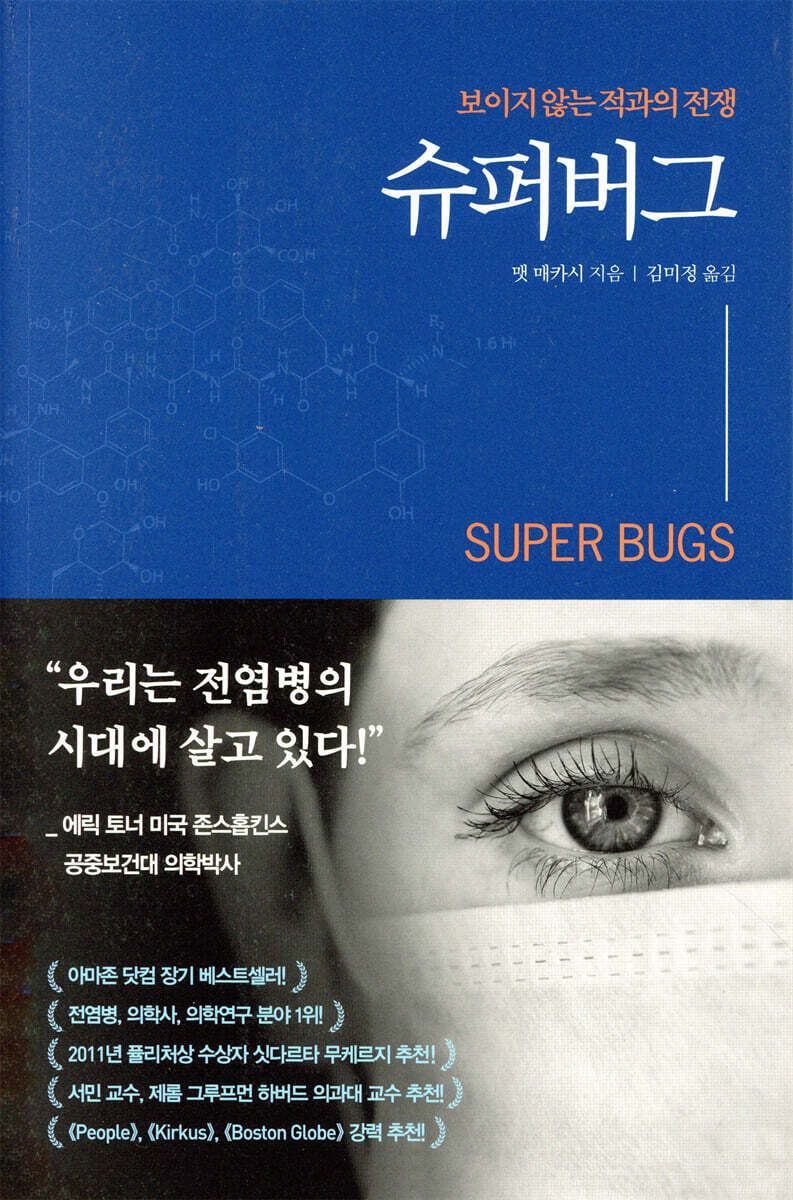
Matt McCarthy, bestselling author and physician at New York-Presbyterian Hospital, is at war with "superbugs."
'Superbugs' are mutated bacteria that cannot be treated with powerful antibiotics.
Dr. Matt McCarthy and his colleagues are at the forefront of clinical trials of new antibiotics to combat superbugs that threaten human life.
The clinical trial process is a breathtaking moment that will determine the future of humanity.
This book is a faithful record of that journey and an honest confession of a doctor who fought fiercely between life and death.
In this book, Dr. Matt McCarthy explores the history of bacteria and antibiotics, from Alexander Fleming's discovery of penicillin to the development of groundbreaking new drugs often found in the soil, to the cutting-edge genetic engineering technology CRISPR.
This shows how humanity has historically achieved incredible breakthroughs in the field of antibiotics, while at the same time, why we are now, in the 21st century, extremely vulnerable to infectious diseases.
The book also contains real-life stories of patients whose lives are running out.
The stories of a teenage girl with a rare infectious disease, a New York firefighter who protected the scene of the 9/11 terrorist attacks, a Holocaust survivor, and a computer programmer who became addicted to drugs after a medical error highlight the deadly dangers of superbugs while also unfilteredly showing the perilous struggles of medical professionals on the perilous journey to treat them.
The story of people fighting to save humanity!
Matt McCarthy, bestselling author and physician at New York-Presbyterian Hospital, is at war with "superbugs."
'Superbugs' are mutated bacteria that cannot be treated with powerful antibiotics.
Dr. Matt McCarthy and his colleagues are at the forefront of clinical trials of new antibiotics to combat superbugs that threaten human life.
The clinical trial process is a breathtaking moment that will determine the future of humanity.
This book is a faithful record of that journey and an honest confession of a doctor who fought fiercely between life and death.
In this book, Dr. Matt McCarthy explores the history of bacteria and antibiotics, from Alexander Fleming's discovery of penicillin to the development of groundbreaking new drugs often found in the soil, to the cutting-edge genetic engineering technology CRISPR.
This shows how humanity has historically achieved incredible breakthroughs in the field of antibiotics, while at the same time, why we are now, in the 21st century, extremely vulnerable to infectious diseases.
The book also contains real-life stories of patients whose lives are running out.
The stories of a teenage girl with a rare infectious disease, a New York firefighter who protected the scene of the 9/11 terrorist attacks, a Holocaust survivor, and a computer programmer who became addicted to drugs after a medical error highlight the deadly dangers of superbugs while also unfilteredly showing the perilous struggles of medical professionals on the perilous journey to treat them.
- You can preview some of the book's contents.
Preview
index
prolog
Part 1: A Chance Observation
Amid the chaos of war | The golden age of antibiotic development
Part 2, Principle 1
The Lucky Grenadier | The Tuskegee Experiment | Safety Measures in Clinical Trials | Variables | Delays in Clinical Trials | Antibiotic Management and Oversight | Stagnation in Antibiotic Research
Part 3 Dalba Clinical Trial Applicants
Ruth | George | Mississippi Mud, Vancomycin | Soren | Donny | Remy | Quiet Revolution | Moments of Decision | Piper | Super Fungal Treatment | 'Trojan Horse' Super Antibiotic
Part 4: Studies Under the Surface
The Rockefellers | Ricin | Groundbreaking Ricin Research | Anthrax | The Arrival of Dalba
Part 5: In Search of a Superbug Cure
Megan | My Mantra | Obstacles in Clinical Trials | Dalva First Recipient | Alicia | Persuasion | Glide | Investment | The Challenges of Antibiotic Discovery | Angry Birds | Medical Ethics | Exploration | Anna | Role Reversal and the Cost | Seeking Help
Epilogue
Translator's Note
Part 1: A Chance Observation
Amid the chaos of war | The golden age of antibiotic development
Part 2, Principle 1
The Lucky Grenadier | The Tuskegee Experiment | Safety Measures in Clinical Trials | Variables | Delays in Clinical Trials | Antibiotic Management and Oversight | Stagnation in Antibiotic Research
Part 3 Dalba Clinical Trial Applicants
Ruth | George | Mississippi Mud, Vancomycin | Soren | Donny | Remy | Quiet Revolution | Moments of Decision | Piper | Super Fungal Treatment | 'Trojan Horse' Super Antibiotic
Part 4: Studies Under the Surface
The Rockefellers | Ricin | Groundbreaking Ricin Research | Anthrax | The Arrival of Dalba
Part 5: In Search of a Superbug Cure
Megan | My Mantra | Obstacles in Clinical Trials | Dalva First Recipient | Alicia | Persuasion | Glide | Investment | The Challenges of Antibiotic Discovery | Angry Birds | Medical Ethics | Exploration | Anna | Role Reversal and the Cost | Seeking Help
Epilogue
Translator's Note
Detailed image

Into the book
By the late 1950s, the toxic side effects of antibiotics were clearly established, and scientists were reporting a dramatic increase in antibiotic-resistant infections.
Bacteria have subtly changed their shape to avoid detection by amazing antibiotics, and they have created enzymes that break down potentially threatening antibiotic components.
The 1950s were an unusual period in which not only the medical-industrial complex evolved, but also bacteria.
Many companies have given up on antibiotic development altogether, leaving us in a difficult situation.
Bacteria that cause fatal infections in humans have become adept at inactivating drugs that have been used to treat infections.
Superbugs are evolving in ways we never expected, producing thousands of enzymes that break down and destroy antibiotics.
These genetic mutations are difficult to detect.
Typically, doctors and patients are unaware of the infection until it becomes severe or spreads.
Sometimes it's not discovered until after an autopsy.
---From "The Golden Age of Antibiotic Development"
“I ended up in the hospital because of a paper cut.”
Donnie stopped scratching and showed me his index finger, which was red and swollen, twice the size of his other finger.
It was like a sausage ready to burst at any moment.
I gently pressed his fingers to squeeze out the pus, just like I did with Soren.
Even a small cut, such as a paper cut, can cause major problems for a leukemia patient.
This is because chemotherapy destroys the immune system, so even small wounds can serve as an entrance for bacteria.
"This is what happens when you cut a piece of paper! Can you believe it?"
Graft-versus-host disease can be fatal.
Several of my patients have died from this.
But I didn't mention that fact.
---From "Donnie"
In the past, people were known to have eaten Saprocte clavata (a newly discovered species of fungus).
Infection with a virus (for which there is no specific antibiotic yet) was once rare, but has recently emerged as a cause of insidious threat, especially to patients with weakened immune systems.
It was not surprising that no pharmaceutical company was interested in developing a targeted therapy to treat this fungal infection.
What was surprising was that this fungal infection was on the rise.
Between the fall of 2011 and 2012, there were 30 cases in France.
In the fall of 2012, thousands of patients in the United States were exposed to mold after being contaminated with steroid injections given to relieve chronic back pain.
Hundreds of people in 20 states have contracted meningitis, and 64 have died.
A better treatment was needed.
There are only three classes of antifungal drugs available to treat this infection, and no new classes have been approved for years.
This is because people are not very interested in finding cures for rare diseases.
---From "Remy"
Worldwide, more than 20 million people suffer from skin infections each year, and nearly 20,000 of them die.
Dalba proposes a new way to treat them and a dramatic change in the distribution of medical costs.
However, Dalba was not a panacea for all infections, and some patients experienced side effects.
If you use Dalba indiscriminately, bacteria will become resistant to Dalba.
Nevertheless, doctors at other hospitals began using dalba to treat a variety of life-threatening conditions, including infections of the bones, heart, and bloodstream, contributing to improvements in medical care across the United States.
This model is expected to ultimately influence new drug development.
Hospitals are inherently conservative places.
Managers try to minimize confusion.
And no matter how excellent a drug is, the decision to try a new drug must be economically justified.
There are reasons to be hesitant to invest in antibiotics, but our Dalba study could serve as a nudge.
Superbugs will never go away.
It's clear that we'll be seeing a lot more superbugs in the future.
But there is a formidable opponent facing it that will shatter it.
We will attack them first.
---From the "Epilogue"
As I write this translator's note, the world is in an uproar over the novel coronavirus infection.
The coronavirus that caused the SARS outbreak in 2003 and the MERS outbreak in 2012 is said to have mutated again.
People are terrified that patients are popping up all over the world and there is no vaccine or treatment.
But there are microbes that cause far more deaths than coronavirus infections.
It's a superbug.
Bacteria are mainly discussed, but fungi that do not respond to treatment are also included.
An example is the antibiotic-resistant Candida fungus with a 60% mortality rate that spread to 20 countries in 2019.
These days, seeing some people's irrational reactions to the novel coronavirus infection makes me realize once again that the starting point for problem solving is awareness.
Disease-causing bacteria, fungi, and viruses have always been around us, mutating over time.
However, it is said that the reason the problem of superbugs has become serious in recent years is due to the misuse of antibiotics.
Looking back through history, only public interest and awareness have brought about changes in systems and practices.
I believe this awareness is even more necessary for us living in Korea, where not only is the rate of antibiotic use and resistance high, but population density is also a major factor influencing the rate of antibiotic resistance.
Bacteria have subtly changed their shape to avoid detection by amazing antibiotics, and they have created enzymes that break down potentially threatening antibiotic components.
The 1950s were an unusual period in which not only the medical-industrial complex evolved, but also bacteria.
Many companies have given up on antibiotic development altogether, leaving us in a difficult situation.
Bacteria that cause fatal infections in humans have become adept at inactivating drugs that have been used to treat infections.
Superbugs are evolving in ways we never expected, producing thousands of enzymes that break down and destroy antibiotics.
These genetic mutations are difficult to detect.
Typically, doctors and patients are unaware of the infection until it becomes severe or spreads.
Sometimes it's not discovered until after an autopsy.
---From "The Golden Age of Antibiotic Development"
“I ended up in the hospital because of a paper cut.”
Donnie stopped scratching and showed me his index finger, which was red and swollen, twice the size of his other finger.
It was like a sausage ready to burst at any moment.
I gently pressed his fingers to squeeze out the pus, just like I did with Soren.
Even a small cut, such as a paper cut, can cause major problems for a leukemia patient.
This is because chemotherapy destroys the immune system, so even small wounds can serve as an entrance for bacteria.
"This is what happens when you cut a piece of paper! Can you believe it?"
Graft-versus-host disease can be fatal.
Several of my patients have died from this.
But I didn't mention that fact.
---From "Donnie"
In the past, people were known to have eaten Saprocte clavata (a newly discovered species of fungus).
Infection with a virus (for which there is no specific antibiotic yet) was once rare, but has recently emerged as a cause of insidious threat, especially to patients with weakened immune systems.
It was not surprising that no pharmaceutical company was interested in developing a targeted therapy to treat this fungal infection.
What was surprising was that this fungal infection was on the rise.
Between the fall of 2011 and 2012, there were 30 cases in France.
In the fall of 2012, thousands of patients in the United States were exposed to mold after being contaminated with steroid injections given to relieve chronic back pain.
Hundreds of people in 20 states have contracted meningitis, and 64 have died.
A better treatment was needed.
There are only three classes of antifungal drugs available to treat this infection, and no new classes have been approved for years.
This is because people are not very interested in finding cures for rare diseases.
---From "Remy"
Worldwide, more than 20 million people suffer from skin infections each year, and nearly 20,000 of them die.
Dalba proposes a new way to treat them and a dramatic change in the distribution of medical costs.
However, Dalba was not a panacea for all infections, and some patients experienced side effects.
If you use Dalba indiscriminately, bacteria will become resistant to Dalba.
Nevertheless, doctors at other hospitals began using dalba to treat a variety of life-threatening conditions, including infections of the bones, heart, and bloodstream, contributing to improvements in medical care across the United States.
This model is expected to ultimately influence new drug development.
Hospitals are inherently conservative places.
Managers try to minimize confusion.
And no matter how excellent a drug is, the decision to try a new drug must be economically justified.
There are reasons to be hesitant to invest in antibiotics, but our Dalba study could serve as a nudge.
Superbugs will never go away.
It's clear that we'll be seeing a lot more superbugs in the future.
But there is a formidable opponent facing it that will shatter it.
We will attack them first.
---From the "Epilogue"
As I write this translator's note, the world is in an uproar over the novel coronavirus infection.
The coronavirus that caused the SARS outbreak in 2003 and the MERS outbreak in 2012 is said to have mutated again.
People are terrified that patients are popping up all over the world and there is no vaccine or treatment.
But there are microbes that cause far more deaths than coronavirus infections.
It's a superbug.
Bacteria are mainly discussed, but fungi that do not respond to treatment are also included.
An example is the antibiotic-resistant Candida fungus with a 60% mortality rate that spread to 20 countries in 2019.
These days, seeing some people's irrational reactions to the novel coronavirus infection makes me realize once again that the starting point for problem solving is awareness.
Disease-causing bacteria, fungi, and viruses have always been around us, mutating over time.
However, it is said that the reason the problem of superbugs has become serious in recent years is due to the misuse of antibiotics.
Looking back through history, only public interest and awareness have brought about changes in systems and practices.
I believe this awareness is even more necessary for us living in Korea, where not only is the rate of antibiotic use and resistance high, but population density is also a major factor influencing the rate of antibiotic resistance.
---From the translator's note
Publisher's Review
- Amazon.com long-term bestseller!
- #1 in infectious diseases, medical history, and medical research!
- Recommended by Dr. Siddhartha Mukherjee, winner of the 2011 Pulitzer Prize!
- Recommended by Professor Jerome Groopman of Harvard Medical School and Professor Seo Min of Dankook University!
- Highly recommended by [People], [Kirkus], and [Boston Globe]!
A mutated superbug for which there is no vaccine!
Humanity is now losing its life to something unseen.
“I am convinced that a global pandemic will bring a disaster far more dangerous to humanity than nuclear bombs or climate change.”
- Bill Gates, founder of Microsoft
In 2016, economist Jim O'Neill analyzed after studying "Antimicrobial Resistance in Bacteria" that "If no solution is found for superbugs, by 2050, superbugs will cause one death every three seconds."
It's not an exaggerated story.
The World Health Organization announced 12 types of superbugs in 2017, warning that 700,000 people die from them every year and that the number of deaths could increase to 10 million per year by 2050.
If that happens, the economic damage alone will amount to 100 trillion dollars.
In 2019, the U.S. Centers for Disease Control and Prevention reported that 2.8 million Americans develop antibiotic-resistant infections each year, and 35,000 die from them.
The European Centre for Disease Control also released a report stating that 33,000 Europeans die each year from superbug infections.
South Korea is no exception, with the number of hospital-acquired superbug infections rapidly increasing in recent years.
In 2019, it was estimated that approximately 9,000 people suffered from sepsis, pneumonia, etc. due to superbug infection, and of these, approximately 3,600 people, or 40%, lost their lives (Professor Kim Hong-bin's team from the Department of Infectious Diseases at Seoul National University Bundang Hospital).
This is a truly enormous number, compared to the 774 deaths worldwide from SARS in 2003 and the 858 deaths from MERS in 2012.
From penicillin to bacteriophages, lysin research and CRISPR,
A science nonfiction book exploring the history of superbugs and antibiotics!
“World War I killed over 17 million people, many of them from tetanus.
After the war, Fleming returned to London and returned to the Vaccination and Laboratory at St Mary's Hospital.
The young doctor, haunted by the horrors he had witnessed on the Western Front, spent the next decade in his laboratory near Paddington Station, devising ways to destroy harmful bacteria and improve the treatment of infections.
One afternoon in September 1928, Fleming noticed that Staphylococcus aureus, one of the pesky germs so prevalent on the battlefield, was killed by a mold called Penicillium rubrum.
He later named this mold penicillin.”
_ From the text
Since British bacteriologist Alexander Fleming discovered penicillin in 1928, which has been called the "miracle of 20th-century medicine," mankind thought it had conquered pathogens.
However, just as Fleming predicted in his 1945 Nobel Prize acceptance speech that “if we use too much, penicillin-resistant bacteria will appear,” bacteria have been continuously evolving, mutating and rendering the antibiotics used by humans ineffective.
Frontline doctors and infectious disease specialists are constantly raising alarms and concerns about this and urging the development of new antibiotics.
This is because most antibiotics currently used in the medical field were developed before 1970, and the rate at which superbugs appear is accelerating.
However, in reality, the development of new antibiotics faces many difficulties.
The biggest reason is economics.
Patients are resistant to new, expensive antibiotics, doctors tend to prescribe existing ones, and pharmaceutical companies, aware of this, are hesitant to develop antibiotics.
Even if a new antibiotic is developed, another reason pharmaceutical companies hesitate is that resistant pathogens appear soon after, making it difficult to recover the investment.
In this book, Matt McCarthy unfolds various stories related to the history of the development of new antibiotics that have continued alongside the progress of mankind.
The backstories surrounding the development of not only penicillin, but also the antifungal drug nystatin, the antibiotic vancomycin, and the key new drug in this book, dalbavancin, are fascinating.
The antibiotic development boom initiated by Alexander Fleming accelerated after 1950, significantly increasing human life expectancy.
In fact, half of the antibiotics currently in use were discovered at this time.
Ironically, however, the development of these antibiotics also accelerated the evolution of bacteria.
Superbugs were virtually non-existent before the 1960s.
It appeared sporadically until the 1990s, but has since grown explosively, and the cause lies at the heart of this: the spread of commercial agriculture.
Humans have been indiscriminately and massively administering antibiotics to livestock to artificially control their growth.
In response, bacteria rapidly mutated to neutralize the drug's effects, and their habitats have now spread across the globe, threatening human life.
“The patient was infected with a new type of bacteria that was resistant to all antibiotics except colistin (one of the last-line antibiotics, but it is highly toxic).
Colistin can kill bacteria, but in the process it damages the kidneys and other internal organs, leaving several of my patients with two choices: dialysis or death.
Antibiotics, which had been proven effective only recently, were now considered useless, but they were the only option if the patient's leg was to be saved.
“Am I going to lose my leg?”
He asked.
Actually, I didn't know for sure either.
Only colistin had the potential to halt the progression of the infection, but it was only a possibility.
I couldn't guarantee the effect.
The most recent patient to receive colistin died 12 hours after receiving the injection.
“The previous patient died while receiving the injection.”
_ From the text
Matt McCarthy shows the various attempts the medical community is making to overcome this dire reality.
One of them is the study of bacteriophages and the lysine derived from them.
Bacteriophages are viruses that kill bacteria, and this method uses an enzyme (lysin) extracted from the virus to prevent and treat infections.
This seemingly risky research on lysine is now emerging as a powerful alternative to antibiotics.
Another method being introduced is research that aims to eliminate antibiotic-resistant genes in bacteria by using the so-called CRISPR technology, a gene scissors.
Here we also introduce a method that uses the latest nanotechnology to physically destroy the outer walls of pathogens.
“We are still looking for a cure.”
The endless race among doctors to find a new drug to put superbugs to sleep!
The central story of this book, "Superbug," is the process of a clinical trial that Matt McCarthy actually conducted.
With the compelling power of a bestselling author, Matt McCarthy guides readers into the medical field, where they are exposed to the daily threat of superbugs.
Typically, new drugs undergo post-marketing studies, also called phase 4 clinical trials, even after they are approved for marketing, to monitor the potential for unexpected side effects.
In this book, Matt McCarthy investigates the postmarketing investigation of an antibiotic called dalbavancin, which was approved by the U.S. Food and Drug Administration in 2014 for the treatment of complex skin and soft tissue infections.
It is now sold under the product name Dalbans.
This study on Dalbavanshin was conducted as a pre- and post-study in two stages, from July to November 2017 and from February to September 2018.
The study results, led by Matt McCarthy, show that dalbavancin is as effective as conventional treatment with multiple antibiotics, while reducing hospital stays by nearly two days.
Reducing hospital stay time has an economic effect of lowering medical costs and is also meaningful in terms of preventing other infections.
This is significant considering that the European Centre for Disease Control observed five superbug infections and reported that 75% of them were contracted in hospitals and clinics.
Matt McCarthy argues that dalbavancin could be an alternative treatment for superbugs.
The story of various people is included in the process of this clinical trial.
A teenage girl with a rare infectious disease, a New York firefighter who protected the scene of the 9/11 terrorist attacks, a Holocaust survivor, and a computer programmer who became addicted to drugs due to a medical error all participate in McCarthy's clinical trial while infected with the superbug.
Their cases vividly illustrate how close (yet invisible) superbugs are to our daily lives, and how much more threatening they are than any virus.
The profile of the doctors featured in this book nonetheless allows us to be optimistic about the future.
Doctors like Tom Walsh, who have been collecting stool samples from patients every morning for years, developing a vaccine to neutralize anthrax, and traveling the world day and night to care for patients, offer hope in a world encroaching on superbugs.
- #1 in infectious diseases, medical history, and medical research!
- Recommended by Dr. Siddhartha Mukherjee, winner of the 2011 Pulitzer Prize!
- Recommended by Professor Jerome Groopman of Harvard Medical School and Professor Seo Min of Dankook University!
- Highly recommended by [People], [Kirkus], and [Boston Globe]!
A mutated superbug for which there is no vaccine!
Humanity is now losing its life to something unseen.
“I am convinced that a global pandemic will bring a disaster far more dangerous to humanity than nuclear bombs or climate change.”
- Bill Gates, founder of Microsoft
In 2016, economist Jim O'Neill analyzed after studying "Antimicrobial Resistance in Bacteria" that "If no solution is found for superbugs, by 2050, superbugs will cause one death every three seconds."
It's not an exaggerated story.
The World Health Organization announced 12 types of superbugs in 2017, warning that 700,000 people die from them every year and that the number of deaths could increase to 10 million per year by 2050.
If that happens, the economic damage alone will amount to 100 trillion dollars.
In 2019, the U.S. Centers for Disease Control and Prevention reported that 2.8 million Americans develop antibiotic-resistant infections each year, and 35,000 die from them.
The European Centre for Disease Control also released a report stating that 33,000 Europeans die each year from superbug infections.
South Korea is no exception, with the number of hospital-acquired superbug infections rapidly increasing in recent years.
In 2019, it was estimated that approximately 9,000 people suffered from sepsis, pneumonia, etc. due to superbug infection, and of these, approximately 3,600 people, or 40%, lost their lives (Professor Kim Hong-bin's team from the Department of Infectious Diseases at Seoul National University Bundang Hospital).
This is a truly enormous number, compared to the 774 deaths worldwide from SARS in 2003 and the 858 deaths from MERS in 2012.
From penicillin to bacteriophages, lysin research and CRISPR,
A science nonfiction book exploring the history of superbugs and antibiotics!
“World War I killed over 17 million people, many of them from tetanus.
After the war, Fleming returned to London and returned to the Vaccination and Laboratory at St Mary's Hospital.
The young doctor, haunted by the horrors he had witnessed on the Western Front, spent the next decade in his laboratory near Paddington Station, devising ways to destroy harmful bacteria and improve the treatment of infections.
One afternoon in September 1928, Fleming noticed that Staphylococcus aureus, one of the pesky germs so prevalent on the battlefield, was killed by a mold called Penicillium rubrum.
He later named this mold penicillin.”
_ From the text
Since British bacteriologist Alexander Fleming discovered penicillin in 1928, which has been called the "miracle of 20th-century medicine," mankind thought it had conquered pathogens.
However, just as Fleming predicted in his 1945 Nobel Prize acceptance speech that “if we use too much, penicillin-resistant bacteria will appear,” bacteria have been continuously evolving, mutating and rendering the antibiotics used by humans ineffective.
Frontline doctors and infectious disease specialists are constantly raising alarms and concerns about this and urging the development of new antibiotics.
This is because most antibiotics currently used in the medical field were developed before 1970, and the rate at which superbugs appear is accelerating.
However, in reality, the development of new antibiotics faces many difficulties.
The biggest reason is economics.
Patients are resistant to new, expensive antibiotics, doctors tend to prescribe existing ones, and pharmaceutical companies, aware of this, are hesitant to develop antibiotics.
Even if a new antibiotic is developed, another reason pharmaceutical companies hesitate is that resistant pathogens appear soon after, making it difficult to recover the investment.
In this book, Matt McCarthy unfolds various stories related to the history of the development of new antibiotics that have continued alongside the progress of mankind.
The backstories surrounding the development of not only penicillin, but also the antifungal drug nystatin, the antibiotic vancomycin, and the key new drug in this book, dalbavancin, are fascinating.
The antibiotic development boom initiated by Alexander Fleming accelerated after 1950, significantly increasing human life expectancy.
In fact, half of the antibiotics currently in use were discovered at this time.
Ironically, however, the development of these antibiotics also accelerated the evolution of bacteria.
Superbugs were virtually non-existent before the 1960s.
It appeared sporadically until the 1990s, but has since grown explosively, and the cause lies at the heart of this: the spread of commercial agriculture.
Humans have been indiscriminately and massively administering antibiotics to livestock to artificially control their growth.
In response, bacteria rapidly mutated to neutralize the drug's effects, and their habitats have now spread across the globe, threatening human life.
“The patient was infected with a new type of bacteria that was resistant to all antibiotics except colistin (one of the last-line antibiotics, but it is highly toxic).
Colistin can kill bacteria, but in the process it damages the kidneys and other internal organs, leaving several of my patients with two choices: dialysis or death.
Antibiotics, which had been proven effective only recently, were now considered useless, but they were the only option if the patient's leg was to be saved.
“Am I going to lose my leg?”
He asked.
Actually, I didn't know for sure either.
Only colistin had the potential to halt the progression of the infection, but it was only a possibility.
I couldn't guarantee the effect.
The most recent patient to receive colistin died 12 hours after receiving the injection.
“The previous patient died while receiving the injection.”
_ From the text
Matt McCarthy shows the various attempts the medical community is making to overcome this dire reality.
One of them is the study of bacteriophages and the lysine derived from them.
Bacteriophages are viruses that kill bacteria, and this method uses an enzyme (lysin) extracted from the virus to prevent and treat infections.
This seemingly risky research on lysine is now emerging as a powerful alternative to antibiotics.
Another method being introduced is research that aims to eliminate antibiotic-resistant genes in bacteria by using the so-called CRISPR technology, a gene scissors.
Here we also introduce a method that uses the latest nanotechnology to physically destroy the outer walls of pathogens.
“We are still looking for a cure.”
The endless race among doctors to find a new drug to put superbugs to sleep!
The central story of this book, "Superbug," is the process of a clinical trial that Matt McCarthy actually conducted.
With the compelling power of a bestselling author, Matt McCarthy guides readers into the medical field, where they are exposed to the daily threat of superbugs.
Typically, new drugs undergo post-marketing studies, also called phase 4 clinical trials, even after they are approved for marketing, to monitor the potential for unexpected side effects.
In this book, Matt McCarthy investigates the postmarketing investigation of an antibiotic called dalbavancin, which was approved by the U.S. Food and Drug Administration in 2014 for the treatment of complex skin and soft tissue infections.
It is now sold under the product name Dalbans.
This study on Dalbavanshin was conducted as a pre- and post-study in two stages, from July to November 2017 and from February to September 2018.
The study results, led by Matt McCarthy, show that dalbavancin is as effective as conventional treatment with multiple antibiotics, while reducing hospital stays by nearly two days.
Reducing hospital stay time has an economic effect of lowering medical costs and is also meaningful in terms of preventing other infections.
This is significant considering that the European Centre for Disease Control observed five superbug infections and reported that 75% of them were contracted in hospitals and clinics.
Matt McCarthy argues that dalbavancin could be an alternative treatment for superbugs.
The story of various people is included in the process of this clinical trial.
A teenage girl with a rare infectious disease, a New York firefighter who protected the scene of the 9/11 terrorist attacks, a Holocaust survivor, and a computer programmer who became addicted to drugs due to a medical error all participate in McCarthy's clinical trial while infected with the superbug.
Their cases vividly illustrate how close (yet invisible) superbugs are to our daily lives, and how much more threatening they are than any virus.
The profile of the doctors featured in this book nonetheless allows us to be optimistic about the future.
Doctors like Tom Walsh, who have been collecting stool samples from patients every morning for years, developing a vaccine to neutralize anthrax, and traveling the world day and night to care for patients, offer hope in a world encroaching on superbugs.
GOODS SPECIFICS
- Publication date: February 24, 2020
- Page count, weight, size: 392 pages | 561g | 145*228*30mm
- ISBN13: 9788965963691
- ISBN10: 8965963699
You may also like
카테고리
korean


korean

![ELLE 엘르 스페셜 에디션 A형 : 12월 [2025]](http://librairie.coreenne.fr/cdn/shop/files/b8e27a3de6c9538896439686c6b0e8fb.jpg?v=1766436872&width=3840)


