

A world made of sand
 |
Description
Book Introduction
- A word from MD
-
The story of sand that changed human civilizationSkyscrapers, highways, smartphones—all these things that have transformed human civilization couldn't exist without sand.
This book explores how sand became essential to our lives and the violence and environmental issues surrounding its depletion.
A sand story we never imagined.
October 22, 2019. Natural Science PD Kim Tae-hee
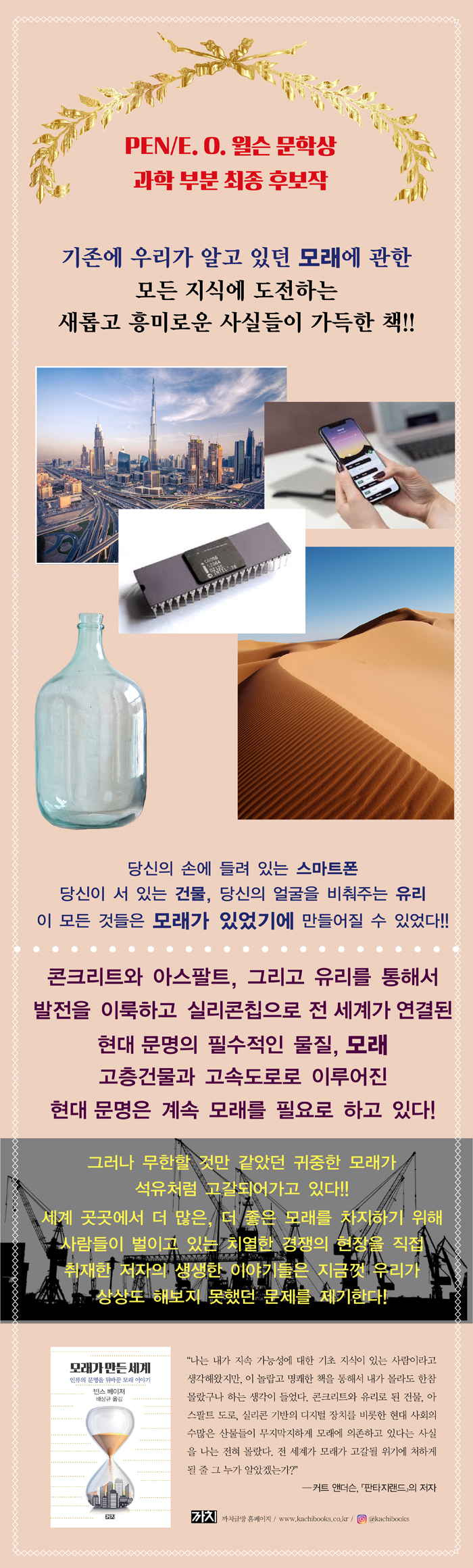
PEN/E.
O. Wilson Prize for Literature, Science Category Finalist
The Story of Sand, the Hidden Hero Who Transformed Civilization and Built Modern Society
Violence and environmental destruction surrounding depleting sand: a vivid scene.
Parables about sand are found all over the world.
It is usually used to mean innumerable and worthless.
But this book gives a completely opposite answer.
Sand is as important as oil, a finite natural resource that has transformed our civilization.
Think about it.
Highways and high-rise buildings, which symbolize modern civilization, contain sand.
Even the smartphones we hold in our hands every day cannot exist without sand.
All the benefits of modern society that we enjoy come from sand.
But, like sand running out of an hourglass, the sand actually disappears.
Buildings are being built in a reckless manner, new cities appear on empty land, new lands are created by pouring sand into the sea, etc. The places where sand is used are endless and the amount is also enormous.
The author travels to sand mining sites around the world, tracing how sand became essential to our lives from the very beginning when it was first used in large quantities, and guides us into the world of sand.
This book also introduces and exposes various incidents that have occurred surrounding sand—fights between neighbors over sand, sand thieves who dig up sand overnight and run away, sand mafia who even commit murder for sand, and even the natural environment that is damaged by reckless digging—and will show us the unknown side of sand and new aspects surrounding it.
O. Wilson Prize for Literature, Science Category Finalist
The Story of Sand, the Hidden Hero Who Transformed Civilization and Built Modern Society
Violence and environmental destruction surrounding depleting sand: a vivid scene.
Parables about sand are found all over the world.
It is usually used to mean innumerable and worthless.
But this book gives a completely opposite answer.
Sand is as important as oil, a finite natural resource that has transformed our civilization.
Think about it.
Highways and high-rise buildings, which symbolize modern civilization, contain sand.
Even the smartphones we hold in our hands every day cannot exist without sand.
All the benefits of modern society that we enjoy come from sand.
But, like sand running out of an hourglass, the sand actually disappears.
Buildings are being built in a reckless manner, new cities appear on empty land, new lands are created by pouring sand into the sea, etc. The places where sand is used are endless and the amount is also enormous.
The author travels to sand mining sites around the world, tracing how sand became essential to our lives from the very beginning when it was first used in large quantities, and guides us into the world of sand.
This book also introduces and exposes various incidents that have occurred surrounding sand—fights between neighbors over sand, sand thieves who dig up sand overnight and run away, sand mafia who even commit murder for sand, and even the natural environment that is damaged by reckless digging—and will show us the unknown side of sand and new aspects surrounding it.
- You can preview some of the book's contents.
Preview
index
1.
The most important solid substance on Earth
Part 1: The 20th Century Industrial Society Built on Sand
2.
The skeleton of the city
3.
The Birth of the Highway
4.
The substance that allows you to see everything
Part 2: 21st Century Globalization and Digitalization: Achieving Sand
5.
Advanced equipment and high-purity sand
6.
hydraulic fracturing facility
7.
Beach towns with disappearing beaches
8.
artificial land
9.
War on the Desert
10.
Concrete that conquered the world
11.
The path we must take
Acknowledgements
main
References
Translator's Note
Biographical Index
The most important solid substance on Earth
Part 1: The 20th Century Industrial Society Built on Sand
2.
The skeleton of the city
3.
The Birth of the Highway
4.
The substance that allows you to see everything
Part 2: 21st Century Globalization and Digitalization: Achieving Sand
5.
Advanced equipment and high-purity sand
6.
hydraulic fracturing facility
7.
Beach towns with disappearing beaches
8.
artificial land
9.
War on the Desert
10.
Concrete that conquered the world
11.
The path we must take
Acknowledgements
main
References
Translator's Note
Biographical Index
Detailed image
Publisher's Review
Sand is easy to see everywhere around us.
But not all sand is created equal.
Dubai, a futuristic city standing tall in the middle of the desert, is densely packed with tall buildings and stylish mansions line the reclaimed coastline.
You might think that since Dubai is located in the desert, all these massive works would have been built using desert sand.
You are absolutely right.
Desert sand is useless because the particles are too round.
These sands are either imported from other countries or dug up from the seabed of the Persian Gulf.
It took a huge amount of sand to build this magnificent city.
It's not like you can just compact the ground with all the sand and make semiconductor chips.
Because of this, high-quality sand is in short supply, and to secure this sand, people are willing to destroy the environment, steal, and even kill.
The author traces the origins of this widespread use of sand, even going so far as to report directly from dangerous locations, leading readers to various locations where sand is being dug up.
Chapter 1 tells the story of Paleram Chauhan from India, who lost his life for preventing sand mining in his village.
The author, who went to investigate this and encountered the sand mafia, wonders what sand is that makes such dangerous things happen.
Chapter 2 covers the process of concrete development.
Although the history of raw concrete is so old that even the ancient Greeks used it, it became widespread after the development of cement.
Concrete can be easily made by mixing aggregate (sand and gravel) with cement, and when reinforced concrete is added, it becomes reinforced concrete, which allows for the construction of strong and sanitary houses at a low cost.
Initially, concrete was ignored as a building material, but in the early 20th century it became the driving force behind the construction of high-rise buildings.
Chapter 3 is about asphalt.
With the invention of artificial asphalt in the 19th century, road paving became easier, and with the popularization of automobiles, paved roads became an essential part of life.
U.S. President Eisenhower personally experienced the importance of highways during the war and began the great journey of building interstate highways.
Chapter 4 features Michael Owens, the inventor of the glass bottle making machine.
Originally, glass products were like works of art created one by one by a glass artisan blowing them with his mouth.
Owens, a quartz sand miner, applied the principle of making glass bottles to a machine, and the glass bottles that were being made at a rate of one per minute were now made at a rate of 12 per minute by Owens' machine.
Now that glass can be manufactured by machines, glass products are permeating every aspect of our lives.
Chapter 5 focuses on quartz sand, the raw material for silicon, the main material of semiconductor chips.
The author visits Spruce Pine in the United States, where the world's finest quartz sand is mined.
Here, quartz crucibles needed to make silicon for semiconductor chips are produced.
Chapter 6 visits a site where hydraulic fracturing sand is mined to extract shale gas hidden deep underground.
The author visits a sand filtration plant and a sand mine for hydraulic fracturing and witnesses the massive environmental damage caused by this.
Chapter 7 features the beaches of South Florida, a popular vacation destination in the United States.
However, this beach is not entirely natural.
Only by bringing in fine sand from nearby areas and pouring it onto the beach can we create the beach we imagine.
However, the sand that can be brought in is limited, and the sand on the beach does not stay in place but continues to disappear.
Chapter 8 is about people who fill the sea with sand to create artificial islands.
The author, who moved to Dubai, interviews them firsthand and observes the city, which has been expanded by sea sand, to see how much sand has been poured into it and what environmental damage it has caused.
In Chapter 9, the author visits Inner Mongolia, China, and investigates the desert reforestation project that the Chinese government is actively pursuing.
In Chapter 10, the author returns to concrete and examines how dependent modern civilization is on concrete.
Modern civilization itself is built of concrete, and the sheer volume of concrete it contains speaks volumes about the gravity of the situation.
In the final chapter, Chapter 11, the author argues that sand is not infinite and raises critical views about modern civilization's excessive consumption of sand.
It also warns of a future where sand may soon become scarce and suggests alternatives.
But not all sand is created equal.
Dubai, a futuristic city standing tall in the middle of the desert, is densely packed with tall buildings and stylish mansions line the reclaimed coastline.
You might think that since Dubai is located in the desert, all these massive works would have been built using desert sand.
You are absolutely right.
Desert sand is useless because the particles are too round.
These sands are either imported from other countries or dug up from the seabed of the Persian Gulf.
It took a huge amount of sand to build this magnificent city.
It's not like you can just compact the ground with all the sand and make semiconductor chips.
Because of this, high-quality sand is in short supply, and to secure this sand, people are willing to destroy the environment, steal, and even kill.
The author traces the origins of this widespread use of sand, even going so far as to report directly from dangerous locations, leading readers to various locations where sand is being dug up.
Chapter 1 tells the story of Paleram Chauhan from India, who lost his life for preventing sand mining in his village.
The author, who went to investigate this and encountered the sand mafia, wonders what sand is that makes such dangerous things happen.
Chapter 2 covers the process of concrete development.
Although the history of raw concrete is so old that even the ancient Greeks used it, it became widespread after the development of cement.
Concrete can be easily made by mixing aggregate (sand and gravel) with cement, and when reinforced concrete is added, it becomes reinforced concrete, which allows for the construction of strong and sanitary houses at a low cost.
Initially, concrete was ignored as a building material, but in the early 20th century it became the driving force behind the construction of high-rise buildings.
Chapter 3 is about asphalt.
With the invention of artificial asphalt in the 19th century, road paving became easier, and with the popularization of automobiles, paved roads became an essential part of life.
U.S. President Eisenhower personally experienced the importance of highways during the war and began the great journey of building interstate highways.
Chapter 4 features Michael Owens, the inventor of the glass bottle making machine.
Originally, glass products were like works of art created one by one by a glass artisan blowing them with his mouth.
Owens, a quartz sand miner, applied the principle of making glass bottles to a machine, and the glass bottles that were being made at a rate of one per minute were now made at a rate of 12 per minute by Owens' machine.
Now that glass can be manufactured by machines, glass products are permeating every aspect of our lives.
Chapter 5 focuses on quartz sand, the raw material for silicon, the main material of semiconductor chips.
The author visits Spruce Pine in the United States, where the world's finest quartz sand is mined.
Here, quartz crucibles needed to make silicon for semiconductor chips are produced.
Chapter 6 visits a site where hydraulic fracturing sand is mined to extract shale gas hidden deep underground.
The author visits a sand filtration plant and a sand mine for hydraulic fracturing and witnesses the massive environmental damage caused by this.
Chapter 7 features the beaches of South Florida, a popular vacation destination in the United States.
However, this beach is not entirely natural.
Only by bringing in fine sand from nearby areas and pouring it onto the beach can we create the beach we imagine.
However, the sand that can be brought in is limited, and the sand on the beach does not stay in place but continues to disappear.
Chapter 8 is about people who fill the sea with sand to create artificial islands.
The author, who moved to Dubai, interviews them firsthand and observes the city, which has been expanded by sea sand, to see how much sand has been poured into it and what environmental damage it has caused.
In Chapter 9, the author visits Inner Mongolia, China, and investigates the desert reforestation project that the Chinese government is actively pursuing.
In Chapter 10, the author returns to concrete and examines how dependent modern civilization is on concrete.
Modern civilization itself is built of concrete, and the sheer volume of concrete it contains speaks volumes about the gravity of the situation.
In the final chapter, Chapter 11, the author argues that sand is not infinite and raises critical views about modern civilization's excessive consumption of sand.
It also warns of a future where sand may soon become scarce and suggests alternatives.
GOODS SPECIFICS
- Publication date: October 17, 2019
- Page count, weight, size: 362 pages | 584g | Checking size
- ISBN13: 9788972916970
- ISBN10: 8972916978
You may also like
카테고리
korean


korean

![ELLE 엘르 스페셜 에디션 A형 : 12월 [2025]](http://librairie.coreenne.fr/cdn/shop/files/b8e27a3de6c9538896439686c6b0e8fb.jpg?v=1766436872&width=3840)


