

Origin of Species
 |
Description
Book Introduction
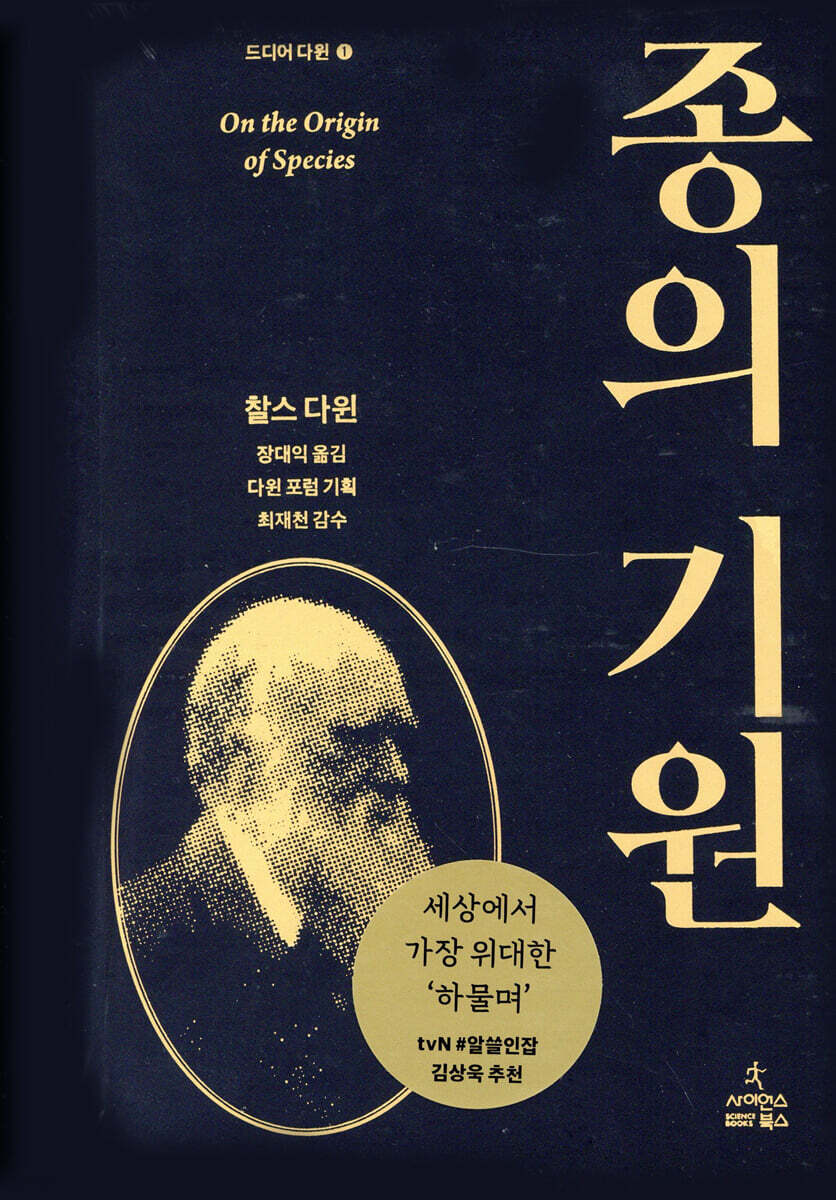
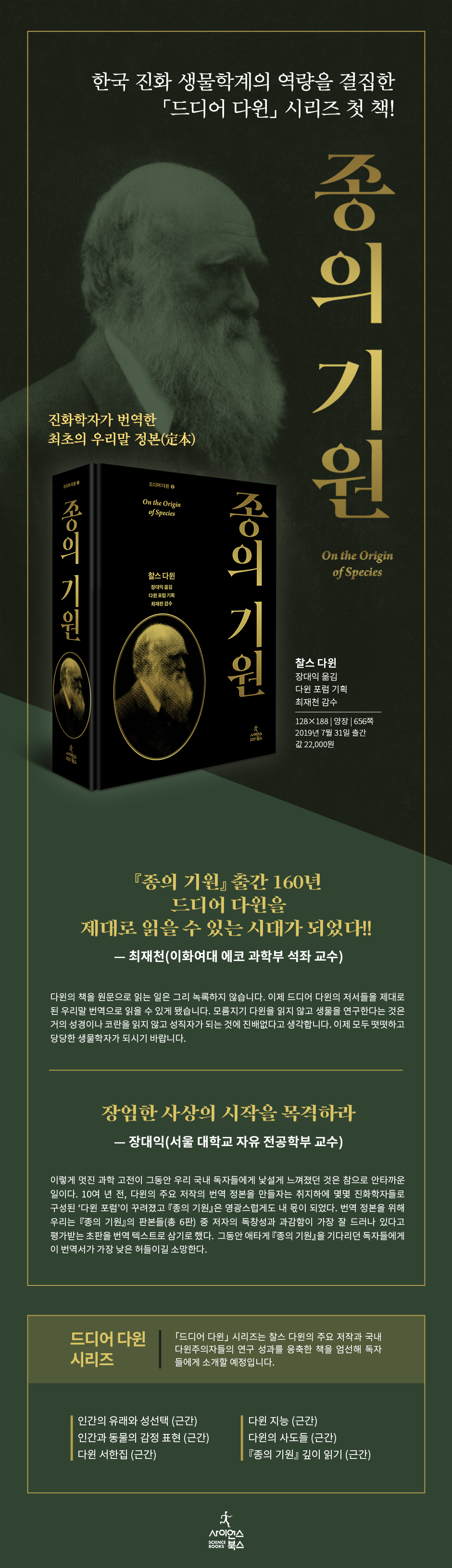
160th Anniversary of the Publication of "The Origin of Species" Finally, I can read Darwin properly. The time has come! The first Korean translation of the first edition of 『Origin of Species』, the starting point of Darwin's thought, translated by an evolutionary biologist, is the first Korean translation in Korean publishing history. The first Darwin anthology, translating by Professor Jang Dae-ik of Seoul National University and planned and supervised by the Darwin Forum, led by Professor Choi Jae-cheon of the Department of Ecological Science at Ewha Womans University, bringing together the capabilities of the Korean evolutionary biology community. The first book in the "Darwin at Last" series. The first edition of "The Origin of Species," where you can witness the quiet birth of the greatest idea in human history: evolution through natural selection, that magnificent thought. |
- You can preview some of the book's contents.
Preview
index
Publisher's Note: On the Publication of the "Finally Darwin" Series (Choi Jae-cheon)
Translator's Preface: Witness the Birth of a Magnificent Idea
introduction
Chapter 1: Mutations Occurring Under Breeding and Cultivation
Chapter 2: Variations in the Natural State
Chapter 3: The Struggle for Survival
Chapter 4 Natural Selection
Chapter 5: The Laws of Mutation
Chapter 6: Difficulties in Theory
Chapter 7: Instinct
Chapter 8: Hybrids
Chapter 9: On the Incompleteness of the Geological Record
Chapter 10: On the Geological Succession of Organisms
Chapter 11 Geographic Distribution
Chapter 12 Geographic Distribution (continued)
Chapter 13: Interrelationships of Organisms, Morphology, Embryology, and Vestigial Organs
Chapter 14 Summary and Conclusion
Search
Translator's Preface: Witness the Birth of a Magnificent Idea
introduction
Chapter 1: Mutations Occurring Under Breeding and Cultivation
Chapter 2: Variations in the Natural State
Chapter 3: The Struggle for Survival
Chapter 4 Natural Selection
Chapter 5: The Laws of Mutation
Chapter 6: Difficulties in Theory
Chapter 7: Instinct
Chapter 8: Hybrids
Chapter 9: On the Incompleteness of the Geological Record
Chapter 10: On the Geological Succession of Organisms
Chapter 11 Geographic Distribution
Chapter 12 Geographic Distribution (continued)
Chapter 13: Interrelationships of Organisms, Morphology, Embryology, and Vestigial Organs
Chapter 14 Summary and Conclusion
Search
Detailed image
Publisher's Review
The first edition of 『Origin of Species』, which can be said to be the starting point of Darwin's thought
The first Korean text translated by an evolutionary biologist
This time, 『The Origin of Species』 published by Science Books and Professor Jang Dae-ik is a translation of the first edition (1st edition) published in 1859.
The Origin of Species went through six revisions between 1859 and 1872, during which time Darwin corrected typos, countered criticisms of previous editions, changed his theories, and introduced new terminology.
So, until the mid-20th century, evolutionary biologists considered the sixth edition of the trilogy, The Descent of Man and Sexual Selection (1871) and The Expression of the Emotions in Man and Animals (1872), which argued the concept of 'evolution through natural selection', to be the complete version of Darwin's ideas.
However, after the mid-20th century, when evolutionary biology matured and research on Darwin's ideas and the literature he left behind began in earnest, it was discovered that Darwin, in the process of publishing a revised edition of The Origin of Species, was aware of the controversy his book created and either refined his expressions or created an excuse that could be used for eugenic and racist prejudice.
This led to a movement to return to the original starting point of Darwin's thought, the very book that had caused a stir in the intellectual world, and to examine the first edition, which contained Darwin's original thoughts.
The translation of the first edition of 『Origin of Species』, the first book in the "Finally Darwin" series, which aims to gather the capabilities of the Korean evolutionary community to create a proper Darwin anthology, is based on this movement in the global academic community.
In Korea, several editions of The Origin of Species have been published since 1960, and while some were translations of the first edition, the majority were in the sixth edition.
Professor Jang Dae-ik, in translating and publishing the first edition of 『The Origin of Species』, endeavored to restore the original form of Darwin's ideas based on recent historical achievements in evolutionary biology and the latest research on Darwin's literature.
For example, we reexamined the word 'evolution'.
In fact, the term 'evolution' was never used in the first edition of 'On the Origin of Species'.
The word "evolution," which has a strong nuance of "progress," was first used by Darwin in his 1871 book, "The Descent of Man and Sexual Selection," which clearly shows the influence of Herbert Spencer, the founder of Social Darwinism, who is evaluated to have applied Darwinism to social phenomena and served as the cradle of racism and eugenics.
And the one used in 『The Origin of Species』 is from the 6th edition published in 1872.
Until then, Darwin had been extremely careful to avoid having his concept of 'evolution' confused with the concept of 'progress', and in fact, in the first edition, he only used the term "descent with modification" instead of the word 'evolution'.
And even when I later started using the word 'evolution', I wanted it to be read as 'unfolding', not 'progress'.
Professor Jang Dae-ik's efforts to find the origin of Darwin's ideas can be seen in the last sentence of 'The Origin of Species'.
There is a grandeur in this view of life, that life, first breathed into a few or one forms, has unfolded and is unfolding from such simple beginnings through various forces as this planet rotates, according to the immutable law of gravity, into the most beautiful, wondrous, and limitless forms.
In this sentence, which is quoted in numerous evolutionary books, the original word translated as 'to unfold' is the verb form of evolution, evolve.
It is used only once in the first edition of 『The Origin of Species』, and as the last word.
Many editions previously published in our country translated this word as 'evolution'.
Even the translated version of the first edition was translated that way.
However, Professor Jang Dae-ik corrected this to 'development' in accordance with Darwin's original meaning.
In addition, the foundation for consistent terminology in the field of evolutionary studies was laid by refining the translation of 'struggle for existence', which was translated as 'competition for existence', to 'struggle for survival', and by refining the translation of 'descent with modification', which was translated in various ways by each translator, to 'succession with change'.
In addition, we refined the sentences so that Korean readers could accurately understand Darwin's meaning while maintaining Darwin's original text as much as possible.
In this sense, this book can be said to be the first Korean version of 『The Origin of Species』 properly translated by an evolutionary biologist.
The greatest idea in human history: evolution through natural selection
We can witness the quiet birth of that magnificent idea.
The Origin of Species, first edition
『Origin of Species』, published by Science Books, Inc. this time, is one of the books in the "Darwin at Last" series, which can be considered a Darwin anthology.
The Darwin Forum, which is led by Ewha Womans University Professor Jae-Cheon Choi and includes ecologist Ho-Jeong Kang, evolutionary ethicist Seong-Han Kim, evolutionary biologist Dae-Ik Jang, evolutionary psychologist Jung-Hwan Jeon, publisher Joo-Il-Woo Joo, and evolutionary economist Jeong-Gyu Choi as its members, is planning and preparing the "Finally Darwin" series. It will consist of Darwin's original works such as "Origin of Species," "The Descent of Humans and Sexual Selection," and "The Expression of the Emotions in Humans and Animals," as well as books on Darwin or Darwinism written by Darwin Forum members, who can be considered representative researchers in Korean evolutionary biology.
Following the recently published 『Origin of Species』, 『The Expression of Emotions in Humans and Animals』, translated by Professor Kim Seong-han of Jeonju National University of Education, is scheduled to be published this fall, and 『Darwin's Apostles』, which Professor Choi Jae-cheon personally interviewed and compiled with world-renowned evolutionary scholars such as the Harvard couple professors Peter and Rosemary Grant, Richard Dawkins, Edward Wilson, and Steven Pinker, is scheduled to be published this winter.
In addition, Science Books, Inc., along with the Darwin Forum, plans to hold various Darwin-related events, including lectures and book concerts, starting in the second half of 2019.
Translated by Professor Jang Dae-ik of Seoul National University
Planned and supervised by the Darwin Forum led by Professor Choi Jae-cheon of the Department of Eco-Science at Ewha Womans University
The first Darwin anthology that brings together the capabilities of the Korean evolutionary biology community.
The first book in the "Finally Darwin" series!
Given our considerable ignorance about the interrelationships of the organisms that live around us, it is not surprising that much remains unexplained about the origins of species and varieties.
Who can explain why some species are distributed in large numbers over wide areas, while others, closely related to them, are rare in narrow areas? Yet, this correlation is of considerable importance.
Because it determines the well-being of all living beings, and, I believe, even their future prosperity and change.
Moreover, we know even less about the interrelationships of the countless life forms that have survived during past geological epochs.
Much remains unclear and will likely remain so.
But I am perfectly convinced that species are not immutable entities, and that just as the varieties recognized as descendants of a species are descendants of that species, so too the species belonging to the group called the same genus are the lineal descendants of some other (usually extinct) species.
Furthermore, I am convinced that natural selection is not the only way of this change, but it is the main way.
-Charles Darwin
The 'century of biology' has arrived in this land.
But unfortunately, most scholars studying biology in this country are not biologists in the strict sense of the word.
They are natural scientists who study chemistry or physics using living organisms as their subject.
As a result, unlike in the West, a significant number of biology or life science professors are not well-versed in Darwin's theory of evolution.
There are surprisingly many professors who teach general biology classes without actually teaching evolution, but instead assign it as a self-study assignment.
Even if I leave aside the general reader, I am most delighted that biologists in this country have finally had the opportunity to properly encounter Darwin.
Reading Darwin's book in its original text is not an easy task.
Now, we can finally read Darwin's works in proper Korean translation.
I believe that studying biology without reading Darwin is almost like becoming a priest without reading the Bible or the Koran.
Now, I hope you all become proud and confident biologists.
-Choi Jae-cheon (Darwin Forum Representative, Ewha Womans University Distinguished Professor)
It is truly regrettable that such a wonderful science classic has remained unfamiliar to our domestic readers for so long.
The biggest reason is probably that the translation of 『The Origin of Species』 was not done properly.
Although there are several translations available, none are accurate and can be considered definitive, considering the level of the general reader.
As an evolutionary scientist, this has always been a situation that has made me feel uncomfortable and sorry.
About ten years ago, a group of evolutionary biologists called the "Darwin Forum" was formed with the aim of producing a definitive translation of Darwin's major works, and "The Origin of Species" was given the honor of being my own.
For the translation, we decided to use the first edition of The Origin of Species (six editions in total) as the translation text, which is considered to best display the author's originality and boldness.
In fact, some scholars rate the second edition, which was republished a few months later with only typos corrected, as the best, but it has been revealed that there are quite a few changes in the second edition, and recently, there is a trend to value the first edition the most.
Moreover, in the case of domestic translations, for some reason, most of them are 6th edition translations, so the task of properly translating the first edition was even more urgent.
-Jang Dae-ik (Professor, College of Liberal Arts, Seoul National University)
The first Korean text translated by an evolutionary biologist
This time, 『The Origin of Species』 published by Science Books and Professor Jang Dae-ik is a translation of the first edition (1st edition) published in 1859.
The Origin of Species went through six revisions between 1859 and 1872, during which time Darwin corrected typos, countered criticisms of previous editions, changed his theories, and introduced new terminology.
So, until the mid-20th century, evolutionary biologists considered the sixth edition of the trilogy, The Descent of Man and Sexual Selection (1871) and The Expression of the Emotions in Man and Animals (1872), which argued the concept of 'evolution through natural selection', to be the complete version of Darwin's ideas.
However, after the mid-20th century, when evolutionary biology matured and research on Darwin's ideas and the literature he left behind began in earnest, it was discovered that Darwin, in the process of publishing a revised edition of The Origin of Species, was aware of the controversy his book created and either refined his expressions or created an excuse that could be used for eugenic and racist prejudice.
This led to a movement to return to the original starting point of Darwin's thought, the very book that had caused a stir in the intellectual world, and to examine the first edition, which contained Darwin's original thoughts.
The translation of the first edition of 『Origin of Species』, the first book in the "Finally Darwin" series, which aims to gather the capabilities of the Korean evolutionary community to create a proper Darwin anthology, is based on this movement in the global academic community.
In Korea, several editions of The Origin of Species have been published since 1960, and while some were translations of the first edition, the majority were in the sixth edition.
Professor Jang Dae-ik, in translating and publishing the first edition of 『The Origin of Species』, endeavored to restore the original form of Darwin's ideas based on recent historical achievements in evolutionary biology and the latest research on Darwin's literature.
For example, we reexamined the word 'evolution'.
In fact, the term 'evolution' was never used in the first edition of 'On the Origin of Species'.
The word "evolution," which has a strong nuance of "progress," was first used by Darwin in his 1871 book, "The Descent of Man and Sexual Selection," which clearly shows the influence of Herbert Spencer, the founder of Social Darwinism, who is evaluated to have applied Darwinism to social phenomena and served as the cradle of racism and eugenics.
And the one used in 『The Origin of Species』 is from the 6th edition published in 1872.
Until then, Darwin had been extremely careful to avoid having his concept of 'evolution' confused with the concept of 'progress', and in fact, in the first edition, he only used the term "descent with modification" instead of the word 'evolution'.
And even when I later started using the word 'evolution', I wanted it to be read as 'unfolding', not 'progress'.
Professor Jang Dae-ik's efforts to find the origin of Darwin's ideas can be seen in the last sentence of 'The Origin of Species'.
There is a grandeur in this view of life, that life, first breathed into a few or one forms, has unfolded and is unfolding from such simple beginnings through various forces as this planet rotates, according to the immutable law of gravity, into the most beautiful, wondrous, and limitless forms.
In this sentence, which is quoted in numerous evolutionary books, the original word translated as 'to unfold' is the verb form of evolution, evolve.
It is used only once in the first edition of 『The Origin of Species』, and as the last word.
Many editions previously published in our country translated this word as 'evolution'.
Even the translated version of the first edition was translated that way.
However, Professor Jang Dae-ik corrected this to 'development' in accordance with Darwin's original meaning.
In addition, the foundation for consistent terminology in the field of evolutionary studies was laid by refining the translation of 'struggle for existence', which was translated as 'competition for existence', to 'struggle for survival', and by refining the translation of 'descent with modification', which was translated in various ways by each translator, to 'succession with change'.
In addition, we refined the sentences so that Korean readers could accurately understand Darwin's meaning while maintaining Darwin's original text as much as possible.
In this sense, this book can be said to be the first Korean version of 『The Origin of Species』 properly translated by an evolutionary biologist.
The greatest idea in human history: evolution through natural selection
We can witness the quiet birth of that magnificent idea.
The Origin of Species, first edition
『Origin of Species』, published by Science Books, Inc. this time, is one of the books in the "Darwin at Last" series, which can be considered a Darwin anthology.
The Darwin Forum, which is led by Ewha Womans University Professor Jae-Cheon Choi and includes ecologist Ho-Jeong Kang, evolutionary ethicist Seong-Han Kim, evolutionary biologist Dae-Ik Jang, evolutionary psychologist Jung-Hwan Jeon, publisher Joo-Il-Woo Joo, and evolutionary economist Jeong-Gyu Choi as its members, is planning and preparing the "Finally Darwin" series. It will consist of Darwin's original works such as "Origin of Species," "The Descent of Humans and Sexual Selection," and "The Expression of the Emotions in Humans and Animals," as well as books on Darwin or Darwinism written by Darwin Forum members, who can be considered representative researchers in Korean evolutionary biology.
Following the recently published 『Origin of Species』, 『The Expression of Emotions in Humans and Animals』, translated by Professor Kim Seong-han of Jeonju National University of Education, is scheduled to be published this fall, and 『Darwin's Apostles』, which Professor Choi Jae-cheon personally interviewed and compiled with world-renowned evolutionary scholars such as the Harvard couple professors Peter and Rosemary Grant, Richard Dawkins, Edward Wilson, and Steven Pinker, is scheduled to be published this winter.
In addition, Science Books, Inc., along with the Darwin Forum, plans to hold various Darwin-related events, including lectures and book concerts, starting in the second half of 2019.
Translated by Professor Jang Dae-ik of Seoul National University
Planned and supervised by the Darwin Forum led by Professor Choi Jae-cheon of the Department of Eco-Science at Ewha Womans University
The first Darwin anthology that brings together the capabilities of the Korean evolutionary biology community.
The first book in the "Finally Darwin" series!
Given our considerable ignorance about the interrelationships of the organisms that live around us, it is not surprising that much remains unexplained about the origins of species and varieties.
Who can explain why some species are distributed in large numbers over wide areas, while others, closely related to them, are rare in narrow areas? Yet, this correlation is of considerable importance.
Because it determines the well-being of all living beings, and, I believe, even their future prosperity and change.
Moreover, we know even less about the interrelationships of the countless life forms that have survived during past geological epochs.
Much remains unclear and will likely remain so.
But I am perfectly convinced that species are not immutable entities, and that just as the varieties recognized as descendants of a species are descendants of that species, so too the species belonging to the group called the same genus are the lineal descendants of some other (usually extinct) species.
Furthermore, I am convinced that natural selection is not the only way of this change, but it is the main way.
-Charles Darwin
The 'century of biology' has arrived in this land.
But unfortunately, most scholars studying biology in this country are not biologists in the strict sense of the word.
They are natural scientists who study chemistry or physics using living organisms as their subject.
As a result, unlike in the West, a significant number of biology or life science professors are not well-versed in Darwin's theory of evolution.
There are surprisingly many professors who teach general biology classes without actually teaching evolution, but instead assign it as a self-study assignment.
Even if I leave aside the general reader, I am most delighted that biologists in this country have finally had the opportunity to properly encounter Darwin.
Reading Darwin's book in its original text is not an easy task.
Now, we can finally read Darwin's works in proper Korean translation.
I believe that studying biology without reading Darwin is almost like becoming a priest without reading the Bible or the Koran.
Now, I hope you all become proud and confident biologists.
-Choi Jae-cheon (Darwin Forum Representative, Ewha Womans University Distinguished Professor)
It is truly regrettable that such a wonderful science classic has remained unfamiliar to our domestic readers for so long.
The biggest reason is probably that the translation of 『The Origin of Species』 was not done properly.
Although there are several translations available, none are accurate and can be considered definitive, considering the level of the general reader.
As an evolutionary scientist, this has always been a situation that has made me feel uncomfortable and sorry.
About ten years ago, a group of evolutionary biologists called the "Darwin Forum" was formed with the aim of producing a definitive translation of Darwin's major works, and "The Origin of Species" was given the honor of being my own.
For the translation, we decided to use the first edition of The Origin of Species (six editions in total) as the translation text, which is considered to best display the author's originality and boldness.
In fact, some scholars rate the second edition, which was republished a few months later with only typos corrected, as the best, but it has been revealed that there are quite a few changes in the second edition, and recently, there is a trend to value the first edition the most.
Moreover, in the case of domestic translations, for some reason, most of them are 6th edition translations, so the task of properly translating the first edition was even more urgent.
-Jang Dae-ik (Professor, College of Liberal Arts, Seoul National University)
GOODS SPECIFICS
- Date of issue: July 31, 2019
- Format: Hardcover book binding method guide
- Page count, weight, size: 656 pages | 770g | 135*195*40mm
- ISBN13: 9791189198862
- ISBN10: 118919886X
You may also like
카테고리
korean


korean

![GQ KOREA Mark (Monthly): December [2025]](http://librairie.coreenne.fr/cdn/shop/files/8ef265dbbfbf186523ed75ba7319009d.jpg?v=1765340328&width=3840)


