

The future of humanity
 |
Description
Book Introduction
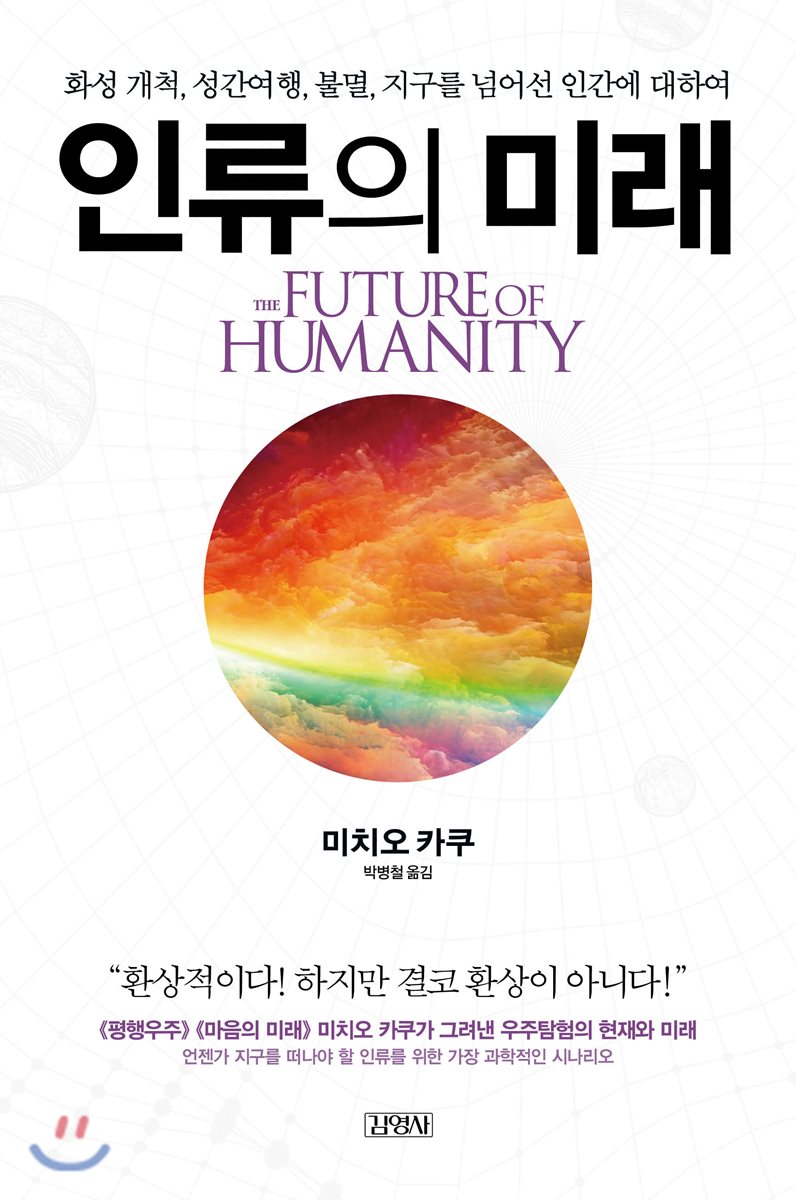
“It’s fantastic! But it’s not fantastic at all!” "Parallel Universes" and "The Future of the Mind": The Present and Future of Space Exploration as Depicted by Michio Kaku The most scientific scenario for humanity, which will one day have to leave Earth. World-renowned theoretical physicist and futurist Michio Kaku guides us into the world of astrophysics, artificial intelligence, and cutting-edge science and technology that will determine the fate of humanity in the space age. We are now living in a new 'golden age of space exploration', so much so that the question is not 'if' we can send humans to other planets, but 'when' we will. This recent, all-out, rapid space race is a result of a combination of rapidly advancing modern science and technology, including robotics, nanotechnology, biotechnology, and astrophysics; the continuous discovery of exoplanets; the global tycoons willing to open their wallets for space exploration; and the strong will of governments and public aspirations fueled by these efforts. In this book, Kaku examines the past and present of space exploration, seamlessly combining rigorous science with ingenious reasoning to gauge the future of humanity in the space age. In this book, readers will be able to see at a glance the cutting edge of space development and vividly picture the future of humanity after it left Earth. |
- You can preview some of the book's contents.
Preview
index
prolog
Introduction | Towards Multiplanetary Life
Part 1: Leaving Earth
1_ Preparing for takeoff
2_ A new era of space travel
3_ Sky Mine
4_ Mars or Bankruptcy
5_ Mars Colony
6_ Gas giant planets and comets
Part 2: Journey to the Stars
7_ Space Robot
8_ Building a spaceship
9_ Kepler and the Planets
Part 3: Life in the Universe
10_ Immortal Being
11_ Transhumanism and Science and Technology
12_ Finding Alien Life
13_ Advanced civilization
14_ Space Escape
Acknowledgements
Translator's Note
Huzhou
Further Reading
Search
Introduction | Towards Multiplanetary Life
Part 1: Leaving Earth
1_ Preparing for takeoff
2_ A new era of space travel
3_ Sky Mine
4_ Mars or Bankruptcy
5_ Mars Colony
6_ Gas giant planets and comets
Part 2: Journey to the Stars
7_ Space Robot
8_ Building a spaceship
9_ Kepler and the Planets
Part 3: Life in the Universe
10_ Immortal Being
11_ Transhumanism and Science and Technology
12_ Finding Alien Life
13_ Advanced civilization
14_ Space Escape
Acknowledgements
Translator's Note
Huzhou
Further Reading
Search
Detailed image

Into the book
When life on Earth is faced with a hostile environment, the only options are (1) escaping from the harsh environment and finding a place to live, (2) adapting to the given environment, or (3) becoming extinct.
However, the disaster that will come in the distant future may be so severe that adaptation is impossible.
Then, the only thing left is to escape Earth or become extinct.
There is no other choice.
--- p.9
As readers read this book, they will encounter pioneers who, with their energy, insight, and resources, are striving to change the destiny of humanity.
--- p.12
After the launch of Apollo 11, powered by the Saturn V in July 1969, NASA was on edge, fearing a repeat of the nightmare, and President Nixon even prepared two speeches in case something happened.
One was a congratulatory speech on the successful moon landing, and the other was a condolence speech in case of a failed landing, saying, “We are deeply saddened by the death of an American astronaut on the moon, and our hearts are with the bereaved families.” It was the second speech that almost got broadcast.
Just seconds before landing on the moon, a computer alarm inside the lander blared loudly.
However, thanks to the quick manual control of the lander control module by Commander Neil Armstrong, the lander was able to land gently on the lunar surface.
I checked later and it turned out to be a warning sound that only 50 seconds of fuel was left.
If it had been just one minute late, the lander would have crashed on the lunar surface.
--- p.49~50
Bezos wrote in his book:
“The basic idea of my idea is not to abandon the Earth, but to preserve it in its original form.
…if everyone leaves the Earth for a while, it will become safe and eventually be reborn as a giant park.” His ultimate goal was to move the industrial facilities that were the main culprits of pollution into space.
--- p.68
Musk explained the differences between SpaceX and NASA as follows:
“They say NASA doesn’t tolerate failure, but that’s a really stupid idea.
Failure is always welcome in our company.
“If things are going well without failure, it means you haven’t been innovating enough.”
--- p.100
Billions of years ago, when the Earth was covered in lava, Mars had already cooled to a tropical climate.
Some planetary scientists argue that DNA developed on Mars during its early stages of formation because the climate was suitable and water was abundant.
According to this scenario, a giant meteorite crashed on Mars in the past, scattering a large amount of rock and dust into space, some of which flew to Earth carrying the DNA of Martian life.
If this theory is correct, we could see Martians any day now.
Just stand in front of a mirror.
Zubrin says.
“Terraforming Mars is nothing new.
“Didn’t DNA that flew from Mars a long time ago modify Earth and make it what it is today?” That’s right.
If Mars is the home of life on Earth, then they have modified the entire environment to suit them, including changing the composition of the Earth's atmosphere, shaping its terrain, and creating oceans.
--- p.130~131
The first spaceship to travel to an exoplanet in the real world will be nothing like a science fiction movie.
It's a long way from a large, sleek spaceship, let alone one that doesn't carry people.
In fact, the first extraterrestrial spacecraft will likely be no larger than a postage stamp.
My former research colleague Stephen Hawking surprised the world in 2016 when he publicly declared his support for the Breakthrough Starshot project, which was launched with the goal of developing nanoships.
Nanoships are tiny chips that will be attached to spacecraft sails, which will be powered by laser beams fired from Earth to propel them into space.
Each chip is the size of a thumbnail, weighs less than 30 grams, and contains billions of transistors.
The biggest appeal of this project is that it can be realized with current technology, without having to wait 100 to 200 years for a new engine to be developed.
--- p.204~205
Alcubierre took Einstein's equations in mind and worked in the opposite direction to the traditional logic of theoretical physics.
What kind of star would compress the space in front of it and expand the space behind it? Surprisingly, the answer was quite simple.
The "space warp" that appears in Star Trek was one of the solutions to Einstein's equations! If so, warp drive should be studied within the realm of physics, not science fiction.
--- p.241
It's fantastic, but it's just a movie, right? No.
Nowadays, science and technology have advanced to the point where we can almost replicate Iron Man.
That's true.
One day, through cybernetics and genetic engineering, humans will be able to survive on alien planets.
Transhumanism (an intellectual and cultural movement that seeks to overcome human mental and physical limitations using science and technology--- p. translator) has now moved beyond science fiction and marginal science to become an important topic of discussion regarding human existence.
Moreover, robots are becoming stronger and smarter by the day.
When the day comes that they surpass humans, we will have to choose between two things.
Will we hand the world over to robots, or will we blend our bodies with theirs and become one?
--- p.299~300
Would you be okay with genetic manipulation if it could enhance human technology and abilities? If you answered "yes" to this question, you are a transhumanist.
To survive and thrive in an alien universe, the human body must be mechanically and biologically improved.
For transhumanists, this is not a matter of choice, but an imperative that must be implemented.
If you want to live long-term on a planet with significantly different gravity, air pressure, atmospheric composition, temperature, and radiation than Earth, you have no choice but to change your body structure.
--- p.314
I believe that there is a 'final line' in the human mind that prevents us from crossing certain limits.
For example, if drugs were legalized, how many more people would become addicted? At first glance, it seems like most people would become addicts, but expert analysis suggests it's unlikely to exceed 5%.
The other 95% would rather live an ordinary life in the real world than ruin their lives for a moment of pleasure.
Likewise, even if virtual reality were perfectly realized, most people would choose to remain in reality rather than live a fake life there.
--- p.322
It is not the critics, but ourselves who decide whether to accept new technologies.
--- p.324
If humanity survives into the distant future, it will not die along with the universe at the last moment, but will choose a suitable universe in the multiverse and move its habitat.
Yes, that's right.
Our story doesn't end when the universe dies.
--- p.437~438
This book made me want to live long for the first time in my life.
A fantastic future is right around the corner, and if I die without seeing it, I will regret it even in the afterlife.
However, the disaster that will come in the distant future may be so severe that adaptation is impossible.
Then, the only thing left is to escape Earth or become extinct.
There is no other choice.
--- p.9
As readers read this book, they will encounter pioneers who, with their energy, insight, and resources, are striving to change the destiny of humanity.
--- p.12
After the launch of Apollo 11, powered by the Saturn V in July 1969, NASA was on edge, fearing a repeat of the nightmare, and President Nixon even prepared two speeches in case something happened.
One was a congratulatory speech on the successful moon landing, and the other was a condolence speech in case of a failed landing, saying, “We are deeply saddened by the death of an American astronaut on the moon, and our hearts are with the bereaved families.” It was the second speech that almost got broadcast.
Just seconds before landing on the moon, a computer alarm inside the lander blared loudly.
However, thanks to the quick manual control of the lander control module by Commander Neil Armstrong, the lander was able to land gently on the lunar surface.
I checked later and it turned out to be a warning sound that only 50 seconds of fuel was left.
If it had been just one minute late, the lander would have crashed on the lunar surface.
--- p.49~50
Bezos wrote in his book:
“The basic idea of my idea is not to abandon the Earth, but to preserve it in its original form.
…if everyone leaves the Earth for a while, it will become safe and eventually be reborn as a giant park.” His ultimate goal was to move the industrial facilities that were the main culprits of pollution into space.
--- p.68
Musk explained the differences between SpaceX and NASA as follows:
“They say NASA doesn’t tolerate failure, but that’s a really stupid idea.
Failure is always welcome in our company.
“If things are going well without failure, it means you haven’t been innovating enough.”
--- p.100
Billions of years ago, when the Earth was covered in lava, Mars had already cooled to a tropical climate.
Some planetary scientists argue that DNA developed on Mars during its early stages of formation because the climate was suitable and water was abundant.
According to this scenario, a giant meteorite crashed on Mars in the past, scattering a large amount of rock and dust into space, some of which flew to Earth carrying the DNA of Martian life.
If this theory is correct, we could see Martians any day now.
Just stand in front of a mirror.
Zubrin says.
“Terraforming Mars is nothing new.
“Didn’t DNA that flew from Mars a long time ago modify Earth and make it what it is today?” That’s right.
If Mars is the home of life on Earth, then they have modified the entire environment to suit them, including changing the composition of the Earth's atmosphere, shaping its terrain, and creating oceans.
--- p.130~131
The first spaceship to travel to an exoplanet in the real world will be nothing like a science fiction movie.
It's a long way from a large, sleek spaceship, let alone one that doesn't carry people.
In fact, the first extraterrestrial spacecraft will likely be no larger than a postage stamp.
My former research colleague Stephen Hawking surprised the world in 2016 when he publicly declared his support for the Breakthrough Starshot project, which was launched with the goal of developing nanoships.
Nanoships are tiny chips that will be attached to spacecraft sails, which will be powered by laser beams fired from Earth to propel them into space.
Each chip is the size of a thumbnail, weighs less than 30 grams, and contains billions of transistors.
The biggest appeal of this project is that it can be realized with current technology, without having to wait 100 to 200 years for a new engine to be developed.
--- p.204~205
Alcubierre took Einstein's equations in mind and worked in the opposite direction to the traditional logic of theoretical physics.
What kind of star would compress the space in front of it and expand the space behind it? Surprisingly, the answer was quite simple.
The "space warp" that appears in Star Trek was one of the solutions to Einstein's equations! If so, warp drive should be studied within the realm of physics, not science fiction.
--- p.241
It's fantastic, but it's just a movie, right? No.
Nowadays, science and technology have advanced to the point where we can almost replicate Iron Man.
That's true.
One day, through cybernetics and genetic engineering, humans will be able to survive on alien planets.
Transhumanism (an intellectual and cultural movement that seeks to overcome human mental and physical limitations using science and technology--- p. translator) has now moved beyond science fiction and marginal science to become an important topic of discussion regarding human existence.
Moreover, robots are becoming stronger and smarter by the day.
When the day comes that they surpass humans, we will have to choose between two things.
Will we hand the world over to robots, or will we blend our bodies with theirs and become one?
--- p.299~300
Would you be okay with genetic manipulation if it could enhance human technology and abilities? If you answered "yes" to this question, you are a transhumanist.
To survive and thrive in an alien universe, the human body must be mechanically and biologically improved.
For transhumanists, this is not a matter of choice, but an imperative that must be implemented.
If you want to live long-term on a planet with significantly different gravity, air pressure, atmospheric composition, temperature, and radiation than Earth, you have no choice but to change your body structure.
--- p.314
I believe that there is a 'final line' in the human mind that prevents us from crossing certain limits.
For example, if drugs were legalized, how many more people would become addicted? At first glance, it seems like most people would become addicts, but expert analysis suggests it's unlikely to exceed 5%.
The other 95% would rather live an ordinary life in the real world than ruin their lives for a moment of pleasure.
Likewise, even if virtual reality were perfectly realized, most people would choose to remain in reality rather than live a fake life there.
--- p.322
It is not the critics, but ourselves who decide whether to accept new technologies.
--- p.324
If humanity survives into the distant future, it will not die along with the universe at the last moment, but will choose a suitable universe in the multiverse and move its habitat.
Yes, that's right.
Our story doesn't end when the universe dies.
--- p.437~438
This book made me want to live long for the first time in my life.
A fantastic future is right around the corner, and if I die without seeing it, I will regret it even in the afterlife.
--- From the Translator's Note
Publisher's Review
“It’s fantastic! But it’s not fantastic at all!”
A new golden age of space exploration
How Science and Technology Are Transforming Space into Humanity's Stage
From artificial intelligence and robotics to astrophysics and biotechnology,
A world of cutting-edge science and technology toward space civilization
We are now living in a new 'golden age of space exploration', so much so that the question is not 'if' we can send humans to other planets, but 'when' we will.
The United States has revised its goal of sending astronauts back to the moon four years earlier than originally planned, from 2028 to 2024, and declared that it will send humans to Mars in 2033.
China, which advocates a "space exploration" strategy, became the first country to land an unmanned probe on the far side of the moon in early 2019, and has announced plans to launch a Mars probe in 2020 and a Jupiter probe in 2029.
Europe is pursuing plans to build a habitable base on the moon, called 'Moon Village', by 2040.
South Korea crossed the threshold of space development with the successful test launch of a Korean launch vehicle in 2018.
The goal is to successfully launch the spacecraft in 2021 and send a lunar probe by 2030.
While past space exploration was government-led and aimed at military purposes, a characteristic of recent space exploration is that many private companies with commercial objectives are participating.
Not only are companies leading commercial space travel such as Tesla CEO Elon Musk's SpaceX, Amazon CEO Jeff Bezos' Blue Origin, and Virgin Group CEO Richard Branson's Virgin Galactic, but Israel also launched the world's first private lunar probe "to instill interest in science, technology, engineering, and math (STEM) fields in the public from an early age."
This recent, all-out, rapid space race is a result of a combination of rapidly advancing modern science and technology, including artificial intelligence, robotics, nanotechnology, biotechnology, and astrophysics; the continuous discovery of exoplanets; the global tycoons willingly opening their wallets for space exploration; and the strong will of governments and public aspirations fueled by these efforts.
In "The Future of Humanity," world-renowned theoretical physicist, futurist, and bestselling author Michio Kaku presents in great detail and persuasively how to build and maintain a civilization in space using cutting-edge science and technology.
By properly utilizing artificial intelligence, robotics, nanotechnology, biotechnology, and astrophysics, it is possible to build habitable cities on Mars and other planets.
This is not the end.
Kaku's imagination extends beyond our solar system to outer solar systems.
Astronomers have already discovered countless planets in outer space, and the list continues to grow.
One day, a planet with habitable conditions like Earth may be discovered.
When the nanoships, laser sails, and nuclear fusion rockets currently under development are completed, interstellar travel will become possible, ushering in a new era of 'space civilization.'
In this book, readers can see at a glance the cutting edge of space development.
“The end of the world is not the end of humanity!”
75,000 years ago, a single event wiped out most of humanity.
Like our ancestors who survived that time, will we overcome the great disaster that was planned?
Can we leave a future for our descendants?
75,000 years ago, Indonesia's Toba volcano erupted, sending a massive ash cloud across the sky and sending debris thousands of kilometers across the land, covering everything on the ground.
In the early stages of the eruption, many people suffocated or were killed by toxic gases, and soon after, temperatures plummeted, ushering in the so-called "volcanic winter," which wiped out all visible vegetation and wildlife.
The approximately 2,000 people who survived in this environment and migrated as far away as possible are the direct ancestors of the world's population of 7.6 billion.
Today we know very well that the events of 75,000 years ago were merely a rehearsal for the catastrophe to come.
Whether we look at it over short cycles of a few decades or long cycles of billions of years, disaster is inevitable.
Even if we avoid all the dangers of human-induced global warming, nuclear weapons, and bioterrorism, as well as uncontrollable natural disasters like ice ages and supervolcanic eruptions, and the ever-present threat of asteroid impacts, the Sun will become a red giant in 5 billion years and engulf the Earth.
Despite humanity's efforts to reduce or eliminate near-term dangers like global warming and nuclear weapons, such catastrophes on a larger scale are inevitable and destined to occur.
In this book, readers will meet pioneers who are striving to change the destiny of humanity by fully utilizing their energy, insight, and given resources.
Michio Kaku personally interviewed most of these people and captured their passionate thoughts surrounding the future of humanity in this book.
When life on Earth is faced with a hostile environment, the only options are (1) escaping from the harsh environment and finding a place to live, (2) adapting to the given environment, or (3) becoming extinct.
However, the disaster that will come in the distant future may be so severe that adaptation is impossible.
Then, the only thing left is to escape Earth or become extinct.
There is no other choice.
Will humanity, when the end of the world approaches, be able to use advanced science and technology to leave Earth and migrate to other planets in the solar system? Or, when even the Sun dies, will we be able to leave our solar system and establish life on exoplanets? As these technologies, once reminiscent of science fiction, become reality, the gap between imagination and reality is narrowing.
The same goes for imaginations about the ‘future of humanity.’
This book provides a clear picture of the future of humanity living in the space age.
"Parallel Universes" and "The Future of the Mind": The Present and Future of Space Exploration as Depicted by Michio Kaku
The most scientific scenario for humanity, which will one day have to leave Earth.
The book is divided into three parts according to the stages of human advancement into space.
Part 1 explores how to establish a permanent base on the Moon and develop Mars as a colony.
To achieve this, we must fully utilize artificial intelligence, nanotechnology, and biotechnology, which are currently rapidly developing.
Part 2 takes us on a journey beyond our solar system to explore nearby stars.
Although it is impossible with current technology, future technologies such as nanospacecraft, laser navigation, ramjet fusion, and antimatter engines will make the impossible possible.
In Part 3, we explore what technologies humanity needs to survive in an alien environment.
Interstellar travel is a long-distance journey that takes at least several decades to several hundred years, so the human body must function normally for a long time, and to achieve this, genetic engineering must be fully utilized to extend lifespan.
Additionally, since exoplanets have gravity, atmospheric composition, and surrounding environments that are completely different from those of Earth, we must use genetic engineering to modify our bodies to adapt to them.
So, if humanity survives into the distant future, it will not die along with the universe at the last moment, but will choose a suitable universe in the multiverse and move its habitat.
Yes, that's right.
The story of humanity does not end with the death of the universe.
A new golden age of space exploration
How Science and Technology Are Transforming Space into Humanity's Stage
From artificial intelligence and robotics to astrophysics and biotechnology,
A world of cutting-edge science and technology toward space civilization
We are now living in a new 'golden age of space exploration', so much so that the question is not 'if' we can send humans to other planets, but 'when' we will.
The United States has revised its goal of sending astronauts back to the moon four years earlier than originally planned, from 2028 to 2024, and declared that it will send humans to Mars in 2033.
China, which advocates a "space exploration" strategy, became the first country to land an unmanned probe on the far side of the moon in early 2019, and has announced plans to launch a Mars probe in 2020 and a Jupiter probe in 2029.
Europe is pursuing plans to build a habitable base on the moon, called 'Moon Village', by 2040.
South Korea crossed the threshold of space development with the successful test launch of a Korean launch vehicle in 2018.
The goal is to successfully launch the spacecraft in 2021 and send a lunar probe by 2030.
While past space exploration was government-led and aimed at military purposes, a characteristic of recent space exploration is that many private companies with commercial objectives are participating.
Not only are companies leading commercial space travel such as Tesla CEO Elon Musk's SpaceX, Amazon CEO Jeff Bezos' Blue Origin, and Virgin Group CEO Richard Branson's Virgin Galactic, but Israel also launched the world's first private lunar probe "to instill interest in science, technology, engineering, and math (STEM) fields in the public from an early age."
This recent, all-out, rapid space race is a result of a combination of rapidly advancing modern science and technology, including artificial intelligence, robotics, nanotechnology, biotechnology, and astrophysics; the continuous discovery of exoplanets; the global tycoons willingly opening their wallets for space exploration; and the strong will of governments and public aspirations fueled by these efforts.
In "The Future of Humanity," world-renowned theoretical physicist, futurist, and bestselling author Michio Kaku presents in great detail and persuasively how to build and maintain a civilization in space using cutting-edge science and technology.
By properly utilizing artificial intelligence, robotics, nanotechnology, biotechnology, and astrophysics, it is possible to build habitable cities on Mars and other planets.
This is not the end.
Kaku's imagination extends beyond our solar system to outer solar systems.
Astronomers have already discovered countless planets in outer space, and the list continues to grow.
One day, a planet with habitable conditions like Earth may be discovered.
When the nanoships, laser sails, and nuclear fusion rockets currently under development are completed, interstellar travel will become possible, ushering in a new era of 'space civilization.'
In this book, readers can see at a glance the cutting edge of space development.
“The end of the world is not the end of humanity!”
75,000 years ago, a single event wiped out most of humanity.
Like our ancestors who survived that time, will we overcome the great disaster that was planned?
Can we leave a future for our descendants?
75,000 years ago, Indonesia's Toba volcano erupted, sending a massive ash cloud across the sky and sending debris thousands of kilometers across the land, covering everything on the ground.
In the early stages of the eruption, many people suffocated or were killed by toxic gases, and soon after, temperatures plummeted, ushering in the so-called "volcanic winter," which wiped out all visible vegetation and wildlife.
The approximately 2,000 people who survived in this environment and migrated as far away as possible are the direct ancestors of the world's population of 7.6 billion.
Today we know very well that the events of 75,000 years ago were merely a rehearsal for the catastrophe to come.
Whether we look at it over short cycles of a few decades or long cycles of billions of years, disaster is inevitable.
Even if we avoid all the dangers of human-induced global warming, nuclear weapons, and bioterrorism, as well as uncontrollable natural disasters like ice ages and supervolcanic eruptions, and the ever-present threat of asteroid impacts, the Sun will become a red giant in 5 billion years and engulf the Earth.
Despite humanity's efforts to reduce or eliminate near-term dangers like global warming and nuclear weapons, such catastrophes on a larger scale are inevitable and destined to occur.
In this book, readers will meet pioneers who are striving to change the destiny of humanity by fully utilizing their energy, insight, and given resources.
Michio Kaku personally interviewed most of these people and captured their passionate thoughts surrounding the future of humanity in this book.
When life on Earth is faced with a hostile environment, the only options are (1) escaping from the harsh environment and finding a place to live, (2) adapting to the given environment, or (3) becoming extinct.
However, the disaster that will come in the distant future may be so severe that adaptation is impossible.
Then, the only thing left is to escape Earth or become extinct.
There is no other choice.
Will humanity, when the end of the world approaches, be able to use advanced science and technology to leave Earth and migrate to other planets in the solar system? Or, when even the Sun dies, will we be able to leave our solar system and establish life on exoplanets? As these technologies, once reminiscent of science fiction, become reality, the gap between imagination and reality is narrowing.
The same goes for imaginations about the ‘future of humanity.’
This book provides a clear picture of the future of humanity living in the space age.
"Parallel Universes" and "The Future of the Mind": The Present and Future of Space Exploration as Depicted by Michio Kaku
The most scientific scenario for humanity, which will one day have to leave Earth.
The book is divided into three parts according to the stages of human advancement into space.
Part 1 explores how to establish a permanent base on the Moon and develop Mars as a colony.
To achieve this, we must fully utilize artificial intelligence, nanotechnology, and biotechnology, which are currently rapidly developing.
Part 2 takes us on a journey beyond our solar system to explore nearby stars.
Although it is impossible with current technology, future technologies such as nanospacecraft, laser navigation, ramjet fusion, and antimatter engines will make the impossible possible.
In Part 3, we explore what technologies humanity needs to survive in an alien environment.
Interstellar travel is a long-distance journey that takes at least several decades to several hundred years, so the human body must function normally for a long time, and to achieve this, genetic engineering must be fully utilized to extend lifespan.
Additionally, since exoplanets have gravity, atmospheric composition, and surrounding environments that are completely different from those of Earth, we must use genetic engineering to modify our bodies to adapt to them.
So, if humanity survives into the distant future, it will not die along with the universe at the last moment, but will choose a suitable universe in the multiverse and move its habitat.
Yes, that's right.
The story of humanity does not end with the death of the universe.
GOODS SPECIFICS
- Date of issue: May 3, 2019
- Format: Hardcover book binding method guide
- Page count, weight, size: 488 pages | 866g | 143*216*30mm
- ISBN13: 9788934995371
- ISBN10: 8934995378
You may also like
카테고리
korean


korean

![ELLE 엘르 스페셜 에디션 A형 : 12월 [2025]](http://librairie.coreenne.fr/cdn/shop/files/b8e27a3de6c9538896439686c6b0e8fb.jpg?v=1766436872&width=3840)


