

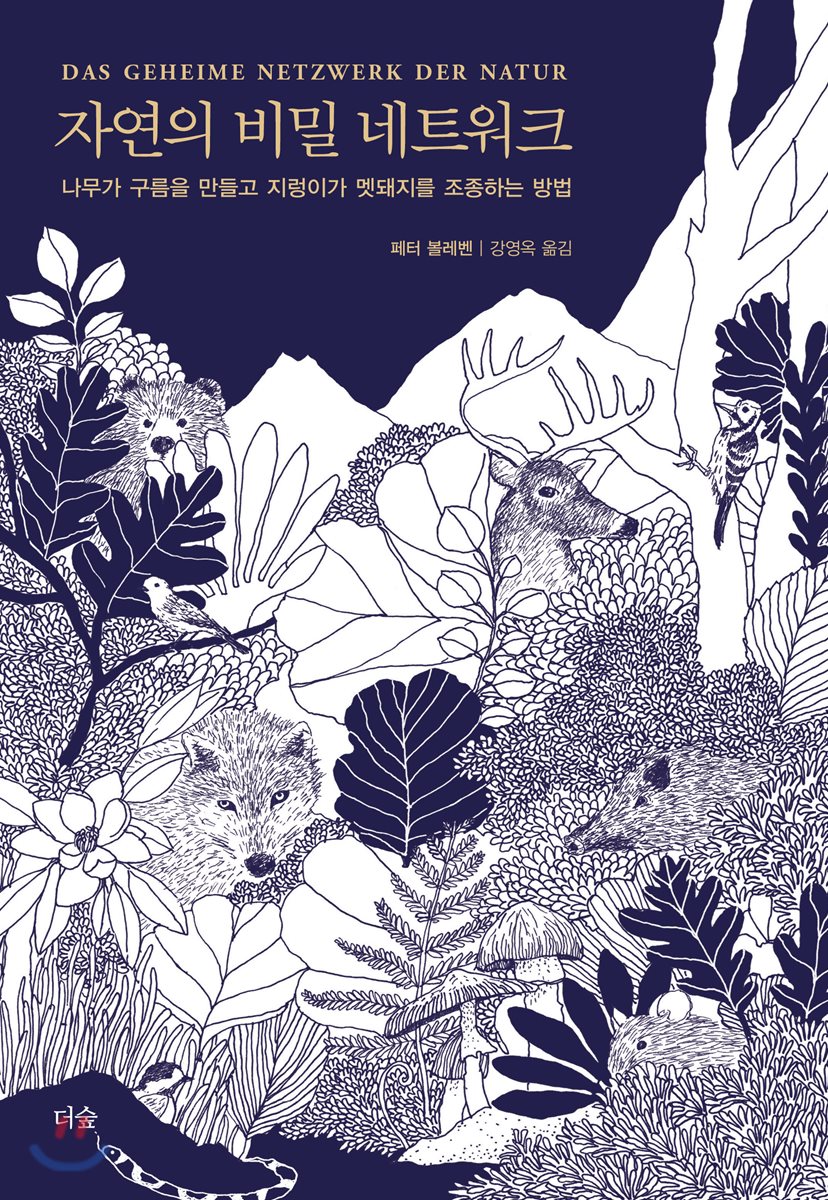
Nature's Secret Network
 |
Description
Book Introduction
- A word from MD
- See the true face of the living forestA new book by forest commentator and bestselling author Peter Wohlleben.
The author, who has been a "happy observer" of the forest for over 30 years, speaks of the wondrous laws of nature based on his long experience, showing that the ecological network that encompasses all life operates wonderfully on its own without human interference.
April 10, 2018. Natural Science PD Park Hyung-wook
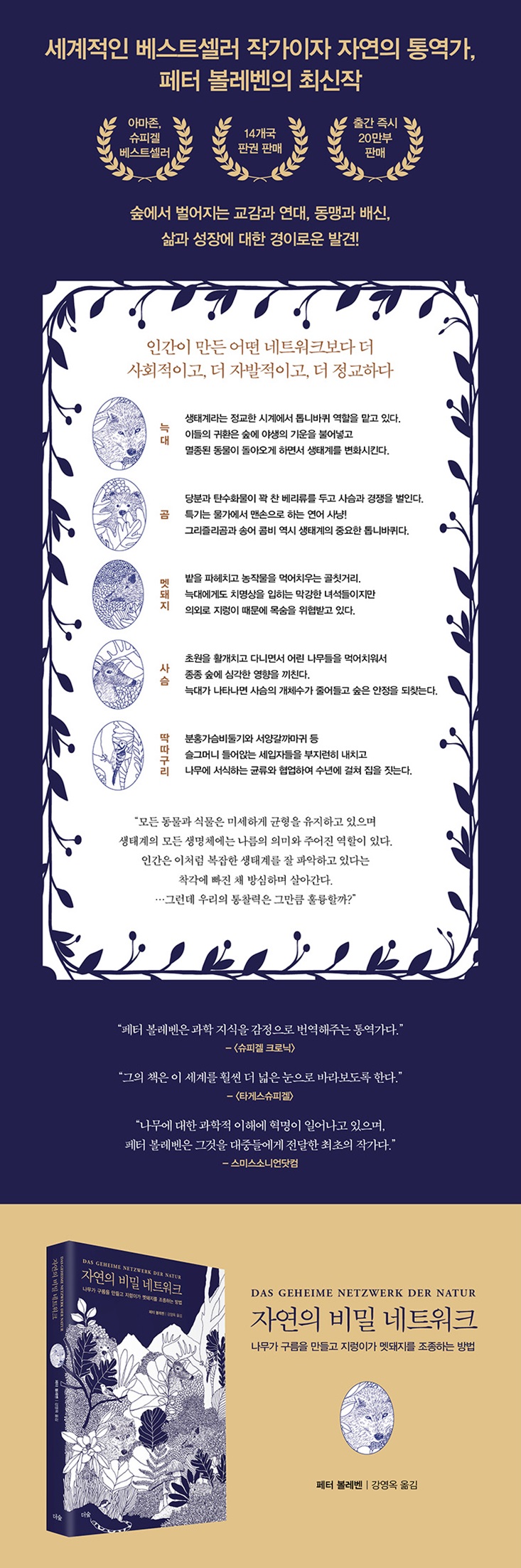
Copyright sold in 14 countries, 200,000 copies sold immediately after publication, Amazon/Spiegel bestseller
A world-renowned bestselling author and the world's most beloved forest interpreter.
Peter Wohlleben's latest work
'A natural interpreter who translates scientific knowledge into emotions', 'Germany's most successful non-fiction writer' - these are the words that follow Peter Wohlleben in every news article around the world.
He is a forest commentator and ecological writer with immense popularity in Germany, and has become an unusually international best-selling author.
His previous work, The Secret Life of Trees (Korean title: Tree Lessons), which was sold in 35 countries, was so well-received that it was even published in Iceland, a country with few forests.
His latest work, "Nature's Secret Network," which was recently published, also sold 200,000 copies and sold rights in 14 countries, becoming an Amazon/Spiegel bestseller.
Peter Wohlleben, who calls himself a "happy observer," has been managing the forest for over 30 years, and the amazing scientific discoveries he has made are as exciting as reading a novel.
This book, which explores all living things in the forest and traces their networks, combines expertise and living knowledge, a deep affection for the forest, and humor that can only be found in someone who has spent a long time observing nature, rather than knowledge learned through books.
He says nature is full of amazing secrets we still don't know.
When wolves return to the forest, the ecosystem changes dramatically, deciduous trees influence the Earth's rotation, cranes reduce Spanish sausage production, and coniferous forests bring rain.
This book shows us the true face of the living forest that coexists with us, not the forest as a romantic entity.
In this book, readers will embark on an exciting adventure with the world's leading forest experts to discover animals, trees, and even invisible bacteria living in a social network far more profound than any human-made network.
A world-renowned bestselling author and the world's most beloved forest interpreter.
Peter Wohlleben's latest work
'A natural interpreter who translates scientific knowledge into emotions', 'Germany's most successful non-fiction writer' - these are the words that follow Peter Wohlleben in every news article around the world.
He is a forest commentator and ecological writer with immense popularity in Germany, and has become an unusually international best-selling author.
His previous work, The Secret Life of Trees (Korean title: Tree Lessons), which was sold in 35 countries, was so well-received that it was even published in Iceland, a country with few forests.
His latest work, "Nature's Secret Network," which was recently published, also sold 200,000 copies and sold rights in 14 countries, becoming an Amazon/Spiegel bestseller.
Peter Wohlleben, who calls himself a "happy observer," has been managing the forest for over 30 years, and the amazing scientific discoveries he has made are as exciting as reading a novel.
This book, which explores all living things in the forest and traces their networks, combines expertise and living knowledge, a deep affection for the forest, and humor that can only be found in someone who has spent a long time observing nature, rather than knowledge learned through books.
He says nature is full of amazing secrets we still don't know.
When wolves return to the forest, the ecosystem changes dramatically, deciduous trees influence the Earth's rotation, cranes reduce Spanish sausage production, and coniferous forests bring rain.
This book shows us the true face of the living forest that coexists with us, not the forest as a romantic entity.
In this book, readers will embark on an exciting adventure with the world's leading forest experts to discover animals, trees, and even invisible bacteria living in a social network far more profound than any human-made network.
- You can preview some of the book's contents.
Preview
index
Preface | It is impossible for us to fully understand nature.
The wolf is back
How salmon drift through the forest
Tiny creatures that flowed into my morning coffee cup
Herbivorous deer like high-calorie foods.
Ants, the forest police and secret conquerors
The unified forest villain, the woodworm
Animal Funeral Dinner
What happens in the forest deep at night?
Correlation between black-necked cranes and sausage production
The Acorn Lotto: A Strategy for Oaks and Chestnuts
Can you predict winter cold by looking at the squirrel?
Trees grow slowly
What happens in the forest after the forest fire passes
extinction event of giant herbivores
Where is human evolution heading today?
Nature regulates everything by itself.
Conclusion | On How to View and Feel the Natural World
Acknowledgements
main
The wolf is back
How salmon drift through the forest
Tiny creatures that flowed into my morning coffee cup
Herbivorous deer like high-calorie foods.
Ants, the forest police and secret conquerors
The unified forest villain, the woodworm
Animal Funeral Dinner
What happens in the forest deep at night?
Correlation between black-necked cranes and sausage production
The Acorn Lotto: A Strategy for Oaks and Chestnuts
Can you predict winter cold by looking at the squirrel?
Trees grow slowly
What happens in the forest after the forest fire passes
extinction event of giant herbivores
Where is human evolution heading today?
Nature regulates everything by itself.
Conclusion | On How to View and Feel the Natural World
Acknowledgements
main
Detailed image
Into the book
In this way, all animals and plants maintain a delicate balance, and every living thing in the ecosystem has its own meaning and given role.
Humans live carelessly, under the illusion that they have a good understanding of this complex ecosystem.
When humans lived a nomadic life on the grasslands, a wider field of vision was advantageous for survival.
So, at that time, the most important sense organ for humans was the eye.
But is our insight really that good?
- From the preface
Wolves add a unique element to the forest experience.
One day, I happened to find a wolf's tracks in the forest and I can't tell you how happy and excited I was.
The place where the wolf's tracks were found was not in Hümmel, Rhineland-Palatinate, where my family lives, but on a quiet forest path in central Sweden.
Just following the wolf's tracks was an exciting adventure, and perhaps because of these tracks, the forest seemed closer to its wild state.
I want to share this awesome feeling with others.
The wolf is bringing wildness back to the forest.
As wolf populations increase in dense forests, the likelihood of extinct animals returning to the forests increases.
- From The Wolf Returns
Ants are recognized as helpers by foresters and forest owners and are thoroughly protected.
Ants not only eat all the notorious pests, they also dispose of their corpses.
As the title 'Secret Conqueror' suggests, ants are the rulers of the forest.
Moreover, although it is not a voluntary act, it also helps to conserve rare bird species.
Woodpeckers, crow-sized black woodpeckers, black grouse, and greater grouse love the larvae and pupae found in ant nests.
Isn't this enough reason for fire ants to fall into the category of 'useful' animals?
But if you observe the world of ants again, you will begin to have doubts.
Are ants really creatures worth protecting?
- Ant, the forest policeman and secret conqueror
So fire is no longer a natural phenomenon.
All of our ancestors' living spaces reflect the civilization and its influence that began with fire.
How can we distinguish between naturally occurring fire and fire caused by civilization? From this period onward, humans were no longer portrayed as coexisting with trees.
How can we determine whether a charred layer is caused by lightning or evidence of fire used by cave dwellers? Of course, forest fires were a regular occurrence.
After the forest fire, the forest regenerated.
In some cases, forest fires are interpreted as a phenomenon accompanying human habitation, but this does not allow us to interpret the rhythm of nature.
- What happens in the forest after the forest fire passes
Are you starting to understand? It seems the weather god doesn't understand the feelings of a forester like me.
You might think I'm just worrying too much about trees and their future.
But since I observe trees every day, I worry about the changes that gradually increase every year.
The warm winter that all the media is competing to report on is not the only problem.
Winter is coming later and later.
Eventually, we had to wait until January to see the first snow.
My jurisdiction usually has over 500 meters of snow by the end of November.
Meanwhile, March flies by before you can even sit outside to enjoy the warm weather.
The bees are also not active and are just huddled inside.
Willows bloom late and other flowers are slow to form nectar.
Besides, the weather hasn't cleared up yet, so I can't go out and catch bugs to eat.
- Extinction event of giant herbivores
Strictly speaking, modern medicine became necessary because of modern civilization.
The so-called diseases of civilization, which are caused by the development of material civilization, hardly existed thousands of years ago.
Orthodontics, spinal disc surgery, bypass surgery, etc. are all caused by an unhealthy lifestyle.
From this perspective, human civilization is halting the high-speed evolutionary process and forcing it to proceed in only one direction.
Instead of hunger and infectious diseases, the genes of people in advanced Western countries are infiltrated with harmful substances such as cholesterol.
Even if we just observe our own bodies, we can see that evolution is not yet finished.
Our body is like a building that started in ancient times and is still unfinished.
Wisdom teeth, appendix, and hair loss are proof of this.
We can live without wisdom teeth, without an appendix, without a little hair, without any problems.
In 50,000 years, human appearance will be completely different from what it is today.
We think we've reached the end of evolution, but these changes are still actively underway.
It's just that the speed is so slow that you don't notice it.
- Where is human evolution heading today?
Humans live carelessly, under the illusion that they have a good understanding of this complex ecosystem.
When humans lived a nomadic life on the grasslands, a wider field of vision was advantageous for survival.
So, at that time, the most important sense organ for humans was the eye.
But is our insight really that good?
- From the preface
Wolves add a unique element to the forest experience.
One day, I happened to find a wolf's tracks in the forest and I can't tell you how happy and excited I was.
The place where the wolf's tracks were found was not in Hümmel, Rhineland-Palatinate, where my family lives, but on a quiet forest path in central Sweden.
Just following the wolf's tracks was an exciting adventure, and perhaps because of these tracks, the forest seemed closer to its wild state.
I want to share this awesome feeling with others.
The wolf is bringing wildness back to the forest.
As wolf populations increase in dense forests, the likelihood of extinct animals returning to the forests increases.
- From The Wolf Returns
Ants are recognized as helpers by foresters and forest owners and are thoroughly protected.
Ants not only eat all the notorious pests, they also dispose of their corpses.
As the title 'Secret Conqueror' suggests, ants are the rulers of the forest.
Moreover, although it is not a voluntary act, it also helps to conserve rare bird species.
Woodpeckers, crow-sized black woodpeckers, black grouse, and greater grouse love the larvae and pupae found in ant nests.
Isn't this enough reason for fire ants to fall into the category of 'useful' animals?
But if you observe the world of ants again, you will begin to have doubts.
Are ants really creatures worth protecting?
- Ant, the forest policeman and secret conqueror
So fire is no longer a natural phenomenon.
All of our ancestors' living spaces reflect the civilization and its influence that began with fire.
How can we distinguish between naturally occurring fire and fire caused by civilization? From this period onward, humans were no longer portrayed as coexisting with trees.
How can we determine whether a charred layer is caused by lightning or evidence of fire used by cave dwellers? Of course, forest fires were a regular occurrence.
After the forest fire, the forest regenerated.
In some cases, forest fires are interpreted as a phenomenon accompanying human habitation, but this does not allow us to interpret the rhythm of nature.
- What happens in the forest after the forest fire passes
Are you starting to understand? It seems the weather god doesn't understand the feelings of a forester like me.
You might think I'm just worrying too much about trees and their future.
But since I observe trees every day, I worry about the changes that gradually increase every year.
The warm winter that all the media is competing to report on is not the only problem.
Winter is coming later and later.
Eventually, we had to wait until January to see the first snow.
My jurisdiction usually has over 500 meters of snow by the end of November.
Meanwhile, March flies by before you can even sit outside to enjoy the warm weather.
The bees are also not active and are just huddled inside.
Willows bloom late and other flowers are slow to form nectar.
Besides, the weather hasn't cleared up yet, so I can't go out and catch bugs to eat.
- Extinction event of giant herbivores
Strictly speaking, modern medicine became necessary because of modern civilization.
The so-called diseases of civilization, which are caused by the development of material civilization, hardly existed thousands of years ago.
Orthodontics, spinal disc surgery, bypass surgery, etc. are all caused by an unhealthy lifestyle.
From this perspective, human civilization is halting the high-speed evolutionary process and forcing it to proceed in only one direction.
Instead of hunger and infectious diseases, the genes of people in advanced Western countries are infiltrated with harmful substances such as cholesterol.
Even if we just observe our own bodies, we can see that evolution is not yet finished.
Our body is like a building that started in ancient times and is still unfinished.
Wisdom teeth, appendix, and hair loss are proof of this.
We can live without wisdom teeth, without an appendix, without a little hair, without any problems.
In 50,000 years, human appearance will be completely different from what it is today.
We think we've reached the end of evolution, but these changes are still actively underway.
It's just that the speed is so slow that you don't notice it.
- Where is human evolution heading today?
--- From the text
GOODS SPECIFICS
- Date of issue: April 10, 2018
- Page count, weight, size: 332 pages | 527g | 146*210*30mm
- ISBN13: 9791186900499
- ISBN10: 1186900490
You may also like
카테고리
korean


korean

![GQ KOREA Mark (Monthly): December [2025]](http://librairie.coreenne.fr/cdn/shop/files/8ef265dbbfbf186523ed75ba7319009d.jpg?v=1765340328&width=3840)


