

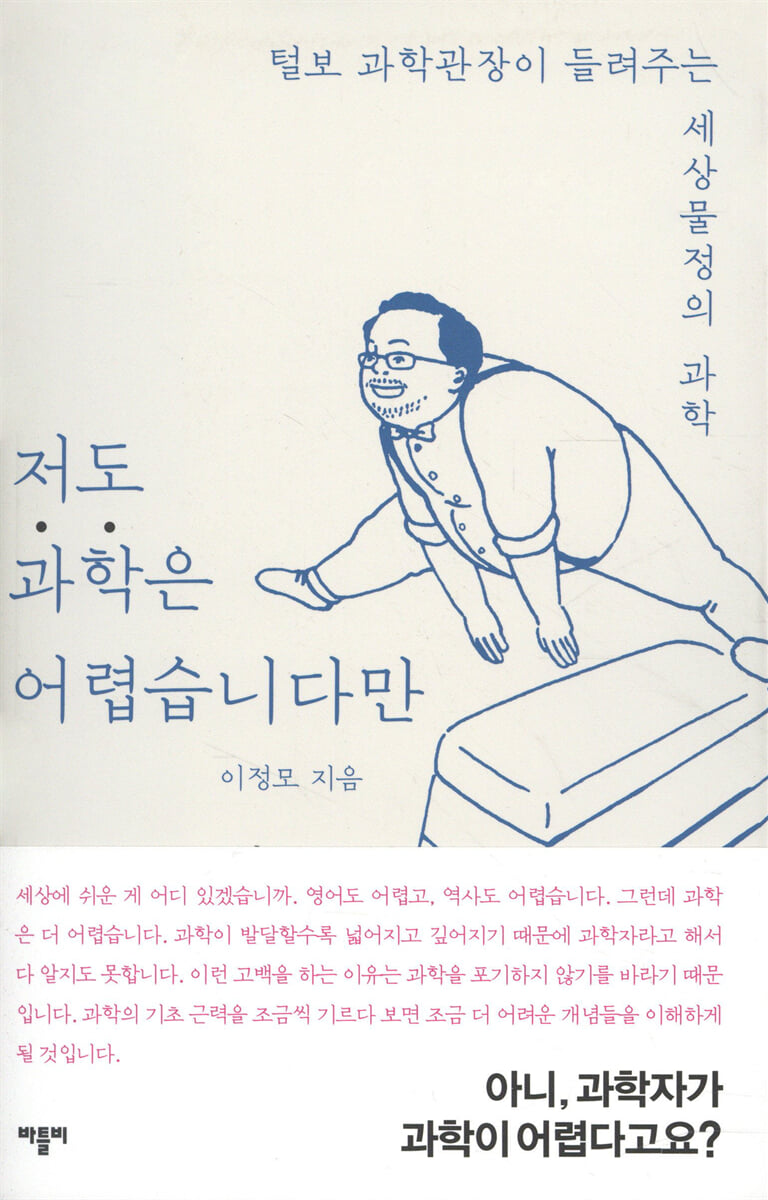
I also find science difficult.
 |
Description
Book Introduction
- A word from MD
-
That's all science, isn't it?A science essay that is closely related to life, written with deep thought and honesty.
Director Lee Jeong-mo of the Seodaemun Museum of Natural History reinterprets various phenomena and issues surrounding us, such as colds, oversleeping, candlelight vigils, and pseudo-religions, from a scientific perspective.
And says:
They say that life becomes more livable when you get closer to science.
January 9, 2018. Natural Science PD
62 Life-Changing Science Essays to Make Life a Little Easier
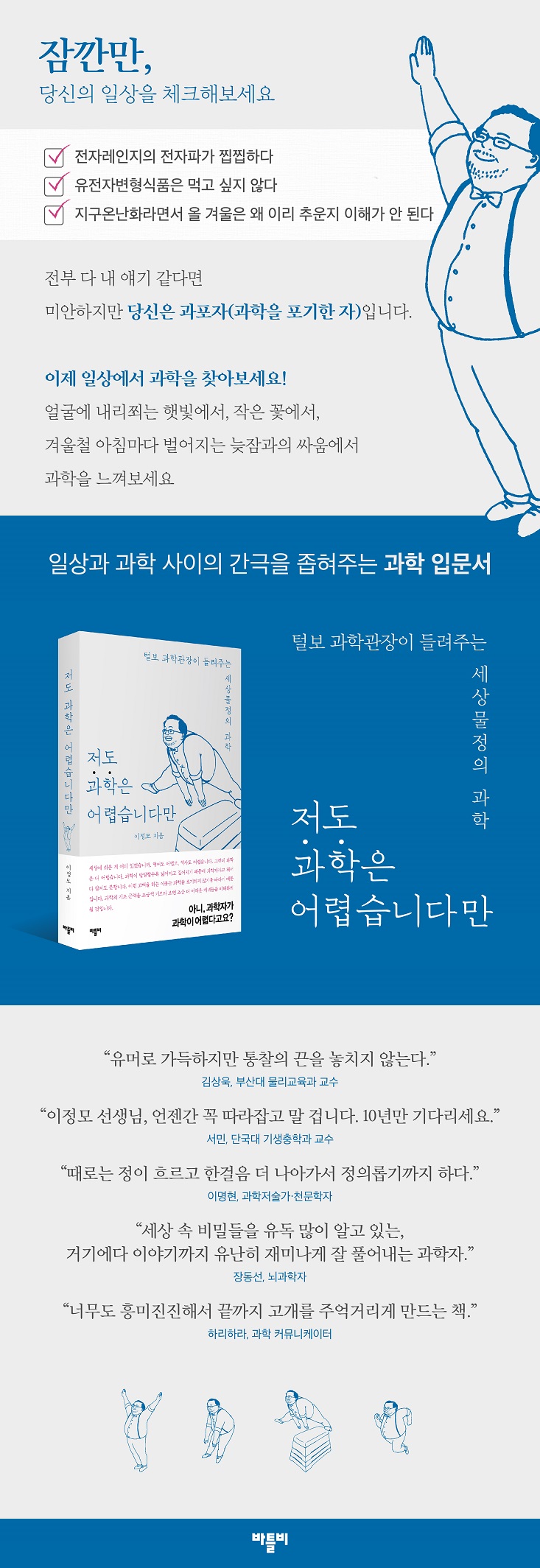
62 life-related science essays written by Lee Jeong-mo, a biochemist and director of the Seoul Metropolitan Science Museum.
By introducing a way of understanding the world through a scientific mindset, we show that becoming familiar with science can make life a little easier and more relaxed.
For example, the scientific fact that loaches are not muddy water nuisances but valuable oxygen providers points out why problematic organizations need employees who speak the truth, and the strategy of small flowers blooming before big ones demonstrates the solidarity of those without connections or power, and the difficulty of humility is discussed through atoms and the sun that shine by giving up what is theirs.
First, Part 1, 'Balance of Life', shows how scientific knowledge is connected to balance in life through things we easily encounter in everyday life, such as intestinal bacteria, photosynthesis, oversleeping, gravitational waves, farts, and flowers.
Part 2, "It Can't Get Any More Shameless," examines social issues such as the Taegeukgi rally, cults, Donald Trump, the MERS outbreak, and euthanasia through the lens of a scientist, explaining why we need to adopt a scientific attitude now.
Part 3, “What Do Scientists Know,” corrects misinformation through pseudoscience, microwave ovens, the flu, fake news, the supermoon, the Four Major Rivers Project, etc. Part 4, “Let’s Live Together,” explores reasons and methods for coexistence through kimchi, mosquitoes, zoos, cicadas, dinosaurs, and non-mainstream scientists.
Part 5, "A Slightly Better Future," raises serious questions about the future of humanity through cutting-edge scientific issues such as space immigration, global warming, mass extinction, and artificial intelligence.
62 life-related science essays written by Lee Jeong-mo, a biochemist and director of the Seoul Metropolitan Science Museum.
By introducing a way of understanding the world through a scientific mindset, we show that becoming familiar with science can make life a little easier and more relaxed.
For example, the scientific fact that loaches are not muddy water nuisances but valuable oxygen providers points out why problematic organizations need employees who speak the truth, and the strategy of small flowers blooming before big ones demonstrates the solidarity of those without connections or power, and the difficulty of humility is discussed through atoms and the sun that shine by giving up what is theirs.
First, Part 1, 'Balance of Life', shows how scientific knowledge is connected to balance in life through things we easily encounter in everyday life, such as intestinal bacteria, photosynthesis, oversleeping, gravitational waves, farts, and flowers.
Part 2, "It Can't Get Any More Shameless," examines social issues such as the Taegeukgi rally, cults, Donald Trump, the MERS outbreak, and euthanasia through the lens of a scientist, explaining why we need to adopt a scientific attitude now.
Part 3, “What Do Scientists Know,” corrects misinformation through pseudoscience, microwave ovens, the flu, fake news, the supermoon, the Four Major Rivers Project, etc. Part 4, “Let’s Live Together,” explores reasons and methods for coexistence through kimchi, mosquitoes, zoos, cicadas, dinosaurs, and non-mainstream scientists.
Part 5, "A Slightly Better Future," raises serious questions about the future of humanity through cutting-edge scientific issues such as space immigration, global warming, mass extinction, and artificial intelligence.
- You can preview some of the book's contents.
Preview
Detailed image
Into the book
What we think of as our constitution is often the result of gut bacteria.
Obesity is the same.
The saying that you can gain weight just by drinking water is 100% false.
However, there are people who eat a lot but do not gain weight.
This is because certain bacteria living in the intestines control the secretion of enzymes and hormones, thereby reducing body weight and blood sugar levels.
Diversity of bacterial species is also needed in the gut.
How can we live with only good bacteria? There must be a lot of bad bacteria too.
What matters is where the balance of power between good and bad bacteria lies.
-Page 16
It's not that a single loach muddies a pond; it's that loach survives and survives in dirty water.
The same goes for work.
It's not about having a loach-like employee come in and cause conflict, but rather about having employees persevere in a workplace with many conflicting factors.
And that employee may be a valuable asset that provides oxygen to the bottom to prevent the organization from rotting.
-Page 24
Sleep is a characteristic of animals with nervous systems.
It's not just time wasted in a daze.
It is a precious time when the whole body creates new cells and the brain produces hormones to prepare us for another day.
How precious must it be that we spend more time sleeping than eating?
-Page 31
We don't yet know what gravitational waves will be used for.
The electromagnetic waves used in smartphones also seemed useless when they were first discovered.
Science may seem useless now, but it will eventually change our lives.
-Page 36
Fish scientists say that the reason fish bite the bait again so quickly is because they are extremely hungry.
A very hungry fish will bite the bait even if it feels diarrhea pain and cannot stand the hunger.
When the environment is uncertain, eating is the best.
So, if you catch a fish again, you should stop fishing and throw out the bait you prepared.
-Page 40
Whether the smallest atom in the world emits light or the largest star in the world emits light, the principle is the same.
It shines when you release energy.
It shines when you let go of what is yours and become small.
-Page 60
Why build a natural history museum to exhibit extinct life? To learn from their failures.
By learning why all life forms, including trilobites and dinosaurs, became extinct, we can find a way for humanity to survive.
-Page 67
Science is not about determining right and wrong.
Science is 'the process of finding tentative answers through doubt.'
-Page 108
One is the courage to accept the reality that life has an end, and the other is the courage to take action based on the truth we have discovered.
At this point, we must decide which is more important: fear or hope.
-Page 130
All electronic devices we use emit electromagnetic waves.
Surprisingly, people who are afraid of microwaves use hair dryers without hesitation.
The electromagnetic waves emitted from a hair dryer are about 10 times more energetic than the electromagnetic waves you would receive if you put your nose up to a microwave oven.
Not to mention the electric blanket.
If you place a 3-centimeter thick blanket on an electric blanket and adjust the temperature to lukewarm, the electromagnetic waves measured are about 10 times higher than when you are 30 centimeters away from the microwave.
-Page 145
Humans are never perfect beings.
No matter how meticulous and wise a person is, his memory is not perfect.
This is a fact that was already confirmed experimentally 100 years ago.
-Page 160
A supermoon cannot and should not exist.
Scientists don't make such bold claims.
We simply use the terms 'perigee full moon' and 'apogee full moon'.
The term "supermoon" is said to have been first used by an astrologer in 1979.
So, it is a magical term.
-Page 163
The universe is big and magnificent, but we humans are great.
Humanity, living on ballpoint pen lead balls scattered across 300 soccer fields, launches tiny, invisible spaceships that accurately navigate to other points scattered across space and even return.
-Page 173
Humans are the most unnatural animals.
No matter how cruel it may be, they do not eat the intestines of a living cow, and no matter how hungry they are, they do not eat their twin siblings who grew up in the same litter.
Human life is fundamentally made up of contracts and trust.
Even if there is betrayal, it is nothing compared to what happens in the animal kingdom.
-Page 187
Learning about society through play, making your own rules, and taking risks.
This is the decisive advantage of Homo sapiens.
-Page 195
Some people claim that the reason cicadas sing even in the middle of the night is because the city nights are bright.
It's a reasonable inference in its own way.
But inference is just inference.
When scientists experimented, the results were different.
There was no correlation between light and the cicadas' cries.
Temperature was the decisive factor in cicadas' singing.
Temperature was important in moving the muscles of the vocal cords.
When it's hot, no matter how dark it is, cicadas sing.
Do your best.
-Pages 216-217
Regardless of species, all males make various efforts to attract females.
But most of it is useless.
Of all the males living on Earth, only 4% have ever been with a female before they died.
The remaining 96% of males die without ever mating.
-Page 221
Science is not easy.
I do it not because it's easy, but because it's difficult, but it's fun when I overcome that difficulty and realize it, and when I discover and create something new.
And we do it because new discoveries and knowledge have meaning in this world.
When do we feel happy? Aren't we happy when we're doing something fun, meaningful, and with a certain degree of uncertainty?
The uncertainty we are talking about here is not ambiguity.
It refers to that precarious feeling of whether it might work or not.
-Page 262
Fish vote? It's true.
When the leader fish decides on the prey, the other fish use their fins to vote whether to follow him or not.
The fish knows.
The fact that collective decisions made through democratic voting are more beneficial than those made by one leader.
-Page 279
Obesity is the same.
The saying that you can gain weight just by drinking water is 100% false.
However, there are people who eat a lot but do not gain weight.
This is because certain bacteria living in the intestines control the secretion of enzymes and hormones, thereby reducing body weight and blood sugar levels.
Diversity of bacterial species is also needed in the gut.
How can we live with only good bacteria? There must be a lot of bad bacteria too.
What matters is where the balance of power between good and bad bacteria lies.
-Page 16
It's not that a single loach muddies a pond; it's that loach survives and survives in dirty water.
The same goes for work.
It's not about having a loach-like employee come in and cause conflict, but rather about having employees persevere in a workplace with many conflicting factors.
And that employee may be a valuable asset that provides oxygen to the bottom to prevent the organization from rotting.
-Page 24
Sleep is a characteristic of animals with nervous systems.
It's not just time wasted in a daze.
It is a precious time when the whole body creates new cells and the brain produces hormones to prepare us for another day.
How precious must it be that we spend more time sleeping than eating?
-Page 31
We don't yet know what gravitational waves will be used for.
The electromagnetic waves used in smartphones also seemed useless when they were first discovered.
Science may seem useless now, but it will eventually change our lives.
-Page 36
Fish scientists say that the reason fish bite the bait again so quickly is because they are extremely hungry.
A very hungry fish will bite the bait even if it feels diarrhea pain and cannot stand the hunger.
When the environment is uncertain, eating is the best.
So, if you catch a fish again, you should stop fishing and throw out the bait you prepared.
-Page 40
Whether the smallest atom in the world emits light or the largest star in the world emits light, the principle is the same.
It shines when you release energy.
It shines when you let go of what is yours and become small.
-Page 60
Why build a natural history museum to exhibit extinct life? To learn from their failures.
By learning why all life forms, including trilobites and dinosaurs, became extinct, we can find a way for humanity to survive.
-Page 67
Science is not about determining right and wrong.
Science is 'the process of finding tentative answers through doubt.'
-Page 108
One is the courage to accept the reality that life has an end, and the other is the courage to take action based on the truth we have discovered.
At this point, we must decide which is more important: fear or hope.
-Page 130
All electronic devices we use emit electromagnetic waves.
Surprisingly, people who are afraid of microwaves use hair dryers without hesitation.
The electromagnetic waves emitted from a hair dryer are about 10 times more energetic than the electromagnetic waves you would receive if you put your nose up to a microwave oven.
Not to mention the electric blanket.
If you place a 3-centimeter thick blanket on an electric blanket and adjust the temperature to lukewarm, the electromagnetic waves measured are about 10 times higher than when you are 30 centimeters away from the microwave.
-Page 145
Humans are never perfect beings.
No matter how meticulous and wise a person is, his memory is not perfect.
This is a fact that was already confirmed experimentally 100 years ago.
-Page 160
A supermoon cannot and should not exist.
Scientists don't make such bold claims.
We simply use the terms 'perigee full moon' and 'apogee full moon'.
The term "supermoon" is said to have been first used by an astrologer in 1979.
So, it is a magical term.
-Page 163
The universe is big and magnificent, but we humans are great.
Humanity, living on ballpoint pen lead balls scattered across 300 soccer fields, launches tiny, invisible spaceships that accurately navigate to other points scattered across space and even return.
-Page 173
Humans are the most unnatural animals.
No matter how cruel it may be, they do not eat the intestines of a living cow, and no matter how hungry they are, they do not eat their twin siblings who grew up in the same litter.
Human life is fundamentally made up of contracts and trust.
Even if there is betrayal, it is nothing compared to what happens in the animal kingdom.
-Page 187
Learning about society through play, making your own rules, and taking risks.
This is the decisive advantage of Homo sapiens.
-Page 195
Some people claim that the reason cicadas sing even in the middle of the night is because the city nights are bright.
It's a reasonable inference in its own way.
But inference is just inference.
When scientists experimented, the results were different.
There was no correlation between light and the cicadas' cries.
Temperature was the decisive factor in cicadas' singing.
Temperature was important in moving the muscles of the vocal cords.
When it's hot, no matter how dark it is, cicadas sing.
Do your best.
-Pages 216-217
Regardless of species, all males make various efforts to attract females.
But most of it is useless.
Of all the males living on Earth, only 4% have ever been with a female before they died.
The remaining 96% of males die without ever mating.
-Page 221
Science is not easy.
I do it not because it's easy, but because it's difficult, but it's fun when I overcome that difficulty and realize it, and when I discover and create something new.
And we do it because new discoveries and knowledge have meaning in this world.
When do we feel happy? Aren't we happy when we're doing something fun, meaningful, and with a certain degree of uncertainty?
The uncertainty we are talking about here is not ambiguity.
It refers to that precarious feeling of whether it might work or not.
-Page 262
Fish vote? It's true.
When the leader fish decides on the prey, the other fish use their fins to vote whether to follow him or not.
The fish knows.
The fact that collective decisions made through democratic voting are more beneficial than those made by one leader.
-Page 279
--- From the text
Publisher's Review
Learning science makes life a little easier.
Life-friendly science that brings science to life
Director Lee Jeong-mo, the author, witnessed a strange sight while visiting his mother's house.
The beds in the bedroom were placed diagonally.
“Mom, why did you leave the bed like this?”
“Well, isn’t there a water vein flowing in the living room?
“I left it like this to avoid the water veins.”
“It’s the 12th floor, what kind of water vein is it?
“How did you know there was a water vein flowing down there?”
My mother learned how to find water veins at a cultural course run by the community center and bought a fairly expensive dowsing rod to find water veins.
I explained this and that to my mother and told her to straighten the bed, but this is what she said.
“Eww, what do you scientists know?
“Just leave it!” - Page 134
Science is unlocking the world's secrets one by one with insatiable curiosity and sincerity, but its achievements are not well communicated to the public.
Many people still believe that antibiotics help cure colds, that microwave ovens produce carcinogens, that GMOs are harmful to humans, and that global warming is a myth.
Superstitions and scams without scientific basis, such as dowsing, germanium bracelets, biorhythms, creation science, pyramid power, and perpetual motion machines, are also on the rise.
Each person tries to survive, but each person perishes.
The principles of worldly affairs discovered in the great laboratory of life
"Science is Difficult for Me Too" vividly illustrates how many scientific events we encounter in our ordinary daily lives.
These 62 essays, which explore social issues and aspects of everyday life, offer insights into the world through the eyes of a scientist.
The author presents readers with a new perspective and interpretation by blending basic scientific concepts with the everyday world, making it easy to understand.
For example, the author reflects on the survival strategies of small spring flowers and the lives of each of us living in our own time of survival.
Most flowers that bloom early in spring, such as forsythia, cherry blossoms, and azaleas, are small.
The strategy adopted by these flowers to pollinate and reproduce with the help of insects is to bloom in clusters and in profusion.
To look good to the bees.
The strategy is to spread the flowers in clumps so that the entire tree appears to be a flower, as the small flowers are not easily visible.
However, if each tiny flower tries to survive on its own, it is obvious that even if you try your best to bloom, it will be of no use.
The same goes for humans.
The power of each individual citizen is small.
The path to becoming our masters is to bloom in a hurry and profusely like cherry blossoms.
Now is the time for us to break free.
-Page 52 of the text
The explanation for the cause of bird flu, an uninvited guest that comes every winter, begins with the Earth's rotation and revolution.
Because our country's axis is tilted 23.5 degrees, our country has four distinct seasons, and various life forms come to visit depending on the season.
Just 100 years ago, tigers, Asiatic black bears, and foxes roamed the Korean Peninsula, but most of the animals that visit our country today are birds, and the most numerous are winter migratory birds.
In recent years, as winter migratory birds have been identified as a source of avian influenza, it has become increasingly difficult to talk about feeding migratory birds and protecting their habitats.
However, when AI is rampant, the rate of winter migratory birds dying from AI infection is less than 0.001 percent.
Migratory birds do not die from AI.
Just like people don't die from the flu.
Therefore, the condition of the infected individual is more important than whether or not they are infected. AI is only fatal to individuals living in unhealthy environments.
For example, chickens raised in unsanitary and cramped cages for efficiency reasons, unable to spread their wings, are vulnerable to stress and disease.
It's the same with humans.
If we blame the AI crisis we face almost every year solely on winter migratory birds, we are left with only two solutions.
One is to eliminate all the mudflats where winter migratory birds can find food, and the other is to straighten the Earth's axis, which is tilted 23.5 degrees.
-Pages 230-231
In this way, the author draws all aspects of daily life into science, from objects and phenomena like intestinal bacteria, farts, oversleeping, colds, and microwave ovens to social issues and concerns such as candlelight vigils, pseudo-religions, artificial intelligence, and space immigration.
It reinterprets the complexities of the world from a scientific perspective through life-related science that crosses biochemistry, biology, physics, and astronomy.
Break it, fail
Praise and encourage each other's failures.
The author, Director Lee Jeong-mo, is currently one of the most popular scientists in Korea.
He is evaluated by his fellow scientists as possessing “exceptional wit and quick thinking,” “knowing how to make eye contact with readers” (Professor Jae-Cheon Choi, Ewha Womans University), “full of humor but never losing sight of insight” (Professor Sang-Wook Kim, Department of Physics Education, Pusan National University), and “a scientist who is particularly good at telling stories in an interesting way” (Brain scientist Dong-Sun Jang, Ph.D.).
Although he is a recognized scientist, he says that science is not always easy and fun.
History is difficult, English is difficult, and geography is difficult.
And science is even more difficult.
Where in the world is anything easy? Even without innate talent, like music, art, sports, or dance, it's not like hard work is useless. It's a blessing that you can enjoy something that suits your efforts.
-Page 262
The author volunteers to serve as a bridge to help people understand science properly, even if it is somewhat difficult.
He describes himself as a "science communicator," a "mediator" who stands between scientists and citizens.
The author's consistent approach to bridging the gap between science and the public is also reflected in the science museum where he serves as director.
At the Seoul Metropolitan Science Museum, which opened in May 2017, there are no signs that say “Do not touch.”
The director of the Hairy Science Museum is instead thinking about how to get visitors to touch the exhibits more.
They get really excited when visitors destroy the exhibits in ways they never imagined.
Because science is a failure.
He emphasizes that we must create a culture of failure from now on.
Until now, our country has been a country that has copied others' work as quickly and cheaply as possible, so there was no need to fail.
But now it is time to create something completely new, something that has never existed before in this world.
To do that, we need to fail, we need to become accustomed to failure, and we need a culture that encourages each other to fail.
At this time, the scientist's attitude becomes an example for us.
A scientist's daily life is a series of failures.
It succeeds about once in a hundred times.
Scientists are not discouraged by failure.
Because science is inherently a failure.
That's why science can be fun.
If you can't accept failure and become frustrated, you will end up manipulating data and plagiarizing other people's papers.
-Page 49
Scientists are people who fail every day.
Failure to formulate a sound hypothesis and failure to observe, observe, and experiment.
They fail to analyze the data they obtain, write a paper, and get it accepted for publication.
Fail every day, but succeed once in a while.
That success remains in the thesis.
Not many people read the paper either.
But as these papers accumulate, science advances little by little through collective intelligence, and our understanding broadens.
"Science is Difficult for Me Too" helps train a scientific attitude through the process of finding scientific truth in everyday life.
Living in the world with a scientific attitude can help you avoid bad choices, cope with risks, and even make you a little happier.
Life-friendly science that brings science to life
Director Lee Jeong-mo, the author, witnessed a strange sight while visiting his mother's house.
The beds in the bedroom were placed diagonally.
“Mom, why did you leave the bed like this?”
“Well, isn’t there a water vein flowing in the living room?
“I left it like this to avoid the water veins.”
“It’s the 12th floor, what kind of water vein is it?
“How did you know there was a water vein flowing down there?”
My mother learned how to find water veins at a cultural course run by the community center and bought a fairly expensive dowsing rod to find water veins.
I explained this and that to my mother and told her to straighten the bed, but this is what she said.
“Eww, what do you scientists know?
“Just leave it!” - Page 134
Science is unlocking the world's secrets one by one with insatiable curiosity and sincerity, but its achievements are not well communicated to the public.
Many people still believe that antibiotics help cure colds, that microwave ovens produce carcinogens, that GMOs are harmful to humans, and that global warming is a myth.
Superstitions and scams without scientific basis, such as dowsing, germanium bracelets, biorhythms, creation science, pyramid power, and perpetual motion machines, are also on the rise.
Each person tries to survive, but each person perishes.
The principles of worldly affairs discovered in the great laboratory of life
"Science is Difficult for Me Too" vividly illustrates how many scientific events we encounter in our ordinary daily lives.
These 62 essays, which explore social issues and aspects of everyday life, offer insights into the world through the eyes of a scientist.
The author presents readers with a new perspective and interpretation by blending basic scientific concepts with the everyday world, making it easy to understand.
For example, the author reflects on the survival strategies of small spring flowers and the lives of each of us living in our own time of survival.
Most flowers that bloom early in spring, such as forsythia, cherry blossoms, and azaleas, are small.
The strategy adopted by these flowers to pollinate and reproduce with the help of insects is to bloom in clusters and in profusion.
To look good to the bees.
The strategy is to spread the flowers in clumps so that the entire tree appears to be a flower, as the small flowers are not easily visible.
However, if each tiny flower tries to survive on its own, it is obvious that even if you try your best to bloom, it will be of no use.
The same goes for humans.
The power of each individual citizen is small.
The path to becoming our masters is to bloom in a hurry and profusely like cherry blossoms.
Now is the time for us to break free.
-Page 52 of the text
The explanation for the cause of bird flu, an uninvited guest that comes every winter, begins with the Earth's rotation and revolution.
Because our country's axis is tilted 23.5 degrees, our country has four distinct seasons, and various life forms come to visit depending on the season.
Just 100 years ago, tigers, Asiatic black bears, and foxes roamed the Korean Peninsula, but most of the animals that visit our country today are birds, and the most numerous are winter migratory birds.
In recent years, as winter migratory birds have been identified as a source of avian influenza, it has become increasingly difficult to talk about feeding migratory birds and protecting their habitats.
However, when AI is rampant, the rate of winter migratory birds dying from AI infection is less than 0.001 percent.
Migratory birds do not die from AI.
Just like people don't die from the flu.
Therefore, the condition of the infected individual is more important than whether or not they are infected. AI is only fatal to individuals living in unhealthy environments.
For example, chickens raised in unsanitary and cramped cages for efficiency reasons, unable to spread their wings, are vulnerable to stress and disease.
It's the same with humans.
If we blame the AI crisis we face almost every year solely on winter migratory birds, we are left with only two solutions.
One is to eliminate all the mudflats where winter migratory birds can find food, and the other is to straighten the Earth's axis, which is tilted 23.5 degrees.
-Pages 230-231
In this way, the author draws all aspects of daily life into science, from objects and phenomena like intestinal bacteria, farts, oversleeping, colds, and microwave ovens to social issues and concerns such as candlelight vigils, pseudo-religions, artificial intelligence, and space immigration.
It reinterprets the complexities of the world from a scientific perspective through life-related science that crosses biochemistry, biology, physics, and astronomy.
Break it, fail
Praise and encourage each other's failures.
The author, Director Lee Jeong-mo, is currently one of the most popular scientists in Korea.
He is evaluated by his fellow scientists as possessing “exceptional wit and quick thinking,” “knowing how to make eye contact with readers” (Professor Jae-Cheon Choi, Ewha Womans University), “full of humor but never losing sight of insight” (Professor Sang-Wook Kim, Department of Physics Education, Pusan National University), and “a scientist who is particularly good at telling stories in an interesting way” (Brain scientist Dong-Sun Jang, Ph.D.).
Although he is a recognized scientist, he says that science is not always easy and fun.
History is difficult, English is difficult, and geography is difficult.
And science is even more difficult.
Where in the world is anything easy? Even without innate talent, like music, art, sports, or dance, it's not like hard work is useless. It's a blessing that you can enjoy something that suits your efforts.
-Page 262
The author volunteers to serve as a bridge to help people understand science properly, even if it is somewhat difficult.
He describes himself as a "science communicator," a "mediator" who stands between scientists and citizens.
The author's consistent approach to bridging the gap between science and the public is also reflected in the science museum where he serves as director.
At the Seoul Metropolitan Science Museum, which opened in May 2017, there are no signs that say “Do not touch.”
The director of the Hairy Science Museum is instead thinking about how to get visitors to touch the exhibits more.
They get really excited when visitors destroy the exhibits in ways they never imagined.
Because science is a failure.
He emphasizes that we must create a culture of failure from now on.
Until now, our country has been a country that has copied others' work as quickly and cheaply as possible, so there was no need to fail.
But now it is time to create something completely new, something that has never existed before in this world.
To do that, we need to fail, we need to become accustomed to failure, and we need a culture that encourages each other to fail.
At this time, the scientist's attitude becomes an example for us.
A scientist's daily life is a series of failures.
It succeeds about once in a hundred times.
Scientists are not discouraged by failure.
Because science is inherently a failure.
That's why science can be fun.
If you can't accept failure and become frustrated, you will end up manipulating data and plagiarizing other people's papers.
-Page 49
Scientists are people who fail every day.
Failure to formulate a sound hypothesis and failure to observe, observe, and experiment.
They fail to analyze the data they obtain, write a paper, and get it accepted for publication.
Fail every day, but succeed once in a while.
That success remains in the thesis.
Not many people read the paper either.
But as these papers accumulate, science advances little by little through collective intelligence, and our understanding broadens.
"Science is Difficult for Me Too" helps train a scientific attitude through the process of finding scientific truth in everyday life.
Living in the world with a scientific attitude can help you avoid bad choices, cope with risks, and even make you a little happier.
GOODS SPECIFICS
- Date of issue: January 5, 2018
- Page count, weight, size: 288 pages | 358g | 135*205*20mm
- ISBN13: 9791196250515
- ISBN10: 1196250510
You may also like
카테고리
korean


korean

![ELLE 엘르 스페셜 에디션 A형 : 12월 [2025]](http://librairie.coreenne.fr/cdn/shop/files/b8e27a3de6c9538896439686c6b0e8fb.jpg?v=1766436872&width=3840)


