

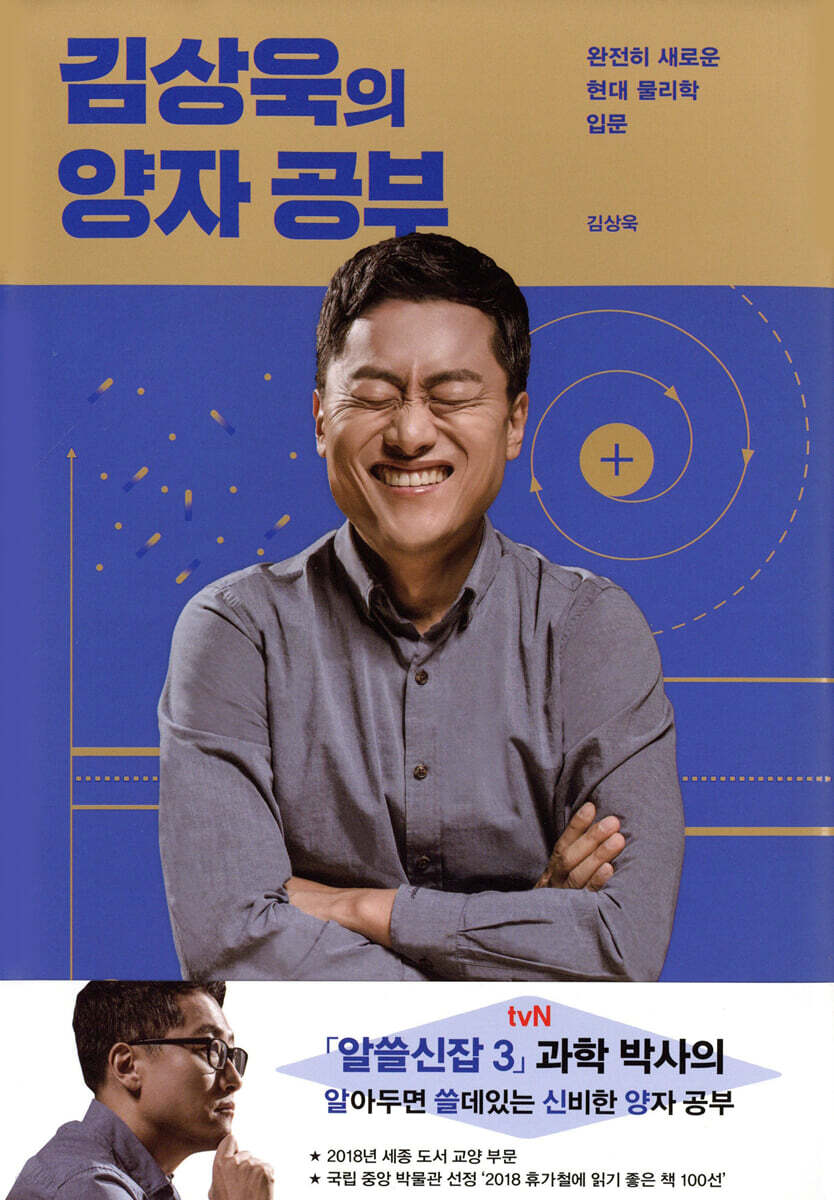
Kim Sang-wook's quantum studies
 |
Description
Book Introduction
The Quantum Study Bible: Achieving Quantum Supremacy in the Quantum Age
2018 marks the beginning of a new 'quantum era'.
A hundred years ago, in 1918, physicist Max Planck won the Nobel Prize for his work on the first quantum theory to determine the temperature of a heated metal from its color (the wavelength of light).
And now, in just over a century, quantum mechanics has gone from the furnace to the engine powering the world's computing and financial networks.
Google has announced that it will build a quantum computer this year that rivals the performance of a supercomputer.
A research team led by Chinese physicist Pan Jienwei successfully launched the world's first quantum communications satellite, Mozi, with massive support from the Chinese government, which promoted "quantum excavation."
Our country is also realizing the importance of quantum mechanics as the theoretical foundation and source technology for the Fourth Industrial Revolution.
The new competition among countries and giant corporations around the world for "quantum supremacy" is heralding the full-fledged dawn of the quantum era.
Therefore, new members of society are at a point where they must immediately begin studying quantum mechanics, a subject they have previously dismissed as difficult.
Advanced science readers, who had anticipated this shift in the times, sought the bible of quantum studies.
However, many people were disappointed that a single textbook that covered quantum mechanics, which was built on a new paradigm of mathematics, non-intuitive natural phenomena, and contradictory interpretations from numerous theorists, was hard to find.
"Kim Sang-wook's Quantum Study," published by Science Books ahead of the first year of the quantum era, is the bible of quantum studies that will resolve these regrets at once.
From the birth of quantum mechanics, which explains the strange phenomena of the atomic world, to its cutting edge, this book contains the entire history and the theories and laws of the "hundred schools of thought" of 20th-century physics, allowing you to fully enjoy them all in one volume.
This book is the essence of quantum studies, explaining complex mathematics in everyday language and using metaphors and visual aids to help readers easily and accurately understand unfamiliar concepts such as superposition, leaps, and entanglement. Professor Kim Sang-wook of the Department of Physics Education at Pusan National University, a leading science communicator in Korea, has given lectures on broadcasts such as “Quantum Mechanics: The Predictability of Nature” on the EBS special program “Insight,” “The Quantum Mechanics Quantum Choice” on YTN Science, and “Kim Sang-wook’s A Look at Quantum Mechanics” on the podcast “Sitting Down with Science,” and has consistently written serial articles on the topic of quantum mechanics in major daily newspapers such as the [Dong-A Ilbo] and [Kyunghyang Shinmun]. As such, this book can be said to be a user manual for quantum mechanics for everyone.
2018 marks the beginning of a new 'quantum era'.
A hundred years ago, in 1918, physicist Max Planck won the Nobel Prize for his work on the first quantum theory to determine the temperature of a heated metal from its color (the wavelength of light).
And now, in just over a century, quantum mechanics has gone from the furnace to the engine powering the world's computing and financial networks.
Google has announced that it will build a quantum computer this year that rivals the performance of a supercomputer.
A research team led by Chinese physicist Pan Jienwei successfully launched the world's first quantum communications satellite, Mozi, with massive support from the Chinese government, which promoted "quantum excavation."
Our country is also realizing the importance of quantum mechanics as the theoretical foundation and source technology for the Fourth Industrial Revolution.
The new competition among countries and giant corporations around the world for "quantum supremacy" is heralding the full-fledged dawn of the quantum era.
Therefore, new members of society are at a point where they must immediately begin studying quantum mechanics, a subject they have previously dismissed as difficult.
Advanced science readers, who had anticipated this shift in the times, sought the bible of quantum studies.
However, many people were disappointed that a single textbook that covered quantum mechanics, which was built on a new paradigm of mathematics, non-intuitive natural phenomena, and contradictory interpretations from numerous theorists, was hard to find.
"Kim Sang-wook's Quantum Study," published by Science Books ahead of the first year of the quantum era, is the bible of quantum studies that will resolve these regrets at once.
From the birth of quantum mechanics, which explains the strange phenomena of the atomic world, to its cutting edge, this book contains the entire history and the theories and laws of the "hundred schools of thought" of 20th-century physics, allowing you to fully enjoy them all in one volume.
This book is the essence of quantum studies, explaining complex mathematics in everyday language and using metaphors and visual aids to help readers easily and accurately understand unfamiliar concepts such as superposition, leaps, and entanglement. Professor Kim Sang-wook of the Department of Physics Education at Pusan National University, a leading science communicator in Korea, has given lectures on broadcasts such as “Quantum Mechanics: The Predictability of Nature” on the EBS special program “Insight,” “The Quantum Mechanics Quantum Choice” on YTN Science, and “Kim Sang-wook’s A Look at Quantum Mechanics” on the podcast “Sitting Down with Science,” and has consistently written serial articles on the topic of quantum mechanics in major daily newspapers such as the [Dong-A Ilbo] and [Kyunghyang Shinmun]. As such, this book can be said to be a user manual for quantum mechanics for everyone.
- You can preview some of the book's contents.
Preview
index
Prologue Everything is made of atoms 7
Part 1
Chapter 1: A Day in the Life of Quantum Mechanics 21
Chapter 2: The Core of Quantum Mechanics: Quantum Superposition 27
Chapter 3: Who Killed Schrödinger's Cat? 43
Chapter 4: The Problem Isn't Atoms, It's Humans! 57
Chapter 5: The Most Extraordinary Leap in Scientific History 83
Chapter 6: Theory Decides! 101
Chapter 7 God Rolls the Dice 117
Chapter 8: The Uncertainty of the Uncertainty Principle? 133
Chapter 9: The EPR Paradox and Quantum Entanglement 145
Part 2
Chapter 10: A World Without Quantum Mechanics 161
Chapter 11: There is no chaos in quantum mechanics 179
Chapter 12: The World's Most Powerful Quantum Computer 195
Chapter 13: The Many-Worlds Interpretation: The Quantum Multiverse 209
Chapter 14: Life's Quantum Leap 219
Chapter 15: From Bit to Being: It from Bit 229
Epilogue Quantum Mechanics User's Manual 250
Acknowledgments 265
Further Reading: The Hitchhiker's Guide to the Quantum World 269
Quantum Mechanics Glossary 279
Later Zhou 291
Search 304
Part 1
Chapter 1: A Day in the Life of Quantum Mechanics 21
Chapter 2: The Core of Quantum Mechanics: Quantum Superposition 27
Chapter 3: Who Killed Schrödinger's Cat? 43
Chapter 4: The Problem Isn't Atoms, It's Humans! 57
Chapter 5: The Most Extraordinary Leap in Scientific History 83
Chapter 6: Theory Decides! 101
Chapter 7 God Rolls the Dice 117
Chapter 8: The Uncertainty of the Uncertainty Principle? 133
Chapter 9: The EPR Paradox and Quantum Entanglement 145
Part 2
Chapter 10: A World Without Quantum Mechanics 161
Chapter 11: There is no chaos in quantum mechanics 179
Chapter 12: The World's Most Powerful Quantum Computer 195
Chapter 13: The Many-Worlds Interpretation: The Quantum Multiverse 209
Chapter 14: Life's Quantum Leap 219
Chapter 15: From Bit to Being: It from Bit 229
Epilogue Quantum Mechanics User's Manual 250
Acknowledgments 265
Further Reading: The Hitchhiker's Guide to the Quantum World 269
Quantum Mechanics Glossary 279
Later Zhou 291
Search 304
Publisher's Review
This book is a masterpiece created by collecting and developing episodes from "Pretend to Know Quantum Mechanics!", a series serialized in [Science Dong-A] and beloved by science readers.
This book dramatically showcases the author's unique style, which has earned him overwhelming public trust by gradually explaining difficult concepts through precise definitions and humorous analogies.
Additionally, we boldly broke down the barriers to entry into quantum mechanics through the virtual drama "A Day in the Life of Quantum Mechanics," which stimulates interest and curiosity.
By following the fascinating story of physicists trying to explain incomprehensible phenomena over a century, you will naturally acquire the ability to think quantumly.
The newly added appendices, "A User's Guide to Quantum Mechanics" and "A Hitchhiker's Guide to the Quantum World," provide readers with opportunities for review and application, as well as guidance for expanding their studies of quantum mechanics.
Additionally, renowned illustrator Rabbit Thief participated in the publication process, presenting sensuous and profound illustrations in the early 20th century Art Deco style for each chapter, naturally taking readers into the history of quantum mechanics.
By adding vivid records such as commemorative photos from the Solvay Conference, Niels Bohr's royal coat of arms, and his last blackboard scribbles, as well as illustrations that effectively convey unfamiliar concepts such as quantum photosynthesis and the Szilard information engine, the book has transformed difficult content into a reader-friendly one.
Professor Kim Sang-wook received his bachelor's, master's, and doctoral degrees in physics from KAIST.
He received his doctorate under the guidance of Professor Hae-Woong Lee, currently the leading quantum information scientist in Korea, and has specialized in quantum mechanics and information physics, publishing over 60 SCI papers.
He has worked at Pohang University of Science and Technology, KAIST, the Max Planck Institute in Germany, and Seoul National University, and is currently a professor in the Department of Physics Education at Pusan National University.
He served as a visiting professor at the University of Tokyo and the University of Innsbruck.
He actively communicates with the public through scientific writing, media, and broadcasting, and is called a “philosophical physicist.”
Broadcaster Kim Je-dong, who met the author through his appearance as a panelist on JTBC's "Kim Je-dong's Talk to You," also says that although quantum mechanics is difficult, "Teacher Kim Sang-wook's book is interesting."
When it comes to quantum studies, most people are no different from Kim Je-dong.
In this book, the author speaks frankly and honestly from beginning to end about the difficulty of quantum mechanics.
But at the same time, it makes the reader realize that it is the most accurate, beautiful, and profound study in the world.
I hope you experience a 'quantum leap' that is difficult but understandable, non-intuitive but insightful.
The definitive textbook on quantum mechanics.
Lee Hae-woong (Professor, UNIST)
What makes things absurd is funny and entertaining.
So quantum mechanics is difficult but fun.
Laughter is quantum mechanics.
―Kim Je-dong (broadcaster)
Now, quantum mechanics is not behind a thick, high wall, but right next to a fence I can touch and turn over!
Lee Jeong-mo (Director of Seoul Metropolitan Science Museum)
The ultimate hitchhiker's guide to the galaxy of quantum mechanics.
―Lee Kwon-woo (book critic)
A balanced and sensible dining experience that allows you to experience the world of quantum mechanics.
―Lee Myeong-hyeon (astronomer)
You have Feynman, right? We have Kim Sang-wook!
―Kang Yang-gu (science journalist)
With Professor Sangwook Kim, Korea's leading science communicator
A sensual and humorous quantum study
One thing is clear.
To understand everything that happens in the world, we must understand the atoms that make it all up.
The science that explains the phenomena occurring in the atomic world is quantum mechanics, the subject of this book.
At this point, you might be curious about quantum mechanics. - From the text
This book is largely composed of two stories.
The first part is an exciting one, with the 'Avengers' of physics, including Niels Bohr, Albert Einstein, Werner Heisenberg, and Erwin Schrödinger, facing the strange phenomena of the atomic world, and the second part tells the story of the future of quantum mechanics, which has infinite possibilities such as quantum computers and quantum biology.
Chapter 1, "A Day in Quantum Mechanics," which begins Part 1, is a virtual drama specially created by the author to help readers who are just beginning to study quantum mechanics relax.
A world that is completely incomprehensible unfolds, including quantum trains, pelmeni noodles, and boson cafes.
However, if you finish all your quantum studies and watch this drama again, you will discover a new kind of fun that only those who 'know a little about quantum mechanics' can feel.
The author has provided readers with a guide to understanding quantum mechanics.
Chapter 2, "The Core of Quantum Mechanics, Quantum Superposition," explains the core concept of quantum mechanics, "superposition," and really makes readers rack their brains.
Superposition is the first gateway that must be overcome to study quantum, as it is a core concept that created the qubit, the basic unit of information processing in current quantum computers.
In Chapter 3, “Who Killed Schrödinger’s Cat?”, you can experience the mystery of superposition through the Schrödinger’s cat paradox, which everyone takes for granted but is actually not well known, and a strange thought experiment that even Stephen Hawking gave up on solving.
Eventually, physicists decided to abandon intuition in favor of quantum mechanics.
(Chapter 4, "The Problem is Not Atoms, But Humans") Now, the mainstream interpretation of quantum mechanics has become that particles jump without an intermediate process (Chapter 5, "The Most Strange Jump in the History of Science") and do not exist before observation.
(Chapter 6 "Theory Decides!") This is called the Copenhagen interpretation, and a great debate ensued between those who agreed with it, such as Bohr and Heisenberg, and those who agreed with Einstein and Schrödinger.
This is the Solvay debate.
In particular, Einstein completely rejected the then-extreme probability interpretation, which held that the essence of existence is a probability distribution function and that it can only exist when observed according to its rules.
But today's science is proving that Bohr and Heisenberg were right.
Einstein, the greatest physicist in history, remains a perpetual loser when it comes to quantum mechanics.
(Chapter 7 “God Rolls the Dice”) The fact that even Einstein and Schrödinger, who laid the foundations of quantum mechanics with the quantum theory of light and wave mechanics, respectively, could not overcome the trap of intuition shows once again how difficult quantum mechanics is.
While Heisenberg's uncertainty principle was established as a major premise of quantum mechanics (Chapter 8, "The Uncertainty of the Uncertainty Principle?"), Einstein was preparing a counterattack.
In the EPR paper, co-published with Boris Podolsky and Nathan Rosen, he relentlessly exposed the weaknesses of the Copenhagen interpretation. Known as the EPR paradox, this thought experiment threatens the fundamental premise of quantum mechanics even more severely than the Schrödinger cat paradox. For those curious, please refer to Chapter 9, "The EPR Paradox, Quantum Entanglement."
In particular, this chapter deals with the concept of 'entanglement', which Einstein devised to explain the contradictions of the Copenhagen interpretation.
Ironically, entanglement was experimentally proven by Anton Zeilinger and became the theoretical basis for quantum computers and quantum communication technologies, represented by the Mohist wave.
If you have studied superposition and entanglement, the Copenhagen interpretation, and the uncertainty principle, which survive contradictions, you will have a 'somewhat' understanding of the past of quantum mechanics.
It encompasses all modern sciences, including information theory, brain science, and cosmology.
Experience the ultimate learning in advance!
Quantum mechanics may be a cutting-edge theory, but it may seem unrelated to everyday life.
But unfortunately(?) it is all around us.
Quantum mechanics is a theory that explains atoms, and everything in the world is made of atoms.
So, we can see that quantum mechanics is at work in everything we see around us. - From the text
Part 2 discusses the present and future of quantum mechanics, which was born in this way.
Chapter 10, “A World Without Quantum Mechanics,” reminds us that quantum mechanics is a theory that explains the basic units that make up the world.
We can see how theories used in fields such as chemistry and semiconductor engineering can be reduced to a more fundamental level of explanation through quantum mechanics.
You will finally be able to understand that quantum mechanics, still a mystery, is the pinnacle of modern science.
For readers who want more advanced quantum mechanics, chapters covering quantum chaos, quantum computers, the quantum multiverse, quantum biology, and quantum information physics are now available.
Chapter 11, “There is no chaos in quantum mechanics,” discusses “quantum chaos,” which quantum mechanics must overcome to comprehensively explain the macroscopic world beyond the microscopic world.
You can indirectly experience strange quantum phenomena that occur in everyday life, such as the quantum Hall effect.
Chapter 12, "The World's Most Powerful Quantum Computer," explores next-generation information theory using superposition and entanglement, as described in Part 1.
We introduce an information processing method that uses qubits, which are in a superposition of 0 and 1, rather than bits that are distinguished as 0 or 1, and a transmission method that dramatically increases efficiency by utilizing entanglement.
You will be able to experience the true meaning of the emergence of Google's quantum computer and China's Mozi Lake, mentioned earlier.
In Chapter 13, “The Many-Worlds Interpretation: The Quantum Multiverse,” quantum mechanics extends to cosmology.
The many-worlds interpretation, which was dismissed as an absurd parallel universe hypothesis, has some similarities with the 'cosmic landscape' theory recently proposed by Leonard Susskind, the father of string theory, and supported by Stephen Hawking.
You can get a taste of quantum cosmology, which may be a new paradigm in cosmology.
Chapter 14, "Quantum Biology," introduces future quantum mechanics, which, while still hypothetical, may explain the overwhelming energy efficiency of plant photosynthesis or introduce superposition into human brain activity, revealing the essential mechanisms of mental function.
It is possible to study quantum properly, not just by skimming the basics of quantum mechanics, but also by experiencing the cutting edge of quantum mechanics.
Chapter 15, "It from Bit," introduces the accidental discovery that the formula for quantitatively measuring information is the same as the formula for entropy, and a thought experiment that demonstrates that information must be treated as a physical object to avoid breaking the laws of thermodynamics.
The universe viewed through quantum mechanics ultimately leads to the conclusion that it is an 'information universe'.
This means that quantum mechanics is becoming the most fundamental discipline that explores the essence of the universe.
The Hitchhiker's Guide to the Quantum World
It is also fun to encounter poems that the author himself created or parodied ("Quantum Mechanics of Love," "Quantum Sonnet," "Quantum Haiku!").
Living up to his nickname of "philosophical physicist," he blends both literature and science, serving as a refuge and lubricant for quantum studies.
By reviewing and learning how to utilize 15 colorful quantum mechanics stories in the aforementioned appendix, "Quantum Mechanics User's Guide," you can complete your final studies to become a member of the quantum age.
In "The Hitchhiker's Guide to the Quantum World," the author personally recommends books on quantum mechanics to broaden the scope of quantum studies.
As unfamiliar terms and concepts appear frequently, we recommend that you frequently refer to the "Quantum Mechanics Glossary."
After you've finished studying quantum mechanics, I recommend going back to the drama "A Day in the Life of Quantum Mechanics."
There is a hidden joy of knowledge that has never been experienced.
Atoms, which make up everything, and quantum mechanics, the unique discipline that explains them, are the most important and at the same time the most difficult discipline.
Therefore, based on the author's experience in science education in schools and media, he developed a solid and detailed structure that allows for easy study from beginning to end.
This is why Professor Lee Hae-woong of UNIST, the author's doctoral advisor and an expert in quantum information science, acknowledged it, and why Kim Je-dong, a broadcaster who is not good at quantum computing, also praised it as fun.
In the 100 years since Planck won the Nobel Prize for his pioneering quantum theory, numerous stories about quantum mechanics have accumulated.
Because of this, although books on quantum mechanics, history, and philosophy have been continuously published in Korea for decades, 『Kim Sang-wook's Quantum Study』 is the only book that properly synthesizes all aspects of quantum mechanics into a book that is accessible to the general public.
This is a great opportunity for beginners in quantum mechanics, as the author will continue to give offline quantum mechanics lectures after the book is published, including the quantum mechanics reader event “Quantum Lightning” held by Science Books on December 20th.
Here is the first instruction manual for quantum mechanics you need to learn to live in a society dominated by quantum mechanics.
Q: Where are the atoms?
A: I don't know.
The question is wrong.
Q: What is quantum mechanics?
A: Let me explain the atom.
Q: So where are the atoms?
A: I said I don't know!
Q: How can you describe atoms without even knowing where they are?
A: I said the question was wrong!
- In the text
This book dramatically showcases the author's unique style, which has earned him overwhelming public trust by gradually explaining difficult concepts through precise definitions and humorous analogies.
Additionally, we boldly broke down the barriers to entry into quantum mechanics through the virtual drama "A Day in the Life of Quantum Mechanics," which stimulates interest and curiosity.
By following the fascinating story of physicists trying to explain incomprehensible phenomena over a century, you will naturally acquire the ability to think quantumly.
The newly added appendices, "A User's Guide to Quantum Mechanics" and "A Hitchhiker's Guide to the Quantum World," provide readers with opportunities for review and application, as well as guidance for expanding their studies of quantum mechanics.
Additionally, renowned illustrator Rabbit Thief participated in the publication process, presenting sensuous and profound illustrations in the early 20th century Art Deco style for each chapter, naturally taking readers into the history of quantum mechanics.
By adding vivid records such as commemorative photos from the Solvay Conference, Niels Bohr's royal coat of arms, and his last blackboard scribbles, as well as illustrations that effectively convey unfamiliar concepts such as quantum photosynthesis and the Szilard information engine, the book has transformed difficult content into a reader-friendly one.
Professor Kim Sang-wook received his bachelor's, master's, and doctoral degrees in physics from KAIST.
He received his doctorate under the guidance of Professor Hae-Woong Lee, currently the leading quantum information scientist in Korea, and has specialized in quantum mechanics and information physics, publishing over 60 SCI papers.
He has worked at Pohang University of Science and Technology, KAIST, the Max Planck Institute in Germany, and Seoul National University, and is currently a professor in the Department of Physics Education at Pusan National University.
He served as a visiting professor at the University of Tokyo and the University of Innsbruck.
He actively communicates with the public through scientific writing, media, and broadcasting, and is called a “philosophical physicist.”
Broadcaster Kim Je-dong, who met the author through his appearance as a panelist on JTBC's "Kim Je-dong's Talk to You," also says that although quantum mechanics is difficult, "Teacher Kim Sang-wook's book is interesting."
When it comes to quantum studies, most people are no different from Kim Je-dong.
In this book, the author speaks frankly and honestly from beginning to end about the difficulty of quantum mechanics.
But at the same time, it makes the reader realize that it is the most accurate, beautiful, and profound study in the world.
I hope you experience a 'quantum leap' that is difficult but understandable, non-intuitive but insightful.
The definitive textbook on quantum mechanics.
Lee Hae-woong (Professor, UNIST)
What makes things absurd is funny and entertaining.
So quantum mechanics is difficult but fun.
Laughter is quantum mechanics.
―Kim Je-dong (broadcaster)
Now, quantum mechanics is not behind a thick, high wall, but right next to a fence I can touch and turn over!
Lee Jeong-mo (Director of Seoul Metropolitan Science Museum)
The ultimate hitchhiker's guide to the galaxy of quantum mechanics.
―Lee Kwon-woo (book critic)
A balanced and sensible dining experience that allows you to experience the world of quantum mechanics.
―Lee Myeong-hyeon (astronomer)
You have Feynman, right? We have Kim Sang-wook!
―Kang Yang-gu (science journalist)
With Professor Sangwook Kim, Korea's leading science communicator
A sensual and humorous quantum study
One thing is clear.
To understand everything that happens in the world, we must understand the atoms that make it all up.
The science that explains the phenomena occurring in the atomic world is quantum mechanics, the subject of this book.
At this point, you might be curious about quantum mechanics. - From the text
This book is largely composed of two stories.
The first part is an exciting one, with the 'Avengers' of physics, including Niels Bohr, Albert Einstein, Werner Heisenberg, and Erwin Schrödinger, facing the strange phenomena of the atomic world, and the second part tells the story of the future of quantum mechanics, which has infinite possibilities such as quantum computers and quantum biology.
Chapter 1, "A Day in Quantum Mechanics," which begins Part 1, is a virtual drama specially created by the author to help readers who are just beginning to study quantum mechanics relax.
A world that is completely incomprehensible unfolds, including quantum trains, pelmeni noodles, and boson cafes.
However, if you finish all your quantum studies and watch this drama again, you will discover a new kind of fun that only those who 'know a little about quantum mechanics' can feel.
The author has provided readers with a guide to understanding quantum mechanics.
Chapter 2, "The Core of Quantum Mechanics, Quantum Superposition," explains the core concept of quantum mechanics, "superposition," and really makes readers rack their brains.
Superposition is the first gateway that must be overcome to study quantum, as it is a core concept that created the qubit, the basic unit of information processing in current quantum computers.
In Chapter 3, “Who Killed Schrödinger’s Cat?”, you can experience the mystery of superposition through the Schrödinger’s cat paradox, which everyone takes for granted but is actually not well known, and a strange thought experiment that even Stephen Hawking gave up on solving.
Eventually, physicists decided to abandon intuition in favor of quantum mechanics.
(Chapter 4, "The Problem is Not Atoms, But Humans") Now, the mainstream interpretation of quantum mechanics has become that particles jump without an intermediate process (Chapter 5, "The Most Strange Jump in the History of Science") and do not exist before observation.
(Chapter 6 "Theory Decides!") This is called the Copenhagen interpretation, and a great debate ensued between those who agreed with it, such as Bohr and Heisenberg, and those who agreed with Einstein and Schrödinger.
This is the Solvay debate.
In particular, Einstein completely rejected the then-extreme probability interpretation, which held that the essence of existence is a probability distribution function and that it can only exist when observed according to its rules.
But today's science is proving that Bohr and Heisenberg were right.
Einstein, the greatest physicist in history, remains a perpetual loser when it comes to quantum mechanics.
(Chapter 7 “God Rolls the Dice”) The fact that even Einstein and Schrödinger, who laid the foundations of quantum mechanics with the quantum theory of light and wave mechanics, respectively, could not overcome the trap of intuition shows once again how difficult quantum mechanics is.
While Heisenberg's uncertainty principle was established as a major premise of quantum mechanics (Chapter 8, "The Uncertainty of the Uncertainty Principle?"), Einstein was preparing a counterattack.
In the EPR paper, co-published with Boris Podolsky and Nathan Rosen, he relentlessly exposed the weaknesses of the Copenhagen interpretation. Known as the EPR paradox, this thought experiment threatens the fundamental premise of quantum mechanics even more severely than the Schrödinger cat paradox. For those curious, please refer to Chapter 9, "The EPR Paradox, Quantum Entanglement."
In particular, this chapter deals with the concept of 'entanglement', which Einstein devised to explain the contradictions of the Copenhagen interpretation.
Ironically, entanglement was experimentally proven by Anton Zeilinger and became the theoretical basis for quantum computers and quantum communication technologies, represented by the Mohist wave.
If you have studied superposition and entanglement, the Copenhagen interpretation, and the uncertainty principle, which survive contradictions, you will have a 'somewhat' understanding of the past of quantum mechanics.
It encompasses all modern sciences, including information theory, brain science, and cosmology.
Experience the ultimate learning in advance!
Quantum mechanics may be a cutting-edge theory, but it may seem unrelated to everyday life.
But unfortunately(?) it is all around us.
Quantum mechanics is a theory that explains atoms, and everything in the world is made of atoms.
So, we can see that quantum mechanics is at work in everything we see around us. - From the text
Part 2 discusses the present and future of quantum mechanics, which was born in this way.
Chapter 10, “A World Without Quantum Mechanics,” reminds us that quantum mechanics is a theory that explains the basic units that make up the world.
We can see how theories used in fields such as chemistry and semiconductor engineering can be reduced to a more fundamental level of explanation through quantum mechanics.
You will finally be able to understand that quantum mechanics, still a mystery, is the pinnacle of modern science.
For readers who want more advanced quantum mechanics, chapters covering quantum chaos, quantum computers, the quantum multiverse, quantum biology, and quantum information physics are now available.
Chapter 11, “There is no chaos in quantum mechanics,” discusses “quantum chaos,” which quantum mechanics must overcome to comprehensively explain the macroscopic world beyond the microscopic world.
You can indirectly experience strange quantum phenomena that occur in everyday life, such as the quantum Hall effect.
Chapter 12, "The World's Most Powerful Quantum Computer," explores next-generation information theory using superposition and entanglement, as described in Part 1.
We introduce an information processing method that uses qubits, which are in a superposition of 0 and 1, rather than bits that are distinguished as 0 or 1, and a transmission method that dramatically increases efficiency by utilizing entanglement.
You will be able to experience the true meaning of the emergence of Google's quantum computer and China's Mozi Lake, mentioned earlier.
In Chapter 13, “The Many-Worlds Interpretation: The Quantum Multiverse,” quantum mechanics extends to cosmology.
The many-worlds interpretation, which was dismissed as an absurd parallel universe hypothesis, has some similarities with the 'cosmic landscape' theory recently proposed by Leonard Susskind, the father of string theory, and supported by Stephen Hawking.
You can get a taste of quantum cosmology, which may be a new paradigm in cosmology.
Chapter 14, "Quantum Biology," introduces future quantum mechanics, which, while still hypothetical, may explain the overwhelming energy efficiency of plant photosynthesis or introduce superposition into human brain activity, revealing the essential mechanisms of mental function.
It is possible to study quantum properly, not just by skimming the basics of quantum mechanics, but also by experiencing the cutting edge of quantum mechanics.
Chapter 15, "It from Bit," introduces the accidental discovery that the formula for quantitatively measuring information is the same as the formula for entropy, and a thought experiment that demonstrates that information must be treated as a physical object to avoid breaking the laws of thermodynamics.
The universe viewed through quantum mechanics ultimately leads to the conclusion that it is an 'information universe'.
This means that quantum mechanics is becoming the most fundamental discipline that explores the essence of the universe.
The Hitchhiker's Guide to the Quantum World
It is also fun to encounter poems that the author himself created or parodied ("Quantum Mechanics of Love," "Quantum Sonnet," "Quantum Haiku!").
Living up to his nickname of "philosophical physicist," he blends both literature and science, serving as a refuge and lubricant for quantum studies.
By reviewing and learning how to utilize 15 colorful quantum mechanics stories in the aforementioned appendix, "Quantum Mechanics User's Guide," you can complete your final studies to become a member of the quantum age.
In "The Hitchhiker's Guide to the Quantum World," the author personally recommends books on quantum mechanics to broaden the scope of quantum studies.
As unfamiliar terms and concepts appear frequently, we recommend that you frequently refer to the "Quantum Mechanics Glossary."
After you've finished studying quantum mechanics, I recommend going back to the drama "A Day in the Life of Quantum Mechanics."
There is a hidden joy of knowledge that has never been experienced.
Atoms, which make up everything, and quantum mechanics, the unique discipline that explains them, are the most important and at the same time the most difficult discipline.
Therefore, based on the author's experience in science education in schools and media, he developed a solid and detailed structure that allows for easy study from beginning to end.
This is why Professor Lee Hae-woong of UNIST, the author's doctoral advisor and an expert in quantum information science, acknowledged it, and why Kim Je-dong, a broadcaster who is not good at quantum computing, also praised it as fun.
In the 100 years since Planck won the Nobel Prize for his pioneering quantum theory, numerous stories about quantum mechanics have accumulated.
Because of this, although books on quantum mechanics, history, and philosophy have been continuously published in Korea for decades, 『Kim Sang-wook's Quantum Study』 is the only book that properly synthesizes all aspects of quantum mechanics into a book that is accessible to the general public.
This is a great opportunity for beginners in quantum mechanics, as the author will continue to give offline quantum mechanics lectures after the book is published, including the quantum mechanics reader event “Quantum Lightning” held by Science Books on December 20th.
Here is the first instruction manual for quantum mechanics you need to learn to live in a society dominated by quantum mechanics.
Q: Where are the atoms?
A: I don't know.
The question is wrong.
Q: What is quantum mechanics?
A: Let me explain the atom.
Q: So where are the atoms?
A: I said I don't know!
Q: How can you describe atoms without even knowing where they are?
A: I said the question was wrong!
- In the text
GOODS SPECIFICS
- Date of publication: December 8, 2017
- Format: Hardcover book binding method guide
- Page count, weight, size: 308 pages | 646g | 155*228*30mm
- ISBN13: 9788983718914
- ISBN10: 8983718919
You may also like
카테고리
korean


korean

![GQ KOREA Mark (Monthly): December [2025]](http://librairie.coreenne.fr/cdn/shop/files/8ef265dbbfbf186523ed75ba7319009d.jpg?v=1765340328&width=3840)


