

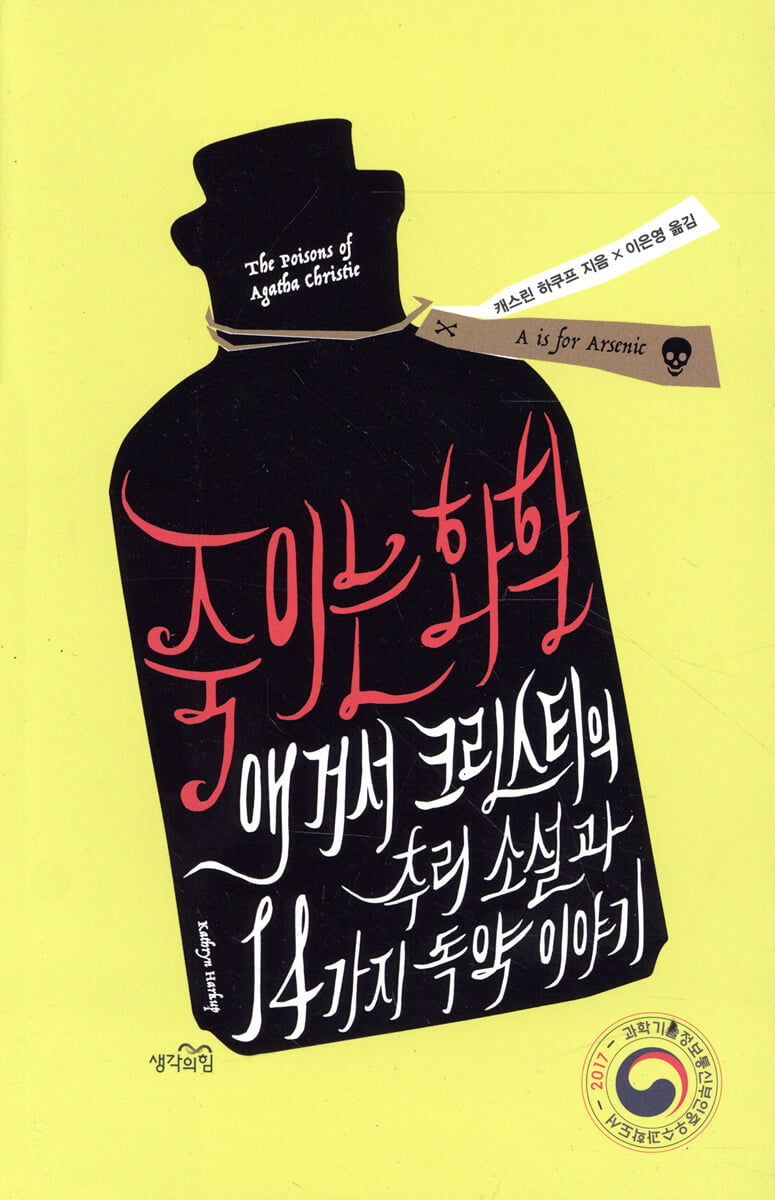
Killing chemicals
 |
Description
Book Introduction
Scientific truth lies behind Agatha Christie's mystery novels.
The fascinating poisons Christie used and the real and fictional stories surrounding her.
Agatha Christie, the 'Queen of Mystery Novels,' frequently used poison to eliminate the unfortunate victims of her works.
Poison was used more than any other murder weapon, and sometimes poison was the key to unlocking the core of the story.
Christie never chose lethal substances haphazardly.
The properties of each poison often provided important clues to catching murderers.
How could such a deadly compound exist? How did the killers use it so meticulously, and how did the detectives uncover its secrets? Christie fully utilized her intimate knowledge of dangerous drugs.
There is scientific truth behind the poison Christie used.
"The Chemistry of Killing" focuses on the ways Christie interweaves scientific truths surrounding poisons into her work.
And it unravels the 14 intriguing poisons Christie used and the real and fictional stories surrounding them.
Christie's extensive knowledge of chemistry formed the basis for this book.
The author delves into the poisons used by murderers in 14 mystery novels written by Agatha Christie.
From questions about why certain chemicals act as murder weapons and what reactions they evoke in our bodies, to the real-life poisonings that may have inspired Christie, and the possibilities of obtaining, injecting, and detecting these poisons, both in the novel's time and today.
The fascinating poisons Christie used and the real and fictional stories surrounding her.
Agatha Christie, the 'Queen of Mystery Novels,' frequently used poison to eliminate the unfortunate victims of her works.
Poison was used more than any other murder weapon, and sometimes poison was the key to unlocking the core of the story.
Christie never chose lethal substances haphazardly.
The properties of each poison often provided important clues to catching murderers.
How could such a deadly compound exist? How did the killers use it so meticulously, and how did the detectives uncover its secrets? Christie fully utilized her intimate knowledge of dangerous drugs.
There is scientific truth behind the poison Christie used.
"The Chemistry of Killing" focuses on the ways Christie interweaves scientific truths surrounding poisons into her work.
And it unravels the 14 intriguing poisons Christie used and the real and fictional stories surrounding them.
Christie's extensive knowledge of chemistry formed the basis for this book.
The author delves into the poisons used by murderers in 14 mystery novels written by Agatha Christie.
From questions about why certain chemicals act as murder weapons and what reactions they evoke in our bodies, to the real-life poisonings that may have inspired Christie, and the possibilities of obtaining, injecting, and detecting these poisons, both in the novel's time and today.
- You can preview some of the book's contents.
Preview
index
Agatha Christie's Poison Laboratory
A Arsenic: Murder is easy
B Belladonna: The Adventures of Hercules
C Cyanide: Shining Cyanide
D Digitalis: A Promise with Death
E Eserin: The Crooked House
H Dokminaree: Five Little Pigs
M Bar Flower: 4:50 PM from Paddington
N Nicotine: A Tragedy in Act 3
O Opium: Sad Cyprus
P: The dumb witness
R Lee Shin: The Detective Couple
S Strychnine: The Mysterious Incident at Styles Mansion
T Thallium: Pale Horse
V Veronal: The Death of Lord Edgware
Acknowledgements
Appendix 1 Agatha Christie's Works and Autographs
Appendix 2 Structure of Poisons and Chemicals
References
A Arsenic: Murder is easy
B Belladonna: The Adventures of Hercules
C Cyanide: Shining Cyanide
D Digitalis: A Promise with Death
E Eserin: The Crooked House
H Dokminaree: Five Little Pigs
M Bar Flower: 4:50 PM from Paddington
N Nicotine: A Tragedy in Act 3
O Opium: Sad Cyprus
P: The dumb witness
R Lee Shin: The Detective Couple
S Strychnine: The Mysterious Incident at Styles Mansion
T Thallium: Pale Horse
V Veronal: The Death of Lord Edgware
Acknowledgements
Appendix 1 Agatha Christie's Works and Autographs
Appendix 2 Structure of Poisons and Chemicals
References
Into the book
Dame Agatha Mary Clarissa Christie (1890-1976), known as the 'Queen of Crime', holds the Guinness World Record for being the most successful novelist of all time.
Only the Bible and Shakespeare have outsold her works (and been translated more widely than Shakespeare).
Christie is the author of the longest-running play, "The Mousetrap," and the creator of not one, but two of the most famous fictional detectives.
Hercule Poirot and Miss Marple.
Accolades, awards and medals are piled high before her, and millions of people still love Christie's books and plays.
Many have tried to find the secret to her success.
Christie always considered herself a 'popular' writer.
He knew that his novel was not a great work of literature or a work of deep reflection on humanity.
That doesn't mean I enjoy killing or trying to shock readers with unnecessary violence.
Although corpses appear here and there in the book, the reaction they evoke is closer to curiosity.
It made readers smile with the anticipation of clues, tricks, and brilliant deductions.
She was a storyteller, a delight, and a tester, posing seemingly insoluble riddles.
--- p.9~10, Agatha Christie's Poison Laboratory
While preparing for the Apothecaries' Hall exam, Christie learned the theoretical aspects of chemistry and pharmacy from her colleagues in the pharmacy, as well as gaining practical experience.
In addition to working and learning at the hospital, I also received private lessons from Mr. P, a pharmacist at a pharmacy in Toki.
One day, as part of a training session, Mr. P showed me the correct way to make suppositories.
It was a challenging task that required several skills.
Mr. P melted the cocoa butter and then added the medicine.
And at the exact moment the suppository was made, the medicine was placed in a box and expertly marked '1 in 100'.
However, Christie was convinced that Mr. P had made a mistake during the preparation process by adding one tenth instead of one hundredth.
This was ten times more than what was needed for a single dose, which could have put the person taking it in a dangerous situation.
She secretly recalculated and confirmed her mistake.
He couldn't reveal his mistake to Mr. P.
But I was afraid of the consequences of prescribing dangerous drugs.
Christie pretended to move, dropped the suppository on the floor, and stomped on it.
She apologized repeatedly for her mistake and cleaned up the messy floor.
The suppositories were re-made, this time in a precisely diluted state.
Mr. P calculated the quantity using the metric system.
At that time, the yard-pound system was much more commonly used in Britain.
Christie didn't trust the metric system.
As she put it, 'if something goes wrong, there's a huge risk of it going wrong tenfold.'
By placing the decimal point in the wrong place, Mr. P made a serious calculation error.
At the time, most pharmacists were familiar with the traditional method of measuring and dividing medications into units called grains.
It wasn't just Mr. P's carelessness about details that bothered Christie.
One day, Mr. P took a brown lump out of his pocket and asked me what I thought it was.
Christie was embarrassed.
Mr. P explained that the brown lump was curare, a poison used by South American hunters on the tips of their arrows.
Kurare is a safe compound when ingested, but it is a lethal substance when injected directly into the bloodstream.
Mr. P said he carries Kurare around with him because it "makes him feel very powerful."
Nearly 50 years later, Christie resurrected the deeply disturbing character of Mr. P as a pharmacist in The Pale Horse.
--- p.12~13, Agatha Christie's Poison Lab
Agatha Christie's 1939 work, "Killing is Easy," is a truly aptly titled book.
In just one year, seven people are murdered in a small English town.
The methods used for murder were varied and were disguised to appear as accidents or natural deaths.
The first victim, Mrs. Horton, appeared to have died of acute gastritis after a long illness.
Her death was all the more tragic because her condition appeared to be improving just before her sudden relapse.
Even the doctor who examined Mrs. Horton was shocked by her sudden death.
At that time, there was no circumstantial evidence to suggest murder.
A year later, with so many people dying, it was only then that the circumstances surrounding Mrs. Horton's illness and condition were taken into closer view.
Gastritis presents with a series of symptoms, including vomiting, diarrhea, and stomach pain.
Inflammation in the digestive tract causes these symptoms, and there are many causes of inflammation.
It is usually caused by a viral or bacterial infection such as norovirus, and rarely by parasites, and can also be caused by an allergic reaction to food.
Usually, the infection clears up completely within a few days or weeks.
Another possibility is arsenic poisoning.
Mrs. Horton was described as having been ill for a long time.
Therefore, it can be assumed that the patient has been ill for at least several weeks, which may lead to suspicion of chronic arsenic poisoning.
And he would have taken a large dose of arsenic just before he died.
In Mrs. Horton's case, the symptoms of chronic arsenic poisoning, such as melasma lines, pigmentation, and dermatitis, may have taken too little time to manifest themselves on the skin.
Fingernails grow about 3 millimeters per month.
Although arsenic accumulates in the nails and hair within hours of ingestion, it can take several weeks for the accumulated arsenic to break through the nail matrix and cuticle.
In Christie's novel, They Do It with Mirrors, the killer meticulously cuts off his victims' fingernails to make arsenic undetectable.
But this method is not perfect either.
If the addiction has been ongoing for a long time, the fingernails should be removed to prevent detection.
Even then, if you analyze the victim's hair, you can find traces of arsenic.
--- p.49~51, A Arsenic: Murder is Easy
Cyanide appears in no fewer than ten novels and four short stories by Agatha Christie, killing seventeen people.
The way Christie's killers administered the poison was also creative and effective.
They were injected directly or added to alcohol, smelling salts, and even cigarettes.
Christie described with great accuracy the poison, the symptoms exhibited by the victims, and the source of the cyanide.
Rather than listing the murderers who appear in Christie's novels one by one, I will focus on one specific novel.
The novel is, of course, Sparkling Cyanide.
"The Shining Cyanide" was written in 1945.
At the center of the story are the wealthy Barton family, their acquaintances, and the people who hang around them.
The novel begins with the recollections of those who witnessed the tragic death of Rosemary Barton in a Luxembourg restaurant.
Seven people gathered to celebrate a birthday.
It was the moment when the show ended on stage and the lights came on.
Rosemary took a sip of champagne and collapsed face down on the table.
His face was bluish and his fingers twitched in convulsions.
Potassium cyanide poisoning was evident.
The cause of death was ruled suicide.
Six months later, Rosemary's husband, George Barton, receives an anonymous letter suggesting that Rosemary has been murdered.
Instead of reporting it to the police, George embarks on an elaborate, yet crazy, plan to catch his wife's killer.
Exactly one year after the tragic 'suicide', George reunites the six people who attended that party.
And then they bring in an actress and dress her up like Rosemary.
The plan was to have her appear during dinner and extract a confession from the culprit.
But the plan fails spectacularly.
It was just after George had finished drinking a toast to Rosemary's memory.
His face turned blue and he suddenly collapsed on the table.
It only took a minute or two for George to die.
His glass contained the same poison that had struck down his wife a year earlier.
Fortunately, George had already shared the names of several suspects and his plans with his friend, Colonel Race.
The clever officer then works with the police to solve crimes.
In 1945, many poisons were readily available.
Some antidotes were the same.
Fortunately, things have changed, but cyanide still has a reputation as a cruel, terrifying, and effective poison.
And there's a reason for that.
--- p.83~85, C Cyanide: Shining Cyanide
Agatha Christie's 1935 novel, Three Act Tragedy, is the only one of her novels to use nicotine as a murder weapon.
The three victims—a gentle parish priest, a prominent doctor, and a patient in a nursing home—seemed to have nothing in common.
The first victim was initially believed to have died of natural causes.
When a second victim died in similar circumstances with nearly identical symptoms, suspicions of murder were raised.
The third crime was committed with the intention of silencing witnesses.
All victims were quickly killed by the deadly natural substance, nicotine.
Suspects include actors, a tailor, a playwright, and even a butler.
None of them seemed to have a motive for murder.
Fortunately, Hercule Poirot reaches out and solves the mystery, uncovering the culprit.
Most people know that nicotine is dangerous.
Thousands of people die every year from smoking, and nicotine is an indirect cause.
In reality, nicotine is the substance that causes addiction, and it is the other compounds released in cigarette smoke that kill smokers.
However, pure nicotine, although rarely used in murders, is highly toxic in itself and has caused many deaths.
Considering that it is a readily available substance, it is surprising that it is not more frequently used in crime.
Perhaps it's so common that we hesitate to believe that such an everyday substance could be used to kill someone.
--- p.187~188, N Nicotine: A Tragedy in Three Acts
In "The House of the Dead," the arsenic poisoning case that Tommy and Tuppence were trying to investigate quickly escalates into a mass murder.
The morning after Lois Hargreeves visits the detectives, Tommy finds an article in the newspaper saying that Lois has died.
Lois died less than 24 hours after leaving a statement saying she was afraid she would be poisoned.
The second tragedy involved the maid, Esther Quant, and two other household members: Lois's cousin Dennis Radcliffe and Dennis's distant cousin Mrs. Logan.
To find out what's going on, Tommy and Tuppence rush to Lois's home, Sunley Farm.
When Tommy and Tuppence arrived at the mansion, Dennis was already on his knees before the poison.
Mrs. Logan was barely holding on to her lifeline.
The cause seemed to be the fig sandwich that came with the afternoon tea the previous day.
At first, it was thought to be a highly contagious form of food poisoning.
It showed typical symptoms of food poisoning, such as vomiting, diarrhea, and stomach pain.
However, these symptoms were also observed in ricin poisoning.
Dr. Burton, who was treating the patient, suspected a crime because there had been a previous attempt to harm Lois.
Fig paste was sent for analysis.
While waiting for the results, Tommy suggested to Dr. Burton that arsenic might have been added to the fig paste.
Because the chocolate had arsenic in it during a previous murder attempt.
However, Dr. Button dismissed this hypothesis, saying that arsenic could not kill a person so quickly.
The doctor initially thought that a powerful plant-based toxin had been used.
Whatever the poison, all the victims died within 12 hours.
The car would have arrived around 4 p.m., and Lois and Esther Quant must have died in the evening before the paper closed.
That's all Tommy and Tuppence have to do to read the obituary in the morning paper.
Twelve hours was an unusually fast time, even for a Risin.
Most people died after suffering for three to five days.
Did the killer put an especially large amount of it in his fig sandwich? Even small amounts of ricin have a distinctively strong odor, and did the figs mask that?
Only the Bible and Shakespeare have outsold her works (and been translated more widely than Shakespeare).
Christie is the author of the longest-running play, "The Mousetrap," and the creator of not one, but two of the most famous fictional detectives.
Hercule Poirot and Miss Marple.
Accolades, awards and medals are piled high before her, and millions of people still love Christie's books and plays.
Many have tried to find the secret to her success.
Christie always considered herself a 'popular' writer.
He knew that his novel was not a great work of literature or a work of deep reflection on humanity.
That doesn't mean I enjoy killing or trying to shock readers with unnecessary violence.
Although corpses appear here and there in the book, the reaction they evoke is closer to curiosity.
It made readers smile with the anticipation of clues, tricks, and brilliant deductions.
She was a storyteller, a delight, and a tester, posing seemingly insoluble riddles.
--- p.9~10, Agatha Christie's Poison Laboratory
While preparing for the Apothecaries' Hall exam, Christie learned the theoretical aspects of chemistry and pharmacy from her colleagues in the pharmacy, as well as gaining practical experience.
In addition to working and learning at the hospital, I also received private lessons from Mr. P, a pharmacist at a pharmacy in Toki.
One day, as part of a training session, Mr. P showed me the correct way to make suppositories.
It was a challenging task that required several skills.
Mr. P melted the cocoa butter and then added the medicine.
And at the exact moment the suppository was made, the medicine was placed in a box and expertly marked '1 in 100'.
However, Christie was convinced that Mr. P had made a mistake during the preparation process by adding one tenth instead of one hundredth.
This was ten times more than what was needed for a single dose, which could have put the person taking it in a dangerous situation.
She secretly recalculated and confirmed her mistake.
He couldn't reveal his mistake to Mr. P.
But I was afraid of the consequences of prescribing dangerous drugs.
Christie pretended to move, dropped the suppository on the floor, and stomped on it.
She apologized repeatedly for her mistake and cleaned up the messy floor.
The suppositories were re-made, this time in a precisely diluted state.
Mr. P calculated the quantity using the metric system.
At that time, the yard-pound system was much more commonly used in Britain.
Christie didn't trust the metric system.
As she put it, 'if something goes wrong, there's a huge risk of it going wrong tenfold.'
By placing the decimal point in the wrong place, Mr. P made a serious calculation error.
At the time, most pharmacists were familiar with the traditional method of measuring and dividing medications into units called grains.
It wasn't just Mr. P's carelessness about details that bothered Christie.
One day, Mr. P took a brown lump out of his pocket and asked me what I thought it was.
Christie was embarrassed.
Mr. P explained that the brown lump was curare, a poison used by South American hunters on the tips of their arrows.
Kurare is a safe compound when ingested, but it is a lethal substance when injected directly into the bloodstream.
Mr. P said he carries Kurare around with him because it "makes him feel very powerful."
Nearly 50 years later, Christie resurrected the deeply disturbing character of Mr. P as a pharmacist in The Pale Horse.
--- p.12~13, Agatha Christie's Poison Lab
Agatha Christie's 1939 work, "Killing is Easy," is a truly aptly titled book.
In just one year, seven people are murdered in a small English town.
The methods used for murder were varied and were disguised to appear as accidents or natural deaths.
The first victim, Mrs. Horton, appeared to have died of acute gastritis after a long illness.
Her death was all the more tragic because her condition appeared to be improving just before her sudden relapse.
Even the doctor who examined Mrs. Horton was shocked by her sudden death.
At that time, there was no circumstantial evidence to suggest murder.
A year later, with so many people dying, it was only then that the circumstances surrounding Mrs. Horton's illness and condition were taken into closer view.
Gastritis presents with a series of symptoms, including vomiting, diarrhea, and stomach pain.
Inflammation in the digestive tract causes these symptoms, and there are many causes of inflammation.
It is usually caused by a viral or bacterial infection such as norovirus, and rarely by parasites, and can also be caused by an allergic reaction to food.
Usually, the infection clears up completely within a few days or weeks.
Another possibility is arsenic poisoning.
Mrs. Horton was described as having been ill for a long time.
Therefore, it can be assumed that the patient has been ill for at least several weeks, which may lead to suspicion of chronic arsenic poisoning.
And he would have taken a large dose of arsenic just before he died.
In Mrs. Horton's case, the symptoms of chronic arsenic poisoning, such as melasma lines, pigmentation, and dermatitis, may have taken too little time to manifest themselves on the skin.
Fingernails grow about 3 millimeters per month.
Although arsenic accumulates in the nails and hair within hours of ingestion, it can take several weeks for the accumulated arsenic to break through the nail matrix and cuticle.
In Christie's novel, They Do It with Mirrors, the killer meticulously cuts off his victims' fingernails to make arsenic undetectable.
But this method is not perfect either.
If the addiction has been ongoing for a long time, the fingernails should be removed to prevent detection.
Even then, if you analyze the victim's hair, you can find traces of arsenic.
--- p.49~51, A Arsenic: Murder is Easy
Cyanide appears in no fewer than ten novels and four short stories by Agatha Christie, killing seventeen people.
The way Christie's killers administered the poison was also creative and effective.
They were injected directly or added to alcohol, smelling salts, and even cigarettes.
Christie described with great accuracy the poison, the symptoms exhibited by the victims, and the source of the cyanide.
Rather than listing the murderers who appear in Christie's novels one by one, I will focus on one specific novel.
The novel is, of course, Sparkling Cyanide.
"The Shining Cyanide" was written in 1945.
At the center of the story are the wealthy Barton family, their acquaintances, and the people who hang around them.
The novel begins with the recollections of those who witnessed the tragic death of Rosemary Barton in a Luxembourg restaurant.
Seven people gathered to celebrate a birthday.
It was the moment when the show ended on stage and the lights came on.
Rosemary took a sip of champagne and collapsed face down on the table.
His face was bluish and his fingers twitched in convulsions.
Potassium cyanide poisoning was evident.
The cause of death was ruled suicide.
Six months later, Rosemary's husband, George Barton, receives an anonymous letter suggesting that Rosemary has been murdered.
Instead of reporting it to the police, George embarks on an elaborate, yet crazy, plan to catch his wife's killer.
Exactly one year after the tragic 'suicide', George reunites the six people who attended that party.
And then they bring in an actress and dress her up like Rosemary.
The plan was to have her appear during dinner and extract a confession from the culprit.
But the plan fails spectacularly.
It was just after George had finished drinking a toast to Rosemary's memory.
His face turned blue and he suddenly collapsed on the table.
It only took a minute or two for George to die.
His glass contained the same poison that had struck down his wife a year earlier.
Fortunately, George had already shared the names of several suspects and his plans with his friend, Colonel Race.
The clever officer then works with the police to solve crimes.
In 1945, many poisons were readily available.
Some antidotes were the same.
Fortunately, things have changed, but cyanide still has a reputation as a cruel, terrifying, and effective poison.
And there's a reason for that.
--- p.83~85, C Cyanide: Shining Cyanide
Agatha Christie's 1935 novel, Three Act Tragedy, is the only one of her novels to use nicotine as a murder weapon.
The three victims—a gentle parish priest, a prominent doctor, and a patient in a nursing home—seemed to have nothing in common.
The first victim was initially believed to have died of natural causes.
When a second victim died in similar circumstances with nearly identical symptoms, suspicions of murder were raised.
The third crime was committed with the intention of silencing witnesses.
All victims were quickly killed by the deadly natural substance, nicotine.
Suspects include actors, a tailor, a playwright, and even a butler.
None of them seemed to have a motive for murder.
Fortunately, Hercule Poirot reaches out and solves the mystery, uncovering the culprit.
Most people know that nicotine is dangerous.
Thousands of people die every year from smoking, and nicotine is an indirect cause.
In reality, nicotine is the substance that causes addiction, and it is the other compounds released in cigarette smoke that kill smokers.
However, pure nicotine, although rarely used in murders, is highly toxic in itself and has caused many deaths.
Considering that it is a readily available substance, it is surprising that it is not more frequently used in crime.
Perhaps it's so common that we hesitate to believe that such an everyday substance could be used to kill someone.
--- p.187~188, N Nicotine: A Tragedy in Three Acts
In "The House of the Dead," the arsenic poisoning case that Tommy and Tuppence were trying to investigate quickly escalates into a mass murder.
The morning after Lois Hargreeves visits the detectives, Tommy finds an article in the newspaper saying that Lois has died.
Lois died less than 24 hours after leaving a statement saying she was afraid she would be poisoned.
The second tragedy involved the maid, Esther Quant, and two other household members: Lois's cousin Dennis Radcliffe and Dennis's distant cousin Mrs. Logan.
To find out what's going on, Tommy and Tuppence rush to Lois's home, Sunley Farm.
When Tommy and Tuppence arrived at the mansion, Dennis was already on his knees before the poison.
Mrs. Logan was barely holding on to her lifeline.
The cause seemed to be the fig sandwich that came with the afternoon tea the previous day.
At first, it was thought to be a highly contagious form of food poisoning.
It showed typical symptoms of food poisoning, such as vomiting, diarrhea, and stomach pain.
However, these symptoms were also observed in ricin poisoning.
Dr. Burton, who was treating the patient, suspected a crime because there had been a previous attempt to harm Lois.
Fig paste was sent for analysis.
While waiting for the results, Tommy suggested to Dr. Burton that arsenic might have been added to the fig paste.
Because the chocolate had arsenic in it during a previous murder attempt.
However, Dr. Button dismissed this hypothesis, saying that arsenic could not kill a person so quickly.
The doctor initially thought that a powerful plant-based toxin had been used.
Whatever the poison, all the victims died within 12 hours.
The car would have arrived around 4 p.m., and Lois and Esther Quant must have died in the evening before the paper closed.
That's all Tommy and Tuppence have to do to read the obituary in the morning paper.
Twelve hours was an unusually fast time, even for a Risin.
Most people died after suffering for three to five days.
Did the killer put an especially large amount of it in his fig sandwich? Even small amounts of ricin have a distinctively strong odor, and did the figs mask that?
--- p.272~273, R. Lee Shin: The Detective Couple
Publisher's Review
There is scientific truth behind Agatha Christie's mystery novels.
14 novels, 14 poisons.
Just because it's a novel doesn't mean it's all made up.
Agatha Christie, the 'Queen of Mystery Novels', holds the Guinness World Record for being the most successful novelist of all time.
Only the Bible and Shakespeare have outsold her works.
Christie was a delightful storyteller and an examiner who presented seemingly insoluble riddles.
Christie's detective novels have repeatedly proven that she is a master of deception.
The clues were revealed fairly and openly, but readers came to their own wrong conclusions.
When the killer was finally revealed, readers either repented, were angry, or cried out injustice and returned to the first chapter of the book.
Christie made full use of her detailed knowledge of dangerous drugs.
There is scientific truth behind the poison Christie used.
The book focuses on the ways Christie interweaves scientific truths surrounding poisons into her work.
And it invites us into the 14 fascinating poisons Christie used and the real and fictional stories surrounding her.
14 novels, 14 poisons
Just because it's a novel doesn't mean it's all made up.
Agatha Christie was fond of using poison to eliminate the unfortunate victims of her works.
Poison was used more than any other murder weapon, and sometimes poison was the key to unlocking the core of the story.
Christie never chose lethal substances haphazardly.
The properties of each poison often provided important clues to catching murderers.
How could such a deadly compound exist? How did the killers use it so meticulously, and how did detectives uncover its secrets?
Christie's extensive knowledge of chemistry formed the basis for this book.
The author delves into the poisons used by murderers in 14 mystery novels written by Agatha Christie.
From questions about why certain chemicals act as murder weapons and what reactions they evoke in our bodies, to the real-life poisonings that may have inspired Christie, and the possibilities of obtaining, injecting, and detecting these poisons, both in the novel's time and today.
A very accurately written mystery novel
Poisons are everywhere, and nothing exists without poisons.
Christie's knowledge of poisons was certainly exceptional.
Her work has been used as a reference by pathologists in actual poisoning cases.
She worked in a hospital pharmacy during World War I.
Afterwards, he studied both theory and practice in chemistry and pharmacy, passed the qualification exam, and finally became a full-time pharmacist. During World War II, he worked as a pharmacist at the University Hospital in London.
Christie's first mystery novel, The Mysterious Affair at Styles (1920), made extensive use of strychnine, a drug commonly used in pharmaceuticals at the time.
The work was featured in a medical journal, which praised it, saying, “This novel has the rare merit of being written with remarkable precision.”
Christie always used poison honestly.
The clues were given fairly to the readers, and no untraceable poison was ever used.
Paracelsus (1493-1541), the founder of toxicology, said, “Poisons are everywhere, and nothing exists without poison.
“Depending on the dosage, it can be either poison or a cure,” he said.
Christie understood the implications of this and used unexpected and unusual poisons, such as nicotine and ricin, to produce surprising effects.
The symptoms, availability, and interpretation of the poison not only provided clues to the case, but also contributed to the characteristic structure of Christie's novels.
For example, the novel Five Little Pigs, which stands out for its amazing composition, uses poison ivy.
Everything about the drug—how it worked in the body, how it tasted, how long it took for it to actually take effect—meant perfectly with the novel's timeline.
The originality and scientific accuracy of Christie's mystery novels
This book, "Killing Chemistry," traces 14 poisons from Christie's 14 mystery novels.
And it deals with real-life events that may have inspired Christie or been inspired by her work.
Readers who have been captivated by Christie's mystery novels will now be confronted with the scientific truth behind the narratives through this book.
You will appreciate the ways in which Christie incorporates scientific knowledge into her work.
Christie's works introduced in this book
The Mysterious Affair at Styles (1920)
Partners in Crime (1929)
Lord Edgware Dies (1933)
A Tragedy in Three Acts (1935)
Dumb Witness (1937)
Appointment with Death (1938)
Murder is Easy (1939)
Sad Cypress (1940)
Five Little Pigs (1942)
Sparkling Cyanide (1945)
The Labours of Hercules (1947)
Crooked House (1949)
4.50 from Paddington (1957)
The Pale Horse (1961)
(by year of publication)
14 novels, 14 poisons.
Just because it's a novel doesn't mean it's all made up.
Agatha Christie, the 'Queen of Mystery Novels', holds the Guinness World Record for being the most successful novelist of all time.
Only the Bible and Shakespeare have outsold her works.
Christie was a delightful storyteller and an examiner who presented seemingly insoluble riddles.
Christie's detective novels have repeatedly proven that she is a master of deception.
The clues were revealed fairly and openly, but readers came to their own wrong conclusions.
When the killer was finally revealed, readers either repented, were angry, or cried out injustice and returned to the first chapter of the book.
Christie made full use of her detailed knowledge of dangerous drugs.
There is scientific truth behind the poison Christie used.
The book focuses on the ways Christie interweaves scientific truths surrounding poisons into her work.
And it invites us into the 14 fascinating poisons Christie used and the real and fictional stories surrounding her.
14 novels, 14 poisons
Just because it's a novel doesn't mean it's all made up.
Agatha Christie was fond of using poison to eliminate the unfortunate victims of her works.
Poison was used more than any other murder weapon, and sometimes poison was the key to unlocking the core of the story.
Christie never chose lethal substances haphazardly.
The properties of each poison often provided important clues to catching murderers.
How could such a deadly compound exist? How did the killers use it so meticulously, and how did detectives uncover its secrets?
Christie's extensive knowledge of chemistry formed the basis for this book.
The author delves into the poisons used by murderers in 14 mystery novels written by Agatha Christie.
From questions about why certain chemicals act as murder weapons and what reactions they evoke in our bodies, to the real-life poisonings that may have inspired Christie, and the possibilities of obtaining, injecting, and detecting these poisons, both in the novel's time and today.
A very accurately written mystery novel
Poisons are everywhere, and nothing exists without poisons.
Christie's knowledge of poisons was certainly exceptional.
Her work has been used as a reference by pathologists in actual poisoning cases.
She worked in a hospital pharmacy during World War I.
Afterwards, he studied both theory and practice in chemistry and pharmacy, passed the qualification exam, and finally became a full-time pharmacist. During World War II, he worked as a pharmacist at the University Hospital in London.
Christie's first mystery novel, The Mysterious Affair at Styles (1920), made extensive use of strychnine, a drug commonly used in pharmaceuticals at the time.
The work was featured in a medical journal, which praised it, saying, “This novel has the rare merit of being written with remarkable precision.”
Christie always used poison honestly.
The clues were given fairly to the readers, and no untraceable poison was ever used.
Paracelsus (1493-1541), the founder of toxicology, said, “Poisons are everywhere, and nothing exists without poison.
“Depending on the dosage, it can be either poison or a cure,” he said.
Christie understood the implications of this and used unexpected and unusual poisons, such as nicotine and ricin, to produce surprising effects.
The symptoms, availability, and interpretation of the poison not only provided clues to the case, but also contributed to the characteristic structure of Christie's novels.
For example, the novel Five Little Pigs, which stands out for its amazing composition, uses poison ivy.
Everything about the drug—how it worked in the body, how it tasted, how long it took for it to actually take effect—meant perfectly with the novel's timeline.
The originality and scientific accuracy of Christie's mystery novels
This book, "Killing Chemistry," traces 14 poisons from Christie's 14 mystery novels.
And it deals with real-life events that may have inspired Christie or been inspired by her work.
Readers who have been captivated by Christie's mystery novels will now be confronted with the scientific truth behind the narratives through this book.
You will appreciate the ways in which Christie incorporates scientific knowledge into her work.
Christie's works introduced in this book
The Mysterious Affair at Styles (1920)
Partners in Crime (1929)
Lord Edgware Dies (1933)
A Tragedy in Three Acts (1935)
Dumb Witness (1937)
Appointment with Death (1938)
Murder is Easy (1939)
Sad Cypress (1940)
Five Little Pigs (1942)
Sparkling Cyanide (1945)
The Labours of Hercules (1947)
Crooked House (1949)
4.50 from Paddington (1957)
The Pale Horse (1961)
(by year of publication)
GOODS SPECIFICS
- Date of issue: December 5, 2016
- Page count, weight, size: 376 pages | 652g | 145*225*23mm
- ISBN13: 9791185585314
- ISBN10: 1185585311
You may also like
카테고리
korean


korean

![ELLE 엘르 스페셜 에디션 A형 : 12월 [2025]](http://librairie.coreenne.fr/cdn/shop/files/b8e27a3de6c9538896439686c6b0e8fb.jpg?v=1766436872&width=3840)


