

Science Radio
 |
Description
Book Introduction
A sweet and fascinating science story unfolds like never before.
Emotional science essays to read on a regular day
The author, Eunyoung Lee, has been working in science book publishing for 15 years.
Even though I've been studying science for quite some time, I still say that science is difficult.
Even without some grand theory, I confess that I don't quite understand how the Earth and the Moon can float in space without colliding.
But she adds:
If you look closely, you will see that the facts that science has discovered so far contain many interesting stories.
Science Radio started right there.
"Science Radio" awakens curiosity about science by revealing fascinating stories hidden beyond the rigid scientific knowledge.
Why would an astronomer be interested in a Van Gogh painting? Why aren't there any lunar photos of Neil Armstrong, the first man to walk on the moon? Why was the Titanic laden with precious feathers? The author, who began his investigation by chance encountering a photo on the internet or a line in a book, traced events and figures, then scoured the archives, piecing together a never-before-seen scientific tale.
Like a radio broadcast in everyday life, a science story unfolds that anyone can comfortably approach.
Let's forget about scientific theories and concepts for a moment and enjoy the stories behind science.
Emotional science essays to read on a regular day
The author, Eunyoung Lee, has been working in science book publishing for 15 years.
Even though I've been studying science for quite some time, I still say that science is difficult.
Even without some grand theory, I confess that I don't quite understand how the Earth and the Moon can float in space without colliding.
But she adds:
If you look closely, you will see that the facts that science has discovered so far contain many interesting stories.
Science Radio started right there.
"Science Radio" awakens curiosity about science by revealing fascinating stories hidden beyond the rigid scientific knowledge.
Why would an astronomer be interested in a Van Gogh painting? Why aren't there any lunar photos of Neil Armstrong, the first man to walk on the moon? Why was the Titanic laden with precious feathers? The author, who began his investigation by chance encountering a photo on the internet or a line in a book, traced events and figures, then scoured the archives, piecing together a never-before-seen scientific tale.
Like a radio broadcast in everyday life, a science story unfolds that anyone can comfortably approach.
Let's forget about scientific theories and concepts for a moment and enjoy the stories behind science.
- You can preview some of the book's contents.
Preview
index
On Air 10
Channel 01.
On the bus on the way to work
Pale Blue Dot 14
The Whites of the Scammer 20
Spy Cat Saves the World 26
The Woman Who Remembers Everything 33
380,000 kilometers from Earth to the Moon 42
Galileo's Moon 50
Channel 02.
5-minute trip
In Search of Van Gogh's Traces 58
Find the Star 66
The First Pet Cat 71
Titanic Feather 75
Copernicus, Sleep Here! 84
Psychology: Turning Back Time 93
Channel 03.
Time to put on an apron
Cooking Revolution 102
The Magic of Story 111
The Power of Empathy 120
Changes brought about by forks 125
The Story Left Behind the Moon 132
Channel 04.
Tea time alone
Affectionate Chat 144
Our Minds Discount the Future 151
The Man Without Yesterday 159
Secrets of Brutal Brain Surgery 166
Time Capsule 172 Launched into Space
Channel 05.
Before going to sleep
The Science of Sleep 180
Look into my eyes 190
Discovery of Dreams 195
200 people who went on an underwater journey
James Cameron's Deep Sea Exploration 209
Hello, Pluto 214
Closing Science 222
Acknowledgments 226
Reference 228
Image source 237
Channel 01.
On the bus on the way to work
Pale Blue Dot 14
The Whites of the Scammer 20
Spy Cat Saves the World 26
The Woman Who Remembers Everything 33
380,000 kilometers from Earth to the Moon 42
Galileo's Moon 50
Channel 02.
5-minute trip
In Search of Van Gogh's Traces 58
Find the Star 66
The First Pet Cat 71
Titanic Feather 75
Copernicus, Sleep Here! 84
Psychology: Turning Back Time 93
Channel 03.
Time to put on an apron
Cooking Revolution 102
The Magic of Story 111
The Power of Empathy 120
Changes brought about by forks 125
The Story Left Behind the Moon 132
Channel 04.
Tea time alone
Affectionate Chat 144
Our Minds Discount the Future 151
The Man Without Yesterday 159
Secrets of Brutal Brain Surgery 166
Time Capsule 172 Launched into Space
Channel 05.
Before going to sleep
The Science of Sleep 180
Look into my eyes 190
Discovery of Dreams 195
200 people who went on an underwater journey
James Cameron's Deep Sea Exploration 209
Hello, Pluto 214
Closing Science 222
Acknowledgments 226
Reference 228
Image source 237
Detailed image
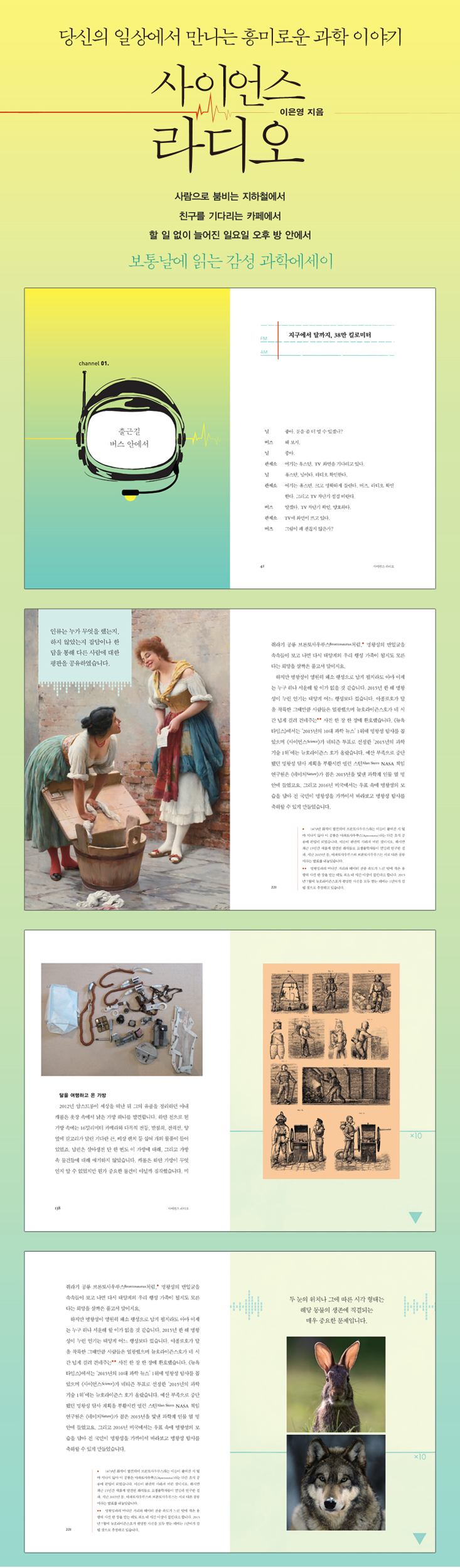
Publisher's Review
Many science books say that they make science easy and fun to understand.
Science is easy and fun? No, science is difficult.
How could it be easy?
The author of this book, Eunyoung Lee, who has been working on creating science books for a science publishing company for 15 years, says that even though many years have passed since she studied science, she still finds it difficult.
Even without some grand theory, I confess that I don't quite understand how the Earth and the Moon can float in space without colliding.
But she adds:
If you look closely, you will see that the facts that science has discovered so far contain many interesting stories.
That's where Science Radio started.
This book tells scientific stories in a friendly and affectionate way, using everyday language, like a radio broadcast on the bus on the way to work, or like an essay enjoyed leisurely over a cup of coffee.
It is another pleasure to look at the various pictures and photos combined with the text with a new perspective.
Let's forget about scientific theories and concepts for a moment and enjoy the stories behind science.
Five minutes a day, injecting scientific sensibility into your daily life! Why not tune in to "Science Radio?"
Enjoy before you feel the true taste of science,
A science book that's like an appetizer that awakens your dead scientific cells.
Science is difficult.
I feel dizzy whenever I encounter strange formulas that seem like they could be used by aliens and 'new words' that would never be used in normal conversation.
I'm always curious about what science is, but I'm not interested at all.
Relativity, eigendynamics, etc., isn't science in our minds confined within the framework of 'knowledge' that must be learned and mastered?
The author confesses, “I majored in science, but I became truly immersed in it after encountering many stories about science.”
Science is difficult, but it also tells 'very ordinary' stories to 'very ordinary' people in everyday life.
Galileo Galilei observed that the moon's surface was uneven, and evolutionary psychologists have read differences between chimpanzees and humans in their pupils.
Stories surrounding science are often stories about people: astronomers searching for secrets hidden in works of art, cruel brain surgeries performed in an era when the brain was not understood, and the Carolina parakeet driven to extinction by the desire for its beautiful feathers.
Without those who tirelessly explored to find answers to their curiosities and ventured into the unknown, neither the global science bestseller Cosmos nor the immortal science classic The Selfish Gene would exist.
Like an appetizer that whets your appetite, let's get closer to scientists through fascinating stories surrounding science.
For those with a vague interest in science, Science Radio will spark a new curiosity about what science truly is.
We are always encountering science
Five minutes a day, talking about science in everyday life
“In a crowded subway, in a cafe waiting for a friend, in a room on a lazy Sunday afternoon with nothing to do, the stories of the universe, the ocean, the creatures, and us humans, diligently explored by a scientist somewhere on Earth, even though we’ve never met before, take us on a journey through time and space, from the past and present, from the depths of the Earth to the outer reaches of the solar system.”
Science Radio awakens curiosity about science by revealing fascinating stories hidden beyond the rigid scientific knowledge.
Why would an astronomer be interested in a Van Gogh painting? Why aren't there any lunar photos of Neil Armstrong, the first man to walk on the moon? Why was the Titanic laden with precious feathers? The author, who began his investigation by chance encountering a photo on the internet or a line in a book, traced events and figures, then scoured the archives, piecing together a never-before-seen scientific tale.
Like a radio broadcast in everyday life, a science story unfolds that anyone can comfortably approach.
Science is easy and fun? No, science is difficult.
How could it be easy?
The author of this book, Eunyoung Lee, who has been working on creating science books for a science publishing company for 15 years, says that even though many years have passed since she studied science, she still finds it difficult.
Even without some grand theory, I confess that I don't quite understand how the Earth and the Moon can float in space without colliding.
But she adds:
If you look closely, you will see that the facts that science has discovered so far contain many interesting stories.
That's where Science Radio started.
This book tells scientific stories in a friendly and affectionate way, using everyday language, like a radio broadcast on the bus on the way to work, or like an essay enjoyed leisurely over a cup of coffee.
It is another pleasure to look at the various pictures and photos combined with the text with a new perspective.
Let's forget about scientific theories and concepts for a moment and enjoy the stories behind science.
Five minutes a day, injecting scientific sensibility into your daily life! Why not tune in to "Science Radio?"
Enjoy before you feel the true taste of science,
A science book that's like an appetizer that awakens your dead scientific cells.
Science is difficult.
I feel dizzy whenever I encounter strange formulas that seem like they could be used by aliens and 'new words' that would never be used in normal conversation.
I'm always curious about what science is, but I'm not interested at all.
Relativity, eigendynamics, etc., isn't science in our minds confined within the framework of 'knowledge' that must be learned and mastered?
The author confesses, “I majored in science, but I became truly immersed in it after encountering many stories about science.”
Science is difficult, but it also tells 'very ordinary' stories to 'very ordinary' people in everyday life.
Galileo Galilei observed that the moon's surface was uneven, and evolutionary psychologists have read differences between chimpanzees and humans in their pupils.
Stories surrounding science are often stories about people: astronomers searching for secrets hidden in works of art, cruel brain surgeries performed in an era when the brain was not understood, and the Carolina parakeet driven to extinction by the desire for its beautiful feathers.
Without those who tirelessly explored to find answers to their curiosities and ventured into the unknown, neither the global science bestseller Cosmos nor the immortal science classic The Selfish Gene would exist.
Like an appetizer that whets your appetite, let's get closer to scientists through fascinating stories surrounding science.
For those with a vague interest in science, Science Radio will spark a new curiosity about what science truly is.
We are always encountering science
Five minutes a day, talking about science in everyday life
“In a crowded subway, in a cafe waiting for a friend, in a room on a lazy Sunday afternoon with nothing to do, the stories of the universe, the ocean, the creatures, and us humans, diligently explored by a scientist somewhere on Earth, even though we’ve never met before, take us on a journey through time and space, from the past and present, from the depths of the Earth to the outer reaches of the solar system.”
Science Radio awakens curiosity about science by revealing fascinating stories hidden beyond the rigid scientific knowledge.
Why would an astronomer be interested in a Van Gogh painting? Why aren't there any lunar photos of Neil Armstrong, the first man to walk on the moon? Why was the Titanic laden with precious feathers? The author, who began his investigation by chance encountering a photo on the internet or a line in a book, traced events and figures, then scoured the archives, piecing together a never-before-seen scientific tale.
Like a radio broadcast in everyday life, a science story unfolds that anyone can comfortably approach.
GOODS SPECIFICS
- Date of issue: December 5, 2016
- Page count, weight, size: 244 pages | 418g | 150*220*14mm
- ISBN13: 9788958625087
- ISBN10: 8958625082
You may also like
카테고리
korean


korean

![ELLE 엘르 스페셜 에디션 A형 : 12월 [2025]](http://librairie.coreenne.fr/cdn/shop/files/b8e27a3de6c9538896439686c6b0e8fb.jpg?v=1766436872&width=3840)


