

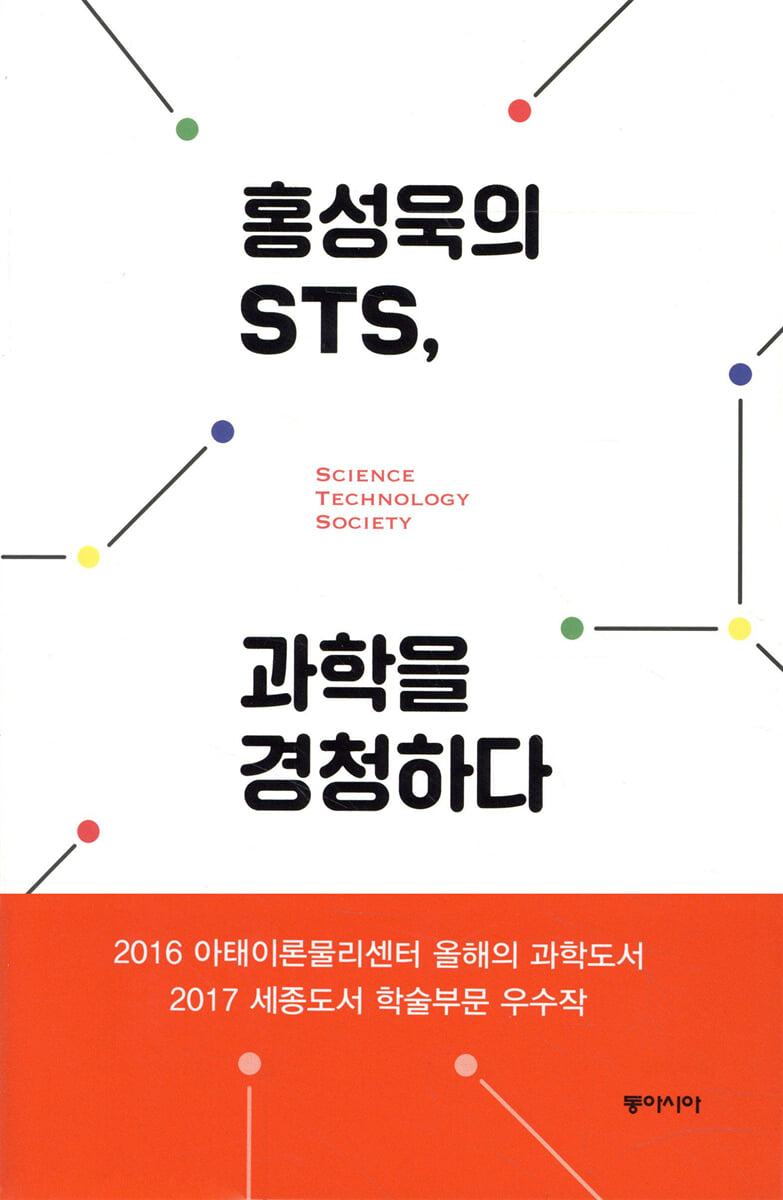
Hong Seong-wook's STS: Listening to Science
 |
Description
Book Introduction
"It completely shatters conventional wisdom about the nature of science." - Jang Ha-seok
Science and technology are driven by social networks.
Nakdong River green algae, artificial intelligence, humidifier disinfectants, nuclear power plants, genetic scissors, animal testing…
Science and Society, Let's Talk Together!
Are whales worthy of protection, or are they predators that devour other fish? Both arguments are based on scientific evidence.
Do "scientific facts" exist? According to Thomas Kuhn, this debate stems from differences in "paradigms."
Paradigm is a concept proposed by Kuhn in ‘The Structure of Scientific Revolutions’, and refers to a framework for viewing and understanding the world.
People with different paradigms perceive the same 'facts' in completely different ways.
In 『Hong Seong-wook's STS, Listening to Science』, Professor Hong Seong-wook presents the concept of 'network' as an extension and development of Kuhn's concept of paradigm.
According to the author, networks are a key concept for understanding modern science and a key to explaining the flow of scientific issues.
Networks have the property of constantly expanding and branching out, and growing networks may disappear or be replaced by other networks, or multiple networks may condense into one.
From this perspective of a 'living, moving' network, we can see that science is in a constant relationship of influence and interaction with society.
Moreover, we can face the fact that science is a human activity rather than an inherent property of nature.
The STS in the title stands for 'Science and Technology Studies'.
It is generally believed that scientific advancement leads to scientific and technological advancement, but from the perspective of science and technology studies, science and technology are the core of science.
For example, the steam engine, a technology invented during the Industrial Revolution, led to the development of modern thermodynamics.
Furthermore, the perspective of science and technology studies leads us to view the process of scientific development not as a simple advancement of knowledge, but as a history that has been 'living and moving' as a social phenomenon.
Accordingly, the purpose of this book is to expand the scope of STS to include 'Science, Technology and Society'.
To see the true face of science and technology, we must also look at their social properties.
This book was written to widely disseminate the perspectives of science and technology studies and to suggest the direction in which the discourse of science and technology studies should proceed.
By following the book's sequence, readers can broaden their thinking from understanding the core concepts of STS to viewing themselves as active participants in modern science.
Science and technology are driven by social networks.
Nakdong River green algae, artificial intelligence, humidifier disinfectants, nuclear power plants, genetic scissors, animal testing…
Science and Society, Let's Talk Together!
Are whales worthy of protection, or are they predators that devour other fish? Both arguments are based on scientific evidence.
Do "scientific facts" exist? According to Thomas Kuhn, this debate stems from differences in "paradigms."
Paradigm is a concept proposed by Kuhn in ‘The Structure of Scientific Revolutions’, and refers to a framework for viewing and understanding the world.
People with different paradigms perceive the same 'facts' in completely different ways.
In 『Hong Seong-wook's STS, Listening to Science』, Professor Hong Seong-wook presents the concept of 'network' as an extension and development of Kuhn's concept of paradigm.
According to the author, networks are a key concept for understanding modern science and a key to explaining the flow of scientific issues.
Networks have the property of constantly expanding and branching out, and growing networks may disappear or be replaced by other networks, or multiple networks may condense into one.
From this perspective of a 'living, moving' network, we can see that science is in a constant relationship of influence and interaction with society.
Moreover, we can face the fact that science is a human activity rather than an inherent property of nature.
The STS in the title stands for 'Science and Technology Studies'.
It is generally believed that scientific advancement leads to scientific and technological advancement, but from the perspective of science and technology studies, science and technology are the core of science.
For example, the steam engine, a technology invented during the Industrial Revolution, led to the development of modern thermodynamics.
Furthermore, the perspective of science and technology studies leads us to view the process of scientific development not as a simple advancement of knowledge, but as a history that has been 'living and moving' as a social phenomenon.
Accordingly, the purpose of this book is to expand the scope of STS to include 'Science, Technology and Society'.
To see the true face of science and technology, we must also look at their social properties.
This book was written to widely disseminate the perspectives of science and technology studies and to suggest the direction in which the discourse of science and technology studies should proceed.
By following the book's sequence, readers can broaden their thinking from understanding the core concepts of STS to viewing themselves as active participants in modern science.
- You can preview some of the book's contents.
Preview
index
Thinking of science and technology as a network of technosciences
Chapter 1 Humans and Nonhumans
Give Technoscience a Lab
Highway, speed bumps, seat belts, and priority seats
Grumpy inhuman actors
The difference between humans and machines
Is a robotic scientist impossible?
Hunter and Scholar
Chapter 2: Technoscience through Networks
For a US aircraft carrier to reach Kuwait,
Monarch butterflies in the laboratory
Reading the World Through Networks
paradigm
Chapter 3: Exploring the Philosophy of Science
Is the world one?
actually
Do laws exist in nature?
Scientific Theory and Democracy
Chapter 4 What Can You Do?
amalgamation
Successful Teams and Leadership
Leadership in Big Science
A world of hybrid beings and care
uncertainty
responsibility
Science and Technology Studies
References and References
Search
Chapter 1 Humans and Nonhumans
Give Technoscience a Lab
Highway, speed bumps, seat belts, and priority seats
Grumpy inhuman actors
The difference between humans and machines
Is a robotic scientist impossible?
Hunter and Scholar
Chapter 2: Technoscience through Networks
For a US aircraft carrier to reach Kuwait,
Monarch butterflies in the laboratory
Reading the World Through Networks
paradigm
Chapter 3: Exploring the Philosophy of Science
Is the world one?
actually
Do laws exist in nature?
Scientific Theory and Democracy
Chapter 4 What Can You Do?
amalgamation
Successful Teams and Leadership
Leadership in Big Science
A world of hybrid beings and care
uncertainty
responsibility
Science and Technology Studies
References and References
Search
Into the book
The science in textbooks is neat and clear.
And it is objective and universal.
There is absolutely no room for social or cultural factors to intervene in the process of solving problems using the formula F=ma.
As we study science, we come to think of it as something tearfully rational, something created by humans but transcendent and beyond the human world.
Of course, there are people who think this way even in the West, the birthplace of modern science, but this tendency is much more prominent and serious around us.
This tendency stems from only accepting and learning science from textbooks, without directly experiencing the process of scientific development as a dynamic culture.
Therefore, examining how the network called technoscience is created, grows, and changes, taking on different forms, can be a way to give science a "human face."
Especially for us, who perceive science solely as a tool for economic growth, we desperately need science with a human face, not science with the face of God.
--- pp.14-15
We live in interaction with non-humans.
Nonhuman entities, such as technology, combine with us to create a kind of 'hybrid being', giving us new possibilities and constraints.
They limit our free will and force us to take certain moral positions.
In this sense, they are 'actors'.
When thinking about society, we must consider not only humans but also non-humans as important members of society.
Technoscience is about creating, understanding, and taming these new non-humans to create new networks.
Understanding technoscience should be part of the social sciences, which seek to understand the complexities of modern society, as well as the humanities, which seek to gain a deeper understanding of the human mind.
--- pp.47-48
I was stopped in traffic on a curved highway.
However, the driver coming from behind could not see that the road was blocked because of the curve.
I slammed on the brakes, but ended up hitting my car, which was stopped.
I was fine, but my car rolled over and hit a driver who had pulled over on the shoulder of the road and was seriously injured.
Whose responsibility is it?
Earlier, I said that when we think about the human-nonhuman network, it is difficult to think of a human being with pure free will.
The presence of other humans or non-humans always expands or limits my freedom.
I can express my opinions more freely because of the internet that other people created, but I am also exposed to more eyes and scrutiny.
Although the law has expanded my freedom of speech, I must also obey laws that go against my free will.
Non-humans also influence me.
When I hold a gun in my hand, I become a completely different person than when I am bare-handed.
There are people whose personality changes just by holding the steering wheel.
So, how much pure freedom can I, so intimately intertwined with other humans and non-humans, truly possess, following my own will? --- p.381
After becoming president of the Royal Society in 1703 and publishing Opticks in 1704, Newton again vigorously defended his theory.
He had his disciples repeat the 'decisive experiment'.
And he had people who didn't get the same results as him argue that the prisms they used in their experiments were faulty, which is why they got the wrong results.
Manfredi, an Italian Newtonian, said, “When the prism is absolutely perfect, like the one we received in England, the results always come out in accordance with the (Newtonian) principles.”
After this debate, the opposing theories of optics and color were silenced, and the 18th century was largely dominated by Newton's theory of optics (although there were exceptions, of course).
Science and technology studies view the process by which Newton's theory of optics and experiments were presented and gradually established as a sociocultural process.
Newton's authority in optics was established as the authority of Newton's experiments was established, and for this reason, the experiments of those who produced experimental results different from Newton's had to be judged as immature experiments using fake prisms.
And it is objective and universal.
There is absolutely no room for social or cultural factors to intervene in the process of solving problems using the formula F=ma.
As we study science, we come to think of it as something tearfully rational, something created by humans but transcendent and beyond the human world.
Of course, there are people who think this way even in the West, the birthplace of modern science, but this tendency is much more prominent and serious around us.
This tendency stems from only accepting and learning science from textbooks, without directly experiencing the process of scientific development as a dynamic culture.
Therefore, examining how the network called technoscience is created, grows, and changes, taking on different forms, can be a way to give science a "human face."
Especially for us, who perceive science solely as a tool for economic growth, we desperately need science with a human face, not science with the face of God.
--- pp.14-15
We live in interaction with non-humans.
Nonhuman entities, such as technology, combine with us to create a kind of 'hybrid being', giving us new possibilities and constraints.
They limit our free will and force us to take certain moral positions.
In this sense, they are 'actors'.
When thinking about society, we must consider not only humans but also non-humans as important members of society.
Technoscience is about creating, understanding, and taming these new non-humans to create new networks.
Understanding technoscience should be part of the social sciences, which seek to understand the complexities of modern society, as well as the humanities, which seek to gain a deeper understanding of the human mind.
--- pp.47-48
I was stopped in traffic on a curved highway.
However, the driver coming from behind could not see that the road was blocked because of the curve.
I slammed on the brakes, but ended up hitting my car, which was stopped.
I was fine, but my car rolled over and hit a driver who had pulled over on the shoulder of the road and was seriously injured.
Whose responsibility is it?
Earlier, I said that when we think about the human-nonhuman network, it is difficult to think of a human being with pure free will.
The presence of other humans or non-humans always expands or limits my freedom.
I can express my opinions more freely because of the internet that other people created, but I am also exposed to more eyes and scrutiny.
Although the law has expanded my freedom of speech, I must also obey laws that go against my free will.
Non-humans also influence me.
When I hold a gun in my hand, I become a completely different person than when I am bare-handed.
There are people whose personality changes just by holding the steering wheel.
So, how much pure freedom can I, so intimately intertwined with other humans and non-humans, truly possess, following my own will? --- p.381
After becoming president of the Royal Society in 1703 and publishing Opticks in 1704, Newton again vigorously defended his theory.
He had his disciples repeat the 'decisive experiment'.
And he had people who didn't get the same results as him argue that the prisms they used in their experiments were faulty, which is why they got the wrong results.
Manfredi, an Italian Newtonian, said, “When the prism is absolutely perfect, like the one we received in England, the results always come out in accordance with the (Newtonian) principles.”
After this debate, the opposing theories of optics and color were silenced, and the 18th century was largely dominated by Newton's theory of optics (although there were exceptions, of course).
Science and technology studies view the process by which Newton's theory of optics and experiments were presented and gradually established as a sociocultural process.
Newton's authority in optics was established as the authority of Newton's experiments was established, and for this reason, the experiments of those who produced experimental results different from Newton's had to be judged as immature experiments using fake prisms.
--- pp.409-140
Publisher's Review
Science moves through 'social networks'!
Professor Hong Seong-wook's "Network" to Replace Thomas Kuhn's "Paradigm"
Recently, the international environmental group Sea Shepherd announced that it has built a whaling surveillance ship that is large and fast enough to chase down Japanese whaling ships.
Even though Sea Shepherd has not hesitated to use extreme violence to stop Japanese whaling ships, it receives direct support from several countries because of the 'facts' about whales that Westerners share.
In the West, whales are considered highly intelligent animals.
It is also an animal that is endangered due to indiscriminate hunting.
To Westerners, whale eating is both a threat to biodiversity and a barbaric act that harms intelligent animals.
This belief, based on 'scientific facts', is very solid.
Conversely, for Japan, which has long consumed whale meat, the anti-whaling movement is a form of violence by the Western-created "environmental imperialist alliance."
According to scientific data from Japan, whales are no different from goldfish, and are not yet endangered, but rather predators that prey on other fish.
Japanese whaling is carried out in alliance with Japanese scientists under the guise of "scientific research."
Are whales worthy of protection, or are they predators that devour other fish? Both arguments are based on scientific evidence.
Do "scientific facts" exist? According to Thomas Kuhn, this debate stems from differences in "paradigms."
Paradigm is a concept proposed by Kuhn in ‘The Structure of Scientific Revolutions’, and refers to a framework for viewing and understanding the world.
People with different paradigms perceive the same 'facts' in completely different ways.
In 『Hong Seong-wook's STS, Listening to Science』, Professor Hong Seong-wook presents the concept of 'network' as an extension and development of Kuhn's concept of paradigm.
According to the author, networks are a key concept for understanding modern science and a key to explaining the flow of scientific issues.
Networks have the property of constantly expanding and branching out, with growing networks sometimes disappearing or being replaced by other networks, or multiple networks condensing into one.
From this perspective of a 'living, moving' network, we can see that science is in a constant relationship of influence and interaction with society.
Moreover, we can face the fact that science is a human activity rather than an inherent property of nature.
Professor Hong Seong-wook of Seoul National University, years of independent planning and writing!
The STS Essay, written in 21 unpublished manuscripts
The author, Professor Hong Seong-wook, is an orthodox historian of science and the person who contributed most to introducing Science, Technology and Society (STS) to Korea.
We strive to move beyond simply conveying scientific knowledge to the general public and to help both the public and established scientists understand science as a multi-layered and complex system.
Because that is the true meaning of ‘popularization of science.’
The author left his position at the University of Toronto in 2003 and moved to the Interdisciplinary Program in History and Philosophy of Science within the Graduate School of Natural Sciences at Seoul National University. In 2006, he established a major program in Science and Technology Studies within the interdisciplinary program and has since been contemplating and researching the various interactions between science, technology, and society.
『Hong Seong-wook's STS, Listening to Science』 contains the new understandings and reflections that Professor Hong Seong-wook has come to while researching, lecturing, and supervising students' papers over the past 10 years.
This book was planned and written solely by the author to suggest the direction in which the discourse on 'science and technology studies' in Korea should proceed. Unlike previous works, this volume is filled with unpublished manuscripts that have never been contributed or made public.
STS Gives Science a 'Human Face'
"It completely shatters conventional wisdom about the nature of science."
STS stands for 'Science and Technology Studies'.
It is generally believed that scientific advancement leads to scientific and technological advancement, but from the perspective of science and technology studies, science and technology are the core of science.
For example, the steam engine, a technology invented during the Industrial Revolution, led to the development of modern thermodynamics.
Furthermore, the perspective of science and technology studies leads us to view the process of scientific development not as a simple advancement of knowledge, but as a history that has been 'living and moving' as a social phenomenon.
Accordingly, the purpose of this book is to expand the scope of STS to include 'Science, Technology and Society'.
To see the true face of science and technology, we must also look at their social properties.
Professor Ha-seok Jang of Cambridge University said in his recommendation that the book “vividly depicts the process by which humans create scientific knowledge in their social and material lives,” and that it “thoroughly shatters conventional wisdom about the nature of science.”
For example, Darwin's theory of evolution was created through interaction with many scientists and had to compete with the evolutionary theories of Wallace and Lamarck at the time.
His 'struggle for existence' theory received countless criticisms from Russian, German, and French biologists.
It was necessary to prove the importance and persuasiveness of the theory of evolution based on the field of natural history that had developed in Europe since the 17th century.
Herbert Spencer's 'Social Darwinism', which appeared at the same time, also became a subject of debate by many scholars, including Darwin.
However, in East Asian countries such as Korea, which lacked a scientific tradition like that of the West, Darwin's theory of evolution was accepted as a matter of course, and social Darwinism was also accepted in the same context as Darwin's theory of evolution without much debate.
In the Western scientific community, Darwin's theory of evolution, Newton's laws of optics and gravity, Einstein's theory of relativity, and quantum mechanics had to go through a process of 'support and roasting' before they were accepted.
This process is a 'sociocultural' process.
However, in our country, complete science was imported without this zigzag development process.
So, we believe that science is tearfully absolute, and that it is already a completed truth and power.
This perspective views science as merely a foundation for economic growth, rather than a social activity, hindering the social participation of scientists and technologists and solidifying the barrier between science and society.
About this, the author says:
“If science is about discovering the complete truth, then we can just take the scientific results that the United States produces.” This is because the truth of nature is the same in Korea as in the United States.
However, science is an activity that creates a living network of humans and nonhumans, and since this network is local, we need to create science that is suitable for our society.
It is possible to bring in papers from the United States, but it is difficult to bring in laboratories, it is even more difficult to bring in tacit knowledge such as the know-how in the heads of scientists, and it is impossible to bring in the network of American science.
Human vs.
Inhuman
Can science control technology?
The network that Professor Hong Seong-wook speaks of includes not only the connections between humans but also the connections between humans and non-humans.
'Non-human' is a general term for all non-human beings, including various types such as technology, natural objects, plants and animals, and papers.
Among these, the most representative non-human we encounter in our daily lives is 'technology', and therefore, understanding the network that technology connects is crucial to understanding science and technology.
Nonhumans are objects created and studied by humans, but they also exert technological and moral influence on humans in turn.
In the early 20th century, New York architect Robert Moses, while designing Jones Beach Park, was concerned about how to keep black people out, so he designed a low skybridge over the road leading into the park.
They used the high body of the buses, which were mainly used by black people, to control the transportation of black people into the park through 'technology'.
Ultimately, the park could become a space for white people only.
In this way, non-human objects such as technology and artifacts can not only embody a society's political ideology but also play a role in reinforcing it.
In that they influence each other, non-humans can be seen as forming a network with equal status to humans, rather than as a subordinate concept to humans.
Additionally, non-humans can create many unexpected problems when they come out into the real world.
In fact, even the skybridge designed by Robert Moses caused a strange problem a few decades later.
Because it was designed to be so low, it was difficult for tall vehicles such as container trucks to pass through.
There was even an accident where a container truck overturned.
There are many cases where non-humans introduced to solve problems like this end up creating other problems.
However, most of these problems are difficult for scientists and engineers to anticipate when studying non-humans.
Therefore, humans must constantly care for and bear some kind of responsibility for the non-humans they create and engineer.
There is a need for ongoing social discourse on this matter.
Science and technology are created based on societal needs, but when applied to actual society, they create unexpected problems, which can be resolved through the combination of legal and ethical discussions and new science and technology.
In other words, since there are areas that science and society share, constant communication between society and science is required.
Listen to society and science
'STS kiss' awakens science from its long slumber!
『Hong Seong-wook's STS, Listening to Science』 was written to widely disseminate the perspective of science and technology studies and to suggest the direction in which the discourse of science and technology studies should proceed.
By following the book's sequence, readers can broaden their thinking from understanding the core concepts of STS to viewing themselves as active participants in modern science.
Chapter 1, “Humans and Non-Humans,” provides a basic understanding of science and technology studies by identifying key concepts used in science and technology studies, such as science and technology studies, networks, technoscience, non-humans, and tacit knowledge.
Chapter 2, “Technoscience through Networks,” focuses on the network theory that Professor Hong Seong-wook discusses, and examines the role that networks have played in the actual history of science.
'Technoscience' refers to science and technology understood in the form of human-nonhuman networks.
Chapter 3, “Exploring the Philosophy of Science,” examines a variety of issues, from classic discussions of electromagnetism to recent ones, such as the silver nano-washing machine controversy and the Seoul tap water debate.
From the perspective of science and technology studies, we can consider how science has been created, compromised, and shared between humans and non-humans.
Chapter 4, “What Can Be Done,” guides readers to consider for themselves how science and technology should be handled in the future.
We examine the current state of modern science and technology from various angles, including fusion, big science, side effects such as GMOs and nuclear accidents, and the issue of responsibility.
Even those not in science or engineering fields can easily read this book, which is rich in case studies. As former Seoul National University professor Oh Se-jeong wrote in his recommendation, “This fascinating collection of stories is easy to read while providing much food for thought.”
Dutch scientist Wii Wijker named this process the 'STS kiss'.
Just as a princess in a fairy tale is awakened from a long sleep by a kiss, the long-held dream of a scientist who believed that science is the absolute truth can be shattered by the contact with science and technology.
Let's listen to the real story of science, which has been ignored while mythologizing and taxidermizing science.
Professor Hong Seong-wook's "Network" to Replace Thomas Kuhn's "Paradigm"
Recently, the international environmental group Sea Shepherd announced that it has built a whaling surveillance ship that is large and fast enough to chase down Japanese whaling ships.
Even though Sea Shepherd has not hesitated to use extreme violence to stop Japanese whaling ships, it receives direct support from several countries because of the 'facts' about whales that Westerners share.
In the West, whales are considered highly intelligent animals.
It is also an animal that is endangered due to indiscriminate hunting.
To Westerners, whale eating is both a threat to biodiversity and a barbaric act that harms intelligent animals.
This belief, based on 'scientific facts', is very solid.
Conversely, for Japan, which has long consumed whale meat, the anti-whaling movement is a form of violence by the Western-created "environmental imperialist alliance."
According to scientific data from Japan, whales are no different from goldfish, and are not yet endangered, but rather predators that prey on other fish.
Japanese whaling is carried out in alliance with Japanese scientists under the guise of "scientific research."
Are whales worthy of protection, or are they predators that devour other fish? Both arguments are based on scientific evidence.
Do "scientific facts" exist? According to Thomas Kuhn, this debate stems from differences in "paradigms."
Paradigm is a concept proposed by Kuhn in ‘The Structure of Scientific Revolutions’, and refers to a framework for viewing and understanding the world.
People with different paradigms perceive the same 'facts' in completely different ways.
In 『Hong Seong-wook's STS, Listening to Science』, Professor Hong Seong-wook presents the concept of 'network' as an extension and development of Kuhn's concept of paradigm.
According to the author, networks are a key concept for understanding modern science and a key to explaining the flow of scientific issues.
Networks have the property of constantly expanding and branching out, with growing networks sometimes disappearing or being replaced by other networks, or multiple networks condensing into one.
From this perspective of a 'living, moving' network, we can see that science is in a constant relationship of influence and interaction with society.
Moreover, we can face the fact that science is a human activity rather than an inherent property of nature.
Professor Hong Seong-wook of Seoul National University, years of independent planning and writing!
The STS Essay, written in 21 unpublished manuscripts
The author, Professor Hong Seong-wook, is an orthodox historian of science and the person who contributed most to introducing Science, Technology and Society (STS) to Korea.
We strive to move beyond simply conveying scientific knowledge to the general public and to help both the public and established scientists understand science as a multi-layered and complex system.
Because that is the true meaning of ‘popularization of science.’
The author left his position at the University of Toronto in 2003 and moved to the Interdisciplinary Program in History and Philosophy of Science within the Graduate School of Natural Sciences at Seoul National University. In 2006, he established a major program in Science and Technology Studies within the interdisciplinary program and has since been contemplating and researching the various interactions between science, technology, and society.
『Hong Seong-wook's STS, Listening to Science』 contains the new understandings and reflections that Professor Hong Seong-wook has come to while researching, lecturing, and supervising students' papers over the past 10 years.
This book was planned and written solely by the author to suggest the direction in which the discourse on 'science and technology studies' in Korea should proceed. Unlike previous works, this volume is filled with unpublished manuscripts that have never been contributed or made public.
STS Gives Science a 'Human Face'
"It completely shatters conventional wisdom about the nature of science."
STS stands for 'Science and Technology Studies'.
It is generally believed that scientific advancement leads to scientific and technological advancement, but from the perspective of science and technology studies, science and technology are the core of science.
For example, the steam engine, a technology invented during the Industrial Revolution, led to the development of modern thermodynamics.
Furthermore, the perspective of science and technology studies leads us to view the process of scientific development not as a simple advancement of knowledge, but as a history that has been 'living and moving' as a social phenomenon.
Accordingly, the purpose of this book is to expand the scope of STS to include 'Science, Technology and Society'.
To see the true face of science and technology, we must also look at their social properties.
Professor Ha-seok Jang of Cambridge University said in his recommendation that the book “vividly depicts the process by which humans create scientific knowledge in their social and material lives,” and that it “thoroughly shatters conventional wisdom about the nature of science.”
For example, Darwin's theory of evolution was created through interaction with many scientists and had to compete with the evolutionary theories of Wallace and Lamarck at the time.
His 'struggle for existence' theory received countless criticisms from Russian, German, and French biologists.
It was necessary to prove the importance and persuasiveness of the theory of evolution based on the field of natural history that had developed in Europe since the 17th century.
Herbert Spencer's 'Social Darwinism', which appeared at the same time, also became a subject of debate by many scholars, including Darwin.
However, in East Asian countries such as Korea, which lacked a scientific tradition like that of the West, Darwin's theory of evolution was accepted as a matter of course, and social Darwinism was also accepted in the same context as Darwin's theory of evolution without much debate.
In the Western scientific community, Darwin's theory of evolution, Newton's laws of optics and gravity, Einstein's theory of relativity, and quantum mechanics had to go through a process of 'support and roasting' before they were accepted.
This process is a 'sociocultural' process.
However, in our country, complete science was imported without this zigzag development process.
So, we believe that science is tearfully absolute, and that it is already a completed truth and power.
This perspective views science as merely a foundation for economic growth, rather than a social activity, hindering the social participation of scientists and technologists and solidifying the barrier between science and society.
About this, the author says:
“If science is about discovering the complete truth, then we can just take the scientific results that the United States produces.” This is because the truth of nature is the same in Korea as in the United States.
However, science is an activity that creates a living network of humans and nonhumans, and since this network is local, we need to create science that is suitable for our society.
It is possible to bring in papers from the United States, but it is difficult to bring in laboratories, it is even more difficult to bring in tacit knowledge such as the know-how in the heads of scientists, and it is impossible to bring in the network of American science.
Human vs.
Inhuman
Can science control technology?
The network that Professor Hong Seong-wook speaks of includes not only the connections between humans but also the connections between humans and non-humans.
'Non-human' is a general term for all non-human beings, including various types such as technology, natural objects, plants and animals, and papers.
Among these, the most representative non-human we encounter in our daily lives is 'technology', and therefore, understanding the network that technology connects is crucial to understanding science and technology.
Nonhumans are objects created and studied by humans, but they also exert technological and moral influence on humans in turn.
In the early 20th century, New York architect Robert Moses, while designing Jones Beach Park, was concerned about how to keep black people out, so he designed a low skybridge over the road leading into the park.
They used the high body of the buses, which were mainly used by black people, to control the transportation of black people into the park through 'technology'.
Ultimately, the park could become a space for white people only.
In this way, non-human objects such as technology and artifacts can not only embody a society's political ideology but also play a role in reinforcing it.
In that they influence each other, non-humans can be seen as forming a network with equal status to humans, rather than as a subordinate concept to humans.
Additionally, non-humans can create many unexpected problems when they come out into the real world.
In fact, even the skybridge designed by Robert Moses caused a strange problem a few decades later.
Because it was designed to be so low, it was difficult for tall vehicles such as container trucks to pass through.
There was even an accident where a container truck overturned.
There are many cases where non-humans introduced to solve problems like this end up creating other problems.
However, most of these problems are difficult for scientists and engineers to anticipate when studying non-humans.
Therefore, humans must constantly care for and bear some kind of responsibility for the non-humans they create and engineer.
There is a need for ongoing social discourse on this matter.
Science and technology are created based on societal needs, but when applied to actual society, they create unexpected problems, which can be resolved through the combination of legal and ethical discussions and new science and technology.
In other words, since there are areas that science and society share, constant communication between society and science is required.
Listen to society and science
'STS kiss' awakens science from its long slumber!
『Hong Seong-wook's STS, Listening to Science』 was written to widely disseminate the perspective of science and technology studies and to suggest the direction in which the discourse of science and technology studies should proceed.
By following the book's sequence, readers can broaden their thinking from understanding the core concepts of STS to viewing themselves as active participants in modern science.
Chapter 1, “Humans and Non-Humans,” provides a basic understanding of science and technology studies by identifying key concepts used in science and technology studies, such as science and technology studies, networks, technoscience, non-humans, and tacit knowledge.
Chapter 2, “Technoscience through Networks,” focuses on the network theory that Professor Hong Seong-wook discusses, and examines the role that networks have played in the actual history of science.
'Technoscience' refers to science and technology understood in the form of human-nonhuman networks.
Chapter 3, “Exploring the Philosophy of Science,” examines a variety of issues, from classic discussions of electromagnetism to recent ones, such as the silver nano-washing machine controversy and the Seoul tap water debate.
From the perspective of science and technology studies, we can consider how science has been created, compromised, and shared between humans and non-humans.
Chapter 4, “What Can Be Done,” guides readers to consider for themselves how science and technology should be handled in the future.
We examine the current state of modern science and technology from various angles, including fusion, big science, side effects such as GMOs and nuclear accidents, and the issue of responsibility.
Even those not in science or engineering fields can easily read this book, which is rich in case studies. As former Seoul National University professor Oh Se-jeong wrote in his recommendation, “This fascinating collection of stories is easy to read while providing much food for thought.”
Dutch scientist Wii Wijker named this process the 'STS kiss'.
Just as a princess in a fairy tale is awakened from a long sleep by a kiss, the long-held dream of a scientist who believed that science is the absolute truth can be shattered by the contact with science and technology.
Let's listen to the real story of science, which has been ignored while mythologizing and taxidermizing science.
GOODS SPECIFICS
- Date of issue: September 21, 2016
- Page count, weight, size: 448 pages | 524g | 135*205*21mm
- ISBN13: 9788962621570
- ISBN10: 8962621576
You may also like
카테고리
korean


korean

![ELLE 엘르 스페셜 에디션 A형 : 12월 [2025]](http://librairie.coreenne.fr/cdn/shop/files/b8e27a3de6c9538896439686c6b0e8fb.jpg?v=1766436872&width=3840)


