

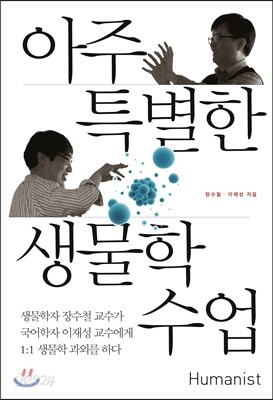
A very special biology class
 |
Description
Book Introduction
A very private biology class where questions are asked freely!
This book contains the process of Professor Jang Su-cheol, who teaches general biology to freshmen at Yonsei University's undergraduate school, teaching biology to Professor Lee Jae-seong, author of "Writing Strategies" and professor of Korean Language and Literature at Seoul Women's University, and completing the book together.
You can see the 1:1 biology tutoring session between Professor Jang Su-cheol, who finds writing unfamiliar and scary, and Professor Lee Jae-seong, who has not been interested in science since graduating from high school.
Professor Lee Jae-seong, who had stubbornly refused to participate in this class, eventually gave in to a trick(?) and took on the role of representing the position of an ordinary man whose job is merely a professor, and boldly asks basic, curious, and absurd questions, thereby bringing biology out of the textbook by helping students understand basic concepts and find examples that can be applied to everyday life.
"They say the more you drink, the more you gain weight. Is that really true? Why do we get glucose shots when we're not feeling well? How should we interpret the triglyceride section on a health checkup?" Through these conversations, which are conducted in a friendly language, you'll experience everything from plants and animals, cells to humans and even biotechnology, all of which are considered "living things" in general biology.
This book contains the process of Professor Jang Su-cheol, who teaches general biology to freshmen at Yonsei University's undergraduate school, teaching biology to Professor Lee Jae-seong, author of "Writing Strategies" and professor of Korean Language and Literature at Seoul Women's University, and completing the book together.
You can see the 1:1 biology tutoring session between Professor Jang Su-cheol, who finds writing unfamiliar and scary, and Professor Lee Jae-seong, who has not been interested in science since graduating from high school.
Professor Lee Jae-seong, who had stubbornly refused to participate in this class, eventually gave in to a trick(?) and took on the role of representing the position of an ordinary man whose job is merely a professor, and boldly asks basic, curious, and absurd questions, thereby bringing biology out of the textbook by helping students understand basic concepts and find examples that can be applied to everyday life.
"They say the more you drink, the more you gain weight. Is that really true? Why do we get glucose shots when we're not feeling well? How should we interpret the triglyceride section on a health checkup?" Through these conversations, which are conducted in a friendly language, you'll experience everything from plants and animals, cells to humans and even biotechnology, all of which are considered "living things" in general biology.
- You can preview some of the book's contents.
Preview
index
11 Before starting class
Lesson 1: Life and Death, What It Means to Be Alive: Life and Biology 17
Let's Learn About the Characteristics of Living Things 18 | Can We Define Life? 22 | How Living Things Live 27 | A High-Level Explanatory Framework for Biology 31 | Linnaeus and Darwin 40 | After Class 49
Lesson 2: Chemistry of You and Me: Molecules That Make Up My Body 1 Water, 53 Carbohydrates
54 Reasons to Know Chemistry | Water, Close to My Body | 58 | Macromolecules | Finding Carbohydrates | 71 | Cutting Carbs | 78 | Fueling Up with Carbohydrates | After Class | 85
Third Lesson Today's Menu: Molecules That Make Up My Body 2 Lipids, Proteins, and Nucleic Acids 87
Lipid Identity 88 | Protein Structure and Activity Conditions 101 | What Proteins Do 110 | Nucleic Acids 113 | After Class 115
Lesson Four: The Gateway to the Cell: The Cell Membrane 117
Discovery of the Cell 118 | What Happens in the Cell Membrane 122 | How to Cross the Cell Membrane Without Using Energy 128 | Cells' Uptake 136 | Cell Communication 139 | After Class 141
Lesson 5: Unicellular Man, Multicellular Woman?: Cell Types and Structure 145
Prokaryotic Cells Are Simple 146 | Observing Eukaryotic Cells 152 | What Membrane Structures Do 157 | Mitochondria: Energy Powerhouses 160 | What Plant Cells Have but Animal Cells Don't? 164 | Area, Volume, and Cellular Reactions 173 | After Class 175
Lesson Six: What Moves Me: Energy and Cellular Respiration 177
Energy, Show Your Power 178 | The Source of Energy, the Sun 182 | Energy Efficiency Comparison 184 | Essential Knowledge for Modern People, ATP 185 | Cellular Respiration 1: How Glucose Meets Oxygen 188 | Cellular Respiration 2: Breaking Down Sugar to Create Energy 189 | Electron Transport Chain and Pinball 197 | Respiration Without Oxygen 201 | ATP Synthesis Inhibition and Toxins 202 | Nutrients and Energy 205 | After Class 207
Lesson 7: Big News in the Biosphere: Using the Sun: Photosynthesis 211
Photosynthesis Isn't Just for Plants 212 | Photosynthetic Materials 214 | Chloroplasts: Where Light Is Captured 218 | Chlorophyll's Favorite Colors 220 | Light Reactions: Converting Light Energy to Chemical Energy 226 | Calvin Cycle: Making Sugars 229 | How Plants Cope with Extreme Environments 233 | After Class 239
Lesson 8: Cells are constantly dying and being reborn: Cell Division and Reproduction 241
Progeria and Telomeres 242 | How Long is DNA? 245 | Cells Falling Off My Body 251 | Cell Suicide 256 | Let's Make Them All the Same: Mitosis 259 | Immortal Cancer Cells 262 | This Is Sexual Reproduction 267 | Let's Make Them All the Different: Meiosis 272 | The Pros and Cons of Sexual Reproduction 283 | After Class 287
Lesson 9: Meet the One Who Looks Like Me: Genetics 1 289
290 | Dominant and Out-of-Taxation | Is Dominant Good, Recessive Bad? 293 | Sex Determination Methods in Other Animals 297 | Chromosome Testing 300 | Mendelian Genetics and Mendel's Genius 305 | The "Particles" Responsible for Heredity 312 | Phenotype and Genotype 316 | Black Cross: What Is That Tiger's Genotype? 319 | Rediscovering Mendel's Laws 322 | After Class 327
Lesson 10: Meet the Other You: Heredity 2 329
Genealogy, Family Tree 330 | Inability to Distinguish Dominance, Co-Dominance 336 | Polygenic Inheritance 344 | Pleiotropy 344 | The Law of Independent Origins 347 | After Class 351
Lesson 11: The Map Within Me, DNA: From DNA to Proteins 357
Amazing DNA 358 | Extracting Information from DNA 361 | Mutations 370 | Common Ancestors 374 | The Story of the Double Helix 376 | Defining Genes 384
Lesson 12: From Science Fiction to Reality: Biotechnology 385
Personalized Medicine 386 | Recombinant DNA 389 | Biotechnology Around Us 399 | The Dream and Reality of Gene Therapy 402 | What Biologists Want to Say About GMOs 407 | DNA Fingerprinting 415 | Primate Genes 420 | The Now-Familiar Cloning of Biological Beings 422 | After Class 427
Ending class 433
Search 438
Lesson 1: Life and Death, What It Means to Be Alive: Life and Biology 17
Let's Learn About the Characteristics of Living Things 18 | Can We Define Life? 22 | How Living Things Live 27 | A High-Level Explanatory Framework for Biology 31 | Linnaeus and Darwin 40 | After Class 49
Lesson 2: Chemistry of You and Me: Molecules That Make Up My Body 1 Water, 53 Carbohydrates
54 Reasons to Know Chemistry | Water, Close to My Body | 58 | Macromolecules | Finding Carbohydrates | 71 | Cutting Carbs | 78 | Fueling Up with Carbohydrates | After Class | 85
Third Lesson Today's Menu: Molecules That Make Up My Body 2 Lipids, Proteins, and Nucleic Acids 87
Lipid Identity 88 | Protein Structure and Activity Conditions 101 | What Proteins Do 110 | Nucleic Acids 113 | After Class 115
Lesson Four: The Gateway to the Cell: The Cell Membrane 117
Discovery of the Cell 118 | What Happens in the Cell Membrane 122 | How to Cross the Cell Membrane Without Using Energy 128 | Cells' Uptake 136 | Cell Communication 139 | After Class 141
Lesson 5: Unicellular Man, Multicellular Woman?: Cell Types and Structure 145
Prokaryotic Cells Are Simple 146 | Observing Eukaryotic Cells 152 | What Membrane Structures Do 157 | Mitochondria: Energy Powerhouses 160 | What Plant Cells Have but Animal Cells Don't? 164 | Area, Volume, and Cellular Reactions 173 | After Class 175
Lesson Six: What Moves Me: Energy and Cellular Respiration 177
Energy, Show Your Power 178 | The Source of Energy, the Sun 182 | Energy Efficiency Comparison 184 | Essential Knowledge for Modern People, ATP 185 | Cellular Respiration 1: How Glucose Meets Oxygen 188 | Cellular Respiration 2: Breaking Down Sugar to Create Energy 189 | Electron Transport Chain and Pinball 197 | Respiration Without Oxygen 201 | ATP Synthesis Inhibition and Toxins 202 | Nutrients and Energy 205 | After Class 207
Lesson 7: Big News in the Biosphere: Using the Sun: Photosynthesis 211
Photosynthesis Isn't Just for Plants 212 | Photosynthetic Materials 214 | Chloroplasts: Where Light Is Captured 218 | Chlorophyll's Favorite Colors 220 | Light Reactions: Converting Light Energy to Chemical Energy 226 | Calvin Cycle: Making Sugars 229 | How Plants Cope with Extreme Environments 233 | After Class 239
Lesson 8: Cells are constantly dying and being reborn: Cell Division and Reproduction 241
Progeria and Telomeres 242 | How Long is DNA? 245 | Cells Falling Off My Body 251 | Cell Suicide 256 | Let's Make Them All the Same: Mitosis 259 | Immortal Cancer Cells 262 | This Is Sexual Reproduction 267 | Let's Make Them All the Different: Meiosis 272 | The Pros and Cons of Sexual Reproduction 283 | After Class 287
Lesson 9: Meet the One Who Looks Like Me: Genetics 1 289
290 | Dominant and Out-of-Taxation | Is Dominant Good, Recessive Bad? 293 | Sex Determination Methods in Other Animals 297 | Chromosome Testing 300 | Mendelian Genetics and Mendel's Genius 305 | The "Particles" Responsible for Heredity 312 | Phenotype and Genotype 316 | Black Cross: What Is That Tiger's Genotype? 319 | Rediscovering Mendel's Laws 322 | After Class 327
Lesson 10: Meet the Other You: Heredity 2 329
Genealogy, Family Tree 330 | Inability to Distinguish Dominance, Co-Dominance 336 | Polygenic Inheritance 344 | Pleiotropy 344 | The Law of Independent Origins 347 | After Class 351
Lesson 11: The Map Within Me, DNA: From DNA to Proteins 357
Amazing DNA 358 | Extracting Information from DNA 361 | Mutations 370 | Common Ancestors 374 | The Story of the Double Helix 376 | Defining Genes 384
Lesson 12: From Science Fiction to Reality: Biotechnology 385
Personalized Medicine 386 | Recombinant DNA 389 | Biotechnology Around Us 399 | The Dream and Reality of Gene Therapy 402 | What Biologists Want to Say About GMOs 407 | DNA Fingerprinting 415 | Primate Genes 420 | The Now-Familiar Cloning of Biological Beings 422 | After Class 427
Ending class 433
Search 438
Detailed image
.jpg)
Publisher's Review
A bickering biology class between two cheerful uncles
A biologist afraid of writing begins teaching biology classes by enlisting a linguist friend.
Three years ago, I received an email from a publisher.
He contacted me after seeing my biology syllabus and lecture evaluation.
The proposal was to create an introductory biology book for the general public.
A publishing offer? It was a welcome surprise to me, someone who'd always wanted to share biology with as many people as possible.
But when I actually received the offer, I started to feel a little fear about writing.
There was someone who came to mind at that time.
It was Professor Lee Jae-seong, a professor of Korean Language and Literature at Seoul Women's University.
Mr. Lee Jae-seong is a friend and the author of the best-selling book, “Writing Strategies.”
After several people gathered together and discussed various things, we decided to try teaching a class using a man in his 40s who had grown away from science after graduating from high school, but who had become curious about biology as he got older.
Of course, that man is none other than Mr. Lee Jae-seong.
―From “Before Starting Class” (page 11)
The humanist's new book, "A Very Special Biology Lesson," depicts the process of a biologist, who is afraid of writing, completing a book with a friend, a linguist, who has a vague idea of what science is.
Professor Jang Su-cheol, who teaches general biology to freshmen at Yonsei University's undergraduate school, has put aside his long-standing research to focus on teaching.
But I've never taught biology outside the classroom to anyone else.
Writing is even more unfamiliar and scary.
Professor Lee Jae-seong of the Department of Korean Language and Literature at Seoul Women's University has never been interested in science since graduating from high school.
I stubbornly refused to participate in this class, but eventually gave in to the temptation.
On the condition that I would take on the role of representing the position of an ordinary man whose only occupation is a professor, and ask basic, curious, and absurd questions without hesitation.
These two professors are close friends(?) but bicker with each other. Will they be able to finish their biology class safely?
Questions are asked without hesitation
Private, but never secret, one-on-one biology tutoring
Jang Su-cheol (……) In Korean, it is ‘cell.’
What is the etymology of the word cell?
Lee Jae-seong's fortune.
Jang Su-cheol, huh?
Lee Jae-seong sell
Sell? Cell? Oh, really! Cell means room.
At that time, the solitary cells where priests lived in monasteries were called 'cells'.
Cell is a Latin word meaning 'small room'.
― From the text “The Fourth Lesson: The Gateway to the Cell” (pp. 119-120)
Lee Jae-seong: But he is both dominant and enthusiastic.
Is it good to be dominant or recessive?
Jang Su-cheol to whom?
Lee Jae-seong: No, so, leaving that aside, the term itself.
When you think about it in everyday life, it seems like it would be good to have only dominant traits, and if you have recessive traits, it feels inferior.
Jang Su-cheol: Let's think about something that isn't like that.
Alzheimer's disease, commonly referred to as 'dementia', is dominant.
Is it good?
Lee Jae-seong is bad.
Jang Su-cheol, right? (omitted) Dominance and recessiveness are separate from normal and abnormal.
In other words, dominance and recessiveness are related to which gene overpowers the other, and normal and abnormal can be said to be discussed by looking at whether it is a disease or not when it is manifested on the outside.
― From the text “The Ninth Lesson: Meeting You Who Resembles Me” (pp. 296-297)
《A Very Special Biology Class》 is a very personal lecture.
First of all, it is a 1:1 tutoring session, and the teacher and student are friends.
There is nothing to be ashamed of.
Professor Lee Jae-seong asks questions without hesitation.
Professor Jang Su-cheol is sometimes taken aback by questions he has never been asked in class before, saying, “Are you really curious about something like that?”
"Does glucose come from grapes?", "What makes saturated fat saturated?" These seem like completely random questions, but aren't they actually the questions we genuinely wonder about but can't bring ourselves to say? Knowledge naturally becomes ours through the process of actively asking questions, not simply "listening" to a lecture.
You will find that your understanding of biology deepens through the questions and answers that take place in one-on-one classes.
They say the more you drink, the more you gain weight. Is that really true?
'Biology': A special biology that is inseparable from humans.
As I get older, I realize that biology is surprisingly close to me.
This is because many problems we encounter in our daily lives are related to biology, such as what kind of exercise we should do to get a great body and how to control our diet, why antibiotic abuse is dangerous, what to do when we get cancer, whether stem cells are a dream medical technology, and how biological cloning will affect our lives.
'I' am also a living thing, and biology is a story about 'I'.
Is biology just a subject to memorization? Let's shed the trauma of high school.
Biology is about me and everything living around me.
《A Very Special Biology Class》 is a private tutoring course for 'old men' who suddenly become curious about biology while living in society.
"They say the more you drink, the more you gain weight. Is that really true? Why do we get glucose shots when we're not feeling well? How should we interpret the triglyceride section on a health checkup?" Professors Jang Soo-chul and Lee Jae-seong take biology beyond the textbook by understanding fundamental biological concepts and finding practical examples that can be applied to everyday life.
Let's engage in a friendly conversation and bring everything from plants and animals, cells to humans and biotechnology, to life in general biology.
There are many of them even during the long season.
The liver is an important organ that detoxifies harmful molecules.
When you drink alcohol, these smooth endoplasmic reticulum processes the alcohol.
The process of processing alcohol is a two-step process: alcohol dehydrogenase works to create aldehydes, which are then broken down by aldehyde dehydrogenase.
I think the alcohol tolerance is probably related to the alcohol-decomposing enzyme.
The more alcohol you drink, the more alcohol-decomposing enzymes you produce.
The smooth endoplasmic reticulum, which contains alcohol-decomposing enzymes, increases.
The story of increased alcohol tolerance means that the amount of alcohol-decomposing enzymes increases.
If you look at the liver of someone who has increased their alcohol intake, you can see that the number of smooth endoplasmic reticulum has increased significantly.
― From the text “Lesson 5: Unicellular Man, Multicellular Woman?” (pp. 158-159)
Why is there only a 'Physics Lecture of ∼'?
Biology classes for everyone from students to seniors
There are many famous science books containing lectures, such as Professor Moo-Young Choi's Physics Lectures, Feynman's Six Physics Stories, and My Happy Physics Special Lecture.
However, most of them were physics lectures, held in schools or auditoriums, and given to large groups of students.
Most of the already well-known biology books either deal with a narrow range of issues related to evolutionary theory or are interesting but lack depth.
I felt like I needed a biology book to bridge the gap.
I thought that we needed a biology lecture that would build a solid foundation and be fun to listen to based on that foundation.
《A Very Special Biology Class》 started by overturning the framework of the existing lecture format.
"Can we make biology understandable to someone who isn't normally interested in it?" "Should we try a more intimate, one-on-one lesson?" Professors Jang Su-cheol and Lee Jae-seong concluded their biology class, walking a tightrope between seeming serious and teasing.
If you follow the biology class of the two uncles well, anyone, from students to uncles, can become the main character of a special class.
Now it's your turn.
A biologist afraid of writing begins teaching biology classes by enlisting a linguist friend.
Three years ago, I received an email from a publisher.
He contacted me after seeing my biology syllabus and lecture evaluation.
The proposal was to create an introductory biology book for the general public.
A publishing offer? It was a welcome surprise to me, someone who'd always wanted to share biology with as many people as possible.
But when I actually received the offer, I started to feel a little fear about writing.
There was someone who came to mind at that time.
It was Professor Lee Jae-seong, a professor of Korean Language and Literature at Seoul Women's University.
Mr. Lee Jae-seong is a friend and the author of the best-selling book, “Writing Strategies.”
After several people gathered together and discussed various things, we decided to try teaching a class using a man in his 40s who had grown away from science after graduating from high school, but who had become curious about biology as he got older.
Of course, that man is none other than Mr. Lee Jae-seong.
―From “Before Starting Class” (page 11)
The humanist's new book, "A Very Special Biology Lesson," depicts the process of a biologist, who is afraid of writing, completing a book with a friend, a linguist, who has a vague idea of what science is.
Professor Jang Su-cheol, who teaches general biology to freshmen at Yonsei University's undergraduate school, has put aside his long-standing research to focus on teaching.
But I've never taught biology outside the classroom to anyone else.
Writing is even more unfamiliar and scary.
Professor Lee Jae-seong of the Department of Korean Language and Literature at Seoul Women's University has never been interested in science since graduating from high school.
I stubbornly refused to participate in this class, but eventually gave in to the temptation.
On the condition that I would take on the role of representing the position of an ordinary man whose only occupation is a professor, and ask basic, curious, and absurd questions without hesitation.
These two professors are close friends(?) but bicker with each other. Will they be able to finish their biology class safely?
Questions are asked without hesitation
Private, but never secret, one-on-one biology tutoring
Jang Su-cheol (……) In Korean, it is ‘cell.’
What is the etymology of the word cell?
Lee Jae-seong's fortune.
Jang Su-cheol, huh?
Lee Jae-seong sell
Sell? Cell? Oh, really! Cell means room.
At that time, the solitary cells where priests lived in monasteries were called 'cells'.
Cell is a Latin word meaning 'small room'.
― From the text “The Fourth Lesson: The Gateway to the Cell” (pp. 119-120)
Lee Jae-seong: But he is both dominant and enthusiastic.
Is it good to be dominant or recessive?
Jang Su-cheol to whom?
Lee Jae-seong: No, so, leaving that aside, the term itself.
When you think about it in everyday life, it seems like it would be good to have only dominant traits, and if you have recessive traits, it feels inferior.
Jang Su-cheol: Let's think about something that isn't like that.
Alzheimer's disease, commonly referred to as 'dementia', is dominant.
Is it good?
Lee Jae-seong is bad.
Jang Su-cheol, right? (omitted) Dominance and recessiveness are separate from normal and abnormal.
In other words, dominance and recessiveness are related to which gene overpowers the other, and normal and abnormal can be said to be discussed by looking at whether it is a disease or not when it is manifested on the outside.
― From the text “The Ninth Lesson: Meeting You Who Resembles Me” (pp. 296-297)
《A Very Special Biology Class》 is a very personal lecture.
First of all, it is a 1:1 tutoring session, and the teacher and student are friends.
There is nothing to be ashamed of.
Professor Lee Jae-seong asks questions without hesitation.
Professor Jang Su-cheol is sometimes taken aback by questions he has never been asked in class before, saying, “Are you really curious about something like that?”
"Does glucose come from grapes?", "What makes saturated fat saturated?" These seem like completely random questions, but aren't they actually the questions we genuinely wonder about but can't bring ourselves to say? Knowledge naturally becomes ours through the process of actively asking questions, not simply "listening" to a lecture.
You will find that your understanding of biology deepens through the questions and answers that take place in one-on-one classes.
They say the more you drink, the more you gain weight. Is that really true?
'Biology': A special biology that is inseparable from humans.
As I get older, I realize that biology is surprisingly close to me.
This is because many problems we encounter in our daily lives are related to biology, such as what kind of exercise we should do to get a great body and how to control our diet, why antibiotic abuse is dangerous, what to do when we get cancer, whether stem cells are a dream medical technology, and how biological cloning will affect our lives.
'I' am also a living thing, and biology is a story about 'I'.
Is biology just a subject to memorization? Let's shed the trauma of high school.
Biology is about me and everything living around me.
《A Very Special Biology Class》 is a private tutoring course for 'old men' who suddenly become curious about biology while living in society.
"They say the more you drink, the more you gain weight. Is that really true? Why do we get glucose shots when we're not feeling well? How should we interpret the triglyceride section on a health checkup?" Professors Jang Soo-chul and Lee Jae-seong take biology beyond the textbook by understanding fundamental biological concepts and finding practical examples that can be applied to everyday life.
Let's engage in a friendly conversation and bring everything from plants and animals, cells to humans and biotechnology, to life in general biology.
There are many of them even during the long season.
The liver is an important organ that detoxifies harmful molecules.
When you drink alcohol, these smooth endoplasmic reticulum processes the alcohol.
The process of processing alcohol is a two-step process: alcohol dehydrogenase works to create aldehydes, which are then broken down by aldehyde dehydrogenase.
I think the alcohol tolerance is probably related to the alcohol-decomposing enzyme.
The more alcohol you drink, the more alcohol-decomposing enzymes you produce.
The smooth endoplasmic reticulum, which contains alcohol-decomposing enzymes, increases.
The story of increased alcohol tolerance means that the amount of alcohol-decomposing enzymes increases.
If you look at the liver of someone who has increased their alcohol intake, you can see that the number of smooth endoplasmic reticulum has increased significantly.
― From the text “Lesson 5: Unicellular Man, Multicellular Woman?” (pp. 158-159)
Why is there only a 'Physics Lecture of ∼'?
Biology classes for everyone from students to seniors
There are many famous science books containing lectures, such as Professor Moo-Young Choi's Physics Lectures, Feynman's Six Physics Stories, and My Happy Physics Special Lecture.
However, most of them were physics lectures, held in schools or auditoriums, and given to large groups of students.
Most of the already well-known biology books either deal with a narrow range of issues related to evolutionary theory or are interesting but lack depth.
I felt like I needed a biology book to bridge the gap.
I thought that we needed a biology lecture that would build a solid foundation and be fun to listen to based on that foundation.
《A Very Special Biology Class》 started by overturning the framework of the existing lecture format.
"Can we make biology understandable to someone who isn't normally interested in it?" "Should we try a more intimate, one-on-one lesson?" Professors Jang Su-cheol and Lee Jae-seong concluded their biology class, walking a tightrope between seeming serious and teasing.
If you follow the biology class of the two uncles well, anyone, from students to uncles, can become the main character of a special class.
Now it's your turn.
GOODS SPECIFICS
- Date of publication: May 26, 2015
- Page count, weight, size: 448 pages | 750g | 150*220*24mm
- ISBN13: 9788958628538
- ISBN10: 8958628537
You may also like
카테고리
korean


korean

![ELLE 엘르 스페셜 에디션 A형 : 12월 [2025]](http://librairie.coreenne.fr/cdn/shop/files/b8e27a3de6c9538896439686c6b0e8fb.jpg?v=1766436872&width=3840)


