

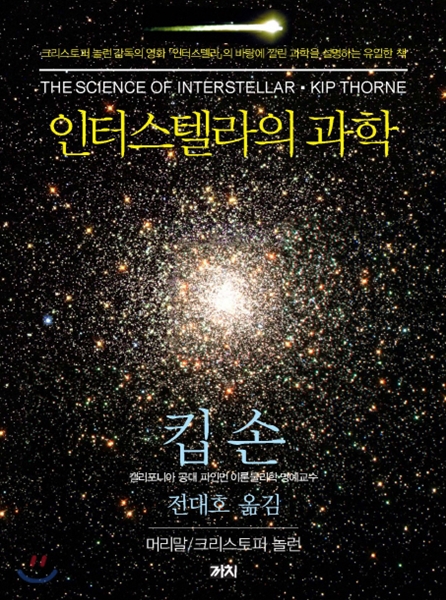
The Science of Interstellar
 |
Description
Book Introduction
Involved from the scenario writing stage and directly participating in production
Kip Thorne, a world-renowned theoretical physicist who provided the theoretical foundation for the film
The only book that explains the science behind the movie "Interstellar"
Professor Kip Thorne, a world-renowned theoretical physicist and close friend of Stephen Hawking, who provided the scientific basis for the movie "Interstellar" and helped write the screenplay, had been planning a space science movie like "Interstellar" since 2005 and had been working on a very specific project, but it did not come to fruition.
However, after many twists and turns, he joined hands with Christopher Nolan and participated in the screenplay work, completing this film.
Christopher Nolan's latest film, Interstellar, takes us on a fantastical journey to the far reaches of our universe and beyond into the fifth dimension (or "the bulk," as physicists call it).
The unique story and visual effects of "Interstellar" are based on real science.
In part, that's thanks to theoretical physicist Kip Thorne, who was involved in the film from the planning stages.
From black holes, to wormholes, warped time, warped space, singularities, quantum gravity, gravitational anomalies, the fifth dimension, Christopher Nolan's "Tesseract" (a four-dimensional cube), and much more, Kip Thorne vividly explains the science of Interstellar and how it translates into the story and visual effects.
In "The Science of Interstellar," you'll learn that real science can be just as weird as science fiction.
Kip Thorne, a world-renowned theoretical physicist who provided the theoretical foundation for the film
The only book that explains the science behind the movie "Interstellar"
Professor Kip Thorne, a world-renowned theoretical physicist and close friend of Stephen Hawking, who provided the scientific basis for the movie "Interstellar" and helped write the screenplay, had been planning a space science movie like "Interstellar" since 2005 and had been working on a very specific project, but it did not come to fruition.
However, after many twists and turns, he joined hands with Christopher Nolan and participated in the screenplay work, completing this film.
Christopher Nolan's latest film, Interstellar, takes us on a fantastical journey to the far reaches of our universe and beyond into the fifth dimension (or "the bulk," as physicists call it).
The unique story and visual effects of "Interstellar" are based on real science.
In part, that's thanks to theoretical physicist Kip Thorne, who was involved in the film from the planning stages.
From black holes, to wormholes, warped time, warped space, singularities, quantum gravity, gravitational anomalies, the fifth dimension, Christopher Nolan's "Tesseract" (a four-dimensional cube), and much more, Kip Thorne vividly explains the science of Interstellar and how it translates into the story and visual effects.
In "The Science of Interstellar," you'll learn that real science can be just as weird as science fiction.
- You can preview some of the book's contents.
Preview
index
Foreword/ Christopher Nolan
introduction
1 Scientists who made it to Hollywood:
The Birth of "Interstellar"
I Basics
2 Our Universe, Briefly
3 Laws that govern the universe
4. Curved time and space, tidal forces
5 black holes
II Gargantua
6 Anatomy of Gargantua
7 Gravity Slingshot Effect
8. Appearance of Gargantua
9 discs and jets
10 The cornerstone of evolution is chance.
III The Disaster that Befell Earth
11 Pests and diseases
12 Oxygen depletion
13 Journey to another star
IV Wormhole
14 wormholes
15. The appearance of the wormhole in "Interstellar"
16 Wormholes Discovered: Gravitational Waves
Exploring the area around V Gargantua
17 Miller's Planet
18 The Vibration of Gargantua
190,000 planets
20 Endurance
VI Physics of Extremes
21 4th and 5th dimensions
22 Beings living in bulk
23 Confining gravity
24 Gravity Anomaly
25 Brand Professor's Equation
26 Singularities and Quantum Gravity
VII Climax
27 Rim of the volcanic crater
28 Into the Gargantua
29 Tesseract
30 Sending a message to the past
31 Humanity's Escape from Earth
More resources to explore
Professional annotation
References
Translator's Glossary
Translator's Note
Biographical Index
subject heading
introduction
1 Scientists who made it to Hollywood:
The Birth of "Interstellar"
I Basics
2 Our Universe, Briefly
3 Laws that govern the universe
4. Curved time and space, tidal forces
5 black holes
II Gargantua
6 Anatomy of Gargantua
7 Gravity Slingshot Effect
8. Appearance of Gargantua
9 discs and jets
10 The cornerstone of evolution is chance.
III The Disaster that Befell Earth
11 Pests and diseases
12 Oxygen depletion
13 Journey to another star
IV Wormhole
14 wormholes
15. The appearance of the wormhole in "Interstellar"
16 Wormholes Discovered: Gravitational Waves
Exploring the area around V Gargantua
17 Miller's Planet
18 The Vibration of Gargantua
190,000 planets
20 Endurance
VI Physics of Extremes
21 4th and 5th dimensions
22 Beings living in bulk
23 Confining gravity
24 Gravity Anomaly
25 Brand Professor's Equation
26 Singularities and Quantum Gravity
VII Climax
27 Rim of the volcanic crater
28 Into the Gargantua
29 Tesseract
30 Sending a message to the past
31 Humanity's Escape from Earth
More resources to explore
Professional annotation
References
Translator's Glossary
Translator's Note
Biographical Index
subject heading
Publisher's Review
Involved from the scenario writing stage and directly participating in production
Kip Thorne, a world-renowned theoretical physicist who provided the theoretical foundation for the film
The only book that explains the science behind the movie "Interstellar"
Professor Kip Thorne, a world-renowned theoretical physicist and close friend of Stephen Hawking, who provided the scientific basis for the movie "Interstellar" and helped write the screenplay, had been planning a space science movie like "Interstellar" since 2005 and had been working on it quite specifically, but it did not come to fruition.
However, after many twists and turns, he joined hands with Christopher Nolan and participated in the screenplay work, completing this film.
Christopher Nolan's latest film, Interstellar, takes us on a fantastical journey to the far reaches of our universe and beyond into the fifth dimension (or "the bulk," as physicists call it).
The unique story and visual effects of "Interstellar" are based on real science.
In part, that's thanks to theoretical physicist Kip Thorne, who was involved in the film from the planning stages.
From black holes, to wormholes, warped time, warped space, singularities, quantum gravity, gravitational anomalies, the fifth dimension, Christopher Nolan's "Tesseract" (a four-dimensional cube), and much more, Kip Thorne vividly explains the science of Interstellar and how it translates into the story and visual effects.
In The Science of Interstellar, you'll learn that real science can be just as weird as science fiction.
Part I, Basics, covers the basics you need to know before embarking on a journey into space.
It covers a brief history of our universe, the laws of physics, and black holes.
Part II: Gargantua deals with Gargantua, the black hole that dominates the galaxy that Cooper and his group, carrying the hopes of humanity, will visit.
We unravel the structure of Gargantua, the gravitational slingshot effect that got them there, and see what Gargantua actually looks like.
Part III: The Disaster that Befell Earth deals with the crisis humanity faces due to the plague that has struck Cooper's Earth, making travel to other stars inevitable.
In Part IV: Wormholes, Cooper and his crew delve into the wormholes that play a key role in traveling to other stars.
It covers the structure and appearance of wormholes, as well as the mysteries within them.
Part V, Exploring the Gargantua Area, details the first planets Cooper and his crew arrived on, Miller and Mann, carrying the hopes of humanity, and the ship that brought them there, the Endurance.
In Part VI, Extreme Physics, the author provides readers with a wealth of images that explain the fundamentals of the film, including the other dimensions that the film "Interstellar" showed audiences, and Professor Brand's equations on gravitational anomalies that defy common sense, as well as things that the film failed to explain.
Part VII's climax deals with the desperate crisis faced by Cooper and his crew after failing to discover a new planet, the explanation of the inside of the black hole Gargantua, where Cooper sacrificed himself and jumped into, the Tesseract that Cooper arrived at, and the quantum data he passed on to his daughter Murph.
It is no exaggeration to say that Kip Thorne gave birth to the movie "Interstellar."
A world-renowned theoretical physicist, he not only provided the theoretical foundation for the film, but also provided data on cosmic phenomena appearing in the film and participated directly in its production, ensuring that the images in the film reflect real science.
The images in this film are not just fiction; they are all based on real science.
This fact is what clearly sets the movie "Interstellar" apart from other science fiction films.
The black holes, wormholes, and anomalies that appear in the movie "Interstellar" were designed based on the scientific knowledge accumulated by mankind to date.
Is time travel possible? Is there a new planet in the film? A devastating tsunami sweeping through Miller's planet? The possibility of Cooper's message to his daughter Murph? Kip Thorne explains the mysteries and curiosities of the universe that the film alone couldn't solve, through rich illustrations that illustrate relevant scenes and theories along the film's storyline.
This will be an excellent read for readers who were intrigued by the film and want to know more about our universe and time travel.
Kip Thorne, a world-renowned theoretical physicist who provided the theoretical foundation for the film
The only book that explains the science behind the movie "Interstellar"
Professor Kip Thorne, a world-renowned theoretical physicist and close friend of Stephen Hawking, who provided the scientific basis for the movie "Interstellar" and helped write the screenplay, had been planning a space science movie like "Interstellar" since 2005 and had been working on it quite specifically, but it did not come to fruition.
However, after many twists and turns, he joined hands with Christopher Nolan and participated in the screenplay work, completing this film.
Christopher Nolan's latest film, Interstellar, takes us on a fantastical journey to the far reaches of our universe and beyond into the fifth dimension (or "the bulk," as physicists call it).
The unique story and visual effects of "Interstellar" are based on real science.
In part, that's thanks to theoretical physicist Kip Thorne, who was involved in the film from the planning stages.
From black holes, to wormholes, warped time, warped space, singularities, quantum gravity, gravitational anomalies, the fifth dimension, Christopher Nolan's "Tesseract" (a four-dimensional cube), and much more, Kip Thorne vividly explains the science of Interstellar and how it translates into the story and visual effects.
In The Science of Interstellar, you'll learn that real science can be just as weird as science fiction.
Part I, Basics, covers the basics you need to know before embarking on a journey into space.
It covers a brief history of our universe, the laws of physics, and black holes.
Part II: Gargantua deals with Gargantua, the black hole that dominates the galaxy that Cooper and his group, carrying the hopes of humanity, will visit.
We unravel the structure of Gargantua, the gravitational slingshot effect that got them there, and see what Gargantua actually looks like.
Part III: The Disaster that Befell Earth deals with the crisis humanity faces due to the plague that has struck Cooper's Earth, making travel to other stars inevitable.
In Part IV: Wormholes, Cooper and his crew delve into the wormholes that play a key role in traveling to other stars.
It covers the structure and appearance of wormholes, as well as the mysteries within them.
Part V, Exploring the Gargantua Area, details the first planets Cooper and his crew arrived on, Miller and Mann, carrying the hopes of humanity, and the ship that brought them there, the Endurance.
In Part VI, Extreme Physics, the author provides readers with a wealth of images that explain the fundamentals of the film, including the other dimensions that the film "Interstellar" showed audiences, and Professor Brand's equations on gravitational anomalies that defy common sense, as well as things that the film failed to explain.
Part VII's climax deals with the desperate crisis faced by Cooper and his crew after failing to discover a new planet, the explanation of the inside of the black hole Gargantua, where Cooper sacrificed himself and jumped into, the Tesseract that Cooper arrived at, and the quantum data he passed on to his daughter Murph.
It is no exaggeration to say that Kip Thorne gave birth to the movie "Interstellar."
A world-renowned theoretical physicist, he not only provided the theoretical foundation for the film, but also provided data on cosmic phenomena appearing in the film and participated directly in its production, ensuring that the images in the film reflect real science.
The images in this film are not just fiction; they are all based on real science.
This fact is what clearly sets the movie "Interstellar" apart from other science fiction films.
The black holes, wormholes, and anomalies that appear in the movie "Interstellar" were designed based on the scientific knowledge accumulated by mankind to date.
Is time travel possible? Is there a new planet in the film? A devastating tsunami sweeping through Miller's planet? The possibility of Cooper's message to his daughter Murph? Kip Thorne explains the mysteries and curiosities of the universe that the film alone couldn't solve, through rich illustrations that illustrate relevant scenes and theories along the film's storyline.
This will be an excellent read for readers who were intrigued by the film and want to know more about our universe and time travel.
GOODS SPECIFICS
- Date of issue: January 5, 2015
- Page count, weight, size: 328 pages | 857g | 190*255*17mm
- ISBN13: 9788972915751
- ISBN10: 8972915750
You may also like
카테고리
korean


korean

![GQ KOREA Mark (Monthly): December [2025]](http://librairie.coreenne.fr/cdn/shop/files/8ef265dbbfbf186523ed75ba7319009d.jpg?v=1765340328&width=3840)


