

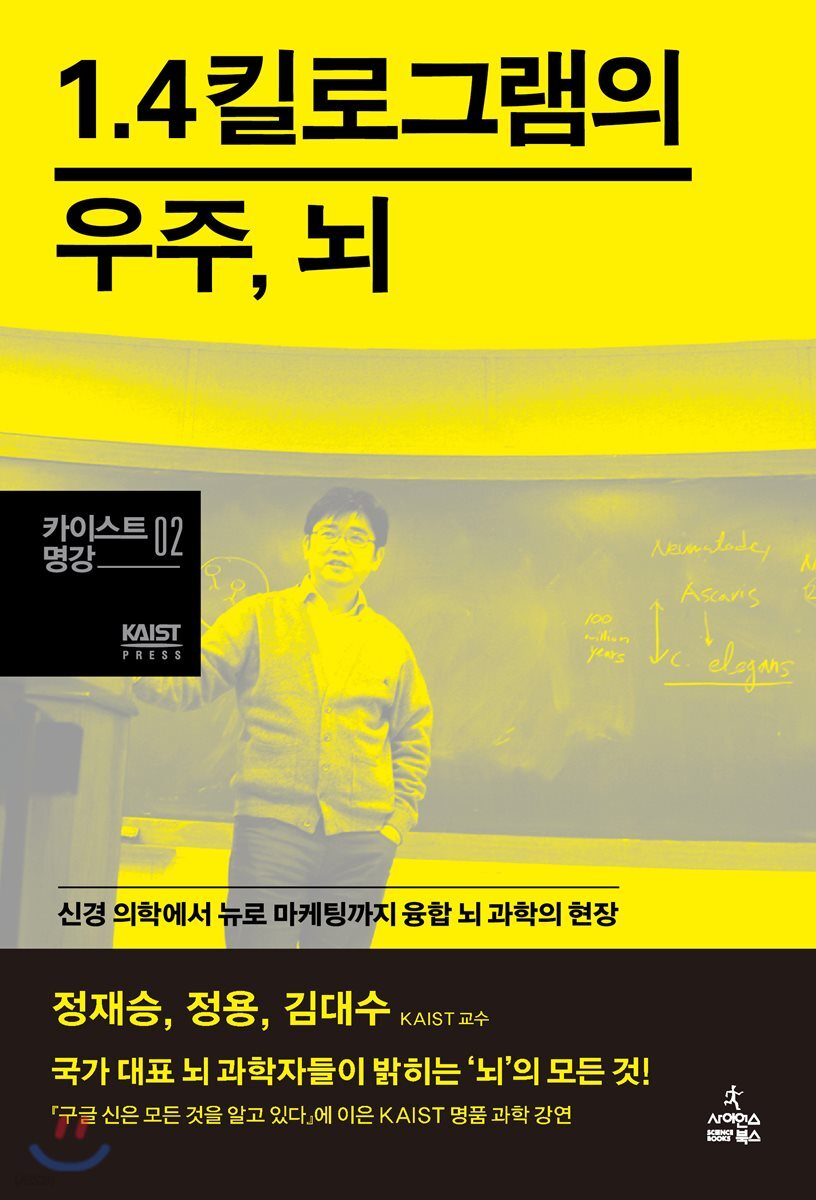
1.4 kilograms of space, brain
 |
Description
Book Introduction
"KAIST Lectures," where you can hear directly from the renowned scholars of the Korea Advanced Institute of Science and Technology (KAIST) about cutting-edge scientific issues that will change the future of humanity, has selected the topic of the "brain," which has recently shown rapid development and become a hot topic not only in the scientific community but also in our society as a whole, as its topic. Professors Jaeseung Jeong (KAIST Department of Bio and Brain Engineering), Yong Jeong (KAIST Department of Bio and Brain Engineering), and Daesu Kim (KAIST Department of Life Sciences) participated in the lectures and published the second book, "The Brain, a 1.4-kilogram Universe."
Following Google God Knows Everything, which looked into the world of information science that will influence the 21st century through the windows of network science, bioinformatics, and quantum information, in the second book of KAIST's famous lectures, 1.4 Kilograms of Universe, Brain, we will take a close look at the field of brain science, the stage where all human thoughts, feelings, and actions take place, together with three professors who are leading the Korean brain science community and actively conducting research at the forefront of convergence science: Jaeseung Jeong, Yong Jeong, and Daesu Kim.
Following Google God Knows Everything, which looked into the world of information science that will influence the 21st century through the windows of network science, bioinformatics, and quantum information, in the second book of KAIST's famous lectures, 1.4 Kilograms of Universe, Brain, we will take a close look at the field of brain science, the stage where all human thoughts, feelings, and actions take place, together with three professors who are leading the Korean brain science community and actively conducting research at the forefront of convergence science: Jaeseung Jeong, Yong Jeong, and Daesu Kim.
- You can preview some of the book's contents.
Preview
index
Seomun Jeong Jae-seung, Professor of Bio and Brain Engineering at KAIST
Brilliant Life Lessons from Brain Scientists
Part 1: Professor Jeong Yong, Department of Bio and Brain Engineering, KAIST
The Brain's Life Cycle: A Neurobiological Look From Cradle to Grave
Lecture 1: The Birth of the Brain
Lecture 2: The Life of the Brain
Lecture 3: Brain Death
Part 2: Professor Jaeseung Jeong of the Department of Bio and Brain Engineering at KAIST
How Do We Choose? The Neuroscience of Decision-Making
Lecture 1: Are Humans Rational Decision Makers?
Lecture 2: Decision Making of Innovative Leaders
Lecture 3: Applications of Decision Neuroscience
Part 3: Professor Kim Dae-soo, Department of Life Sciences, KAIST
What Does the Brain Want? The Equation of Survival and Reproduction Solved Through Animal Behavior
Lecture 1: Life's Eternal Homework: Survival and Reproduction
Lecture 2: The Dilemma of Survival and Reproduction
Lecture 3: The Equation of Behavior Created by the Brain
Jeongdam Jeong Yong, Jeong Jae Seung, Kim Dae Su, Jin Jung Kwon
Is brain science dreaming of a new humanity?
Huzhou
Further Reading
Copyright of photos and illustrations
Brilliant Life Lessons from Brain Scientists
Part 1: Professor Jeong Yong, Department of Bio and Brain Engineering, KAIST
The Brain's Life Cycle: A Neurobiological Look From Cradle to Grave
Lecture 1: The Birth of the Brain
Lecture 2: The Life of the Brain
Lecture 3: Brain Death
Part 2: Professor Jaeseung Jeong of the Department of Bio and Brain Engineering at KAIST
How Do We Choose? The Neuroscience of Decision-Making
Lecture 1: Are Humans Rational Decision Makers?
Lecture 2: Decision Making of Innovative Leaders
Lecture 3: Applications of Decision Neuroscience
Part 3: Professor Kim Dae-soo, Department of Life Sciences, KAIST
What Does the Brain Want? The Equation of Survival and Reproduction Solved Through Animal Behavior
Lecture 1: Life's Eternal Homework: Survival and Reproduction
Lecture 2: The Dilemma of Survival and Reproduction
Lecture 3: The Equation of Behavior Created by the Brain
Jeongdam Jeong Yong, Jeong Jae Seung, Kim Dae Su, Jin Jung Kwon
Is brain science dreaming of a new humanity?
Huzhou
Further Reading
Copyright of photos and illustrations
Publisher's Review
“Let’s say you order a plate of assorted sushi consisting of seven pieces at a restaurant.
You've had sushi before, so you know the flavors of each and have a certain level of preference for each type of sushi.
So, which of the seven sushi pieces before you would you choose first? Why did you choose that one?
? Jaeseung Jeong, Professor of Bio and Brain Engineering at KAIST, in the text
The sushi experiment led by Professor Jaeseung Jeong of the Department of Bio and Brain Engineering at KAIST has recently become a hot topic in domestic and international media and social media.
The results of this study, which demonstrates the human decision-making process using the food called sushi, were published in the international academic journal PLoS ONE and received over 8,500 views in just over a month, and were reported by domestic media following overseas media.
This 'sushi experiment' is a prime example of the current state of brain science, which is sounding an alarm bell to the conventional economics that portrays humans as 'rational decision makers' and renewing our understanding of not only the brain but also ourselves by looking into the process of making choices and judgments in our brains.
Now, brain science goes beyond studying the brain as a mere physical entity, offering major insights into all aspects of human thought and behavior, even down to the smallest actions and choices we make in our daily lives.
Furthermore, thanks to the advancement of cutting-edge imaging technology, it is truly demonstrating its potential as a 21st-century convergence science by meeting at the forefront of disciplines beyond the walls of science, such as genetics and physiology, as well as economics, business administration, psychology, architecture, and design.
"KAIST Lectures," where you can hear directly from the renowned scholars of the Korea Advanced Institute of Science and Technology (KAIST) about cutting-edge scientific issues that will change the future of humanity, has selected the topic of the "brain," which has recently shown rapid development and become a hot topic not only in the scientific community but also in our society as a whole, and published its second book, "The 1.4-kilogram Universe, the Brain," with the participation of Professors Jaeseung Jeong (KAIST Department of Bio and Brain Engineering), Yong Jeong (KAIST Department of Bio and Brain Engineering), and Daesu Kim (KAIST Department of Life Sciences).
"KAIST Lectures" is a series of books jointly planned by Science Books Co., Ltd. and KAIST Press, the publishing division of KAIST, the cradle of science and technology in Korea, in response to the recognition that, as we enter a knowledge-information society with the advancement of information and communication technology and biotechnology, there is a need for general science and technology courses for the general public. The first volume, "Google God Knows Everything," published in 2013, contains lectures by Professors Ha-woong Jeong, Dong-seop Kim, and Hae-woong Lee, all of whom have won the KAIST Excellence in Lecture Award. It immediately became a science bestseller and has been selected as an excellent book by various organizations, including the Korea Energy Management Corporation as a "Government 3.0" educational book.
Following 『Google God Knows Everything』, which looked into the world of information science that will influence the 21st century through the windows of network science, bioinformatics, and quantum information science, in the second book of KAIST's famous lectures, 『1.4 Kilogram Universe, Brain』, we will take a close look at the field of brain science, the stage where all human thoughts, feelings, and actions take place, together with three professors who are leading the Korean brain science community and actively conducting research at the forefront of convergence science: Jaeseung Jeong, Yong Jeong, and Daesu Kim.
Scientists who study the brain are always passionate.
We always return to our desks, even after pondering questions like, "What is a human being?" and "What kind of beings are we?" that linger in our minds throughout our lives, believing that our brains will provide us with clues to the answers.
I sincerely hope that the moment readers open this book, they will return to their college days and become students listening to passionate lectures in a cramped classroom. Thus, our society, exhausted by daily life, and this Korean peninsula, where we race forward 24 hours a day, will become a "KAIST campus" burning with academic passion, a "KAIST classroom" where questions and discussions are heated.
―Professor Jaeseung Jeong, Department of Bio and Brain Engineering, KAIST, from the text
He who controls the brain controls the world!
In April 2013, U.S. President Barack Obama announced the BRAIN (Brain Research through Advancing Innovative Neurotechnologies) initiative.
This massive scientific study, with a budget of $100 million (100 billion won) for the first year alone, aims to map all the pathways of human brain activity and elucidate how they work.
The race to unlock the secrets of the brain includes not only the United States but also other world powers, including China, Germany, and India, as well as IT companies like Google and Amazon.
Now, the world is paying attention to brain science.
The brain, which is responsible for human thoughts, emotions, and functions and is the source of all human creations, has remained the closest thing to humans yet the most difficult to understand due to its complexity.
However, with the recent development of cutting-edge technologies such as brain imaging that allows us to see inside the skull without opening it, and optogenetics that controls brain activity with light, brain science has emerged as a new discipline that integrates with all fields, including genetics, IT, life sciences, medicine, politics, and economics.
New fields born from brain science, such as brain-based education, which utilizes the results of brain research to improve students' grades and concentration; cosmetic neurology, which uses drugs that enhance cognitive function to improve people's movements, mental functions, and emotions as if through plastic surgery; and neuropolitics, which observes the inside of voters' brains and reflects this in election campaigns, are heralding the future of the "Neuro Revolution" that will follow the information revolution.
In 『1.4 Kilogram Universe, Brain』, we had time to learn about the brain, the key to all human-related problems and the last blue ocean left in the scientific world in the era of the neural revolution, from Professor Jaeseung Jeong (KAIST Department of Bio and Brain Engineering), a physicist who 'studies the brain with complex systems science', Professor Yong Jeong (KAIST Department of Bio and Brain Engineering), a neurologist who 'studies and fixes the brain', and Professor Daesu Kim (KAIST Department of Life Sciences), a geneticist who 'unravel the secrets of behavior through the brain'.
This book, written by three professors who are leading the Korean brain science community and actively conducting research at the forefront of convergence science, contains the latest topics in brain science that have heated up the 21st century. It is the one and only 'brain science' book of our time that anyone interested in not only the brain but also human existence must read.
This book, which contains research results shared by experts who have reached the top of their fields, will provide college students and the general public with an interest in scientific and technological knowledge with the scientific literacy necessary for this era, and those preparing to leap forward as technocrats (people who exert significant influence on decision-making in society or organizations by possessing scientific knowledge or specialized skills) with information that will be useful in the future field.
A Journey Inside the Brain: A "Small but Big Universe"
The brain is a small organ, about the size of two fists, accounting for only 2 percent of an adult's body weight, but it is also the 'most complex system in the universe', with 10 billion nerve cells forming 100 trillion synapses.
The brain is also a Pandora's box that contains all the information about human history, behavior, language, and memory, created through a long evolutionary process.
『The 1.4-Kilogram Universe, the Brain』 first teaches us about the structure and function of the brain, the most basic of brain science, from Professor Jeong Yong. Then, we learn from Professor Jeong Jae-seung how the brain, which is created in this way, makes various choices and decisions that govern human daily life. Finally, we learn from Professor Kim Dae-soo how the brain solves the equation of survival and reproduction, which is the most important for living things. By doing so, we cover everything about our brain and everything about the latest brain science.
The three professors, each in their own fields of expertise, pose three major questions: "What kind of being is the brain, and what kind of life does it experience?", "How does the brain determine what it wants?", and "What strategies does the brain employ to get what it wants, and how does it act on them?", and they embark on a journey to find the answers together with the reader.
Part 1: From Cradle to Grave
Brain scientists are now trying to answer questions about the origins of the mind, which were once the domain of philosophy and religion.
In this lecture, I will explore the life cycle of the brain from two perspectives.
How the brain has emerged and developed in living organisms over the long period of evolution, and how the brain develops in each of us, as individuals.
―Professor Jeong Yong, Department of Bio and Brain Engineering, KAIST, from the text
"The 1.4-Kilogram Universe: The Brain" begins its journey of inquiry with the fundamental question, "Why does the brain exist?"
There is a widespread belief that we have a mind because we have a brain, and that the brain is what determines our personal identity.
It is said that the saying 'know thyself' can be replaced with 'know thy brain'.
But when asked exactly what the brain's role in living organisms is, we often find ourselves at a loss as to how to answer.
What exactly is the brain created for?
The protagonist who will answer this question is the first speaker, Professor Jeong Yong of the Department of Bio and Brain Engineering at KAIST.
He is a neurologist who graduated from Yonsei University College of Medicine and boasts a unique background as a scientist who studied cognitive processes at the University of Florida. He is currently conducting cutting-edge neuromedical research by installing windows in the skulls of genetically modified mice and measuring the networks of the living brain using a multiphoton microscope.
Professor Jeong Yong traces the life cycle of the brain from the perspective of a physician and researcher, and explores the reason for the brain's existence.
You can learn how the brain, which was created for the movement of living things, acquired the functions of thought and memory, and how humans attempt to scientifically address the secrets contained in the death of the brain after its function has been fulfilled, through his excellent explanation that interweaves the evolution of living things with the history of individual humans.
Professor Jeong Yong emphasizes, through his computer-graphic reconstruction of the brain and the latest theories explaining how it works, that in order to resolve the questions about the brain, of which there are still many unknowns, it is most important to first view the brain as an object that can be objectified.
He lifts the veil of the 'mysterious unknown' that the media has placed on us, and confronts us with the brain as a physical entity that can be touched and cut.
Part 2: How Do We Choose?
I've written many books about science, but I don't think I've ever fully shown who I am as a neuroscientist studying the brain as I do in this book.
I hope that my lecture will provide you with some insight into how the human brain perceives, judges, chooses, and acts on the world.
"―Professor Jaeseung Jeong, Department of Bio and Brain Engineering, KAIST, in the text
The second lecture was given by Professor Jaeseung Jeong of the Department of Bio and Brain Engineering at KAIST, author of the perennial bestseller in the science textbook market, “Jaeseung Jeong’s Science Concert.”
Many people remember him as the person who led the new wave of popularizing science with his interdisciplinary knowledge and thinking, appearing on the television program "Exclamation Point." However, Professor Jeong Jae-seung is actually one of the most notable scientists of our time, having studied complex physics at KAIST and then researched neuroscience and psychiatry at Yale University School of Medicine and Columbia University School of Medicine.
In "The 1.4-Kilogram Universe, the Brain," he briefly sheds his image as a convergent intellectual who has traveled the media, bridging science and art, science and entertainment, and science and industry, and delivers a lecture that is most faithful to the original stance of a scientist who studies human choices through brain science.
He demonstrates the complexity of our everyday actions and choices through brain science research conducted with numerous scholars across various fields, from the commonplace observation of what rats choose to eat each meal to the recently popular sushi experiment, unusual experiments such as playing rock-paper-scissors with schizophrenic patients, and teaching monkeys to drink.
The moment we focus on this amazing ability of the human brain, embedded in even the smallest of choices, the brain becomes the starting point for a new era in management, economics, and marketing.
Neuroeconomics, which breaks away from the "rational human" criterion that has long dominated economics based on the achievements of brain science, and neuromarketing, which incorporates brain activities such as consumers' unconscious reactions into marketing, are examples of this.
By unflinchingly demonstrating the achievements and limitations of these interdisciplinary disciplines, Professor Jeong Jae-seung urges us to live our lives with a constant, reflective attitude and never lose hope in science.
Part 3: What Does the Brain Want?
I want to look into the brain through the behaviors of 'love' and 'competition', which are important issues for all sexually reproducing creatures on Earth.
By examining how each animal solves the equation for survival in the battlefield of love, which is as harsh and challenging as the ever-changing natural environment, and as a result, exhibits diverse strategies and behaviors, we will approach the small but special universe of the brain in a different way than before.
―Kim Dae-soo, Professor of Life Sciences at KAIST, from the text
The final speaker, Professor Dae-Soo Kim of the Department of Life Sciences at KAIST, will guide us through the latest scientific research on interpreting brain strategies from the diverse behaviors of living organisms.
Professor Dae-Soo Kim is an authority in behavioral genetics who has contributed papers to world-renowned academic journals such as Science and Neuron, starting with the groundbreaking paper on rat epilepsy that was first published in Nature by a Korean graduate student.
Recently, the process of memory impairment occurring in the brains of mice with Alzheimer's disease was elucidated at the neural cell level, and a paper was published in Nature Medicine in June 2014.
From microorganisms that survive for hundreds of years in a desiccated mummy state to mayflies that wait a year before mating and dying in just 17 hours, all life on Earth exists to achieve two great goals: survival and reproduction.
In the behavior of two seemingly opposite creatures, such as the praying mantis, which willingly offers its body as food to the female for good eggs, and the stinger bug, which eats its eggs, Professor Kim Dae-soo reads the complex equation that the brain unfolds to achieve two conflicting goals.
It also tells the story of how the brain, faced with a dilemma, comes up with solutions, using numerous examples from the natural world, such as how altruistic behavior can emerge in creatures that would otherwise act selfishly for their own survival and reproduction.
Among the countless strategies, sometimes absurd and sometimes bizarre, what Professor Kim Dae-soo notes is, paradoxically, the fact that we do not need to be absolutely dependent on survival and reproduction.
We can learn from his lecture that the brain, as an organ, binds humans as living beings to survival and reproduction, but it also makes it possible for us to reject a simple life lived solely for survival and reproduction.
Full Story: Is Brain Science Dreaming of a New Human?
From a philosophical standpoint, brain scientists can sometimes seem a bit dangerous.
Professor Kim Dae-soo, don't you observe behavior by inserting electrodes? That's fine.
But when I look at Professor Jeong Jae-seung, I see that he tries to read other people's thoughts through that.
That would seem to raise some very fundamental privacy concerns.
“Let’s scan your brain.” “Have you got a warrant?” Will this day ever come?
―Jin Jung-kwon, Professor of Liberal Arts, Dongyang University, from the text
Since we are all born into this world, we will all eventually die, so there is no reason to get married or have children, or to work hard at anything, whether it be school or work.
The brain is the organ that gives meaning to this life, where we fight and argue with others every day, and feel sad and frustrated, and makes us live each day diligently.
―Kim Dae-soo, Professor of Life Sciences at KAIST, from the text
I think we're moving away from an era where we considered it a great human ability to cram a lot of things into the brain, to an era where we value empathy, or the ability to take an emotional approach that sees the forest for the trees, much more than we used to, and we consider that to be a person's ability.
―Professor Jaeseung Jeong, Department of Bio and Brain Engineering, KAIST, from the text
If there were a drug that would make you smarter, it would obviously be expensive, but if you think about who would buy it, the problem of the gap between rich and poor becoming entrenched as a gap in ability will clearly arise.
―Professor Jeong Yong, Department of Bio and Brain Engineering, KAIST, from the text
Another must-see attraction of "The Brain, a 1.4-Kilogram Universe" is the plenary discussion led by Professor Jin Jung-kwon of Dongyang University, where three speakers gathered to discuss the future and possibilities of brain science.
Professors Jeong Jae-seung, Jeong Yong, and Kim Dae-su not only shared stories they hadn't fully covered in their respective lectures, but also engaged in a heated debate on questions posed by moderator Professor Jin Jung-kwon from a humanistic and philosophical perspective.
In this conversation that transcended academic boundaries, they examined controversial issues surrounding brain science, such as the brain as a physical entity that defines human existence, the future society that cutting-edge brain science technology will bring, and the future of humanity. By doing so, they went beyond simply envisioning a utopia that brain science would bring, and directly confronted the achievements and prospects of brain science.
The Only Guide You Need for a Journey Through the 1.4-Kilogram Universe
In 1990, American President George H.
Since President W. Bush declared the "Decade of the Brain," drawing the attention of the world's major powers to the brain as a future growth engine, brain science has emerged as a hot topic in the scientific community, producing tremendous results in just 20 years that surpass the achievements of the previous 200 years.
Reflecting the familiarity of brain science, which has become increasingly familiar to us, from analyzing male-female relationships to elucidating mental illness, brain science books have also been ranking highly in the popular science literature category for several years.
However, most popular books published in the field of brain science have focused on explaining the structure and function of the brain or highlighting only interesting aspects of human psychology or behavior that the brain evokes.
This book, which includes lectures from Professor Yong Jeong, who traces the life of the brain from an evolutionary historical perspective, Professor Dae-soo Kim, who solves the complex equation of behavior directly related to survival and reproduction through the brain, and Professor Jae-seung Jeong, who provides a new understanding of humans through brain science that combines economics and business administration, provides a fresh experience of viewing the brain from an integrated perspective to readers who were not satisfied with existing brain science books.
If you want to understand our brains in the coming era of the neural revolution and learn about the cutting-edge of brain science, this book will be the ultimate guide.
Introducing the "KAIST Lecture Series"
The "KAIST Lectures" series is a book version of the "KAIST Lectures," a public lecture series jointly planned by KAIST PRESS and Science Books.
Following the first volume of the series, 『Google God Knows Everything』, and the second volume, 『The 1.4-Kilogram Universe, the Brain』, 『Evolve with Design』 (published) is scheduled to be published, which explores the power and potential of design to transform the world from the faculty of the KAIST Department of Industrial Design, which has been named one of the world's top 30 design schools three times in a row.
The "KAIST Lectures" series will continue to provide readers with a rich feast of knowledge.
You've had sushi before, so you know the flavors of each and have a certain level of preference for each type of sushi.
So, which of the seven sushi pieces before you would you choose first? Why did you choose that one?
? Jaeseung Jeong, Professor of Bio and Brain Engineering at KAIST, in the text
The sushi experiment led by Professor Jaeseung Jeong of the Department of Bio and Brain Engineering at KAIST has recently become a hot topic in domestic and international media and social media.
The results of this study, which demonstrates the human decision-making process using the food called sushi, were published in the international academic journal PLoS ONE and received over 8,500 views in just over a month, and were reported by domestic media following overseas media.
This 'sushi experiment' is a prime example of the current state of brain science, which is sounding an alarm bell to the conventional economics that portrays humans as 'rational decision makers' and renewing our understanding of not only the brain but also ourselves by looking into the process of making choices and judgments in our brains.
Now, brain science goes beyond studying the brain as a mere physical entity, offering major insights into all aspects of human thought and behavior, even down to the smallest actions and choices we make in our daily lives.
Furthermore, thanks to the advancement of cutting-edge imaging technology, it is truly demonstrating its potential as a 21st-century convergence science by meeting at the forefront of disciplines beyond the walls of science, such as genetics and physiology, as well as economics, business administration, psychology, architecture, and design.
"KAIST Lectures," where you can hear directly from the renowned scholars of the Korea Advanced Institute of Science and Technology (KAIST) about cutting-edge scientific issues that will change the future of humanity, has selected the topic of the "brain," which has recently shown rapid development and become a hot topic not only in the scientific community but also in our society as a whole, and published its second book, "The 1.4-kilogram Universe, the Brain," with the participation of Professors Jaeseung Jeong (KAIST Department of Bio and Brain Engineering), Yong Jeong (KAIST Department of Bio and Brain Engineering), and Daesu Kim (KAIST Department of Life Sciences).
"KAIST Lectures" is a series of books jointly planned by Science Books Co., Ltd. and KAIST Press, the publishing division of KAIST, the cradle of science and technology in Korea, in response to the recognition that, as we enter a knowledge-information society with the advancement of information and communication technology and biotechnology, there is a need for general science and technology courses for the general public. The first volume, "Google God Knows Everything," published in 2013, contains lectures by Professors Ha-woong Jeong, Dong-seop Kim, and Hae-woong Lee, all of whom have won the KAIST Excellence in Lecture Award. It immediately became a science bestseller and has been selected as an excellent book by various organizations, including the Korea Energy Management Corporation as a "Government 3.0" educational book.
Following 『Google God Knows Everything』, which looked into the world of information science that will influence the 21st century through the windows of network science, bioinformatics, and quantum information science, in the second book of KAIST's famous lectures, 『1.4 Kilogram Universe, Brain』, we will take a close look at the field of brain science, the stage where all human thoughts, feelings, and actions take place, together with three professors who are leading the Korean brain science community and actively conducting research at the forefront of convergence science: Jaeseung Jeong, Yong Jeong, and Daesu Kim.
Scientists who study the brain are always passionate.
We always return to our desks, even after pondering questions like, "What is a human being?" and "What kind of beings are we?" that linger in our minds throughout our lives, believing that our brains will provide us with clues to the answers.
I sincerely hope that the moment readers open this book, they will return to their college days and become students listening to passionate lectures in a cramped classroom. Thus, our society, exhausted by daily life, and this Korean peninsula, where we race forward 24 hours a day, will become a "KAIST campus" burning with academic passion, a "KAIST classroom" where questions and discussions are heated.
―Professor Jaeseung Jeong, Department of Bio and Brain Engineering, KAIST, from the text
He who controls the brain controls the world!
In April 2013, U.S. President Barack Obama announced the BRAIN (Brain Research through Advancing Innovative Neurotechnologies) initiative.
This massive scientific study, with a budget of $100 million (100 billion won) for the first year alone, aims to map all the pathways of human brain activity and elucidate how they work.
The race to unlock the secrets of the brain includes not only the United States but also other world powers, including China, Germany, and India, as well as IT companies like Google and Amazon.
Now, the world is paying attention to brain science.
The brain, which is responsible for human thoughts, emotions, and functions and is the source of all human creations, has remained the closest thing to humans yet the most difficult to understand due to its complexity.
However, with the recent development of cutting-edge technologies such as brain imaging that allows us to see inside the skull without opening it, and optogenetics that controls brain activity with light, brain science has emerged as a new discipline that integrates with all fields, including genetics, IT, life sciences, medicine, politics, and economics.
New fields born from brain science, such as brain-based education, which utilizes the results of brain research to improve students' grades and concentration; cosmetic neurology, which uses drugs that enhance cognitive function to improve people's movements, mental functions, and emotions as if through plastic surgery; and neuropolitics, which observes the inside of voters' brains and reflects this in election campaigns, are heralding the future of the "Neuro Revolution" that will follow the information revolution.
In 『1.4 Kilogram Universe, Brain』, we had time to learn about the brain, the key to all human-related problems and the last blue ocean left in the scientific world in the era of the neural revolution, from Professor Jaeseung Jeong (KAIST Department of Bio and Brain Engineering), a physicist who 'studies the brain with complex systems science', Professor Yong Jeong (KAIST Department of Bio and Brain Engineering), a neurologist who 'studies and fixes the brain', and Professor Daesu Kim (KAIST Department of Life Sciences), a geneticist who 'unravel the secrets of behavior through the brain'.
This book, written by three professors who are leading the Korean brain science community and actively conducting research at the forefront of convergence science, contains the latest topics in brain science that have heated up the 21st century. It is the one and only 'brain science' book of our time that anyone interested in not only the brain but also human existence must read.
This book, which contains research results shared by experts who have reached the top of their fields, will provide college students and the general public with an interest in scientific and technological knowledge with the scientific literacy necessary for this era, and those preparing to leap forward as technocrats (people who exert significant influence on decision-making in society or organizations by possessing scientific knowledge or specialized skills) with information that will be useful in the future field.
A Journey Inside the Brain: A "Small but Big Universe"
The brain is a small organ, about the size of two fists, accounting for only 2 percent of an adult's body weight, but it is also the 'most complex system in the universe', with 10 billion nerve cells forming 100 trillion synapses.
The brain is also a Pandora's box that contains all the information about human history, behavior, language, and memory, created through a long evolutionary process.
『The 1.4-Kilogram Universe, the Brain』 first teaches us about the structure and function of the brain, the most basic of brain science, from Professor Jeong Yong. Then, we learn from Professor Jeong Jae-seung how the brain, which is created in this way, makes various choices and decisions that govern human daily life. Finally, we learn from Professor Kim Dae-soo how the brain solves the equation of survival and reproduction, which is the most important for living things. By doing so, we cover everything about our brain and everything about the latest brain science.
The three professors, each in their own fields of expertise, pose three major questions: "What kind of being is the brain, and what kind of life does it experience?", "How does the brain determine what it wants?", and "What strategies does the brain employ to get what it wants, and how does it act on them?", and they embark on a journey to find the answers together with the reader.
Part 1: From Cradle to Grave
Brain scientists are now trying to answer questions about the origins of the mind, which were once the domain of philosophy and religion.
In this lecture, I will explore the life cycle of the brain from two perspectives.
How the brain has emerged and developed in living organisms over the long period of evolution, and how the brain develops in each of us, as individuals.
―Professor Jeong Yong, Department of Bio and Brain Engineering, KAIST, from the text
"The 1.4-Kilogram Universe: The Brain" begins its journey of inquiry with the fundamental question, "Why does the brain exist?"
There is a widespread belief that we have a mind because we have a brain, and that the brain is what determines our personal identity.
It is said that the saying 'know thyself' can be replaced with 'know thy brain'.
But when asked exactly what the brain's role in living organisms is, we often find ourselves at a loss as to how to answer.
What exactly is the brain created for?
The protagonist who will answer this question is the first speaker, Professor Jeong Yong of the Department of Bio and Brain Engineering at KAIST.
He is a neurologist who graduated from Yonsei University College of Medicine and boasts a unique background as a scientist who studied cognitive processes at the University of Florida. He is currently conducting cutting-edge neuromedical research by installing windows in the skulls of genetically modified mice and measuring the networks of the living brain using a multiphoton microscope.
Professor Jeong Yong traces the life cycle of the brain from the perspective of a physician and researcher, and explores the reason for the brain's existence.
You can learn how the brain, which was created for the movement of living things, acquired the functions of thought and memory, and how humans attempt to scientifically address the secrets contained in the death of the brain after its function has been fulfilled, through his excellent explanation that interweaves the evolution of living things with the history of individual humans.
Professor Jeong Yong emphasizes, through his computer-graphic reconstruction of the brain and the latest theories explaining how it works, that in order to resolve the questions about the brain, of which there are still many unknowns, it is most important to first view the brain as an object that can be objectified.
He lifts the veil of the 'mysterious unknown' that the media has placed on us, and confronts us with the brain as a physical entity that can be touched and cut.
Part 2: How Do We Choose?
I've written many books about science, but I don't think I've ever fully shown who I am as a neuroscientist studying the brain as I do in this book.
I hope that my lecture will provide you with some insight into how the human brain perceives, judges, chooses, and acts on the world.
"―Professor Jaeseung Jeong, Department of Bio and Brain Engineering, KAIST, in the text
The second lecture was given by Professor Jaeseung Jeong of the Department of Bio and Brain Engineering at KAIST, author of the perennial bestseller in the science textbook market, “Jaeseung Jeong’s Science Concert.”
Many people remember him as the person who led the new wave of popularizing science with his interdisciplinary knowledge and thinking, appearing on the television program "Exclamation Point." However, Professor Jeong Jae-seung is actually one of the most notable scientists of our time, having studied complex physics at KAIST and then researched neuroscience and psychiatry at Yale University School of Medicine and Columbia University School of Medicine.
In "The 1.4-Kilogram Universe, the Brain," he briefly sheds his image as a convergent intellectual who has traveled the media, bridging science and art, science and entertainment, and science and industry, and delivers a lecture that is most faithful to the original stance of a scientist who studies human choices through brain science.
He demonstrates the complexity of our everyday actions and choices through brain science research conducted with numerous scholars across various fields, from the commonplace observation of what rats choose to eat each meal to the recently popular sushi experiment, unusual experiments such as playing rock-paper-scissors with schizophrenic patients, and teaching monkeys to drink.
The moment we focus on this amazing ability of the human brain, embedded in even the smallest of choices, the brain becomes the starting point for a new era in management, economics, and marketing.
Neuroeconomics, which breaks away from the "rational human" criterion that has long dominated economics based on the achievements of brain science, and neuromarketing, which incorporates brain activities such as consumers' unconscious reactions into marketing, are examples of this.
By unflinchingly demonstrating the achievements and limitations of these interdisciplinary disciplines, Professor Jeong Jae-seung urges us to live our lives with a constant, reflective attitude and never lose hope in science.
Part 3: What Does the Brain Want?
I want to look into the brain through the behaviors of 'love' and 'competition', which are important issues for all sexually reproducing creatures on Earth.
By examining how each animal solves the equation for survival in the battlefield of love, which is as harsh and challenging as the ever-changing natural environment, and as a result, exhibits diverse strategies and behaviors, we will approach the small but special universe of the brain in a different way than before.
―Kim Dae-soo, Professor of Life Sciences at KAIST, from the text
The final speaker, Professor Dae-Soo Kim of the Department of Life Sciences at KAIST, will guide us through the latest scientific research on interpreting brain strategies from the diverse behaviors of living organisms.
Professor Dae-Soo Kim is an authority in behavioral genetics who has contributed papers to world-renowned academic journals such as Science and Neuron, starting with the groundbreaking paper on rat epilepsy that was first published in Nature by a Korean graduate student.
Recently, the process of memory impairment occurring in the brains of mice with Alzheimer's disease was elucidated at the neural cell level, and a paper was published in Nature Medicine in June 2014.
From microorganisms that survive for hundreds of years in a desiccated mummy state to mayflies that wait a year before mating and dying in just 17 hours, all life on Earth exists to achieve two great goals: survival and reproduction.
In the behavior of two seemingly opposite creatures, such as the praying mantis, which willingly offers its body as food to the female for good eggs, and the stinger bug, which eats its eggs, Professor Kim Dae-soo reads the complex equation that the brain unfolds to achieve two conflicting goals.
It also tells the story of how the brain, faced with a dilemma, comes up with solutions, using numerous examples from the natural world, such as how altruistic behavior can emerge in creatures that would otherwise act selfishly for their own survival and reproduction.
Among the countless strategies, sometimes absurd and sometimes bizarre, what Professor Kim Dae-soo notes is, paradoxically, the fact that we do not need to be absolutely dependent on survival and reproduction.
We can learn from his lecture that the brain, as an organ, binds humans as living beings to survival and reproduction, but it also makes it possible for us to reject a simple life lived solely for survival and reproduction.
Full Story: Is Brain Science Dreaming of a New Human?
From a philosophical standpoint, brain scientists can sometimes seem a bit dangerous.
Professor Kim Dae-soo, don't you observe behavior by inserting electrodes? That's fine.
But when I look at Professor Jeong Jae-seung, I see that he tries to read other people's thoughts through that.
That would seem to raise some very fundamental privacy concerns.
“Let’s scan your brain.” “Have you got a warrant?” Will this day ever come?
―Jin Jung-kwon, Professor of Liberal Arts, Dongyang University, from the text
Since we are all born into this world, we will all eventually die, so there is no reason to get married or have children, or to work hard at anything, whether it be school or work.
The brain is the organ that gives meaning to this life, where we fight and argue with others every day, and feel sad and frustrated, and makes us live each day diligently.
―Kim Dae-soo, Professor of Life Sciences at KAIST, from the text
I think we're moving away from an era where we considered it a great human ability to cram a lot of things into the brain, to an era where we value empathy, or the ability to take an emotional approach that sees the forest for the trees, much more than we used to, and we consider that to be a person's ability.
―Professor Jaeseung Jeong, Department of Bio and Brain Engineering, KAIST, from the text
If there were a drug that would make you smarter, it would obviously be expensive, but if you think about who would buy it, the problem of the gap between rich and poor becoming entrenched as a gap in ability will clearly arise.
―Professor Jeong Yong, Department of Bio and Brain Engineering, KAIST, from the text
Another must-see attraction of "The Brain, a 1.4-Kilogram Universe" is the plenary discussion led by Professor Jin Jung-kwon of Dongyang University, where three speakers gathered to discuss the future and possibilities of brain science.
Professors Jeong Jae-seung, Jeong Yong, and Kim Dae-su not only shared stories they hadn't fully covered in their respective lectures, but also engaged in a heated debate on questions posed by moderator Professor Jin Jung-kwon from a humanistic and philosophical perspective.
In this conversation that transcended academic boundaries, they examined controversial issues surrounding brain science, such as the brain as a physical entity that defines human existence, the future society that cutting-edge brain science technology will bring, and the future of humanity. By doing so, they went beyond simply envisioning a utopia that brain science would bring, and directly confronted the achievements and prospects of brain science.
The Only Guide You Need for a Journey Through the 1.4-Kilogram Universe
In 1990, American President George H.
Since President W. Bush declared the "Decade of the Brain," drawing the attention of the world's major powers to the brain as a future growth engine, brain science has emerged as a hot topic in the scientific community, producing tremendous results in just 20 years that surpass the achievements of the previous 200 years.
Reflecting the familiarity of brain science, which has become increasingly familiar to us, from analyzing male-female relationships to elucidating mental illness, brain science books have also been ranking highly in the popular science literature category for several years.
However, most popular books published in the field of brain science have focused on explaining the structure and function of the brain or highlighting only interesting aspects of human psychology or behavior that the brain evokes.
This book, which includes lectures from Professor Yong Jeong, who traces the life of the brain from an evolutionary historical perspective, Professor Dae-soo Kim, who solves the complex equation of behavior directly related to survival and reproduction through the brain, and Professor Jae-seung Jeong, who provides a new understanding of humans through brain science that combines economics and business administration, provides a fresh experience of viewing the brain from an integrated perspective to readers who were not satisfied with existing brain science books.
If you want to understand our brains in the coming era of the neural revolution and learn about the cutting-edge of brain science, this book will be the ultimate guide.
Introducing the "KAIST Lecture Series"
The "KAIST Lectures" series is a book version of the "KAIST Lectures," a public lecture series jointly planned by KAIST PRESS and Science Books.
Following the first volume of the series, 『Google God Knows Everything』, and the second volume, 『The 1.4-Kilogram Universe, the Brain』, 『Evolve with Design』 (published) is scheduled to be published, which explores the power and potential of design to transform the world from the faculty of the KAIST Department of Industrial Design, which has been named one of the world's top 30 design schools three times in a row.
The "KAIST Lectures" series will continue to provide readers with a rich feast of knowledge.
GOODS SPECIFICS
- Date of publication: July 18, 2014
- Format: Hardcover book binding method guide
- Page count, weight, size: 350 pages | 701g | 148*220*26mm
- ISBN13: 9788983718839
- ISBN10: 8983718838
You may also like
카테고리
korean


korean

![GQ KOREA Mark (Monthly): December [2025]](http://librairie.coreenne.fr/cdn/shop/files/8ef265dbbfbf186523ed75ba7319009d.jpg?v=1765340328&width=3840)


