

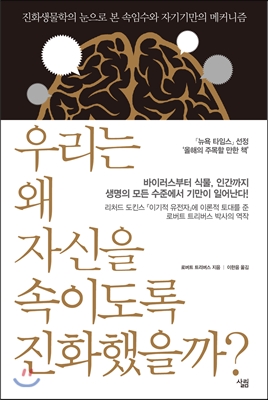
Why did we evolve to deceive ourselves?
 |
Description
Book Introduction
Robert Trivers, considered "the greatest living evolutionary biologist," is a highly original scholar.
"Why We Evolved to Deceive Ourselves" is his latest work and the first book to be introduced in Korea, and it directly addresses the topics of deception and self-deception.
This book, which addresses a topic Richard Dawkins describes as “the most provocative and interesting he has ever put forth,” is filled with Robert Trivers’s characteristic honesty and brilliant ideas.
Our sense organs have evolved to show us the outside world in amazing detail and accuracy.
The problem is that when that detailed information is transmitted to the brain, our consciousness often distorts and biases that information.
It is self-deception that deceives oneself.
They create false memories and rationalize their immoral behavior.
They also overestimate themselves.
Why? He says he discovered the beginnings of the answer while studying parent-child conflict in 1976.
Parents use deception and self-deception to shape their children's identities, not for the sake of their children, but for their own sake.
This can be inferred from the parental control over their children, expressed in the phrase, “I’m doing this for your good.”
Dr. Trivers expanded on this idea to study self-deception, and presents the results in his book, Why Did We Evolve to Delude Ourselves?
The content of this book alone makes us aware of the dangers of self-deception that are prevalent in politics, economics, culture, and elsewhere, and provides us with the insight to reflect on ourselves.
Dr. Robert Trivers's own instances of deception and self-deception, which are revealed throughout the book, and humorous episodes related to the author's womanizing, are a bonus when reading this book.
"Why We Evolved to Deceive Ourselves" is his latest work and the first book to be introduced in Korea, and it directly addresses the topics of deception and self-deception.
This book, which addresses a topic Richard Dawkins describes as “the most provocative and interesting he has ever put forth,” is filled with Robert Trivers’s characteristic honesty and brilliant ideas.
Our sense organs have evolved to show us the outside world in amazing detail and accuracy.
The problem is that when that detailed information is transmitted to the brain, our consciousness often distorts and biases that information.
It is self-deception that deceives oneself.
They create false memories and rationalize their immoral behavior.
They also overestimate themselves.
Why? He says he discovered the beginnings of the answer while studying parent-child conflict in 1976.
Parents use deception and self-deception to shape their children's identities, not for the sake of their children, but for their own sake.
This can be inferred from the parental control over their children, expressed in the phrase, “I’m doing this for your good.”
Dr. Trivers expanded on this idea to study self-deception, and presents the results in his book, Why Did We Evolve to Delude Ourselves?
The content of this book alone makes us aware of the dangers of self-deception that are prevalent in politics, economics, culture, and elsewhere, and provides us with the insight to reflect on ourselves.
Dr. Robert Trivers's own instances of deception and self-deception, which are revealed throughout the book, and humorous episodes related to the author's womanizing, are a bonus when reading this book.
- You can preview some of the book's contents.
Preview
index
Translator's Note
Introduction
Chapter 1: The Evolutionary Logic of Self-Deception
Chapter 2: Deception in Nature
Chapter 3 Neurophysiology and Enforced Self-Deception
Chapter 4: Self-Deception and the Divided Self in the Family
Chapter 5: Deception, Self-Deception, and Sex
Chapter 6: The Immunology of Self-Deception
Chapter 7: The Psychology of Self-Deception
Chapter 8 Self-Deception in Everyday Life
Chapter 9 Aerospace Disasters and Self-Deception
Chapter 10: False Historical Narratives
Chapter 11: Self-Deception and War
Chapter 12 Religion and Self-Deception
Chapter 13: Self-Deception and the Structure of Social Science
Chapter 14: Fighting Self-Deception in Our Own Lives
Acknowledgements
main
References
Introduction
Chapter 1: The Evolutionary Logic of Self-Deception
Chapter 2: Deception in Nature
Chapter 3 Neurophysiology and Enforced Self-Deception
Chapter 4: Self-Deception and the Divided Self in the Family
Chapter 5: Deception, Self-Deception, and Sex
Chapter 6: The Immunology of Self-Deception
Chapter 7: The Psychology of Self-Deception
Chapter 8 Self-Deception in Everyday Life
Chapter 9 Aerospace Disasters and Self-Deception
Chapter 10: False Historical Narratives
Chapter 11: Self-Deception and War
Chapter 12 Religion and Self-Deception
Chapter 13: Self-Deception and the Structure of Social Science
Chapter 14: Fighting Self-Deception in Our Own Lives
Acknowledgements
main
References
Into the book
The Evolution of Self-Deception
This book takes an evolutionary approach to this topic.
If we measure self-deception as a positive effect on survival and reproduction, what biological advantage does self-deception provide? How does self-deception help us survive and reproduce? Or more precisely, how does self-deception help our genes survive and reproduce? In other words, why does natural selection favor the mechanism of self-deception? (p. 22)
False memories of child abuse
But dozens of communities have already suffered the agonizing trauma of learning that their children were sexually abused, attacked by robots and lobsters, and forced to eat frogs alive.
Some have been imprisoned for fictitious abuse, and some innocent parents have had to endure the humiliation of public condemnation from those who believe they have perpetrated pedophilia on their own children.
Unfortunately, there were countless clinical psychologists who willingly participated in the fool's game by appearing in court and testifying as experts that the women and children were telling the truth.
(Pages 118-119)
Deception and Self-Deception in Courtship
When I was young in the early 1960s, I discovered something called 'false emotions'.
When I met a woman, I was strongly attracted to her and showed her everything I had.
I felt in love and had sex a couple of times.
And then the feelings I had for him completely disappeared.
No, in fact, I turned around with the intention of avoiding it.
The false feeling of romantic love appeared to facilitate sex, and it was clear that it disappeared after sex.
Of course, I only realized that after the fact.
Of course, women were more heartbroken.
(Page 168)
Biased memory
People remember that they voted in elections even though they didn't, and they remember that they donated even though they didn't.
Also, if you did vote, remember that you voted for the candidate who won rather than the candidate you actually voted for.
I also remember the children being more precocious and more talented than they actually were.
There are many cases like this.
People often think of memories as photographs that become less vivid over time, but in fact, memories are reconstructed and easily manipulated.
In other words, people constantly recreate their memories, and it is relatively easy for others to influence this process.
(Page 232)
lie detection test
The only question that produces truly reliable results is the 'guilty knowledge test'.
Among the harmless questions, insert one that points to a fact that only the criminal would know.
Was the victim lying on a red silk quilt before death? Any response that deviates from the background responses is evidence of deception.
All you have to do is show a different reaction, whether more or less excited, than when the person asked something they didn't know.
(Page 290)
America's False Historical Narrative
He ruled with sadistic terror.
Newborns were fed to dogs or beaten to death against rocks in front of their crying mothers.
Twenty thousand people were killed on Hispaniola alone, and many more on nearby islands.
In response to the terror they experienced, indigenous people often committed mass suicide and infanticide.
To cut a long story short, in the mere 25 years after Columbus and his successors conquered the island of Hispaniola, the indigenous population, estimated at around 5 million, plummeted to less than 50,000.
(Page 348)
2003 US war in Iraq
The war the United States waged in Iraq in 2003 was mired in deception and self-deception from the beginning.
The war, which was waged under the false pretext of the 9/11 incident, was aimed at securing control of oil and related economic assets while building up military bases.
It was a war of deliberate choice and an offensive designed to support Israel, its ally.
Of course, they came up with obvious false excuses.
This war would later be seen as a textbook example of colossal military blunders involving deception and self-deception.
It is certain that this case will be taught in schools.
(Page 406)
Religion: The Secret of Self-Deception
And here is the crucial, all-encompassing self-deception.
We are the measure by which we judge what is good, we represent the best, ours is the true religion, and as believers we are superior to those around us.
(We are 'saved', while they are not.) Our religion is a religion that loves and cares for the world, and our God is literally God, so our actions in the name of God can never be evil.
(Page 446)
Psychoanalysis: Self-Deception in the Study of Self-Deception
Freud's theory consisted of two parts.
Self-deception and psychosocial development.
The theory of self-deception contained several creative concepts.
Denial, projection, reaction formation, ego defense mechanisms, etc.
But those concepts were combined with a larger, nonsensical system called the id, ego, and superego.
His theory of psychosocial development was rotten in the sense that it was built on weak and questionable assumptions that had little or no support from reality.
(Page 494)
Fighting Self-Deception in Our Own Lives
Let me give you an example of a common problem that involves both conflict and self-deception.
When someone harms me, I imagine a malicious response, a curse, or some other accusatory gesture.
Then the hidden part inside me speaks.
“But Robert, you’ve been in this situation 614 times already, committing malicious acts, and each time you regretted your actions shortly after.
This time is no different at all.
“Don’t do that.” Then the dominant part of my personality strikes back fiercely.
"no.
This time it's different.
This time, you will feel satisfied and happy.” And the same thing happens again for the 615th time.
(Page 502)
An invitation to self-deception and personal disaster
Try to avoid overconfidence and unconsciousness.
Both are dangerous in their own way.
And as we've seen so vividly in several airplane crashes, the combination of the two can be deadly.
Showing off is a special kind of behavior that reveals our tendency to be proud and deliberately exaggerate our actions to impress others.
This can create a very bad mismatch between actions and reality.
(Page 520)
This book takes an evolutionary approach to this topic.
If we measure self-deception as a positive effect on survival and reproduction, what biological advantage does self-deception provide? How does self-deception help us survive and reproduce? Or more precisely, how does self-deception help our genes survive and reproduce? In other words, why does natural selection favor the mechanism of self-deception? (p. 22)
False memories of child abuse
But dozens of communities have already suffered the agonizing trauma of learning that their children were sexually abused, attacked by robots and lobsters, and forced to eat frogs alive.
Some have been imprisoned for fictitious abuse, and some innocent parents have had to endure the humiliation of public condemnation from those who believe they have perpetrated pedophilia on their own children.
Unfortunately, there were countless clinical psychologists who willingly participated in the fool's game by appearing in court and testifying as experts that the women and children were telling the truth.
(Pages 118-119)
Deception and Self-Deception in Courtship
When I was young in the early 1960s, I discovered something called 'false emotions'.
When I met a woman, I was strongly attracted to her and showed her everything I had.
I felt in love and had sex a couple of times.
And then the feelings I had for him completely disappeared.
No, in fact, I turned around with the intention of avoiding it.
The false feeling of romantic love appeared to facilitate sex, and it was clear that it disappeared after sex.
Of course, I only realized that after the fact.
Of course, women were more heartbroken.
(Page 168)
Biased memory
People remember that they voted in elections even though they didn't, and they remember that they donated even though they didn't.
Also, if you did vote, remember that you voted for the candidate who won rather than the candidate you actually voted for.
I also remember the children being more precocious and more talented than they actually were.
There are many cases like this.
People often think of memories as photographs that become less vivid over time, but in fact, memories are reconstructed and easily manipulated.
In other words, people constantly recreate their memories, and it is relatively easy for others to influence this process.
(Page 232)
lie detection test
The only question that produces truly reliable results is the 'guilty knowledge test'.
Among the harmless questions, insert one that points to a fact that only the criminal would know.
Was the victim lying on a red silk quilt before death? Any response that deviates from the background responses is evidence of deception.
All you have to do is show a different reaction, whether more or less excited, than when the person asked something they didn't know.
(Page 290)
America's False Historical Narrative
He ruled with sadistic terror.
Newborns were fed to dogs or beaten to death against rocks in front of their crying mothers.
Twenty thousand people were killed on Hispaniola alone, and many more on nearby islands.
In response to the terror they experienced, indigenous people often committed mass suicide and infanticide.
To cut a long story short, in the mere 25 years after Columbus and his successors conquered the island of Hispaniola, the indigenous population, estimated at around 5 million, plummeted to less than 50,000.
(Page 348)
2003 US war in Iraq
The war the United States waged in Iraq in 2003 was mired in deception and self-deception from the beginning.
The war, which was waged under the false pretext of the 9/11 incident, was aimed at securing control of oil and related economic assets while building up military bases.
It was a war of deliberate choice and an offensive designed to support Israel, its ally.
Of course, they came up with obvious false excuses.
This war would later be seen as a textbook example of colossal military blunders involving deception and self-deception.
It is certain that this case will be taught in schools.
(Page 406)
Religion: The Secret of Self-Deception
And here is the crucial, all-encompassing self-deception.
We are the measure by which we judge what is good, we represent the best, ours is the true religion, and as believers we are superior to those around us.
(We are 'saved', while they are not.) Our religion is a religion that loves and cares for the world, and our God is literally God, so our actions in the name of God can never be evil.
(Page 446)
Psychoanalysis: Self-Deception in the Study of Self-Deception
Freud's theory consisted of two parts.
Self-deception and psychosocial development.
The theory of self-deception contained several creative concepts.
Denial, projection, reaction formation, ego defense mechanisms, etc.
But those concepts were combined with a larger, nonsensical system called the id, ego, and superego.
His theory of psychosocial development was rotten in the sense that it was built on weak and questionable assumptions that had little or no support from reality.
(Page 494)
Fighting Self-Deception in Our Own Lives
Let me give you an example of a common problem that involves both conflict and self-deception.
When someone harms me, I imagine a malicious response, a curse, or some other accusatory gesture.
Then the hidden part inside me speaks.
“But Robert, you’ve been in this situation 614 times already, committing malicious acts, and each time you regretted your actions shortly after.
This time is no different at all.
“Don’t do that.” Then the dominant part of my personality strikes back fiercely.
"no.
This time it's different.
This time, you will feel satisfied and happy.” And the same thing happens again for the 615th time.
(Page 502)
An invitation to self-deception and personal disaster
Try to avoid overconfidence and unconsciousness.
Both are dangerous in their own way.
And as we've seen so vividly in several airplane crashes, the combination of the two can be deadly.
Showing off is a special kind of behavior that reveals our tendency to be proud and deliberately exaggerate our actions to impress others.
This can create a very bad mismatch between actions and reality.
(Page 520)
---p.520
Publisher's Review
Why We Deceive Ourselves
Our sense organs have evolved to show us the outside world in amazing detail and accuracy.
We can perceive objects in three dimensions with full color and perceive their movement, texture, order, inherent patterns, and even sounds and smells.
It has evolved to be able to perceive reality almost as it is.
The problem is that when that detailed information is transmitted to the brain, our consciousness often distorts and biases that information.
It is self-deception that deceives oneself.
They create false memories and rationalize their immoral behavior.
They also overestimate themselves.
Why is that?
Dr. Robert Trivers asks, “Why did we evolve to deceive ourselves?” even though such biases clearly have negative consequences for our biological well-being—our survival and reproduction.
This question has a long history.
When Richard Dawkins's seminal work, The Selfish Gene, was published in 1976, Dr. Trivers wrote the foreword to the first edition (Dawkins restored Dr. Trivers's foreword to the 30th anniversary edition of The Selfish Gene and expressed his gratitude and respect, saying that his ideas made up most of chapters 9, 10, 12, and all of chapter 8).
In that article, Dr. Trivers extends Dawkins's idea that deception is a fundamental element of animal communication, introducing the idea that the ability to detect this deception would have been a powerful advantage (or coevolved) during the process of natural selection, thus selecting for self-deception.
He said he discovered the beginnings of the answer while studying the problem of parent-child conflict in 1976.
Parents use deception and self-deception to shape their children's identities, not for the sake of their children, but for their own sake.
This can be inferred from the parental control over their children, expressed in the phrase, “I’m doing this for your good.”
Dr. Trivers expanded on this idea to study self-deception, and presents the results in his book, Why Did We Evolve to Delude Ourselves?
Why did evolution, or natural selection, select the mechanism of self-deception? In other words, did self-deception provide some biological advantage to our genes for survival and reproduction, leading us to evolve to deceive ourselves? A psychological approach explains it as a "feel-good" response.
That is, to feel happier about yourself.
But Dr. Trivers offers a biological answer: self-deception evolved to serve not just a defensive, feel-good instinct, but also a kind of aggressive instinct for survival: deception.
The great cost of self-deception
Deception is inherent in all the basic relationships of life: parasite and host, predator and prey, plant and animal, parent and child, and so on.
For example, viruses and bacteria camouflage themselves and invade parts of the host's body so as not to be recognized as foreign invaders.
Some animals hunt by waving insect-like body parts to catch prey, and some display protective coloration or mimic other species.
But as time goes by, this kind of deception is seen through by the other party.
Then, the living organism will try to create another deception that surpasses that deception.
A look at animals reveals that their evolution has been a constant co-evolution of deception and detection.
Humans also use deception for their own benefit, and when this happens, they feel cognitive load and react physically in various ways.
A person who is lying blinks more frequently, which is a sign of nervousness, and if it is accompanied by overcontrol, the person may unconsciously raise their voice.
Therefore, when deceiving others, we need to reduce the cognitive burden to hide signs of lying, such as 'anxiety'.
When we practice self-deception, these things can be controlled.
As the saying goes, a true conman must be able to fool himself.
Self-deception is also good for defending yourself when the deception is discovered.
The easiest strategy to counter a tactic of insight is to react with an attitude of “I didn’t know”.
Being overly 'confident' can also be an example of self-deception.
Just as animals inflate their bodies to appear larger than their actual size in times of crisis, people can also instill confidence in others by "over-confident" themselves.
(Of course, if left unchecked to a certain extent, it can lead to fatal and tragic consequences.) 94% of scholars are confident that they are in the top half of their fields.
Additionally, more than 80% of American high school students consider themselves to be in the top half of their leadership abilities.
I really believe that!!
We believe ourselves to be more moral, more attractive, and more self-serving than we actually are.
And it pushes the memories of negative actions further back into the past, more than ten years ago, than the memories of positive actions.
I think he used to be a bit bad, but he's gotten a lot better lately.
Even though it's the same now as it was then! This false narrative is a biased interpretation of current motivations in order to hide one's true motives from others.
The problem is that the benefits we reap from deceiving others and ourselves are temporary and small, while the costs are sometimes too great for individuals to bear.
And the problem is that most of those costs are borne by others, not me.
The horror of the aircraft accidents presented in this book is palpable.
A good example is the pre-takeoff conversation between the pilot and copilot of Air Florida Flight 90 on January 13, 1982.
The co-pilot, sensing the danger of an accident, hesitantly resists the pilot, but is stopped by the pilot's evasive remarks and deceives himself.
He initially points out that the speed on the instrument panel is wrong, but when the pilot tries to avoid reality, he rationalizes by saying, “Well, maybe it’s normal.”
Even before takeoff, the co-pilot pointed out the dangers of snow on the wings and a muddy runway, but the pilot's dismissive attitude (what could possibly happen?) made him helpless.
And the price for such self-deception is a staggering 74 passenger lives.
Similar things happen in countless organizations.
A similar case is when, despite recognizing the risks of a risky corporate strategy, the company vaguely pushes ahead with the CEO's strong insistence, only to face a crisis.
In this way, self-deception initially provides a series of small benefits, but ultimately exacts a great price.
The benefits of self-deception are immediate, but the costs of such ignorance are paid later—that's the general rule of life, says Dr. Trivers.
So we must try to avoid overconfidence and unconsciousness, and, although it is not easy, we must avoid the danger of falling into self-deception.
The cost is so great, whether at the individual or organizational level.
According to the author, the problem of deception and self-deception is everywhere.
It also appears in parent-child relationships, and is particularly common between men and women (Dr. Trivers cites the example of how he felt completely infatuated with a woman before they slept together, and how that interest cooled after work).
The relationship between self-deception and the immune system is also interesting.
(The more a person hid their sexual identity, the more likely they were to become infected with AIDS!) Self-deception at the organizational level (aircraft accidents and NASA accidents are also surprising) also attracts attention.
Chapter 8 and onwards of this book covers the application of the theory of self-deception to real-world cases.
Vivid examples are presented of how self-deception has caused numerous man-made disasters, catastrophes, and accidents.
Interestingly, there are also examples from our country, such as Korean Air and the comfort women issue in Japan.
The author says that research on self-deception is only in its infancy.
It is a research mine that will yield enormous results the more you dig into it.
While we anticipate future research, the content of this book alone provides us with insight into the dangers of self-deception, which are prevalent across politics, economics, culture, and elsewhere, and provides us with the necessary self-reflection.
Dr. Robert Trivers's own instances of deception and self-deception, which are revealed throughout the book, and humorous episodes related to the author's womanizing, are a bonus when reading this book.
Our sense organs have evolved to show us the outside world in amazing detail and accuracy.
We can perceive objects in three dimensions with full color and perceive their movement, texture, order, inherent patterns, and even sounds and smells.
It has evolved to be able to perceive reality almost as it is.
The problem is that when that detailed information is transmitted to the brain, our consciousness often distorts and biases that information.
It is self-deception that deceives oneself.
They create false memories and rationalize their immoral behavior.
They also overestimate themselves.
Why is that?
Dr. Robert Trivers asks, “Why did we evolve to deceive ourselves?” even though such biases clearly have negative consequences for our biological well-being—our survival and reproduction.
This question has a long history.
When Richard Dawkins's seminal work, The Selfish Gene, was published in 1976, Dr. Trivers wrote the foreword to the first edition (Dawkins restored Dr. Trivers's foreword to the 30th anniversary edition of The Selfish Gene and expressed his gratitude and respect, saying that his ideas made up most of chapters 9, 10, 12, and all of chapter 8).
In that article, Dr. Trivers extends Dawkins's idea that deception is a fundamental element of animal communication, introducing the idea that the ability to detect this deception would have been a powerful advantage (or coevolved) during the process of natural selection, thus selecting for self-deception.
He said he discovered the beginnings of the answer while studying the problem of parent-child conflict in 1976.
Parents use deception and self-deception to shape their children's identities, not for the sake of their children, but for their own sake.
This can be inferred from the parental control over their children, expressed in the phrase, “I’m doing this for your good.”
Dr. Trivers expanded on this idea to study self-deception, and presents the results in his book, Why Did We Evolve to Delude Ourselves?
Why did evolution, or natural selection, select the mechanism of self-deception? In other words, did self-deception provide some biological advantage to our genes for survival and reproduction, leading us to evolve to deceive ourselves? A psychological approach explains it as a "feel-good" response.
That is, to feel happier about yourself.
But Dr. Trivers offers a biological answer: self-deception evolved to serve not just a defensive, feel-good instinct, but also a kind of aggressive instinct for survival: deception.
The great cost of self-deception
Deception is inherent in all the basic relationships of life: parasite and host, predator and prey, plant and animal, parent and child, and so on.
For example, viruses and bacteria camouflage themselves and invade parts of the host's body so as not to be recognized as foreign invaders.
Some animals hunt by waving insect-like body parts to catch prey, and some display protective coloration or mimic other species.
But as time goes by, this kind of deception is seen through by the other party.
Then, the living organism will try to create another deception that surpasses that deception.
A look at animals reveals that their evolution has been a constant co-evolution of deception and detection.
Humans also use deception for their own benefit, and when this happens, they feel cognitive load and react physically in various ways.
A person who is lying blinks more frequently, which is a sign of nervousness, and if it is accompanied by overcontrol, the person may unconsciously raise their voice.
Therefore, when deceiving others, we need to reduce the cognitive burden to hide signs of lying, such as 'anxiety'.
When we practice self-deception, these things can be controlled.
As the saying goes, a true conman must be able to fool himself.
Self-deception is also good for defending yourself when the deception is discovered.
The easiest strategy to counter a tactic of insight is to react with an attitude of “I didn’t know”.
Being overly 'confident' can also be an example of self-deception.
Just as animals inflate their bodies to appear larger than their actual size in times of crisis, people can also instill confidence in others by "over-confident" themselves.
(Of course, if left unchecked to a certain extent, it can lead to fatal and tragic consequences.) 94% of scholars are confident that they are in the top half of their fields.
Additionally, more than 80% of American high school students consider themselves to be in the top half of their leadership abilities.
I really believe that!!
We believe ourselves to be more moral, more attractive, and more self-serving than we actually are.
And it pushes the memories of negative actions further back into the past, more than ten years ago, than the memories of positive actions.
I think he used to be a bit bad, but he's gotten a lot better lately.
Even though it's the same now as it was then! This false narrative is a biased interpretation of current motivations in order to hide one's true motives from others.
The problem is that the benefits we reap from deceiving others and ourselves are temporary and small, while the costs are sometimes too great for individuals to bear.
And the problem is that most of those costs are borne by others, not me.
The horror of the aircraft accidents presented in this book is palpable.
A good example is the pre-takeoff conversation between the pilot and copilot of Air Florida Flight 90 on January 13, 1982.
The co-pilot, sensing the danger of an accident, hesitantly resists the pilot, but is stopped by the pilot's evasive remarks and deceives himself.
He initially points out that the speed on the instrument panel is wrong, but when the pilot tries to avoid reality, he rationalizes by saying, “Well, maybe it’s normal.”
Even before takeoff, the co-pilot pointed out the dangers of snow on the wings and a muddy runway, but the pilot's dismissive attitude (what could possibly happen?) made him helpless.
And the price for such self-deception is a staggering 74 passenger lives.
Similar things happen in countless organizations.
A similar case is when, despite recognizing the risks of a risky corporate strategy, the company vaguely pushes ahead with the CEO's strong insistence, only to face a crisis.
In this way, self-deception initially provides a series of small benefits, but ultimately exacts a great price.
The benefits of self-deception are immediate, but the costs of such ignorance are paid later—that's the general rule of life, says Dr. Trivers.
So we must try to avoid overconfidence and unconsciousness, and, although it is not easy, we must avoid the danger of falling into self-deception.
The cost is so great, whether at the individual or organizational level.
According to the author, the problem of deception and self-deception is everywhere.
It also appears in parent-child relationships, and is particularly common between men and women (Dr. Trivers cites the example of how he felt completely infatuated with a woman before they slept together, and how that interest cooled after work).
The relationship between self-deception and the immune system is also interesting.
(The more a person hid their sexual identity, the more likely they were to become infected with AIDS!) Self-deception at the organizational level (aircraft accidents and NASA accidents are also surprising) also attracts attention.
Chapter 8 and onwards of this book covers the application of the theory of self-deception to real-world cases.
Vivid examples are presented of how self-deception has caused numerous man-made disasters, catastrophes, and accidents.
Interestingly, there are also examples from our country, such as Korean Air and the comfort women issue in Japan.
The author says that research on self-deception is only in its infancy.
It is a research mine that will yield enormous results the more you dig into it.
While we anticipate future research, the content of this book alone provides us with insight into the dangers of self-deception, which are prevalent across politics, economics, culture, and elsewhere, and provides us with the necessary self-reflection.
Dr. Robert Trivers's own instances of deception and self-deception, which are revealed throughout the book, and humorous episodes related to the author's womanizing, are a bonus when reading this book.
GOODS SPECIFICS
- Date of issue: July 31, 2013
- Format: Hardcover book binding method guide
- Page count, weight, size: 576 pages | 953g | 152*225*35mm
- ISBN13: 9788952226693
- ISBN10: 8952226690
You may also like
카테고리
korean


korean

![GQ KOREA Mark (Monthly): December [2025]](http://librairie.coreenne.fr/cdn/shop/files/8ef265dbbfbf186523ed75ba7319009d.jpg?v=1765340328&width=3840)


