

Physics of the Future
 |
Description
Book Introduction
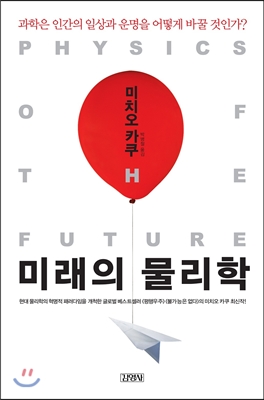
Michio Kaku, author of "Nothing is Impossible," returns with "Physics of the Future," a masterful exploration of the enormous scientific challenges that will dominate the future world, presented through physical reasoning, overwhelming knowledge, and brilliant arguments.
Humans can move objects with just their thoughts through sensors attached to their heads, and the discovery of room-temperature superconductors allows them to fly.
Advances in molecular medicine will eradicate all genetic diseases, millions of DNA sensors will roam our bodies to treat diseases, and genetic engineering will halt aging.
A space probe the size of a needle tip builds a space station, and a space elevator using nanotechnology instantly transports humans into space.
Through a whirlwind of arguments, rigorous experiments and research, and incisive analysis from over 300 leading figures in science, economics, and philosophy from around the world, this book boldly and excitingly unfolds the future of science.
Like his previous works, 『Parallel Universe』 and 『Nothing is Impossible』, he easily conveys the seemingly difficult theories and concepts of modern physics through excellent metaphors and wit, and perfectly explains them through physical verification and vast knowledge.
"Physics of the Future," which accurately predicts the world of cutting-edge physics, advancing at the speed of light and revolutionizing scientific discoveries and inventions, is a must-read for anyone curious about the future world that science will create, and for intellectuals seeking the coordinates of future society and new ideas that will dominate the future.
Humans can move objects with just their thoughts through sensors attached to their heads, and the discovery of room-temperature superconductors allows them to fly.
Advances in molecular medicine will eradicate all genetic diseases, millions of DNA sensors will roam our bodies to treat diseases, and genetic engineering will halt aging.
A space probe the size of a needle tip builds a space station, and a space elevator using nanotechnology instantly transports humans into space.
Through a whirlwind of arguments, rigorous experiments and research, and incisive analysis from over 300 leading figures in science, economics, and philosophy from around the world, this book boldly and excitingly unfolds the future of science.
Like his previous works, 『Parallel Universe』 and 『Nothing is Impossible』, he easily conveys the seemingly difficult theories and concepts of modern physics through excellent metaphors and wit, and perfectly explains them through physical verification and vast knowledge.
"Physics of the Future," which accurately predicts the world of cutting-edge physics, advancing at the speed of light and revolutionizing scientific discoveries and inventions, is a must-read for anyone curious about the future world that science will create, and for intellectuals seeking the coordinates of future society and new ideas that will dominate the future.
- You can preview some of the book's contents.
Preview
index
The next 100 years
Chapter 1: The Future of Computers: Controlling Matter with the Mind
Internet glasses and contact lenses / Self-driving cars / Wallpaper screens / Foldable electronic paper / Virtual worlds / Medicine of the near future / Living in a fairy tale / The end of Moore's Law / Blending reality and virtual reality / Revolutions in tourism, art, shopping, and war / Universal translators / Holograms and 3D (three-dimensional) /
Controlling Matter with the Mind / Mindreading / Dream Camera / Ethical Issues / Michio Kaku's Brain Undergoes an fMRI Scan / Tricorder and Portable Brain Scanner / Psychokinesis
Chapter 2: The Future of Artificial Intelligence: The Advancement of Machines
The End of Humanity? / Asimo Robot / History of AI / Is the Human Brain a Digital Computer? / Two Problems with Robots / The Confrontation Between Humans and Machines / Expert Systems / Modular Robots / Robot Doctors and Robot Chefs / Robots That Feel Emotions / Reverse Engineering the Brain / Brain Models / Dissecting the Brain / Machines with Consciousness / A World Where Robots Surpass Humans / The Most Likely Scenario, Friendly AI / Humans Become Robots / Star Wars and Robot Arms / Agents and Avatars / How Far Have We Come in the Convergence of Humans and Robots? / Obstacles to the Singularity
Chapter 3: The Future of Medicine: The Perfect Body and Beyond
The Three Stages of Medicine / Genetic Medicine / Visiting a Doctor / Stem Cells / Cloning / Gene Therapy / Living with Cancer / Developing Gene Therapy / Designed Babies / Mighty Mouse Genes / Side Effects of Biotechnology / Reversing Age / Calorie Restriction / The Source of Youth / Are Humans Destined to Die? / Biological Clock / Immortality and Youth / Population and Food Resources / A Bit of Hope / The Resurrection of Extinct Lifeforms / Neanderthals Revived? / Reviving Mammoths? / Creating New Lifeforms / Can We Overcome All Diseases? / Brave New World / Germ Warfare
Chapter 4 Nanotechnology - Is everything born from nothing?
Quantum World / Passing Obstacles / Manipulating Individual Atoms / MEMS and Nanoparticles / Nanomachines in the Body / Killing Cancer Cells / Nanocars in the Blood / DNA Chips / Carbon Nanotubes / The Post-Silicon Era / Atomic Transistors / Quantum Computers / Shape-Shifting / Universal Replicator, the Last Holy Grail / How to Build a Replicator / Gray-Goo Scenario / The Impact of Replicators on Society
Chapter 5: The Future of Energy - Star Energy
The End of the Oil Age / The Economics of Solar and Hydrogen / Wind Power / The Sun is Coming! / Electric Cars / Nuclear Fission / Nuclear Proliferation / Global Warming / A Visit to Iceland / Floods in Bangladesh and Vietnam / Climate Change Prevention Technology / Nuclear Fusion Energy / Thermonuclear Fusion / Laser Fusion at NIF / ITER: Nuclear Fusion in a Magnetic Field / Tabletop Fusion Generator / The Age of Magnetism / Magnetic Cars and Trains / Maglev Trains and Cars / Harvesting Energy from the Sky
Chapter 6: The Future of Space Travel - Towards the Stars
Exoplanets / Outside the Goldilocks Zone, Europa / LISA, Exploration Before the Big Bang / Manned Space Probes / Abandoned Moon Development Program / Landing on an Asteroid / Landing on a Martian Moon / Returning to the Moon / Building a Permanent Base on the Moon / Is There Water on the Moon? / Exploring Mars / Modifying Mars / Economic Gains / Space Tourism / Wild Card / Space Elevator / Interstellar Spaceship, Starship / Nuclear Rocket / Ramjet Fusion / Antimatter Rocket / Nanospacecraft
Chapter 7: The Future of Wealth - Winners and Losers
Conquering the Four Forces / The Four Stages of Technology / The Burst Bubble / Jobs That Determine Winners and Losers / The Future of Entertainment and Recreation / The Matrix / The Impact of Capitalism / From Product-Based Capitalism to Knowledge-Based Capitalism / Entry-Level Workers / A Nation Divided into Winners and Losers / Harnessing Science / A Tangible Future / Lessons from Singapore / Challenges for the Future
Chapter 8: The Future of Humanity - Planetary Civilization
Stages of Civilization / Stages I, II, and III of Civilization / From Stage 0 Civilization to Stage I Civilization / Dictatorship and Terror / Stage II Civilization / Stage III Civilization / SETI, Exploring Extraterrestrial Intelligent Life / New Classification / Entropy and Stages of Civilization / From 'Conquerors of Nature' to 'Protectors of Nature' / The Most Dangerous Transition / Seeking Wisdom / Wisdom, the Keyword of the Future / A Future Resembling a Freight Train
Chapter 9: A Day in the Year 2100
Acknowledgements
Translator's Note
References
Search
Chapter 1: The Future of Computers: Controlling Matter with the Mind
Internet glasses and contact lenses / Self-driving cars / Wallpaper screens / Foldable electronic paper / Virtual worlds / Medicine of the near future / Living in a fairy tale / The end of Moore's Law / Blending reality and virtual reality / Revolutions in tourism, art, shopping, and war / Universal translators / Holograms and 3D (three-dimensional) /
Controlling Matter with the Mind / Mindreading / Dream Camera / Ethical Issues / Michio Kaku's Brain Undergoes an fMRI Scan / Tricorder and Portable Brain Scanner / Psychokinesis
Chapter 2: The Future of Artificial Intelligence: The Advancement of Machines
The End of Humanity? / Asimo Robot / History of AI / Is the Human Brain a Digital Computer? / Two Problems with Robots / The Confrontation Between Humans and Machines / Expert Systems / Modular Robots / Robot Doctors and Robot Chefs / Robots That Feel Emotions / Reverse Engineering the Brain / Brain Models / Dissecting the Brain / Machines with Consciousness / A World Where Robots Surpass Humans / The Most Likely Scenario, Friendly AI / Humans Become Robots / Star Wars and Robot Arms / Agents and Avatars / How Far Have We Come in the Convergence of Humans and Robots? / Obstacles to the Singularity
Chapter 3: The Future of Medicine: The Perfect Body and Beyond
The Three Stages of Medicine / Genetic Medicine / Visiting a Doctor / Stem Cells / Cloning / Gene Therapy / Living with Cancer / Developing Gene Therapy / Designed Babies / Mighty Mouse Genes / Side Effects of Biotechnology / Reversing Age / Calorie Restriction / The Source of Youth / Are Humans Destined to Die? / Biological Clock / Immortality and Youth / Population and Food Resources / A Bit of Hope / The Resurrection of Extinct Lifeforms / Neanderthals Revived? / Reviving Mammoths? / Creating New Lifeforms / Can We Overcome All Diseases? / Brave New World / Germ Warfare
Chapter 4 Nanotechnology - Is everything born from nothing?
Quantum World / Passing Obstacles / Manipulating Individual Atoms / MEMS and Nanoparticles / Nanomachines in the Body / Killing Cancer Cells / Nanocars in the Blood / DNA Chips / Carbon Nanotubes / The Post-Silicon Era / Atomic Transistors / Quantum Computers / Shape-Shifting / Universal Replicator, the Last Holy Grail / How to Build a Replicator / Gray-Goo Scenario / The Impact of Replicators on Society
Chapter 5: The Future of Energy - Star Energy
The End of the Oil Age / The Economics of Solar and Hydrogen / Wind Power / The Sun is Coming! / Electric Cars / Nuclear Fission / Nuclear Proliferation / Global Warming / A Visit to Iceland / Floods in Bangladesh and Vietnam / Climate Change Prevention Technology / Nuclear Fusion Energy / Thermonuclear Fusion / Laser Fusion at NIF / ITER: Nuclear Fusion in a Magnetic Field / Tabletop Fusion Generator / The Age of Magnetism / Magnetic Cars and Trains / Maglev Trains and Cars / Harvesting Energy from the Sky
Chapter 6: The Future of Space Travel - Towards the Stars
Exoplanets / Outside the Goldilocks Zone, Europa / LISA, Exploration Before the Big Bang / Manned Space Probes / Abandoned Moon Development Program / Landing on an Asteroid / Landing on a Martian Moon / Returning to the Moon / Building a Permanent Base on the Moon / Is There Water on the Moon? / Exploring Mars / Modifying Mars / Economic Gains / Space Tourism / Wild Card / Space Elevator / Interstellar Spaceship, Starship / Nuclear Rocket / Ramjet Fusion / Antimatter Rocket / Nanospacecraft
Chapter 7: The Future of Wealth - Winners and Losers
Conquering the Four Forces / The Four Stages of Technology / The Burst Bubble / Jobs That Determine Winners and Losers / The Future of Entertainment and Recreation / The Matrix / The Impact of Capitalism / From Product-Based Capitalism to Knowledge-Based Capitalism / Entry-Level Workers / A Nation Divided into Winners and Losers / Harnessing Science / A Tangible Future / Lessons from Singapore / Challenges for the Future
Chapter 8: The Future of Humanity - Planetary Civilization
Stages of Civilization / Stages I, II, and III of Civilization / From Stage 0 Civilization to Stage I Civilization / Dictatorship and Terror / Stage II Civilization / Stage III Civilization / SETI, Exploring Extraterrestrial Intelligent Life / New Classification / Entropy and Stages of Civilization / From 'Conquerors of Nature' to 'Protectors of Nature' / The Most Dangerous Transition / Seeking Wisdom / Wisdom, the Keyword of the Future / A Future Resembling a Freight Train
Chapter 9: A Day in the Year 2100
Acknowledgements
Translator's Note
References
Search
Into the book
Computers are taking over the human mind!
How long will the computer revolution last? By 2100, computer performance will have improved beyond imagination, giving all humans near-equal powers to the gods they once worshipped.
If you could move heavy objects and improve your quality of life with a simple hand movement or nod, what else could you do if not God?
Moreover, humans will be able to control their surroundings with just their thoughts.
By then, computer chips will be ubiquitous, and if they are given the ability to interact with human thought, they will be able to accomplish what they want without having to issue commands through a terminal.
A robot more human than humans!
By 2100, the world will be overflowing with robots that are human-like in every way.
What would happen if they were smarter than humans? When would robots become as intelligent as humans, and would it be possible for robots that are more human than humans to dominate us? The invention of robots with superhuman abilities will surely happen.
But the idea of humans abandoning their own lives and living forever trapped inside computers, or of their bodies being transformed into robots beyond recognition, as imagined by science fiction writers, is sure to evoke strong resistance.
By creating benevolent and friendly robots that enhance human capabilities to some extent, they will eventually follow the principles of cavemen.
Age backwards!
By 2050, various treatments will be available to slow down aging.
For example, we can replace old organs with stem cells, a department store of human organs, or repair aging genes with gene therapy.
If this is realized, human lifespan will be extended to 150 years.
And by 2100, cell repair processes will be accelerated, making it possible to age backwards.
Simply living a long life and staying young are two entirely different things.
Nanobots, the universal replicators!
A universal duplicator is literally a device that can duplicate any object in the world, and is as small as a washing machine.
When you put the raw materials into this device and press the button, trillions upon trillions of nanobots attach themselves to the raw materials and perform complex tasks.
In principle, there is nothing a universal replicator cannot create.
If a universal replicator were realized, allowing people to have whatever they want whenever they want, wouldn't people strive to be productive? In such a scenario, three things should be considered.
First, if there were a universal replicator, no one would starve in this world.
But secondly, most people will still be proud of their skills and accomplishments, so they will attach considerable meaning to what they do.
And third, for social pressure to continue, individual freedom must be restricted.
Therefore, social pressure will no longer exist, and education will be directed toward changing people's attitudes toward work and rewards so that the universal replicator will not be abused.
A flying car!
The 20th century was certainly the age of electricity.
Because electrons, the source of all electrical phenomena, are easy to handle, we have enjoyed the benefits of all kinds of electronic products, including radios, TVs, computers, lasers, and MRI scanners.
Physicists of the 21st century are striving to find another holy grail.
That's what a 'superconductor that operates at room temperature' is.
If this is realized, humanity will say goodbye to the age of electricity and enter the 'age of magnetism'.
Imagine a car floating above the ground, traveling at hundreds of kilometers per hour without fuel.
The same goes for trains and people.
If you use your magnetic power well, you can go anywhere while floating in the air.
It's a myth, a space elevator!
By the end of the 21st century, the mythical 'space elevator' may become a reality with the help of nanotechnology.
Like in "Jack and the Beanstalk," where a boy climbs up a beanstalk into the sky, we take an elevator up to space.
What kind of nonsense are you talking about? No.
In theory, anything is possible.
By taking an elevator from the ground and pressing a button, you can ascend thousands of kilometers along a passageway made of carbon nanotubes.
The space elevator will completely change the economics of space travel.
What jobs will be popular in the future?
It's a really difficult question if you don't consider science.
However, Michio Kaku's logic, based on scientific facts, is truly simple and clear.
In the future, advanced robots that are far more efficient than humans will be widespread in all fields, so simple, repetitive tasks that are the specialty of robots (machine assemblers, simple stock brokers, etc.) will disappear, and jobs based on 'shape recognition' and 'useful common sense' that are robots' weak points (construction workers, detectives, artists, writers, etc.) will survive.
The reason this prediction sounds plausible is because everyone recognizes the need for robots.
In other words, you need to have basic scientific knowledge to select and choose predictions made by others.
How long will the computer revolution last? By 2100, computer performance will have improved beyond imagination, giving all humans near-equal powers to the gods they once worshipped.
If you could move heavy objects and improve your quality of life with a simple hand movement or nod, what else could you do if not God?
Moreover, humans will be able to control their surroundings with just their thoughts.
By then, computer chips will be ubiquitous, and if they are given the ability to interact with human thought, they will be able to accomplish what they want without having to issue commands through a terminal.
A robot more human than humans!
By 2100, the world will be overflowing with robots that are human-like in every way.
What would happen if they were smarter than humans? When would robots become as intelligent as humans, and would it be possible for robots that are more human than humans to dominate us? The invention of robots with superhuman abilities will surely happen.
But the idea of humans abandoning their own lives and living forever trapped inside computers, or of their bodies being transformed into robots beyond recognition, as imagined by science fiction writers, is sure to evoke strong resistance.
By creating benevolent and friendly robots that enhance human capabilities to some extent, they will eventually follow the principles of cavemen.
Age backwards!
By 2050, various treatments will be available to slow down aging.
For example, we can replace old organs with stem cells, a department store of human organs, or repair aging genes with gene therapy.
If this is realized, human lifespan will be extended to 150 years.
And by 2100, cell repair processes will be accelerated, making it possible to age backwards.
Simply living a long life and staying young are two entirely different things.
Nanobots, the universal replicators!
A universal duplicator is literally a device that can duplicate any object in the world, and is as small as a washing machine.
When you put the raw materials into this device and press the button, trillions upon trillions of nanobots attach themselves to the raw materials and perform complex tasks.
In principle, there is nothing a universal replicator cannot create.
If a universal replicator were realized, allowing people to have whatever they want whenever they want, wouldn't people strive to be productive? In such a scenario, three things should be considered.
First, if there were a universal replicator, no one would starve in this world.
But secondly, most people will still be proud of their skills and accomplishments, so they will attach considerable meaning to what they do.
And third, for social pressure to continue, individual freedom must be restricted.
Therefore, social pressure will no longer exist, and education will be directed toward changing people's attitudes toward work and rewards so that the universal replicator will not be abused.
A flying car!
The 20th century was certainly the age of electricity.
Because electrons, the source of all electrical phenomena, are easy to handle, we have enjoyed the benefits of all kinds of electronic products, including radios, TVs, computers, lasers, and MRI scanners.
Physicists of the 21st century are striving to find another holy grail.
That's what a 'superconductor that operates at room temperature' is.
If this is realized, humanity will say goodbye to the age of electricity and enter the 'age of magnetism'.
Imagine a car floating above the ground, traveling at hundreds of kilometers per hour without fuel.
The same goes for trains and people.
If you use your magnetic power well, you can go anywhere while floating in the air.
It's a myth, a space elevator!
By the end of the 21st century, the mythical 'space elevator' may become a reality with the help of nanotechnology.
Like in "Jack and the Beanstalk," where a boy climbs up a beanstalk into the sky, we take an elevator up to space.
What kind of nonsense are you talking about? No.
In theory, anything is possible.
By taking an elevator from the ground and pressing a button, you can ascend thousands of kilometers along a passageway made of carbon nanotubes.
The space elevator will completely change the economics of space travel.
What jobs will be popular in the future?
It's a really difficult question if you don't consider science.
However, Michio Kaku's logic, based on scientific facts, is truly simple and clear.
In the future, advanced robots that are far more efficient than humans will be widespread in all fields, so simple, repetitive tasks that are the specialty of robots (machine assemblers, simple stock brokers, etc.) will disappear, and jobs based on 'shape recognition' and 'useful common sense' that are robots' weak points (construction workers, detectives, artists, writers, etc.) will survive.
The reason this prediction sounds plausible is because everyone recognizes the need for robots.
In other words, you need to have basic scientific knowledge to select and choose predictions made by others.
--- From the text
Publisher's Review
Michio Kaku, author of the global bestsellers "Parallel Universes" and "Nothing is Impossible," which pioneered a revolutionary paradigm in modern physics, presents his latest work! From medicine and computers to artificial intelligence, nanotechnology, energy, and even aerospace, this book offers a comprehensive overview of the immense and wondrous scientific challenges that will dominate the future world, presented through grounded physical reasoning, compelling knowledge, and brilliant arguments.
A global bestseller that pioneered a revolutionary paradigm in modern physics.
Michio Kaku's latest work, creator of "Parallel Universe" and "Nothing is Impossible"!
Founder of the theory of parallel universes, world-renowned theoretical physicist, and unrivaled futurist
Everything about future physics, finally completed by Michio Kaku!
Michio Kaku, the author of "Parallel Universes," which completely overturned our common sense about the universe and heralded the beginning of the space age, and "Nothing is Impossible," which vividly unfolded the world of extreme physics that put an end to all scientific impossibilities that all mankind has challenged since Einstein's theory of relativity, has returned with "Physics of the Future," which perfectly forecasts the gigantic and wondrous challenges of science that will dominate the future world with physical reasoning, overwhelming knowledge, and brilliant arguments.
Humans can move objects with just their thoughts through sensors attached to their heads, and the discovery of room-temperature superconductors allows them to fly.
Advances in molecular medicine will eradicate all genetic diseases, millions of DNA sensors will roam our bodies to treat diseases, and genetic engineering will halt aging.
A space probe the size of a needle tip builds a space station, and a space elevator using nanotechnology instantly transports humans into space.
Through a whirlwind of arguments, rigorous experiments and research, and incisive analysis from over 300 leading figures in science, economics, and philosophy from around the world, this book boldly and excitingly unfolds the world of future science.
Just like his previous works, "Parallel Universe" and "Nothing is Impossible," he uses excellent metaphors and wit to convey the seemingly difficult theories and concepts of modern physics in an easy-to-understand manner, and perfectly explains them through physical verification and vast knowledge.
"Physics of the Future," which accurately predicts the world of cutting-edge physics, advancing at the speed of light and revolutionizing scientific discoveries and inventions, is a must-read for anyone curious about the future world that science will create, and for intellectuals seeking the coordinates of future society and new ideas that will dominate the future.
Medicine, computers, artificial intelligence, nanotechnology, energy, and even aerospace!
The great and wondrous challenge of science that will dominate the future world is physical reasoning and overwhelming knowledge,
A perfect overview with a brilliant argument.
In 1865, Jules Verne wrote From the Earth to the Moon, which provided a very realistic and detailed description of how to send astronauts to the moon.
And 100 years later, in 1969, humans actually set foot on the moon for the first time.
In the late 1400s, Leonardo da Vinci drew beautiful and accurate blueprints for the devices that would one day dominate the skies, including parachutes, helicopters, hang gliders, and even airplanes.
When we encounter the extraordinary vision of da Vinci and Jules Verne, who knew the power of science to the core, we are faced with one question.
Could we also foresee the world of 2100? Michio Kaku, a futurist who has dedicated his life to "previewing the future," meticulously analyzes cutting-edge technologies and prototypes that will transform humanity's future.
It clearly reveals that the future world is not a by-product of the overactive imagination of Hollywood screenwriters, but a possible reality.
It is extremely difficult to see into the future 100 years from now.
In 1943, IBM President Thomas Watson predicted that there would be five computers worldwide, and in 1899, U.S. Patent Office Commissioner Charles Duel declared, “Everything that can be invented has been invented.”
Many journalists, scientists, and futurists have underestimated the power of science and made incorrect predictions.
To make correct predictions, you must first have correct information.
In this book, Michio Kaku perfectly predicts the future 100 years from now by taking into account accurate scientific facts and information, as well as human characteristics and social trends.
It is divided into the near future (present-2030), the somewhat distant future (2030-2070), and the distant future (2070-2100), and is divided into eight fields: computers, artificial intelligence, medicine, nanotechnology, energy, space travel, wealth, and the future of humanity.
A global bestseller that pioneered a revolutionary paradigm in modern physics.
Michio Kaku's latest work, creator of "Parallel Universe" and "Nothing is Impossible"!
Founder of the theory of parallel universes, world-renowned theoretical physicist, and unrivaled futurist
Everything about future physics, finally completed by Michio Kaku!
Michio Kaku, the author of "Parallel Universes," which completely overturned our common sense about the universe and heralded the beginning of the space age, and "Nothing is Impossible," which vividly unfolded the world of extreme physics that put an end to all scientific impossibilities that all mankind has challenged since Einstein's theory of relativity, has returned with "Physics of the Future," which perfectly forecasts the gigantic and wondrous challenges of science that will dominate the future world with physical reasoning, overwhelming knowledge, and brilliant arguments.
Humans can move objects with just their thoughts through sensors attached to their heads, and the discovery of room-temperature superconductors allows them to fly.
Advances in molecular medicine will eradicate all genetic diseases, millions of DNA sensors will roam our bodies to treat diseases, and genetic engineering will halt aging.
A space probe the size of a needle tip builds a space station, and a space elevator using nanotechnology instantly transports humans into space.
Through a whirlwind of arguments, rigorous experiments and research, and incisive analysis from over 300 leading figures in science, economics, and philosophy from around the world, this book boldly and excitingly unfolds the world of future science.
Just like his previous works, "Parallel Universe" and "Nothing is Impossible," he uses excellent metaphors and wit to convey the seemingly difficult theories and concepts of modern physics in an easy-to-understand manner, and perfectly explains them through physical verification and vast knowledge.
"Physics of the Future," which accurately predicts the world of cutting-edge physics, advancing at the speed of light and revolutionizing scientific discoveries and inventions, is a must-read for anyone curious about the future world that science will create, and for intellectuals seeking the coordinates of future society and new ideas that will dominate the future.
Medicine, computers, artificial intelligence, nanotechnology, energy, and even aerospace!
The great and wondrous challenge of science that will dominate the future world is physical reasoning and overwhelming knowledge,
A perfect overview with a brilliant argument.
In 1865, Jules Verne wrote From the Earth to the Moon, which provided a very realistic and detailed description of how to send astronauts to the moon.
And 100 years later, in 1969, humans actually set foot on the moon for the first time.
In the late 1400s, Leonardo da Vinci drew beautiful and accurate blueprints for the devices that would one day dominate the skies, including parachutes, helicopters, hang gliders, and even airplanes.
When we encounter the extraordinary vision of da Vinci and Jules Verne, who knew the power of science to the core, we are faced with one question.
Could we also foresee the world of 2100? Michio Kaku, a futurist who has dedicated his life to "previewing the future," meticulously analyzes cutting-edge technologies and prototypes that will transform humanity's future.
It clearly reveals that the future world is not a by-product of the overactive imagination of Hollywood screenwriters, but a possible reality.
It is extremely difficult to see into the future 100 years from now.
In 1943, IBM President Thomas Watson predicted that there would be five computers worldwide, and in 1899, U.S. Patent Office Commissioner Charles Duel declared, “Everything that can be invented has been invented.”
Many journalists, scientists, and futurists have underestimated the power of science and made incorrect predictions.
To make correct predictions, you must first have correct information.
In this book, Michio Kaku perfectly predicts the future 100 years from now by taking into account accurate scientific facts and information, as well as human characteristics and social trends.
It is divided into the near future (present-2030), the somewhat distant future (2030-2070), and the distant future (2070-2100), and is divided into eight fields: computers, artificial intelligence, medicine, nanotechnology, energy, space travel, wealth, and the future of humanity.
GOODS SPECIFICS
- Date of publication: September 27, 2012
- Format: Hardcover book binding method guide
- Page count, weight, size: 616 pages | 838g | 153*224*35mm
- ISBN13: 9788934958826
- ISBN10: 8934958820
You may also like
카테고리
korean


korean

![ELLE 엘르 스페셜 에디션 A형 : 12월 [2025]](http://librairie.coreenne.fr/cdn/shop/files/b8e27a3de6c9538896439686c6b0e8fb.jpg?v=1766436872&width=3840)


