

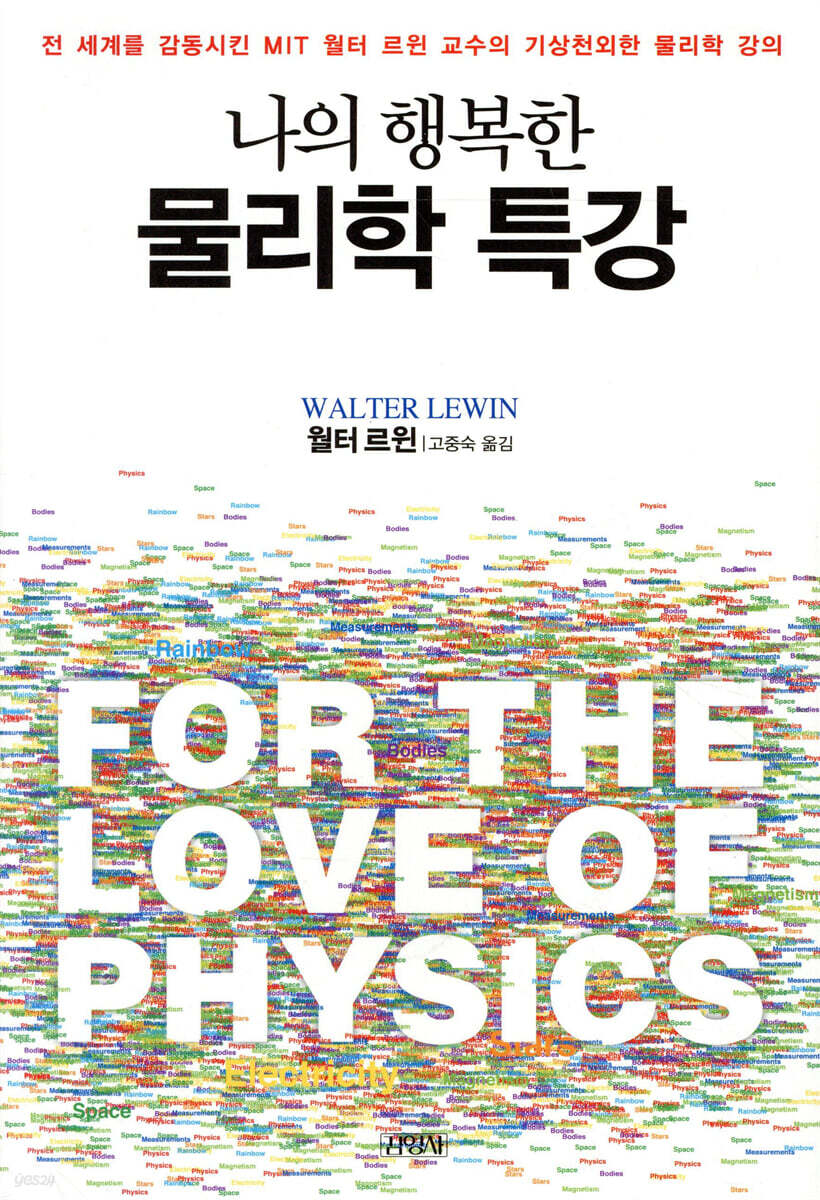
My Happy Physics Special Lecture
 |
Description
Book Introduction
The thrilling and exhilarating essence of physics, presented by an eccentric scientist in love with physics! This book contains lectures given by Professor Walter Lewin, who was praised by the New York Times in December 2007, even calling him a “web star.” Students who attended the professor's lectures are also enthusiastic about his lectures. His lectures elevated physics from a complex and difficult subject filled with mere formulas to an enjoyable subject that allowed us to understand the principles of the world. In this book, Professor Lewin unfolds the wondrous world of physics, from the harmony of string and wind instruments to the end of time. This book captures his passion for physics and the essence of his lectures that have inspired countless students over 30 years. His class is completely different from the typical physics lectures filled with formulas and equations. His classroom is filled with exciting experiments instead of complex formulas, and lively proofs instead of tedious calculations. And he demonstrates experiments that anyone can try in real life by doing them in the classroom. To explain the principles of magnetic fields, he charges his own body with 300,000 volts of high voltage, and climbs on a metal ball hanging from the ceiling of a classroom to personally demonstrate the laws related to the oscillation of a pendulum. His passion for explaining the principles of physics with his whole body makes it impossible for students to take their eyes off the lecture even for a moment. And through these vividly presented lectures, students realize that physics is not a discipline detached from reality, but rather laws directly related to our lives and laws that drive the world we live in. Watch the author of "My Happy Physics Lecture"'s delightful lecture *Click* |
- You can preview some of the book's contents.
Preview
index
introduction
Chapter 1 From the Nucleus to the Universe
Chapter 2 Measurement, Error, and Stars
Chapter 3 Moving Objects
Chapter 4 The Magic of the Straw
Chapter 5 The Mystery of the Rainbow
Chapter 6 Harmony of String and Wind Instruments
Chapter 7 The Mystery of Electricity
Chapter 8 The Mystery of the Self
Chapter 9 Conservation of Energy
Chapter 10 X-rays from outer space
Chapter 11 Early X-ray Balloons
Chapter 12: Cosmic Catastrophes, Neutron Stars, and Black Holes
Chapter 13: Celestial Ballet
Chapter 14 X-ray Burst
Chapter 15 How to See the World
Appendix 1 Femur of Mammalians
Appendix 2 Newton's Laws
Translator's Note
Search
Chapter 1 From the Nucleus to the Universe
Chapter 2 Measurement, Error, and Stars
Chapter 3 Moving Objects
Chapter 4 The Magic of the Straw
Chapter 5 The Mystery of the Rainbow
Chapter 6 Harmony of String and Wind Instruments
Chapter 7 The Mystery of Electricity
Chapter 8 The Mystery of the Self
Chapter 9 Conservation of Energy
Chapter 10 X-rays from outer space
Chapter 11 Early X-ray Balloons
Chapter 12: Cosmic Catastrophes, Neutron Stars, and Black Holes
Chapter 13: Celestial Ballet
Chapter 14 X-ray Burst
Chapter 15 How to See the World
Appendix 1 Femur of Mammalians
Appendix 2 Newton's Laws
Translator's Note
Search
Into the book
Things like gravity and air pressure, which we had never seen before and therefore took for granted, are actually among the most fantastic phenomena.
It's like a joke between two fish swimming happily in the river.
One fish looks at the other fish with a questioning expression and says:
"What on earth is this new story about 'water'?"
We naturally perceive the weight and density of air, which is invisible to the eye.
But in reality, we live at the bottom of a vast ocean of air.
So we are under a lot of pressure every moment of every day.
Let's extend our palms out in front of us, facing upwards.
Then, let us say that a long, rectangular tube, one centimeter in cross-section, stands on the palm of your hand, its end touching the top of the atmosphere.
The height of the atmosphere is hundreds of kilometers.
Therefore, the weight of the air alone, excluding the weight of the tube, is approximately 1 kilogram.
But if such great forces are acting simultaneously on both sides of the hand, why don't our hands get crushed? (...) What about our chest? Its area is about 1,000 square centimeters.
Therefore, the net force exerted by the air is about 1,000 kilograms, or about 1 ton.
Also, this much force is applied to the back.
So why don't our lungs collapse?
It's like a joke between two fish swimming happily in the river.
One fish looks at the other fish with a questioning expression and says:
"What on earth is this new story about 'water'?"
We naturally perceive the weight and density of air, which is invisible to the eye.
But in reality, we live at the bottom of a vast ocean of air.
So we are under a lot of pressure every moment of every day.
Let's extend our palms out in front of us, facing upwards.
Then, let us say that a long, rectangular tube, one centimeter in cross-section, stands on the palm of your hand, its end touching the top of the atmosphere.
The height of the atmosphere is hundreds of kilometers.
Therefore, the weight of the air alone, excluding the weight of the tube, is approximately 1 kilogram.
But if such great forces are acting simultaneously on both sides of the hand, why don't our hands get crushed? (...) What about our chest? Its area is about 1,000 square centimeters.
Therefore, the net force exerted by the air is about 1,000 kilograms, or about 1 ton.
Also, this much force is applied to the back.
So why don't our lungs collapse?
---p.92
What exactly is resonance? A good way to understand it vividly is to push a child on a swing.
At this point, you intuitively see how to get a large amplitude with little effort.
The swing is like a pendulum and has a regular period.
So, if you push the swing while precisely aligning with this cycle, even if you add just a little bit of force, the forces will accumulate and eventually swing with a large amplitude.
As you can see, with just a few gentle pushes of your fingers, you can make a child rise higher and higher.
When you push the swing like this, you are exploiting resonance.
In physics, resonance is the phenomenon in which something vibrates more strongly at certain frequencies than at other frequencies. Examples include pendulums, tuning forks, violin strings, wine glasses, drum skins, steel columns, atoms, electrons, atomic nuclei, and even a column of air in a tube, among many others.
And the frequency of the resonance state is called the resonance frequency or natural frequency.
What exactly is resonance? A good way to understand it vividly is to push a child on a swing.
At this point, you intuitively see how to get a large amplitude with little effort.
The swing is like a pendulum and has a regular period.
So, if you push the swing while precisely aligning with this cycle, even if you add just a little bit of force, the forces will accumulate and eventually swing with a large amplitude.
As you can see, with just a few gentle pushes of your fingers, you can make a child rise higher and higher.
When you push the swing like this, you are exploiting resonance.
In physics, resonance is the phenomenon in which something vibrates more strongly at certain frequencies than at other frequencies. Examples include pendulums, tuning forks, violin strings, wine glasses, drum skins, steel columns, atoms, electrons, atomic nuclei, and even a column of air in a tube, among many others.
And the frequency of the resonance state is called the resonance frequency or natural frequency.
At this point, you intuitively see how to get a large amplitude with little effort.
The swing is like a pendulum and has a regular period.
So, if you push the swing while precisely aligning with this cycle, even if you add just a little bit of force, the forces will accumulate and eventually swing with a large amplitude.
As you can see, with just a few gentle pushes of your fingers, you can make a child rise higher and higher.
When you push the swing like this, you are exploiting resonance.
In physics, resonance is the phenomenon in which something vibrates more strongly at certain frequencies than at other frequencies. Examples include pendulums, tuning forks, violin strings, wine glasses, drum skins, steel columns, atoms, electrons, atomic nuclei, and even a column of air in a tube, among many others.
And the frequency of the resonance state is called the resonance frequency or natural frequency.
What exactly is resonance? A good way to understand it vividly is to push a child on a swing.
At this point, you intuitively see how to get a large amplitude with little effort.
The swing is like a pendulum and has a regular period.
So, if you push the swing while precisely aligning with this cycle, even if you add just a little bit of force, the forces will accumulate and eventually swing with a large amplitude.
As you can see, with just a few gentle pushes of your fingers, you can make a child rise higher and higher.
When you push the swing like this, you are exploiting resonance.
In physics, resonance is the phenomenon in which something vibrates more strongly at certain frequencies than at other frequencies. Examples include pendulums, tuning forks, violin strings, wine glasses, drum skins, steel columns, atoms, electrons, atomic nuclei, and even a column of air in a tube, among many others.
And the frequency of the resonance state is called the resonance frequency or natural frequency.
---p.160
Publisher's Review
"Professor Lewin's lecture changed my life!"
A miraculous physics lecture attended by 3,000 people a day and millions a year!
In December 2007, the New York Times featured a very special physics professor on its front page.
The protagonist was none other than Professor Walter Lewin, who had been teaching fundamental physics at MIT for nearly 30 years.
His lectures, which have been among the most popular at MIT for the past 30 years, have been featured on MIT's OpenCourseWare, YouTube, iTunes University, AcademicUs, and other platforms, and have received explosive responses worldwide.
The New York Times praised his lectures, even calling him a “webstar.”
In addition to media outlets such as the New York Times and the Washington Post, numerous experts responded enthusiastically to Professor Lewin's lecture.
A book titled “My Happy Physics Special Lecture,” which provides a glimpse into the lectures of Professor Walter Lewin, who is enjoying worldwide popularity, has been published by Kim Young Publishing.
Professor Walter Lewin receives dozens of emails every week from enthusiastic fans of his video lectures.
And the words, "You changed my life," are repeated like a chorus in the emails he receives every week.
One fan even wrote, "I've found new energy and started looking at life from a physical perspective."
Even Bill Gates, the founder of Microsoft, sent a letter saying he was fascinated by his lectures.
His lectures, which transcend the realm of mere academics and change the lives of countless people around the world, are truly miraculous, reaching approximately 3,000 people every day and reaching 1 million views annually.
And his lectures elevated physics from a complex and difficult subject filled with mere formulas to an enjoyable subject that allowed us to understand the principles of the world.
Just as Carl Sagan did with astronomy and Brian Greene did with cosmology, Professor Lewin unfolds the wondrous world of physics, from the harmonies of strings and wind instruments to the end of time.
This book captures his passion for physics and the essence of his lectures that have inspired countless students over 30 years.
Amazingly creative and exciting experiments, with original and vibrant interpretations and proofs!
The thrilling and exhilarating essence of physics, presented by an eccentric scientist in love with physics!
Professor Lewin is famous for his lectures on fundamental physics, but he is also a world-renowned scholar in the field of physics who pioneered a new field called X-ray astronomy.
So, overall, this book explains the laws of physics through simple but exciting experiments such as Newton's laws of motion, which can be considered the foundation of physics, the principle of air pressure through the straw experiment, the principle of light through a rainbow, and the principle of resonance through stringed and wind instruments. At the same time, it also vividly explains the unfamiliar field of X-ray astronomy, which is his specialty.
But his class is completely different from the typical physics lectures filled with formulas and equations.
His classroom is filled with exciting experiments instead of complex formulas, and lively proofs instead of tedious calculations.
And he demonstrates experiments that anyone can try in real life by doing them in the classroom.
So, the front of his classroom is filled with various experimental tools, and he even uses his own body as an experimental tool, saying, "Scientific discovery always requires sacrifice."
For example, to explain the principles of magnetic fields, he charges his own body with 300,000 volts of high voltage, and climbs on a metal ball hanging from the ceiling of a classroom to personally demonstrate the laws related to the oscillation of a pendulum.
Not only that, he explains about air pressure while sitting at the top of a 5-meter-tall ladder, sucking juice from a beaker on the floor with a long, snake-like straw made from laboratory tubes, and he puts his head in the path of a powerful additional swing, coming just a few millimeters closer to his chin, putting himself at risk of serious injury.
His passion for explaining the principles of physics with his whole body makes it impossible for students to take their eyes off the lecture even for a moment.
And through these vividly presented lectures, students realize that physics is not a discipline detached from reality, but rather laws directly related to our lives and laws that drive the world we live in.
From the principles of the rainbow to the ecstatic world of the universe,
A very special physics lecture that has changed the lives of countless people around the world begins now!
At some point in our society, science has been considered the domain of special people, not only in the education system but also in the general public's perception.
When people think of science, especially physics, most people shake their heads, thinking it's a complex, headache-inducing subject filled with formulas that have nothing to do with them.
But in Professor Lewin's lecture, physics becomes a very interesting and fun phenomenon that is very closely related to our lives and that we must know.
In that sense, readers' emails saying, "Professor, your lectures changed my life" are by no means an exaggeration.
Professor Koh Jung-sook of Suncheon National University, who translated this book, compares the way we learn science in Korea to Professor Lewin's lectures, and cites the example of coach Guus Hiddink, who led the team to the 2002 World Cup.
Coach Hiddink helped the national team players, who had been suppressed by patriotism and responsibility, realize that more creative play is possible when the players can enjoy soccer on their own.
Like Coach Hiddink, Professor Lewin's lectures are those of one of the most passionate and outstanding scientific guides, breaking down the stereotypes about physics that have been holding us back and showing us how beautiful and interesting physics is.
So, the moment you watch his lecture, you will be captivated by the magical charm of physics and amazed by the wondrous power of physics hidden in the world!
This book not only provides URL addresses for video lectures so you can immediately check out his passionate lectures, but also introduces internet sites where you can find various related materials.
Above all, for the convenience of readers, QR codes were included so that they could look up related materials while reading the book.
Therefore, anyone can immerse themselves in the exciting and vivid world of physics through this book.
A miraculous physics lecture attended by 3,000 people a day and millions a year!
In December 2007, the New York Times featured a very special physics professor on its front page.
The protagonist was none other than Professor Walter Lewin, who had been teaching fundamental physics at MIT for nearly 30 years.
His lectures, which have been among the most popular at MIT for the past 30 years, have been featured on MIT's OpenCourseWare, YouTube, iTunes University, AcademicUs, and other platforms, and have received explosive responses worldwide.
The New York Times praised his lectures, even calling him a “webstar.”
In addition to media outlets such as the New York Times and the Washington Post, numerous experts responded enthusiastically to Professor Lewin's lecture.
A book titled “My Happy Physics Special Lecture,” which provides a glimpse into the lectures of Professor Walter Lewin, who is enjoying worldwide popularity, has been published by Kim Young Publishing.
Professor Walter Lewin receives dozens of emails every week from enthusiastic fans of his video lectures.
And the words, "You changed my life," are repeated like a chorus in the emails he receives every week.
One fan even wrote, "I've found new energy and started looking at life from a physical perspective."
Even Bill Gates, the founder of Microsoft, sent a letter saying he was fascinated by his lectures.
His lectures, which transcend the realm of mere academics and change the lives of countless people around the world, are truly miraculous, reaching approximately 3,000 people every day and reaching 1 million views annually.
And his lectures elevated physics from a complex and difficult subject filled with mere formulas to an enjoyable subject that allowed us to understand the principles of the world.
Just as Carl Sagan did with astronomy and Brian Greene did with cosmology, Professor Lewin unfolds the wondrous world of physics, from the harmonies of strings and wind instruments to the end of time.
This book captures his passion for physics and the essence of his lectures that have inspired countless students over 30 years.
Amazingly creative and exciting experiments, with original and vibrant interpretations and proofs!
The thrilling and exhilarating essence of physics, presented by an eccentric scientist in love with physics!
Professor Lewin is famous for his lectures on fundamental physics, but he is also a world-renowned scholar in the field of physics who pioneered a new field called X-ray astronomy.
So, overall, this book explains the laws of physics through simple but exciting experiments such as Newton's laws of motion, which can be considered the foundation of physics, the principle of air pressure through the straw experiment, the principle of light through a rainbow, and the principle of resonance through stringed and wind instruments. At the same time, it also vividly explains the unfamiliar field of X-ray astronomy, which is his specialty.
But his class is completely different from the typical physics lectures filled with formulas and equations.
His classroom is filled with exciting experiments instead of complex formulas, and lively proofs instead of tedious calculations.
And he demonstrates experiments that anyone can try in real life by doing them in the classroom.
So, the front of his classroom is filled with various experimental tools, and he even uses his own body as an experimental tool, saying, "Scientific discovery always requires sacrifice."
For example, to explain the principles of magnetic fields, he charges his own body with 300,000 volts of high voltage, and climbs on a metal ball hanging from the ceiling of a classroom to personally demonstrate the laws related to the oscillation of a pendulum.
Not only that, he explains about air pressure while sitting at the top of a 5-meter-tall ladder, sucking juice from a beaker on the floor with a long, snake-like straw made from laboratory tubes, and he puts his head in the path of a powerful additional swing, coming just a few millimeters closer to his chin, putting himself at risk of serious injury.
His passion for explaining the principles of physics with his whole body makes it impossible for students to take their eyes off the lecture even for a moment.
And through these vividly presented lectures, students realize that physics is not a discipline detached from reality, but rather laws directly related to our lives and laws that drive the world we live in.
From the principles of the rainbow to the ecstatic world of the universe,
A very special physics lecture that has changed the lives of countless people around the world begins now!
At some point in our society, science has been considered the domain of special people, not only in the education system but also in the general public's perception.
When people think of science, especially physics, most people shake their heads, thinking it's a complex, headache-inducing subject filled with formulas that have nothing to do with them.
But in Professor Lewin's lecture, physics becomes a very interesting and fun phenomenon that is very closely related to our lives and that we must know.
In that sense, readers' emails saying, "Professor, your lectures changed my life" are by no means an exaggeration.
Professor Koh Jung-sook of Suncheon National University, who translated this book, compares the way we learn science in Korea to Professor Lewin's lectures, and cites the example of coach Guus Hiddink, who led the team to the 2002 World Cup.
Coach Hiddink helped the national team players, who had been suppressed by patriotism and responsibility, realize that more creative play is possible when the players can enjoy soccer on their own.
Like Coach Hiddink, Professor Lewin's lectures are those of one of the most passionate and outstanding scientific guides, breaking down the stereotypes about physics that have been holding us back and showing us how beautiful and interesting physics is.
So, the moment you watch his lecture, you will be captivated by the magical charm of physics and amazed by the wondrous power of physics hidden in the world!
This book not only provides URL addresses for video lectures so you can immediately check out his passionate lectures, but also introduces internet sites where you can find various related materials.
Above all, for the convenience of readers, QR codes were included so that they could look up related materials while reading the book.
Therefore, anyone can immerse themselves in the exciting and vivid world of physics through this book.
GOODS SPECIFICS
- Date of publication: June 14, 2012
- Page count, weight, size: 414 pages | 693g | 153*224*30mm
- ISBN13: 9788934957843
- ISBN10: 8934957840
You may also like
카테고리
korean


korean

![ELLE 엘르 스페셜 에디션 A형 : 12월 [2025]](http://librairie.coreenne.fr/cdn/shop/files/b8e27a3de6c9538896439686c6b0e8fb.jpg?v=1766436872&width=3840)


