

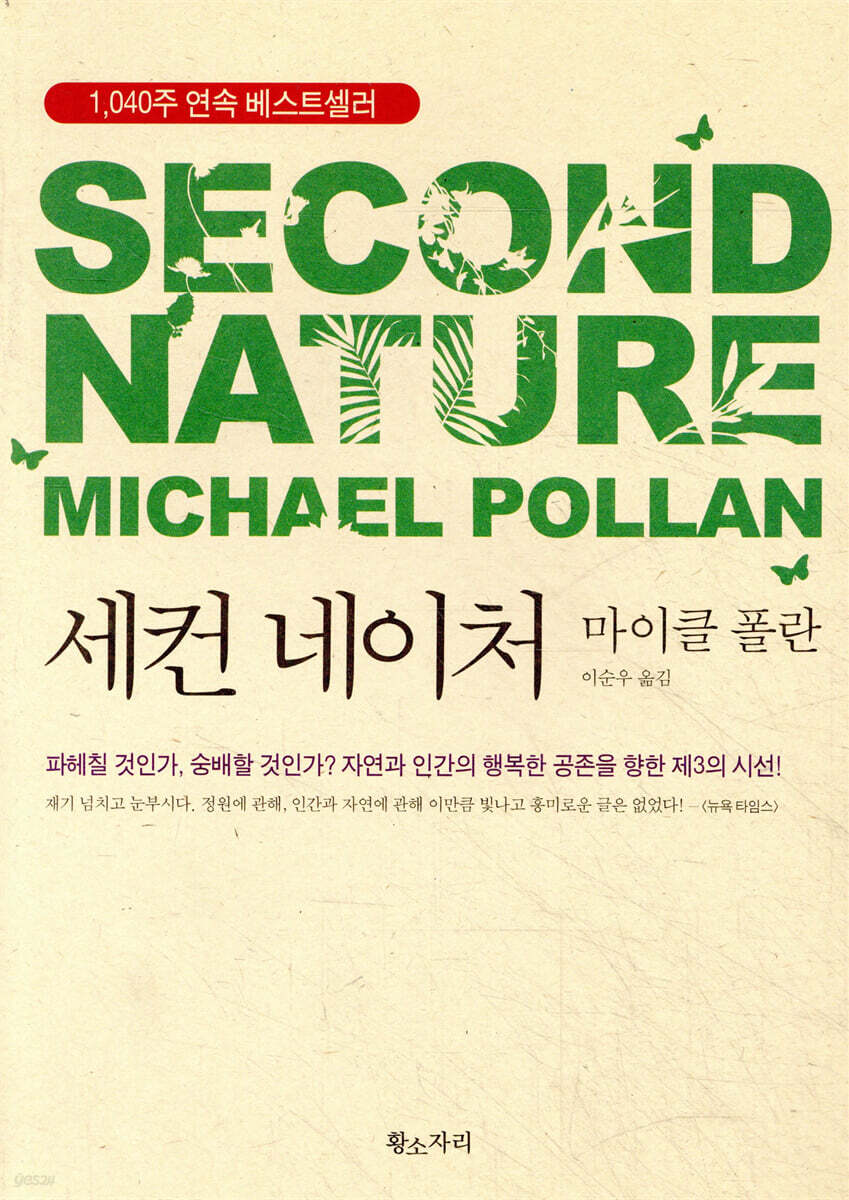
Second Nature
 |
Description
Book Introduction
This is a nature essay written by Michael Pollan, an environmental activist who has consistently won the love of readers around the world, based on his experience of working the land for seven years.
With his characteristically lively and vibrant prose, the author concisely unfolds a vast narrative ranging from the most practical questions of the relationship between humans and nature to the realities of history, politics, aesthetics, and ethics.
This shows that nature and humans can live together in a healthy relationship, rather than one of conflict and opposition.
Pollan proposes the garden as a space that offers modern people, who have lost the ability to properly communicate with nature, the possibility and basis for the happy coexistence of nature and humans.
Living in a Manhattan apartment that averaged less than two hours of sunlight a day, he decided to return to gardening by purchasing an abandoned dairy farm on the eastern edge of Cornwall's Housatonic Valley, a memory that lingered in his memory as a precious child.
I have written down in this book everything I felt and realized while spending spring, summer, fall, and winter there.
This book, which shatters the fiction of dichotomous thinking about nature and culture, will offer a new perspective and hopeful alternative to environmental and food issues for this generation, which struggles with the polar opposites of development and conservation.
With his characteristically lively and vibrant prose, the author concisely unfolds a vast narrative ranging from the most practical questions of the relationship between humans and nature to the realities of history, politics, aesthetics, and ethics.
This shows that nature and humans can live together in a healthy relationship, rather than one of conflict and opposition.
Pollan proposes the garden as a space that offers modern people, who have lost the ability to properly communicate with nature, the possibility and basis for the happy coexistence of nature and humans.
Living in a Manhattan apartment that averaged less than two hours of sunlight a day, he decided to return to gardening by purchasing an abandoned dairy farm on the eastern edge of Cornwall's Housatonic Valley, a memory that lingered in his memory as a precious child.
I have written down in this book everything I felt and realized while spending spring, summer, fall, and winter there.
This book, which shatters the fiction of dichotomous thinking about nature and culture, will offer a new perspective and hopeful alternative to environmental and food issues for this generation, which struggles with the polar opposites of development and conservation.
- You can preview some of the book's contents.
Preview
Into the book
It was nice to visit my grandfather's house and still have something to harvest.
I ran out into the field before my grandfather could even hand me the basket.
Because my grandfather kept nagging me about this and that whenever I was with him, I went to the field by myself before my mother could even finish greeting him.
The vegetables that grew well were a wonder to me.
The unharvested vegetable garden was full of possibilities.
It made me feel good to see the tomatoes ripening from dark green to red.
When I saw the kidney beans growing long pods under the heart-shaped leaves, it took my breath away.
It was a real pleasure to hug a cantaloupe warmed by the sun and to pull out the yellow weeds sprouting from the ground.
--- p.34, from Chapter 1, Two Gardens
My father started the machine, which miraculously started, and started mowing the lawn.
But the early bird did not move in a straight line.
From right to left, then from left to right again.
He mowed the overgrown grass in an S-shaped curve.
He made an M again and finally a P.
The three letters were his father's initials, and he engraved them and then turned off the engine.
Then he threw the starter into the garage and never started it again.
--- p.39, from Chapter 1, Two Gardens
spring
As the fire spread through the trees and the situation grew, I was alarmed and decided not to deal with the garden nuisance in a Vietnam War-style way.
It was not possible to burn all the garden leaves or pollute the groundwater.
But my anger at the woodchuck made me understand that sometimes we can't help but feel so angry at nature.
Nature's uncompromising ways sometimes drive us crazy.
To achieve our goals, we become so persistent that we even resort to poison.
But after I got rid of cabbage worms and aphids all at once with high-performance pesticides, it seemed like it would be difficult to judge whether I was doing a good job.
The lesson I learned from the chemical method was that it was better to contain the guy than to try to beat him.
--- p.68, from Chapter 2, Nature Hates Gardens
The more I got into gardening, the more skeptical I became about lawns.
It was not a problem arising from my relationship with my neighbors, as my father had experienced, but a doubt about my relationship with nature.
If grass has a democratic meaning in our relationships with our neighbors, it is no exaggeration to say that it is treated in an extremely authoritarian way in our relationship with nature.
The natural landscape disappears before the merciless and indiscriminate power of the early stage, and the grass becomes completely subservient to human power.
Tending the lawn in the garden felt like waxing a floor or paving a road.
Gardening could be said to be a process of giving and receiving something with nature, in the middle ground between nature and culture.
But the lawn was nothing more than nature thoroughly trampled.
--- p.93, from Chapter 3, Why Do We Mow the Lawn?
In a metaphysical sense, compost restores the gardener's independence.
At least that's what garden centers and pesticide companies say.
By creating a natural cycle in your garden when producing crops, you no longer need to rely on anyone other than the seed dealer.
Compost also makes the soil more fertile, further solidifying our long-held belief that we can get more from the land by improving it through composting.
--- p.106, from Chapter 4, Metaphysics of Duum
summer
What makes that flower so alluring is that it resembles a woman.
A bumblebee will never understand the metaphor of “excited fairy thighs.”
Because this is something we humans created or chose.
So is this fiction? Mere imagination? (But what about the bumblebee? Isn't its pollination a very real reality, one that leaves no room for imagination?) If we talk about a rose (nature) that we have hybridized (culture) and that flower (nature) makes us imagine a woman (nature) (culture), are we talking about nature or culture? Perhaps this kind of confusion is what we need more than anything else.
--- pp.145~146, from Chapter 5, In the Rose Garden
Finally, I realized that it was irresponsible to suffocate my garden with weeds.
The plants in my garden trusted me with their fate, but I failed to protect them from the onslaught of weeds.
So I dug up my garden again and started tending it in a new way.
This time, I dug a square patch in the lawn, made 18-inch furrows, and sowed the seeds.
From the moment the sprouts started to come up, I took up the hoe my grandfather had given me and diligently pulled out the weeds that had sprouted between the furrows.
I didn't think much of it.
--- p.173, from Chapter 6, We Are the Weeds
How could someone who couldn't even grow a single carrot properly deserve to be praised for his talent? My carrot-growing failure left me bewildered, and my faith in gardening was in jeopardy.
I began to study carrots with a generous heart.
I thought deeply and seriously.
I even tried to think from the carrot's perspective.
What situations do carrots dislike? (…) Is it the other crops they're growing alongside that are the problem? (…) What do carrots care about? These are not silly questions.
--- p.177, from Chapter 7, Talent in Gardening
autumn
What could possibly form such a large lump? One could say it's dirt, but that's not quite right.
The soil is no less saturated than it was when I planted the pumpkins here last May.
If it took a similar amount of other materials to create a mass of this size, we would have encountered a Sibley pumpkin sitting in a sunken pit.
But the reality was not like that.
It felt like a miracle to me.
--- p.213, from Chapter 8, Autumn Harvest
Just as iron is attracted to a magnet, all our thoughts and metaphors rush to the tree.
Trees are not only not created by humans, but they exist completely independent of the meaning we give them.
But trees have long been married to the metaphors we create, so we don't think of them as independent entities at all.
We have always thought that the metaphors we give trees (as a place of God, a commodity, a part of transcendent nature, or an element of a forest ecosystem) are what they really are.
So what new metaphors might be appropriate for the modern situation? The metaphor of the tree is crucial.
Because that largely determines the fate of the tree.
--- p.253, from Chapter 9, Planting a Tree
The ethics of the wild require judgments to be 'all or nothing'.
The American landscape is the result of faithfully following such uniform judgments.
Americans have taken extreme measures, drawing strict boundaries around sacred areas such as wilderness areas and allowing development without restraint in other areas.
Once the landscape of a region loses its 'virginity', it becomes a corrupted place, a land that cannot be restored to its previous natural state.
This notion was transferred to another sacred American ethic, the laissez-faire economic ideology.
--- p.279, from Chapter 10, The Unfinished Garden: The Concept of Another Garden
winter
Hudson is right.
I am not the master of the plant world, but their servant.
By providing the impetus for DNA transfer between species, and by transmitting diverse information that transcends time and space, they serve as mediators for the ultimate evolution that is difficult to even dream of.
For a long time, I thought that things like devouring catalogs, distributing seeds by mail, and combining completely different varieties to create new combinations were all for my own enjoyment.
But it doesn't seem to be that simple of a problem.
You might want to call me a bumblebee.
--- p.334, from Chapter 11, Winter Garden of Reflection
Creating rectilinear shapes in the garden has surprisingly sparked controversy.
After I wrote a piece about my experiences growing annual flower beds, I received strong letters of protest from both environmentalists and garden designers.
A Massachusetts garden designer did not hesitate to accuse me of being 'irresponsible' and of 'disrupting established aesthetic traditions' by planting crops in square or row patterns.
They also argued that such methods would lead to excessive reliance on fertilizers, herbicides and pesticides, which would damage the environment.
I ran out into the field before my grandfather could even hand me the basket.
Because my grandfather kept nagging me about this and that whenever I was with him, I went to the field by myself before my mother could even finish greeting him.
The vegetables that grew well were a wonder to me.
The unharvested vegetable garden was full of possibilities.
It made me feel good to see the tomatoes ripening from dark green to red.
When I saw the kidney beans growing long pods under the heart-shaped leaves, it took my breath away.
It was a real pleasure to hug a cantaloupe warmed by the sun and to pull out the yellow weeds sprouting from the ground.
--- p.34, from Chapter 1, Two Gardens
My father started the machine, which miraculously started, and started mowing the lawn.
But the early bird did not move in a straight line.
From right to left, then from left to right again.
He mowed the overgrown grass in an S-shaped curve.
He made an M again and finally a P.
The three letters were his father's initials, and he engraved them and then turned off the engine.
Then he threw the starter into the garage and never started it again.
--- p.39, from Chapter 1, Two Gardens
spring
As the fire spread through the trees and the situation grew, I was alarmed and decided not to deal with the garden nuisance in a Vietnam War-style way.
It was not possible to burn all the garden leaves or pollute the groundwater.
But my anger at the woodchuck made me understand that sometimes we can't help but feel so angry at nature.
Nature's uncompromising ways sometimes drive us crazy.
To achieve our goals, we become so persistent that we even resort to poison.
But after I got rid of cabbage worms and aphids all at once with high-performance pesticides, it seemed like it would be difficult to judge whether I was doing a good job.
The lesson I learned from the chemical method was that it was better to contain the guy than to try to beat him.
--- p.68, from Chapter 2, Nature Hates Gardens
The more I got into gardening, the more skeptical I became about lawns.
It was not a problem arising from my relationship with my neighbors, as my father had experienced, but a doubt about my relationship with nature.
If grass has a democratic meaning in our relationships with our neighbors, it is no exaggeration to say that it is treated in an extremely authoritarian way in our relationship with nature.
The natural landscape disappears before the merciless and indiscriminate power of the early stage, and the grass becomes completely subservient to human power.
Tending the lawn in the garden felt like waxing a floor or paving a road.
Gardening could be said to be a process of giving and receiving something with nature, in the middle ground between nature and culture.
But the lawn was nothing more than nature thoroughly trampled.
--- p.93, from Chapter 3, Why Do We Mow the Lawn?
In a metaphysical sense, compost restores the gardener's independence.
At least that's what garden centers and pesticide companies say.
By creating a natural cycle in your garden when producing crops, you no longer need to rely on anyone other than the seed dealer.
Compost also makes the soil more fertile, further solidifying our long-held belief that we can get more from the land by improving it through composting.
--- p.106, from Chapter 4, Metaphysics of Duum
summer
What makes that flower so alluring is that it resembles a woman.
A bumblebee will never understand the metaphor of “excited fairy thighs.”
Because this is something we humans created or chose.
So is this fiction? Mere imagination? (But what about the bumblebee? Isn't its pollination a very real reality, one that leaves no room for imagination?) If we talk about a rose (nature) that we have hybridized (culture) and that flower (nature) makes us imagine a woman (nature) (culture), are we talking about nature or culture? Perhaps this kind of confusion is what we need more than anything else.
--- pp.145~146, from Chapter 5, In the Rose Garden
Finally, I realized that it was irresponsible to suffocate my garden with weeds.
The plants in my garden trusted me with their fate, but I failed to protect them from the onslaught of weeds.
So I dug up my garden again and started tending it in a new way.
This time, I dug a square patch in the lawn, made 18-inch furrows, and sowed the seeds.
From the moment the sprouts started to come up, I took up the hoe my grandfather had given me and diligently pulled out the weeds that had sprouted between the furrows.
I didn't think much of it.
--- p.173, from Chapter 6, We Are the Weeds
How could someone who couldn't even grow a single carrot properly deserve to be praised for his talent? My carrot-growing failure left me bewildered, and my faith in gardening was in jeopardy.
I began to study carrots with a generous heart.
I thought deeply and seriously.
I even tried to think from the carrot's perspective.
What situations do carrots dislike? (…) Is it the other crops they're growing alongside that are the problem? (…) What do carrots care about? These are not silly questions.
--- p.177, from Chapter 7, Talent in Gardening
autumn
What could possibly form such a large lump? One could say it's dirt, but that's not quite right.
The soil is no less saturated than it was when I planted the pumpkins here last May.
If it took a similar amount of other materials to create a mass of this size, we would have encountered a Sibley pumpkin sitting in a sunken pit.
But the reality was not like that.
It felt like a miracle to me.
--- p.213, from Chapter 8, Autumn Harvest
Just as iron is attracted to a magnet, all our thoughts and metaphors rush to the tree.
Trees are not only not created by humans, but they exist completely independent of the meaning we give them.
But trees have long been married to the metaphors we create, so we don't think of them as independent entities at all.
We have always thought that the metaphors we give trees (as a place of God, a commodity, a part of transcendent nature, or an element of a forest ecosystem) are what they really are.
So what new metaphors might be appropriate for the modern situation? The metaphor of the tree is crucial.
Because that largely determines the fate of the tree.
--- p.253, from Chapter 9, Planting a Tree
The ethics of the wild require judgments to be 'all or nothing'.
The American landscape is the result of faithfully following such uniform judgments.
Americans have taken extreme measures, drawing strict boundaries around sacred areas such as wilderness areas and allowing development without restraint in other areas.
Once the landscape of a region loses its 'virginity', it becomes a corrupted place, a land that cannot be restored to its previous natural state.
This notion was transferred to another sacred American ethic, the laissez-faire economic ideology.
--- p.279, from Chapter 10, The Unfinished Garden: The Concept of Another Garden
winter
Hudson is right.
I am not the master of the plant world, but their servant.
By providing the impetus for DNA transfer between species, and by transmitting diverse information that transcends time and space, they serve as mediators for the ultimate evolution that is difficult to even dream of.
For a long time, I thought that things like devouring catalogs, distributing seeds by mail, and combining completely different varieties to create new combinations were all for my own enjoyment.
But it doesn't seem to be that simple of a problem.
You might want to call me a bumblebee.
--- p.334, from Chapter 11, Winter Garden of Reflection
Creating rectilinear shapes in the garden has surprisingly sparked controversy.
After I wrote a piece about my experiences growing annual flower beds, I received strong letters of protest from both environmentalists and garden designers.
A Massachusetts garden designer did not hesitate to accuse me of being 'irresponsible' and of 'disrupting established aesthetic traditions' by planting crops in square or row patterns.
They also argued that such methods would lead to excessive reliance on fertilizers, herbicides and pesticides, which would damage the environment.
--- p.357, from Chapter 12, Garden Journey
Publisher's Review
Michael Pollan, America's most beloved author,
Creating a real paradise where humans and nature coexist!
A naturalist who once championed the wild threw down his hoe while ploughing a soybean field as an experiment.
He turned his back on the world and hid by the lake for three years, and wrote about his experiences in a book that would later be revered as a great work.
"Couldn't it be said that these beans are grown for woodchucks? (...) Then, why should we be so disheartened by the failure of our bean crops? Isn't it a pleasant thought that the abundant weeds provide a richer food source for birds?"
As you know, this is the story of Henry David Thoreau, the author of Walden.
About 150 years later.
A man in Connecticut, USA, who was engaged in a fierce standoff with a woodchuck to protect his vegetable seedlings, laughed it off.
“Of course it’s fun, Henry.
And then you starve to death.”
The Adventures of a Gardener Who Said Goodbye to Thoreau
Michael Pollan.
He has a bestseller list that is as impressive as Thoreau's, and he has earned a reputation as one of America's most beloved authors.
He too was initially a faithful disciple of Soro.
But it was extremely difficult to maintain a romantic identity when deer, raccoons, woodchucks, all sorts of insects and weeds were waging an all-out attack on the garden he had painstakingly cultivated on the rocky hillside.
Because he was not an observer of nature, but a 'gardener' who had to act within nature.
Second Nature, which the Washington Post praised as “part autobiography, part garden book, and part intellectual epic,” is a book written by author Michael Pollan based on his seven years of experience working the land.
With his characteristically lively and vibrant prose, Pollan concisely unfolds a vast narrative ranging from the most practical questions of the relationship between humans and nature to the realities of history, politics, aesthetics, and ethics.
Pollan discovered the garden as a space that presents the possibility and basis for the happy coexistence of nature and humans to modern people who have lost the ability to properly communicate with nature.
For those of us who are struggling between the extremes of development and conservation, his idea of perceiving the world as a garden offers a new perspective and hopeful alternative for approaching the environment and food issues, the biggest issues of the 21st century.
Leaving Manhattan for the farm
As a child, he experienced two extreme gardens.
My grandfather's garden, which bordered on obsession with geometric rules, and my father's neglected garden, which mercilessly ruined the suburban landscape that had been undulating with neat waves of lawn.
Although it was clear that his grandfather viewed land as a 'good of great exchange value,' he loved his grandfather's garden.
Harvesting melons and tomatoes in the clean fields always made his heart race, and until he reached puberty, he cultivated the empty land and grew vegetables such as strawberries, watermelons, cucumbers, and eggplants.
If it was his maternal grandfather who gave him the impression and concept of gardens, it was his father who made him realize that gardens could be used to express political opinions.
My father, who had consistently ignored the neighbors' silent pressure to mow the lawn that had grown wild, started the mower and carved his initials in the middle of the yard on the day the man next door came to visit as a messenger.
(As those who know him know, Michael Pollan's father is Stephen Pollan, the author of famous books such as Die Broke and Fire Your Boss.)
When he lived in a Manhattan apartment that received less than two hours of sunlight a day, the memories of the two gardens that remained in his dim memory kept waving to him.
He decided to buy an abandoned dairy farm on the eastern edge of the Housatonic Valley in Cornwall.
Finally, it's time to return to the garden.
Spring: Nature hates gardens
Michael Pollan unpacked in Cornwall and was filled with dreams.
Perennial flower beds should not be ridged to allow weeds to grow together, and it is inelegant to insist on one's own share of the garden.
But the romantic and optimistic plan to cultivate a garden in harmony with the wild began to fail the very next day after planting the vegetable seedlings.
A guy named Woodchuck showed up and proudly ate the seedlings in the field that we had worked so hard to cultivate as if it were a meal prepared just for him.
He tried pushing rocks into the burrows and pouring gasoline on woodchuck dens in a Vietnam War-like chemical attack, but it only spread the fire in the wrong places and had no effect.
It wasn't just Woodchuck.
The weeds, which had hoped to grow in harmony with the garden plants, were gradually expanding their influence and threatening to suffocate the perennials.
The attacks by aphids, all kinds of bugs, and soil bacteria were also at a formidable level.
Nature has invaded the garden in every possible way.
He realized too late that he was not only unprepared to repel the enemy's attack, but he was also unprepared to even properly determine his attitude in nature.
Summer: Will you accept it or will you reign it over?
It was utterly irresponsible to tolerate their invasion under the pretense of respecting the wildness of nature, based on the naive perception of city dwellers who only observed nature.
Young sprouts attacked by woodchucks from dawn, ugly carrots growing in poor soil, flowers choked by weeds and unable to grow, dahlias not blooming properly, tomatoes not ripening before the frost… … .
Garden plants cannot grow properly without proper human intervention to prevent nature's violent attacks.
However, I also did not like the idea of controlling the garden by using toxic pesticides such as DDT or malathion.
After World War II, chemical fertilizers and pesticides briefly prospered, realizing the dream of mass production. But within half a century, weren't the lands devastated and crops, like drug-addled addicts, rendered hopelessly weak? Human arrogance has indiscriminately destroyed the symbiotic relationships that nature has cultivated over 2.5 billion years of evolution.
Having experienced the failures of both 'overcultivation', which reduces nature to an object, and 'undercultivation', which excessively limits human intervention, Pollan realized that the role of a good gardener is to maintain a balance so that neither humans nor nature wins or loses completely.
He thought of his carrots, small and lumpy like arthritic fingers.
The ugly carrot that was 'romanticized' and 'neglected'.
I hurriedly broke up the coarse clods of dirt and mixed in compost to make the soil soft, and that summer the carrots pushed up their plump, light yellow shoulders.
I wiped a carrot root on my shirt and took a bite.
It is a 'carrot-like' carrot with a strong, fresh and sweet taste along with an earthy scent.
He smiled faintly and thought about it.
'Maybe I really have talent.'
Autumn: The Garden of Earth
Throughout the fall of 1989, Cornwall was reeling from stories of the Cathedral Pine Grove, utterly obliterated by a tornado.
People argued over whether or not to clear away the debris and plant trees in the forest that had been destroyed overnight.
On one side were the purist environmentalists who believed that any intervention in nature was unnatural, while on the other side were those who valued practical interests.
As the controversy heated up, Pollan became more despondent.
This dispute was another classic example of our flawed approach to environmental issues.
Armed with a pioneering spirit, the Puritans viewed nature only as an object to be overcome.
Since Thoreau went into the woods, shuddering at the merciless destruction of nature, people have long had a choice between the Puritan and Thoreau's views.
Although the two seem to be very different, they are like two sides of the same coin in that they perceive humans (culture) and nature (wildlife) as opposing each other.
However, we must acknowledge that nature and humans are not only very similar, but are also intertwined like warp and weft within the framework of history.
Modern people living in cities support the theory of 'forest succession', which states that nature changes according to certain rules, and dismiss all changes attempted by humans as unnatural.
But in the natural world, absolute power is actually a matter of chance.
An acorn hidden by a squirrel, a deer suddenly appearing and eating a pine bud, seed pods blown from a street tree, acid rain, or even a cigarette carelessly discarded by a person can completely change the future of a forest.
Everything can affect the future of nature, so why shouldn't we project our hopes and aspirations onto the future of the forest?
Moreover, it is too late to maintain a passive approach of preserving the wild and leaving everything to it.
Perhaps these profoundly human and ecologically unfriendly qualities—conscience, ethical choice, memory, and discernment—are actually the very things that offer the Earth its last hope? Now is the time to truly unleash these abilities in the natural world.
Winter: Garden Possibilities
During the winter, when all the garden plants were dormant, Pollan would flip through the catalogs sent by the nursery and plan the garden for the following year.
This time, what caught his eye was Hudson's catalogue, 'Anarchists in the Garden'.
“We have an incredible opportunity to travel the world quickly with the help of fossil fuels,” Hudson said, suggesting that humans should contribute to evolution by transferring DNA between species and preserving seeds, much like migratory birds transfer seeds.
Soon, a multicultural and timeless garden sprouted in Pollan's imagination.
A garden where Indian Sibley pumpkins, Madame Hardy roses bred in Malmaison, France, and hollyhocks arrived from Monet's Giverny garden via Toyota and Boeing 747 all grow together! Ladybugs and lacewing larvae are busily circling the refrigerator to ward off pests, and soon, courier companies like UPS and FedEx will be delivering seeds.
After seven years of working with the land, Pollan shed his shallow romanticism and transformed into a professional gardener.
He boldly introduced geometric flower beds, which he had previously been reluctant to consider too artificial, into his garden, while also learning to leave the wetlands, which had repeatedly frustrated his attempts, as they were.
How beautiful is the tension between the disorderly wetlands and the divided vegetable gardens!
Even if you diligently push the lawn mower to clear a path through the pasture, nature will soon come and, in its pursuit of man-made beauty, erase any trace of the gardener's actions.
But he waited for that moment instead.
What could be more thrilling than the prospect of nature and humanity reconciling and harmonizing?
A real paradise where humans and nature coexist
Michael Pollan won the 'New Perspective Award' selected by the Quality Paperback Book Club (QPB) that year for his book 'Second Nature', which completely shattered the fiction of the dichotomous thinking about nature and culture.
The fact that his story remains on the bestseller list in the United States more than 20 years after its publication probably means that it is still 'new'.
We, here now, with our feet firmly planted in the gray apartments that are rising by the day, vaguely dream of nature as a place to escape to someday.
The story of a man who escaped his New York apartment and worked hard to cultivate a garden, "Second Nature," poses countless questions to us.
As we answer Pollan's questions, sometimes jokingly, sometimes with a serious tone, we will find ourselves escaping from the gloomy reality and finding ourselves enveloped in a sense of spiritual uplift, seeking a more positive future.
An experience where the aesthetic and ethical foundation of readers' views of nature and humanity becomes increasingly enriched, and a bud of hope sprouts that we can happily coexist!
This is precisely the role of a truly great gardener that Pollan dreams of.
Creating a real paradise where humans and nature coexist!
A naturalist who once championed the wild threw down his hoe while ploughing a soybean field as an experiment.
He turned his back on the world and hid by the lake for three years, and wrote about his experiences in a book that would later be revered as a great work.
"Couldn't it be said that these beans are grown for woodchucks? (...) Then, why should we be so disheartened by the failure of our bean crops? Isn't it a pleasant thought that the abundant weeds provide a richer food source for birds?"
As you know, this is the story of Henry David Thoreau, the author of Walden.
About 150 years later.
A man in Connecticut, USA, who was engaged in a fierce standoff with a woodchuck to protect his vegetable seedlings, laughed it off.
“Of course it’s fun, Henry.
And then you starve to death.”
The Adventures of a Gardener Who Said Goodbye to Thoreau
Michael Pollan.
He has a bestseller list that is as impressive as Thoreau's, and he has earned a reputation as one of America's most beloved authors.
He too was initially a faithful disciple of Soro.
But it was extremely difficult to maintain a romantic identity when deer, raccoons, woodchucks, all sorts of insects and weeds were waging an all-out attack on the garden he had painstakingly cultivated on the rocky hillside.
Because he was not an observer of nature, but a 'gardener' who had to act within nature.
Second Nature, which the Washington Post praised as “part autobiography, part garden book, and part intellectual epic,” is a book written by author Michael Pollan based on his seven years of experience working the land.
With his characteristically lively and vibrant prose, Pollan concisely unfolds a vast narrative ranging from the most practical questions of the relationship between humans and nature to the realities of history, politics, aesthetics, and ethics.
Pollan discovered the garden as a space that presents the possibility and basis for the happy coexistence of nature and humans to modern people who have lost the ability to properly communicate with nature.
For those of us who are struggling between the extremes of development and conservation, his idea of perceiving the world as a garden offers a new perspective and hopeful alternative for approaching the environment and food issues, the biggest issues of the 21st century.
Leaving Manhattan for the farm
As a child, he experienced two extreme gardens.
My grandfather's garden, which bordered on obsession with geometric rules, and my father's neglected garden, which mercilessly ruined the suburban landscape that had been undulating with neat waves of lawn.
Although it was clear that his grandfather viewed land as a 'good of great exchange value,' he loved his grandfather's garden.
Harvesting melons and tomatoes in the clean fields always made his heart race, and until he reached puberty, he cultivated the empty land and grew vegetables such as strawberries, watermelons, cucumbers, and eggplants.
If it was his maternal grandfather who gave him the impression and concept of gardens, it was his father who made him realize that gardens could be used to express political opinions.
My father, who had consistently ignored the neighbors' silent pressure to mow the lawn that had grown wild, started the mower and carved his initials in the middle of the yard on the day the man next door came to visit as a messenger.
(As those who know him know, Michael Pollan's father is Stephen Pollan, the author of famous books such as Die Broke and Fire Your Boss.)
When he lived in a Manhattan apartment that received less than two hours of sunlight a day, the memories of the two gardens that remained in his dim memory kept waving to him.
He decided to buy an abandoned dairy farm on the eastern edge of the Housatonic Valley in Cornwall.
Finally, it's time to return to the garden.
Spring: Nature hates gardens
Michael Pollan unpacked in Cornwall and was filled with dreams.
Perennial flower beds should not be ridged to allow weeds to grow together, and it is inelegant to insist on one's own share of the garden.
But the romantic and optimistic plan to cultivate a garden in harmony with the wild began to fail the very next day after planting the vegetable seedlings.
A guy named Woodchuck showed up and proudly ate the seedlings in the field that we had worked so hard to cultivate as if it were a meal prepared just for him.
He tried pushing rocks into the burrows and pouring gasoline on woodchuck dens in a Vietnam War-like chemical attack, but it only spread the fire in the wrong places and had no effect.
It wasn't just Woodchuck.
The weeds, which had hoped to grow in harmony with the garden plants, were gradually expanding their influence and threatening to suffocate the perennials.
The attacks by aphids, all kinds of bugs, and soil bacteria were also at a formidable level.
Nature has invaded the garden in every possible way.
He realized too late that he was not only unprepared to repel the enemy's attack, but he was also unprepared to even properly determine his attitude in nature.
Summer: Will you accept it or will you reign it over?
It was utterly irresponsible to tolerate their invasion under the pretense of respecting the wildness of nature, based on the naive perception of city dwellers who only observed nature.
Young sprouts attacked by woodchucks from dawn, ugly carrots growing in poor soil, flowers choked by weeds and unable to grow, dahlias not blooming properly, tomatoes not ripening before the frost… … .
Garden plants cannot grow properly without proper human intervention to prevent nature's violent attacks.
However, I also did not like the idea of controlling the garden by using toxic pesticides such as DDT or malathion.
After World War II, chemical fertilizers and pesticides briefly prospered, realizing the dream of mass production. But within half a century, weren't the lands devastated and crops, like drug-addled addicts, rendered hopelessly weak? Human arrogance has indiscriminately destroyed the symbiotic relationships that nature has cultivated over 2.5 billion years of evolution.
Having experienced the failures of both 'overcultivation', which reduces nature to an object, and 'undercultivation', which excessively limits human intervention, Pollan realized that the role of a good gardener is to maintain a balance so that neither humans nor nature wins or loses completely.
He thought of his carrots, small and lumpy like arthritic fingers.
The ugly carrot that was 'romanticized' and 'neglected'.
I hurriedly broke up the coarse clods of dirt and mixed in compost to make the soil soft, and that summer the carrots pushed up their plump, light yellow shoulders.
I wiped a carrot root on my shirt and took a bite.
It is a 'carrot-like' carrot with a strong, fresh and sweet taste along with an earthy scent.
He smiled faintly and thought about it.
'Maybe I really have talent.'
Autumn: The Garden of Earth
Throughout the fall of 1989, Cornwall was reeling from stories of the Cathedral Pine Grove, utterly obliterated by a tornado.
People argued over whether or not to clear away the debris and plant trees in the forest that had been destroyed overnight.
On one side were the purist environmentalists who believed that any intervention in nature was unnatural, while on the other side were those who valued practical interests.
As the controversy heated up, Pollan became more despondent.
This dispute was another classic example of our flawed approach to environmental issues.
Armed with a pioneering spirit, the Puritans viewed nature only as an object to be overcome.
Since Thoreau went into the woods, shuddering at the merciless destruction of nature, people have long had a choice between the Puritan and Thoreau's views.
Although the two seem to be very different, they are like two sides of the same coin in that they perceive humans (culture) and nature (wildlife) as opposing each other.
However, we must acknowledge that nature and humans are not only very similar, but are also intertwined like warp and weft within the framework of history.
Modern people living in cities support the theory of 'forest succession', which states that nature changes according to certain rules, and dismiss all changes attempted by humans as unnatural.
But in the natural world, absolute power is actually a matter of chance.
An acorn hidden by a squirrel, a deer suddenly appearing and eating a pine bud, seed pods blown from a street tree, acid rain, or even a cigarette carelessly discarded by a person can completely change the future of a forest.
Everything can affect the future of nature, so why shouldn't we project our hopes and aspirations onto the future of the forest?
Moreover, it is too late to maintain a passive approach of preserving the wild and leaving everything to it.
Perhaps these profoundly human and ecologically unfriendly qualities—conscience, ethical choice, memory, and discernment—are actually the very things that offer the Earth its last hope? Now is the time to truly unleash these abilities in the natural world.
Winter: Garden Possibilities
During the winter, when all the garden plants were dormant, Pollan would flip through the catalogs sent by the nursery and plan the garden for the following year.
This time, what caught his eye was Hudson's catalogue, 'Anarchists in the Garden'.
“We have an incredible opportunity to travel the world quickly with the help of fossil fuels,” Hudson said, suggesting that humans should contribute to evolution by transferring DNA between species and preserving seeds, much like migratory birds transfer seeds.
Soon, a multicultural and timeless garden sprouted in Pollan's imagination.
A garden where Indian Sibley pumpkins, Madame Hardy roses bred in Malmaison, France, and hollyhocks arrived from Monet's Giverny garden via Toyota and Boeing 747 all grow together! Ladybugs and lacewing larvae are busily circling the refrigerator to ward off pests, and soon, courier companies like UPS and FedEx will be delivering seeds.
After seven years of working with the land, Pollan shed his shallow romanticism and transformed into a professional gardener.
He boldly introduced geometric flower beds, which he had previously been reluctant to consider too artificial, into his garden, while also learning to leave the wetlands, which had repeatedly frustrated his attempts, as they were.
How beautiful is the tension between the disorderly wetlands and the divided vegetable gardens!
Even if you diligently push the lawn mower to clear a path through the pasture, nature will soon come and, in its pursuit of man-made beauty, erase any trace of the gardener's actions.
But he waited for that moment instead.
What could be more thrilling than the prospect of nature and humanity reconciling and harmonizing?
A real paradise where humans and nature coexist
Michael Pollan won the 'New Perspective Award' selected by the Quality Paperback Book Club (QPB) that year for his book 'Second Nature', which completely shattered the fiction of the dichotomous thinking about nature and culture.
The fact that his story remains on the bestseller list in the United States more than 20 years after its publication probably means that it is still 'new'.
We, here now, with our feet firmly planted in the gray apartments that are rising by the day, vaguely dream of nature as a place to escape to someday.
The story of a man who escaped his New York apartment and worked hard to cultivate a garden, "Second Nature," poses countless questions to us.
As we answer Pollan's questions, sometimes jokingly, sometimes with a serious tone, we will find ourselves escaping from the gloomy reality and finding ourselves enveloped in a sense of spiritual uplift, seeking a more positive future.
An experience where the aesthetic and ethical foundation of readers' views of nature and humanity becomes increasingly enriched, and a bud of hope sprouts that we can happily coexist!
This is precisely the role of a truly great gardener that Pollan dreams of.
GOODS SPECIFICS
- Date of issue: September 15, 2009
- Page count, weight, size: 384 pages | 525g | 153*224*30mm
- ISBN13: 9788991508606
- ISBN10: 899150860X
You may also like
카테고리
korean


korean

![GQ KOREA Mark (Monthly): December [2025]](http://librairie.coreenne.fr/cdn/shop/files/8ef265dbbfbf186523ed75ba7319009d.jpg?v=1765340328&width=3840)


