

Science Essay for the President
 |
Description
Book Introduction
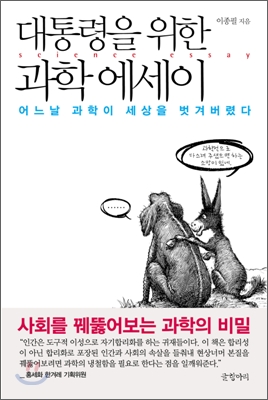
A general education book in which the author, a particle physicist, analyzes Korean society as a whole, including politics, culture, society, and humanity, across the humanities, social sciences, and natural sciences.
The author, who has shifted science from an "object to be explained" to a "lens through which to view the world," views social phenomena through the lens of rationality that scientists consider.
He brings science into the rough and tumble of politics, the complexities of economics, and the nuances of culture, and he uses it to his advantage.
We are exploring whether science has meaning beyond the laboratory, and whether the phenomena of physical space will exhibit similar symmetries in the world of power and human relationships.
Conversely, we also examine whether the phenomena of the world are scientifically motions, interruptions, or continuities.
There is something in the deep thinking of a scientist who has devoured social science books that goes beyond the scientist's lectures on society.
This is because a more intimate and active ‘self-identity’ is reflected a lot.
Until now, it has been rare for a scientist to publish a book that explores the struggles and wanderings between the two cultures of liberal arts and science.
It was usually a one-sided discourse where one side either loved or criticized the other, but there were not many cases where it was embodied and put into writing.
This book seeks phenomenological analysis, and sometimes philosophical questions and solutions, in the four areas of politics, culture, society, and humanity, through a fusion rather than a mechanical combination of science and society.
The author, who has shifted science from an "object to be explained" to a "lens through which to view the world," views social phenomena through the lens of rationality that scientists consider.
He brings science into the rough and tumble of politics, the complexities of economics, and the nuances of culture, and he uses it to his advantage.
We are exploring whether science has meaning beyond the laboratory, and whether the phenomena of physical space will exhibit similar symmetries in the world of power and human relationships.
Conversely, we also examine whether the phenomena of the world are scientifically motions, interruptions, or continuities.
There is something in the deep thinking of a scientist who has devoured social science books that goes beyond the scientist's lectures on society.
This is because a more intimate and active ‘self-identity’ is reflected a lot.
Until now, it has been rare for a scientist to publish a book that explores the struggles and wanderings between the two cultures of liberal arts and science.
It was usually a one-sided discourse where one side either loved or criticized the other, but there were not many cases where it was embodied and put into writing.
This book seeks phenomenological analysis, and sometimes philosophical questions and solutions, in the four areas of politics, culture, society, and humanity, through a fusion rather than a mechanical combination of science and society.
- You can preview some of the book's contents.
Preview
index
preface
Part 1 Politics
Physics for the President 1
- Physics is a required major for presidential aspirants.
The dangers of scientific thinking's 'inability' | Does simply knowing the separation of politics and religion make you a good president?
| Minimum common sense and minimum principles
Physics for the President 2
- Why corrupt politicians are not immediately vindicated
One or two counterattacks won't shake the theory | Lee Myung-bak is the most 'well-equipped theory' | The Duhem-Quine thesis in politics
Physics for the President 3
- Absurdly low entropy, the BBK incident
Why Scientists Believe in the Law of Increasing Entropy | The BBK Incident: A Case Unexplainable Through Entropy Theory
An honest confession is better than a bogus scientific paper.
Is objective observation of politics possible?
-Theory dependence of observations
Why Experiments Can't Beat Theory | New Experimental Results Need a Grace Period | Is an Incompetent Left-Wing Government Ruining the Nation?
Is one person, one vote a natural principle?
-Evolution and Cosmology
The Universe Is Expanding | From Inhomogeneity to Inequality | The Meaning of One Person, One Vote
Part 2 Culture
The physicist who fascinated Spielberg
Randall and Sundrum Find a Solution to the "Hierarchy Problem"
The Fifth Dimension Unveils | Why Natural Sciences Are Crucial in Storytelling
“Imagination is more important than knowledge.”
- A movie created by a biologist
A film made from lectures by a fish expert | Humanities help make science more plausible
Can science be beautiful?
- 5 Correlations Between Scientific Theories and Beautiful Storylines
What Science and TV Dramas Have in Common | Five Things That Support the Beauty of Science
Korean dramas that go beyond the problem of fine-tuning
- The differences between "The Legend" and "Jumong"
The Dissonance Between Fantasy and Reality | 'Hierarchy Issues' or 'Fine-Tuning Issues' | The Inconsistent Story of "The War"
| Kim Soo-hyun's most scientific(?) drama
Korean film, production cost 10 billion won, what about scientific consulting fees?
- "Shingijeon" lacking classical mechanics
Science exists only as a formula without "awareness" | "Shin Gi Jeon" was "martial arts" rather than "scientific."
Part 3 Society
A substance that proves humanity's ignorance
- Is the cosmological constant really dark energy?
A Substance That Vividly Demonstrates Human Ignorance | The Identity of Dark Matter and Dark Energy | "Why is the Universe Expanding Now?"
The US economy, which even dark matter couldn't save
- Hausmann and Stutzeniger's dark matter theory
Is overseas investment "dark matter"? | Is it the work of the "invisible hand"?
Scientists and fortune telling and feng shui
- Baesan Imsu explained using scientific principles
"Science" must be falsifiable | Yin-Yang and the Five Elements are a codification of the universal environment | There is no quantitative analysis in fortune telling.
The problem of feng shui that science can explain
Science is also needed in politics and diplomacy.
- Quantification, modeling, and simulation
Why the media isn't scientific | What scientific combat training has achieved | Is the North Korean military really superior to South Korea's?
Conflicts between nations should be scientifically analyzed.
Game Theory Analysis of U.S. Beef Negotiations
- Successful threats according to mathematical theory
A Look at the Scientific Conditions of Negotiation | Is Korea a Rational Player? | Specialization Requires a Comprehensive Perspective
Part 4 Humans
All we know is probability.
- The world of quantum mechanics
The photon hypothesis proves the nature of light as a bundle of energy | Realizing the spirit of quantum mechanics | The birth of the Copenhagen interpretation
Is it possible to study the universe without the theory of gravity?
- Korea's first astronaut
Koreans' "natural predicament" since time immemorial | Korean science, fundamentally flawed | "Space travel is a showpiece sport"
Quantum mechanics and the observer
- The importance of observers and non-fixed eigenstates
The Crucial Role of Observation | "Even Cats Without Observation Are Just Alone"
The most beautiful physics equation in the world
- Cosmological constant and anthropic principle
Mass warps spacetime | A theory that penetrates quantum mechanics and gravity | The labyrinthine anthropic principle
The Korean government has lost its "anthropic principles"
- The lessons of Diocletian
Human autonomy not reduced to a system | The 'margins' revealed by a thousand years of Roman history
Beef negotiations lack the "anthropic principle"
Part 1 Politics
Physics for the President 1
- Physics is a required major for presidential aspirants.
The dangers of scientific thinking's 'inability' | Does simply knowing the separation of politics and religion make you a good president?
| Minimum common sense and minimum principles
Physics for the President 2
- Why corrupt politicians are not immediately vindicated
One or two counterattacks won't shake the theory | Lee Myung-bak is the most 'well-equipped theory' | The Duhem-Quine thesis in politics
Physics for the President 3
- Absurdly low entropy, the BBK incident
Why Scientists Believe in the Law of Increasing Entropy | The BBK Incident: A Case Unexplainable Through Entropy Theory
An honest confession is better than a bogus scientific paper.
Is objective observation of politics possible?
-Theory dependence of observations
Why Experiments Can't Beat Theory | New Experimental Results Need a Grace Period | Is an Incompetent Left-Wing Government Ruining the Nation?
Is one person, one vote a natural principle?
-Evolution and Cosmology
The Universe Is Expanding | From Inhomogeneity to Inequality | The Meaning of One Person, One Vote
Part 2 Culture
The physicist who fascinated Spielberg
Randall and Sundrum Find a Solution to the "Hierarchy Problem"
The Fifth Dimension Unveils | Why Natural Sciences Are Crucial in Storytelling
“Imagination is more important than knowledge.”
- A movie created by a biologist
A film made from lectures by a fish expert | Humanities help make science more plausible
Can science be beautiful?
- 5 Correlations Between Scientific Theories and Beautiful Storylines
What Science and TV Dramas Have in Common | Five Things That Support the Beauty of Science
Korean dramas that go beyond the problem of fine-tuning
- The differences between "The Legend" and "Jumong"
The Dissonance Between Fantasy and Reality | 'Hierarchy Issues' or 'Fine-Tuning Issues' | The Inconsistent Story of "The War"
| Kim Soo-hyun's most scientific(?) drama
Korean film, production cost 10 billion won, what about scientific consulting fees?
- "Shingijeon" lacking classical mechanics
Science exists only as a formula without "awareness" | "Shin Gi Jeon" was "martial arts" rather than "scientific."
Part 3 Society
A substance that proves humanity's ignorance
- Is the cosmological constant really dark energy?
A Substance That Vividly Demonstrates Human Ignorance | The Identity of Dark Matter and Dark Energy | "Why is the Universe Expanding Now?"
The US economy, which even dark matter couldn't save
- Hausmann and Stutzeniger's dark matter theory
Is overseas investment "dark matter"? | Is it the work of the "invisible hand"?
Scientists and fortune telling and feng shui
- Baesan Imsu explained using scientific principles
"Science" must be falsifiable | Yin-Yang and the Five Elements are a codification of the universal environment | There is no quantitative analysis in fortune telling.
The problem of feng shui that science can explain
Science is also needed in politics and diplomacy.
- Quantification, modeling, and simulation
Why the media isn't scientific | What scientific combat training has achieved | Is the North Korean military really superior to South Korea's?
Conflicts between nations should be scientifically analyzed.
Game Theory Analysis of U.S. Beef Negotiations
- Successful threats according to mathematical theory
A Look at the Scientific Conditions of Negotiation | Is Korea a Rational Player? | Specialization Requires a Comprehensive Perspective
Part 4 Humans
All we know is probability.
- The world of quantum mechanics
The photon hypothesis proves the nature of light as a bundle of energy | Realizing the spirit of quantum mechanics | The birth of the Copenhagen interpretation
Is it possible to study the universe without the theory of gravity?
- Korea's first astronaut
Koreans' "natural predicament" since time immemorial | Korean science, fundamentally flawed | "Space travel is a showpiece sport"
Quantum mechanics and the observer
- The importance of observers and non-fixed eigenstates
The Crucial Role of Observation | "Even Cats Without Observation Are Just Alone"
The most beautiful physics equation in the world
- Cosmological constant and anthropic principle
Mass warps spacetime | A theory that penetrates quantum mechanics and gravity | The labyrinthine anthropic principle
The Korean government has lost its "anthropic principles"
- The lessons of Diocletian
Human autonomy not reduced to a system | The 'margins' revealed by a thousand years of Roman history
Beef negotiations lack the "anthropic principle"
Publisher's Review
A bold political imagination presented to Korean society by a leading theoretical physicist!
1.
A bold counter-thinking approach to popularizing science
History and philosophy are in a similar situation today, but no other field has felt as compelled to speak to the public as science.
How can we communicate scientific principles more easily and understandably?
This was the main topic of discussion on popularizing science.
That is, how to trick it.
Perhaps it wasn't the thought of a good teacher? The moment he tried to teach, the moment he tried to explain, didn't the public actually become even more distant from science? Even if he tried to explain scientific principles through everyday terms and examples, or through comical situations, it only sparked a flash of light for a moment.
Scientific knowledge and thinking have not become a part of life.
Could it be that the approach was too uniform? Wasn't it a case of assuming that once the public understood the principles of science, they would automatically appreciate its utility?
『Science Essays for the President』 is a book that was published with this problem in mind.
Why do we view science solely as something to be explained? Isn't science, rather, a tool given to us as a lens through which we view the world? Shouldn't it be used as a turning tool to turn the world upside down, a scalpel to dissect it?
This book also builds on a scientist's impatience with a world that doesn't understand science.
But the approach is different.
Author Lee Jong-pil brings science to the harsh realm of politics, the complex economy, and the subtle world of culture, and uses it to his advantage.
We are exploring whether science has meaning beyond the laboratory, and whether the phenomena of physical space will exhibit similar symmetries in the world of power and human relationships.
Conversely, we are also examining the scientific nature of world phenomena, such as whether they are movements, interruptions, or continuities.
The starting point is that, in the author's view as a particle physicist, there are too many irrational things in the world, and too many rationalizations disguised as rationality.
So the author began to look at the world through the eyes of a scientist.
Scientists began to measure society by the standards of 'rationality'.
It was never intended to explain or inform science.
Nevertheless, in this book, science is set up as a metaphor, a mirror, and a web of ridicule and satire to explain social phenomena.
At this very point, the book is both a scientist's social critique and an introduction to 'a politicized and perspective-oriented scientific knowledge of one person' who has intervened in society.
The dynamism and unfamiliarity brought about by this reverse thinking are the novelty of "Science Essays for the President."
2.
A 'fusion' rather than a 'combination' of two cultures
The author, who boarded the last train of the 80s class, was a student activist during his college days.
Although he was not an activist who took the lead and led the public, he was an avid reader of social science books.
My major in physics was put on the back burner.
Now, more than ten years later, he has become a theoretical physicist.
His time reading social science books and pondering society was not just a memory for him; it became the driving force that allowed him to analyze society from a physicist's perspective.
So this book goes beyond a scientist's lecture to society.
This is a piece that reflects a more intimate and active 'self-identity'.
Until now, it has been rare for a scientist to publish a book that explores the struggles and wanderings between the two cultures of liberal arts and science.
It was usually a one-sided discourse where one side either loved or criticized the other, but there were not many cases where it was embodied and put into writing.
This is precisely why this book is not a mechanical combination of science and society.
3.
So what does this book contain?
The author explores questions and solutions, sometimes through phenomenological analysis and sometimes through philosophical inquiry, in the four areas of politics, culture, society, and humanity.
First, let's briefly look at the contents of each chapter based on the table of contents of the book.
Part 1, "Politics," illustrates the dangers of the "inability" of scientific thinking and explains why "physical thinking" is essential for the president. It also explains the reason why corrupt politicians are not immediately proven wrong through the relationship between theory and experiment in science.
▲The BBK incident that broke out during the 2007 presidential election is explained using entropy theory.
▲Furthermore, the reason why objective observation of politics is impossible is explained by the problem of ‘theory dependence’ in science.
▲Finally, we examine the principle of 'one person, one vote', a representative system of modern democracy, through the theory of evolution and cosmology.
In Part 2, ‘Culture,’ we look at ▲ the reason why director Steven Spielberg is calling out to Randall, a female physicist who has received worldwide attention for solving the ‘hierarchy problem’ in physics; ▲ an example of a foreign film that created a blockbuster spectacle with the participation of a biologist who studies fish; ▲ five commonalities between a perfect scientific theory and a well-made television drama script.
▲And it ‘scientifically’ finds the 2% missing point in Korea’s blockbuster dramas and movies such as 『The Legend』, 『Jumong』, and 『Singijeon』.
These include the dissonance between fantasy and reality, the problem of fine-tuning, and science existing only as a ‘formula’ without ‘recognition.’
Part 3, “Society,” shows ▲why the recently discovered dark matter in the universe proves humanity’s ignorance, and further applies this to the global economic sphere, showing the story of how Hausmann and Stutzeniger’s dark matter theory was introduced as a project to revive the American economy, only to fail.
▲And we try to provide a scientific explanation of fortune telling and feng shui.
Rather than rejecting it unconditionally as unscientific, it is emphasized that there is a need to attempt to 'quantitatively' model and experiment with the things inherent in it.
▲And through the popular "scientific combat training" that has recently been introduced to corporate new employee training, we will present the reasons why science is necessary in politics and diplomacy, and analyze the beef negotiation issues through a game.
In Part 4, 'Human', ▲the anthropic principle in science is similar to the principle that governs the world, ▲the fact that all we can know by analyzing the world of quantum mechanics is 'probability', ▲the fact that space research is not possible without the theory of gravity, etc., are criticized in the current state of basic science in Korea. ▲The possibility of aesthetic ordering of modern society that has fallen into a maze is explored through the 'cosmological constant', one of the most beautiful physics equations in the world.
Below, we will examine how the author's attempt is implemented through several passages from the text.
-->Physics for the President
The University of California in the United States offers a course called 'Physics for Future Presidents.'
This course, one of Berkeley's most popular, is designed for students with non-science majors.
The first topic of the lecture was about energy and explosives.
The author cynically introduces this material, saying, “It is very appropriate as the first hour of ‘Physics for the President’ in a country like the United States, which consumes the most energy and possesses the most nuclear weapons in the world.”
Of course, with envy of the United States, a country where such lectures exist.
It was this sense of envy and awareness of necessity that led to the title of this book: "Science Essays for the President."
The pain that the irrationality of the presidents inflicted on the people seemed to be the same in both Korea and the United States.
It must have been so bad that the New York Times wrote of Democratic candidate John Kerry in the 2004 presidential election, “We are relieved that he understands the concept of separating church and state.”
The author argues that the reason we suffer from politicians and presidents is not because they lack scientific 'knowledge' but because they lack scientific 'thinking brains'.
The author believes that the former United New Party, which briefly deceived the public with its claim of "dedicating Seoul to God" and its 2007 divorce agreement, were much closer to barbarism than rationality or reason.
-->The US economy, which even dark matter couldn't save
Scientists call the substance in the universe that clearly exists (there are more than 10 pieces of evidence that it exists) but does not emit light and is therefore unobservable, "dark matter."
Dark matter, which was introduced to explain the results of observing the rotation curve of galaxies, has also been pointed out as the cause of the universe's continued expansion.
But we still don't know what it is.
There have been attempts to explain the American economy by incorporating this dark matter.
In 2005, Harvard University's Hausmann and Stutzeniger published a paper titled "America and the World's Imbalances," arguing that something invisible (dark matter) was covering America's enormous deficit.
The dark matter they claim refers to the knowledge services that the United States obtains through direct investment overseas, such as knowledge, technology, and brands.
Additionally, the premium that the United States enjoys because it is the world's strongest economically and militarily, such as the insurance services guaranteed by the safety of American assets and the dollar's power to issue currency as the world's reserve currency, were also viewed as dark matter.
They argued that while the cumulative current account deficit of the United States from 2000 to 2004 was $2.5 trillion, recalculating it to account for dark matter would have resulted in the United States exporting $2.8 trillion more during the same period.
The author argues that while scientists have invented dark matter to explain observations, economists have invoked it to explain a belief or hope for the stability of the American economy.
The two authors complained that existing explanations that do not assume dark matter are very confusing, and that it is like introducing multiple arbitrary epicycles to explain planetary orbits while accepting Ptolemy's geocentrism, but looking at it from the perspective of the present, three years later, their theory is wrong.
Because dark matter didn't save the American economy.
The author says the idea that something unseen balances the whole is fascinating.
Like Adam Smith's 'invisible hand'.
Hausmann and Stutzeniger's dark matter theory may also have originated from that same fascination.
But let's look at this case.
Scientists have discovered that the visible genes in the DNA that contains an organism's genetic information only account for a tiny fraction of the total DNA. This dark portion of DNA is called the "dark matter of the genome."
Fortunately, dark matter in the genome is better understood than dark matter in the universe.
Scientists are even taking these genomic dark matter pieces and reassembling them elsewhere.
But most of the genomic dark matter is just a kind of garbage that doesn't do anything.
Only 2-3% of the dark matter in the human genome plays a role.
Yes, that's right.
Scientists have a lot to ask for about the dark matter in the universe, and economists have a lot to ask for about the dark matter in the economy.
But the author reminds us that the dark matter of DNA and the current crisis in the US economy illustrate well what happens when invisible charms offset visible ones.
-->Scientific combat training and the issue of returning wartime operational control
Korea still has a strong aversion to digitalization (quantitative analysis).
There are times when analog experience is more reliable than numerical evidence.
Is it possible to quantify and model a nation's defense and diplomacy? If so, in what form?
A good example of this is the Korea Combat Training Center (KCTC), an Army scientific combat training center operated by the Army.
Units that come for training are provided with equipment called 'MILES, Multiple Integrated Laser Engagement System.'
Miles' equipment shoots or detects lasers.
Each soldier attaches Miles equipment to various parts of his body.
This device detects lasers fired at one's body and displays whether the injury is minor, major, or fatal.
Not only rifles, but also mines, artillery, and tanks fire lasers. The KCTC has a counterforce to the training unit.
The opposing force is a professionally trained unit that acts as a kind of sparring partner for the training unit.
Since KCTC opened in 2005, the opposing team has won the training team by an overwhelming margin.
All of these combat situations are transmitted to the training control headquarters in real time.
The location and movements of all combat troops, as well as each and every combat action, are reported on a daily basis.
It reveals in detail who attacked whom and what injuries they sustained from being shot by whom.
The results and outcomes of this realistic training were beyond imagination.
For example, the mortality rate of soldiers as well as the mortality rate of commanders at all levels can be known in detail.
According to one source, the mortality rate of commanders was significantly higher than that of ordinary soldiers, indicating that the damage caused by the confusion in the command structure in combat situations was severe.
On the other hand, the opposing force has a relatively smooth succession of authority even if the commander dies.
North Korea's so-called cadre system for the entire military is also exerting great influence in actual combat.
You can also obtain data on day and night, casualties during attack and defense, and friendly fire between allies.
The absurdly low mortality rate among trainees has been steadily decreasing as training continues, a major achievement of the KCTC. It's noteworthy that the KCTC has been designated a "scientific" combat training center.
What exactly is "science" about KCTC? The author identifies "quantification" as the most crucial element. While cutting-edge equipment plays a significant role in KCTC's success, the foundation of that equipment and the overall system is a quantitative design that assesses the extent of damage suffered by each unit during combat.
The Korean mindset doesn't really care about the severity of the shot, but rather the fact that "I got shot."
However, if we want to create models to simulate reality, conduct simulations using these models, and gather data to obtain new information, quantification is unavoidable.
The question is how reliable the quantification process is, how close it is to reality, and whether the overall system maintains logical consistency.
This is not fundamentally different from the process of scientific analysis.
The author argues that the lessons of KCTC can be expanded further.
South Korea, along with China and Taiwan, is almost the only divided country in the world.
Across North and South Korea, two million troops stand face to face along the 155-mile-long Military Demarcation Line.
A military standoff with North Korea is clearly the greatest military threat to South Korea.
That's why we are investing a huge amount of defense budget, reaching 20 trillion won annually.
Whenever a political or social problem arises, words like “pro-North Korea,” “communist,” or “North Korea’s threat” have dominated Korean society for the past half century.
The basis of this logic is the judgment that the North Korean military is superior to the South Korean military.
The logic that South Korean forces alone cannot deter North Korea's war plans is the biggest reason for the existence of US forces in Korea.
So, let me ask you this question.
“How do you know it’s true?”
The Ministry of National Defense and the media have attributed the North Korean military's superiority over the past 50 years to its numerical superiority in troops and military equipment.
Number games seem very scientific because they are in themselves numerical or quantifiable.
But immediately a question arises.
So what's the point of the KCTC? Why spend so much money building training grounds and training soldiers when they could simply compare the numbers of troops and weapons secured by the training and opposing forces?
We all know the answer to this funny question.
This is because we need to consider the performance of each piece of equipment along with the numbers.
This is where things get complicated.
Some still claim that the South Korean military is being pushed back by the North Korean military.
So, they say that national defense capabilities must be strengthened further and that US troops must remain stationed in Korea.
Conversely, others argue that the South Korean military alone is already sufficient to deter war.
Therefore, it is said that the original purpose of stationing US troops in Korea has disappeared.
This controversy grew even more during the Roh Moo-hyun administration when it set a schedule for South Korea to reclaim wartime operational control (OPCON) from the United States.
If the Department of Defense had conducted several truly credible war simulations and honestly disclosed the results, the public debate about the difference in military power between North and South Korea would have long since subsided.
The author believes that the South Korean government still lacks the capacity to conduct reliable war simulations.
For this reason, the gap in military power between North and South Korea and their deterrence of war will always be a hot issue.
Until now, the simulations of the Korean War that have been released to the media have been American creations.
When the nuclear crisis erupted in 1994, the Clinton administration came close to bombing North Korea's Yongbyon nuclear facility.
At that time, former US President Carter visited North Korea and held dramatic talks with Chairman Kim Il-sung, ultimately leading to the Geneva Agreement.
According to a war simulation conducted in the United States at the time while considering bombing Yongbyon, the result was that 50,000 American soldiers would die and 1 million Korean civilians would die within the first three months of the war.
Considering that the Bush administration is currently suffering the humiliation of having lost only about 3,000 American soldiers in the Iraq War, it would not have been easy for the United States to accept the deaths of 50,000 American soldiers.
There are many reasons why we haven't even properly conducted independent war simulations in a situation where the military standoff between North and South Korea has a major impact on the foundation of national security. However, a major reason is the lack of the mindset to scientifically analyze national security and respond accordingly.
-->Theory-dependent nature of elections
There is a thing called the Duhem-Quine thesis that strikes at the empirical misconception in science.
In other words, even if an experiment produces results that are different from those of a previously firmly established theory, it is difficult to say that the theory is wrong.
For example, after the publication of Newtonian mechanics, numerous astronomical observations contradicting it were raised, but they were all rejected.
Newtonian mechanics was finally broken by Einstein, not because of experimental results, but because Einstein's "theory" was more complete and beautiful than Newton's.
The author evokes this relationship between theory and experiment in science, while also suggesting that this reliance on theory can be applied directly to the candidate verification process during presidential elections.
When voters support a particular candidate, it is rare for them to withdraw their support even if the candidate's flaws are revealed.
Usually, they believe there is a problem with the verification process or expect the candidate to provide an active explanation.
From this perspective, President Lee Myung-bak was the “candidate with the best theory.”
There were countless suspicions and attacks on him, but the fact that he was able to shake them all off and be elected president proves that there was no 'theory' to defeat Lee Myung-bak, and that the 'theory' of Lee Myung-bak was strong enough not to be shaken by one or two counterattacks.
The author describes this in physics terms as 'candidate underdetermination by verification'.
In politics, as in physics, observation, experiment, and verification without theory are meaningless.
Rather, if the 'Lee Myung-bak theory' is not disproved by one or two suspicions, it will instill even stronger confidence in the correctness of the theory.
Another example is that in the 1997 presidential election, candidate Lee Hoi-chang also had an excellent theory.
Although Lee Hoi-chang did not become president, he achieved the feat of coming in second place by a narrow margin.
But the variables he faced were serious.
Not only was the issue of his son's military service raised, but there were also a series of unfavorable variables, such as the IMF crisis, Lee In-je's candidacy, and the Kim Dae-jung-Kim Jong-pil alliance.
However, the author's interpretation is that the reason he received so many votes was because he had a better theory than the then-elected President Kim Dae-jung.
In this way, the author unfolds the topics he has taken on in a dense, logical, rich, and flowing manner.
The great appeal of this book lies in its 'thick' depiction of reality, with science and humanities complementing each other.
The author never forgets that he is reducing science to society and society to science.
So we can happily join in his intellectual adventure.
1.
A bold counter-thinking approach to popularizing science
History and philosophy are in a similar situation today, but no other field has felt as compelled to speak to the public as science.
How can we communicate scientific principles more easily and understandably?
This was the main topic of discussion on popularizing science.
That is, how to trick it.
Perhaps it wasn't the thought of a good teacher? The moment he tried to teach, the moment he tried to explain, didn't the public actually become even more distant from science? Even if he tried to explain scientific principles through everyday terms and examples, or through comical situations, it only sparked a flash of light for a moment.
Scientific knowledge and thinking have not become a part of life.
Could it be that the approach was too uniform? Wasn't it a case of assuming that once the public understood the principles of science, they would automatically appreciate its utility?
『Science Essays for the President』 is a book that was published with this problem in mind.
Why do we view science solely as something to be explained? Isn't science, rather, a tool given to us as a lens through which we view the world? Shouldn't it be used as a turning tool to turn the world upside down, a scalpel to dissect it?
This book also builds on a scientist's impatience with a world that doesn't understand science.
But the approach is different.
Author Lee Jong-pil brings science to the harsh realm of politics, the complex economy, and the subtle world of culture, and uses it to his advantage.
We are exploring whether science has meaning beyond the laboratory, and whether the phenomena of physical space will exhibit similar symmetries in the world of power and human relationships.
Conversely, we are also examining the scientific nature of world phenomena, such as whether they are movements, interruptions, or continuities.
The starting point is that, in the author's view as a particle physicist, there are too many irrational things in the world, and too many rationalizations disguised as rationality.
So the author began to look at the world through the eyes of a scientist.
Scientists began to measure society by the standards of 'rationality'.
It was never intended to explain or inform science.
Nevertheless, in this book, science is set up as a metaphor, a mirror, and a web of ridicule and satire to explain social phenomena.
At this very point, the book is both a scientist's social critique and an introduction to 'a politicized and perspective-oriented scientific knowledge of one person' who has intervened in society.
The dynamism and unfamiliarity brought about by this reverse thinking are the novelty of "Science Essays for the President."
2.
A 'fusion' rather than a 'combination' of two cultures
The author, who boarded the last train of the 80s class, was a student activist during his college days.
Although he was not an activist who took the lead and led the public, he was an avid reader of social science books.
My major in physics was put on the back burner.
Now, more than ten years later, he has become a theoretical physicist.
His time reading social science books and pondering society was not just a memory for him; it became the driving force that allowed him to analyze society from a physicist's perspective.
So this book goes beyond a scientist's lecture to society.
This is a piece that reflects a more intimate and active 'self-identity'.
Until now, it has been rare for a scientist to publish a book that explores the struggles and wanderings between the two cultures of liberal arts and science.
It was usually a one-sided discourse where one side either loved or criticized the other, but there were not many cases where it was embodied and put into writing.
This is precisely why this book is not a mechanical combination of science and society.
3.
So what does this book contain?
The author explores questions and solutions, sometimes through phenomenological analysis and sometimes through philosophical inquiry, in the four areas of politics, culture, society, and humanity.
First, let's briefly look at the contents of each chapter based on the table of contents of the book.
Part 1, "Politics," illustrates the dangers of the "inability" of scientific thinking and explains why "physical thinking" is essential for the president. It also explains the reason why corrupt politicians are not immediately proven wrong through the relationship between theory and experiment in science.
▲The BBK incident that broke out during the 2007 presidential election is explained using entropy theory.
▲Furthermore, the reason why objective observation of politics is impossible is explained by the problem of ‘theory dependence’ in science.
▲Finally, we examine the principle of 'one person, one vote', a representative system of modern democracy, through the theory of evolution and cosmology.
In Part 2, ‘Culture,’ we look at ▲ the reason why director Steven Spielberg is calling out to Randall, a female physicist who has received worldwide attention for solving the ‘hierarchy problem’ in physics; ▲ an example of a foreign film that created a blockbuster spectacle with the participation of a biologist who studies fish; ▲ five commonalities between a perfect scientific theory and a well-made television drama script.
▲And it ‘scientifically’ finds the 2% missing point in Korea’s blockbuster dramas and movies such as 『The Legend』, 『Jumong』, and 『Singijeon』.
These include the dissonance between fantasy and reality, the problem of fine-tuning, and science existing only as a ‘formula’ without ‘recognition.’
Part 3, “Society,” shows ▲why the recently discovered dark matter in the universe proves humanity’s ignorance, and further applies this to the global economic sphere, showing the story of how Hausmann and Stutzeniger’s dark matter theory was introduced as a project to revive the American economy, only to fail.
▲And we try to provide a scientific explanation of fortune telling and feng shui.
Rather than rejecting it unconditionally as unscientific, it is emphasized that there is a need to attempt to 'quantitatively' model and experiment with the things inherent in it.
▲And through the popular "scientific combat training" that has recently been introduced to corporate new employee training, we will present the reasons why science is necessary in politics and diplomacy, and analyze the beef negotiation issues through a game.
In Part 4, 'Human', ▲the anthropic principle in science is similar to the principle that governs the world, ▲the fact that all we can know by analyzing the world of quantum mechanics is 'probability', ▲the fact that space research is not possible without the theory of gravity, etc., are criticized in the current state of basic science in Korea. ▲The possibility of aesthetic ordering of modern society that has fallen into a maze is explored through the 'cosmological constant', one of the most beautiful physics equations in the world.
Below, we will examine how the author's attempt is implemented through several passages from the text.
-->Physics for the President
The University of California in the United States offers a course called 'Physics for Future Presidents.'
This course, one of Berkeley's most popular, is designed for students with non-science majors.
The first topic of the lecture was about energy and explosives.
The author cynically introduces this material, saying, “It is very appropriate as the first hour of ‘Physics for the President’ in a country like the United States, which consumes the most energy and possesses the most nuclear weapons in the world.”
Of course, with envy of the United States, a country where such lectures exist.
It was this sense of envy and awareness of necessity that led to the title of this book: "Science Essays for the President."
The pain that the irrationality of the presidents inflicted on the people seemed to be the same in both Korea and the United States.
It must have been so bad that the New York Times wrote of Democratic candidate John Kerry in the 2004 presidential election, “We are relieved that he understands the concept of separating church and state.”
The author argues that the reason we suffer from politicians and presidents is not because they lack scientific 'knowledge' but because they lack scientific 'thinking brains'.
The author believes that the former United New Party, which briefly deceived the public with its claim of "dedicating Seoul to God" and its 2007 divorce agreement, were much closer to barbarism than rationality or reason.
-->The US economy, which even dark matter couldn't save
Scientists call the substance in the universe that clearly exists (there are more than 10 pieces of evidence that it exists) but does not emit light and is therefore unobservable, "dark matter."
Dark matter, which was introduced to explain the results of observing the rotation curve of galaxies, has also been pointed out as the cause of the universe's continued expansion.
But we still don't know what it is.
There have been attempts to explain the American economy by incorporating this dark matter.
In 2005, Harvard University's Hausmann and Stutzeniger published a paper titled "America and the World's Imbalances," arguing that something invisible (dark matter) was covering America's enormous deficit.
The dark matter they claim refers to the knowledge services that the United States obtains through direct investment overseas, such as knowledge, technology, and brands.
Additionally, the premium that the United States enjoys because it is the world's strongest economically and militarily, such as the insurance services guaranteed by the safety of American assets and the dollar's power to issue currency as the world's reserve currency, were also viewed as dark matter.
They argued that while the cumulative current account deficit of the United States from 2000 to 2004 was $2.5 trillion, recalculating it to account for dark matter would have resulted in the United States exporting $2.8 trillion more during the same period.
The author argues that while scientists have invented dark matter to explain observations, economists have invoked it to explain a belief or hope for the stability of the American economy.
The two authors complained that existing explanations that do not assume dark matter are very confusing, and that it is like introducing multiple arbitrary epicycles to explain planetary orbits while accepting Ptolemy's geocentrism, but looking at it from the perspective of the present, three years later, their theory is wrong.
Because dark matter didn't save the American economy.
The author says the idea that something unseen balances the whole is fascinating.
Like Adam Smith's 'invisible hand'.
Hausmann and Stutzeniger's dark matter theory may also have originated from that same fascination.
But let's look at this case.
Scientists have discovered that the visible genes in the DNA that contains an organism's genetic information only account for a tiny fraction of the total DNA. This dark portion of DNA is called the "dark matter of the genome."
Fortunately, dark matter in the genome is better understood than dark matter in the universe.
Scientists are even taking these genomic dark matter pieces and reassembling them elsewhere.
But most of the genomic dark matter is just a kind of garbage that doesn't do anything.
Only 2-3% of the dark matter in the human genome plays a role.
Yes, that's right.
Scientists have a lot to ask for about the dark matter in the universe, and economists have a lot to ask for about the dark matter in the economy.
But the author reminds us that the dark matter of DNA and the current crisis in the US economy illustrate well what happens when invisible charms offset visible ones.
-->Scientific combat training and the issue of returning wartime operational control
Korea still has a strong aversion to digitalization (quantitative analysis).
There are times when analog experience is more reliable than numerical evidence.
Is it possible to quantify and model a nation's defense and diplomacy? If so, in what form?
A good example of this is the Korea Combat Training Center (KCTC), an Army scientific combat training center operated by the Army.
Units that come for training are provided with equipment called 'MILES, Multiple Integrated Laser Engagement System.'
Miles' equipment shoots or detects lasers.
Each soldier attaches Miles equipment to various parts of his body.
This device detects lasers fired at one's body and displays whether the injury is minor, major, or fatal.
Not only rifles, but also mines, artillery, and tanks fire lasers. The KCTC has a counterforce to the training unit.
The opposing force is a professionally trained unit that acts as a kind of sparring partner for the training unit.
Since KCTC opened in 2005, the opposing team has won the training team by an overwhelming margin.
All of these combat situations are transmitted to the training control headquarters in real time.
The location and movements of all combat troops, as well as each and every combat action, are reported on a daily basis.
It reveals in detail who attacked whom and what injuries they sustained from being shot by whom.
The results and outcomes of this realistic training were beyond imagination.
For example, the mortality rate of soldiers as well as the mortality rate of commanders at all levels can be known in detail.
According to one source, the mortality rate of commanders was significantly higher than that of ordinary soldiers, indicating that the damage caused by the confusion in the command structure in combat situations was severe.
On the other hand, the opposing force has a relatively smooth succession of authority even if the commander dies.
North Korea's so-called cadre system for the entire military is also exerting great influence in actual combat.
You can also obtain data on day and night, casualties during attack and defense, and friendly fire between allies.
The absurdly low mortality rate among trainees has been steadily decreasing as training continues, a major achievement of the KCTC. It's noteworthy that the KCTC has been designated a "scientific" combat training center.
What exactly is "science" about KCTC? The author identifies "quantification" as the most crucial element. While cutting-edge equipment plays a significant role in KCTC's success, the foundation of that equipment and the overall system is a quantitative design that assesses the extent of damage suffered by each unit during combat.
The Korean mindset doesn't really care about the severity of the shot, but rather the fact that "I got shot."
However, if we want to create models to simulate reality, conduct simulations using these models, and gather data to obtain new information, quantification is unavoidable.
The question is how reliable the quantification process is, how close it is to reality, and whether the overall system maintains logical consistency.
This is not fundamentally different from the process of scientific analysis.
The author argues that the lessons of KCTC can be expanded further.
South Korea, along with China and Taiwan, is almost the only divided country in the world.
Across North and South Korea, two million troops stand face to face along the 155-mile-long Military Demarcation Line.
A military standoff with North Korea is clearly the greatest military threat to South Korea.
That's why we are investing a huge amount of defense budget, reaching 20 trillion won annually.
Whenever a political or social problem arises, words like “pro-North Korea,” “communist,” or “North Korea’s threat” have dominated Korean society for the past half century.
The basis of this logic is the judgment that the North Korean military is superior to the South Korean military.
The logic that South Korean forces alone cannot deter North Korea's war plans is the biggest reason for the existence of US forces in Korea.
So, let me ask you this question.
“How do you know it’s true?”
The Ministry of National Defense and the media have attributed the North Korean military's superiority over the past 50 years to its numerical superiority in troops and military equipment.
Number games seem very scientific because they are in themselves numerical or quantifiable.
But immediately a question arises.
So what's the point of the KCTC? Why spend so much money building training grounds and training soldiers when they could simply compare the numbers of troops and weapons secured by the training and opposing forces?
We all know the answer to this funny question.
This is because we need to consider the performance of each piece of equipment along with the numbers.
This is where things get complicated.
Some still claim that the South Korean military is being pushed back by the North Korean military.
So, they say that national defense capabilities must be strengthened further and that US troops must remain stationed in Korea.
Conversely, others argue that the South Korean military alone is already sufficient to deter war.
Therefore, it is said that the original purpose of stationing US troops in Korea has disappeared.
This controversy grew even more during the Roh Moo-hyun administration when it set a schedule for South Korea to reclaim wartime operational control (OPCON) from the United States.
If the Department of Defense had conducted several truly credible war simulations and honestly disclosed the results, the public debate about the difference in military power between North and South Korea would have long since subsided.
The author believes that the South Korean government still lacks the capacity to conduct reliable war simulations.
For this reason, the gap in military power between North and South Korea and their deterrence of war will always be a hot issue.
Until now, the simulations of the Korean War that have been released to the media have been American creations.
When the nuclear crisis erupted in 1994, the Clinton administration came close to bombing North Korea's Yongbyon nuclear facility.
At that time, former US President Carter visited North Korea and held dramatic talks with Chairman Kim Il-sung, ultimately leading to the Geneva Agreement.
According to a war simulation conducted in the United States at the time while considering bombing Yongbyon, the result was that 50,000 American soldiers would die and 1 million Korean civilians would die within the first three months of the war.
Considering that the Bush administration is currently suffering the humiliation of having lost only about 3,000 American soldiers in the Iraq War, it would not have been easy for the United States to accept the deaths of 50,000 American soldiers.
There are many reasons why we haven't even properly conducted independent war simulations in a situation where the military standoff between North and South Korea has a major impact on the foundation of national security. However, a major reason is the lack of the mindset to scientifically analyze national security and respond accordingly.
-->Theory-dependent nature of elections
There is a thing called the Duhem-Quine thesis that strikes at the empirical misconception in science.
In other words, even if an experiment produces results that are different from those of a previously firmly established theory, it is difficult to say that the theory is wrong.
For example, after the publication of Newtonian mechanics, numerous astronomical observations contradicting it were raised, but they were all rejected.
Newtonian mechanics was finally broken by Einstein, not because of experimental results, but because Einstein's "theory" was more complete and beautiful than Newton's.
The author evokes this relationship between theory and experiment in science, while also suggesting that this reliance on theory can be applied directly to the candidate verification process during presidential elections.
When voters support a particular candidate, it is rare for them to withdraw their support even if the candidate's flaws are revealed.
Usually, they believe there is a problem with the verification process or expect the candidate to provide an active explanation.
From this perspective, President Lee Myung-bak was the “candidate with the best theory.”
There were countless suspicions and attacks on him, but the fact that he was able to shake them all off and be elected president proves that there was no 'theory' to defeat Lee Myung-bak, and that the 'theory' of Lee Myung-bak was strong enough not to be shaken by one or two counterattacks.
The author describes this in physics terms as 'candidate underdetermination by verification'.
In politics, as in physics, observation, experiment, and verification without theory are meaningless.
Rather, if the 'Lee Myung-bak theory' is not disproved by one or two suspicions, it will instill even stronger confidence in the correctness of the theory.
Another example is that in the 1997 presidential election, candidate Lee Hoi-chang also had an excellent theory.
Although Lee Hoi-chang did not become president, he achieved the feat of coming in second place by a narrow margin.
But the variables he faced were serious.
Not only was the issue of his son's military service raised, but there were also a series of unfavorable variables, such as the IMF crisis, Lee In-je's candidacy, and the Kim Dae-jung-Kim Jong-pil alliance.
However, the author's interpretation is that the reason he received so many votes was because he had a better theory than the then-elected President Kim Dae-jung.
In this way, the author unfolds the topics he has taken on in a dense, logical, rich, and flowing manner.
The great appeal of this book lies in its 'thick' depiction of reality, with science and humanities complementing each other.
The author never forgets that he is reducing science to society and society to science.
So we can happily join in his intellectual adventure.
GOODS SPECIFICS
- Date of issue: April 21, 2009
- Page count, weight, size: 272 pages | 456g | 153*224*20mm
- ISBN13: 9788996215561
- ISBN10: 8996215562
You may also like
카테고리
korean


korean

![ELLE 엘르 스페셜 에디션 A형 : 12월 [2025]](http://librairie.coreenne.fr/cdn/shop/files/b8e27a3de6c9538896439686c6b0e8fb.jpg?v=1766436872&width=3840)


