

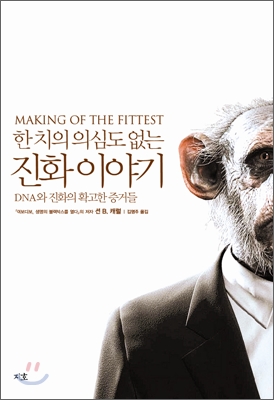
A story of evolution without a single doubt
 |
Description
Book Introduction
This book shows very clearly 'how evolution actually happens'.
Until now, evolution has been explained mainly through anatomical or physiological differences in animals, but now we have more powerful tools.
This is DNA analysis. Using DNA data, we can clearly see what specific changes have occurred in which parts of the genetic code.
The author presents the 'final scientific investigation record' proving evolution using DNA, thereby destroying numerous arguments against evolution.
As an example, he cites the 'fossil' gene.
In the DNA of many animals, including us, there are genes that have lost their function and only traces remain.
Just as icefish have lost the genes that make hemoglobin, we humans have also lost the genes that make strong muscles.
And if someone "created" or "designed" us, then it's absurd that we have broken genes in our bodies, and fossil genes are ultimately one of the strongest pieces of evidence showing that we evolved.
It has been 150 years since Darwin revealed the principles of evolution in “The Origin of Species,” but the debate between evolution and creationism continues in society.
But the author's argument is so adamant that he seems unable to understand this argument.
As philosopher of science Michael Ruse said, “Of all the scientists on earth today, if Charles Darwin had to choose just one person he would want to spend an evening with, it would definitely be Sean Carroll,” this book firmly argues that Darwin was right.
Until now, evolution has been explained mainly through anatomical or physiological differences in animals, but now we have more powerful tools.
This is DNA analysis. Using DNA data, we can clearly see what specific changes have occurred in which parts of the genetic code.
The author presents the 'final scientific investigation record' proving evolution using DNA, thereby destroying numerous arguments against evolution.
As an example, he cites the 'fossil' gene.
In the DNA of many animals, including us, there are genes that have lost their function and only traces remain.
Just as icefish have lost the genes that make hemoglobin, we humans have also lost the genes that make strong muscles.
And if someone "created" or "designed" us, then it's absurd that we have broken genes in our bodies, and fossil genes are ultimately one of the strongest pieces of evidence showing that we evolved.
It has been 150 years since Darwin revealed the principles of evolution in “The Origin of Species,” but the debate between evolution and creationism continues in society.
But the author's argument is so adamant that he seems unable to understand this argument.
As philosopher of science Michael Ruse said, “Of all the scientists on earth today, if Charles Darwin had to choose just one person he would want to spend an evening with, it would definitely be Sean Carroll,” this book firmly argues that Darwin was right.
- You can preview some of the book's contents.
Preview
index
Preface - 'So that not a single doubt remains
Chapter 1.
Introduction - The Bloodless Fish of Bouvet Island
Chapter 2.
The Mathematics of Evolution: Chance, Selection, and Time
Chapter 3.
immortal genes
Chapter 4.
Making new from old
Chapter 5.
Fossil Genes: Broken Remnants of the Past
Chapter 6.
Déjà Vu: Evolution Repeats Itself - Why? And How?
Chapter 7.
Our Flesh and Blood: The Evolutionary Arms Race and Human Natural Selection
Chapter 8.
On the Birth and Evolution of Complexity
Chapter 9.
Seeing is believing
Chapter 10.
Palm trees in Wyoming
References
Acknowledgements
Translator's Note
Search
Chapter 1.
Introduction - The Bloodless Fish of Bouvet Island
Chapter 2.
The Mathematics of Evolution: Chance, Selection, and Time
Chapter 3.
immortal genes
Chapter 4.
Making new from old
Chapter 5.
Fossil Genes: Broken Remnants of the Past
Chapter 6.
Déjà Vu: Evolution Repeats Itself - Why? And How?
Chapter 7.
Our Flesh and Blood: The Evolutionary Arms Race and Human Natural Selection
Chapter 8.
On the Birth and Evolution of Complexity
Chapter 9.
Seeing is believing
Chapter 10.
Palm trees in Wyoming
References
Acknowledgements
Translator's Note
Search
Publisher's Review
Author of "Ibodibo, Opening the Black Box of Life"
Sean Carroll's "Unquestionable" Evolution
The renowned philosopher of science Michael Ruse praised the author of this book, Sean Carroll, saying, “Of all the scientists on earth today, if Charles Darwin had to pick just one person he would want to spend an evening with, it would be Sean Carroll.”
After reading this book, I can completely relate to this statement.
In this book, Sean Carroll presents overwhelming evidence of evolution that Darwin could never have imagined.
The evidence for evolution presented in this book conclusively proves that Darwin was indeed right.
So how delighted Darwin would be if he met Carroll and heard this story!
Unfortunately, Darwin can't do that, but fortunately we can hear this story.
Sean Carroll goes beyond simply showing us how the 'fittest' survive, and shows us how the fittest are actually 'born'.
The stories he wrote allow us to accept the theory of evolution 'without a single doubt'.
Evidence of evolution etched into our DNA: Bloodless fish and birds that see ultraviolet light?
The purpose of this book is to show 'how evolution actually happens.'
Until now, evolution has been explained mainly through anatomical or physiological differences in animals, but now we have more powerful tools.
This is DNA analysis. Using DNA data, we can clearly see what specific changes have occurred in which parts of the genetic code.
Icefish living in the South Atlantic have no red blood cells, so their blood is as clear as water.
Why do icefish lack red blood cells, the vital cells that carry oxygen? Analysis of the icefish's DNA has revealed the reason.
The DNA of the icefish lacked the genetic code for making hemoglobin.
Comparisons with other relatives with red blood cells revealed that the genetic code was erased when the waters of the South Atlantic cooled.
In this way, DNA contains traces of all the changes that the organism has experienced.
The case of birds is also interesting.
Some bird species can see ultraviolet light instead of violet.
Scientists have pinpointed the changes that make this difference.
If there is an A (adenine) at position 268 of the opsin gene responsible for vision, you see purple, and if there is a T (thymine) in that position, you see ultraviolet light.
Changes in the four bases A, C, G, and T completely change the form and physiological functions of living organisms.
The Mathematics of Evolution: Evolution's Odds Are Better Than Lottery Odds
The base sequence changes due to completely random mutations.
When DNA is copied to create offspring, unexpected 'mistakes' occur, resulting in a genetic code that is different from that of the parents.
Of course, the probability of a mutation occurring is very low, only about 1 in 500 million per base in most animals.
Because of this low probability of mutation, people sometimes doubt the possibility of evolution.
But in this book, Sean Carroll uses neat mathematics to explain the validity of evolution.
Mathematics is a topic that is not well covered in other popular texts explaining evolution, but it is essential to understanding evolution.
For example, what are the chances that the purple-seeing bird we saw earlier will evolve into a bird that sees ultraviolet light?
To see ultraviolet light, the base A at position 268 of the opsin gene must be changed to T.
The mutation rate for a single base is 1 in 500 million, and base A can change to C, G, or T.
Therefore, the probability of A changing into T is 1 in 1.5 billion.
However, since there are two opsin genes and only one needs to be activated, the odds of a violet-vision bird seeing ultraviolet light are 1 in 750 million.
Although it may seem like it will never happen, annual reproductive rates and time must be taken into account here.
In many bird populations, at least one million chicks are born each year.
If you divide 750 million by a million, you get 750, so a bird that can see ultraviolet light appears once every 750 years.
750 years is an absurdly long time for one human, but on the evolutionary timescale, 75,000 years is a mere moment, and in that time, the UV vision mutation occurs a hundred times.
Sean Carroll logically demonstrates that such useful traits have a good chance of evolving.
Just as lottery winners are not uncommon, even with odds of one in millions, even if the probability of evolution is small, considering the population size of hundreds of thousands and the time span of hundreds of thousands of years, it is bound to happen eventually.
Moreover, even in completely random mutations, as long as selection is in play, only traits that are advantageous for adaptation will remain.
This is evolution.
Evolution occurs without the intervention of external 'intelligent beings'.
Evidence that 'creation' and 'design' are wrong
It's been 150 years since Darwin unveiled the principles of evolution in "The Origin of Species," yet skepticism and criticism of the theory of evolution still persist in society.
Over the years, numerous discoveries have been made that support the principle of evolution, and the scientific community unanimously supports this principle. However, many people come up with "scientific" counterarguments to the theory of evolution, and debates surrounding the theory of evolution continue to rage on online science-related bulletin boards every day.
In this book, Sean Carroll presents the "ultimate scientific investigation record" proving evolution and dismantles numerous arguments against it.
As an example, he cites the 'fossil' gene.
In the DNA of many animals, including us, there are genes that have lost their function and only traces remain.
Just as icefish have lost the genes that make hemoglobin, we humans have lost the genes that make strong muscles.
Even the bacteria lost more than a thousand genes.
Since natural selection only acts in the present, genes that are not currently used are automatically destroyed by mutation.
Even if it may be needed again in the future, it cannot stop the process.
If someone 'created' or 'designed' us, then it makes no sense that we have broken genes in our bodies.
Fossil genes are one of the strongest pieces of evidence showing that we evolved.
The author's argument, which unfolds logically and slowly, makes it impossible for any rational person to reject evolution.
Why evolution matters
In the final chapter of this book, Sean Carroll explains why it is important to understand and accept the principles of evolution.
The Earth's ecosystem is currently in serious crisis due to humans' 'unnatural' choices.
The example of North Atlantic cod is chilling.
Cod were once so abundant that they could feed the entire population of Europe, but now the fisheries are being shut down.
The reason is natural selection.
As fishing boats primarily caught large cod, individuals that were able to reproduce while still small were selected and came to dominate the cod population.
However, because its small body is at a disadvantage in confrontations with other predators and competitors, the cod species itself is losing the competition for survival.
This is happening in every ocean and land around the world.
Therefore, it is very important to know how human hunting and fishing affect the ecosystem.
Denying the principles of evolution makes it impossible to devise a proper solution.
The book ends with the following:
"Facts don't disappear when denied, and we are 'determining the direction of Earth's evolution.'" So, should we deny evolution and ignore the issues at hand? "The Unmistakable Story of Evolution" shows us the clarity and importance of evolution.
Sean Carroll's "Unquestionable" Evolution
The renowned philosopher of science Michael Ruse praised the author of this book, Sean Carroll, saying, “Of all the scientists on earth today, if Charles Darwin had to pick just one person he would want to spend an evening with, it would be Sean Carroll.”
After reading this book, I can completely relate to this statement.
In this book, Sean Carroll presents overwhelming evidence of evolution that Darwin could never have imagined.
The evidence for evolution presented in this book conclusively proves that Darwin was indeed right.
So how delighted Darwin would be if he met Carroll and heard this story!
Unfortunately, Darwin can't do that, but fortunately we can hear this story.
Sean Carroll goes beyond simply showing us how the 'fittest' survive, and shows us how the fittest are actually 'born'.
The stories he wrote allow us to accept the theory of evolution 'without a single doubt'.
Evidence of evolution etched into our DNA: Bloodless fish and birds that see ultraviolet light?
The purpose of this book is to show 'how evolution actually happens.'
Until now, evolution has been explained mainly through anatomical or physiological differences in animals, but now we have more powerful tools.
This is DNA analysis. Using DNA data, we can clearly see what specific changes have occurred in which parts of the genetic code.
Icefish living in the South Atlantic have no red blood cells, so their blood is as clear as water.
Why do icefish lack red blood cells, the vital cells that carry oxygen? Analysis of the icefish's DNA has revealed the reason.
The DNA of the icefish lacked the genetic code for making hemoglobin.
Comparisons with other relatives with red blood cells revealed that the genetic code was erased when the waters of the South Atlantic cooled.
In this way, DNA contains traces of all the changes that the organism has experienced.
The case of birds is also interesting.
Some bird species can see ultraviolet light instead of violet.
Scientists have pinpointed the changes that make this difference.
If there is an A (adenine) at position 268 of the opsin gene responsible for vision, you see purple, and if there is a T (thymine) in that position, you see ultraviolet light.
Changes in the four bases A, C, G, and T completely change the form and physiological functions of living organisms.
The Mathematics of Evolution: Evolution's Odds Are Better Than Lottery Odds
The base sequence changes due to completely random mutations.
When DNA is copied to create offspring, unexpected 'mistakes' occur, resulting in a genetic code that is different from that of the parents.
Of course, the probability of a mutation occurring is very low, only about 1 in 500 million per base in most animals.
Because of this low probability of mutation, people sometimes doubt the possibility of evolution.
But in this book, Sean Carroll uses neat mathematics to explain the validity of evolution.
Mathematics is a topic that is not well covered in other popular texts explaining evolution, but it is essential to understanding evolution.
For example, what are the chances that the purple-seeing bird we saw earlier will evolve into a bird that sees ultraviolet light?
To see ultraviolet light, the base A at position 268 of the opsin gene must be changed to T.
The mutation rate for a single base is 1 in 500 million, and base A can change to C, G, or T.
Therefore, the probability of A changing into T is 1 in 1.5 billion.
However, since there are two opsin genes and only one needs to be activated, the odds of a violet-vision bird seeing ultraviolet light are 1 in 750 million.
Although it may seem like it will never happen, annual reproductive rates and time must be taken into account here.
In many bird populations, at least one million chicks are born each year.
If you divide 750 million by a million, you get 750, so a bird that can see ultraviolet light appears once every 750 years.
750 years is an absurdly long time for one human, but on the evolutionary timescale, 75,000 years is a mere moment, and in that time, the UV vision mutation occurs a hundred times.
Sean Carroll logically demonstrates that such useful traits have a good chance of evolving.
Just as lottery winners are not uncommon, even with odds of one in millions, even if the probability of evolution is small, considering the population size of hundreds of thousands and the time span of hundreds of thousands of years, it is bound to happen eventually.
Moreover, even in completely random mutations, as long as selection is in play, only traits that are advantageous for adaptation will remain.
This is evolution.
Evolution occurs without the intervention of external 'intelligent beings'.
Evidence that 'creation' and 'design' are wrong
It's been 150 years since Darwin unveiled the principles of evolution in "The Origin of Species," yet skepticism and criticism of the theory of evolution still persist in society.
Over the years, numerous discoveries have been made that support the principle of evolution, and the scientific community unanimously supports this principle. However, many people come up with "scientific" counterarguments to the theory of evolution, and debates surrounding the theory of evolution continue to rage on online science-related bulletin boards every day.
In this book, Sean Carroll presents the "ultimate scientific investigation record" proving evolution and dismantles numerous arguments against it.
As an example, he cites the 'fossil' gene.
In the DNA of many animals, including us, there are genes that have lost their function and only traces remain.
Just as icefish have lost the genes that make hemoglobin, we humans have lost the genes that make strong muscles.
Even the bacteria lost more than a thousand genes.
Since natural selection only acts in the present, genes that are not currently used are automatically destroyed by mutation.
Even if it may be needed again in the future, it cannot stop the process.
If someone 'created' or 'designed' us, then it makes no sense that we have broken genes in our bodies.
Fossil genes are one of the strongest pieces of evidence showing that we evolved.
The author's argument, which unfolds logically and slowly, makes it impossible for any rational person to reject evolution.
Why evolution matters
In the final chapter of this book, Sean Carroll explains why it is important to understand and accept the principles of evolution.
The Earth's ecosystem is currently in serious crisis due to humans' 'unnatural' choices.
The example of North Atlantic cod is chilling.
Cod were once so abundant that they could feed the entire population of Europe, but now the fisheries are being shut down.
The reason is natural selection.
As fishing boats primarily caught large cod, individuals that were able to reproduce while still small were selected and came to dominate the cod population.
However, because its small body is at a disadvantage in confrontations with other predators and competitors, the cod species itself is losing the competition for survival.
This is happening in every ocean and land around the world.
Therefore, it is very important to know how human hunting and fishing affect the ecosystem.
Denying the principles of evolution makes it impossible to devise a proper solution.
The book ends with the following:
"Facts don't disappear when denied, and we are 'determining the direction of Earth's evolution.'" So, should we deny evolution and ignore the issues at hand? "The Unmistakable Story of Evolution" shows us the clarity and importance of evolution.
GOODS SPECIFICS
- Date of issue: October 15, 2008
- Page count, weight, size: 360 pages | 566g | 155*225*30mm
- ISBN13: 9788959090457
- ISBN10: 895909045X
You may also like
카테고리
korean


korean

![ELLE 엘르 스페셜 에디션 A형 : 12월 [2025]](http://librairie.coreenne.fr/cdn/shop/files/b8e27a3de6c9538896439686c6b0e8fb.jpg?v=1766436872&width=3840)


