

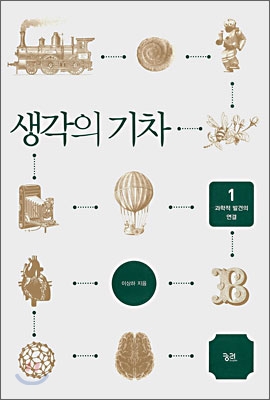
Train of Thought 1
 |
Description
Book Introduction
A popular science textbook written by an author who majored in both science and philosophy, using a train station analogy to illustrate 47 cases of discovery, ranging from cosmic rays, anesthesia, and television to semiconductors, artificial intelligence, and Hilbert's conundrums.
The topics worth considering in the case studies are written under each title, likening them to the landscape of history, and the case studies are organized to be connected to each other, just as train stations are connected to form a single region.
The book mainly covers cases from the 19th and 20th centuries, and each case was selected based on its connection to the process of the emergence and interdisciplinary connection of various branches of science.
In 『Train of Thought 1』, the journey from ‘measurement and exploration’ to ‘conceptual revision process’ is examined.
It introduces 'scientific exploration, anesthesia and sterilization, electromagnetic induction, the endocrine system, in vitro fertilization (IVF), diphtheria vaccine, aspirin, and alpha decay'.
The topics worth considering in the case studies are written under each title, likening them to the landscape of history, and the case studies are organized to be connected to each other, just as train stations are connected to form a single region.
The book mainly covers cases from the 19th and 20th centuries, and each case was selected based on its connection to the process of the emergence and interdisciplinary connection of various branches of science.
In 『Train of Thought 1』, the journey from ‘measurement and exploration’ to ‘conceptual revision process’ is examined.
It introduces 'scientific exploration, anesthesia and sterilization, electromagnetic induction, the endocrine system, in vitro fertilization (IVF), diphtheria vaccine, aspirin, and alpha decay'.
- You can preview some of the book's contents.
Preview
index
preface
1.
Measurement and Exploration
1.
Securing scientific exploration resources
2.
Spaceship Evidence Assembly
3.
The spirit of the cosmic background radiation measurer
4.
Cepheid variable star measurements
5.
Vision SF
6.
Discovery Connection Map 1
2. Historical prerequisites for success
7.
The first discoverer of anesthesia
8.
Application of the provisional hypothesis of disinfection
9.
The Shadow of Prejudice and Discrimination in Albinism Surgery
10.
Discovery Connection Map 1-2
3. Combination of science and technology
11.
Exchange of roles of electricity
12.
Turning electromagnetic induction weaknesses into strengths
13.
A bold hypothesis based on a meticulous review process of the discovery of the former
14.
The value of discoveries often gets lost in the public interest of X-rays.
15.
Television patent dispute
16.
Discovery Connection Map 1-3
4.
Science and technology targeted by policy
17.
The name of the woman with the red line drawn between the sibling scientists
18.
Endocrine system animal testing
19.
What is an effective IVF policy?
20.
Discovery Connection Map 1-4
5.
A mishmash of methodologies
21.
Organizing the diphtheria vaccine
22.
Diphtheria Chick test: Social establishment of scientific discovery
23.
The Relationship Between Physiology and Medicine and Its Changing Disciplines
24.
The Social Authority of Blood Type Science
25.
Technology that expands immunological theory
26.
Arm transplant life support and a satisfying life
27.
Discovery Connection Map 1-5
6.
Cooperation between departments based on the same perspective
28.
Aspirin Scientific Discovery and Application of That Knowledge
29.
Buckminsterfullerene Nobel Prize
30.
Linking atomic structure measurements and hypotheses
31.
Discovery Connection Map 1-6
7.
Conceptual revision process
32.
The Compton Effect: The Process by which a Tentative Hypothesis is Solidified
33.
Alpha decay: Inference based on a synthesis of everyday experience and background knowledge
34.
Conceptual reorganization of electron shells
35.
Discovery Connection Map 1-7
Characters
1.
Measurement and Exploration
1.
Securing scientific exploration resources
2.
Spaceship Evidence Assembly
3.
The spirit of the cosmic background radiation measurer
4.
Cepheid variable star measurements
5.
Vision SF
6.
Discovery Connection Map 1
2. Historical prerequisites for success
7.
The first discoverer of anesthesia
8.
Application of the provisional hypothesis of disinfection
9.
The Shadow of Prejudice and Discrimination in Albinism Surgery
10.
Discovery Connection Map 1-2
3. Combination of science and technology
11.
Exchange of roles of electricity
12.
Turning electromagnetic induction weaknesses into strengths
13.
A bold hypothesis based on a meticulous review process of the discovery of the former
14.
The value of discoveries often gets lost in the public interest of X-rays.
15.
Television patent dispute
16.
Discovery Connection Map 1-3
4.
Science and technology targeted by policy
17.
The name of the woman with the red line drawn between the sibling scientists
18.
Endocrine system animal testing
19.
What is an effective IVF policy?
20.
Discovery Connection Map 1-4
5.
A mishmash of methodologies
21.
Organizing the diphtheria vaccine
22.
Diphtheria Chick test: Social establishment of scientific discovery
23.
The Relationship Between Physiology and Medicine and Its Changing Disciplines
24.
The Social Authority of Blood Type Science
25.
Technology that expands immunological theory
26.
Arm transplant life support and a satisfying life
27.
Discovery Connection Map 1-5
6.
Cooperation between departments based on the same perspective
28.
Aspirin Scientific Discovery and Application of That Knowledge
29.
Buckminsterfullerene Nobel Prize
30.
Linking atomic structure measurements and hypotheses
31.
Discovery Connection Map 1-6
7.
Conceptual revision process
32.
The Compton Effect: The Process by which a Tentative Hypothesis is Solidified
33.
Alpha decay: Inference based on a synthesis of everyday experience and background knowledge
34.
Conceptual reorganization of electron shells
35.
Discovery Connection Map 1-7
Characters
Publisher's Review
How are scientific discoveries connected?
How will science play out in our lives?
What contemporary concerns are embedded in the process of scientific discovery?
The birth of a seasoned science writer who has demonstrated sharp writing skills that cross over philosophy and science!
http://goodking.new21.net.
It is a fairly well-known science and philosophy commentary site among students majoring in science at universities such as Pohang University of Science and Technology and KAIST, as well as young scholars teaching science in the classroom.
While running this site, author Lee Sang-ha has undertaken various projects, including introducing and co-translating foreign books on science and mathematics that have not yet been introduced in Korea, and criticizing mistranslations in translated science books.
As can be seen from the author's background, who majored in physics and minored in mathematics at Korea University, double-majored in philosophy and physics at the University of Göttingen in Germany, and received a doctorate in philosophy, he is one of the few science writers who majored in both science and philosophy. He has produced a wealth of scientific content through the website, and has finally begun to bear fruit in the form of books, one by one.
While publishing substantial specialized books such as 『Philosophy of Science: The Historical Dependence of Science』 and 『Situational Ethics: Engineering Discourse in the Real World』, the author's first work, aimed at reaching out to young people and general readers interested in science, is 『Train of Thought 1, 2』, which contains the history of discovery with the theme, "How are scientific discoveries connected? In what form will science wriggle in our lives? What contemporary concerns are embedded in the process of scientific discovery?"
The train of thought runs with 47 exciting discoveries that have become issues in the history of science!
The author uses a train station analogy to explain 47 cases of discovery, ranging from cosmic rays, anesthesia, and television to semiconductors, artificial intelligence, and Hilbert's problems.
The topics to consider in the case studies are written under each title, analogous to the landscape of history.
Just as train stations are connected to form a single region, the discovered cases are designed to be connected to each other.
Thus, at the end of each chapter, divided into 12 major topics, a map of the connections between the discoveries is drawn to provide an overview at a glance.
In the connection map, each discovery is connected by an arrow or line segment.
When the connection between two cases of discovery is based on a specific topic, it is indicated using a line segment, and when the connection between two cases of discovery is based on a historical or causal connection, it is indicated using an arrow.
These connected discovery cases show one characteristic.
The feature is likened to the entire landscape of the region, with regions interconnected to form a vast network of railways.
『Train of Thought 1, 2』 is '1.
Measurement and Exploration', '2.
‘Historical prerequisites for success’, ‘3.
The combination of science and technology', '4.
Science and technology as policy targets', '5.
‘Mixture of Methods’, ‘6.
Cooperation of departments based on the same viewpoint', '7.
Conceptual revision process', '8.
'Extension of dynamic perspective', '9.
'Forklift', '10.
'New experimental methodology', '11.
Interdisciplinary Research', '12.
It shows the landscape of regions called 'secularization of science'.
The landscape in some areas may be monotonous, in others bizarre, and in still others complex and difficult to grasp at a glance.
Because the history of discovery is not as simply connected as the symmetrical figures of geometry.
The purpose of this book is to show the diversity of the history of discovery.
In 『Train of Thought 1』, the journey from ‘measurement and exploration’ to ‘conceptual revision process’ is examined.
It introduces 'scientific exploration, cosmic background radiation, anesthesia and sterilization, electromagnetic induction, the endocrine system, in vitro fertilization (IVF), diphtheria vaccine, aspirin, and alpha decay'.
Although all branches of science are bounded by the tasks of measurement and exploration, the way each branch functions and the relationships among them are not fixed.
The convergence of science and technology has brought together multiple methodologies in a single research space, and research results have become the subject of social discourse.
The key concepts that governed each discipline also had to be revised to accommodate new discoveries.
In 『Train of Thought 2』, the train passes through the areas of ‘dynamic expansion of perspective’, ‘branching’, ‘new experimental methodologies’, ‘interdisciplinary research’, and ‘secularization of science’.
Discoveries featured here include 'continental drift, the structure of the Earth, Cro-Magnon man, fractals, semiconductors, Apple, artificial intelligence, nature and nurture, and the black box debate.'
How we understand nature has changed dynamically, both within and across scientific disciplines.
Some discoveries in a particular field can stimulate the birth of other fields.
As scientific disciplines have grown in diversity, interdisciplinary research has been promoted, and new experimental methodologies have been developed accordingly.
Various perspectives, such as structure, function, and development, were intertwined and interacted with each other in the process of discovery.
The 'secularization of science', which symbolizes this reality, is the final destination of this book.
Waiting for another train of thought created by readers!
In this book, the author covers cases from the 19th and 20th centuries, each selected based on its connection to the emergence and interdisciplinary connection of various branches of science.
Of course, it cannot be said that the selection was completely objective, but the author, for his own reasons, decided that it would be better to introduce the theory of relativity together with the process by which Newtonian mechanics was accepted and discussed in various regions of 18th-century Europe.
The historical significance of evolution is revealed when it is introduced alongside the pioneers who established the view that nature also has a history in the late 18th century.
The railroad that connects the cases of discovery not covered in this book awaits another 'train of thought.'
A total of 47 discovery cases were analyzed by topic and questions to consider were presented.
Thematically organized case studies can be used as scientific writing or discussion material, and will help provide background knowledge for scientific and in-depth discussions.
At the beginning of each discovery case, other discovery cases related to the article are included for reference, and at the end of the article, there are sections titled 'Thinking Further' and 'Reading Further', so that readers can create their own train of thought in response to the questions posed by the author, and it is designed to encourage more extensive reading.
In particular, the questions in 'Things to Think About Further' are exemplary for 'scientific essays', which have become a hot topic these days, and contain content that can sound an alarm about 'scientific essays' that imitate the format of famous university entrance exams that have caused much controversy.
To prepare for using this book for this purpose, the difficulty levels of the cases discovered have been ranked according to their content.
All scientific discoveries share a common thread: the pursuit of verifiable observations, reproducible measurements, and the connection between hypotheses. However, the methods of pursuing these pursuits are so diverse that they cannot be standardized.
The social evaluation surrounding the discovery process and its results has also become more complex than ever before.
The way hypotheses are generated and accepted cannot be confined to a single logical form.
The history of scientific discovery is full of countless episodes.
As we cover some of those episodes, the 'train of thoughts' will run along the railroad of the history of discovery.
But readers didn't build and drive their own trains and explore the history of science.
The 47 discovery cases discussed here could be arranged and analyzed in other ways.
But no method can be completely new.
Because actual discovery cases are arranged randomly and cannot be analyzed.
It is also a mistake to think that there is a common structure that runs through all the discovered cases, or that the history connected by such cases can be defined in a single way.
Even if some famous philosopher thought so, he is insensitive to the actual history of discovery.
Now, the reader must create his own train of thought and run along the railroad of the history of discovery.
How will science play out in our lives?
What contemporary concerns are embedded in the process of scientific discovery?
The birth of a seasoned science writer who has demonstrated sharp writing skills that cross over philosophy and science!
http://goodking.new21.net.
It is a fairly well-known science and philosophy commentary site among students majoring in science at universities such as Pohang University of Science and Technology and KAIST, as well as young scholars teaching science in the classroom.
While running this site, author Lee Sang-ha has undertaken various projects, including introducing and co-translating foreign books on science and mathematics that have not yet been introduced in Korea, and criticizing mistranslations in translated science books.
As can be seen from the author's background, who majored in physics and minored in mathematics at Korea University, double-majored in philosophy and physics at the University of Göttingen in Germany, and received a doctorate in philosophy, he is one of the few science writers who majored in both science and philosophy. He has produced a wealth of scientific content through the website, and has finally begun to bear fruit in the form of books, one by one.
While publishing substantial specialized books such as 『Philosophy of Science: The Historical Dependence of Science』 and 『Situational Ethics: Engineering Discourse in the Real World』, the author's first work, aimed at reaching out to young people and general readers interested in science, is 『Train of Thought 1, 2』, which contains the history of discovery with the theme, "How are scientific discoveries connected? In what form will science wriggle in our lives? What contemporary concerns are embedded in the process of scientific discovery?"
The train of thought runs with 47 exciting discoveries that have become issues in the history of science!
The author uses a train station analogy to explain 47 cases of discovery, ranging from cosmic rays, anesthesia, and television to semiconductors, artificial intelligence, and Hilbert's problems.
The topics to consider in the case studies are written under each title, analogous to the landscape of history.
Just as train stations are connected to form a single region, the discovered cases are designed to be connected to each other.
Thus, at the end of each chapter, divided into 12 major topics, a map of the connections between the discoveries is drawn to provide an overview at a glance.
In the connection map, each discovery is connected by an arrow or line segment.
When the connection between two cases of discovery is based on a specific topic, it is indicated using a line segment, and when the connection between two cases of discovery is based on a historical or causal connection, it is indicated using an arrow.
These connected discovery cases show one characteristic.
The feature is likened to the entire landscape of the region, with regions interconnected to form a vast network of railways.
『Train of Thought 1, 2』 is '1.
Measurement and Exploration', '2.
‘Historical prerequisites for success’, ‘3.
The combination of science and technology', '4.
Science and technology as policy targets', '5.
‘Mixture of Methods’, ‘6.
Cooperation of departments based on the same viewpoint', '7.
Conceptual revision process', '8.
'Extension of dynamic perspective', '9.
'Forklift', '10.
'New experimental methodology', '11.
Interdisciplinary Research', '12.
It shows the landscape of regions called 'secularization of science'.
The landscape in some areas may be monotonous, in others bizarre, and in still others complex and difficult to grasp at a glance.
Because the history of discovery is not as simply connected as the symmetrical figures of geometry.
The purpose of this book is to show the diversity of the history of discovery.
In 『Train of Thought 1』, the journey from ‘measurement and exploration’ to ‘conceptual revision process’ is examined.
It introduces 'scientific exploration, cosmic background radiation, anesthesia and sterilization, electromagnetic induction, the endocrine system, in vitro fertilization (IVF), diphtheria vaccine, aspirin, and alpha decay'.
Although all branches of science are bounded by the tasks of measurement and exploration, the way each branch functions and the relationships among them are not fixed.
The convergence of science and technology has brought together multiple methodologies in a single research space, and research results have become the subject of social discourse.
The key concepts that governed each discipline also had to be revised to accommodate new discoveries.
In 『Train of Thought 2』, the train passes through the areas of ‘dynamic expansion of perspective’, ‘branching’, ‘new experimental methodologies’, ‘interdisciplinary research’, and ‘secularization of science’.
Discoveries featured here include 'continental drift, the structure of the Earth, Cro-Magnon man, fractals, semiconductors, Apple, artificial intelligence, nature and nurture, and the black box debate.'
How we understand nature has changed dynamically, both within and across scientific disciplines.
Some discoveries in a particular field can stimulate the birth of other fields.
As scientific disciplines have grown in diversity, interdisciplinary research has been promoted, and new experimental methodologies have been developed accordingly.
Various perspectives, such as structure, function, and development, were intertwined and interacted with each other in the process of discovery.
The 'secularization of science', which symbolizes this reality, is the final destination of this book.
Waiting for another train of thought created by readers!
In this book, the author covers cases from the 19th and 20th centuries, each selected based on its connection to the emergence and interdisciplinary connection of various branches of science.
Of course, it cannot be said that the selection was completely objective, but the author, for his own reasons, decided that it would be better to introduce the theory of relativity together with the process by which Newtonian mechanics was accepted and discussed in various regions of 18th-century Europe.
The historical significance of evolution is revealed when it is introduced alongside the pioneers who established the view that nature also has a history in the late 18th century.
The railroad that connects the cases of discovery not covered in this book awaits another 'train of thought.'
A total of 47 discovery cases were analyzed by topic and questions to consider were presented.
Thematically organized case studies can be used as scientific writing or discussion material, and will help provide background knowledge for scientific and in-depth discussions.
At the beginning of each discovery case, other discovery cases related to the article are included for reference, and at the end of the article, there are sections titled 'Thinking Further' and 'Reading Further', so that readers can create their own train of thought in response to the questions posed by the author, and it is designed to encourage more extensive reading.
In particular, the questions in 'Things to Think About Further' are exemplary for 'scientific essays', which have become a hot topic these days, and contain content that can sound an alarm about 'scientific essays' that imitate the format of famous university entrance exams that have caused much controversy.
To prepare for using this book for this purpose, the difficulty levels of the cases discovered have been ranked according to their content.
All scientific discoveries share a common thread: the pursuit of verifiable observations, reproducible measurements, and the connection between hypotheses. However, the methods of pursuing these pursuits are so diverse that they cannot be standardized.
The social evaluation surrounding the discovery process and its results has also become more complex than ever before.
The way hypotheses are generated and accepted cannot be confined to a single logical form.
The history of scientific discovery is full of countless episodes.
As we cover some of those episodes, the 'train of thoughts' will run along the railroad of the history of discovery.
But readers didn't build and drive their own trains and explore the history of science.
The 47 discovery cases discussed here could be arranged and analyzed in other ways.
But no method can be completely new.
Because actual discovery cases are arranged randomly and cannot be analyzed.
It is also a mistake to think that there is a common structure that runs through all the discovered cases, or that the history connected by such cases can be defined in a single way.
Even if some famous philosopher thought so, he is insensitive to the actual history of discovery.
Now, the reader must create his own train of thought and run along the railroad of the history of discovery.
GOODS SPECIFICS
- Date of issue: January 10, 2008
- Page count, weight, size: 277 pages | 510g | 153*224*20mm
- ISBN13: 9788958201168
- ISBN10: 8958201169
You may also like
카테고리
korean


korean

![GQ KOREA Mark (Monthly): December [2025]](http://librairie.coreenne.fr/cdn/shop/files/8ef265dbbfbf186523ed75ba7319009d.jpg?v=1765340328&width=3840)


