

Beyond Dichotomy
 |
Description
Book Introduction
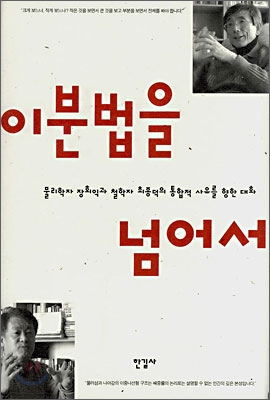
Physicist Jang Hoe-ik and philosopher Choi Jong-deok, who have always been interested in the integration and communication of academic disciplines, met.
Jang Hoe-ik, well known for his work on 'metascience' and 'whole life', has long studied a wide range of humanities topics from a scientist's perspective, while Choi Jong-deok is a leading philosopher who studies the scientific world from the perspective of philosophical thought, and his research is broad, spanning Oriental medicine, biology, and Eastern and Western academic fields.
This book begins with the awareness that we must break down the dichotomous thinking that excessively distinguishes between me and you, positive and negative, and explores and reflects on the possibility of integrated thinking by overcoming the dichotomous thinking we encounter in the world of academia and knowledge, and furthermore, throughout our lives.
As an important topic of conversation, we focused on the issue of interaction between natural science and humanities, and we had a free conversation without any predetermined conclusions and with the utmost elimination of didactic assertions.
Jang Hoe-ik, well known for his work on 'metascience' and 'whole life', has long studied a wide range of humanities topics from a scientist's perspective, while Choi Jong-deok is a leading philosopher who studies the scientific world from the perspective of philosophical thought, and his research is broad, spanning Oriental medicine, biology, and Eastern and Western academic fields.
This book begins with the awareness that we must break down the dichotomous thinking that excessively distinguishes between me and you, positive and negative, and explores and reflects on the possibility of integrated thinking by overcoming the dichotomous thinking we encounter in the world of academia and knowledge, and furthermore, throughout our lives.
As an important topic of conversation, we focused on the issue of interaction between natural science and humanities, and we had a free conversation without any predetermined conclusions and with the utmost elimination of didactic assertions.
- You can preview some of the book's contents.
Preview
index
Preface │Learning a wider world of knowledge through conversation
1. The meeting of science and philosophy
A Journey to Study Science
What does it mean to know?
In search of integrated reasoning
The potential of open education
2. Accumulation and Transformation of Knowledge: From Classics to Modern Times
The breadth of understanding grows
Systemic Transition and Accumulation: Don-o and Jeom-o
Relativity and Absoluteness, and the Theory of Relativity
What is reality?
Distortion of reason
3 About Life
The beginning of the philosophy of life
Whole life as a science
The language and existence of all life
Niels Bohr's Understanding of Life
4 East and West
Geokmulchiji: The possibility of great knowledge of life
Differences and Diversity Between East and West
Understanding each other
The possibility of interdisciplinary integration between East and West
5 Consciousness and Matter
Archetypes and leaps of consciousness
Evolution of consciousness
Subjectivation of consciousness
The subject of consciousness in quantum mechanics
Consciousness as a subject of life experience
Subjectivity of Value: Ethics of Life
6 Confrontation and Reconciliation, Retreat and Advance
Insights toward synthesis
Beyond existential conflict
Morality and Nature: Life and the World
Search
1. The meeting of science and philosophy
A Journey to Study Science
What does it mean to know?
In search of integrated reasoning
The potential of open education
2. Accumulation and Transformation of Knowledge: From Classics to Modern Times
The breadth of understanding grows
Systemic Transition and Accumulation: Don-o and Jeom-o
Relativity and Absoluteness, and the Theory of Relativity
What is reality?
Distortion of reason
3 About Life
The beginning of the philosophy of life
Whole life as a science
The language and existence of all life
Niels Bohr's Understanding of Life
4 East and West
Geokmulchiji: The possibility of great knowledge of life
Differences and Diversity Between East and West
Understanding each other
The possibility of interdisciplinary integration between East and West
5 Consciousness and Matter
Archetypes and leaps of consciousness
Evolution of consciousness
Subjectivation of consciousness
The subject of consciousness in quantum mechanics
Consciousness as a subject of life experience
Subjectivity of Value: Ethics of Life
6 Confrontation and Reconciliation, Retreat and Advance
Insights toward synthesis
Beyond existential conflict
Morality and Nature: Life and the World
Search
Into the book
Euclid's mathematical axioms are not just a set of human promises.
It was naturally accepted by humans as they coped with the terrain and climate of the Nile River basin.
Morality, too, was not created through a priori theorizing or through grand socialized promises. Rather, it evolved as an optimized way of life to navigate nature and preserve the species of socialized groups, and was culturally normative.
In other words, morality and nature are not contrasting concepts, but rather two ends of a large spectrum of human lifestyles.
There is no longer any need to debate whether morality is a product of nature or of culture.
- Choi Jong-deok
The faster the pace of change in human civilization, the more we must open our eyes and look farther ahead.
You can't drive a car at 100 kilometers per hour with a flashlight on in the middle of the night.
Now, science alone is not enough, and humanities alone is not enough.
Also, it can't be just Eastern or Western; we need to gather wisdom from all fields to come up with a credible story.
In the past, you could set out on the road with just a lantern, but now you have to turn on your headlights.
- Jang Hoe-ik
It was naturally accepted by humans as they coped with the terrain and climate of the Nile River basin.
Morality, too, was not created through a priori theorizing or through grand socialized promises. Rather, it evolved as an optimized way of life to navigate nature and preserve the species of socialized groups, and was culturally normative.
In other words, morality and nature are not contrasting concepts, but rather two ends of a large spectrum of human lifestyles.
There is no longer any need to debate whether morality is a product of nature or of culture.
- Choi Jong-deok
The faster the pace of change in human civilization, the more we must open our eyes and look farther ahead.
You can't drive a car at 100 kilometers per hour with a flashlight on in the middle of the night.
Now, science alone is not enough, and humanities alone is not enough.
Also, it can't be just Eastern or Western; we need to gather wisdom from all fields to come up with a credible story.
In the past, you could set out on the road with just a lantern, but now you have to turn on your headlights.
- Jang Hoe-ik
--- Author's Note
Publisher's Review
Communication and Integration, Breaking Down Academic Boundaries
In the 21st century, symbolized by the Internet revolution, we live in a flood of knowledge and information more vast than ever before.
Knowledge and information are literally likened to an infinite universe, like the trillions of stars twinkling in the galaxy.
Humanity, which loves to categorize, divide, and organize, has brought order to this vast sea of chaos and created countless branches (categories) of learning.
However, for a long time, the divided academic disciplines only pursued their own paths and showed little interest in the other world.
Recently, the word 'integration' has become a trending topic in all areas of society, emphasizing the importance of 'integration of learning and knowledge.'
In order to solve today's complex and multifaceted problems, we need to gather wisdom from all fields.
To do so, communication and dialogue between each other must take priority, and we need to break down the dichotomous thinking that excessively distinguishes between me and you, positive and negative.
Deep reflection on knowledge and scholarship
This book, "Beyond Dichotomy," begins with this very question, and explores and reflects on the possibility of integrated thinking, overcoming the dichotomous thinking we encounter in the world of academia and knowledge, and furthermore, throughout our lives.
The two people who had the conversation were physicist Jang Hoe-ik and philosopher Choi Jong-deok, who are usually interested in the integration and communication of academic disciplines.
Jang Hoe-ik, well known for his work on 'metascience' and 'whole life', has long studied a wide range of humanities topics from a scientist's perspective, while Choi Jong-deok is a leading philosopher who studies the scientific world from the perspective of philosophical thought, and his research is broad, spanning Oriental medicine, biology, and Eastern and Western academic fields.
First, we focused on the issue of communication between natural science and humanities as an important topic of conversation.
However, the topics of conversation extend far and wide, from classical mechanics to modern physics, the individual and the whole of life, the East and the West, consciousness and matter, and even the problems of life and nature.
We had a free conversation, without any pre-determined conclusions and with as little didactic caution as possible.
What I found really important was a philosophical reflection on what knowledge is, why it is needed, and how it is acquired.
Of course, I began to examine how knowledge and life intersect in specific situations, and naturally, I recognized the limitations of fragmented knowledge such as tradition and modernity, East and West, and even went so far as to consider how to integrate fragmented knowledge.
Chapter 1 ("Where Science and Philosophy Meet") asks the true meaning of knowledge through the boundless study journey of two people.
And we find a clue to integrated thinking in the premise that objective knowledge and reflective knowledge, that is, ‘questions about the world’ (physics) and ‘questions about life’ (philosophy), are ultimately the same question.
He also likens interdisciplinary communication to an unfolding fan, emphasizing the need for attention to the connecting link, the common area where all the ribs of a fan meet.
Chapter 2 ("Accumulation and Transformation of Knowledge") covers the evolution of Newton's classical mechanics, Einstein's 'theory of relativity', which can be considered a dazzling achievement of 20th-century physics, and quantum mechanics represented by Heisenberg's 'uncertainty principle'.
We discuss the issues of expanding the framework of thinking and transforming knowledge, focusing on academics.
In particular, he points out the problem of uncertainty theory being misused as a scientific tool for irrationality and unreason, and emphasizes that “this is clearly a triumph of rational reason, not its collapse.”
Furthermore, the dichotomy that quantum mechanics is indeterminate and classical mechanics is determinate, and the simple diagram that relativity is relative and classical mechanics is absolute are also wrong.
Chapter 3 (On Life) starts from the premise that “talking about matter without life is only half a science,” and rejects the dualistic view of material and life phenomena, focusing on the theory of whole life (or individual life).
Global life, defined by the concepts of 'self-sufficient units of life' and 'autocatalytic local order', is also distinct from the Gaia theory.
In addition, the distinction between life and matter is not seen as a distinction between objects, but as a distinction between 'one mode of existence of the object' (life) and 'the material that distinguishes the object' (matter).
It is impossible to understand life without considering the time period of billions of years, and it is also seen as crucial in understanding the process of evolution.
Chapter 4 ("East and West") points out the error of the common dichotomous stereotype that the West understood things in a rational way and the East in a mythical and irrational way, and emphasizes that we should also be wary of blind Eastern superiority due to antipathy toward excessive Westernization.
On that basis, we examined the Eastern method of perception, which always sought to understand things in relation to life, as revealed in the concept of knowledge of dealing with life and the method of examining things and gaining knowledge.
Meanwhile, the process of introducing the Tao Te Ching to the West and the difficulties in accepting Eastern and Western learning were also examined through the example of Hyegang Choi Han-gi, who studied Newtonian classical mechanics.
Chapter 5 (Consciousness and Matter) broadly examines long-standing topics such as consciousness and subject, spirit and matter, mind and body, and the relationships between them, namely, mind-body dualism versus monism, materialism versus idealism.
At the beginning of the long history of life, we recalled the significance of the naturalistic approach, which holds that consciousness arose from the original form of matter, and that further heightened consciousness emerged through culture and language. We also focused on the duality within the unity, that matter possesses both a subjective inner aspect and a physical outer aspect.
And he emphasized that the approach to changes in nature, the evolution of life, and the elevation of consciousness must always be viewed three-dimensionally and metaphysically.
Chapter 6 ("Confrontation and Reconciliation, Withdrawal and Forward") is the final chapter that summarizes the conversation and reflects on the issues of withdrawal and forward movement in social participation as an intellectual.
Ultimately, these concerns, which arise from the constant questioning and doubts about whether one is living rightly, are a deep part of human nature that cannot be explained by the simple logic of the exclusionary rule.
The relationship between the two, which can be summarized as “advancing without retreating is blind, and retreating without advancing is an illusion,” is not one of conflict, but of balance and harmony.
He compares 'participation' to the moral life of Confucianism and 'seclusion' to the natural life of Taoism, but he says that in the end, they are just two ends of the large spectrum of human lifestyles, so the debate about choosing one over the other is no longer meaningful.
In the 21st century, symbolized by the Internet revolution, we live in a flood of knowledge and information more vast than ever before.
Knowledge and information are literally likened to an infinite universe, like the trillions of stars twinkling in the galaxy.
Humanity, which loves to categorize, divide, and organize, has brought order to this vast sea of chaos and created countless branches (categories) of learning.
However, for a long time, the divided academic disciplines only pursued their own paths and showed little interest in the other world.
Recently, the word 'integration' has become a trending topic in all areas of society, emphasizing the importance of 'integration of learning and knowledge.'
In order to solve today's complex and multifaceted problems, we need to gather wisdom from all fields.
To do so, communication and dialogue between each other must take priority, and we need to break down the dichotomous thinking that excessively distinguishes between me and you, positive and negative.
Deep reflection on knowledge and scholarship
This book, "Beyond Dichotomy," begins with this very question, and explores and reflects on the possibility of integrated thinking, overcoming the dichotomous thinking we encounter in the world of academia and knowledge, and furthermore, throughout our lives.
The two people who had the conversation were physicist Jang Hoe-ik and philosopher Choi Jong-deok, who are usually interested in the integration and communication of academic disciplines.
Jang Hoe-ik, well known for his work on 'metascience' and 'whole life', has long studied a wide range of humanities topics from a scientist's perspective, while Choi Jong-deok is a leading philosopher who studies the scientific world from the perspective of philosophical thought, and his research is broad, spanning Oriental medicine, biology, and Eastern and Western academic fields.
First, we focused on the issue of communication between natural science and humanities as an important topic of conversation.
However, the topics of conversation extend far and wide, from classical mechanics to modern physics, the individual and the whole of life, the East and the West, consciousness and matter, and even the problems of life and nature.
We had a free conversation, without any pre-determined conclusions and with as little didactic caution as possible.
What I found really important was a philosophical reflection on what knowledge is, why it is needed, and how it is acquired.
Of course, I began to examine how knowledge and life intersect in specific situations, and naturally, I recognized the limitations of fragmented knowledge such as tradition and modernity, East and West, and even went so far as to consider how to integrate fragmented knowledge.
Chapter 1 ("Where Science and Philosophy Meet") asks the true meaning of knowledge through the boundless study journey of two people.
And we find a clue to integrated thinking in the premise that objective knowledge and reflective knowledge, that is, ‘questions about the world’ (physics) and ‘questions about life’ (philosophy), are ultimately the same question.
He also likens interdisciplinary communication to an unfolding fan, emphasizing the need for attention to the connecting link, the common area where all the ribs of a fan meet.
Chapter 2 ("Accumulation and Transformation of Knowledge") covers the evolution of Newton's classical mechanics, Einstein's 'theory of relativity', which can be considered a dazzling achievement of 20th-century physics, and quantum mechanics represented by Heisenberg's 'uncertainty principle'.
We discuss the issues of expanding the framework of thinking and transforming knowledge, focusing on academics.
In particular, he points out the problem of uncertainty theory being misused as a scientific tool for irrationality and unreason, and emphasizes that “this is clearly a triumph of rational reason, not its collapse.”
Furthermore, the dichotomy that quantum mechanics is indeterminate and classical mechanics is determinate, and the simple diagram that relativity is relative and classical mechanics is absolute are also wrong.
Chapter 3 (On Life) starts from the premise that “talking about matter without life is only half a science,” and rejects the dualistic view of material and life phenomena, focusing on the theory of whole life (or individual life).
Global life, defined by the concepts of 'self-sufficient units of life' and 'autocatalytic local order', is also distinct from the Gaia theory.
In addition, the distinction between life and matter is not seen as a distinction between objects, but as a distinction between 'one mode of existence of the object' (life) and 'the material that distinguishes the object' (matter).
It is impossible to understand life without considering the time period of billions of years, and it is also seen as crucial in understanding the process of evolution.
Chapter 4 ("East and West") points out the error of the common dichotomous stereotype that the West understood things in a rational way and the East in a mythical and irrational way, and emphasizes that we should also be wary of blind Eastern superiority due to antipathy toward excessive Westernization.
On that basis, we examined the Eastern method of perception, which always sought to understand things in relation to life, as revealed in the concept of knowledge of dealing with life and the method of examining things and gaining knowledge.
Meanwhile, the process of introducing the Tao Te Ching to the West and the difficulties in accepting Eastern and Western learning were also examined through the example of Hyegang Choi Han-gi, who studied Newtonian classical mechanics.
Chapter 5 (Consciousness and Matter) broadly examines long-standing topics such as consciousness and subject, spirit and matter, mind and body, and the relationships between them, namely, mind-body dualism versus monism, materialism versus idealism.
At the beginning of the long history of life, we recalled the significance of the naturalistic approach, which holds that consciousness arose from the original form of matter, and that further heightened consciousness emerged through culture and language. We also focused on the duality within the unity, that matter possesses both a subjective inner aspect and a physical outer aspect.
And he emphasized that the approach to changes in nature, the evolution of life, and the elevation of consciousness must always be viewed three-dimensionally and metaphysically.
Chapter 6 ("Confrontation and Reconciliation, Withdrawal and Forward") is the final chapter that summarizes the conversation and reflects on the issues of withdrawal and forward movement in social participation as an intellectual.
Ultimately, these concerns, which arise from the constant questioning and doubts about whether one is living rightly, are a deep part of human nature that cannot be explained by the simple logic of the exclusionary rule.
The relationship between the two, which can be summarized as “advancing without retreating is blind, and retreating without advancing is an illusion,” is not one of conflict, but of balance and harmony.
He compares 'participation' to the moral life of Confucianism and 'seclusion' to the natural life of Taoism, but he says that in the end, they are just two ends of the large spectrum of human lifestyles, so the debate about choosing one over the other is no longer meaningful.
GOODS SPECIFICS
- Date of issue: December 20, 2007
- Format: Hardcover book binding method guide
- Page count, weight, size: 347 pages | 442g | Checking size
- ISBN13: 9788935658664
- ISBN10: 8935658669
You may also like
카테고리
korean


korean

![ELLE 엘르 스페셜 에디션 A형 : 12월 [2025]](http://librairie.coreenne.fr/cdn/shop/files/b8e27a3de6c9538896439686c6b0e8fb.jpg?v=1766436872&width=3840)


