

Pocket Drink Guide - Hokkaido Edition
 |
Description
Book Introduction
A new map of wine, food, and travel
When most people think of Hokkaido, the first things that come to mind are 'snow-covered land, lavender fields, hot springs, ramen, and seafood.'
This book goes beyond the familiar scenery and explores the true charm of Hokkaido, focusing on the pairing of alcohol and food.
The author went beyond simply introducing restaurants focused on tourist attractions and visited beer breweries, sake breweries, wineries, and whiskey distilleries to hear the producers' philosophies and record the process of creating alcohol.
It also showcases how food and drink create a positive synergy by experiencing the rich ingredients cultivated by Hokkaido's nature, the restaurants that cook them deliciously, and especially the cuisine of Michelin-starred chefs.
Here, you can enjoy delicious specialty coffee at local cafes, browse great markets, and visit local festivals, offering a diverse array of cultural experiences.
This book is quite different from existing Hokkaido travel books.
Rather than a typical tourist guide, it offers a more in-depth and mature way of traveling, encompassing drinks, food, and local lifestyles.
The author explores Hokkaido's major cities and smaller towns, including Sapporo, Otaru, Yoichi, Niseko, Obihiro, Abashiri, Asahikawa, and Biei, proving that eating and drinking are experiences that connect you with the history, culture, and people of the region.
This book will serve as a reliable guide for wine lovers, culinary travelers, cultural explorers, and anyone seeking a unique journey.
* This book is the first book in the 'Pocket Drink Guide' series by author Jeong Bo-yeon, and is the 'Hokkaido edition.'
This series is a project that introduces the drinking, food, and travel pleasures of various cities in Japan, as well as other countries such as China, the United States, and Europe, in a three-dimensional and in-depth manner.
Next will be the 'Kyoto edition'.
When most people think of Hokkaido, the first things that come to mind are 'snow-covered land, lavender fields, hot springs, ramen, and seafood.'
This book goes beyond the familiar scenery and explores the true charm of Hokkaido, focusing on the pairing of alcohol and food.
The author went beyond simply introducing restaurants focused on tourist attractions and visited beer breweries, sake breweries, wineries, and whiskey distilleries to hear the producers' philosophies and record the process of creating alcohol.
It also showcases how food and drink create a positive synergy by experiencing the rich ingredients cultivated by Hokkaido's nature, the restaurants that cook them deliciously, and especially the cuisine of Michelin-starred chefs.
Here, you can enjoy delicious specialty coffee at local cafes, browse great markets, and visit local festivals, offering a diverse array of cultural experiences.
This book is quite different from existing Hokkaido travel books.
Rather than a typical tourist guide, it offers a more in-depth and mature way of traveling, encompassing drinks, food, and local lifestyles.
The author explores Hokkaido's major cities and smaller towns, including Sapporo, Otaru, Yoichi, Niseko, Obihiro, Abashiri, Asahikawa, and Biei, proving that eating and drinking are experiences that connect you with the history, culture, and people of the region.
This book will serve as a reliable guide for wine lovers, culinary travelers, cultural explorers, and anyone seeking a unique journey.
* This book is the first book in the 'Pocket Drink Guide' series by author Jeong Bo-yeon, and is the 'Hokkaido edition.'
This series is a project that introduces the drinking, food, and travel pleasures of various cities in Japan, as well as other countries such as China, the United States, and Europe, in a three-dimensional and in-depth manner.
Next will be the 'Kyoto edition'.
- You can preview some of the book's contents.
Preview
index
Letter from Hokkaido
Hokkaido Drink Guide Map
History
Why it's easy to find your way around Sapporo, even without Google Maps
Finding the North Star in Hokkaido, Japan's Kitchen
Susukino, a place for drinkers
Beer
Pioneer's Beer in the Snow
Genghis Khan and Otaru Beer
Beer made at a Michelin-starred restaurant
Beer at the tea shop
Drinking beer while admiring the ice floes on an icebreaker
Hidden Spot: A place where you can see drift ice up close without having to board an icebreaker.
Sake
Drinking sake in a century-old cultural heritage site
Sake bar operated by a sake brewery
The national liquor representing the North
Completing the Hokkaido Ingredient Pairing
A sake brewery located on a university campus
Sake from a ryokan and hot spring water with peat
Bingsul-aged sake from a brewery 120 years ago
Hokkaido sake at a kaiseki restaurant
Where can I buy Hidden Shop sake?
Wine
Winery tours in Japan, wineries in Yoichi
Wine made in a land where seven types of fruit trees grow
Hidden Spot: Grandma and Grandpa's Cooking Taste, Pizza and Pasta Made with Yoichi Ingredients
Hidden Spot: Yoichi region wines all in one place
Domaine that only produces Pinot Gris
Interview: A winery walk with the producer
The oldest winery in Yoichi
Wine made by a coffee company
Hokkaido's Wine Laboratory
Hidden Shop From Burgundy to Hokkaido wines
Hidden Shop: A wine shop in Obihiro that has been operating for over 70 years.
Whisky
More Scottish than Scotland
Master Class: Hiromi Ozaki's Open Seminar
Whiskey made by a hundred-year-old sake company
A great place for a whiskey tasting during the day
A bar where you can experience the essence of Yoichi whiskey
Hidden Event: Hokkaido Whisky Festival
Hidden Shop Limited edition whiskey available only here
Coffee
Coffee here instead of hotel breakfast
Enjoying coffee at the market
Specialty coffee made by champions
A cafe open only in summer
Specialty coffee at an art museum
Enjoying coffee while admiring the ice floes
Whitebeard Falls and coffee that melts your body
Bar & Restaurant
If you only have time to go to one bar in Sapporo
A bar that is only open six days a month
A cocktail that captures the essence of Hokkaido in a glass
Sapporo's malt specialty bar
A place to meet experienced sommeliers
The eccentric handsome boss who only sells rum
Soup curry and Sapporo beer
Wine cafe by day, yakitori restaurant by night
If you want to taste yakitori properly
Hangover ramen made with jaecheop broth
A wine bar where you can experience the essence of Japanese ceramics.
A Hokkaido sushi restaurant of a different dimension
Brunch house operated by a 3-star restaurant
A jazz bar run by the wife of a jazz musician
Hotels with complimentary local wine tastings
What beer goes well with chicken?
Venison burger
Fresh seafood and Sapporo beer
In Yoichi, have fruit sorbet!
A modern-style Genghis Khan restaurant
Shopping & Festival
A great place to shop for Hokkaido ingredients
If you're cooking in Hokkaido, this is a great place to shop.
Hokkaido seafood specialty market
French charcuterie in Sapporo
Hokkaido Cheese Specialty Store
Snacks and wine at a coffee shop
Tasting and purchasing alcohol
Where to find freshly squeezed milk
A Shiribeshi specialty store with a loving curation
Tofu restaurant where you can drink water
Between a convenience store and a restaurant
Otaru Glass Craft Street
Naoki Kimura, the craftsman chosen by Lexus
Crystal Curation at Mitsukoshi Department Store
Baccarat Crystal at Secondhand Shop
Enjoy the festival at Odori Park this weekend.
Hidden Event: Sapporo's representative festivals
Epilogue
Hokkaido Drink Guide Map
History
Why it's easy to find your way around Sapporo, even without Google Maps
Finding the North Star in Hokkaido, Japan's Kitchen
Susukino, a place for drinkers
Beer
Pioneer's Beer in the Snow
Genghis Khan and Otaru Beer
Beer made at a Michelin-starred restaurant
Beer at the tea shop
Drinking beer while admiring the ice floes on an icebreaker
Hidden Spot: A place where you can see drift ice up close without having to board an icebreaker.
Sake
Drinking sake in a century-old cultural heritage site
Sake bar operated by a sake brewery
The national liquor representing the North
Completing the Hokkaido Ingredient Pairing
A sake brewery located on a university campus
Sake from a ryokan and hot spring water with peat
Bingsul-aged sake from a brewery 120 years ago
Hokkaido sake at a kaiseki restaurant
Where can I buy Hidden Shop sake?
Wine
Winery tours in Japan, wineries in Yoichi
Wine made in a land where seven types of fruit trees grow
Hidden Spot: Grandma and Grandpa's Cooking Taste, Pizza and Pasta Made with Yoichi Ingredients
Hidden Spot: Yoichi region wines all in one place
Domaine that only produces Pinot Gris
Interview: A winery walk with the producer
The oldest winery in Yoichi
Wine made by a coffee company
Hokkaido's Wine Laboratory
Hidden Shop From Burgundy to Hokkaido wines
Hidden Shop: A wine shop in Obihiro that has been operating for over 70 years.
Whisky
More Scottish than Scotland
Master Class: Hiromi Ozaki's Open Seminar
Whiskey made by a hundred-year-old sake company
A great place for a whiskey tasting during the day
A bar where you can experience the essence of Yoichi whiskey
Hidden Event: Hokkaido Whisky Festival
Hidden Shop Limited edition whiskey available only here
Coffee
Coffee here instead of hotel breakfast
Enjoying coffee at the market
Specialty coffee made by champions
A cafe open only in summer
Specialty coffee at an art museum
Enjoying coffee while admiring the ice floes
Whitebeard Falls and coffee that melts your body
Bar & Restaurant
If you only have time to go to one bar in Sapporo
A bar that is only open six days a month
A cocktail that captures the essence of Hokkaido in a glass
Sapporo's malt specialty bar
A place to meet experienced sommeliers
The eccentric handsome boss who only sells rum
Soup curry and Sapporo beer
Wine cafe by day, yakitori restaurant by night
If you want to taste yakitori properly
Hangover ramen made with jaecheop broth
A wine bar where you can experience the essence of Japanese ceramics.
A Hokkaido sushi restaurant of a different dimension
Brunch house operated by a 3-star restaurant
A jazz bar run by the wife of a jazz musician
Hotels with complimentary local wine tastings
What beer goes well with chicken?
Venison burger
Fresh seafood and Sapporo beer
In Yoichi, have fruit sorbet!
A modern-style Genghis Khan restaurant
Shopping & Festival
A great place to shop for Hokkaido ingredients
If you're cooking in Hokkaido, this is a great place to shop.
Hokkaido seafood specialty market
French charcuterie in Sapporo
Hokkaido Cheese Specialty Store
Snacks and wine at a coffee shop
Tasting and purchasing alcohol
Where to find freshly squeezed milk
A Shiribeshi specialty store with a loving curation
Tofu restaurant where you can drink water
Between a convenience store and a restaurant
Otaru Glass Craft Street
Naoki Kimura, the craftsman chosen by Lexus
Crystal Curation at Mitsukoshi Department Store
Baccarat Crystal at Secondhand Shop
Enjoy the festival at Odori Park this weekend.
Hidden Event: Sapporo's representative festivals
Epilogue
Detailed image
Into the book
In 1876, in the heart of Hokkaido's development, 'Sapporo Beer' was born.
It wasn't just about making alcohol.
It was the first step toward establishing 'Western technology' in Japan and becoming a 'country of beer.'
--- p.25
A meal where the ice floes become the scenery, the alcohol becomes the food, and the wind becomes the scent, without any side dishes.
It was a feast of senses, something only possible on the winter sea.
In the Sea of Okhotsk, where a cold wind blows, drift ice drifts across the calm but cold blue waves.
(…) cold fingertips, frozen air, foam as soft as snow.
Hokkaido's unique winter, complete with a single can.
It is not simply the act of drinking beer, but rather the scenery itself, breathing with the ice floes and drinking with the wind.
--- p.49
Shuji Minami, the eighth-generation master brewer of Kobayashi Shuzo, believes that “sake is ultimately something to be enjoyed with food,” and focuses on brewing sake that pairs well with food.
Specifically, we aim to create sake with a distinct acidity and clean taste, and pursue harmony with various dishes made with Hokkaido ingredients.
Perhaps for this reason, Kobayashi's sakes are excellent as 'drinks to enjoy with meals.'
Minami Toji says that since Hokkaido boasts an abundance of food as Japan's "treasure trove of ingredients," it is only natural that it brews sake to match.
--- p.57
Kamikawa Daisetsu Shuzo uses rice, water, and people produced throughout Hokkaido as the main ingredients of its brewing, realizing a symbiosis between local agriculture and sake.
What's striking is that each brewery is designed not just as a production facility, but as a hub for dialogue with the local community.
I was impressed by the fact that they were building a sustainable local ecosystem that spans agriculture, fermentation, and food culture, and that they were helping young talents pursue academic passion and innovation in the traditional field of "brewing."
--- pp.90~91
Tokachigawa Onsen has similar characteristics to the European 'Mor Onsen' and is called 'Japan's Mor Onsen'.
The Tokachi region has many wetlands and riverside sediments that were formed after the Ice Age, which has led to the development of peat layers. The hot spring water that springs from these areas is called "Mor Onsen."
Many people say that the biggest attraction of Sanyoan is the private hot springs in each room supplied with hot spring water.
Reading the description of Mori Onsen, I thought it would be nice to have a glass of Yoichi whiskey with its smoky flavor.
--- p.106
Morimoto Toji pursues a brewing philosophy that maximizes the benefits of the region's natural environment and raw materials.
He says, “If we fully utilize the strengths of the given environment, such as water, rice, and climate, which are unique to Hokkaido, we can achieve the best results.”
In fact, Takasago Shuzo appropriately utilizes Hokkaido-grown rice (Ginpu, Suisei, Kitashizuku, etc.) and high-quality rice produced throughout Japan, matching each sake with the most suitable rice variety.
Morimoto Toji strives to create the best sake together with local farmers, advocating for “good rice, good sake, and good relationships.”
--- pp.119~120
Yoichi's climate is said to be similar in average temperature and sunshine hours to the Alsace region of Germany and the northern Burgundy region of France.
Thanks to the unique terroir of the Yoichi region, the wines produced here have a balanced acidity.
--- p.133
Currently, Domaine Takahiko's wines are popular not only in Japan but also around the world.
Not only is the production volume small, but the wine is only sold to those who understand the wine philosophy of founder Takahiko Soga, so the wine is not sold to just any place.
For this reason, Domaine Takahiko is so popular in the secondary wine market that it can be called a craze.
--- p.144
“I guess you like Taketsuru?”
“Yes! The unique blending balance is so good.
But now it's hard to meet, so it's a shame.
“It’s especially hard to find in Seoul.”
“You should stop drinking now!”
--- p.218
If you look closely at the space, you will see that there is nothing carelessly placed there.
Tables and chairs created by woodworker Santaro Takahashi are paired with Louis Poulsen lighting.
I finished my work while sitting on comfortable furniture and slowly drinking coffee.
While spending time in a place where the light-filled interior, characteristic of Northern Europe, meets the refined sensibility of Japan, I felt as if I was being purified by the sunlight.
--- pp.247~249
Experiencing special flavors and cultures at travel destinations through the medium of 'alcohol' is always exciting and enjoyable.
However, as writing about my favorite alcohol became my 'job', my perspective on a glass of alcohol also changed little by little.
Why did they create this flavor? How did they express it this way? What do we want to say through alcohol now? A single glass of alcohol suddenly becomes a question, and before we know it, it becomes a window into our quiet hearts.
It wasn't just about making alcohol.
It was the first step toward establishing 'Western technology' in Japan and becoming a 'country of beer.'
--- p.25
A meal where the ice floes become the scenery, the alcohol becomes the food, and the wind becomes the scent, without any side dishes.
It was a feast of senses, something only possible on the winter sea.
In the Sea of Okhotsk, where a cold wind blows, drift ice drifts across the calm but cold blue waves.
(…) cold fingertips, frozen air, foam as soft as snow.
Hokkaido's unique winter, complete with a single can.
It is not simply the act of drinking beer, but rather the scenery itself, breathing with the ice floes and drinking with the wind.
--- p.49
Shuji Minami, the eighth-generation master brewer of Kobayashi Shuzo, believes that “sake is ultimately something to be enjoyed with food,” and focuses on brewing sake that pairs well with food.
Specifically, we aim to create sake with a distinct acidity and clean taste, and pursue harmony with various dishes made with Hokkaido ingredients.
Perhaps for this reason, Kobayashi's sakes are excellent as 'drinks to enjoy with meals.'
Minami Toji says that since Hokkaido boasts an abundance of food as Japan's "treasure trove of ingredients," it is only natural that it brews sake to match.
--- p.57
Kamikawa Daisetsu Shuzo uses rice, water, and people produced throughout Hokkaido as the main ingredients of its brewing, realizing a symbiosis between local agriculture and sake.
What's striking is that each brewery is designed not just as a production facility, but as a hub for dialogue with the local community.
I was impressed by the fact that they were building a sustainable local ecosystem that spans agriculture, fermentation, and food culture, and that they were helping young talents pursue academic passion and innovation in the traditional field of "brewing."
--- pp.90~91
Tokachigawa Onsen has similar characteristics to the European 'Mor Onsen' and is called 'Japan's Mor Onsen'.
The Tokachi region has many wetlands and riverside sediments that were formed after the Ice Age, which has led to the development of peat layers. The hot spring water that springs from these areas is called "Mor Onsen."
Many people say that the biggest attraction of Sanyoan is the private hot springs in each room supplied with hot spring water.
Reading the description of Mori Onsen, I thought it would be nice to have a glass of Yoichi whiskey with its smoky flavor.
--- p.106
Morimoto Toji pursues a brewing philosophy that maximizes the benefits of the region's natural environment and raw materials.
He says, “If we fully utilize the strengths of the given environment, such as water, rice, and climate, which are unique to Hokkaido, we can achieve the best results.”
In fact, Takasago Shuzo appropriately utilizes Hokkaido-grown rice (Ginpu, Suisei, Kitashizuku, etc.) and high-quality rice produced throughout Japan, matching each sake with the most suitable rice variety.
Morimoto Toji strives to create the best sake together with local farmers, advocating for “good rice, good sake, and good relationships.”
--- pp.119~120
Yoichi's climate is said to be similar in average temperature and sunshine hours to the Alsace region of Germany and the northern Burgundy region of France.
Thanks to the unique terroir of the Yoichi region, the wines produced here have a balanced acidity.
--- p.133
Currently, Domaine Takahiko's wines are popular not only in Japan but also around the world.
Not only is the production volume small, but the wine is only sold to those who understand the wine philosophy of founder Takahiko Soga, so the wine is not sold to just any place.
For this reason, Domaine Takahiko is so popular in the secondary wine market that it can be called a craze.
--- p.144
“I guess you like Taketsuru?”
“Yes! The unique blending balance is so good.
But now it's hard to meet, so it's a shame.
“It’s especially hard to find in Seoul.”
“You should stop drinking now!”
--- p.218
If you look closely at the space, you will see that there is nothing carelessly placed there.
Tables and chairs created by woodworker Santaro Takahashi are paired with Louis Poulsen lighting.
I finished my work while sitting on comfortable furniture and slowly drinking coffee.
While spending time in a place where the light-filled interior, characteristic of Northern Europe, meets the refined sensibility of Japan, I felt as if I was being purified by the sunlight.
--- pp.247~249
Experiencing special flavors and cultures at travel destinations through the medium of 'alcohol' is always exciting and enjoyable.
However, as writing about my favorite alcohol became my 'job', my perspective on a glass of alcohol also changed little by little.
Why did they create this flavor? How did they express it this way? What do we want to say through alcohol now? A single glass of alcohol suddenly becomes a question, and before we know it, it becomes a window into our quiet hearts.
--- p.350
Publisher's Review
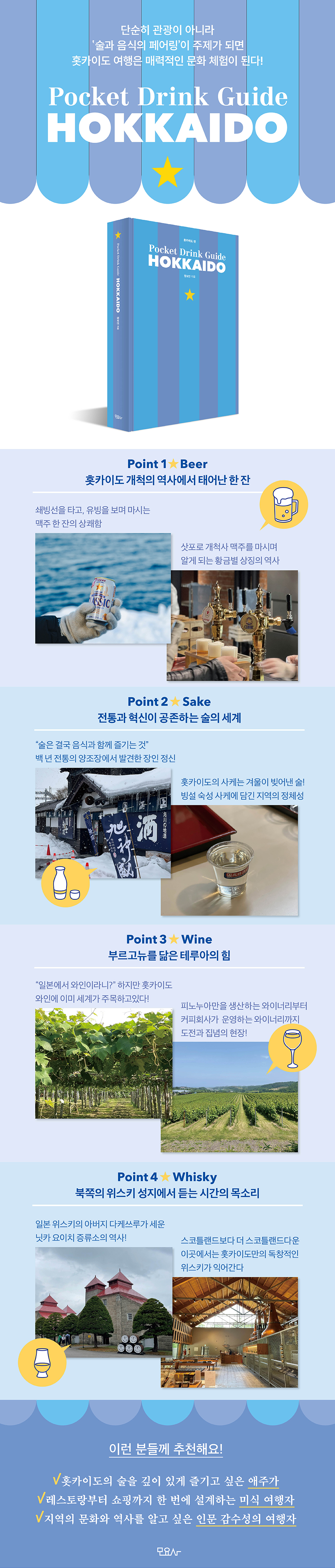
Beer, a drink born from the history of Hokkaido's pioneering
The Sapporo Beer Museum is not just a place to enjoy fresh beer, but also a space where the history of Hokkaido's development is preserved intact.
The red star shining atop the red brick building, which bears the marks of time, symbolizes the pioneers' compass and the North Star.
The author drinks the 'Pioneer Beer', which can only be tasted here, and confirms that a single glass of beer is a 'record of history and culture.'
From Otaru craft beer paired with Genghis Khan, to a tea-inspired beer from Niseko's Lupicia Brewery, to a beer brewed by a Michelin-starred chef and his crew, to a drift ice beer enjoyed while gazing at the breaking ice on an icebreaker in Abashiri, this book vividly demonstrates just how diverse and experimental Hokkaido beer can be.
Sake: A World of Alcohol Where Tradition and Innovation Coexist
Hokkaido sake is a product of snow, ice, and the rich nature.
The author visits Kobayashi Shuzo, a brewery with over a century of tradition, and documents Minami's belief that "sake is ultimately something to be enjoyed with food."
From the famous "Snow Field Dance" from Chitosetsuru, Sapporo's only brewery, to the unique sake from an experimental brewery located on a university campus, to the ice-aged sake from Takasago Shuzo, a brewery established 120 years ago, Hokkaido's sake is truly worthy of the expression "winter-made sake."
The author shows that a glass of sake can be a cultural medium that fully captures the identity and seasonality of a region.
Wine, the power of terroir resembling Burgundy
The question, "Wine in Japan?" changes the moment you set foot in Hokkaido.
Wineries in places like Yoichi and Furano are already producing wines that are attracting worldwide attention.
Here, you can see various attempts and dedication to making wine unique to Japan, such as Takahiko Domaine, which insists on only producing Pinot Noir on land where seven types of fruit trees once grew; Domaine Mong, which produces only Pinot Gris as the variety that best matches Hokkaido ingredients; Camel Farm Winery, operated by a coffee company; and 10R Winery, which provides a “learning workshop for brewing.”
In particular, the author does not simply tour the winery, but rather, through walking and talking with the producers, he interestingly unravels the stories of the people behind the wine.
The exquisite harmony of Hokkaido's wines, high-quality dairy products, and ingredients instantly transforms a trip to Hokkaido into a culinary journey through France.
Whiskey, the voice of time heard from the whiskey sanctuary of the north
Hokkaido whisky begins at the Nikka Whisky Yoichi Distillery.
This is the place founded by Masataka Taketsuru, known as the father of Japanese whiskey.
The reason he chose this place is because the climate and climate are more Scottish than Scotland.
However, the unique flavors created by the sea breeze, peat, and oak barrel aging are in line with Scottish traditions, while also clearly showing the unique character of Hokkaido.
Niseko Distillery is a whiskey distillery established by the century-old sake company Hakkai Shuzo. Its unique spatial design, which integrates the distillery and visitor center into one space, is noteworthy.
The author tells a rich story that could be called a "pilgrimage to the holy land of Hokkaido whisky," including scenes from whisky distilleries and maturation cells, limited edition bottles, and stories from people he met at local bars.
Coffee, a moment to catch your breath on your journey
Sapporo's long-established Kissaten Barbizon, Ippo Ippo in the market alley, Yoichi's ocean-view cafe Wilderness, and Niseko's Arishima Memorial Takano Coffee Shop.
A cup of coffee, which creates a moment of respite between drinks and food, slows down the pace of travel and provides a space to experience the local daily life.
In addition, we introduce a malt specialty bar, a restaurant where you can enjoy local wine and sake, a brunch spot at a Michelin-starred restaurant, and we also tell you about the experience of filling a shopping cart with local ingredients and crafts from places such as Sapporo Central Market, a cheese specialty shop, a French charcuterie, a tofu shop, Otaru Craft Street, and Mitsukoshi Department Store.
At the end of the book, there is a brief introduction to festivals that can be enjoyed in Sapporo, including the festival at Sapporo Odori Park.
The Sapporo Beer Museum is not just a place to enjoy fresh beer, but also a space where the history of Hokkaido's development is preserved intact.
The red star shining atop the red brick building, which bears the marks of time, symbolizes the pioneers' compass and the North Star.
The author drinks the 'Pioneer Beer', which can only be tasted here, and confirms that a single glass of beer is a 'record of history and culture.'
From Otaru craft beer paired with Genghis Khan, to a tea-inspired beer from Niseko's Lupicia Brewery, to a beer brewed by a Michelin-starred chef and his crew, to a drift ice beer enjoyed while gazing at the breaking ice on an icebreaker in Abashiri, this book vividly demonstrates just how diverse and experimental Hokkaido beer can be.
Sake: A World of Alcohol Where Tradition and Innovation Coexist
Hokkaido sake is a product of snow, ice, and the rich nature.
The author visits Kobayashi Shuzo, a brewery with over a century of tradition, and documents Minami's belief that "sake is ultimately something to be enjoyed with food."
From the famous "Snow Field Dance" from Chitosetsuru, Sapporo's only brewery, to the unique sake from an experimental brewery located on a university campus, to the ice-aged sake from Takasago Shuzo, a brewery established 120 years ago, Hokkaido's sake is truly worthy of the expression "winter-made sake."
The author shows that a glass of sake can be a cultural medium that fully captures the identity and seasonality of a region.
Wine, the power of terroir resembling Burgundy
The question, "Wine in Japan?" changes the moment you set foot in Hokkaido.
Wineries in places like Yoichi and Furano are already producing wines that are attracting worldwide attention.
Here, you can see various attempts and dedication to making wine unique to Japan, such as Takahiko Domaine, which insists on only producing Pinot Noir on land where seven types of fruit trees once grew; Domaine Mong, which produces only Pinot Gris as the variety that best matches Hokkaido ingredients; Camel Farm Winery, operated by a coffee company; and 10R Winery, which provides a “learning workshop for brewing.”
In particular, the author does not simply tour the winery, but rather, through walking and talking with the producers, he interestingly unravels the stories of the people behind the wine.
The exquisite harmony of Hokkaido's wines, high-quality dairy products, and ingredients instantly transforms a trip to Hokkaido into a culinary journey through France.
Whiskey, the voice of time heard from the whiskey sanctuary of the north
Hokkaido whisky begins at the Nikka Whisky Yoichi Distillery.
This is the place founded by Masataka Taketsuru, known as the father of Japanese whiskey.
The reason he chose this place is because the climate and climate are more Scottish than Scotland.
However, the unique flavors created by the sea breeze, peat, and oak barrel aging are in line with Scottish traditions, while also clearly showing the unique character of Hokkaido.
Niseko Distillery is a whiskey distillery established by the century-old sake company Hakkai Shuzo. Its unique spatial design, which integrates the distillery and visitor center into one space, is noteworthy.
The author tells a rich story that could be called a "pilgrimage to the holy land of Hokkaido whisky," including scenes from whisky distilleries and maturation cells, limited edition bottles, and stories from people he met at local bars.
Coffee, a moment to catch your breath on your journey
Sapporo's long-established Kissaten Barbizon, Ippo Ippo in the market alley, Yoichi's ocean-view cafe Wilderness, and Niseko's Arishima Memorial Takano Coffee Shop.
A cup of coffee, which creates a moment of respite between drinks and food, slows down the pace of travel and provides a space to experience the local daily life.
In addition, we introduce a malt specialty bar, a restaurant where you can enjoy local wine and sake, a brunch spot at a Michelin-starred restaurant, and we also tell you about the experience of filling a shopping cart with local ingredients and crafts from places such as Sapporo Central Market, a cheese specialty shop, a French charcuterie, a tofu shop, Otaru Craft Street, and Mitsukoshi Department Store.
At the end of the book, there is a brief introduction to festivals that can be enjoyed in Sapporo, including the festival at Sapporo Odori Park.
GOODS SPECIFICS
- Date of issue: September 27, 2025
- Page count, weight, size: 352 pages | 494g | 124*194*25mm
- ISBN13: 9791199263598
- ISBN10: 1199263591
You may also like
카테고리
korean


korean

![GQ KOREA Mark (Monthly): December [2025]](http://librairie.coreenne.fr/cdn/shop/files/8ef265dbbfbf186523ed75ba7319009d.jpg?v=1765340328&width=3840)


