

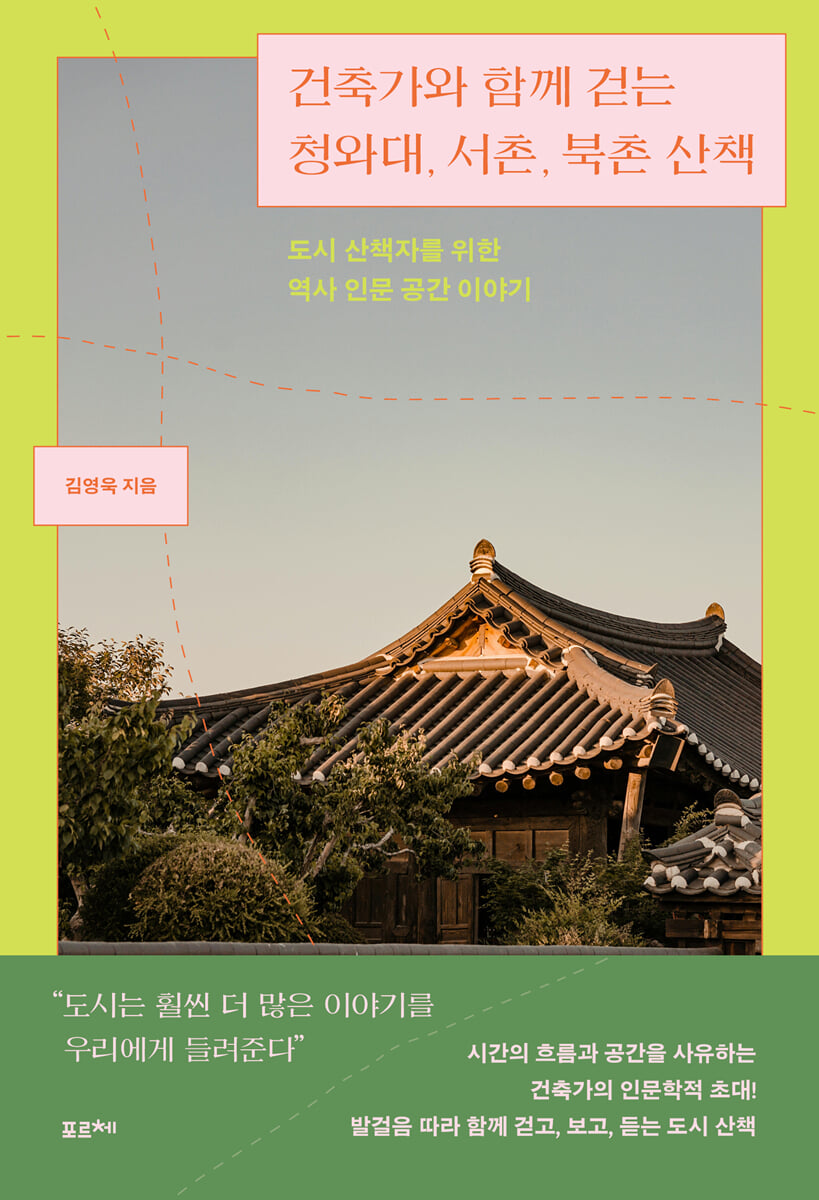
A walk through the Blue House, Seochon, and Bukchon with an architect
 |
Description
Book Introduction
A walking tour of Seochon and Bukchon, from the Blue House to the architect's office
“The city holds a wide and deep story.”
A walking tour of downtown Seoul, exploring the streets you've often overlooked.
The charm of a city revealed through unfamiliar yet familiar scenery!
Our daily lives revolve around space.
The spaces within the city are filled with layers of traces of time and various stories.
A space that has accumulated over many years has a deep charm in itself.
The author states that “buildings are historical artifacts and at the same time, they are the social and artistic crystallization of the time in which they were built.”
Let's take some time to think while looking at the old building.
You can have a mystical experience as if you have gone back in time to that time.
Break down the boundaries of time by personally experiencing the vivid scenery and atmosphere of that time.
"A Walk Through the Blue House, Seochon, and Bukchon with an Architect" offers a leisurely, cultural stroll through the transformed Blue House, a public park, and the Seochon and Bukchon villages, where past and present coexist.
It gives us the joy of taking in the countless scenes that pass us by while taking a walk and savoring the stories contained within them.
Books allow us to escape the hustle and bustle of the city, take a break, and experience the present moment.
Even in a comfortable and familiar neighborhood, let's walk back down the alleys.
You will encounter “the road the king traveled on, the neighborhoods where high-ranking officials lived, the valleys where the nobles enjoyed the arts, and the spaces where writers and painters created their works” in every nook and cranny.
Listening intently to sounds and gazing at scenery for a long time allows us to fully appreciate things we might otherwise overlook.
This alone will make your trip more fulfilling.
We introduce the one book that can awaken the sense of rest and reflection that modern people have lost.
“The city holds a wide and deep story.”
A walking tour of downtown Seoul, exploring the streets you've often overlooked.
The charm of a city revealed through unfamiliar yet familiar scenery!
Our daily lives revolve around space.
The spaces within the city are filled with layers of traces of time and various stories.
A space that has accumulated over many years has a deep charm in itself.
The author states that “buildings are historical artifacts and at the same time, they are the social and artistic crystallization of the time in which they were built.”
Let's take some time to think while looking at the old building.
You can have a mystical experience as if you have gone back in time to that time.
Break down the boundaries of time by personally experiencing the vivid scenery and atmosphere of that time.
"A Walk Through the Blue House, Seochon, and Bukchon with an Architect" offers a leisurely, cultural stroll through the transformed Blue House, a public park, and the Seochon and Bukchon villages, where past and present coexist.
It gives us the joy of taking in the countless scenes that pass us by while taking a walk and savoring the stories contained within them.
Books allow us to escape the hustle and bustle of the city, take a break, and experience the present moment.
Even in a comfortable and familiar neighborhood, let's walk back down the alleys.
You will encounter “the road the king traveled on, the neighborhoods where high-ranking officials lived, the valleys where the nobles enjoyed the arts, and the spaces where writers and painters created their works” in every nook and cranny.
Listening intently to sounds and gazing at scenery for a long time allows us to fully appreciate things we might otherwise overlook.
This alone will make your trip more fulfilling.
We introduce the one book that can awaken the sense of rest and reflection that modern people have lost.
- You can preview some of the book's contents.
Preview
index
Introduction: Towards a city with a wide and deep story 4
Part 1: Blue House
Chapter 1: The Blue House and the Offices of Foreign Leaders
Blue House and White House 16
What do foreign presidential offices look like? 22
The Blue House and Sejong-daero vs. Paris' Champs-Élysées 28
If the Blue House were to be rebuilt in its current location, it would be 32
Chapter 2: A Walk Around the Blue House
39 from the Blue House to Citizens' Park
Blue House's symbol, Blue-House 41
Part 2: Seochon and Bukchon
Chapter 1: Villages around the Blue House
64 Reasons to Explore Seochon and Bukchon After Seeing the Blue House
Yun Dong-ju Literature Museum and The Forest Bookstore 68
Why were there so many artists in Seochon? 73
The Shameful Space of Seochon: Traces of Yi Wan-yong and Yun Deok-yeong 76
81 Buildings You'll Encounter While Walking Through Bukchon
Villages around the Blue House in the movie 94
Chapter 2: Seochon, Bukchon, and a Walk
Walking through Seochon
Culture and Arts
Cheong Wa Dae Sarangchae and Fountain Plaza 103
Rose of Sharon Garden 104
Hyoja Bakery 105
Sangchonjae 106
Tongin Market 107
Daeo Bookstore 108
Daelim Museum 109
Security 1942 110
Ground Seesaw 112
Arumjigi Foundation 113
Sejong Village Food Culture Street 114
history
115 Gyeomjae-gil
Seochonjae 116
Yun Dong-ju's boarding house site 117
Park No-su House 118
Lee Sang-beom's house 120
Hong Geon-ik House 121
House of Ideals 122
Seochon Hanok Village and Old Road 124
Song Seok-won site 125
Pilundae 126
Byeoksusanjang site 127
Seo Yong-taek House 128
Baekhojeong 129
Yun Dong-ju Literature Museum 130
Susong-dong Valley 131
Sajikdan 132
Walking through Bukchon
Culture and Arts
National Folk Museum 134
Samcheong-dong Cafe Street 136
Samcheong Park Forest Library 138
Bukchon Living History Museum 140
Bukchon Hanok Village Main Photo Zone 142
Bukchon Museum of Oriental Culture 143
Jeongdok Library 146
Sulwhasoo Flagship Store, 148
Osulloc Tea House
150 for the gamgodanggil
Seoul Museum of Craft 151
Songwon Art Center 152
Wood & Brick 153
Palpan-dong Alley 154
history
Jungang High School 155
Baek In-je House 156
Gahoe-dong Cathedral 158
Joseon Language Society Site 159
See you at Bukaksan (Baekaksan) 160
Reference 181
Part 1: Blue House
Chapter 1: The Blue House and the Offices of Foreign Leaders
Blue House and White House 16
What do foreign presidential offices look like? 22
The Blue House and Sejong-daero vs. Paris' Champs-Élysées 28
If the Blue House were to be rebuilt in its current location, it would be 32
Chapter 2: A Walk Around the Blue House
39 from the Blue House to Citizens' Park
Blue House's symbol, Blue-House 41
Part 2: Seochon and Bukchon
Chapter 1: Villages around the Blue House
64 Reasons to Explore Seochon and Bukchon After Seeing the Blue House
Yun Dong-ju Literature Museum and The Forest Bookstore 68
Why were there so many artists in Seochon? 73
The Shameful Space of Seochon: Traces of Yi Wan-yong and Yun Deok-yeong 76
81 Buildings You'll Encounter While Walking Through Bukchon
Villages around the Blue House in the movie 94
Chapter 2: Seochon, Bukchon, and a Walk
Walking through Seochon
Culture and Arts
Cheong Wa Dae Sarangchae and Fountain Plaza 103
Rose of Sharon Garden 104
Hyoja Bakery 105
Sangchonjae 106
Tongin Market 107
Daeo Bookstore 108
Daelim Museum 109
Security 1942 110
Ground Seesaw 112
Arumjigi Foundation 113
Sejong Village Food Culture Street 114
history
115 Gyeomjae-gil
Seochonjae 116
Yun Dong-ju's boarding house site 117
Park No-su House 118
Lee Sang-beom's house 120
Hong Geon-ik House 121
House of Ideals 122
Seochon Hanok Village and Old Road 124
Song Seok-won site 125
Pilundae 126
Byeoksusanjang site 127
Seo Yong-taek House 128
Baekhojeong 129
Yun Dong-ju Literature Museum 130
Susong-dong Valley 131
Sajikdan 132
Walking through Bukchon
Culture and Arts
National Folk Museum 134
Samcheong-dong Cafe Street 136
Samcheong Park Forest Library 138
Bukchon Living History Museum 140
Bukchon Hanok Village Main Photo Zone 142
Bukchon Museum of Oriental Culture 143
Jeongdok Library 146
Sulwhasoo Flagship Store, 148
Osulloc Tea House
150 for the gamgodanggil
Seoul Museum of Craft 151
Songwon Art Center 152
Wood & Brick 153
Palpan-dong Alley 154
history
Jungang High School 155
Baek In-je House 156
Gahoe-dong Cathedral 158
Joseon Language Society Site 159
See you at Bukaksan (Baekaksan) 160
Reference 181
Detailed image

Into the book
This book will help you have a much more enjoyable and meaningful experience when walking around the Blue House and its surrounding neighborhoods.
I don't know how long the Blue House can remain an open space for citizens.
So, I hope you will visit now and feel the architectural meaning embedded in the history and space created over a long period of time.
And I hope we can think deeply about what kind of era will unfold before us.
Let's think together about what choices we need to make to become wise and smart citizens in the Republic of Korea where we live.
I hope this book will be beneficial to readers.
--- p.7 From “Towards a City with Broad and Deep Stories”
The spatial structure of a building influences human behavior.
Depending on how a space is designed, it can either facilitate free communication or hinder communication and promote isolation and isolation.
Even people who are good at communicating will gradually close off their communication possibilities if they live in a space where communication is difficult for a long time.
To respond to the rapidly evolving domestic and international political landscape and current issues, there is a greater need than ever for a space where the president can work and communicate with his staff, overcoming the ideological symbolism of his authority.
--- p.21 From “The Blue House and the White House”
As mentioned before, the site of the Blue House was formerly the garden of Gyeongbokgung Palace.
Traces of this palace can be found along the road from Chunchugwan to Bukaksan Mountain, surrounding the rear garden area outside of Gyeongbokgung Palace's Sinmumun Gate.
According to various sources, the wall of the outer palace wall, Chunsaengmun, on the east is connected to the ridge toward the Prime Minister's official residence, and the wall starting from the inner palace wall, Chunhwamun, passes the ridge of Bukaksan Mountain to the north and continues to Chuseongmun on the west.
The length of the palace was recorded to be 698 gan (approximately 1,675 m).
It is believed that the current wall surrounding the Blue House was built based on the site of the palace in the rear garden built during the reign of King Gojong of the Joseon Dynasty.
This can be estimated based on the long stones that remain at the base of the Blue House wall.
--- p.58 From “Blue House, the Symbol of the Blue House”
You may have hidden in the attic or under the stairs when playing hide-and-seek as a child.
There is comfort in a space that is human-scale (an architectural term meaning that it uses people as the basis for design).
People feel comfortable in these spaces.
That's why people stay for a long time.
Although it may seem a bit chaotic, Seochon has a strange sense of familiarity and comfort.
It's similar to how we are delighted when we travel abroad and discover the old narrow alleys and houses crowded together in that city.
This is because places like this smell like warm people.
--- p.66 From “Reasons to Visit Seochon and Bukchon After Seeing the Blue House”
The boundary between inside and outside feels vague.
It makes you feel like you're outside the building even when you're inside, and inside the building even when you're outside.
The two levels are created by taking advantage of the steps of the fault, and the roof of the higher outpost provides an excellent observation deck.
The view of Gwanghwamun is visible at a glance.
Remodeling is the act of layering time on a space that holds memories of the past.
Architects breathe new life into existing buildings that have reached the end of their lifespan with their creative passion.
--- p.72 From “Yoon Dong-ju Literature Museum and The Forest Bookstore”
The size of buildings has a great influence on the image of a town.
The sight of buildings of similar size next to each other is harmonious and beautiful.
The Gahoe-dong Cathedral was divided into three wings, hiding the large sanctuary and priest's residence behind the surrounding small buildings.
In a church, interaction between believers is important.
Architects think deeply about not only the building but also what kind of yard it will have.
It's as if the building was built with the five courtyards in mind, taking into account people's movements and gazes.
The space left after building a building is the exterior space and the yard.
For many architects, the form of a building takes precedence over the exterior space.
This is an attempt to express the meaning and architectural view of the building.
--- p.89 From “Buildings Encountered While Walking Through Bukchon”
Currently, the Park No-su House is operated as the Jongno-gu Park No-su Art Museum.
Park No-su's house, registered as Seoul Cultural Heritage Material No. 1, exhibits the characteristics of an urban hanok built on sloping land.
Known as the artist's house and an open art gallery in Sejong Village, the well-preserved floor, hallway, staircase, and window frames, along with the presence of several fireplaces, suggest that it was a luxurious residence.
It is located on a sloping lot, and if you climb the hill behind the house, you can overlook Seochon.
It has a wonderful view of the narrow alleys and small hanok houses of Seochon.
--- p.118 From “Park No-su House (Jongno-gu Park No-su Art Museum)”
The two houses in Gahoe-dong, Sulwhasoo's flagship store and Osulloc Tea House, are a harmonious blend of Hanok and Western-style architecture.
The Sulwhasoo cosmetics exhibition hall, housed in a two-story Western-style building with a Korean tile roof and glass, and the Osulloc Tea House, housed in a modern house, create an awkward yet harmonious and splendid encounter.
Standing in the space between a Hanok and a Western-style house, you can experience the heterogeneous elements mixing together to create a unique atmosphere.
The modern landscape connects two eras.
Let's take a look at the railing on the second floor of the building that connects the Sulwhasoo building, a remodeled Hanok, and the Osulloc Tea House, a modern house.
Up until Sulwhasoo, wooden railings were used, and from Osulloc Tea House onwards, glass railings were used, cleverly expressing the intersection of past and present.
--- p.148 From “Sulwhasoo Flagship Store, Osulloc Tea House”
Palpan-dong is a place where historic houses and new attempts coexist.
As you enter the alleys of Palpan-dong, you will find small coffee shops, restaurants, and bakeries.
‘Milk Hall 1937’ and ‘Rosso’ are famous restaurants on social media.
The representative place of Palpan-dong is ‘Palpan Butcher Shop’.
It started in 1940, so it has a history of 80 years.
In addition, there are stores with a long history that have firmly established themselves.
There are many locals in Palpan-dong who have been living here for at least 30 to 40 years.
--- p.154 From "Palpan-dong Alley"
Baekakjeong is a rest area behind the Blue House residence. It can be reached by climbing along the wall next to Chunchugwan for about 20 minutes.
It plays a central role in hiking Mt. Bukak.
This is because it is a place that people who aim to reach the summit of Bukaksan Mountain and other hikers must pass through when climbing.
Originally, there was no pavilion here.
If you look around, you can find trees planted by past presidents everywhere.
From here, you can see the city center of Seoul as well as three sides of Seoul except for the north, and the surrounding area is dotted with roof tiles from the Joseon Dynasty.
Looking at this, if it is true that the Baekak Shrine was moved from the summit to the bottom, it is highly likely that this is the place.
I don't know how long the Blue House can remain an open space for citizens.
So, I hope you will visit now and feel the architectural meaning embedded in the history and space created over a long period of time.
And I hope we can think deeply about what kind of era will unfold before us.
Let's think together about what choices we need to make to become wise and smart citizens in the Republic of Korea where we live.
I hope this book will be beneficial to readers.
--- p.7 From “Towards a City with Broad and Deep Stories”
The spatial structure of a building influences human behavior.
Depending on how a space is designed, it can either facilitate free communication or hinder communication and promote isolation and isolation.
Even people who are good at communicating will gradually close off their communication possibilities if they live in a space where communication is difficult for a long time.
To respond to the rapidly evolving domestic and international political landscape and current issues, there is a greater need than ever for a space where the president can work and communicate with his staff, overcoming the ideological symbolism of his authority.
--- p.21 From “The Blue House and the White House”
As mentioned before, the site of the Blue House was formerly the garden of Gyeongbokgung Palace.
Traces of this palace can be found along the road from Chunchugwan to Bukaksan Mountain, surrounding the rear garden area outside of Gyeongbokgung Palace's Sinmumun Gate.
According to various sources, the wall of the outer palace wall, Chunsaengmun, on the east is connected to the ridge toward the Prime Minister's official residence, and the wall starting from the inner palace wall, Chunhwamun, passes the ridge of Bukaksan Mountain to the north and continues to Chuseongmun on the west.
The length of the palace was recorded to be 698 gan (approximately 1,675 m).
It is believed that the current wall surrounding the Blue House was built based on the site of the palace in the rear garden built during the reign of King Gojong of the Joseon Dynasty.
This can be estimated based on the long stones that remain at the base of the Blue House wall.
--- p.58 From “Blue House, the Symbol of the Blue House”
You may have hidden in the attic or under the stairs when playing hide-and-seek as a child.
There is comfort in a space that is human-scale (an architectural term meaning that it uses people as the basis for design).
People feel comfortable in these spaces.
That's why people stay for a long time.
Although it may seem a bit chaotic, Seochon has a strange sense of familiarity and comfort.
It's similar to how we are delighted when we travel abroad and discover the old narrow alleys and houses crowded together in that city.
This is because places like this smell like warm people.
--- p.66 From “Reasons to Visit Seochon and Bukchon After Seeing the Blue House”
The boundary between inside and outside feels vague.
It makes you feel like you're outside the building even when you're inside, and inside the building even when you're outside.
The two levels are created by taking advantage of the steps of the fault, and the roof of the higher outpost provides an excellent observation deck.
The view of Gwanghwamun is visible at a glance.
Remodeling is the act of layering time on a space that holds memories of the past.
Architects breathe new life into existing buildings that have reached the end of their lifespan with their creative passion.
--- p.72 From “Yoon Dong-ju Literature Museum and The Forest Bookstore”
The size of buildings has a great influence on the image of a town.
The sight of buildings of similar size next to each other is harmonious and beautiful.
The Gahoe-dong Cathedral was divided into three wings, hiding the large sanctuary and priest's residence behind the surrounding small buildings.
In a church, interaction between believers is important.
Architects think deeply about not only the building but also what kind of yard it will have.
It's as if the building was built with the five courtyards in mind, taking into account people's movements and gazes.
The space left after building a building is the exterior space and the yard.
For many architects, the form of a building takes precedence over the exterior space.
This is an attempt to express the meaning and architectural view of the building.
--- p.89 From “Buildings Encountered While Walking Through Bukchon”
Currently, the Park No-su House is operated as the Jongno-gu Park No-su Art Museum.
Park No-su's house, registered as Seoul Cultural Heritage Material No. 1, exhibits the characteristics of an urban hanok built on sloping land.
Known as the artist's house and an open art gallery in Sejong Village, the well-preserved floor, hallway, staircase, and window frames, along with the presence of several fireplaces, suggest that it was a luxurious residence.
It is located on a sloping lot, and if you climb the hill behind the house, you can overlook Seochon.
It has a wonderful view of the narrow alleys and small hanok houses of Seochon.
--- p.118 From “Park No-su House (Jongno-gu Park No-su Art Museum)”
The two houses in Gahoe-dong, Sulwhasoo's flagship store and Osulloc Tea House, are a harmonious blend of Hanok and Western-style architecture.
The Sulwhasoo cosmetics exhibition hall, housed in a two-story Western-style building with a Korean tile roof and glass, and the Osulloc Tea House, housed in a modern house, create an awkward yet harmonious and splendid encounter.
Standing in the space between a Hanok and a Western-style house, you can experience the heterogeneous elements mixing together to create a unique atmosphere.
The modern landscape connects two eras.
Let's take a look at the railing on the second floor of the building that connects the Sulwhasoo building, a remodeled Hanok, and the Osulloc Tea House, a modern house.
Up until Sulwhasoo, wooden railings were used, and from Osulloc Tea House onwards, glass railings were used, cleverly expressing the intersection of past and present.
--- p.148 From “Sulwhasoo Flagship Store, Osulloc Tea House”
Palpan-dong is a place where historic houses and new attempts coexist.
As you enter the alleys of Palpan-dong, you will find small coffee shops, restaurants, and bakeries.
‘Milk Hall 1937’ and ‘Rosso’ are famous restaurants on social media.
The representative place of Palpan-dong is ‘Palpan Butcher Shop’.
It started in 1940, so it has a history of 80 years.
In addition, there are stores with a long history that have firmly established themselves.
There are many locals in Palpan-dong who have been living here for at least 30 to 40 years.
--- p.154 From "Palpan-dong Alley"
Baekakjeong is a rest area behind the Blue House residence. It can be reached by climbing along the wall next to Chunchugwan for about 20 minutes.
It plays a central role in hiking Mt. Bukak.
This is because it is a place that people who aim to reach the summit of Bukaksan Mountain and other hikers must pass through when climbing.
Originally, there was no pavilion here.
If you look around, you can find trees planted by past presidents everywhere.
From here, you can see the city center of Seoul as well as three sides of Seoul except for the north, and the surrounding area is dotted with roof tiles from the Joseon Dynasty.
Looking at this, if it is true that the Baekak Shrine was moved from the summit to the bottom, it is highly likely that this is the place.
--- p.166 From “Bukaksan Mountain, From a Fortress of Defense and Border to a Resting Place for Citizens”
Publisher's Review
Curated for city walkers looking to find their own space!
From places with a long history
Hot places you want to visit again and again
Uncovering the beauty and charm of Seochon and Bukchon
There is a neighborhood that puts my mind at ease.
Although it is located in the heart of bustling Seoul, there are few buildings that are lower in height than high-rise buildings, so the scenery is great no matter where you look.
Seochon and Bukchon, with their hanok buildings and rustic alleyways, are places you'll want to take a leisurely stroll through.
The two neighborhoods, where you can naturally take the time to walk around the flat ground and look around, have many attractive spaces where the past and present coexist.
There are many spaces where the long history of the area is vividly alive, such as the 'Tongin Market', a traditional alley-style market with a long history; 'Boan 1942', which was remodeled from the Boan Inn built during the Japanese colonial period; 'Lee Sang's House', which preserves and opens part of the site of the writer Lee Sang's former home; and the 'Bukchon Life History Museum', which exhibits items used by Bukchon residents until the late 1970s.
In addition, 'Hyoja Bakery', which is a must-visit on the Seochon 'Bread Pilgrimage' course, is a place where bread is so delicious that it was supplied to the Blue House security service, and 'Samcheong Park Forest Library' located in Bukchon is a place of rest where you can read a book and savor the scenery in the lush forest.
The Sulwhasoo Flagship Store and Osulloc Tea House, which were remodeled from a Hanok built in 1930 and a Western-style house built in the 1960s, respectively, create a new landscape, expanding the possibilities of space and presenting architectural attractions.
There are also spaces that remind us of a painful past.
In Seochon, there are still traces of the French-style mansion 'Byeoksusanjang' built by pro-Japanese collaborator Yun Deok-yeong as compensation for his pro-Japanese activities during the Japanese colonial period.
These spaces serve as small clues to help us look back on the past and move toward a better future.
"A Walk Through the Blue House, Seochon, and Bukchon with an Architect" gives you the strength to keep walking in the noisy city.
Walking slowly helps you pause for a moment to take a deep breath and feel the flow of the wind as you admire the scenery that you can only see for the first time.
This book will be your guide for each step you take.
“Space should be created for people.”
The Blue House, a space of harmony connecting people
A look through the eyes of architect Kim Young-wook
In 2022, the Blue House, once a forbidden space, was opened to everyone and became a welcoming space.
With the complete opening, the road connecting Gyeongbokgung Palace and the Blue House to Bukaksan Mountain has established itself as a new tourist attraction.
The Blue House, which has been around for a long time from the Japanese colonial era to the present day, holds secret stories that we did not know about.
The book introduces the Blue House space step by step.
Looking at the front of the Blue House building, which combines the traditional wooden palace architectural style with modern elements, the sturdy and beautiful blue roof tiles that are said to last more than 100 years stand out.
Once inside, you will find spaces where the nation's big and small issues are discussed and resolved, including the presidential office, reception room, and banquet hall.
Outside, a spacious front yard unfolds, and traditional Korean houses are scattered throughout, as well as Buddhist statues from the Unified Silla period, which are designated as tangible cultural properties of Seoul.
In addition, you can enjoy a landscape where the past and present coexist, including the official residence where the president lived, a shrine built during the Joseon Dynasty, and a 750-year-old jujube tree.
In this way, the Blue House is a place where beautiful spaces that have been formed over a long period of time are gathered together.
However, many people still remember the Blue House as a symbol of 'lack of communication' and 'authority.'
The author, who said that “the spatial structure of a building influences human behavior,” had previously pointed out that the problems of communication breakdown and power-dominance within the Blue House were problems of spatial structure.
He also said that the chronic problems of the Blue House should be closely examined by comparing them to the offices of foreign leaders, and that we should reflect and think about ways to create a better space.
The architect's deep perspective on space from multiple perspectives will be felt in a new way.
From places with a long history
Hot places you want to visit again and again
Uncovering the beauty and charm of Seochon and Bukchon
There is a neighborhood that puts my mind at ease.
Although it is located in the heart of bustling Seoul, there are few buildings that are lower in height than high-rise buildings, so the scenery is great no matter where you look.
Seochon and Bukchon, with their hanok buildings and rustic alleyways, are places you'll want to take a leisurely stroll through.
The two neighborhoods, where you can naturally take the time to walk around the flat ground and look around, have many attractive spaces where the past and present coexist.
There are many spaces where the long history of the area is vividly alive, such as the 'Tongin Market', a traditional alley-style market with a long history; 'Boan 1942', which was remodeled from the Boan Inn built during the Japanese colonial period; 'Lee Sang's House', which preserves and opens part of the site of the writer Lee Sang's former home; and the 'Bukchon Life History Museum', which exhibits items used by Bukchon residents until the late 1970s.
In addition, 'Hyoja Bakery', which is a must-visit on the Seochon 'Bread Pilgrimage' course, is a place where bread is so delicious that it was supplied to the Blue House security service, and 'Samcheong Park Forest Library' located in Bukchon is a place of rest where you can read a book and savor the scenery in the lush forest.
The Sulwhasoo Flagship Store and Osulloc Tea House, which were remodeled from a Hanok built in 1930 and a Western-style house built in the 1960s, respectively, create a new landscape, expanding the possibilities of space and presenting architectural attractions.
There are also spaces that remind us of a painful past.
In Seochon, there are still traces of the French-style mansion 'Byeoksusanjang' built by pro-Japanese collaborator Yun Deok-yeong as compensation for his pro-Japanese activities during the Japanese colonial period.
These spaces serve as small clues to help us look back on the past and move toward a better future.
"A Walk Through the Blue House, Seochon, and Bukchon with an Architect" gives you the strength to keep walking in the noisy city.
Walking slowly helps you pause for a moment to take a deep breath and feel the flow of the wind as you admire the scenery that you can only see for the first time.
This book will be your guide for each step you take.
“Space should be created for people.”
The Blue House, a space of harmony connecting people
A look through the eyes of architect Kim Young-wook
In 2022, the Blue House, once a forbidden space, was opened to everyone and became a welcoming space.
With the complete opening, the road connecting Gyeongbokgung Palace and the Blue House to Bukaksan Mountain has established itself as a new tourist attraction.
The Blue House, which has been around for a long time from the Japanese colonial era to the present day, holds secret stories that we did not know about.
The book introduces the Blue House space step by step.
Looking at the front of the Blue House building, which combines the traditional wooden palace architectural style with modern elements, the sturdy and beautiful blue roof tiles that are said to last more than 100 years stand out.
Once inside, you will find spaces where the nation's big and small issues are discussed and resolved, including the presidential office, reception room, and banquet hall.
Outside, a spacious front yard unfolds, and traditional Korean houses are scattered throughout, as well as Buddhist statues from the Unified Silla period, which are designated as tangible cultural properties of Seoul.
In addition, you can enjoy a landscape where the past and present coexist, including the official residence where the president lived, a shrine built during the Joseon Dynasty, and a 750-year-old jujube tree.
In this way, the Blue House is a place where beautiful spaces that have been formed over a long period of time are gathered together.
However, many people still remember the Blue House as a symbol of 'lack of communication' and 'authority.'
The author, who said that “the spatial structure of a building influences human behavior,” had previously pointed out that the problems of communication breakdown and power-dominance within the Blue House were problems of spatial structure.
He also said that the chronic problems of the Blue House should be closely examined by comparing them to the offices of foreign leaders, and that we should reflect and think about ways to create a better space.
The architect's deep perspective on space from multiple perspectives will be felt in a new way.
GOODS SPECIFICS
- Date of issue: November 13, 2024
- Page count, weight, size: 184 pages | 294g | 140*250*12mm
- ISBN13: 9791193584859
- ISBN10: 119358485X
You may also like
카테고리
korean


korean

![ELLE 엘르 스페셜 에디션 A형 : 12월 [2025]](http://librairie.coreenne.fr/cdn/shop/files/b8e27a3de6c9538896439686c6b0e8fb.jpg?v=1766436872&width=3840)


