

Restarting the faith of the mother
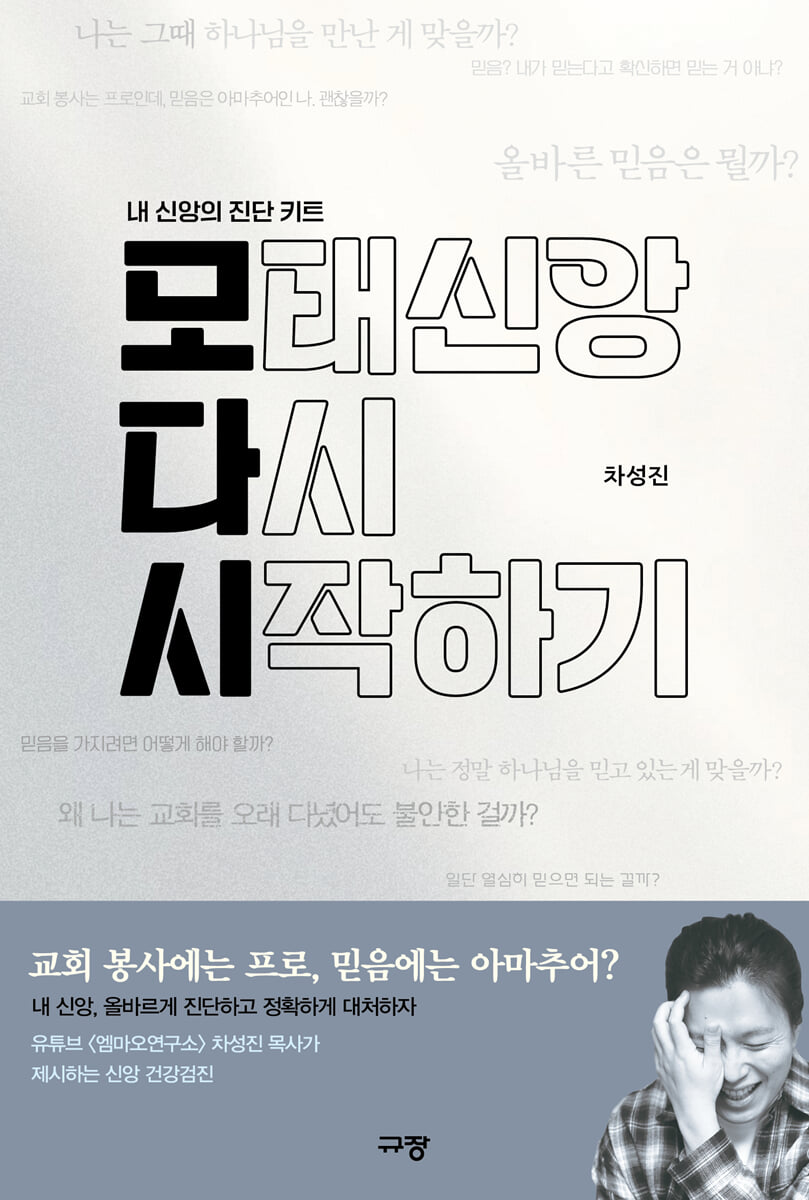 |
Description
Book Introduction
A Faith Health Checkup Kit to Face Your Beliefs and Build a Sound Foundation
Easy-to-read editing and illustrations, suitable as a small group textbook
People often call ‘mother-faith’ ‘faith that cannot be done.’
If you study something consistently for just two or three years, you will gain some ability to teach others. Why is it that so many people who have been faithful to the church for over 20 years have not even established the basics of their faith?
The author says it is due to the lack of proper diagnosis and treatment.
Because the standards of faith based on the Bible are not clearly presented, people mistakenly believe they have faith based on superficial and incorrect standards, and they are unable to follow the correct prescriptions, which ultimately leads to the collapse of their faith.
As a born-again Christian, the author, who was a victim(?) of this, started from this awareness of the problem and reached a conversion, and has since been preaching “Starting anew with the born-again faith” on YouTube and the podium.
His explanations are humorous, but the facts he points out and the diagnostic questions he asks are sharp and penetrating.
But the more I read, the more I find myself asking myself, "Do I really have faith?" and I feel fortunate that I can realize this now, rather than when I stand before God's judgment seat.
This book presents profound content in poetic prose and illustrations, enhancing readability and providing emotional empathy and space for reflection. It also includes summary notes and reflection questions at the end of each lecture, making it suitable as a teaching tool for Sunday school and small groups for middle-aged and older adults.
We have already included reviews from middle and high school students, youth, and teachers who have used the book as a teaching material in several churches as 'recommendations.'
This book is essential for everyone, from long-time believers to those who are new to the gospel.
In particular, I highly recommend this book to anyone who attends church diligently but lacks confidence in their faith or has never even considered such concerns, anyone who experiences a faith that is passionate at retreats but cold in daily life, or anyone who feels a sense of duty rather than gratitude when they hear the word “salvation.”
Easy-to-read editing and illustrations, suitable as a small group textbook
People often call ‘mother-faith’ ‘faith that cannot be done.’
If you study something consistently for just two or three years, you will gain some ability to teach others. Why is it that so many people who have been faithful to the church for over 20 years have not even established the basics of their faith?
The author says it is due to the lack of proper diagnosis and treatment.
Because the standards of faith based on the Bible are not clearly presented, people mistakenly believe they have faith based on superficial and incorrect standards, and they are unable to follow the correct prescriptions, which ultimately leads to the collapse of their faith.
As a born-again Christian, the author, who was a victim(?) of this, started from this awareness of the problem and reached a conversion, and has since been preaching “Starting anew with the born-again faith” on YouTube and the podium.
His explanations are humorous, but the facts he points out and the diagnostic questions he asks are sharp and penetrating.
But the more I read, the more I find myself asking myself, "Do I really have faith?" and I feel fortunate that I can realize this now, rather than when I stand before God's judgment seat.
This book presents profound content in poetic prose and illustrations, enhancing readability and providing emotional empathy and space for reflection. It also includes summary notes and reflection questions at the end of each lecture, making it suitable as a teaching tool for Sunday school and small groups for middle-aged and older adults.
We have already included reviews from middle and high school students, youth, and teachers who have used the book as a teaching material in several churches as 'recommendations.'
This book is essential for everyone, from long-time believers to those who are new to the gospel.
In particular, I highly recommend this book to anyone who attends church diligently but lacks confidence in their faith or has never even considered such concerns, anyone who experiences a faith that is passionate at retreats but cold in daily life, or anyone who feels a sense of duty rather than gratitude when they hear the word “salvation.”
- You can preview some of the book's contents.
Preview
index
Recommendation
prolog
Lesson 1: Do I Believe in God? - The Standard of Faith
Lesson 2: You Can Play the Piano Well Even Without Faith
- Criteria for False Belief (1)
Lesson 3: I believe in the existence of God!
- Criteria for False Beliefs (2,3)
Semi-final I met God!
- Criteria for False Beliefs (4)
Lesson 5: What You Already Know
- The standard of correct belief
Lesson 6 So, what should we do now?
- A starting point for correct faith
Lesson 7: How to Start a Faithful Life
- The right way to deal with my condition
The quarterfinals are annoying and boring
- Temptations in the Church
prolog
Lesson 1: Do I Believe in God? - The Standard of Faith
Lesson 2: You Can Play the Piano Well Even Without Faith
- Criteria for False Belief (1)
Lesson 3: I believe in the existence of God!
- Criteria for False Beliefs (2,3)
Semi-final I met God!
- Criteria for False Beliefs (4)
Lesson 5: What You Already Know
- The standard of correct belief
Lesson 6 So, what should we do now?
- A starting point for correct faith
Lesson 7: How to Start a Faithful Life
- The right way to deal with my condition
The quarterfinals are annoying and boring
- Temptations in the Church
Detailed image

Into the book
The right question to ask when examining our faith is not, "Do I acknowledge my faith?" but, "Will God acknowledge my faith?"
What exactly is God's "standard of faith"? And does our faith meet that standard?
--- p.24
Faith can make one zealous, but not everyone who is zealous believes in God.
I didn't know that when I was young.
I was just diligent in church life because of a sense of responsibility and a desire for recognition, but when I heard people say, “You have good faith,” I thought I had faith.
--- p.66
You can live a faithful church life without believing in God, and people around you will see no problem with it.
The praise given there, the rewards of work, and the need for recognition being fulfilled all give great satisfaction.
So we often get it wrong.
'This is the joy of believing in God.'
--- p.68
"No! But I still believe in God! I truly believe there is a Creator!" This is the definition of faith felt in this conversation.
'If you believe in the existence of God, you believe in God.' Of course, that's a good confession.
But can we really call this ‘faith’?
--- p.77
Salvation is a concept that is very familiar to us.
There is probably no one among us who does not believe in salvation.
But here we need to think about it one more time.
Do you really believe in salvation? Or maybe you just know it?
--- pp.139-140
We know the Dangun myth.
But, I don't believe that.
We also know the gods of Greek and Roman mythology.
But still, I don't believe in those gods.
Isn't your understanding of salvation limited to mere knowledge?
--- p.141
The faith that the Bible requires for salvation, ‘believing with the heart,’ means a faith that truly believes in salvation, going beyond mere recognition of salvation.
So how can I know, 'Do I truly believe in salvation?'
--- p.143
Let's imagine something fun. If you could trade your life for Cha Eun-woo right now, would you? You'd probably receive the kind of attention and love you've never received before, and it would be much easier to win someone's heart.
But there is one condition: what if after you change you can never attend church again?
--- p.148
Since salvation is the event that gave us eternal life, it would be natural to be more grateful for it than for any other blessing we can enjoy on this earth.
How about it? Do you feel the greatest gratitude for salvation above all else?
--- p.151
We will take the first step toward welcoming the moment when we are completely moved by salvation, hold it as the most precious value in our lives, and our lives are transformed by that emotion.
So, what steps do we need to take to have faith?
--- p.179
The Bible calls a person who lives a life that is distinct from that of ordinary people a “saint,” and from the moment of “conversion,” which makes that distinct life possible, that person can be called a “saint” in the true sense of the word.
And from this point on, we are given the duty to live the life of a saint.
What is the life of a saint?
--- pp.238-239
Sometimes we don't feel a sense of problem when someone who has been a believer for a long time has not yet been converted, that is, has not been moved to salvation.
Rather, there are times when people who have the correct knowledge of the gospel and are influenced by its contents are looked upon as great people.
Doesn't that seem a bit strange?
--- p.261
If a friend who went to swimming school for two years is afraid of water, we can't understand that friend.
But why are we so tolerant of people who have been attending church for over 20 years without being converted?
--- pp.265-266
Only when church life is built on the right foundation of the inspiration and joy of salvation and the excitement of the kingdom of God can that church life truly become a life of faith.
--- p.271
Let us start again from our original faith, from our essence.
Let us lay down everything we have accumulated so far at the Lord's feet, humbly confess our state, and start again from the basics.
What exactly is God's "standard of faith"? And does our faith meet that standard?
--- p.24
Faith can make one zealous, but not everyone who is zealous believes in God.
I didn't know that when I was young.
I was just diligent in church life because of a sense of responsibility and a desire for recognition, but when I heard people say, “You have good faith,” I thought I had faith.
--- p.66
You can live a faithful church life without believing in God, and people around you will see no problem with it.
The praise given there, the rewards of work, and the need for recognition being fulfilled all give great satisfaction.
So we often get it wrong.
'This is the joy of believing in God.'
--- p.68
"No! But I still believe in God! I truly believe there is a Creator!" This is the definition of faith felt in this conversation.
'If you believe in the existence of God, you believe in God.' Of course, that's a good confession.
But can we really call this ‘faith’?
--- p.77
Salvation is a concept that is very familiar to us.
There is probably no one among us who does not believe in salvation.
But here we need to think about it one more time.
Do you really believe in salvation? Or maybe you just know it?
--- pp.139-140
We know the Dangun myth.
But, I don't believe that.
We also know the gods of Greek and Roman mythology.
But still, I don't believe in those gods.
Isn't your understanding of salvation limited to mere knowledge?
--- p.141
The faith that the Bible requires for salvation, ‘believing with the heart,’ means a faith that truly believes in salvation, going beyond mere recognition of salvation.
So how can I know, 'Do I truly believe in salvation?'
--- p.143
Let's imagine something fun. If you could trade your life for Cha Eun-woo right now, would you? You'd probably receive the kind of attention and love you've never received before, and it would be much easier to win someone's heart.
But there is one condition: what if after you change you can never attend church again?
--- p.148
Since salvation is the event that gave us eternal life, it would be natural to be more grateful for it than for any other blessing we can enjoy on this earth.
How about it? Do you feel the greatest gratitude for salvation above all else?
--- p.151
We will take the first step toward welcoming the moment when we are completely moved by salvation, hold it as the most precious value in our lives, and our lives are transformed by that emotion.
So, what steps do we need to take to have faith?
--- p.179
The Bible calls a person who lives a life that is distinct from that of ordinary people a “saint,” and from the moment of “conversion,” which makes that distinct life possible, that person can be called a “saint” in the true sense of the word.
And from this point on, we are given the duty to live the life of a saint.
What is the life of a saint?
--- pp.238-239
Sometimes we don't feel a sense of problem when someone who has been a believer for a long time has not yet been converted, that is, has not been moved to salvation.
Rather, there are times when people who have the correct knowledge of the gospel and are influenced by its contents are looked upon as great people.
Doesn't that seem a bit strange?
--- p.261
If a friend who went to swimming school for two years is afraid of water, we can't understand that friend.
But why are we so tolerant of people who have been attending church for over 20 years without being converted?
--- pp.265-266
Only when church life is built on the right foundation of the inspiration and joy of salvation and the excitement of the kingdom of God can that church life truly become a life of faith.
--- p.271
Let us start again from our original faith, from our essence.
Let us lay down everything we have accumulated so far at the Lord's feet, humbly confess our state, and start again from the basics.
--- p.280
Publisher's Review
A Guide to Faith that Diagnoses My Faith
'I've been going to church for a long time, so of course I have faith.'
'Seeing you doing good service, I can see you have faith.'
'They must have faith, since they are the pastor's children.'
We have been diagnosing our own and others' beliefs based on overly superficial criteria.
Because of this, it would have been difficult to accurately know the state of faith and to make accurate decisions about how to respond to that state.
This book aims to provide diagnosis and coping strategies.
'Do I really believe in God?'
What is faith?
'Where should I find that standard?' 'If I don't have faith, what should I do from now on?'
This book will provide answers to these questions.
--- From the prologue
'I've been going to church for a long time, so of course I have faith.'
'Seeing you doing good service, I can see you have faith.'
'They must have faith, since they are the pastor's children.'
We have been diagnosing our own and others' beliefs based on overly superficial criteria.
Because of this, it would have been difficult to accurately know the state of faith and to make accurate decisions about how to respond to that state.
This book aims to provide diagnosis and coping strategies.
'Do I really believe in God?'
What is faith?
'Where should I find that standard?' 'If I don't have faith, what should I do from now on?'
This book will provide answers to these questions.
--- From the prologue
GOODS SPECIFICS
- Date of issue: September 22, 2025
- Page count, weight, size: 288 pages | 135*200*20mm
- ISBN13: 9791165046521
- ISBN10: 1165046520
You may also like
카테고리
korean


korean

![GQ KOREA Mark (Monthly): December [2025]](http://librairie.coreenne.fr/cdn/shop/files/8ef265dbbfbf186523ed75ba7319009d.jpg?v=1765340328&width=3840)


