

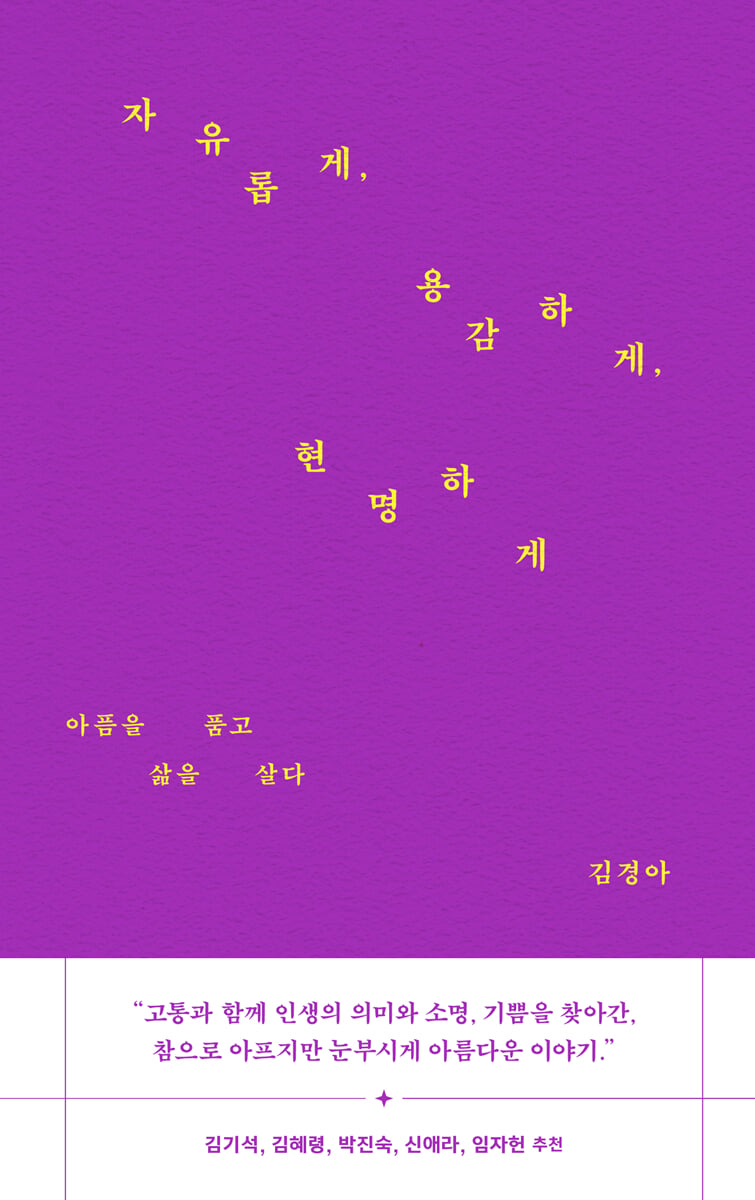
Freely, bravely, wisely
 |
Description
Book Introduction
“I searched for the meaning, calling, and joy of life through pain,
“A truly painful yet dazzlingly beautiful story.”
- Recommended by Kim Ki-seok, Kim Hye-ryeong, Park Jin-sook, Shin Ae-ra, and Im Ja-heon
“I now know that even the pieces of life that seem like failures are not worth throwing away.
“If only we could see that piece from a distance, it might actually make our lives shine.”
This is the life story of an author who lived with chronic illness and pain for 37 years throughout his adult life, yet is remembered as a man of love, friendship, and hospitality, and a record of the loss and grief experienced by a husband who was by his wife's side during her final days.
Living with an autoimmune disease that does not get better or get better, it depicts a faithful life gait that focuses on 'living' rather than focusing on pain.
“I, too, may one day find myself lying on the edge of death at an unexpected time.
The past days of hating, regretting, and complaining felt pointless.
“When I leave, all I have left is love.”
Faced with suffering given without reason, the author created a beautiful and dignified life by shaping the harsh conditions of life given to him.
What made that creative transformation possible were the people he loved, those who loved him, and the great root of faith.
Ultimately, as readers look at the life memoir completed with beautiful patterns, they will gain the courage, hope, and comfort to view life with more dignity and live courageously.
“A truly painful yet dazzlingly beautiful story.”
- Recommended by Kim Ki-seok, Kim Hye-ryeong, Park Jin-sook, Shin Ae-ra, and Im Ja-heon
“I now know that even the pieces of life that seem like failures are not worth throwing away.
“If only we could see that piece from a distance, it might actually make our lives shine.”
This is the life story of an author who lived with chronic illness and pain for 37 years throughout his adult life, yet is remembered as a man of love, friendship, and hospitality, and a record of the loss and grief experienced by a husband who was by his wife's side during her final days.
Living with an autoimmune disease that does not get better or get better, it depicts a faithful life gait that focuses on 'living' rather than focusing on pain.
“I, too, may one day find myself lying on the edge of death at an unexpected time.
The past days of hating, regretting, and complaining felt pointless.
“When I leave, all I have left is love.”
Faced with suffering given without reason, the author created a beautiful and dignified life by shaping the harsh conditions of life given to him.
What made that creative transformation possible were the people he loved, those who loved him, and the great root of faith.
Ultimately, as readers look at the life memoir completed with beautiful patterns, they will gain the courage, hope, and comfort to view life with more dignity and live courageously.
- You can preview some of the book's contents.
Preview
index
Before reading
Introduction
Chapter 1 Context and Situation
“You have to accept yourself and live to survive.”
Chapter 2 Patient Relationship
“I want to live like an ordinary person.”
Chapter 3: The Patient's Faith
“I am learning to live with hardship today too.”
Chapter 4 Patient Self-Actualization
“I silently did what I accepted as mine.”
Chapter 5: Patients and Death
“I want to make the best decision for myself.”
Appendix 1: Hospital Diary + Prayer Letter
- Posts shared on Facebook between January 16, 2025 and March 31, 2025
Appendix 2: A grain of wheat fell to the ground
- Remembering the appearance of author Kim Kyung-ah
Appendix 3: I think what was important to me was 'people'.
- Interview with Dr. Ji-Hyeon Joo, Department of Rheumatology, Seoul St. Mary's Hospital
Introduction
Chapter 1 Context and Situation
“You have to accept yourself and live to survive.”
Chapter 2 Patient Relationship
“I want to live like an ordinary person.”
Chapter 3: The Patient's Faith
“I am learning to live with hardship today too.”
Chapter 4 Patient Self-Actualization
“I silently did what I accepted as mine.”
Chapter 5: Patients and Death
“I want to make the best decision for myself.”
Appendix 1: Hospital Diary + Prayer Letter
- Posts shared on Facebook between January 16, 2025 and March 31, 2025
Appendix 2: A grain of wheat fell to the ground
- Remembering the appearance of author Kim Kyung-ah
Appendix 3: I think what was important to me was 'people'.
- Interview with Dr. Ji-Hyeon Joo, Department of Rheumatology, Seoul St. Mary's Hospital
Into the book
My illness is entirely mine, but it is not entirely mine.
It affected everyone around me, and sometimes even the people I loved most.
Even though I was a patient, I wanted to love.
Maybe because he was a patient, he needed more love.
Because he was a patient, he was betrayed in love, and despite being a patient, he finally found his last love.
Even though I was sick, I wanted to have a child.
I wanted my life to be recognized by giving birth to a child with my own body.
So I gave birth to two children and raised three more.
Finding love, getting married, having children and raising them were all not easy for the patient.
--- p.26 From the “Introductory Note”
How did I survive as a chronically ill person in a world of healthy people? Having been seriously ill for the past two years, I've been forced to reflect on my life as a patient, living my daily life from my hospital bed.
My life so far can be summarized in two words: ‘pain’ and ‘love.’
On nights when I was overcome with pain, I wondered what use it was for love and for me.
They say that life is a command to 'live', to 'survive', so I prayed and prayed that that command would be taken away.
But I'm alive.
--- p.27 From the “Introductory Note”
Another debilitating symptom of rheumatoid arthritis is fatigue.
Since I was eighteen, words like 'refreshing' and 'cool' have not appeared in my daily life.
There's always at least one place that hurts, and my body always feels like it weighs a ton.
I'm so tired that I feel like my body is digging through the floor and into the center of the earth.
I also had a vision of my body falling into an endless abyss.
--- p.43 From “Chapter 1 Context and Situation”
I may not be able to find a convincing reason for my suffering or my illness.
This time it came down to a peripheral nerve problem, including hepatitis, but next time there may be a problem with any part of the body, such as the heart or blood vessels.
There is every possibility that this could happen.
I'm too old to be rolling around in disbelief, tearing my hair out.
If you come, you come, if you go, you go. From now on, we must live with this attitude even more.
I think there will be more days when I'm grateful that things aren't as bad as I thought they would be, rather than days when I'm grateful that the best I could have done came true.
--- p.50 From “Chapter 1 Context and Situation”
People with disabilities or illnesses are constantly walking a tightrope between what they want to do and the limitations of their bodies.
I'm always confused between earning my living and getting help.
I dream of a life where I am not a patient or disabled, but sometimes I want to hide behind my body as a patient or disabled person.
In this way, I am a divided being.
He is a fragile person by nature.
I have to accept this side of myself and live to survive.
--- p.52 From “Chapter 1 Context and Situation”
What was more painful than the physical pain was the emptiness of wondering, 'What is the meaning of this pain?'
If I wait patiently, will the "day of the bright sun" really come? If life is meaningless, what's the point? I felt like living was just miserable.
Every religious expression like “God of love” or “Our Lord, the good shepherd” made me question, “Is that really true?”
Then, in the end, I realized that my faith up until then was nothing more than a faith that was only about getting what I wanted.
After that, I began to seriously question what it meant to believe in God and what my relationship with God was like.
The disease has uprooted my life and my mind.
--- p.86 From “Chapter 3: The Patient’s Faith”
Like a piece of the quilt I made, the choices I make now will inevitably become a part of my life.
I know now that I shouldn't just randomly cut out any color or shape, but that doesn't mean I should just throw away the pieces of life that seem like failures.
If only we could see that piece from a distance, it might actually brighten our lives.
The confession that “working together for good” comes out at a time like this.
I think people also need to be viewed from a distance.
Isn't growing old, becoming old, the ability to see the whole picture from a distance?
--- p.103 From “Chapter 3: The Patient’s Faith”
The lament of the writer of Ecclesiastes, “Vanity of vanities, all is vanity,” rang in my ears.
Death was much closer than I thought.
Maybe life and death are only a few dozen centimeters apart, like where that child and I are.
I, too, may one day find myself lying on the edge of death at an unexpected time.
The past days of hating, regretting, and complaining felt pointless.
When I left, all I had left behind was love.
The sudden death of someone I cherished left me and those left behind with the question and homework of how to live.
--- p.123 From “Chapter 4 Patient’s Self-Actualization”
I believe that it is natural for all living things to leave and make way for the next generation.
We can never defeat death.
Aging and death are not diseases to be cured.
Growing old and dying is the fate of all creatures.
I welcome measures to 'save' my life when I am in a certain situation, but I am against 'extending' my life.
So, while I'm still sane, I'm going to write down what treatments I want and what treatments I don't want and let my family know.
It affected everyone around me, and sometimes even the people I loved most.
Even though I was a patient, I wanted to love.
Maybe because he was a patient, he needed more love.
Because he was a patient, he was betrayed in love, and despite being a patient, he finally found his last love.
Even though I was sick, I wanted to have a child.
I wanted my life to be recognized by giving birth to a child with my own body.
So I gave birth to two children and raised three more.
Finding love, getting married, having children and raising them were all not easy for the patient.
--- p.26 From the “Introductory Note”
How did I survive as a chronically ill person in a world of healthy people? Having been seriously ill for the past two years, I've been forced to reflect on my life as a patient, living my daily life from my hospital bed.
My life so far can be summarized in two words: ‘pain’ and ‘love.’
On nights when I was overcome with pain, I wondered what use it was for love and for me.
They say that life is a command to 'live', to 'survive', so I prayed and prayed that that command would be taken away.
But I'm alive.
--- p.27 From the “Introductory Note”
Another debilitating symptom of rheumatoid arthritis is fatigue.
Since I was eighteen, words like 'refreshing' and 'cool' have not appeared in my daily life.
There's always at least one place that hurts, and my body always feels like it weighs a ton.
I'm so tired that I feel like my body is digging through the floor and into the center of the earth.
I also had a vision of my body falling into an endless abyss.
--- p.43 From “Chapter 1 Context and Situation”
I may not be able to find a convincing reason for my suffering or my illness.
This time it came down to a peripheral nerve problem, including hepatitis, but next time there may be a problem with any part of the body, such as the heart or blood vessels.
There is every possibility that this could happen.
I'm too old to be rolling around in disbelief, tearing my hair out.
If you come, you come, if you go, you go. From now on, we must live with this attitude even more.
I think there will be more days when I'm grateful that things aren't as bad as I thought they would be, rather than days when I'm grateful that the best I could have done came true.
--- p.50 From “Chapter 1 Context and Situation”
People with disabilities or illnesses are constantly walking a tightrope between what they want to do and the limitations of their bodies.
I'm always confused between earning my living and getting help.
I dream of a life where I am not a patient or disabled, but sometimes I want to hide behind my body as a patient or disabled person.
In this way, I am a divided being.
He is a fragile person by nature.
I have to accept this side of myself and live to survive.
--- p.52 From “Chapter 1 Context and Situation”
What was more painful than the physical pain was the emptiness of wondering, 'What is the meaning of this pain?'
If I wait patiently, will the "day of the bright sun" really come? If life is meaningless, what's the point? I felt like living was just miserable.
Every religious expression like “God of love” or “Our Lord, the good shepherd” made me question, “Is that really true?”
Then, in the end, I realized that my faith up until then was nothing more than a faith that was only about getting what I wanted.
After that, I began to seriously question what it meant to believe in God and what my relationship with God was like.
The disease has uprooted my life and my mind.
--- p.86 From “Chapter 3: The Patient’s Faith”
Like a piece of the quilt I made, the choices I make now will inevitably become a part of my life.
I know now that I shouldn't just randomly cut out any color or shape, but that doesn't mean I should just throw away the pieces of life that seem like failures.
If only we could see that piece from a distance, it might actually brighten our lives.
The confession that “working together for good” comes out at a time like this.
I think people also need to be viewed from a distance.
Isn't growing old, becoming old, the ability to see the whole picture from a distance?
--- p.103 From “Chapter 3: The Patient’s Faith”
The lament of the writer of Ecclesiastes, “Vanity of vanities, all is vanity,” rang in my ears.
Death was much closer than I thought.
Maybe life and death are only a few dozen centimeters apart, like where that child and I are.
I, too, may one day find myself lying on the edge of death at an unexpected time.
The past days of hating, regretting, and complaining felt pointless.
When I left, all I had left behind was love.
The sudden death of someone I cherished left me and those left behind with the question and homework of how to live.
--- p.123 From “Chapter 4 Patient’s Self-Actualization”
I believe that it is natural for all living things to leave and make way for the next generation.
We can never defeat death.
Aging and death are not diseases to be cured.
Growing old and dying is the fate of all creatures.
I welcome measures to 'save' my life when I am in a certain situation, but I am against 'extending' my life.
So, while I'm still sane, I'm going to write down what treatments I want and what treatments I don't want and let my family know.
--- p.152 From “Chapter 5: The Death of a Patient”
GOODS SPECIFICS
- Date of issue: September 22, 2025
- Page count, weight, size: 300 pages | 332g | 125*198*18mm
- ISBN13: 9791191887327
- ISBN10: 1191887324
You may also like
카테고리
korean


korean

![GQ KOREA Mark (Monthly): December [2025]](http://librairie.coreenne.fr/cdn/shop/files/8ef265dbbfbf186523ed75ba7319009d.jpg?v=1765340328&width=3840)


