

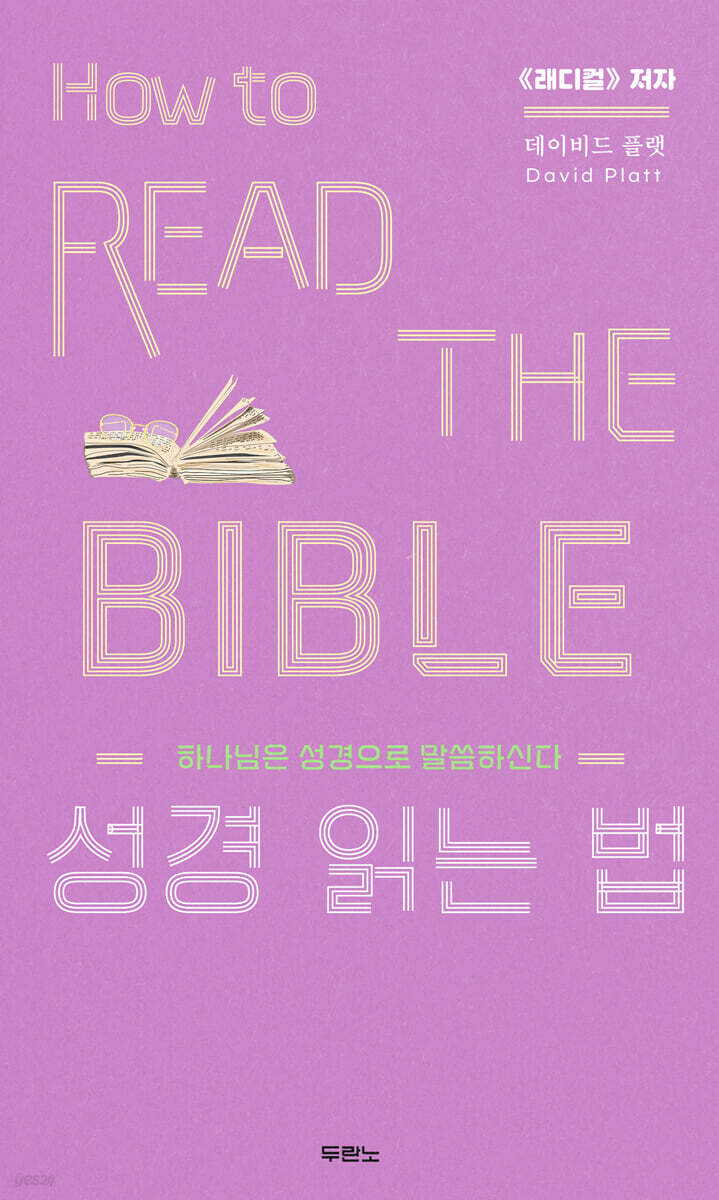
How to Read the Bible
 |
Description
Book Introduction
Those who, despite their long religious life, are still unfamiliar with the Bible,
For those who are at a loss as to where and how to start with a thick Bible,
Today, for all God's people who stand before the Word
"The Bible? I know I should read it, but I just can't seem to get around to it." Every Christian has probably thought this at least once.
Even though the Bible has already been translated into numerous languages and is readily available around the world, countless Christians live without reading it properly for various reasons.
As a result, joy disappears from life, faith dries up or wavers, and the influence of faith in the world fades.
Pastor David Platt, who has deeply resonated with Christians around the world and led them to the true path of the gospel through 『Radical』 and 『The Gospel Cries』, now presents a new path, an old one, to Christians weary of broken relationships, fleeting pleasures, anxiety, and discouragement in a complex and difficult world.
That is, reading the living word of God, the Bible.
A Bible reading manual that'll make you want to open your Bible right away! Let's read the Bible now!
For those who are at a loss as to where and how to start with a thick Bible,
Today, for all God's people who stand before the Word
"The Bible? I know I should read it, but I just can't seem to get around to it." Every Christian has probably thought this at least once.
Even though the Bible has already been translated into numerous languages and is readily available around the world, countless Christians live without reading it properly for various reasons.
As a result, joy disappears from life, faith dries up or wavers, and the influence of faith in the world fades.
Pastor David Platt, who has deeply resonated with Christians around the world and led them to the true path of the gospel through 『Radical』 and 『The Gospel Cries』, now presents a new path, an old one, to Christians weary of broken relationships, fleeting pleasures, anxiety, and discouragement in a complex and difficult world.
That is, reading the living word of God, the Bible.
A Bible reading manual that'll make you want to open your Bible right away! Let's read the Bible now!
- You can preview some of the book's contents.
Preview
index
preface.
Plunge! Fall in love with God
Part 1.
Before opening the Bible
Misunderstandings and misguided attitudes surrounding Bible study
Chapter 1.
A precarious Christian living without the Word
Chapter 2.
Reading the Bible with this attitude is dangerous.
Part 2.
Starting today, read the Bible as the author intended.
―Following the wise and clear guidance (MAPS)
Step 1 I.
Meditate on and memorize God's Word
Step 1 II.
Meditate on and 'memorize' God's Word
Step 2.
Apply the Word to every level of life
Step 3.
Pray with bold faith as the Word says.
Step 4.
Share the Word, near and far
Conclusion.
A love worth sacrificing our lives for
supplement.
How to Read the Bible by Genre
Acknowledgements
Plunge! Fall in love with God
Part 1.
Before opening the Bible
Misunderstandings and misguided attitudes surrounding Bible study
Chapter 1.
A precarious Christian living without the Word
Chapter 2.
Reading the Bible with this attitude is dangerous.
Part 2.
Starting today, read the Bible as the author intended.
―Following the wise and clear guidance (MAPS)
Step 1 I.
Meditate on and memorize God's Word
Step 1 II.
Meditate on and 'memorize' God's Word
Step 2.
Apply the Word to every level of life
Step 3.
Pray with bold faith as the Word says.
Step 4.
Share the Word, near and far
Conclusion.
A love worth sacrificing our lives for
supplement.
How to Read the Bible by Genre
Acknowledgements
Detailed image
.jpg)
Into the book
Some people work 50, 60, or even 70 hours a week.
Even if you're at home, you rarely have time to be alone because you're taking care of your young children, and you certainly don't have the mental capacity to sit down and study anything.
This prevailing sentiment today stands in stark contrast to the way Christians have treated God's Word throughout church history.
As is common in some Christian groups and traditions, in the past, not only the "especially devout" church leaders but all believers would rise early in the morning, meditate on God's Word, and then gather around the table with the whole family to share a meal and share the Word.
Even in broad daylight, I set aside time to read God's Word, either alone or with other Christians.
Then, after work, I would sit around the dinner table and read God's word, and later, before going to bed, I would meditate on the word in private.
It is a scene that is difficult for us, who live hectic lives these days, to understand.
I can't imagine spending that much time all day, from the moment I open my eyes to the moment I fall asleep, looking at something.
No, but wait a minute… … .
Aren't we all already viewing our smartphones that way? According to US statistics, people spend an average of 5 hours and 24 minutes a day using mobile devices.
From the moment we open our eyes to the moment we fall asleep, we check our smartphones an average of 96 times a day, or once every 10 minutes.
If you think about it, we are not as pressed for time as we think.
While it's true that smartphones are addictive, what's even more evident is that everyone finds time for the things they deem truly important in their lives.
So this question is important.
'How important is God's Word to my life?'
--- p.20-21
Sometimes we read God's Word to gain new insights that have not been revealed to anyone before.
Of course, this feeling is not entirely wrong.
It is natural to want to understand everything God says in the text.
But countless Christians have studied the same words since ancient times, and Christian history hasn't been waiting for you, an individual, to come on stage and discover something new.
If we insist on finding something that applies specifically to our lives, we may once again end up misinterpreting God's Word from its original meaning.
As you read the Bible, you might think like this:
'Okay, this is what it means when you first read it, but I want to delve deeper here.' That's how you analyze the text and eventually fit the meaning to your current self.
When seeking the meaning of a word, let us be content with the meaning that is already clearly revealed.
Let us be content and rejoice that we are part of a great multitude.
Until now, they have heard, believed, and obeyed the same promises, exhortations, reproofs, commands, and eternal truths, and God has given all these words, then and now, to bring about the good of His people.
--- p.33-34
Memorization is the process of putting His Word in our hearts to help us walk with God.
Some people might say, “I’m not good at memorizing things...” and that might be true.
Of course, memorization ability varies from person to person.
But let me ask you one thing.
What if I gave you $1,000 for every time you memorized a Bible verse from now until this time tomorrow? You'd at least somehow memorize a few verses.
“Jesus wept.” John 11:35
You have already earned $1,000.
If money is at stake, you can certainly recite quite a few verses.
Now listen to this psalm:
“The law of your mouth is better to me than thousands of gold and silver pieces” (Psalm 119:72).
Do you really believe this? That's the real question.
The important question is not, "Do I have the ability to memorize?" but, "Which is more precious to me: money or the Word of God?"
--- p.59-60
Jesus taught us to pray for God's will to be done in our lives, and God reveals His will to us through His Word.
Therefore, after meditating on, memorizing, and applying the Word of God to our lives, we too must pray like Jesus did:
“Not my will, but yours, be done” (Luke 22:42).
As I mentioned earlier when examining the wrong way to study the Bible, we should pray like this before we open the Bible to meditate on it.
“God, whatever you say, I will believe and follow it.
“I will live according to the Lord’s words in this world, no matter what the consequences may be.”
Likewise, you should pray similarly before closing the Bible.
“God, I have seen your will in your words, and now I want to do it.
“Please help me to believe and do all that God commands me to believe and do in these words.”
--- p.90
Around 400 AD, a man named Jerome translated the Bible from Hebrew and Greek into Latin.
This has led to more people being able to read and study the Bible.
Almost 1,000 years after Jerome's Latin translation, a man named John Wycliffe translated the Bible into English.
However, Wycliffe was persecuted as a heretic because he tried to spread the Bible in the language of the 'common people'.
A little over a century later, William Tyndale complemented Wycliffe's efforts by translating the Bible from Latin, as well as its original Hebrew and Greek, into English.
Tyndale attempted to translate the entire Bible, but was burned at the stake in 1536 for translating the Bible without finishing the Old Testament.
The Old Testament translation that Tyndale had begun was completed by his colleague, John Rogers, who was also later burned at the stake.
The Bible in your native language that you and I see is the result of the hard work and sacrifice of those who wrote it.
Jesus is at the center of that process.
He, the Word of God, became flesh (John 1:14) and shed His blood to save us.
After that, those who followed him passed on the word of God to us, many of whom also shed blood.
There are two reasons why I emphasize this history of Bible translation.
First of all, we must never take lightly the treasure that is the word of God given to us.
The Bible has been distributed to many countries around the world for a long time, and many people own multiple copies of the Bible.
But unfortunately, many Christians do not even open their Bibles, leaving them on a bookshelf to gather dust or using them as coasters.
It is not for this reason that our brothers and sisters in Christ who went before us were martyred, and it is certainly not for this reason that Jesus gave up his life.
--- pp.106-107
** Letter **
Of the 27 books of the New Testament, 21 are letters written to individuals and churches.
Most of these letters have a similar format.
The reporter and recipient are revealed in the introduction, the official greeting, the body of the letter, and the prayer, exhortation, or command in the conclusion.
In the epistles we get a fascinating glimpse into the joys and struggles of those who followed Jesus in the first century.
The epistles are full of promises and commands that God gives us as His people living under the new covenant.
Here are some tips to follow when studying the Epistles:
- First, take the time to understand the writer and recipient of the letter, as well as the overall intent.
- Remember that these letters are documents that arose out of necessity.
This means that it was not written as a theological treatise or theoretical book, but rather to deal with a specific situation.
Reading a letter is like listening to only one side of a phone call.
So, to understand what the reporter meant, try to picture the person on the other end of the line.
- Before studying a specific text, read the entire letter first.
Then each part can be understood in light of the whole.
It's also a good idea to outline the flow of the entire letter.
Then you can see how the structure of the text is organized.
- For each paragraph or section of the letter, ask:
'What is the reporter's point here?' 'How does this part fit into the overall message of the letter?'
- If there is anything ambiguous or uncertain in the letter, do not draw conclusions that are contrary to the teachings clearly stated in other letters or other parts of the Bible.
Even if you're at home, you rarely have time to be alone because you're taking care of your young children, and you certainly don't have the mental capacity to sit down and study anything.
This prevailing sentiment today stands in stark contrast to the way Christians have treated God's Word throughout church history.
As is common in some Christian groups and traditions, in the past, not only the "especially devout" church leaders but all believers would rise early in the morning, meditate on God's Word, and then gather around the table with the whole family to share a meal and share the Word.
Even in broad daylight, I set aside time to read God's Word, either alone or with other Christians.
Then, after work, I would sit around the dinner table and read God's word, and later, before going to bed, I would meditate on the word in private.
It is a scene that is difficult for us, who live hectic lives these days, to understand.
I can't imagine spending that much time all day, from the moment I open my eyes to the moment I fall asleep, looking at something.
No, but wait a minute… … .
Aren't we all already viewing our smartphones that way? According to US statistics, people spend an average of 5 hours and 24 minutes a day using mobile devices.
From the moment we open our eyes to the moment we fall asleep, we check our smartphones an average of 96 times a day, or once every 10 minutes.
If you think about it, we are not as pressed for time as we think.
While it's true that smartphones are addictive, what's even more evident is that everyone finds time for the things they deem truly important in their lives.
So this question is important.
'How important is God's Word to my life?'
--- p.20-21
Sometimes we read God's Word to gain new insights that have not been revealed to anyone before.
Of course, this feeling is not entirely wrong.
It is natural to want to understand everything God says in the text.
But countless Christians have studied the same words since ancient times, and Christian history hasn't been waiting for you, an individual, to come on stage and discover something new.
If we insist on finding something that applies specifically to our lives, we may once again end up misinterpreting God's Word from its original meaning.
As you read the Bible, you might think like this:
'Okay, this is what it means when you first read it, but I want to delve deeper here.' That's how you analyze the text and eventually fit the meaning to your current self.
When seeking the meaning of a word, let us be content with the meaning that is already clearly revealed.
Let us be content and rejoice that we are part of a great multitude.
Until now, they have heard, believed, and obeyed the same promises, exhortations, reproofs, commands, and eternal truths, and God has given all these words, then and now, to bring about the good of His people.
--- p.33-34
Memorization is the process of putting His Word in our hearts to help us walk with God.
Some people might say, “I’m not good at memorizing things...” and that might be true.
Of course, memorization ability varies from person to person.
But let me ask you one thing.
What if I gave you $1,000 for every time you memorized a Bible verse from now until this time tomorrow? You'd at least somehow memorize a few verses.
“Jesus wept.” John 11:35
You have already earned $1,000.
If money is at stake, you can certainly recite quite a few verses.
Now listen to this psalm:
“The law of your mouth is better to me than thousands of gold and silver pieces” (Psalm 119:72).
Do you really believe this? That's the real question.
The important question is not, "Do I have the ability to memorize?" but, "Which is more precious to me: money or the Word of God?"
--- p.59-60
Jesus taught us to pray for God's will to be done in our lives, and God reveals His will to us through His Word.
Therefore, after meditating on, memorizing, and applying the Word of God to our lives, we too must pray like Jesus did:
“Not my will, but yours, be done” (Luke 22:42).
As I mentioned earlier when examining the wrong way to study the Bible, we should pray like this before we open the Bible to meditate on it.
“God, whatever you say, I will believe and follow it.
“I will live according to the Lord’s words in this world, no matter what the consequences may be.”
Likewise, you should pray similarly before closing the Bible.
“God, I have seen your will in your words, and now I want to do it.
“Please help me to believe and do all that God commands me to believe and do in these words.”
--- p.90
Around 400 AD, a man named Jerome translated the Bible from Hebrew and Greek into Latin.
This has led to more people being able to read and study the Bible.
Almost 1,000 years after Jerome's Latin translation, a man named John Wycliffe translated the Bible into English.
However, Wycliffe was persecuted as a heretic because he tried to spread the Bible in the language of the 'common people'.
A little over a century later, William Tyndale complemented Wycliffe's efforts by translating the Bible from Latin, as well as its original Hebrew and Greek, into English.
Tyndale attempted to translate the entire Bible, but was burned at the stake in 1536 for translating the Bible without finishing the Old Testament.
The Old Testament translation that Tyndale had begun was completed by his colleague, John Rogers, who was also later burned at the stake.
The Bible in your native language that you and I see is the result of the hard work and sacrifice of those who wrote it.
Jesus is at the center of that process.
He, the Word of God, became flesh (John 1:14) and shed His blood to save us.
After that, those who followed him passed on the word of God to us, many of whom also shed blood.
There are two reasons why I emphasize this history of Bible translation.
First of all, we must never take lightly the treasure that is the word of God given to us.
The Bible has been distributed to many countries around the world for a long time, and many people own multiple copies of the Bible.
But unfortunately, many Christians do not even open their Bibles, leaving them on a bookshelf to gather dust or using them as coasters.
It is not for this reason that our brothers and sisters in Christ who went before us were martyred, and it is certainly not for this reason that Jesus gave up his life.
--- pp.106-107
** Letter **
Of the 27 books of the New Testament, 21 are letters written to individuals and churches.
Most of these letters have a similar format.
The reporter and recipient are revealed in the introduction, the official greeting, the body of the letter, and the prayer, exhortation, or command in the conclusion.
In the epistles we get a fascinating glimpse into the joys and struggles of those who followed Jesus in the first century.
The epistles are full of promises and commands that God gives us as His people living under the new covenant.
Here are some tips to follow when studying the Epistles:
- First, take the time to understand the writer and recipient of the letter, as well as the overall intent.
- Remember that these letters are documents that arose out of necessity.
This means that it was not written as a theological treatise or theoretical book, but rather to deal with a specific situation.
Reading a letter is like listening to only one side of a phone call.
So, to understand what the reporter meant, try to picture the person on the other end of the line.
- Before studying a specific text, read the entire letter first.
Then each part can be understood in light of the whole.
It's also a good idea to outline the flow of the entire letter.
Then you can see how the structure of the text is organized.
- For each paragraph or section of the letter, ask:
'What is the reporter's point here?' 'How does this part fit into the overall message of the letter?'
- If there is anything ambiguous or uncertain in the letter, do not draw conclusions that are contrary to the teachings clearly stated in other letters or other parts of the Bible.
--- pp.128-129
Publisher's Review
Encountering God's love and sincerity toward me
A heart-pounding roadmap to reading the Bible!
A dull heart, warmed again by the Word!
A broken life, rise again with the Word!
A practical yet concise guide in your hand
This book is not a guide to reading the Bible as a religious duty.
We are invited to a place where we can share love with God the Creator.
It leads us to move beyond the self-centered approach of reading the Bible based on our own feelings, subjectivity, and seemingly plausible insights, and instead approach the Word “as God, the Author, intended.”
We also introduce a reliable, practical, four-step map (MAPS) that provides the basics, direction, and attitude for reading the Bible.
It is about meditating on the Bible, memorizing it, applying it, praying about it, and sharing it.
A prayer and question section is included at the end of each chapter to help you understand and put the contents of this book into practice more deeply.
Originally, Bible study was not a rigid and mechanical religious activity.
The Bible is full of the treasures of the kingdom of God.
Enjoy the treasure that awaits you! If we simply read His Word, filled with His life and love, consistently and faithfully, His love will surely revive and transform our lives.
If we can enjoy His love, we would not mind giving our all!
A heart-pounding roadmap to reading the Bible!
A dull heart, warmed again by the Word!
A broken life, rise again with the Word!
A practical yet concise guide in your hand
This book is not a guide to reading the Bible as a religious duty.
We are invited to a place where we can share love with God the Creator.
It leads us to move beyond the self-centered approach of reading the Bible based on our own feelings, subjectivity, and seemingly plausible insights, and instead approach the Word “as God, the Author, intended.”
We also introduce a reliable, practical, four-step map (MAPS) that provides the basics, direction, and attitude for reading the Bible.
It is about meditating on the Bible, memorizing it, applying it, praying about it, and sharing it.
A prayer and question section is included at the end of each chapter to help you understand and put the contents of this book into practice more deeply.
Originally, Bible study was not a rigid and mechanical religious activity.
The Bible is full of the treasures of the kingdom of God.
Enjoy the treasure that awaits you! If we simply read His Word, filled with His life and love, consistently and faithfully, His love will surely revive and transform our lives.
If we can enjoy His love, we would not mind giving our all!
GOODS SPECIFICS
- Date of issue: September 10, 2025
- Pages, weight, size: 136 pages | 164g | 120*200*9mm
- ISBN13: 9788953151635
- ISBN10: 8953151635
You may also like
카테고리
korean


korean

![GQ KOREA Mark (Monthly): December [2025]](http://librairie.coreenne.fr/cdn/shop/files/8ef265dbbfbf186523ed75ba7319009d.jpg?v=1765340328&width=3840)


