

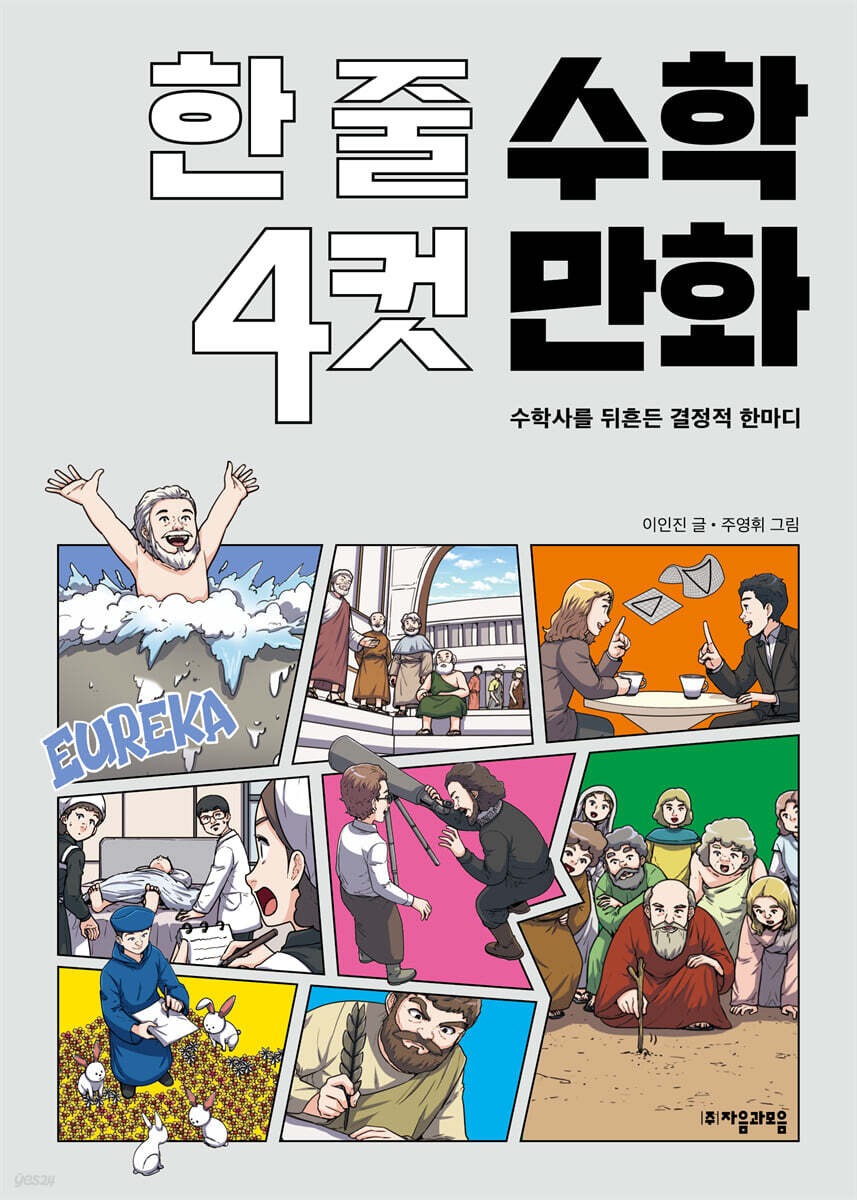
One-line math 4-panel comic
 |
Description
Book Introduction
Just one line can turn even a math dropout into a math nerd!
The most defining moments in history, as told by mathematicians.
Lying in bed, staring at flies, and then drowning his disciple to death because he didn't want to admit his error? The protagonists of this outrageous act were Descartes, famous for his famous line, "I think, therefore I am," and Pythagoras, famous for the Pythagorean theorem.
When you think of mathematicians, you probably think of them as people who sit at their desks every day and solve math problems, but the great mathematicians whose names everyone knows were actually more eccentric and unique than that.
"One-Line Math 4-Cut Comics" introduces the mathematical knowledge and interesting episodes hidden in the words of 26 mathematicians who changed the world.
It covers concepts that are part of the essential curriculum, such as the coordinate plane, imaginary numbers, and logarithms, as well as intellectually intriguing problems, such as Fermat's Last Theorem and Poincaré's conjecture.
Additionally, for readers who are unfamiliar with mathematics, anecdotes about mathematicians were presented in 4-panel comics to add to the fun.
This will be the best textbook to spark interest in mathematics among young people who think that mathematics is a boring subject that involves memorizing formulas and solving problems.
The most defining moments in history, as told by mathematicians.
Lying in bed, staring at flies, and then drowning his disciple to death because he didn't want to admit his error? The protagonists of this outrageous act were Descartes, famous for his famous line, "I think, therefore I am," and Pythagoras, famous for the Pythagorean theorem.
When you think of mathematicians, you probably think of them as people who sit at their desks every day and solve math problems, but the great mathematicians whose names everyone knows were actually more eccentric and unique than that.
"One-Line Math 4-Cut Comics" introduces the mathematical knowledge and interesting episodes hidden in the words of 26 mathematicians who changed the world.
It covers concepts that are part of the essential curriculum, such as the coordinate plane, imaginary numbers, and logarithms, as well as intellectually intriguing problems, such as Fermat's Last Theorem and Poincaré's conjecture.
Additionally, for readers who are unfamiliar with mathematics, anecdotes about mathematicians were presented in 4-panel comics to add to the fun.
This will be the best textbook to spark interest in mathematics among young people who think that mathematics is a boring subject that involves memorizing formulas and solving problems.
- You can preview some of the book's contents.
Preview
index
Introduction
Part 1: The Genius of Ideas Given by God
1.
Newton's One-Line Mathematics: Unraveling the Principles of the Universe with Mathematics
2.
Descartes' One-Line Mathematics: To me, everything in the world is explained by mathematics.
3.
Fermat's One-Line Mathematics: I already proved it, but the margins are too narrow to write it down.
4.
Eratosthenes' One-Line Math: Give me a stick and I will measure the circumference of the Earth.
5.
Fibonacci's One-Line Math: Any Number Can Be Represented with Indian Numerals
6.
Cardano's One-Line Math: Arithmetic Precision Has Become Insignificant
7.
Poincaré's One-Line Mathematics: Proving with Logic, Discovering with Intuition
8.
Turing's One-Line Math: If you can imagine it, you can make it.
Part 2: The Perfectionist Who Doesn't Know Error
9.
Archimedes' One-Line Mathematics: There are things that are hard to believe for those who have not studied mathematics.
10.
Thales' One-Line Mathematics: Does it Always Hold in All Cases?
11.
Euler's One-Line Math: Trust Mathematics More Than Human Judgment
12.
Nightingale's One-Line Math: Understanding God's Mind Through Statistics
13.
Gödel's One-Line Math: The Human Mind Cannot Be Contained in a Machine
14.
Gauss's One Line of Mathematics: Even if it is small, be careful.
15.
A line of mathematics from Diophantus: Born with the blessing of the gods, he spent one-sixth of his life as a boy.
16.
Leibniz's One-Line Mathematics: Symbols That Embrace the Essence Save Labor
17.
Kepler's One-Line Math: Where There's a Problem, There's Geometry
18.
Catherine's One-Line Math: I'll be leaving when she checks my calculations.
Part 3: The Unstoppable Bulldozer
19.
Euclid's One-Line Mathematics: There is no royal road to mathematics.
20.
Plato's One Line of Mathematics: Let no one ignorant of geometry enter.
21.
One line of Pythagorean mathematics: Everything is made of numbers.
22.
Hypatia's One-Line Mathematics: I Married the Truth
23.
Napier's One-Line Math: Logarithms Doubled Astronomers' Lifespans
24.
Germain's one-line mathematics: Algebra is geometry written down, and geometry is algebra drawn up.
25.
Cantor's One-Line Mathematics: The Essence of Mathematics Lies in Freedom
26.
Lobachevsky's One-Line Math: No matter how abstract mathematics is, it will eventually be used.
References/Reference Sites
Part 1: The Genius of Ideas Given by God
1.
Newton's One-Line Mathematics: Unraveling the Principles of the Universe with Mathematics
2.
Descartes' One-Line Mathematics: To me, everything in the world is explained by mathematics.
3.
Fermat's One-Line Mathematics: I already proved it, but the margins are too narrow to write it down.
4.
Eratosthenes' One-Line Math: Give me a stick and I will measure the circumference of the Earth.
5.
Fibonacci's One-Line Math: Any Number Can Be Represented with Indian Numerals
6.
Cardano's One-Line Math: Arithmetic Precision Has Become Insignificant
7.
Poincaré's One-Line Mathematics: Proving with Logic, Discovering with Intuition
8.
Turing's One-Line Math: If you can imagine it, you can make it.
Part 2: The Perfectionist Who Doesn't Know Error
9.
Archimedes' One-Line Mathematics: There are things that are hard to believe for those who have not studied mathematics.
10.
Thales' One-Line Mathematics: Does it Always Hold in All Cases?
11.
Euler's One-Line Math: Trust Mathematics More Than Human Judgment
12.
Nightingale's One-Line Math: Understanding God's Mind Through Statistics
13.
Gödel's One-Line Math: The Human Mind Cannot Be Contained in a Machine
14.
Gauss's One Line of Mathematics: Even if it is small, be careful.
15.
A line of mathematics from Diophantus: Born with the blessing of the gods, he spent one-sixth of his life as a boy.
16.
Leibniz's One-Line Mathematics: Symbols That Embrace the Essence Save Labor
17.
Kepler's One-Line Math: Where There's a Problem, There's Geometry
18.
Catherine's One-Line Math: I'll be leaving when she checks my calculations.
Part 3: The Unstoppable Bulldozer
19.
Euclid's One-Line Mathematics: There is no royal road to mathematics.
20.
Plato's One Line of Mathematics: Let no one ignorant of geometry enter.
21.
One line of Pythagorean mathematics: Everything is made of numbers.
22.
Hypatia's One-Line Mathematics: I Married the Truth
23.
Napier's One-Line Math: Logarithms Doubled Astronomers' Lifespans
24.
Germain's one-line mathematics: Algebra is geometry written down, and geometry is algebra drawn up.
25.
Cantor's One-Line Mathematics: The Essence of Mathematics Lies in Freedom
26.
Lobachevsky's One-Line Math: No matter how abstract mathematics is, it will eventually be used.
References/Reference Sites
Detailed image

Into the book
One day, Descartes followed the movements of a fly moving around on the ceiling with his eyes.
As I watched the fly's movements, going down, flying diagonally, and then returning, I wondered how I could express the fly's position mathematically.
After much thought, Descartes decided to represent the location of Paris as 'five spaces to the right and three spaces above' based on the corner of the ceiling.
--- p.25
To those who ask what use it is to learn mathematics, I would like to tell the story of Eratosthenes.
Anyone who knows mathematics can figure out that the Earth is round without having to go into space, and can measure the Earth's circumference without having to pick up a tape measure.
With just a single stick, you can broaden your field of vision as if you were looking at the Earth from space.
--- p.41
People tried hard to solve the Königsberg Bridge problem, but in the end they could not solve it.
There is a gap between what we feel we can do and what is mathematically possible.
When we get caught up in the search for answers, it's hard to consider the possibility that there might not be an answer.
But in mathematics, the existence of an answer takes precedence over the process of finding the answer.
--- p.86
All stars and planets move according to Kepler's laws.
Although we cannot directly observe the vast universe and the movements of the planets with our human eyes, we can know that the planets are arranged and orbit according to certain laws.
“Where there is a problem, there is geometry.” Perhaps it means that even the movements of celestial bodies, which we thought we could not know, have rules, so we should look into them.
--- p.126
Plato, the founder of the Academy, regarded geometry as sacred enough to consider it the foundation of all learning.
Plato hung a sign on the door of his Academy that read, “Let no one ignorant of geometry enter.”
You can't even enter the Academy without knowing geometry! He may seem like a cold teacher, but Plato believed mathematics was a crucial discipline and that only those who understood geometry were qualified to enter the Academy.
As I watched the fly's movements, going down, flying diagonally, and then returning, I wondered how I could express the fly's position mathematically.
After much thought, Descartes decided to represent the location of Paris as 'five spaces to the right and three spaces above' based on the corner of the ceiling.
--- p.25
To those who ask what use it is to learn mathematics, I would like to tell the story of Eratosthenes.
Anyone who knows mathematics can figure out that the Earth is round without having to go into space, and can measure the Earth's circumference without having to pick up a tape measure.
With just a single stick, you can broaden your field of vision as if you were looking at the Earth from space.
--- p.41
People tried hard to solve the Königsberg Bridge problem, but in the end they could not solve it.
There is a gap between what we feel we can do and what is mathematically possible.
When we get caught up in the search for answers, it's hard to consider the possibility that there might not be an answer.
But in mathematics, the existence of an answer takes precedence over the process of finding the answer.
--- p.86
All stars and planets move according to Kepler's laws.
Although we cannot directly observe the vast universe and the movements of the planets with our human eyes, we can know that the planets are arranged and orbit according to certain laws.
“Where there is a problem, there is geometry.” Perhaps it means that even the movements of celestial bodies, which we thought we could not know, have rules, so we should look into them.
--- p.126
Plato, the founder of the Academy, regarded geometry as sacred enough to consider it the foundation of all learning.
Plato hung a sign on the door of his Academy that read, “Let no one ignorant of geometry enter.”
You can't even enter the Academy without knowing geometry! He may seem like a cold teacher, but Plato believed mathematics was a crucial discipline and that only those who understood geometry were qualified to enter the Academy.
--- p.145
Publisher's Review
Breaking the prejudice that math is boring and uninteresting
A Math Story with a Reversal of Charm
Mathematics has a particularly high barrier to entry compared to other subjects.
If someone says they like math, it seems like they're going to be exceptionally good at studying and have a tenacious side that would stay up all night to find the answer.
Just as the word 'math dropout' was the first to appear among the many subjects, people's perception of math is generally negative.
Why is math so difficult and rigid? Can't you love it, regardless of your grades?
"One-Line Math 4-Cut Comic" was born from the author, a current math teacher, pondering how everyone can enjoy math.
This book teaches mathematics through the words of famous mathematicians who have made their mark on history. It approaches readers who find mathematics difficult in an easy and fun storytelling style.
The most interesting and eye-catching events in the long history of mathematics from ancient times to the present are collected and explained in 4-panel comics and various mathematical materials.
For those who are not interested in mathematics, this book will be an opportunity to discover the unexpected charm of mathematics, and for those who are just beginning to study mathematics, it will be a fun and friendly introductory book.
From logs to geometry and statistics
The most heinous challenge of the century
Until Fermat's Last Theorem!
Newton's statement, "I will reveal the principles of the universe through mathematics," contained the law of universal gravitation that permeates the entire universe, and Pythagoras' statement, "All things are made of numbers," contained the story of the discovery of irrational numbers and the power struggle surrounding the truth.
In this way, the words left behind by mathematicians contain important mathematical concepts that became turning points in human history and historical facts that permeate an era.
As the author says, “Mathematics is also history, containing the stories of various people from all over the world, past and present.” This book shows that mathematics can be both history and philosophy, depending on one’s perspective.
You can also learn about the unique thinking and perspectives of mathematicians who have achieved great things, as well as their attitudes toward dealing with crises and limitations.
Let's become familiar with mathematics properly with "One-Line Math 4-Cut Comics," which not only contains mathematical knowledge, history, and philosophy in one volume, but also adds the fun of reading in the form of comics.
Adding culture and common sense to the fun of reading
Mathematics Humanities for All of Us
This book, consisting of easy and fun four-panel comics and a smooth-reading story, is suitable for a wide range of age groups.
Elementary school students in the upper grades can naturally become familiar with mathematicians by simply reading four-panel comics.
Middle school students can review the mathematical concepts in their textbooks and connect them to the lives of mathematicians.
This kind of math study is memorable.
For high school students, it can be helpful in selecting new topics for performance assessments or math club activities.
Finally, what about adults who feel like math is far away?
Immerse yourself in 26 stories that shook the history of mathematics and you will gain mathematical knowledge without even realizing it.
『One-Line Math 4-Cut Comics』, which is a math textbook for everyone, instantly makes math, which was previously vague and unfamiliar, more approachable.
I hope that through this book, mathematics will not be a rigid and difficult subject, but rather a daily knowledge that will make the world seem bigger the more you know about it.
A Math Story with a Reversal of Charm
Mathematics has a particularly high barrier to entry compared to other subjects.
If someone says they like math, it seems like they're going to be exceptionally good at studying and have a tenacious side that would stay up all night to find the answer.
Just as the word 'math dropout' was the first to appear among the many subjects, people's perception of math is generally negative.
Why is math so difficult and rigid? Can't you love it, regardless of your grades?
"One-Line Math 4-Cut Comic" was born from the author, a current math teacher, pondering how everyone can enjoy math.
This book teaches mathematics through the words of famous mathematicians who have made their mark on history. It approaches readers who find mathematics difficult in an easy and fun storytelling style.
The most interesting and eye-catching events in the long history of mathematics from ancient times to the present are collected and explained in 4-panel comics and various mathematical materials.
For those who are not interested in mathematics, this book will be an opportunity to discover the unexpected charm of mathematics, and for those who are just beginning to study mathematics, it will be a fun and friendly introductory book.
From logs to geometry and statistics
The most heinous challenge of the century
Until Fermat's Last Theorem!
Newton's statement, "I will reveal the principles of the universe through mathematics," contained the law of universal gravitation that permeates the entire universe, and Pythagoras' statement, "All things are made of numbers," contained the story of the discovery of irrational numbers and the power struggle surrounding the truth.
In this way, the words left behind by mathematicians contain important mathematical concepts that became turning points in human history and historical facts that permeate an era.
As the author says, “Mathematics is also history, containing the stories of various people from all over the world, past and present.” This book shows that mathematics can be both history and philosophy, depending on one’s perspective.
You can also learn about the unique thinking and perspectives of mathematicians who have achieved great things, as well as their attitudes toward dealing with crises and limitations.
Let's become familiar with mathematics properly with "One-Line Math 4-Cut Comics," which not only contains mathematical knowledge, history, and philosophy in one volume, but also adds the fun of reading in the form of comics.
Adding culture and common sense to the fun of reading
Mathematics Humanities for All of Us
This book, consisting of easy and fun four-panel comics and a smooth-reading story, is suitable for a wide range of age groups.
Elementary school students in the upper grades can naturally become familiar with mathematicians by simply reading four-panel comics.
Middle school students can review the mathematical concepts in their textbooks and connect them to the lives of mathematicians.
This kind of math study is memorable.
For high school students, it can be helpful in selecting new topics for performance assessments or math club activities.
Finally, what about adults who feel like math is far away?
Immerse yourself in 26 stories that shook the history of mathematics and you will gain mathematical knowledge without even realizing it.
『One-Line Math 4-Cut Comics』, which is a math textbook for everyone, instantly makes math, which was previously vague and unfamiliar, more approachable.
I hope that through this book, mathematics will not be a rigid and difficult subject, but rather a daily knowledge that will make the world seem bigger the more you know about it.
GOODS SPECIFICS
- Date of issue: August 4, 2025
- Page count, weight, size: 196 pages | 345g | 150*210*12mm
- ISBN13: 9788954453561
You may also like
카테고리
korean


korean

![GQ KOREA Mark (Monthly): December [2025]](http://librairie.coreenne.fr/cdn/shop/files/8ef265dbbfbf186523ed75ba7319009d.jpg?v=1765340328&width=3840)


