

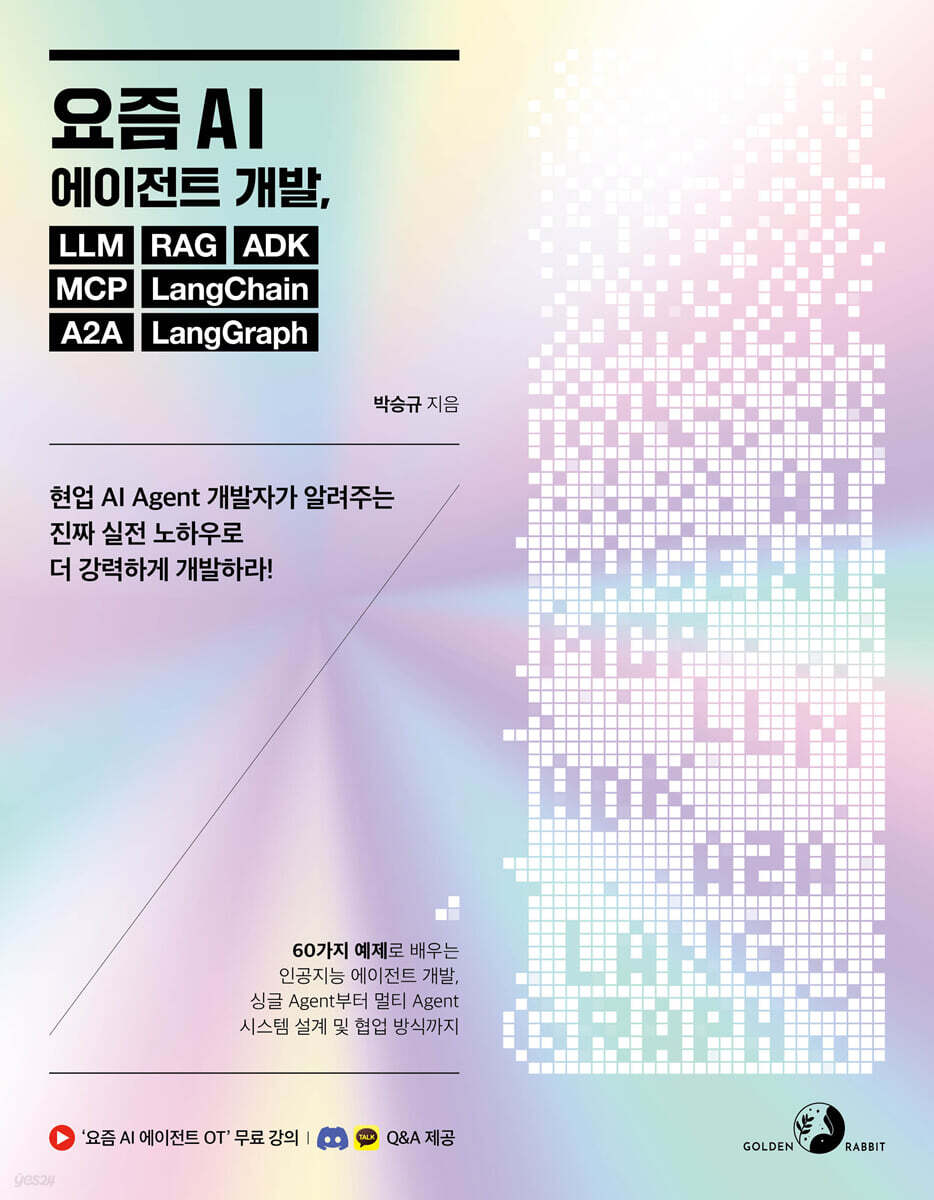
AI agent development these days, LLM RAG ADK MCP LangChain A2A LangGraph
 |
Description
Book Introduction
★ AI agent practical experience presented by a developer
★ From single agent to multi-agent
★ Discover practical development secrets through 60 examples!
This book, which incorporates all the know-how the author has accumulated in developing AI agents in the field, goes beyond simply calling it an LLM and helps you build complex, useful, and secure multi-agent systems yourself.
Focusing on the OpenAI Agent SDK, Google ADK, and LangGraph framework, this book explains the basic structure of agents, tool utilization, guardrails for ensuring safety, multi-agent collaboration (handoff), state management (checkpoint), conditional routing, parallel processing, and various advanced techniques such as subgraphs.
It also covers cutting-edge AI protocols such as MCP and A2A, which are hot topics these days.
This book covers over 60 practical examples, including "The Little Prince Persona Chatbot," "Multi-Agent News Summary System," "Web-Based Chat Agent Development," "MCP Server Construction," and "Markdown Report Generation Agent Implementation."
By implementing these examples, readers will learn the importance of orchestration and debugging and tracing techniques essential to the field, and strengthen their ability to design and implement practical AI agent systems.
★ From single agent to multi-agent
★ Discover practical development secrets through 60 examples!
This book, which incorporates all the know-how the author has accumulated in developing AI agents in the field, goes beyond simply calling it an LLM and helps you build complex, useful, and secure multi-agent systems yourself.
Focusing on the OpenAI Agent SDK, Google ADK, and LangGraph framework, this book explains the basic structure of agents, tool utilization, guardrails for ensuring safety, multi-agent collaboration (handoff), state management (checkpoint), conditional routing, parallel processing, and various advanced techniques such as subgraphs.
It also covers cutting-edge AI protocols such as MCP and A2A, which are hot topics these days.
This book covers over 60 practical examples, including "The Little Prince Persona Chatbot," "Multi-Agent News Summary System," "Web-Based Chat Agent Development," "MCP Server Construction," and "Markdown Report Generation Agent Implementation."
By implementing these examples, readers will learn the importance of orchestration and debugging and tracing techniques essential to the field, and strengthen their ability to design and implement practical AI agent systems.
- You can preview some of the book's contents.
Preview
index
Chapter 00 Setting up the development environment
__0.1 Python environment setup
__0.2 VSCode settings
__0.3 Obtaining an API key
[PART 1] LLM and Langchain Development
Chapter 01 Basics of LLM API
__1.1 Why should I use the LLM API?
__1.2 Basic usage of LLM API
__1.3 Streaming Processing
__1.4 Asynchronous processing and error handling
Learning completion
Chapter 02 Creating a Chatbot Using the LLM API
__2.1 Creating a Chatbot Using CLI
__2.2 Enabling the chatbot to remember previous conversations
__2.3 Adding the Little Prince Persona
__2.4 Adding a web interface
Learning completion
Chapter 03: Langchain's Core Concepts
__3.1 Introduction to the Langchain Framework
__3.2 Langchain's Core Concept: Chat Model
__3.3 Langchain's Core Concept: Message
__3.4 Core concepts of Langchain: PromptTemplate and OutputParser
__3.5 Core Concepts of Langchain: Runnable and LCEL
__3.6 Langchain's Core Concept: Tools
__3.7 Core Concepts of Langchain: Embedding and Vector Stores
__3.8 Langchain's Core Concepts: Retriever and RAG
Learning completion
[PART 2] Development of AI Agents Today
Chapter 04 OpenAI's Agent SDK
__4.1 Getting to Know AI Agents
__4.2 Creating Your First Agent: The Greeting Agent
__4.3 Core Concepts
__4.4 Using Tools: News Agent
__4.5 Using guardrails
__4.6 Multi-Agent Collaboration Using Handoff: Hospital Guidance System
__4.7 Checking logs and tracing
Learning completion
Chapter 05 Google's ADK
__5.1 Preparing the ADK Development Environment
__5.2 Features and Advantages of ADK
__5.3 Creating Hello ADK
__5.4 Three ways to run ADK
__5.5 Agents with multiple tools: Weather and baseball ranking agents
__5.6 Agents that support structured output
__5.7 Using Multi-Agent
__5.8 Creating Workflow Agents: Weather Information, Today's News, Stock Multi-Agents
__5.9 Creating a Spam Check Agent
Learning completion
Chapter 06 Langgraph
__6.1 Understanding Graph Data Structures
__6.2 Key Concepts of Langgraph
__6.3 Creating a Hello Langgraph
__6.4 Applying Conditional Routing: Sentiment Analysis Chatbot
__6.5 Managing State Using Checkpointers
__6.6 Implementing a Loop Workflow: A Number Guessing Game
__6.7 Implementing a Parallel Processing Workflow: Parallel Processing of Weather, News, and Stocks
__6.8 Creating tool usage functions using ToolNode: Tools for calculator, weather, and currency exchange tools
__6.9 Reflecting on Human in the Loop
__6.10 Using Subgraphs: Weather Experts and General Agents
Learning completion
[PART 3] AI Agent Protocols: MCP and A2A
Chapter 07 AI Agent Protocol, Claude MCP
__7.1 Background of the Birth of MCP
__7.2 What is MCP?
__7.3 Looking at MCP from a technical perspective
__7.4 Was MCP a success?
__7.5 Creating an MCP Server
__7.6 Examining MCP's Future Tasks
Learning completion
Chapter 08 AI Agent Protocol, Google A2A
__8.1 What is A2A?
__8.2 A2A Key Concepts and Terms
__8.3 What is the difference between MCP and A2A?
__8.4 A2A Operation Principle Practice: AI Secretary Server and Client
Learning completion
[PART 4] Developing Advanced AI Agents: The Challenge! Two Projects
Chapter 09 Multi-Agent News Collection and Summary System
__9.1 System Architecture and Preparation
__9.2 Defining the data model
__9.3 Implementing utility functions
__9.4 Adding Project Settings Management
__9.5 Implementing an Agent
__9.6 Implementing a Workflow
__9.7 Implementing the main executable file
__9.8 Run and check the report
Learning completion
Chapter 10: Developing Advanced Agents Using LangGraph and MCP
__10.1 System Architecture and Preparation
__10.2 Building an MCP Server
__10.3 Creating a Chat Agent
__10.4 Creating a Web Interface
__10.5 Running and Testing the MCP Server and Agent
Learning completion
Appendix A: Things to know when setting up your development environment
__A.1 What runtime manager should I use?
__A.2 Simple UV usage
__A.3 How to manage environment variables?
__A.4 Setting up logging
__0.1 Python environment setup
__0.2 VSCode settings
__0.3 Obtaining an API key
[PART 1] LLM and Langchain Development
Chapter 01 Basics of LLM API
__1.1 Why should I use the LLM API?
__1.2 Basic usage of LLM API
__1.3 Streaming Processing
__1.4 Asynchronous processing and error handling
Learning completion
Chapter 02 Creating a Chatbot Using the LLM API
__2.1 Creating a Chatbot Using CLI
__2.2 Enabling the chatbot to remember previous conversations
__2.3 Adding the Little Prince Persona
__2.4 Adding a web interface
Learning completion
Chapter 03: Langchain's Core Concepts
__3.1 Introduction to the Langchain Framework
__3.2 Langchain's Core Concept: Chat Model
__3.3 Langchain's Core Concept: Message
__3.4 Core concepts of Langchain: PromptTemplate and OutputParser
__3.5 Core Concepts of Langchain: Runnable and LCEL
__3.6 Langchain's Core Concept: Tools
__3.7 Core Concepts of Langchain: Embedding and Vector Stores
__3.8 Langchain's Core Concepts: Retriever and RAG
Learning completion
[PART 2] Development of AI Agents Today
Chapter 04 OpenAI's Agent SDK
__4.1 Getting to Know AI Agents
__4.2 Creating Your First Agent: The Greeting Agent
__4.3 Core Concepts
__4.4 Using Tools: News Agent
__4.5 Using guardrails
__4.6 Multi-Agent Collaboration Using Handoff: Hospital Guidance System
__4.7 Checking logs and tracing
Learning completion
Chapter 05 Google's ADK
__5.1 Preparing the ADK Development Environment
__5.2 Features and Advantages of ADK
__5.3 Creating Hello ADK
__5.4 Three ways to run ADK
__5.5 Agents with multiple tools: Weather and baseball ranking agents
__5.6 Agents that support structured output
__5.7 Using Multi-Agent
__5.8 Creating Workflow Agents: Weather Information, Today's News, Stock Multi-Agents
__5.9 Creating a Spam Check Agent
Learning completion
Chapter 06 Langgraph
__6.1 Understanding Graph Data Structures
__6.2 Key Concepts of Langgraph
__6.3 Creating a Hello Langgraph
__6.4 Applying Conditional Routing: Sentiment Analysis Chatbot
__6.5 Managing State Using Checkpointers
__6.6 Implementing a Loop Workflow: A Number Guessing Game
__6.7 Implementing a Parallel Processing Workflow: Parallel Processing of Weather, News, and Stocks
__6.8 Creating tool usage functions using ToolNode: Tools for calculator, weather, and currency exchange tools
__6.9 Reflecting on Human in the Loop
__6.10 Using Subgraphs: Weather Experts and General Agents
Learning completion
[PART 3] AI Agent Protocols: MCP and A2A
Chapter 07 AI Agent Protocol, Claude MCP
__7.1 Background of the Birth of MCP
__7.2 What is MCP?
__7.3 Looking at MCP from a technical perspective
__7.4 Was MCP a success?
__7.5 Creating an MCP Server
__7.6 Examining MCP's Future Tasks
Learning completion
Chapter 08 AI Agent Protocol, Google A2A
__8.1 What is A2A?
__8.2 A2A Key Concepts and Terms
__8.3 What is the difference between MCP and A2A?
__8.4 A2A Operation Principle Practice: AI Secretary Server and Client
Learning completion
[PART 4] Developing Advanced AI Agents: The Challenge! Two Projects
Chapter 09 Multi-Agent News Collection and Summary System
__9.1 System Architecture and Preparation
__9.2 Defining the data model
__9.3 Implementing utility functions
__9.4 Adding Project Settings Management
__9.5 Implementing an Agent
__9.6 Implementing a Workflow
__9.7 Implementing the main executable file
__9.8 Run and check the report
Learning completion
Chapter 10: Developing Advanced Agents Using LangGraph and MCP
__10.1 System Architecture and Preparation
__10.2 Building an MCP Server
__10.3 Creating a Chat Agent
__10.4 Creating a Web Interface
__10.5 Running and Testing the MCP Server and Agent
Learning completion
Appendix A: Things to know when setting up your development environment
__A.1 What runtime manager should I use?
__A.2 Simple UV usage
__A.3 How to manage environment variables?
__A.4 Setting up logging
Detailed image

Publisher's Review
★ Don't know where or how to start developing AI agents?
★ Learn practical agent development techniques used in real-world applications!
This book has so much to learn, including LangGraph, MCP (Model-Context-Protocol), and Google ADK, that it's overwhelming to know where to start. This book teaches you how to use frameworks and protocols used in real-world collaboration to create "advanced AI agents and multi-AI agents that go beyond simple chatbots and actually perform tasks."
We will teach you how to build applications that handle realistic tasks such as weather checks and news summaries, and even explain the internal workings of AI agents.
From setting up a Python development environment to learning the basics of the LLM API and designing multi-agent systems, you'll learn all the essential elements you need to build practical skills in a single book.
★ What is an AI agent?
★ A preferred technology that will be developed and used by all companies.
★ Dive into the world of AI agent development right now.
Google's Agents white paper defines AI agents as "applications that observe the world and act accordingly to achieve given goals," and states that agents can make and execute plans on their own without human intervention.
OpenAI CEO Sam Altman describes the evolution of AI in five stages.
〈Stage 1〉 is a chatbot like ChatGPT, and 〈Stage 2〉 is an AI that uses inference.
〈Stage 3〉 is an AI agent that performs tasks on behalf of humans, and 〈Stage 4〉 is an AI system that innovates on its own and creates new results.
By the final stage, 〈Stage 5〉, AI will have reached the level of running the entire organization.
This book explores various methods for developing AI agents in three stages, focusing on over 60 examples. It will serve as an excellent reference and practical guide for those just starting out in AI agent development.
★ Target audience for this book
_Developers looking to enter the AI field
This book starts with setting up the development environment and then explains the basic usage of the LLM API step by step.
This book provides a detailed guide to the first steps required for AI development, including installing Python and VSCode and obtaining an API key, making it an excellent introduction for developers with programming experience but new to LLM.
Developers who want to create complex AI agents beyond simple chatbots.
It is suitable for developers who want to go beyond basic chatbot creation and build sophisticated AI applications by leveraging specialized frameworks such as LangChain and LangGraph.
Take your practical capabilities to the next level by covering advanced agent patterns such as conditional routing, external tool integration, augmented generation for search (RAG), and human-in-the-loop.
Developers interested in building practical AI applications
This is useful for developers who want to gain practical experience through projects that solve complex problems they might encounter in the real world, such as news summary systems and personalized assistants.
In particular, you can learn practical techniques such as multi-agent architectures where multiple agents collaborate and parallel processing workflows.
AI architects and leaders interested in the latest AI agent ecosystem and standard protocols.
It covers the concepts and practical implementations of cutting-edge AI agent protocols, such as MCP (Model-Context Protocol) and A2A (Agent-to-Agent), providing deep insights to senior developers and architects who want to understand the future direction of AI technology and design highly scalable and interoperable systems.
★ Key practical examples covered in the book
This book will walk you through creating and practicing about 60 example codes.
All code is available on GitHub to make it easier to practice.
The main practical exercises covered in Chapters 1 through 10 are as follows: 〈The Little Prince Persona Chatbot〉, 〈Multi-Agent News Summary System〉, 〈Development of a Web-Based Chat Agent〉, 〈Building an MCP Server that Provides Various Functions such as Weather Inquiry and News Headline Collection〉, and 〈Implementation of a Markdown Report Generation Agent〉.
Chapter 01 Basics of LLM API
__Streaming Response
__Asynchronous API call
__Apply error handling and retry logic
Chapter 02 Creating a Chatbot Using the LLM API
__CLI Chatbot Implementation
__Conversation that remembers previous conversations
__The Little Prince Persona Chatbot
__Augmented Search Generation (RAG)
Chapter 03: Langchain's Core Concepts
__Understanding and utilizing chat models, messages, prompt templates, and output parsers
Declarative chaining using __Runnable and LCEL
Integrating external tools using the __@tool decorator
Semantic Search Using Embeddings and FAISS Vector Stores
Chapter 04 OpenAI's Agent SDK
__Creating a Basic Agent Using the OpenAI Agent SDK
__Developing a news search agent that leverages external tools
__Controlling agent behavior through input/output guardrails
Building a multi-agent collaboration system using the __handoff function
__Check response log/tracing
Chapter 05 Google's ADK
__Practice with ADK's three execution methods (web, run, api_server)
__Developing an agent that uses multiple tools (weather and baseball rankings)
__Developing a book recommendation agent that supports structured output
__Building a daily briefing and spam filter system using sequential/parallel/loop workflow agents.
__Implementing a multi-agent architecture using sub-agents
Chapter 06 Langgraph
__Sentiment Analysis Chatbot Using Conditional Routing
__Conversation memory chatbot using checkpointer
__Number Guessing Game Using Loop Workflow
__Data Dashboards Leveraging Parallel Processing
Calling external tools (calculators, APIs) using __ToolNode
__Implementing the Human-in-the-Loop Pattern
Building an expert system using __subgraphs
Chapter 07 AI Agent Protocol, Claude MCP
__MCP server implementation and startup
Defining tools and resources using the __@mcp.tool() decorator
__Testing MCP server functions using MCP Inspector and Postman
Chapter 08 AI Agent Protocol, Google A2A
__Create an A2A agent card
__Create an Agent Executor
__A2A Server/Client Implementation and Testing
__Testing server connection and chat using the A2A Inspector
__Write A2A client code to send non-streaming and streaming messages
Chapter 09 Multi-Agent News Collection and Summary System
__Development of a multi-agent news summary system
__Implementing an automatic RSS feed collection agent
__Implementing an AI-powered news summary and classification agent
__Implementing an agent that generates markdown reports based on collected data
Chapter 10: Developing Advanced Agents Using LangGraph and MCP
__Developing advanced AI agents combining Langgraph and MCP
__Building an MCP server that provides various functions such as web scraping, weather check, and news headline collection.
__Developing an MCP client that uses the MCP server's tools using FastAPI and Langgraph.
__Implementing a web-based chat interface that handles real-time streaming responses
★ Structure of this book
00 Development Environment Setup: This is a preparatory step that guides you through the essential environment setup process to begin developing AI agents.
We'll cover everything from installing Python and VSCode on Windows and macOS to setting up a virtual environment (venv) to isolate project-specific dependencies.
We also provide a detailed explanation of the process for obtaining OpenAI and Antropic API keys, which are essential for utilizing AI models.
[PART 1] LLM and Langchain Development
__01 LLM API Basics: As a first step in developing AI agents, we cover the basics of the LLM API, an essential gateway for integrating LLM into your services.
Learn how to use key OpenAI and Antropic APIs, and compare model features and costs to learn criteria for selecting the right model for your situation.
You will also learn advanced techniques essential for practical use, such as streaming processing for real-time responses, asynchronous programming (async/await) for concurrent request processing, and implementing retry (Tenacity) logic for reliable API calls.
__02 Building a Chatbot Using the LLM API: A hands-on course that walks you through building a complete chatbot application using the LLM API, step by step.
Starting with a simple CLI chatbot, you'll learn how to make it remember previous conversations using OpenAI's conversational state management feature, and give your chatbot a "Little Prince" persona using prompt engineering.
Finally, we'll cover how to use FastAPI to extend a terminal-based chatbot into a web interface that can interact with users.
__03 LangChain's Core Concepts: Systematically learn the core components of LangChain.
You will learn the fundamental concepts, from the 'Chat Model' that handles various LLMs in a consistent manner, 'Message' for structured conversations, 'PromptTemplate' for handling dynamic input, and 'OutputParser' for cleaning the output of LLMs.
Furthermore, we will cover in depth 'Runnable', a powerful abstraction layer of LangChain, 'LCEL', which combines components using the pipe (|) operator, 'Tools', which connects with external functions, and 'Embedding', 'Vector Store', and 'RAG', which overcome the limitations of LLM.
[PART 2] Development of AI Agents Today
__04 Developing AI Agents Today: This course defines the concept of "AI agents" and covers how to build them directly using OpenAI's Agent SDK. You'll learn the SDK's core concepts—agents, runners, tools, guardrails, and handoffs—through hands-on learning.
You'll build a news search agent, integrate with external tools, implement guardrails to ensure input and output stability, and master handoff capabilities through a "hospital guidance system" where multiple specialized agents collaborate.
__05 Google's ADK: Learn about the ADK (Agent Development Kit), Google's production-grade AI agent framework. Understand the various agent types provided by the ADK, including LLM agents, workflow agents (sequential, parallel, loop), and custom agents. Practice flexible execution methods like adk web, adk run, and adk api_server.
Experience the power of ADK by implementing a multi-tool agent that reports weather and baseball standings, a structured output agent that forces output with a Pydantic model, and a complex workflow that combines multiple agents to generate a daily briefing.
__06 LangGraph: Learn LangGraph, a powerful framework for building AI agent workflows.
Through a graph structure composed of 'nodes' representing work units and 'edges' representing execution flow, AI implements 'conditional routing', which dynamically determines execution paths according to the situation.
Additionally, you will implement a memory function that automatically manages conversation records by utilizing the checkpoint function, and learn core patterns for creating sophisticated agent systems, such as loops, parallel processing, external tool integration (ToolNode), and human-in-the-loop, through hands-on practice.
[PART 3] AI Agent Protocols: MCP and A2A
__07 AI Agent Protocol, Claude MCP: An in-depth look at MCP, which was created to solve the problem of fragmented interoperability between AI models and external tools.
Inspired by LSP, which standardizes integration between various IDEs and languages, MCP reduces complexity from M × N to M + N, and learn about host/client/server architecture and JSON-RPC 2.0-based communication methods.
We will build our own MCP server using the official Python SDK and the FastMCP library, define tools with the @mcp.tool( ) decorator, and test the server with the MCP Inspector and Postman.
__08 AI Agent Protocol, Google A2A: Learn about Google's open protocol A2A for AI agents in distributed environments to communicate and collaborate with each other.
Learn the core concepts of A2A, such as the 'agent card' that allows the agent to announce itself to the outside world, the 'task' that is the unit of work, and the 'message' that is the content of communication.
Implement your own A2A server and client using the Python SDK, and test the entire protocol flow, from agent discovery to message sending and streaming responses, using the A2A Inspector.
[PART 4] Developing Advanced Multi-AI Agents: The Challenge! Two Projects
__09 Developing Practical AI Agents: Covers how to build a multi-agent system that uses LangGraph and LangChain to collect, summarize, categorize, and generate final reports from Google News RSS feeds.
The system automates news gathering, AI-based summarization and classification, and Markdown report generation, and consists of four agents dedicated to each function: collection, summarization, classification, and reporting.
You'll also learn practical techniques for efficiently handling multiple news articles using asynchronous processing.
__10 Developing Advanced Agents Using LangGraph and MCP: By combining LangGraph and MCP, we develop advanced AI agents that understand users' natural language commands and perform tasks using external tools.
To achieve this, we build an MCP server that provides various functions such as weather check and news search, and a chat agent that dynamically loads and uses the tools of this server.
Ultimately, we end up with a complete application where users and agents interact through a web chat interface that supports real-time streaming.
__Appendix A
This chapter provides useful environment setup know-how for developing AI agents.
In particular, we introduce how to use uv, a runtime manager that manages various Python versions, and explain how to manage environment variables to safely handle sensitive information such as API keys.
We also cover in detail how to use Python's logging module for efficient log management.
Author's Note
This book draws on all the expertise I've accumulated while developing AI agents in my field, going beyond what you might call an LLM and structuring it to enable you to build complex, useful, and secure multi-agent systems yourself.
Focusing on the OpenAI Agent SDK, Google ADK, and the LangGraph framework, we explain the basic structure of agents, tool utilization, guardrails for ensuring safety, multi-agent collaboration (handoff), state management (checkpoints), conditional routing, parallel processing, and various advanced techniques such as subgraphs.
We also cover cutting-edge AI protocols like MCP and A2A, which are hot topics these days.
This book will help you gradually build the knowledge and skills needed to develop AI agents by implementing over 60 examples, including a news summary system.
Overall, it is structured to help improve fundamentals and practical skills, and in the final chapters, chapters 9 and 10, it is structured to give a practical feel while writing minimal code.
I hope this book will serve as a good starting point for those who wish to develop AI agents.
★ Learn practical agent development techniques used in real-world applications!
This book has so much to learn, including LangGraph, MCP (Model-Context-Protocol), and Google ADK, that it's overwhelming to know where to start. This book teaches you how to use frameworks and protocols used in real-world collaboration to create "advanced AI agents and multi-AI agents that go beyond simple chatbots and actually perform tasks."
We will teach you how to build applications that handle realistic tasks such as weather checks and news summaries, and even explain the internal workings of AI agents.
From setting up a Python development environment to learning the basics of the LLM API and designing multi-agent systems, you'll learn all the essential elements you need to build practical skills in a single book.
★ What is an AI agent?
★ A preferred technology that will be developed and used by all companies.
★ Dive into the world of AI agent development right now.
Google's Agents white paper defines AI agents as "applications that observe the world and act accordingly to achieve given goals," and states that agents can make and execute plans on their own without human intervention.
OpenAI CEO Sam Altman describes the evolution of AI in five stages.
〈Stage 1〉 is a chatbot like ChatGPT, and 〈Stage 2〉 is an AI that uses inference.
〈Stage 3〉 is an AI agent that performs tasks on behalf of humans, and 〈Stage 4〉 is an AI system that innovates on its own and creates new results.
By the final stage, 〈Stage 5〉, AI will have reached the level of running the entire organization.
This book explores various methods for developing AI agents in three stages, focusing on over 60 examples. It will serve as an excellent reference and practical guide for those just starting out in AI agent development.
★ Target audience for this book
_Developers looking to enter the AI field
This book starts with setting up the development environment and then explains the basic usage of the LLM API step by step.
This book provides a detailed guide to the first steps required for AI development, including installing Python and VSCode and obtaining an API key, making it an excellent introduction for developers with programming experience but new to LLM.
Developers who want to create complex AI agents beyond simple chatbots.
It is suitable for developers who want to go beyond basic chatbot creation and build sophisticated AI applications by leveraging specialized frameworks such as LangChain and LangGraph.
Take your practical capabilities to the next level by covering advanced agent patterns such as conditional routing, external tool integration, augmented generation for search (RAG), and human-in-the-loop.
Developers interested in building practical AI applications
This is useful for developers who want to gain practical experience through projects that solve complex problems they might encounter in the real world, such as news summary systems and personalized assistants.
In particular, you can learn practical techniques such as multi-agent architectures where multiple agents collaborate and parallel processing workflows.
AI architects and leaders interested in the latest AI agent ecosystem and standard protocols.
It covers the concepts and practical implementations of cutting-edge AI agent protocols, such as MCP (Model-Context Protocol) and A2A (Agent-to-Agent), providing deep insights to senior developers and architects who want to understand the future direction of AI technology and design highly scalable and interoperable systems.
★ Key practical examples covered in the book
This book will walk you through creating and practicing about 60 example codes.
All code is available on GitHub to make it easier to practice.
The main practical exercises covered in Chapters 1 through 10 are as follows: 〈The Little Prince Persona Chatbot〉, 〈Multi-Agent News Summary System〉, 〈Development of a Web-Based Chat Agent〉, 〈Building an MCP Server that Provides Various Functions such as Weather Inquiry and News Headline Collection〉, and 〈Implementation of a Markdown Report Generation Agent〉.
Chapter 01 Basics of LLM API
__Streaming Response
__Asynchronous API call
__Apply error handling and retry logic
Chapter 02 Creating a Chatbot Using the LLM API
__CLI Chatbot Implementation
__Conversation that remembers previous conversations
__The Little Prince Persona Chatbot
__Augmented Search Generation (RAG)
Chapter 03: Langchain's Core Concepts
__Understanding and utilizing chat models, messages, prompt templates, and output parsers
Declarative chaining using __Runnable and LCEL
Integrating external tools using the __@tool decorator
Semantic Search Using Embeddings and FAISS Vector Stores
Chapter 04 OpenAI's Agent SDK
__Creating a Basic Agent Using the OpenAI Agent SDK
__Developing a news search agent that leverages external tools
__Controlling agent behavior through input/output guardrails
Building a multi-agent collaboration system using the __handoff function
__Check response log/tracing
Chapter 05 Google's ADK
__Practice with ADK's three execution methods (web, run, api_server)
__Developing an agent that uses multiple tools (weather and baseball rankings)
__Developing a book recommendation agent that supports structured output
__Building a daily briefing and spam filter system using sequential/parallel/loop workflow agents.
__Implementing a multi-agent architecture using sub-agents
Chapter 06 Langgraph
__Sentiment Analysis Chatbot Using Conditional Routing
__Conversation memory chatbot using checkpointer
__Number Guessing Game Using Loop Workflow
__Data Dashboards Leveraging Parallel Processing
Calling external tools (calculators, APIs) using __ToolNode
__Implementing the Human-in-the-Loop Pattern
Building an expert system using __subgraphs
Chapter 07 AI Agent Protocol, Claude MCP
__MCP server implementation and startup
Defining tools and resources using the __@mcp.tool() decorator
__Testing MCP server functions using MCP Inspector and Postman
Chapter 08 AI Agent Protocol, Google A2A
__Create an A2A agent card
__Create an Agent Executor
__A2A Server/Client Implementation and Testing
__Testing server connection and chat using the A2A Inspector
__Write A2A client code to send non-streaming and streaming messages
Chapter 09 Multi-Agent News Collection and Summary System
__Development of a multi-agent news summary system
__Implementing an automatic RSS feed collection agent
__Implementing an AI-powered news summary and classification agent
__Implementing an agent that generates markdown reports based on collected data
Chapter 10: Developing Advanced Agents Using LangGraph and MCP
__Developing advanced AI agents combining Langgraph and MCP
__Building an MCP server that provides various functions such as web scraping, weather check, and news headline collection.
__Developing an MCP client that uses the MCP server's tools using FastAPI and Langgraph.
__Implementing a web-based chat interface that handles real-time streaming responses
★ Structure of this book
00 Development Environment Setup: This is a preparatory step that guides you through the essential environment setup process to begin developing AI agents.
We'll cover everything from installing Python and VSCode on Windows and macOS to setting up a virtual environment (venv) to isolate project-specific dependencies.
We also provide a detailed explanation of the process for obtaining OpenAI and Antropic API keys, which are essential for utilizing AI models.
[PART 1] LLM and Langchain Development
__01 LLM API Basics: As a first step in developing AI agents, we cover the basics of the LLM API, an essential gateway for integrating LLM into your services.
Learn how to use key OpenAI and Antropic APIs, and compare model features and costs to learn criteria for selecting the right model for your situation.
You will also learn advanced techniques essential for practical use, such as streaming processing for real-time responses, asynchronous programming (async/await) for concurrent request processing, and implementing retry (Tenacity) logic for reliable API calls.
__02 Building a Chatbot Using the LLM API: A hands-on course that walks you through building a complete chatbot application using the LLM API, step by step.
Starting with a simple CLI chatbot, you'll learn how to make it remember previous conversations using OpenAI's conversational state management feature, and give your chatbot a "Little Prince" persona using prompt engineering.
Finally, we'll cover how to use FastAPI to extend a terminal-based chatbot into a web interface that can interact with users.
__03 LangChain's Core Concepts: Systematically learn the core components of LangChain.
You will learn the fundamental concepts, from the 'Chat Model' that handles various LLMs in a consistent manner, 'Message' for structured conversations, 'PromptTemplate' for handling dynamic input, and 'OutputParser' for cleaning the output of LLMs.
Furthermore, we will cover in depth 'Runnable', a powerful abstraction layer of LangChain, 'LCEL', which combines components using the pipe (|) operator, 'Tools', which connects with external functions, and 'Embedding', 'Vector Store', and 'RAG', which overcome the limitations of LLM.
[PART 2] Development of AI Agents Today
__04 Developing AI Agents Today: This course defines the concept of "AI agents" and covers how to build them directly using OpenAI's Agent SDK. You'll learn the SDK's core concepts—agents, runners, tools, guardrails, and handoffs—through hands-on learning.
You'll build a news search agent, integrate with external tools, implement guardrails to ensure input and output stability, and master handoff capabilities through a "hospital guidance system" where multiple specialized agents collaborate.
__05 Google's ADK: Learn about the ADK (Agent Development Kit), Google's production-grade AI agent framework. Understand the various agent types provided by the ADK, including LLM agents, workflow agents (sequential, parallel, loop), and custom agents. Practice flexible execution methods like adk web, adk run, and adk api_server.
Experience the power of ADK by implementing a multi-tool agent that reports weather and baseball standings, a structured output agent that forces output with a Pydantic model, and a complex workflow that combines multiple agents to generate a daily briefing.
__06 LangGraph: Learn LangGraph, a powerful framework for building AI agent workflows.
Through a graph structure composed of 'nodes' representing work units and 'edges' representing execution flow, AI implements 'conditional routing', which dynamically determines execution paths according to the situation.
Additionally, you will implement a memory function that automatically manages conversation records by utilizing the checkpoint function, and learn core patterns for creating sophisticated agent systems, such as loops, parallel processing, external tool integration (ToolNode), and human-in-the-loop, through hands-on practice.
[PART 3] AI Agent Protocols: MCP and A2A
__07 AI Agent Protocol, Claude MCP: An in-depth look at MCP, which was created to solve the problem of fragmented interoperability between AI models and external tools.
Inspired by LSP, which standardizes integration between various IDEs and languages, MCP reduces complexity from M × N to M + N, and learn about host/client/server architecture and JSON-RPC 2.0-based communication methods.
We will build our own MCP server using the official Python SDK and the FastMCP library, define tools with the @mcp.tool( ) decorator, and test the server with the MCP Inspector and Postman.
__08 AI Agent Protocol, Google A2A: Learn about Google's open protocol A2A for AI agents in distributed environments to communicate and collaborate with each other.
Learn the core concepts of A2A, such as the 'agent card' that allows the agent to announce itself to the outside world, the 'task' that is the unit of work, and the 'message' that is the content of communication.
Implement your own A2A server and client using the Python SDK, and test the entire protocol flow, from agent discovery to message sending and streaming responses, using the A2A Inspector.
[PART 4] Developing Advanced Multi-AI Agents: The Challenge! Two Projects
__09 Developing Practical AI Agents: Covers how to build a multi-agent system that uses LangGraph and LangChain to collect, summarize, categorize, and generate final reports from Google News RSS feeds.
The system automates news gathering, AI-based summarization and classification, and Markdown report generation, and consists of four agents dedicated to each function: collection, summarization, classification, and reporting.
You'll also learn practical techniques for efficiently handling multiple news articles using asynchronous processing.
__10 Developing Advanced Agents Using LangGraph and MCP: By combining LangGraph and MCP, we develop advanced AI agents that understand users' natural language commands and perform tasks using external tools.
To achieve this, we build an MCP server that provides various functions such as weather check and news search, and a chat agent that dynamically loads and uses the tools of this server.
Ultimately, we end up with a complete application where users and agents interact through a web chat interface that supports real-time streaming.
__Appendix A
This chapter provides useful environment setup know-how for developing AI agents.
In particular, we introduce how to use uv, a runtime manager that manages various Python versions, and explain how to manage environment variables to safely handle sensitive information such as API keys.
We also cover in detail how to use Python's logging module for efficient log management.
Author's Note
This book draws on all the expertise I've accumulated while developing AI agents in my field, going beyond what you might call an LLM and structuring it to enable you to build complex, useful, and secure multi-agent systems yourself.
Focusing on the OpenAI Agent SDK, Google ADK, and the LangGraph framework, we explain the basic structure of agents, tool utilization, guardrails for ensuring safety, multi-agent collaboration (handoff), state management (checkpoints), conditional routing, parallel processing, and various advanced techniques such as subgraphs.
We also cover cutting-edge AI protocols like MCP and A2A, which are hot topics these days.
This book will help you gradually build the knowledge and skills needed to develop AI agents by implementing over 60 examples, including a news summary system.
Overall, it is structured to help improve fundamentals and practical skills, and in the final chapters, chapters 9 and 10, it is structured to give a practical feel while writing minimal code.
I hope this book will serve as a good starting point for those who wish to develop AI agents.
GOODS SPECIFICS
- Date of issue: August 20, 2025
- Page count, weight, size: 400 pages | 183*235*30mm
- ISBN13: 9791194383413
- ISBN10: 1194383416
You may also like
카테고리
korean


korean

![GQ KOREA Mark (Monthly): December [2025]](http://librairie.coreenne.fr/cdn/shop/files/8ef265dbbfbf186523ed75ba7319009d.jpg?v=1765340328&width=3840)


