

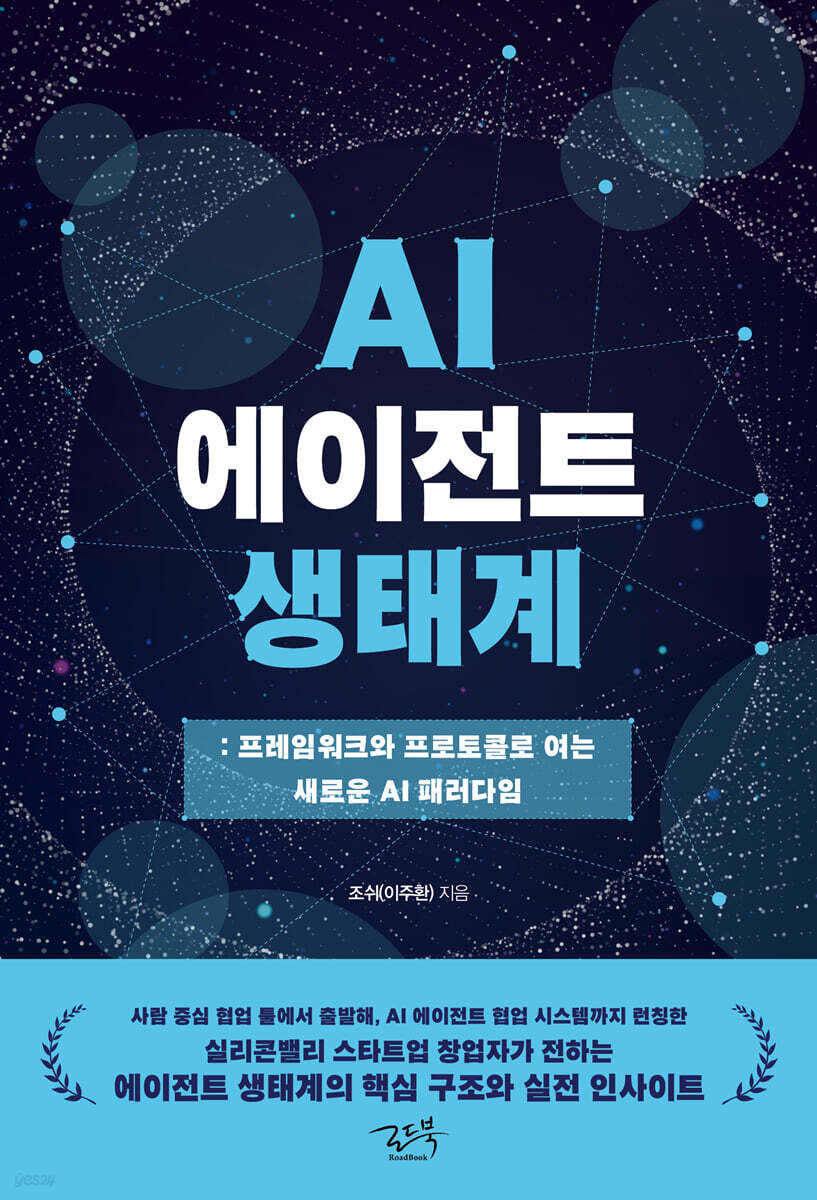
AI agent ecosystem
 |
Description
Book Introduction
AI is now moving beyond LLM and entering the 'age of agents'.
"AI Agent Ecosystem" is not just a developer tutorial or a collection of the latest trends.
Rather than simply listing technology pieces like LangGraph, MCP, and A2A, we structurally interpret the entire agent ecosystem around the core axes of frameworks and protocols.
We've selected concepts essential for practical application from over 130 recent agent-related papers, reorganized them into diagrams and figures, and translated them into Korean.
It helps you to balance the depth of the thesis with the realities of practice, so that you can grasp both theory and practice.
Practical application strategies tailored to each role, such as planners, developers, PMs, and business leaders, are also presented in abundance.
The author's experience in commercializing the world's first hybrid multi-agent system combining API and GUI in Silicon Valley and collaborating with major domestic and international companies is fully reflected in this book.
Don't worry, model performance changes rapidly and the leaderboard is updated weekly.
This book helps you understand the fundamental principles of an agent-centered ecosystem, without being swayed by technological trends, and cultivates the ability to develop and apply your own learning strategies.
From those new to agent technology to practitioners considering its adoption, this book covers everything from the essence and future of agentic AI to practical application.
Prepare to take the lead in the AI transformation now.
"AI Agent Ecosystem" is not just a developer tutorial or a collection of the latest trends.
Rather than simply listing technology pieces like LangGraph, MCP, and A2A, we structurally interpret the entire agent ecosystem around the core axes of frameworks and protocols.
We've selected concepts essential for practical application from over 130 recent agent-related papers, reorganized them into diagrams and figures, and translated them into Korean.
It helps you to balance the depth of the thesis with the realities of practice, so that you can grasp both theory and practice.
Practical application strategies tailored to each role, such as planners, developers, PMs, and business leaders, are also presented in abundance.
The author's experience in commercializing the world's first hybrid multi-agent system combining API and GUI in Silicon Valley and collaborating with major domestic and international companies is fully reflected in this book.
Don't worry, model performance changes rapidly and the leaderboard is updated weekly.
This book helps you understand the fundamental principles of an agent-centered ecosystem, without being swayed by technological trends, and cultivates the ability to develop and apply your own learning strategies.
From those new to agent technology to practitioners considering its adoption, this book covers everything from the essence and future of agentic AI to practical application.
Prepare to take the lead in the AI transformation now.
- You can preview some of the book's contents.
Preview
index
Prologue: From Syntax to Agents - DOS, Corpus, and the Future
Part I.
The Birth and Flow of Agentic AI
Chapter 1.
The Dawn of the Agent Ecosystem: The Evolution of Intelligence, the Reshaping of Experience
1.1.
The Storm's Prelude, AI Rush
1.2.
Agent vs. App: The End of Apps, or Their Evolution?
1.3.
Agentic UX: User Expectations and Interface Changes - From Clicks to Conversations, from Conversations to Actions
Chapter 2.
The Post-Chatbot World: The Structure and Operation of Agents
2.1.
Beyond Chatbots to Acting Agents: Awareness of Limitations and a New Beginning
2.2.
Anatomy of an Agent: LAMT - Intelligence (L), Autonomy (A), Memory (M), and Action (T)
2.3.
Collaboration between Agents: MAS - The Emergence of Swarm AI
Part II.
Agent Tech Stack
Chapter 3.
Agent Framework - A Collaborative AI Design Strategy
3.1.
The first step in building an agent
3.2.
The concept and necessity of the agent framework
3.3.
Agent Flow Control: Linear and Nonlinear Structures
3.4.
The composition principle of the agent loop designed by the developer
3.5.
Scaling to Multi-Agents: Practical First Steps and Framework Links
3.6. MAS Challenges and Solutions
Chapter 4.
Agent Protocols - The Evolution of API, MCP, and A2A Communications
4.1.
Introduction: Agents Need a Link to the World
4.2. API: The Agent's "Hands and Feet" and Open Window to the World
4.3. Practical Challenges of API Integration and Standardization Efforts
4.4.
The emergence of agent-to-agent (A2A) protocols
4.5. MCP: A Standard Protocol for a Decentralized Skills Ecosystem
4.6.
Google A2A: A Standard Protocol for a Collaborative Autonomous Agent Ecosystem
4.7.
Other major protocol approaches and overviews
4.8.
Conclusion: Protocols, the Aorta of the Agent Ecosystem
Part III.
Agent experience
Chapter 5.
Agentic Life - Reconstructing Everyday Life
5.1 What is Agentic Life?
5.2 The Two Wings of Agentic Life: Hyper-Personalization and Proactivity
5.3 Agentic Devices: In Every Space of Life
- AI PC, AI Phone, AI Car, AI Home
5.4 Seamless Life: Continuous Experiences and Future Daily Life Transcending Time and Space
5.5 The Light and Shadow of Agentic Life
Chapter 6.
Agentic DX - Reimagining Work
6.1 Core Values of Agentic DX
6.2 Preparation for a Successful Transition
6.3 PoC Design and Implementation
6.4 Implementing, Integrating, and Advancing the Agentic DX System
6.5 Vision, Implementation Strategy, and Challenges of Agentic DX
Part IV.
The Agentic Era
Chapter 7.
Agent Symbiosis - Superhuman
7.1 Conditions for Symbiosis: Differences and Augmentation of Intelligence
7.2 The Rise of the 'Superhuman': Redefining Potential
7.3 The Shadow of Symbiosis: The GELSI Dilemma in the Agent Age
- Governance, Ethics, Legal, Social
7.4 GELSI-Based Responsible Coexistence Roadmap
7.5 Humans of the Future: Roles and Capabilities in the Agentic Age
7.6 Conclusion: The Agentic Age: A New Leap Forward for Humanity Through Symbiosis
Chapter 8.
Appendix - AX (Agentic Transition) Playbook
Epilogue: Agent, a Journey to Expand Humanity
Part I.
The Birth and Flow of Agentic AI
Chapter 1.
The Dawn of the Agent Ecosystem: The Evolution of Intelligence, the Reshaping of Experience
1.1.
The Storm's Prelude, AI Rush
1.2.
Agent vs. App: The End of Apps, or Their Evolution?
1.3.
Agentic UX: User Expectations and Interface Changes - From Clicks to Conversations, from Conversations to Actions
Chapter 2.
The Post-Chatbot World: The Structure and Operation of Agents
2.1.
Beyond Chatbots to Acting Agents: Awareness of Limitations and a New Beginning
2.2.
Anatomy of an Agent: LAMT - Intelligence (L), Autonomy (A), Memory (M), and Action (T)
2.3.
Collaboration between Agents: MAS - The Emergence of Swarm AI
Part II.
Agent Tech Stack
Chapter 3.
Agent Framework - A Collaborative AI Design Strategy
3.1.
The first step in building an agent
3.2.
The concept and necessity of the agent framework
3.3.
Agent Flow Control: Linear and Nonlinear Structures
3.4.
The composition principle of the agent loop designed by the developer
3.5.
Scaling to Multi-Agents: Practical First Steps and Framework Links
3.6. MAS Challenges and Solutions
Chapter 4.
Agent Protocols - The Evolution of API, MCP, and A2A Communications
4.1.
Introduction: Agents Need a Link to the World
4.2. API: The Agent's "Hands and Feet" and Open Window to the World
4.3. Practical Challenges of API Integration and Standardization Efforts
4.4.
The emergence of agent-to-agent (A2A) protocols
4.5. MCP: A Standard Protocol for a Decentralized Skills Ecosystem
4.6.
Google A2A: A Standard Protocol for a Collaborative Autonomous Agent Ecosystem
4.7.
Other major protocol approaches and overviews
4.8.
Conclusion: Protocols, the Aorta of the Agent Ecosystem
Part III.
Agent experience
Chapter 5.
Agentic Life - Reconstructing Everyday Life
5.1 What is Agentic Life?
5.2 The Two Wings of Agentic Life: Hyper-Personalization and Proactivity
5.3 Agentic Devices: In Every Space of Life
- AI PC, AI Phone, AI Car, AI Home
5.4 Seamless Life: Continuous Experiences and Future Daily Life Transcending Time and Space
5.5 The Light and Shadow of Agentic Life
Chapter 6.
Agentic DX - Reimagining Work
6.1 Core Values of Agentic DX
6.2 Preparation for a Successful Transition
6.3 PoC Design and Implementation
6.4 Implementing, Integrating, and Advancing the Agentic DX System
6.5 Vision, Implementation Strategy, and Challenges of Agentic DX
Part IV.
The Agentic Era
Chapter 7.
Agent Symbiosis - Superhuman
7.1 Conditions for Symbiosis: Differences and Augmentation of Intelligence
7.2 The Rise of the 'Superhuman': Redefining Potential
7.3 The Shadow of Symbiosis: The GELSI Dilemma in the Agent Age
- Governance, Ethics, Legal, Social
7.4 GELSI-Based Responsible Coexistence Roadmap
7.5 Humans of the Future: Roles and Capabilities in the Agentic Age
7.6 Conclusion: The Agentic Age: A New Leap Forward for Humanity Through Symbiosis
Chapter 8.
Appendix - AX (Agentic Transition) Playbook
Epilogue: Agent, a Journey to Expand Humanity
Detailed image

Into the book
Making Agents a Reality in Silicon Valley
In late 2018, I founded my second enterprise SaaS startup, and the following year, in 2019, I made the bold decision to incorporate AI into my product roadmap.
Afterwards, in line with the advancement of LLM technology, we began developing a hybrid agent system that combined API and GUI.
In 2023, we launched the beta version of our enterprise personalized agent system, and in 2024, we commercialized the multi-agent system we developed with a global IT company on a scale of 1 million licenses.
As far as I know, this is the first commercialization of a multi-agent system of this scale in the world.
At the time, agent frameworks and multi-agent technologies were still in their infancy in terms of stability, scalability, and standardization, and even protocols like Google's A2A and Antropic's MCP had not yet emerged.
Given this technical background, it was highly unusual to develop a proprietary system that allowed dozens of agents to safely and accurately perform hundreds of skills at a commercial level and then connect them to actual contracts.
I would like to express my deepest gratitude to my legendary team members who overcame extreme difficulties and created a miracle.
[The Reason for Writing This Book and an Invitation to a Journey]
This book is a record of the traces and insights gained from the tumultuous journey of a boy who studied DOS and calligraphy together, met Professor Chomsky while contemplating the structure and meaning of language, started two startups in Silicon Valley, and finally commercialized a multi-agent system.
At the same time, it is also a strategic introduction to the upcoming era of the 'agent ecosystem'.
I hope this book will serve as a small compass for programmers developing agents themselves, leaders and practitioners contemplating business innovation with AI, and future leaders who will lead the coming agent era.
We aim to help you create, implement, and gain the wisdom to live with agents.
We believe that becoming superhuman goes beyond simply improving technological productivity. It means reconfiguring our way of life and ushering in an era of "re:Humanizing" humanity, redefining humanity beyond what AI can replace.
I hope you will join me on this journey.
In Sunnyvale, Josh
In late 2018, I founded my second enterprise SaaS startup, and the following year, in 2019, I made the bold decision to incorporate AI into my product roadmap.
Afterwards, in line with the advancement of LLM technology, we began developing a hybrid agent system that combined API and GUI.
In 2023, we launched the beta version of our enterprise personalized agent system, and in 2024, we commercialized the multi-agent system we developed with a global IT company on a scale of 1 million licenses.
As far as I know, this is the first commercialization of a multi-agent system of this scale in the world.
At the time, agent frameworks and multi-agent technologies were still in their infancy in terms of stability, scalability, and standardization, and even protocols like Google's A2A and Antropic's MCP had not yet emerged.
Given this technical background, it was highly unusual to develop a proprietary system that allowed dozens of agents to safely and accurately perform hundreds of skills at a commercial level and then connect them to actual contracts.
I would like to express my deepest gratitude to my legendary team members who overcame extreme difficulties and created a miracle.
[The Reason for Writing This Book and an Invitation to a Journey]
This book is a record of the traces and insights gained from the tumultuous journey of a boy who studied DOS and calligraphy together, met Professor Chomsky while contemplating the structure and meaning of language, started two startups in Silicon Valley, and finally commercialized a multi-agent system.
At the same time, it is also a strategic introduction to the upcoming era of the 'agent ecosystem'.
I hope this book will serve as a small compass for programmers developing agents themselves, leaders and practitioners contemplating business innovation with AI, and future leaders who will lead the coming agent era.
We aim to help you create, implement, and gain the wisdom to live with agents.
We believe that becoming superhuman goes beyond simply improving technological productivity. It means reconfiguring our way of life and ushering in an era of "re:Humanizing" humanity, redefining humanity beyond what AI can replace.
I hope you will join me on this journey.
In Sunnyvale, Josh
--- From the "Prologue"
Publisher's Review
If LLM is the engine, the agent is the finished car!
Now is the time when all you have to do is state your destination.
Beyond prompts, we have entered the era of AI 'agents' that act.
GPT is just the beginning!
It's agents, not models, that create real user experiences.
AI, which used to be confined to conversations, now becomes a being that calls tools, collaborates, and solves problems.
The first comprehensive book to explore the agent ecosystem from technical, philosophical, and business perspectives.
Rather than simply listing cutting-edge technologies like LangGraph, MCP, MAS, and A2A, it structurally examines how the new agent-centric AI paradigm is changing the world.
Beyond simple tutorials or passing trends, it answers the fundamental question: "How do agents reconstruct the world?"
MAS Practices from Silicon Valley Collaboration Engineers
Based on the experience of a Silicon Valley startup founder who has been designing human collaboration systems for seven years, this paper presents the structure and orchestration strategy of a multi-agent system (MAS) in a practically feasible form.
From Language Model to Agent: A Liberal Arts Entrepreneur's Journey
Through the perspective of a liberal arts major who has been exploring language models since before GPT,
Beyond technology-centric discourse, it offers philosophical insights into how AI transforms human thinking and collaboration.
A Strategy Guide for DX/AX Practitioners
Based on our experience with DX and AX projects with major Korean and American companies, we provide clear guidance on how planners, PMs, developers, and leaders can participate in the agent ecosystem in their respective roles.
A Survival Strategy for the Agentic Native Era
AI is no longer a research lab topic.
This book is a practical guide to the agent era for students, working professionals, entrepreneurs, and leaders.
It contains survival strategies in an era where daily life, work, products, and organizations are being reorganized around agents.
_Target Readers
* Practitioners who cross the boundaries between technology and planning
I've heard of MCP and A2A, but I'm still unsure about how to apply them in practice.
Developers/PMs who are doing PoCs with LangGraph or MCP but need a full roadmap
Planners who are familiar with chatbots and RAGs, but are curious about MAS, agent loops, and MCP structures.
Teams that want to automate or customize internal systems based on agents
Practitioners who want to take a leap forward in prompt engineering and learn agent design and collaborative architecture.
* Leaders considering service strategy and DX
Business development managers who plan new AI-based services or want to agentize existing SaaS/CS work tools.
Enterprise AX managers considering introducing agents to their enterprise DX projects
Startup founders/CTOs who are building B2B agent solutions or expanding into consulting services.
* Decision makers who must structurally understand the technology flow
Policymakers who want to gain insight into the direction of agent technology and industry changes.
Venture investors evaluating AI and agent-based startups or reviewing their strategies.
A consulting expert who must establish an agentic strategy and technology framework tailored to the client's DX needs.
* Learners/researchers who want to determine the direction of their studies
College students/researchers who want to learn about the technological trends after GPT and the principles of agentic AI.
Readers who want to learn the fundamentals without being swayed by rapidly changing model performance and leaderboards.
Now is the time when all you have to do is state your destination.
Beyond prompts, we have entered the era of AI 'agents' that act.
GPT is just the beginning!
It's agents, not models, that create real user experiences.
AI, which used to be confined to conversations, now becomes a being that calls tools, collaborates, and solves problems.
The first comprehensive book to explore the agent ecosystem from technical, philosophical, and business perspectives.
Rather than simply listing cutting-edge technologies like LangGraph, MCP, MAS, and A2A, it structurally examines how the new agent-centric AI paradigm is changing the world.
Beyond simple tutorials or passing trends, it answers the fundamental question: "How do agents reconstruct the world?"
MAS Practices from Silicon Valley Collaboration Engineers
Based on the experience of a Silicon Valley startup founder who has been designing human collaboration systems for seven years, this paper presents the structure and orchestration strategy of a multi-agent system (MAS) in a practically feasible form.
From Language Model to Agent: A Liberal Arts Entrepreneur's Journey
Through the perspective of a liberal arts major who has been exploring language models since before GPT,
Beyond technology-centric discourse, it offers philosophical insights into how AI transforms human thinking and collaboration.
A Strategy Guide for DX/AX Practitioners
Based on our experience with DX and AX projects with major Korean and American companies, we provide clear guidance on how planners, PMs, developers, and leaders can participate in the agent ecosystem in their respective roles.
A Survival Strategy for the Agentic Native Era
AI is no longer a research lab topic.
This book is a practical guide to the agent era for students, working professionals, entrepreneurs, and leaders.
It contains survival strategies in an era where daily life, work, products, and organizations are being reorganized around agents.
_Target Readers
* Practitioners who cross the boundaries between technology and planning
I've heard of MCP and A2A, but I'm still unsure about how to apply them in practice.
Developers/PMs who are doing PoCs with LangGraph or MCP but need a full roadmap
Planners who are familiar with chatbots and RAGs, but are curious about MAS, agent loops, and MCP structures.
Teams that want to automate or customize internal systems based on agents
Practitioners who want to take a leap forward in prompt engineering and learn agent design and collaborative architecture.
* Leaders considering service strategy and DX
Business development managers who plan new AI-based services or want to agentize existing SaaS/CS work tools.
Enterprise AX managers considering introducing agents to their enterprise DX projects
Startup founders/CTOs who are building B2B agent solutions or expanding into consulting services.
* Decision makers who must structurally understand the technology flow
Policymakers who want to gain insight into the direction of agent technology and industry changes.
Venture investors evaluating AI and agent-based startups or reviewing their strategies.
A consulting expert who must establish an agentic strategy and technology framework tailored to the client's DX needs.
* Learners/researchers who want to determine the direction of their studies
College students/researchers who want to learn about the technological trends after GPT and the principles of agentic AI.
Readers who want to learn the fundamentals without being swayed by rapidly changing model performance and leaderboards.
GOODS SPECIFICS
- Date of issue: August 4, 2025
- Page count, weight, size: 616 pages | 912g | 152*223*30mm
- ISBN13: 9791193229347
- ISBN10: 1193229340
You may also like
카테고리
korean


korean

![GQ KOREA Mark (Monthly): December [2025]](http://librairie.coreenne.fr/cdn/shop/files/8ef265dbbfbf186523ed75ba7319009d.jpg?v=1765340328&width=3840)


