

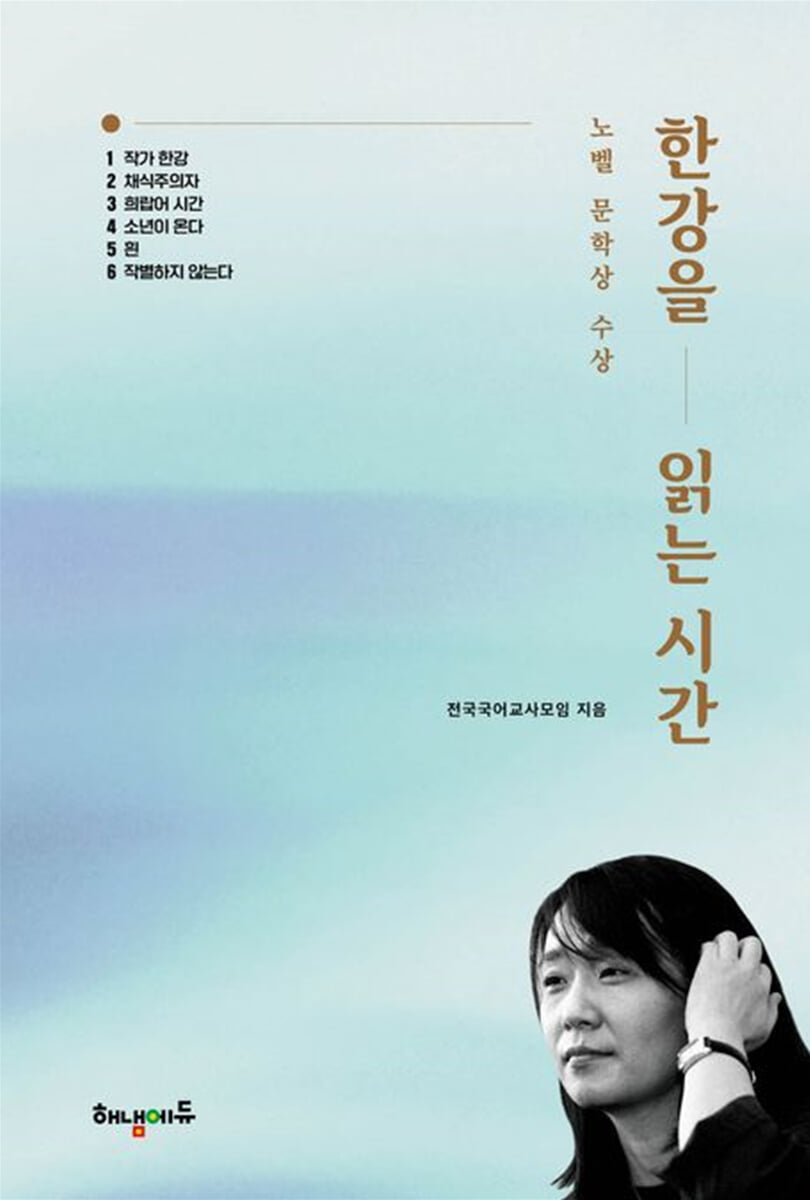
Time to read the Han River
 |
Description
Book Introduction
Teachers from the National Korean Language Teachers Association
A collection of appreciations that easily interprets author Han Kang's novels.
Nobel Prize in Literature Winner - Reading the Han River
October 10, 2024, we can never forget the excitement of that day.
Our country's author Han Kang won the Nobel Prize in Literature.
It was a long-awaited moment that will remain in our literary history.
However, reading Han Kang's novels is not an easy task.
This is because historical facts and fiction are exquisitely mixed, past and present events cross over, symbolic devices are hidden, highly poetic expressions are used throughout, and the narrative point of view changes in various ways.
That is why Han Kang's novels are something that readers must read deeply, step by step, with a lot of thought.
With these points in mind, teachers from the National Association of Korean Language Teachers interpreted 'Author Han Kang' and her major novels.
The initial plan was to use the Korean language and literature concepts of middle and high school students as a guide to help young people become familiar with Han Kang's novels.
It also served as a gateway for ordinary adults to read Han Kang's novels without difficulty.
I hope that this book will deepen the appreciation of Han Kang's work for those who have already read it, and serve as a friendly guide to her work for those who are about to read it.
A collection of appreciations that easily interprets author Han Kang's novels.
Nobel Prize in Literature Winner - Reading the Han River
October 10, 2024, we can never forget the excitement of that day.
Our country's author Han Kang won the Nobel Prize in Literature.
It was a long-awaited moment that will remain in our literary history.
However, reading Han Kang's novels is not an easy task.
This is because historical facts and fiction are exquisitely mixed, past and present events cross over, symbolic devices are hidden, highly poetic expressions are used throughout, and the narrative point of view changes in various ways.
That is why Han Kang's novels are something that readers must read deeply, step by step, with a lot of thought.
With these points in mind, teachers from the National Association of Korean Language Teachers interpreted 'Author Han Kang' and her major novels.
The initial plan was to use the Korean language and literature concepts of middle and high school students as a guide to help young people become familiar with Han Kang's novels.
It also served as a gateway for ordinary adults to read Han Kang's novels without difficulty.
I hope that this book will deepen the appreciation of Han Kang's work for those who have already read it, and serve as a friendly guide to her work for those who are about to read it.
- You can preview some of the book's contents.
Preview
index
01.
Author Han Kang _ Ahn Byeong-man
- Reasons for selecting the 2024 Nobel Prize in Literature (Anders Olsson/Chairman of the Nobel Prize in Literature Jury)
- Nobel Prize in Literature? Nobel Prize in Literature!
- Why You Should Read Han Kang's Novels
Han Kang's novels reveal the fragility of human life.
- Healing begins with exposing the wound.
- Dream, the motif of Han Kang's work
- Italics in Han Kang's works
- Han Kang's novels reflect the author's life.
02.
Vegetarian _ Hong Mi-ae
- Entering
- A story woven with three colors
- A special way of telling a story, a point of view
- The aspects of life shaped by desire
- The violence of desire, a violent life
- Questions about an imperfect life
- Reading the work as a symbol
- The rest of the story
03.
Greek Time _ Min Tae-hong
- Entering
- Me, you, and our story
- The topic that the world is an illusion and that living is a dream
- Listen to the silence
- Dreams are the key to the well of the unconscious.
- Warm communication conveyed through body temperature
- The rest of the story
04.
The Boy Comes _ Lee Seok-jung
- Entering
- A boy's story seen through seven eyes
Massacre and Resistance - May 18th Democratization Movement
- The national anthem and Taegeukgi of 'us' and 'our army'
- Boy Dong-ho, left behind in the wiretapping
- Why 'boy' and why 'coming'?
- Variations in perspective and composition of meaning
- Individuality and homogeneity of characters
- Mother's Heart 'Towards the Blooming Flower' and italics
- The rest of the story
05.
White _ Strong
- Entering
- A story created by sixty-five pieces
- A delicate sensibility cultivated from within
- 'White' open to possibility
- Painful reality and human dignity
The Han River and the 'White City' connected by golden thread
- The rest of the story
06.
No Farewell _ Hwang Moon-hee
- Entering
- Reading the novel by following the characters
Jeju Island, the South that Never Sleeps
- A narrative method for memory
- How to mourn
- How to remember
- A material that is light but not light
- The rest of the story
Author Han Kang _ Ahn Byeong-man
- Reasons for selecting the 2024 Nobel Prize in Literature (Anders Olsson/Chairman of the Nobel Prize in Literature Jury)
- Nobel Prize in Literature? Nobel Prize in Literature!
- Why You Should Read Han Kang's Novels
Han Kang's novels reveal the fragility of human life.
- Healing begins with exposing the wound.
- Dream, the motif of Han Kang's work
- Italics in Han Kang's works
- Han Kang's novels reflect the author's life.
02.
Vegetarian _ Hong Mi-ae
- Entering
- A story woven with three colors
- A special way of telling a story, a point of view
- The aspects of life shaped by desire
- The violence of desire, a violent life
- Questions about an imperfect life
- Reading the work as a symbol
- The rest of the story
03.
Greek Time _ Min Tae-hong
- Entering
- Me, you, and our story
- The topic that the world is an illusion and that living is a dream
- Listen to the silence
- Dreams are the key to the well of the unconscious.
- Warm communication conveyed through body temperature
- The rest of the story
04.
The Boy Comes _ Lee Seok-jung
- Entering
- A boy's story seen through seven eyes
Massacre and Resistance - May 18th Democratization Movement
- The national anthem and Taegeukgi of 'us' and 'our army'
- Boy Dong-ho, left behind in the wiretapping
- Why 'boy' and why 'coming'?
- Variations in perspective and composition of meaning
- Individuality and homogeneity of characters
- Mother's Heart 'Towards the Blooming Flower' and italics
- The rest of the story
05.
White _ Strong
- Entering
- A story created by sixty-five pieces
- A delicate sensibility cultivated from within
- 'White' open to possibility
- Painful reality and human dignity
The Han River and the 'White City' connected by golden thread
- The rest of the story
06.
No Farewell _ Hwang Moon-hee
- Entering
- Reading the novel by following the characters
Jeju Island, the South that Never Sleeps
- A narrative method for memory
- How to mourn
- How to remember
- A material that is light but not light
- The rest of the story
Detailed image

Into the book
On October 10, 2024, the Swedish Academy announced that it had selected novelist Han Kang as the winner of the Nobel Prize in Literature.
With this, he became the first Korean to win the Nobel Prize in Literature, and we now have the pleasure of appreciating the work of a Nobel Prize winner in its entirety without translation.
---p.15, 「1.
From "Writer Han Kang"
At the center of the three series, “The Vegetarian,” “Mongolian Spot,” and “Tree Flame,” is Young-hye’s story.
Although Young-hye is the main character of the novel, she is unable to find her own voice anywhere in the work.
The novel unfolds from the perspectives of Yeong-hye's husband, brother-in-law, and older sister.
Point of view refers to the perspective or position from which the narrator of a story views a character or event.
In a novel, whose point of view is chosen is an important factor in determining one's attitude or view of the character.
---p.43, 「2.
Among the "Vegetarians"
『Greek Hours』, consisting of a total of 22 chapters, begins with Chapter 1 and ends with Chapter 0.
Some chapters have subheadings and some do not.
The length of the story varies from chapter to chapter.
Sometimes a long story unfolds, and other times a chapter consists of a few Greek sentences or a poem.
Another chapter is about a man, but then it changes to a woman's story, and the point of view changes from first person to third person.
A character's thoughts are sometimes expressed in italics without quotation marks.
It is very different from the structure of a novel that we commonly know as ‘beginning---p. development---p. crisis---p. climax---p. conclusion.’
---p.66, 「3.
From "Greek Time"
Dong-ho's reason for staying at the wiretapping office on the last day wasn't just because he wanted to find Jeong-dae.
When Eun-sook finds Dong-ho at the wiretapping office on the last day and asks him to go out with her, Dong-ho runs away quickly down the stairs as if running away is the only way to survive.
Looking at Dong-ho's actions, we can see that his remaining in the wiretapping was a result of a completely voluntary and willful decision.
So where does Dong-ho's determination come from? Dong-ho isn't just waiting for his friend Jeong Dae-man to come to terms with something. He's aware that something is deeply wrong with the world, and he's observing what's unfolding before his eyes.
And we deeply recognize the abnormal situation in which we cannot share ‘our military’ and ‘the Taegeukgi and the national anthem.’
---p.105~106, 「4.
From "The Boy Comes"
Have you ever seen our country's traditional patchwork? As you can see in the photo on the left, patchwork is a practical yet beautiful wrapping cloth made by patching together pieces of cloth of different colors and shapes.
I think the composition of 『White』 could be called a ‘patchwork composition.’
By piecing together pieces of different stories about 'white things', I created a novel called 'White'.
---p.129, 「5.
Among the "white"
Among the villagers of Jeongsim, all those taken by the soldiers are shot dead on the beach.
Even the water babies (Jeju dialect for 'babies') were all killed for the purpose of extermination.
The expression 'extermination is the goal' shows how brutally the military and police suppressed Jeju at the time.
The 'scorched earth operation' against Jeju Island residents is a suppression operation that treats not only armed groups but also ordinary civilians as enemies and kills them.
The term “extermination,” which means to completely eliminate without leaving even a trace, is consistent with the expression “sweep (Jeju Island) as if sweeping with a broom” in the US military report.
With this, he became the first Korean to win the Nobel Prize in Literature, and we now have the pleasure of appreciating the work of a Nobel Prize winner in its entirety without translation.
---p.15, 「1.
From "Writer Han Kang"
At the center of the three series, “The Vegetarian,” “Mongolian Spot,” and “Tree Flame,” is Young-hye’s story.
Although Young-hye is the main character of the novel, she is unable to find her own voice anywhere in the work.
The novel unfolds from the perspectives of Yeong-hye's husband, brother-in-law, and older sister.
Point of view refers to the perspective or position from which the narrator of a story views a character or event.
In a novel, whose point of view is chosen is an important factor in determining one's attitude or view of the character.
---p.43, 「2.
Among the "Vegetarians"
『Greek Hours』, consisting of a total of 22 chapters, begins with Chapter 1 and ends with Chapter 0.
Some chapters have subheadings and some do not.
The length of the story varies from chapter to chapter.
Sometimes a long story unfolds, and other times a chapter consists of a few Greek sentences or a poem.
Another chapter is about a man, but then it changes to a woman's story, and the point of view changes from first person to third person.
A character's thoughts are sometimes expressed in italics without quotation marks.
It is very different from the structure of a novel that we commonly know as ‘beginning---p. development---p. crisis---p. climax---p. conclusion.’
---p.66, 「3.
From "Greek Time"
Dong-ho's reason for staying at the wiretapping office on the last day wasn't just because he wanted to find Jeong-dae.
When Eun-sook finds Dong-ho at the wiretapping office on the last day and asks him to go out with her, Dong-ho runs away quickly down the stairs as if running away is the only way to survive.
Looking at Dong-ho's actions, we can see that his remaining in the wiretapping was a result of a completely voluntary and willful decision.
So where does Dong-ho's determination come from? Dong-ho isn't just waiting for his friend Jeong Dae-man to come to terms with something. He's aware that something is deeply wrong with the world, and he's observing what's unfolding before his eyes.
And we deeply recognize the abnormal situation in which we cannot share ‘our military’ and ‘the Taegeukgi and the national anthem.’
---p.105~106, 「4.
From "The Boy Comes"
Have you ever seen our country's traditional patchwork? As you can see in the photo on the left, patchwork is a practical yet beautiful wrapping cloth made by patching together pieces of cloth of different colors and shapes.
I think the composition of 『White』 could be called a ‘patchwork composition.’
By piecing together pieces of different stories about 'white things', I created a novel called 'White'.
---p.129, 「5.
Among the "white"
Among the villagers of Jeongsim, all those taken by the soldiers are shot dead on the beach.
Even the water babies (Jeju dialect for 'babies') were all killed for the purpose of extermination.
The expression 'extermination is the goal' shows how brutally the military and police suppressed Jeju at the time.
The 'scorched earth operation' against Jeju Island residents is a suppression operation that treats not only armed groups but also ordinary civilians as enemies and kills them.
The term “extermination,” which means to completely eliminate without leaving even a trace, is consistent with the expression “sweep (Jeju Island) as if sweeping with a broom” in the US military report.
---p.163, 「6.
From "Not Saying Goodbye"
From "Not Saying Goodbye"
Publisher's Review
A collection of essays by teachers from the National Association of Korean Language Teachers, interpreting and interpreting author Han Kang's novels in an easy-to-understand manner!
In 2024, the winner of that year's Nobel Prize in Literature was our country's author Han Kang.
She is the first Korean writer and the first Asian woman to win the Nobel Prize in Literature.
Teachers from the National Korean Language Teachers Association gathered to hear the good news, which can be said to be monumental in the history of our literature.
This is to plan a collection of reviews of author Han Kang's novels, targeting young readers.
We discussed which works to target, what level of content to cover, and what style to use, and read Han Kang's works together.
In addition, I read a wide range of papers and critiques on Han Kang's work, and searched through interviews and videos of the author.
Through countless face-to-face and online meetings, including one that lasted two days and one night, we determined the direction of what to cover for each piece, wrote the text, and then revised it countless times.
After such efforts, this book was finally published to the world.
This book first included an article about ‘author Han Kang.’
Starting with the reasons for selecting the 2024 Nobel Prize in Literature by Anders Olsson, the chairman of the Nobel Prize in Literature jury, the book explains the details of Han Kang's Nobel Prize in Literature award, the characteristics of Han Kang's novels, and the relationship between Han Kang's life and novels.
Next, we covered Han Kang's major works, including 'The Vegetarian', 'Greek Hour', 'The Boy Comes', 'White', and 'No Farewell'.
Here, we have developed the main concepts of literature that middle and high school students learn in Korean language and literature classes at school, such as theme, structure, style, characters, events, setting, point of view, material, imagery, and expressive techniques.
This is because the content of most collections of reviews on Han Kang's works is often very difficult, and I felt a strong need for a collection of reviews that young people could read.
So, this book can be called a ‘must-read for teenagers.’
Saying that the content is at a youth level also means that it is a collection of appreciation that adults can easily read.
This is a must-read for teenagers, but adults can also easily and deeply understand Han Kang's novels by recalling the literary concepts they studied in school.
What the authors hope to achieve through this book can be expressed in the following words on the first page of the book.
“We congratulate author Han Kang on winning the Nobel Prize in Literature. We hope that this book, painstakingly written by teachers from the National Association of Korean Language Teachers, will deepen the appreciation of Han Kang’s work for those who have already read it, and serve as a valuable guide for those who wish to read it.”
In 2024, the winner of that year's Nobel Prize in Literature was our country's author Han Kang.
She is the first Korean writer and the first Asian woman to win the Nobel Prize in Literature.
Teachers from the National Korean Language Teachers Association gathered to hear the good news, which can be said to be monumental in the history of our literature.
This is to plan a collection of reviews of author Han Kang's novels, targeting young readers.
We discussed which works to target, what level of content to cover, and what style to use, and read Han Kang's works together.
In addition, I read a wide range of papers and critiques on Han Kang's work, and searched through interviews and videos of the author.
Through countless face-to-face and online meetings, including one that lasted two days and one night, we determined the direction of what to cover for each piece, wrote the text, and then revised it countless times.
After such efforts, this book was finally published to the world.
This book first included an article about ‘author Han Kang.’
Starting with the reasons for selecting the 2024 Nobel Prize in Literature by Anders Olsson, the chairman of the Nobel Prize in Literature jury, the book explains the details of Han Kang's Nobel Prize in Literature award, the characteristics of Han Kang's novels, and the relationship between Han Kang's life and novels.
Next, we covered Han Kang's major works, including 'The Vegetarian', 'Greek Hour', 'The Boy Comes', 'White', and 'No Farewell'.
Here, we have developed the main concepts of literature that middle and high school students learn in Korean language and literature classes at school, such as theme, structure, style, characters, events, setting, point of view, material, imagery, and expressive techniques.
This is because the content of most collections of reviews on Han Kang's works is often very difficult, and I felt a strong need for a collection of reviews that young people could read.
So, this book can be called a ‘must-read for teenagers.’
Saying that the content is at a youth level also means that it is a collection of appreciation that adults can easily read.
This is a must-read for teenagers, but adults can also easily and deeply understand Han Kang's novels by recalling the literary concepts they studied in school.
What the authors hope to achieve through this book can be expressed in the following words on the first page of the book.
“We congratulate author Han Kang on winning the Nobel Prize in Literature. We hope that this book, painstakingly written by teachers from the National Association of Korean Language Teachers, will deepen the appreciation of Han Kang’s work for those who have already read it, and serve as a valuable guide for those who wish to read it.”
GOODS SPECIFICS
- Date of issue: June 16, 2025
- Page count, weight, size: 194 pages | 356g | 152*225*10mm
- ISBN13: 9788964462706
- ISBN10: 896446270X
You may also like
카테고리
korean


korean

![GQ KOREA Mark (Monthly): December [2025]](http://librairie.coreenne.fr/cdn/shop/files/8ef265dbbfbf186523ed75ba7319009d.jpg?v=1765340328&width=3840)


