

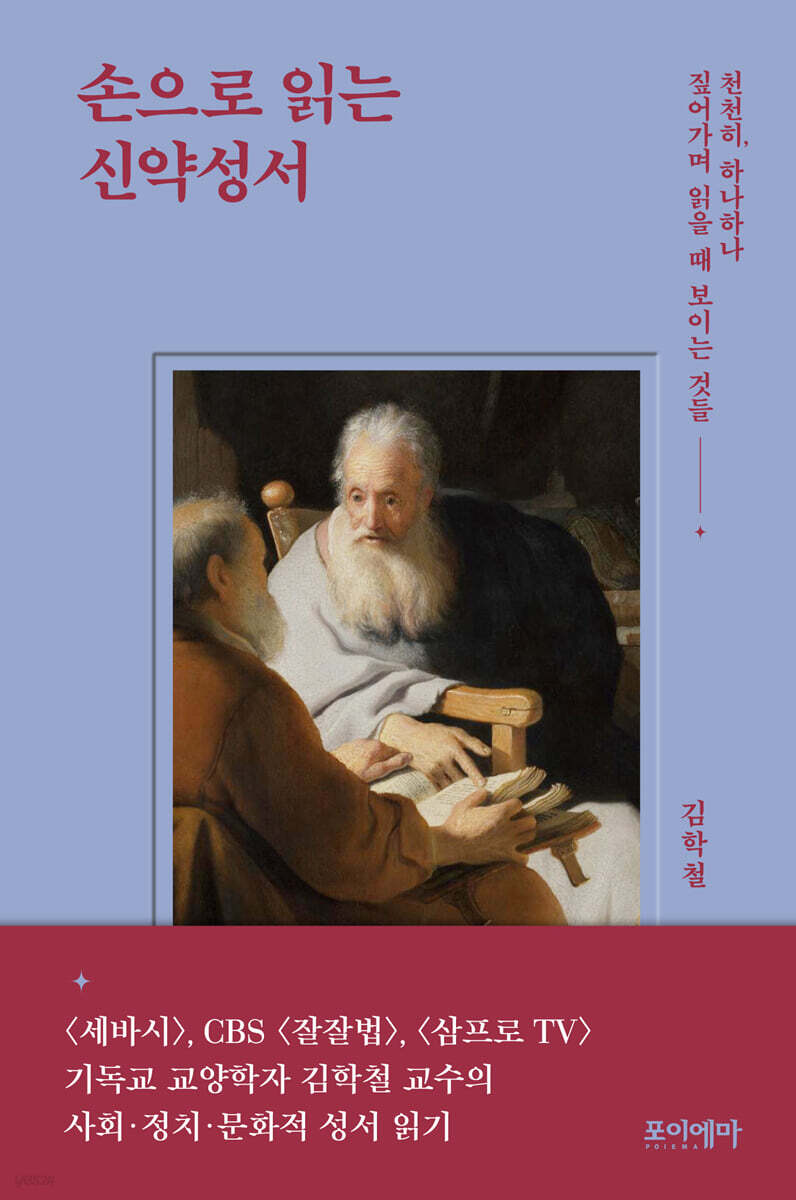
Hand-reading the New Testament
 |
Description
Book Introduction
Sebashi, CBS's "Jaljalbeop," and Sampro TV
Christian liberal arts scholar Professor Kim Hak-cheol's socio-political and cultural interpretation of the Bible
Reading the Bible to renew our faith and existence!
What does the Bible say? How do we read it today? Professor Kim Hak-cheol of Yonsei University, a New Testament scholar and Christian liberal arts scholar, proposes "reading the Bible with your hands."
“Let’s put aside our existing prejudices and preconceptions and listen seriously, word by word, to what the Bible says.”
From the tyranny of Herod and Archelaus, to the oracle of the Jewish leader's prophecy about the end of Rome, to the bloody horrors of the Jewish-Roman War, to Paul's fierce rhetorical arguments in the Athenian Agora, this book broadens the horizons of biblical understanding by introducing key events and scenes from the time when the Greco-Roman and Jewish worlds clashed.
This is a gesture that seeks to bridge the gap between 'academic theology' and 'faith,' and it is also an invitation to move beyond rigid faith and romantic faith and enter into a relationship of 'communion and lingering together.'
Christian liberal arts scholar Professor Kim Hak-cheol's socio-political and cultural interpretation of the Bible
Reading the Bible to renew our faith and existence!
What does the Bible say? How do we read it today? Professor Kim Hak-cheol of Yonsei University, a New Testament scholar and Christian liberal arts scholar, proposes "reading the Bible with your hands."
“Let’s put aside our existing prejudices and preconceptions and listen seriously, word by word, to what the Bible says.”
From the tyranny of Herod and Archelaus, to the oracle of the Jewish leader's prophecy about the end of Rome, to the bloody horrors of the Jewish-Roman War, to Paul's fierce rhetorical arguments in the Athenian Agora, this book broadens the horizons of biblical understanding by introducing key events and scenes from the time when the Greco-Roman and Jewish worlds clashed.
This is a gesture that seeks to bridge the gap between 'academic theology' and 'faith,' and it is also an invitation to move beyond rigid faith and romantic faith and enter into a relationship of 'communion and lingering together.'
- You can preview some of the book's contents.
Preview
index
preface
1.
Before reading the New Testament
A faith that seeks understanding
canonical, apocrypha, and pseudepigrapha
The Authority of the Bible
2.
Language and Geography
Saul and Paul
The Cross, Conveyed by the Beauty of Words and Wisdom
Asia and Asia Minor
I went to Arabia
speech and mood
3.
The Bible and the Roman Rule
The Emperor's Friend and Jesus' Friend
The Emperor's and God's
The Peace of Rome and the Peace of Jesus
A strict disciple and a man riding a donkey
Sounds from Rama
The taste of life for a Roman citizen, the taste of death for others
4.
Religion and Culture
The Gospel of Matthew and Judaism
1st-century Jewish renewal movement
The Cultural and Religious Context of the Magi Story
False Christ, false prophet
5.
jesus
The Genealogy of Jesus
The name 'Jesus'
Immanuel
The name of hope
Son of Man
Jesus' healing
6.
Jesus' people
Jesus' teacher or victim of systemic deception
Jesus, then Jesus
arms and stay
7.
church
Let's go back to the early church?
What does a pastor do and what does a deacon do?
'Your body is a temple' and the beginning of the week
Even two or three people
8.
Faith and Prayer
I can do anything?
Nothing is impossible for those who believe?
Tell God your wishes.
then,
Widow, are you a successful person in annoying prayers?
9.
Understanding and misunderstanding
Jesus and Beelzebub
You say
Anger or love
Is 'Abba' a father?
Worship and Doubt
Conclusion: Inviting the Spirit of Truth
main
1.
Before reading the New Testament
A faith that seeks understanding
canonical, apocrypha, and pseudepigrapha
The Authority of the Bible
2.
Language and Geography
Saul and Paul
The Cross, Conveyed by the Beauty of Words and Wisdom
Asia and Asia Minor
I went to Arabia
speech and mood
3.
The Bible and the Roman Rule
The Emperor's Friend and Jesus' Friend
The Emperor's and God's
The Peace of Rome and the Peace of Jesus
A strict disciple and a man riding a donkey
Sounds from Rama
The taste of life for a Roman citizen, the taste of death for others
4.
Religion and Culture
The Gospel of Matthew and Judaism
1st-century Jewish renewal movement
The Cultural and Religious Context of the Magi Story
False Christ, false prophet
5.
jesus
The Genealogy of Jesus
The name 'Jesus'
Immanuel
The name of hope
Son of Man
Jesus' healing
6.
Jesus' people
Jesus' teacher or victim of systemic deception
Jesus, then Jesus
arms and stay
7.
church
Let's go back to the early church?
What does a pastor do and what does a deacon do?
'Your body is a temple' and the beginning of the week
Even two or three people
8.
Faith and Prayer
I can do anything?
Nothing is impossible for those who believe?
Tell God your wishes.
then,
Widow, are you a successful person in annoying prayers?
9.
Understanding and misunderstanding
Jesus and Beelzebub
You say
Anger or love
Is 'Abba' a father?
Worship and Doubt
Conclusion: Inviting the Spirit of Truth
main
Detailed image
.jpg)
Into the book
If a promising young scholar studying geology were to lecture in a graduate seminar, every student would listen, understand, and try to write down what he said.
But the case of theologians is quite different.
When a veteran scholar who has studied theology for decades begins lecturing to first-year college students, some students immediately raise their hands.
They recite a few Bible verses on the spot and then criticize the old professor's views, saying that they are 'biblically wrong.'
Examining instances where the academic nature of theology is suppressed by popular stereotypes allows us to understand why academic authority, which extends beyond the confines of academia, tends to limit its social commentary to confirming existing "biblical views."
--- p.14
Paul was a “believer who seeks understanding” who valued discussion, argument, and persuasion.
He not only appealed to the souls of the people, but was also not lazy in seeking their rational consent.
--- p.29
The authority of the Bible is an event that occurs when the confession that the Bible was written by the inspiration of God arises from an inner spontaneity, when the words of the Bible discern right from wrong in my life as the word of God, and when I feel joy in living according to the word.
--- p.46
At the time the New Testament was written, the Mediterranean world was in a political system different from our democracy.
Rome built a vast empire from a single small city-state, and to maintain this empire, they refined their own unique model of governance.
Soon, the Roman Empire sought to establish a specific relationship that could be understood as the so-called "patronage" model, allowing one emperor to easily rule over the people of a vast empire, and for a small city-state like Rome to effectively govern a vast territory.
--- p.76
The words, “Render to Caesar the things that are Caesar’s, and to God the things that are God’s,” which have been interpreted as a key text in relation to tax issues and worldly government, always serve to call a new-age audience to confess their faith rather than to provide any doctrinal details.
Believers in this new situation must answer before the people through their faith and religious wisdom what is ‘Caesar’s’ and what is ‘God’s.’
--- p.88
Not only did he kill his wife, whom he loved dearly, but he also murdered his own sons.
The reason was very simple: Herod's own life and position were threatened.
A Roman who knew Herod sneered, “It would be better to be born a pig of Herod than a son of Herod.”
Herod died in extreme fear, and he even devised a plan to make sure that no one would cry for him when he died.
Soon after his death, he arrested all the influential people of Judea.
And he commanded that they should be killed with him when he died, so that Jerusalem would be filled with weeping.
--- p.109
Of course, Christianity is not like Judaism.
Christianity's successful mission to the Gentiles laid the historical foundation for thinking of itself as something different from Judaism, and the traditions and stories of Jesus encouraged believers to interpret and practice God and the world in ways different from those of rabbinic Judaism.
However, the way early Christianity sought to break away from Judaism was not through unconditional hatred and opposition.
Christianity did not grow into an anti-thesis religion established by hating someone or opposing something.
--- p.121~122
Through this genealogy, Matthew ultimately focuses his readers' attention on God, who is at work behind Jesus' ministry.
Readers discover a God who bestows the grace of the covenant upon humanity and who faithfully drives history toward the goals of that covenant despite human sin and failure.
The genealogy says:
Do not boast about King David.
He is just a weak human being, and it is God who raises him up and takes him down.
Don't be arrogant when you look at the history of men.
Your lives have been continued through the women God uses.
Don't be proud of your superior lineage.
You are descendants of the prostitutes of Jericho, the foreign women whom God used.
Don't advertise that you are elite.
If it had not been for that wandering widow who found mercy, you would not be alive today.
Don't talk about purity.
You are the ones who borrowed 'Uriyah's wife'.
Don't talk about etiquette between people.
God accomplishes his will through the daughter-in-law who seduces her father-in-law.
The genealogy of Jesus is a clear illustration of the kingdom of heaven invading this earth, shaking the world's order and preconceptions.
--- p.151~152
Matthew saw the propaganda of the emperor's justice, victory, and hope on coins, in inscriptions, in imperial ceremonies, and in various official gatherings.
And then he must have shook his head.
The Emperor's justice was founded on injustice, and his victory was a victory made possible only by the miserable defeat of others.
His hope is built on the despair of others.
Matthew proclaims the justice, victory, and hope of Jesus instead of the emperor.
That justice is a justice that drives out injustice by targeting the weak, and its victory is God's eschatological reversal.
Therefore, Jesus' rule is a hope even for the 'Gentiles' who reject the rule of other nations.
--- p.166~167
When Jesus called his people, he must have felt sorry for those who were content to obtain historical information about him.
Jesus wanted to give us not only his blood, but also his eyes, ears, and skin.
Jesus with his own eyes, his own ears, his own soul, then Jesus.
--- p.191
Returning to the early church? The New Testament encourages us to envision a new heaven and a new earth, but ignores the instinct to return to Eden, the original homeland.
Let's go back to the early church? The church God desires is rushing forward from the far reaches of history.
--- p.205~206
This passage is usually misunderstood as indicating that God is pleased with even a small group of two or three people.
However, in the Gospel of Matthew, this passage can be said to be a passage that reveals the reality of the Matthew community, where even just two people desperately needed to come together and unite in His name.
Even at a time when faith and miracles were raging like wildfire, it was not easy for believers to unite in His name.
As mentioned earlier, these texts reflect the situation in the Matthean community, where mutual criticism and condemnation were intense.
But the case of theologians is quite different.
When a veteran scholar who has studied theology for decades begins lecturing to first-year college students, some students immediately raise their hands.
They recite a few Bible verses on the spot and then criticize the old professor's views, saying that they are 'biblically wrong.'
Examining instances where the academic nature of theology is suppressed by popular stereotypes allows us to understand why academic authority, which extends beyond the confines of academia, tends to limit its social commentary to confirming existing "biblical views."
--- p.14
Paul was a “believer who seeks understanding” who valued discussion, argument, and persuasion.
He not only appealed to the souls of the people, but was also not lazy in seeking their rational consent.
--- p.29
The authority of the Bible is an event that occurs when the confession that the Bible was written by the inspiration of God arises from an inner spontaneity, when the words of the Bible discern right from wrong in my life as the word of God, and when I feel joy in living according to the word.
--- p.46
At the time the New Testament was written, the Mediterranean world was in a political system different from our democracy.
Rome built a vast empire from a single small city-state, and to maintain this empire, they refined their own unique model of governance.
Soon, the Roman Empire sought to establish a specific relationship that could be understood as the so-called "patronage" model, allowing one emperor to easily rule over the people of a vast empire, and for a small city-state like Rome to effectively govern a vast territory.
--- p.76
The words, “Render to Caesar the things that are Caesar’s, and to God the things that are God’s,” which have been interpreted as a key text in relation to tax issues and worldly government, always serve to call a new-age audience to confess their faith rather than to provide any doctrinal details.
Believers in this new situation must answer before the people through their faith and religious wisdom what is ‘Caesar’s’ and what is ‘God’s.’
--- p.88
Not only did he kill his wife, whom he loved dearly, but he also murdered his own sons.
The reason was very simple: Herod's own life and position were threatened.
A Roman who knew Herod sneered, “It would be better to be born a pig of Herod than a son of Herod.”
Herod died in extreme fear, and he even devised a plan to make sure that no one would cry for him when he died.
Soon after his death, he arrested all the influential people of Judea.
And he commanded that they should be killed with him when he died, so that Jerusalem would be filled with weeping.
--- p.109
Of course, Christianity is not like Judaism.
Christianity's successful mission to the Gentiles laid the historical foundation for thinking of itself as something different from Judaism, and the traditions and stories of Jesus encouraged believers to interpret and practice God and the world in ways different from those of rabbinic Judaism.
However, the way early Christianity sought to break away from Judaism was not through unconditional hatred and opposition.
Christianity did not grow into an anti-thesis religion established by hating someone or opposing something.
--- p.121~122
Through this genealogy, Matthew ultimately focuses his readers' attention on God, who is at work behind Jesus' ministry.
Readers discover a God who bestows the grace of the covenant upon humanity and who faithfully drives history toward the goals of that covenant despite human sin and failure.
The genealogy says:
Do not boast about King David.
He is just a weak human being, and it is God who raises him up and takes him down.
Don't be arrogant when you look at the history of men.
Your lives have been continued through the women God uses.
Don't be proud of your superior lineage.
You are descendants of the prostitutes of Jericho, the foreign women whom God used.
Don't advertise that you are elite.
If it had not been for that wandering widow who found mercy, you would not be alive today.
Don't talk about purity.
You are the ones who borrowed 'Uriyah's wife'.
Don't talk about etiquette between people.
God accomplishes his will through the daughter-in-law who seduces her father-in-law.
The genealogy of Jesus is a clear illustration of the kingdom of heaven invading this earth, shaking the world's order and preconceptions.
--- p.151~152
Matthew saw the propaganda of the emperor's justice, victory, and hope on coins, in inscriptions, in imperial ceremonies, and in various official gatherings.
And then he must have shook his head.
The Emperor's justice was founded on injustice, and his victory was a victory made possible only by the miserable defeat of others.
His hope is built on the despair of others.
Matthew proclaims the justice, victory, and hope of Jesus instead of the emperor.
That justice is a justice that drives out injustice by targeting the weak, and its victory is God's eschatological reversal.
Therefore, Jesus' rule is a hope even for the 'Gentiles' who reject the rule of other nations.
--- p.166~167
When Jesus called his people, he must have felt sorry for those who were content to obtain historical information about him.
Jesus wanted to give us not only his blood, but also his eyes, ears, and skin.
Jesus with his own eyes, his own ears, his own soul, then Jesus.
--- p.191
Returning to the early church? The New Testament encourages us to envision a new heaven and a new earth, but ignores the instinct to return to Eden, the original homeland.
Let's go back to the early church? The church God desires is rushing forward from the far reaches of history.
--- p.205~206
This passage is usually misunderstood as indicating that God is pleased with even a small group of two or three people.
However, in the Gospel of Matthew, this passage can be said to be a passage that reveals the reality of the Matthew community, where even just two people desperately needed to come together and unite in His name.
Even at a time when faith and miracles were raging like wildfire, it was not easy for believers to unite in His name.
As mentioned earlier, these texts reflect the situation in the Matthean community, where mutual criticism and condemnation were intense.
--- p.219
Publisher's Review
Sebashi, CBS's "Jaljalbeop," and Sampro TV
Reading the Bible 'Slowly and Accurately' Guided by Christian Liberal Arts Professor Kim Hak-cheol
What does the Bible say? How do we read it today? Professor Kim Hak-cheol of Yonsei University, a New Testament scholar and Christian liberal arts scholar, proposes "reading the Bible with your hands."
“Let’s put aside our existing prejudices and preconceptions and listen seriously, word by word, to what the Bible says.”
And this is evident in this book, which asks what the Bible says, by referring to the religious, cultural, and socio-political backgrounds of the time, examines whether we truly understand it, and examines the relevant text in relation to today's circumstances.
From the tyranny of Herod and Archelaus, to the oracle of the Jewish leader's prophecy about the end of Rome, to the bloody horrors of the Jewish-Roman War, to Paul's fierce rhetorical arguments in the Athenian Agora, this book broadens the horizons of biblical understanding by introducing key events and scenes from the time when the Greco-Roman and Jewish worlds clashed.
This is a gesture that seeks to bridge the gap between 'academic theology' and 'faith,' and it is also an invitation to move beyond rigid faith and romantic faith and enter into a relationship of 'communion and lingering together.'
Things you see when you read them one by one
The book's content covers a wide range of topics in biblical studies and the New Testament.
First, it begins by highlighting the value of a “faith that seeks understanding” (Chapter 1), then points out several cases of misunderstanding about the language and geography of the Bible (Chapter 2), and “views the New Testament in the context of the Roman ruling system, especially the political and military context” (Chapter 3). It also shows the messianic oracles that can be found in the first-century Jewish renewal movement and the Greco-Roman world (Chapter 4), and supplements the existing understanding of Jesus from a socio-political perspective by examining his genealogy and names (Chapter 5).
In the chapters on the people Jesus met and his disciples, we explore what Jesus expected of his people (Chapter 6) and examine the reality of the early church that emerged as a result of the Jesus movement (Chapter 7).
We will look at the 'faith' and 'prayer' that characterize Korean Protestantism (Chapter 8), and consider the attitude of a humble believer while examining examples of misunderstandings about Jesus in the New Testament (Chapter 9).
Through this, readers can look at the content of the widow's cry against the unjust judge in Jesus' parable from a different perspective, and whether Paul's sermon in Athens, which attempted to persuade through argument, was truly a failure.
We learn that 'Saul' did not change into 'Paul' and that he did not meditate in the Arabian desert after his conversion.
We are forced to ponder how we should view the 'apocrypha' and 'pseudo-canonical books' outside the canon, and whether abandoning the literal inerrancy of the Bible would undermine our faith in the truth of the Bible and its authority.
When we understand the background, such as why Pilate could not release Jesus, what Jesus' words in response to the question of whether taxes should be paid to Rome reveal, and the actual incident that served as the motif for the parable of the ten minas and its meaning, we discover new meanings that can only be discovered.
Reading the Bible Socially, Politically, and Culturally
Above all, this book shows how to read the Bible within its social, political, and cultural context.
The intention is not to overturn existing interpretations and present a novel interpretation, but to find out why the text was written that way based on the results of biblical studies.
Of course, sometimes I point out the misreadings that often occur in sermons and Bible study groups, and the romantic understandings that result from them.
For example, the tears Jesus shed when Lazarus died are often understood as tears of sorrow at the death of a loved one, but the author analyzes the meaning and usage of the words used in the passage, “Jesus was deeply moved in the spirit and troubled” (John 11:33), and argues that it is more persuasive to view the tears as “tears of anger and sorrow for those who mourned the death of Lazarus even though they had Jesus, the Son of God, and his authority right before their eyes,” rather than tears of love.
He adds:
“There is absolutely no need to be upset that the tears Jesus shed in this story were not ‘tears of love.’
“In the Gospel of John, Jesus’ love is proven by the blood and water he shed.” (p. 260)
It's not like I'm going to present an analytical and complex discussion like you'd find in a paper.
Although the text does cover specialized topics, such as the introduction to the Roman patronage system in the article dealing with Governor Pilate, it is short and concise, so anyone can read it without too much burden.
The biblical texts covered are also passages familiar to many Christians, and there is the joy of broadening one's perspective by hearing interpretations that are difficult to hear in regular sermons.
Reading the Bible to Renew Our Faith
At the very beginning of the book are four oil paintings by Rembrandt, all of which depict the Bible and the hand.
In the first painting, two old men, probably Paul and Peter, are engaged in a heated debate over a book, while in the second, an old man is reading the Bible, pointing to it with his wrinkled hands.
The third picture shows Matthew writing the Gospel while struggling, and the last picture shows the preacher and his wife pointing to the Bible with their hands.
Although they are in different situations and poses, these figures consistently treat the Bible with the utmost seriousness, and this seems to show a unique way of 'reading the Bible with one's hands.'
Even if we do not strive for a moving or 'gracious' interpretation, this 'reading of the Bible with our hands' will invite us into a new life, because the Holy Spirit, the Spirit of truth, is not 'enthusiasm or heat' but comforts and encourages us through 'sharp discernment, that is, enlightenment to the truth' (p. 276).
This is probably why this book, which demonstrates a rather dry reading method of reading the Bible 'slowly and accurately', leaves such a deep impression on readers.
This book will be a good guide for Christians who have begun reading the Bible in the new year and for readers who wish to read the Bible as a form of cultural education.
Reading the Bible 'Slowly and Accurately' Guided by Christian Liberal Arts Professor Kim Hak-cheol
What does the Bible say? How do we read it today? Professor Kim Hak-cheol of Yonsei University, a New Testament scholar and Christian liberal arts scholar, proposes "reading the Bible with your hands."
“Let’s put aside our existing prejudices and preconceptions and listen seriously, word by word, to what the Bible says.”
And this is evident in this book, which asks what the Bible says, by referring to the religious, cultural, and socio-political backgrounds of the time, examines whether we truly understand it, and examines the relevant text in relation to today's circumstances.
From the tyranny of Herod and Archelaus, to the oracle of the Jewish leader's prophecy about the end of Rome, to the bloody horrors of the Jewish-Roman War, to Paul's fierce rhetorical arguments in the Athenian Agora, this book broadens the horizons of biblical understanding by introducing key events and scenes from the time when the Greco-Roman and Jewish worlds clashed.
This is a gesture that seeks to bridge the gap between 'academic theology' and 'faith,' and it is also an invitation to move beyond rigid faith and romantic faith and enter into a relationship of 'communion and lingering together.'
Things you see when you read them one by one
The book's content covers a wide range of topics in biblical studies and the New Testament.
First, it begins by highlighting the value of a “faith that seeks understanding” (Chapter 1), then points out several cases of misunderstanding about the language and geography of the Bible (Chapter 2), and “views the New Testament in the context of the Roman ruling system, especially the political and military context” (Chapter 3). It also shows the messianic oracles that can be found in the first-century Jewish renewal movement and the Greco-Roman world (Chapter 4), and supplements the existing understanding of Jesus from a socio-political perspective by examining his genealogy and names (Chapter 5).
In the chapters on the people Jesus met and his disciples, we explore what Jesus expected of his people (Chapter 6) and examine the reality of the early church that emerged as a result of the Jesus movement (Chapter 7).
We will look at the 'faith' and 'prayer' that characterize Korean Protestantism (Chapter 8), and consider the attitude of a humble believer while examining examples of misunderstandings about Jesus in the New Testament (Chapter 9).
Through this, readers can look at the content of the widow's cry against the unjust judge in Jesus' parable from a different perspective, and whether Paul's sermon in Athens, which attempted to persuade through argument, was truly a failure.
We learn that 'Saul' did not change into 'Paul' and that he did not meditate in the Arabian desert after his conversion.
We are forced to ponder how we should view the 'apocrypha' and 'pseudo-canonical books' outside the canon, and whether abandoning the literal inerrancy of the Bible would undermine our faith in the truth of the Bible and its authority.
When we understand the background, such as why Pilate could not release Jesus, what Jesus' words in response to the question of whether taxes should be paid to Rome reveal, and the actual incident that served as the motif for the parable of the ten minas and its meaning, we discover new meanings that can only be discovered.
Reading the Bible Socially, Politically, and Culturally
Above all, this book shows how to read the Bible within its social, political, and cultural context.
The intention is not to overturn existing interpretations and present a novel interpretation, but to find out why the text was written that way based on the results of biblical studies.
Of course, sometimes I point out the misreadings that often occur in sermons and Bible study groups, and the romantic understandings that result from them.
For example, the tears Jesus shed when Lazarus died are often understood as tears of sorrow at the death of a loved one, but the author analyzes the meaning and usage of the words used in the passage, “Jesus was deeply moved in the spirit and troubled” (John 11:33), and argues that it is more persuasive to view the tears as “tears of anger and sorrow for those who mourned the death of Lazarus even though they had Jesus, the Son of God, and his authority right before their eyes,” rather than tears of love.
He adds:
“There is absolutely no need to be upset that the tears Jesus shed in this story were not ‘tears of love.’
“In the Gospel of John, Jesus’ love is proven by the blood and water he shed.” (p. 260)
It's not like I'm going to present an analytical and complex discussion like you'd find in a paper.
Although the text does cover specialized topics, such as the introduction to the Roman patronage system in the article dealing with Governor Pilate, it is short and concise, so anyone can read it without too much burden.
The biblical texts covered are also passages familiar to many Christians, and there is the joy of broadening one's perspective by hearing interpretations that are difficult to hear in regular sermons.
Reading the Bible to Renew Our Faith
At the very beginning of the book are four oil paintings by Rembrandt, all of which depict the Bible and the hand.
In the first painting, two old men, probably Paul and Peter, are engaged in a heated debate over a book, while in the second, an old man is reading the Bible, pointing to it with his wrinkled hands.
The third picture shows Matthew writing the Gospel while struggling, and the last picture shows the preacher and his wife pointing to the Bible with their hands.
Although they are in different situations and poses, these figures consistently treat the Bible with the utmost seriousness, and this seems to show a unique way of 'reading the Bible with one's hands.'
Even if we do not strive for a moving or 'gracious' interpretation, this 'reading of the Bible with our hands' will invite us into a new life, because the Holy Spirit, the Spirit of truth, is not 'enthusiasm or heat' but comforts and encourages us through 'sharp discernment, that is, enlightenment to the truth' (p. 276).
This is probably why this book, which demonstrates a rather dry reading method of reading the Bible 'slowly and accurately', leaves such a deep impression on readers.
This book will be a good guide for Christians who have begun reading the Bible in the new year and for readers who wish to read the Bible as a form of cultural education.
GOODS SPECIFICS
- Date of issue: February 5, 2025
- Format: Hardcover book binding method guide
- Page count, weight, size: 284 pages | 362g | 124*190*20mm
- ISBN13: 9791158090982
- ISBN10: 1158090986
You may also like
카테고리
korean


korean

![GQ KOREA Mark (Monthly): December [2025]](http://librairie.coreenne.fr/cdn/shop/files/8ef265dbbfbf186523ed75ba7319009d.jpg?v=1765340328&width=3840)


