

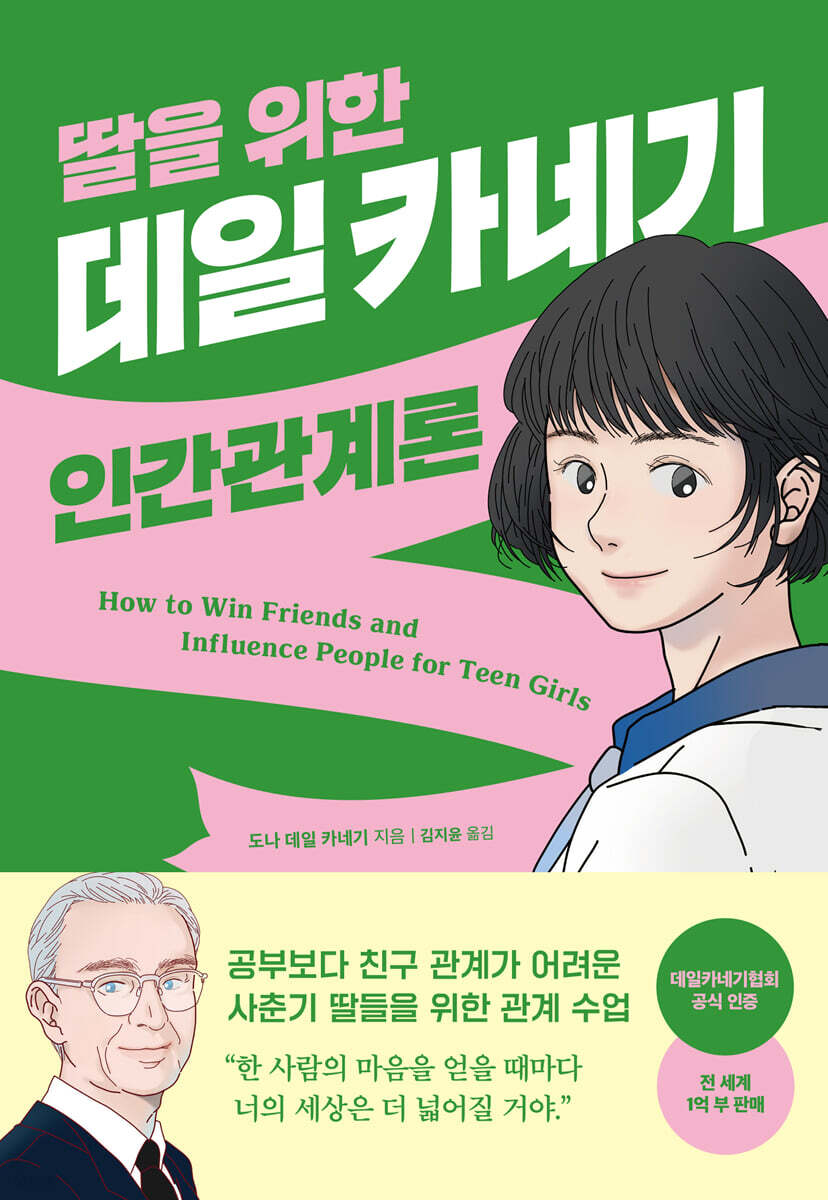
Dale Carnegie's Guide to Human Relations for Daughters
 |
Description
Book Introduction
The only youth education book officially certified by the Dale Carnegie Association!
Relationship classes for teenage daughters who find friendships more difficult than academics.
Dale Carnegie's "How to Win Friends and Influence People," the bible of human relationships that has sold over 100 million copies worldwide, has been reborn for adolescent girls.
『Dale Carnegie's Guide to Influencing Human Relations for Daughters』 is a book based on the philosophy of the legendary communication mentor Dale Carnegie. Donna Dale Carnegie, his biological daughter and president of the Dale Carnegie Association, explains in a cheerful voice the human relationship skills that today's teenage girls can apply in their daily lives, at school and at home.
This book will serve as a warm guide not only for children who have difficulty making friends in new environments, those who struggle to overcome conflicts among friends, and those who struggle in relationships with parents and teachers, but also for daughters who aspire to become leaders at the center of the world based on their excellent communication skills.
Relationship classes for teenage daughters who find friendships more difficult than academics.
Dale Carnegie's "How to Win Friends and Influence People," the bible of human relationships that has sold over 100 million copies worldwide, has been reborn for adolescent girls.
『Dale Carnegie's Guide to Influencing Human Relations for Daughters』 is a book based on the philosophy of the legendary communication mentor Dale Carnegie. Donna Dale Carnegie, his biological daughter and president of the Dale Carnegie Association, explains in a cheerful voice the human relationship skills that today's teenage girls can apply in their daily lives, at school and at home.
This book will serve as a warm guide not only for children who have difficulty making friends in new environments, those who struggle to overcome conflicts among friends, and those who struggle in relationships with parents and teachers, but also for daughters who aspire to become leaders at the center of the world based on their excellent communication skills.
- You can preview some of the book's contents.
Preview
index
How to Make Friends and Become a Leader
Chapter 1: Don't criticize, condemn, or complain.
How to Speak Without Hurt | Break the Habit of Judging | Gain Strength from Negative Energy
Chapter 2 Praise and Acknowledge
The desire to be recognized as an "important person" | The power of praise to change people | What happens when you say "thank you" | Beware of meaningless compliments | How to feel respected
Chapter 3: Show your smile and interest
Welcome! | What makes you smile? | The power of 'calling people by their names' | The best conversation techniques to attract people | Where do people meet? | Show your true self
Chapter 4: Focus on the Other Person's Interests
Every action has a motive | Understand the other person's position first | If you don't feel like it, others won't either | Anticipate and prepare in advance | What we can learn from advertising | Negotiations that benefit everyone
Chapter 5 Please listen carefully
Think of the other person first | When I listen, the other person listens in return | The power of listening that saves lives | Learn by listening with an open mind | The relationship between listening and praise | Express your opinions confidently
Chapter 6: Avoid Arguments
Even if you win, you can't change it | Save your opponent's face | Don't lose your balance | Stop arguing before it starts | Open your heart by asking the right questions | Let's not look at the comments
Chapter 7: Admit your mistakes honestly.
Don't make excuses | Take responsibility for your mistakes | Tips for apologizing | What to do when your apology is rejected | Accepting a respectful and sincere apology | Acknowledge your limitations | Learn to let go
Chapter 8: Become the Best Leader You Can Be
Practice the principles you've learned | Everyone needs help | Don't be a nitpicker | Always give others credit | Trust them | Expect the best from them | Even if you fail, be bold and try again | Be a positive friend | Accept them if they've done their best.
A Recommendation for Adolescent Girls Worried About Interpersonal Relationships
Chapter 1: Don't criticize, condemn, or complain.
How to Speak Without Hurt | Break the Habit of Judging | Gain Strength from Negative Energy
Chapter 2 Praise and Acknowledge
The desire to be recognized as an "important person" | The power of praise to change people | What happens when you say "thank you" | Beware of meaningless compliments | How to feel respected
Chapter 3: Show your smile and interest
Welcome! | What makes you smile? | The power of 'calling people by their names' | The best conversation techniques to attract people | Where do people meet? | Show your true self
Chapter 4: Focus on the Other Person's Interests
Every action has a motive | Understand the other person's position first | If you don't feel like it, others won't either | Anticipate and prepare in advance | What we can learn from advertising | Negotiations that benefit everyone
Chapter 5 Please listen carefully
Think of the other person first | When I listen, the other person listens in return | The power of listening that saves lives | Learn by listening with an open mind | The relationship between listening and praise | Express your opinions confidently
Chapter 6: Avoid Arguments
Even if you win, you can't change it | Save your opponent's face | Don't lose your balance | Stop arguing before it starts | Open your heart by asking the right questions | Let's not look at the comments
Chapter 7: Admit your mistakes honestly.
Don't make excuses | Take responsibility for your mistakes | Tips for apologizing | What to do when your apology is rejected | Accepting a respectful and sincere apology | Acknowledge your limitations | Learn to let go
Chapter 8: Become the Best Leader You Can Be
Practice the principles you've learned | Everyone needs help | Don't be a nitpicker | Always give others credit | Trust them | Expect the best from them | Even if you fail, be bold and try again | Be a positive friend | Accept them if they've done their best.
A Recommendation for Adolescent Girls Worried About Interpersonal Relationships
Detailed image

Into the book
“Criticism is useless.
“People become defensive when they are criticized, and most of the time they try to prove that they are right.” Carnegie was very sensitive to the evaluation of others and always taught the principle of ‘don’t criticize, condemn, or complain’ as the first thing.
How do you react when you encounter criticism, blame, or complaints? Do you listen to the criticism immediately and say, "Yeah, you're right.
Do you respond with, "Thank you for telling me," or do you feel hurt and angry, feeling like you're being cornered? Criticism, blame, and complaints only serve to build a high wall between you and the other person.
Once a wall is built, it is difficult for anything to get through.
I feel like I have to protect myself from getting hurt anymore.
---p.16
Dale Carnegie knew that people crave being recognized as "important" as much as they crave the most basic needs of food and shelter.
So, if you figure out how to be perceived as important, you'll have the secret to feeling much closer to your friends, clubs, and family.
People sometimes want to feel important, so much so that they trample on others to feel that way.
---p.35
If you don't respect the other person, arguing can have the opposite effect.
The more you ridicule someone's choices, the more they will try to defend themselves.
No one wants to be told they're wrong.
I especially don't want to hear that kind of thing about the things that make me who I am, like the clothes I wear, the music I listen to, or the friends I hang out with.
You gain much more if you focus only on different ideas and don't undermine the other person's self-esteem.
Let's see the other person as they are and respect their opinions.
This way, the conversation can flow in a way that benefits everyone.
Let's keep the line between ourselves and others.
If you find it difficult to show respect, sometimes it's better not to argue at all.
------p.162
Hearing excuses will never make someone feel better.
So let's not waste time thinking of excuses.
If you want the other person to continue to trust and respect you, just admit when you're wrong.
It doesn't matter if it's a big mistake like stealing something, skipping school, drinking, or hitting a close friend on the back of the head, or a small mistake like breaking a promise with a friend or not doing your chores.
Even if you are scared, say, “I was wrong.
Saying “I’m sorry” is the first step toward making things right.
It's also the best way to prevent things from getting worse.
---p.178~179
The nitpicking attitude easily ignores the most important principle of active listening.
We must remember that everyone has something to learn and new ideas to share.
Of course, your partner may want to work differently from you.
But that's how new ideas emerge and progress is made.
If you ever need to ask someone for help later, respect their ability to do their own thing.
This will result in a good outcome for both you and the other person.
---p.206~207
If you don't get along well with people, good things won't last long.
Even if you have some shortcomings, if you can win the other person's heart, there will be no obstacles in your future.
Dale Carnegie's principles have changed millions of lives.
People read books and tried to live according to what they learned.
I hope that this newly published book, especially for you, will add depth to your thoughts.
So, whether now or later in life, I hope this will help you strengthen your relationships with others, achieve your goals, and stand tall as a leader in any gathering.
Now, let's go out and change the world.
You can do it.
“People become defensive when they are criticized, and most of the time they try to prove that they are right.” Carnegie was very sensitive to the evaluation of others and always taught the principle of ‘don’t criticize, condemn, or complain’ as the first thing.
How do you react when you encounter criticism, blame, or complaints? Do you listen to the criticism immediately and say, "Yeah, you're right.
Do you respond with, "Thank you for telling me," or do you feel hurt and angry, feeling like you're being cornered? Criticism, blame, and complaints only serve to build a high wall between you and the other person.
Once a wall is built, it is difficult for anything to get through.
I feel like I have to protect myself from getting hurt anymore.
---p.16
Dale Carnegie knew that people crave being recognized as "important" as much as they crave the most basic needs of food and shelter.
So, if you figure out how to be perceived as important, you'll have the secret to feeling much closer to your friends, clubs, and family.
People sometimes want to feel important, so much so that they trample on others to feel that way.
---p.35
If you don't respect the other person, arguing can have the opposite effect.
The more you ridicule someone's choices, the more they will try to defend themselves.
No one wants to be told they're wrong.
I especially don't want to hear that kind of thing about the things that make me who I am, like the clothes I wear, the music I listen to, or the friends I hang out with.
You gain much more if you focus only on different ideas and don't undermine the other person's self-esteem.
Let's see the other person as they are and respect their opinions.
This way, the conversation can flow in a way that benefits everyone.
Let's keep the line between ourselves and others.
If you find it difficult to show respect, sometimes it's better not to argue at all.
------p.162
Hearing excuses will never make someone feel better.
So let's not waste time thinking of excuses.
If you want the other person to continue to trust and respect you, just admit when you're wrong.
It doesn't matter if it's a big mistake like stealing something, skipping school, drinking, or hitting a close friend on the back of the head, or a small mistake like breaking a promise with a friend or not doing your chores.
Even if you are scared, say, “I was wrong.
Saying “I’m sorry” is the first step toward making things right.
It's also the best way to prevent things from getting worse.
---p.178~179
The nitpicking attitude easily ignores the most important principle of active listening.
We must remember that everyone has something to learn and new ideas to share.
Of course, your partner may want to work differently from you.
But that's how new ideas emerge and progress is made.
If you ever need to ask someone for help later, respect their ability to do their own thing.
This will result in a good outcome for both you and the other person.
---p.206~207
If you don't get along well with people, good things won't last long.
Even if you have some shortcomings, if you can win the other person's heart, there will be no obstacles in your future.
Dale Carnegie's principles have changed millions of lives.
People read books and tried to live according to what they learned.
I hope that this newly published book, especially for you, will add depth to your thoughts.
So, whether now or later in life, I hope this will help you strengthen your relationships with others, achieve your goals, and stand tall as a leader in any gathering.
Now, let's go out and change the world.
You can do it.
---p.224
Publisher's Review
“Every time you win someone’s heart, your world will expand.”
The greatest legacy a self-improvement guru left to his daughter
Adolescence is the first step toward opening the door to human relationships.
Friendships during this period go beyond simple bonds and become important channels for understanding oneself and learning about the world.
But forming and maintaining relationships is not an easy process even for adults.
As we grow up, we all have had the experience of having difficulty making new friends and having our relationships with close friends damaged by minor misunderstandings.
Especially in today's society, teenagers often experience a variety of interpersonal relationship problems, such as communication through social media and conflicts in various internal and external activities, which can shake their self-esteem and make it difficult to overcome emotional wounds.
For teenage girls, relationships become more complex and sensitive issues.
During this time of great emotional volatility and when peer relationships are crucial, developing healthy relationships is a crucial part of growing up.
Dale Carnegie's "How to Win Friends and Influence People" is a book created for teenage girls who have these concerns.
Dale Carnegie, the master of success philosophy who became the foundation of the modern self-development field, has reinterpreted the teachings of his biological daughter and president of the Dale Carnegie Association with a modern sensibility to suit teenage girls.
Based on real-life interviews with female students and female leaders, this book presents practical, practical, and practical friend-making skills that go beyond mere theory.
It also helps students learn the essentials of leadership that will help them win the hearts of others and lead the wider world by teaching them practical communication skills such as how to effectively express their thoughts, persuade others, empathize, and take the lead in group projects or club activities.
Dale Carnegie, a mentor in human relationships that transcends time
A delightful communication lesson for every teenage daughter in the world.
Dale Carnegie's "How to Win Friends and Influence People" presents eight principles that can help you change your relationships for the better.
These principles may seem simple, but when applied in practice, they can make a big difference in your relationships.
1.
Don't criticize, blame, or complain.
2.
Praise and acknowledge
3.
Show your smile and interest
4.
Focus on the other person's interests
5.
Please listen carefully
6.
Avoid arguments
7.
Be honest about your mistakes
8.
Be the best leader you can be
For example, if a friend says something hurtful, rather than reacting emotionally right away, your relationship can become smoother simply by trying to understand the other person's perspective and continuing the conversation with an open attitude.
People are naturally more attracted to those who acknowledge and respect them, so a small compliment can have a powerful effect in any relationship.
Principles such as focusing on the other person's interests and listening attentively improve conversation skills, and the principle of honestly admitting mistakes teaches us how to build trust.
These principles are effective not only in forming and maintaining relationships, but also in exercising leadership in club activities or as a class representative.
Leadership is not something you're born with, but something you cultivate through learning and practice. This book will serve as a faithful guide to learning true leadership based on empathy, respect, listening, and consideration.
Additionally, this book is also a great tool for parents and daughters to read together and share their true feelings.
Teenagers often feel that their parents do not understand them, and parents often feel that their adolescent child's speech is awkward.
If parents and children treat each other based on Dale Carnegie's principles, the conversation between them will become much smoother and more meaningful.
Parents can also understand what their daughters are struggling with in their friendships and gain insight into how to advise them.
Human relationships are not influenced by personality and temperament.
Anyone can learn and practice to build better relationships.
Of course, winning people's hearts and building strong relationships is not a simple skill.
It is also a process of respecting others and growing oneself.
Dale Carnegie's "How to Win Friends and Influence Women" is just the beginning, and it will go beyond simple worldly wisdom to become a guide to help teenage girls live more independent and confident lives.
The greatest legacy a self-improvement guru left to his daughter
Adolescence is the first step toward opening the door to human relationships.
Friendships during this period go beyond simple bonds and become important channels for understanding oneself and learning about the world.
But forming and maintaining relationships is not an easy process even for adults.
As we grow up, we all have had the experience of having difficulty making new friends and having our relationships with close friends damaged by minor misunderstandings.
Especially in today's society, teenagers often experience a variety of interpersonal relationship problems, such as communication through social media and conflicts in various internal and external activities, which can shake their self-esteem and make it difficult to overcome emotional wounds.
For teenage girls, relationships become more complex and sensitive issues.
During this time of great emotional volatility and when peer relationships are crucial, developing healthy relationships is a crucial part of growing up.
Dale Carnegie's "How to Win Friends and Influence People" is a book created for teenage girls who have these concerns.
Dale Carnegie, the master of success philosophy who became the foundation of the modern self-development field, has reinterpreted the teachings of his biological daughter and president of the Dale Carnegie Association with a modern sensibility to suit teenage girls.
Based on real-life interviews with female students and female leaders, this book presents practical, practical, and practical friend-making skills that go beyond mere theory.
It also helps students learn the essentials of leadership that will help them win the hearts of others and lead the wider world by teaching them practical communication skills such as how to effectively express their thoughts, persuade others, empathize, and take the lead in group projects or club activities.
Dale Carnegie, a mentor in human relationships that transcends time
A delightful communication lesson for every teenage daughter in the world.
Dale Carnegie's "How to Win Friends and Influence People" presents eight principles that can help you change your relationships for the better.
These principles may seem simple, but when applied in practice, they can make a big difference in your relationships.
1.
Don't criticize, blame, or complain.
2.
Praise and acknowledge
3.
Show your smile and interest
4.
Focus on the other person's interests
5.
Please listen carefully
6.
Avoid arguments
7.
Be honest about your mistakes
8.
Be the best leader you can be
For example, if a friend says something hurtful, rather than reacting emotionally right away, your relationship can become smoother simply by trying to understand the other person's perspective and continuing the conversation with an open attitude.
People are naturally more attracted to those who acknowledge and respect them, so a small compliment can have a powerful effect in any relationship.
Principles such as focusing on the other person's interests and listening attentively improve conversation skills, and the principle of honestly admitting mistakes teaches us how to build trust.
These principles are effective not only in forming and maintaining relationships, but also in exercising leadership in club activities or as a class representative.
Leadership is not something you're born with, but something you cultivate through learning and practice. This book will serve as a faithful guide to learning true leadership based on empathy, respect, listening, and consideration.
Additionally, this book is also a great tool for parents and daughters to read together and share their true feelings.
Teenagers often feel that their parents do not understand them, and parents often feel that their adolescent child's speech is awkward.
If parents and children treat each other based on Dale Carnegie's principles, the conversation between them will become much smoother and more meaningful.
Parents can also understand what their daughters are struggling with in their friendships and gain insight into how to advise them.
Human relationships are not influenced by personality and temperament.
Anyone can learn and practice to build better relationships.
Of course, winning people's hearts and building strong relationships is not a simple skill.
It is also a process of respecting others and growing oneself.
Dale Carnegie's "How to Win Friends and Influence Women" is just the beginning, and it will go beyond simple worldly wisdom to become a guide to help teenage girls live more independent and confident lives.
GOODS SPECIFICS
- Date of issue: May 12, 2025
- Page count, weight, size: 232 pages | 383g | 145*210*15mm
- ISBN13: 9791130671093
- ISBN10: 1130671097
You may also like
카테고리
korean


korean

![GQ KOREA Mark (Monthly): December [2025]](http://librairie.coreenne.fr/cdn/shop/files/8ef265dbbfbf186523ed75ba7319009d.jpg?v=1765340328&width=3840)


