

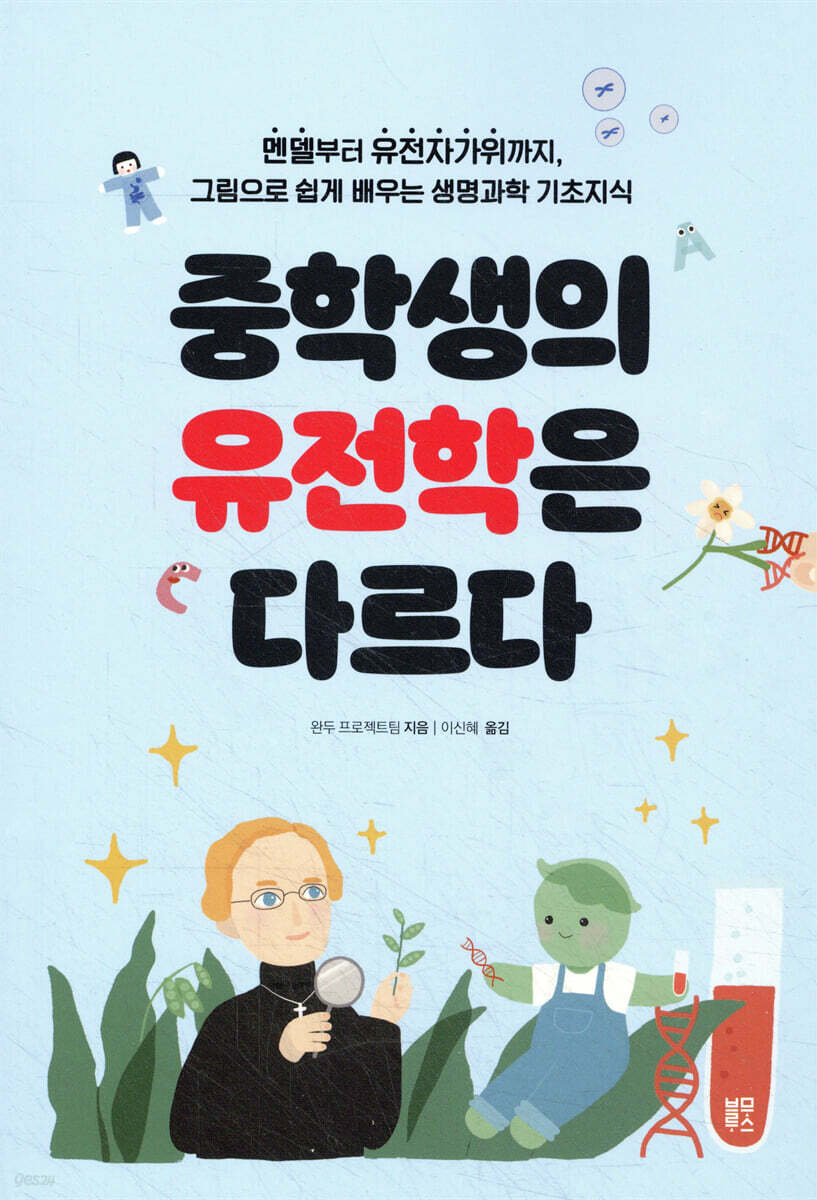
Middle school genetics are different
 |
Description
Book Introduction
Genetics, which suddenly appeared in textbooks and tormented everyone.
Let's overcome it with fun storytelling and intuitive illustrations!
Bestseller with 20,000 copies sold!
This is a book that explains genetics in an easy-to-understand way to middle school students.
From Mendelian inheritance, which first appeared in middle school textbooks, to CRISPR gene scissors, which is a major subject in college, the broad yet profound story of genetics is told in a light and fun way.
Within a short volume of about 10 pages per episode, witty yet accurate writing and pretty, intuitive, and vivid illustrations combine to delight readers' eyes.
By reading "Middle School Students' Genetics Are Different," you can learn about genetics, which holds the 'key' to life science, in an easy and fun way.
It also helps develop the ability to read non-fiction texts with ease.
Therefore, it is recommended not only to middle school students, but also to elementary and high school students who are interested in life sciences and medicine.
It is also highly recommended for teachers who need creative ideas on how to help children better understand difficult life science concepts, and for teachers who are exploring appropriate science writing topics to give their children.
Let's overcome it with fun storytelling and intuitive illustrations!
Bestseller with 20,000 copies sold!
This is a book that explains genetics in an easy-to-understand way to middle school students.
From Mendelian inheritance, which first appeared in middle school textbooks, to CRISPR gene scissors, which is a major subject in college, the broad yet profound story of genetics is told in a light and fun way.
Within a short volume of about 10 pages per episode, witty yet accurate writing and pretty, intuitive, and vivid illustrations combine to delight readers' eyes.
By reading "Middle School Students' Genetics Are Different," you can learn about genetics, which holds the 'key' to life science, in an easy and fun way.
It also helps develop the ability to read non-fiction texts with ease.
Therefore, it is recommended not only to middle school students, but also to elementary and high school students who are interested in life sciences and medicine.
It is also highly recommended for teachers who need creative ideas on how to help children better understand difficult life science concepts, and for teachers who are exploring appropriate science writing topics to give their children.
- You can preview some of the book's contents.
Preview
index
Note
01 What a Pea Can Do
02 Anti-fan's fan club membership incident
03 The three most important letters in life
04 Guess the answer blindly
05 Half are new, half remain
06 Decryption Instructions
07 The Lonely Prophet in the Cornfield
08 A hero appears in Gangho and reads the base sequence.
09 The technology to freely copy and paste genes is born.
10 Stories of Healthy Cells Turning into Zombies 1
11 The story of a healthy cell turning into a zombie 2
12 Scientists Sing About Love and Hope
13 I can't lose to that guy
14 Secrets Hidden in the Genes of Eccentric Scientists
15 Is it enough to just copy and paste cloned life forms?
16 Genetically modified organisms are bad and dangerous?
17 Shuffle the cards God gave you with your own hands
18 The era of precision medicine opens the door to personalized treatment.
Bonus Episode: Farewell to Meet Again
Finishing the book
01 What a Pea Can Do
02 Anti-fan's fan club membership incident
03 The three most important letters in life
04 Guess the answer blindly
05 Half are new, half remain
06 Decryption Instructions
07 The Lonely Prophet in the Cornfield
08 A hero appears in Gangho and reads the base sequence.
09 The technology to freely copy and paste genes is born.
10 Stories of Healthy Cells Turning into Zombies 1
11 The story of a healthy cell turning into a zombie 2
12 Scientists Sing About Love and Hope
13 I can't lose to that guy
14 Secrets Hidden in the Genes of Eccentric Scientists
15 Is it enough to just copy and paste cloned life forms?
16 Genetically modified organisms are bad and dangerous?
17 Shuffle the cards God gave you with your own hands
18 The era of precision medicine opens the door to personalized treatment.
Bonus Episode: Farewell to Meet Again
Finishing the book
Detailed image

Into the book
Morgan once published a critical article, saying, "Mendel's 1:3 ratio is a fancy trick."
But who would have thought that his own experimental results would prove Mendel right? Though heartbroken, Morgan, a young man who prioritized experiments above all else, immediately abandoned his prejudices against his old teacher, Mendel, and transformed from an anti-fan to a big fan.
And to our surprise and delight, Morgan discovered something new that Mendel had not discovered.
The thing is, among the third generation fruit flies, all the ones with white eyes were male!
--- p.2 From “02 Anti-fan’s Fan Club Membership Incident”
If you keep your distance, you will lose everything.
If you know your enemy and know yourself, you will not be imperiled in a hundred battles! Player #1 Pauling used the pretext of a graduate student exchange to infiltrate Team #3 as a secret agent.
But who would have thought that Pauling's son would be so intent on winning the heart of the Danish girl working in Team 3's lab that he would completely forget about his father's request.
The son returned to his father and reported:
“Watson and Crick found nothing.
“As expected, Dad is the best!”
--- p.46~47 From "Guessing the Answer Blindfolded"
After successfully completing her PhD, Barbara began to focus on her chosen field of study: genetics.
That was the corn study.
Barbara quickly became an expert in corn growing and pollination.
Although Barbara was an outstanding researcher, she had difficulty obtaining a tenured professorship because she was a woman.
It was also the subject of many rumors.
Barbara rarely wore skirts, and she would leave her office keys behind and crawl into her office through the window.
Then, finally, Barbara moved to Cold Spring Harbor Laboratory in New York.
There were no restrictions or constraints in that lab, where everyone wore jeans and could work 70 to 80 hours a week.
Having finally found her own scientific research paradise, Barbara was free to work in her cornfield.
--- p.78~79 From “The Lonely Prophet in the Cornfield”
In fact, scientists have been concerned about the risks of genetic engineering since 1973, when genetic engineering was just beginning to sprout.
Seventy-eight molecular biologists sent a joint statement to the National Academy of Sciences, urging them to pay attention to this emerging field and develop safety guidelines.
And by 1976, when the National Institutes of Health issued safety regulations, many scientists, including Boyer and Cohen, voluntarily stopped experimenting with genetic modification.
Scientists think much earlier, deeper, and further ahead than most people when using new technologies.
The new products we encounter have gone through numerous tests and passed strict safety standards before being released into the world.
So, we shouldn't conclude that something is bad based on our experiences or thoughts before we really know what the product is.
It's just like you shouldn't be prejudiced against someone just by looking at their appearance.
--- p.103 From “The Birth of the Technology to Copy and Paste Genes at Will”
Hybrid rice is considered one of the greatest contributors to solving food problems.
A scientist named Yuan Longping contributed to increasing food production in China by making a groundbreaking hybrid rice by crossbreeding rice-like plants, such as paddy rice and paddy rice, through 'artificial pollination'.
So why are GMOs, created using similar principles, viewed with suspicion? Perhaps it's because hybrid rice is perceived as "natural," while GMOs are perceived as "artificial."
Here we need to take a closer look at the concept of 'artificial'.
In fact, the act of crossbreeding blood and rice is also 'artificial'.
We also need to reconsider the idea that natural things are always safe.
Noodles made with bracken starch have always been one of my favorite foods, but it has recently been discovered that bracken contains a dangerous toxin that affects the liver.
While we humans have been eating bracken as a natural food for over 2,000 years, no one has paid attention to it, but in fact, it has not been a safe food.
But who would have thought that his own experimental results would prove Mendel right? Though heartbroken, Morgan, a young man who prioritized experiments above all else, immediately abandoned his prejudices against his old teacher, Mendel, and transformed from an anti-fan to a big fan.
And to our surprise and delight, Morgan discovered something new that Mendel had not discovered.
The thing is, among the third generation fruit flies, all the ones with white eyes were male!
--- p.2 From “02 Anti-fan’s Fan Club Membership Incident”
If you keep your distance, you will lose everything.
If you know your enemy and know yourself, you will not be imperiled in a hundred battles! Player #1 Pauling used the pretext of a graduate student exchange to infiltrate Team #3 as a secret agent.
But who would have thought that Pauling's son would be so intent on winning the heart of the Danish girl working in Team 3's lab that he would completely forget about his father's request.
The son returned to his father and reported:
“Watson and Crick found nothing.
“As expected, Dad is the best!”
--- p.46~47 From "Guessing the Answer Blindfolded"
After successfully completing her PhD, Barbara began to focus on her chosen field of study: genetics.
That was the corn study.
Barbara quickly became an expert in corn growing and pollination.
Although Barbara was an outstanding researcher, she had difficulty obtaining a tenured professorship because she was a woman.
It was also the subject of many rumors.
Barbara rarely wore skirts, and she would leave her office keys behind and crawl into her office through the window.
Then, finally, Barbara moved to Cold Spring Harbor Laboratory in New York.
There were no restrictions or constraints in that lab, where everyone wore jeans and could work 70 to 80 hours a week.
Having finally found her own scientific research paradise, Barbara was free to work in her cornfield.
--- p.78~79 From “The Lonely Prophet in the Cornfield”
In fact, scientists have been concerned about the risks of genetic engineering since 1973, when genetic engineering was just beginning to sprout.
Seventy-eight molecular biologists sent a joint statement to the National Academy of Sciences, urging them to pay attention to this emerging field and develop safety guidelines.
And by 1976, when the National Institutes of Health issued safety regulations, many scientists, including Boyer and Cohen, voluntarily stopped experimenting with genetic modification.
Scientists think much earlier, deeper, and further ahead than most people when using new technologies.
The new products we encounter have gone through numerous tests and passed strict safety standards before being released into the world.
So, we shouldn't conclude that something is bad based on our experiences or thoughts before we really know what the product is.
It's just like you shouldn't be prejudiced against someone just by looking at their appearance.
--- p.103 From “The Birth of the Technology to Copy and Paste Genes at Will”
Hybrid rice is considered one of the greatest contributors to solving food problems.
A scientist named Yuan Longping contributed to increasing food production in China by making a groundbreaking hybrid rice by crossbreeding rice-like plants, such as paddy rice and paddy rice, through 'artificial pollination'.
So why are GMOs, created using similar principles, viewed with suspicion? Perhaps it's because hybrid rice is perceived as "natural," while GMOs are perceived as "artificial."
Here we need to take a closer look at the concept of 'artificial'.
In fact, the act of crossbreeding blood and rice is also 'artificial'.
We also need to reconsider the idea that natural things are always safe.
Noodles made with bracken starch have always been one of my favorite foods, but it has recently been discovered that bracken contains a dangerous toxin that affects the liver.
While we humans have been eating bracken as a natural food for over 2,000 years, no one has paid attention to it, but in fact, it has not been a safe food.
--- p.163 From “Are genetically modified organisms bad and dangerous?”
Publisher's Review
A must-read for children who want to pursue science
A single guide to genetics
Recommended by Harvard University Professor George Church, a leader in the field of genetics!
Life science is truly easy and fun to learn about the life cycles of animals and plants, their life cycles, and their ecosystems.
But the moment 'genetics' comes into play, life science becomes something far removed from children.
Not only does the content itself suddenly become too difficult, but it is also schematized and not fun.
Middle school students are already struggling to calculate the genetic ratios according to Mendel's laws in their textbooks, and are forced to study difficult workbooks, telling them they must cover DNA transcription and protein synthesis before entering high school.
As you work through those kinds of workbooks, life science itself becomes less interesting, and furthermore, the fear of "is this what science is like?" inevitably grows.
However, genetics is something that cannot be given up on because it is difficult and boring, and students' concerns about genetics are common all over the world.
So, a group of geneticists, writers, and illustrators who aim to popularize genetics came together to form the 'Pea Project Team.'
After years of hard work, they transformed science textbooks, which students often find boring, into something three-dimensional and alive, and through this book, many students have found genetics fun and exciting.
A proven bestseller in the field of genetics, with over 20,000 copies sold in China.
If you glance over it, you'll understand it in no time
All About Genetics
This book covers not only all the genetics stories found in middle school science, high school integrated science, high school life science, and high school biology textbooks, but also includes content covered in basic university majors, so with just this one book, teenagers can digest all the genetics knowledge they need to know.
It also covers life science issues that must be known now in detail, which is very helpful for scientific writing and argumentation.
《Middle School Genetics is Different》, which is helpful for schoolwork, has the following features:
First, make it short and easy to read.
Within a short volume of no more than 10 pages on average, only the essential knowledge is packed in a witty yet neat manner.
Second, the pretty and well-placed pictures catch the eye.
Pictures help explain the content in an easy-to-understand way, while apt metaphors help deepen understanding.
Third, 18 experts and professors meticulously reviewed the content of each chapter and provided more detailed information through the "Scientist's Commentary" section.
Readers can reread the same content from different perspectives and have the opportunity to think deeply.
I recommend that all students, not just middle school students, read this book as part of their "One Book a Semester" reading plan.
It's not difficult to read and doesn't take much time.
Just read three or four chapters a week with a light heart.
Reading the history of how the secrets of heredity have been unraveled over the past 200 years will allow readers to realize just how remarkable human wisdom and courage are.
Then, you will not only easily understand the textbook, but you will also come to love genetics and become scientifically inspired.
A single guide to genetics
Recommended by Harvard University Professor George Church, a leader in the field of genetics!
Life science is truly easy and fun to learn about the life cycles of animals and plants, their life cycles, and their ecosystems.
But the moment 'genetics' comes into play, life science becomes something far removed from children.
Not only does the content itself suddenly become too difficult, but it is also schematized and not fun.
Middle school students are already struggling to calculate the genetic ratios according to Mendel's laws in their textbooks, and are forced to study difficult workbooks, telling them they must cover DNA transcription and protein synthesis before entering high school.
As you work through those kinds of workbooks, life science itself becomes less interesting, and furthermore, the fear of "is this what science is like?" inevitably grows.
However, genetics is something that cannot be given up on because it is difficult and boring, and students' concerns about genetics are common all over the world.
So, a group of geneticists, writers, and illustrators who aim to popularize genetics came together to form the 'Pea Project Team.'
After years of hard work, they transformed science textbooks, which students often find boring, into something three-dimensional and alive, and through this book, many students have found genetics fun and exciting.
A proven bestseller in the field of genetics, with over 20,000 copies sold in China.
If you glance over it, you'll understand it in no time
All About Genetics
This book covers not only all the genetics stories found in middle school science, high school integrated science, high school life science, and high school biology textbooks, but also includes content covered in basic university majors, so with just this one book, teenagers can digest all the genetics knowledge they need to know.
It also covers life science issues that must be known now in detail, which is very helpful for scientific writing and argumentation.
《Middle School Genetics is Different》, which is helpful for schoolwork, has the following features:
First, make it short and easy to read.
Within a short volume of no more than 10 pages on average, only the essential knowledge is packed in a witty yet neat manner.
Second, the pretty and well-placed pictures catch the eye.
Pictures help explain the content in an easy-to-understand way, while apt metaphors help deepen understanding.
Third, 18 experts and professors meticulously reviewed the content of each chapter and provided more detailed information through the "Scientist's Commentary" section.
Readers can reread the same content from different perspectives and have the opportunity to think deeply.
I recommend that all students, not just middle school students, read this book as part of their "One Book a Semester" reading plan.
It's not difficult to read and doesn't take much time.
Just read three or four chapters a week with a light heart.
Reading the history of how the secrets of heredity have been unraveled over the past 200 years will allow readers to realize just how remarkable human wisdom and courage are.
Then, you will not only easily understand the textbook, but you will also come to love genetics and become scientifically inspired.
GOODS SPECIFICS
- Date of issue: March 31, 2025
- Page count, weight, size: 196 pages | 152*223*20mm
- ISBN13: 9791193407318
- ISBN10: 1193407311
You may also like
카테고리
korean


korean

![GQ KOREA Mark (Monthly): December [2025]](http://librairie.coreenne.fr/cdn/shop/files/8ef265dbbfbf186523ed75ba7319009d.jpg?v=1765340328&width=3840)


